The MC's introduction is captured at the start. The Mainstage was ahead of the grid, so the
recording starts 8 minutes before the scheduled slot.
Transcribed locally with Qwen3-ASR 1.7B (timings per ~5 s segment), prompted with the
speaker names and affiliations of overlapping sessions. "Quinn Slack" and "Amp" were in that prompt; the unprompted
Voice Memos transcript has "Quinn Slack" and "ANT" in the introduction. Sourcegraph and Thorsten Ball
were not in it. Other names are kept as transcribed: Sourcegraph is once "sourcecraft". The swag
hand-outs are left in. The Voice Memos transcript is kept beside it as transcript.txt.
00:00:00 — Introduction
Agents. Our next speaker has been at the forefront of developer tools. Ladies and gentlemen, please welcome Quinn Slack, co-founder and CEO of Amp. Great to see you. You might want to come up in front a little more because I do like an NBA game. Have some swag and hats. To give out. So if you're in the back and if you like hats, come on up. All right. As whatever you know that said, my name is Quinn Slack. I am one of the founders of Amp. An invented sourcecraft before.
I don't want to talk about Amp, though. I want to talk about really a personal story of how agents. Blew my mind and changed my life. There was a day when I walked outside and the birds were chirping more, and the sky was bluer. And how they changed my company, and how I think they're going to change every company, and. It's kind of frustrating sometimes to see friends and people I care about, companies I care about, really struggle with this.
So we're gonna go on a little bit of a roller coaster, but why don't we get started? I know it's almost dinnertime. Anyone want some hats? Some amp hats. All right, here we go. I see people getting closer. There we go. All right. I hope I don't hit anyone. There we go. Wow! All right. Everybody gets that. Everybody gets that. Come up and find me after.
00:01:31 — The day an agent blew my mind
All right. There was a moment in January of 2025. When I was just coding and. I wanted to see what if you just make an agent. This was before Claude code and. It was like the dumbest stuff ever. It was like change this background color, but it just blew my mind. When I saw an agent actually work for the first time. It ran commands. It looked at itself. It gave itself some feedback loops. That blew my mind, and.
I had this sense. I think that everyone has when they first see an agent. That everything is going to change after that. Everything is going to change about how you build software. I think we've all felt that. Everything is going to change about how you form companies to work on software, and how you sell software, how you distribute software. All other work is going to change, and it was just an absolutely crazy, crazy moment.
I was actually at the Frankfurt Airport with Thorsten Ball on our team. He wrote that compiler book. Anyone. Who knows Thorsten on our team? Yeah, he's a cool guy. We were just like minds blowing at the Frankfurt Airport, and we knew that everything was going to change. We didn't know where this was all going to go. But we just wanted to go. We just wanted to go run at it.
00:02:39 — Inside Sourcegraph
So inside of Sourcegraph. Which was a 200-person enterprise software company. I was the CEO. And we made code search. We decided to just start building this to tune out everything else. And just start building this thing. Not go to sales calls. Not go to like exec meeting. None of that stuff. Just tune out all the distractions. And I was in this position that I think a lot of people.
Say you know, wow! You know, I'm a software developer at a company, and I want to change. I want my company to be more AI forward, and I can't. You know I was a CEO, and in theory I could change anything. I could change teams. I could say you don't need to get pull request code review. You don't need to, you know, do any of the other processes we used to do, and yet.
It was very hard. What we did is we ended up taking twenty people from the company and. Inside of Sourcegraph, still we made a little team, the Amp team. And that's what we tried. So for those of you who are trying to push back against your company to try to make it more. Agent friendly. I have a lot of sympathy for you, and I hope you can take away some things from here. I know how hard it is, and also.
Have some empathy for your CEO too. It's hard for them too. This is really hard.
00:03:52 — What we knew would change
Kind of change and transformation, but we knew that there are some things that were going to change, and this all seems kind of obvious now. But back in 2025, early 2025, with this idea of enterprise ready, you do this thing, and then you can build a sales team and go sell it. We knew that was just going to totally die off. You had to be on the frontier if.
You had you know a taste of success, and then you started doing all the enterprise checklist bullshit. To make the median enterprise buyer happy, your product was going to go obsolete in like three months. And the whole game had to change. Nothing mattered other than making it so that the people at these other companies love your product, and the CEO. The budget was infinite. And all bets are off. So we knew that.
We didn't quite know all the challenges we'd run into. Also, you know, in this world where agents can build a product or build a feature, how do you even think about differentiation? I mean, to this day. There's people who say, well, why is Amp better? Why is you know Claude Code better than Codex or whatever? And so many people are begging to have the answer in the form of well, it's these three features, you know.
Amp has orbs, which are really good cloud agents. And we have multiplayer. But the crazy thing is, you all know that if we can do that, if we prove it, then any of our competitors could as well. So, you know, why even play that game? Like, what does it even mean to build and sell software? Why would you go and hire a sales team? Why do you go and do anything in the traditional way if you don't even know what it's going to look like in a month?
And if you don't even know how to describe differentiation, there's no sustainable differentiation. For Amp, you know people end up loving it. But you can even see, like, you know, Adam Watkin, who's the Tailwind guy. He loves Amp. But he's like, you know, it's one of those things where you can't understand it. You know, it's can't understand why it's good until you use it. Can you imagine?
Having a whole product management team, a design team, an engineering team that's so disconnected from the actual customers, a whole company apparatus. If that's the best way that you can market a product, it's really tough.
00:05:51 — Spinning out Amp
So we knew that we just had to change everything, and we rethought so many things. Because kind of unintentionally, we were in under some weird constraints. We decided to spin out Amp. So, for those of you who've been at a company, like a small. You know, you're on a small team at a company. You're trying to do things different. You're trying to be the startup within a startup. You probably have these fantasies of.
Let's just go off and start a new company. Well, we actually did that. We you know did the right thing by investors and employees, and everyone has ownership in both. But we actually spun out, and for until last Friday, we couldn't hire anyone. We couldn't grant options. The legal spinoff process was a huge pain. And we were forced to make do with the twenty-one people that we brought over.
We didn't have time in this crazy competitive environment to do. You know we couldn't move as slowly in order to do you know mandatory pull requests. We couldn't have meetings. We couldn't have our time be sucked up by enterprises that would need to take you know many months to decide on something. And so we were forced into this radically different way of working. And we also had this environment where every single person on the team has a huge stake in the company.
And that skin in the game that you get when AI makes it so you can operate with way less people. Skin in the game—it's like this spiritual thing for the soul. Of great people, it makes them better at everything they do. It makes them grow faster, and so this is what we have seen. This, I think. When you've seen a company that operates like this without any of that bullshit.
It's obvious how companies like this are going to crush everyone else, and how every company in the future is going to look a lot more like that. So, yeah, we run Amp out. And we had to figure out a lot of new ways of working with these constraints that we had no idea that we were going to be under. And we couldn't hire, as I said. So as a result, while our this is a log chart, by the way, while you know all the other big competitors in the space were.
Growing and building old-fashioned companies in order to go and exploit this amazing technology of AI, we had to stay at twenty-one people. That was awesome because it was a forcing function for us to work differently and figure out how can you do so much more with an agent, where we couldn't. Hire people. There's actually one guy who was like, I don't care that I can't get options for like eight months, and I'm going to come join. And Hamish is
00:08:04 — Building around the agent
Pretty awesome. So I want to talk about the ways in which we built Amp, which is our agent product. Around the way that these constraints forced us to work, and how we grew up around the agent here. We got rid of all of the other tools. We got rid of all of the other things you got to check. Obviously, not Jira. No task tracking. We don't have a support system. Everything we do in the agent.
In anthropomorphic threads, we even communicate in the agent. You can say, you know, I made a something bad in the product. Let's do it. The agent can listen to everything and then go fix it. If you're in like a local agent that runs on your laptop, you can't bring someone else in if you realize you're in over your head. Really valuable. We push way too often. And I want to show you know how we actually reduce the risk here because you might say.
Let me let me start that again. You might say, well, if you're pushing constantly, then how do you not take down the site all the time? And the difference is when you can push, and you can do it any time of day, just by yourself. You can chunk up your work into way smaller pieces before you're going and doing a big change. You can go and say, "Let me add the logging to make sure that my understanding, the agent's understanding, the system is correct." Let me push a little change, a little change, you know, and then the agent can monitor it for an hour, and then push the next change.
You can run a whole shadow system. Side by side with the old system to see does it compute the exact same results in every single case. And that way of working actually reduces the risk because by the time. You know, you finish the old way of doing it, and the pace that things have to move these days. What your customers expect, you've probably forgotten what you're building.
And it just totally sucks. Let me give us more hats. You want some more hats? All right. Sorry, the one guy who's on his laptop. That's a lesson, right?
00:09:54 — Agents that prove their work
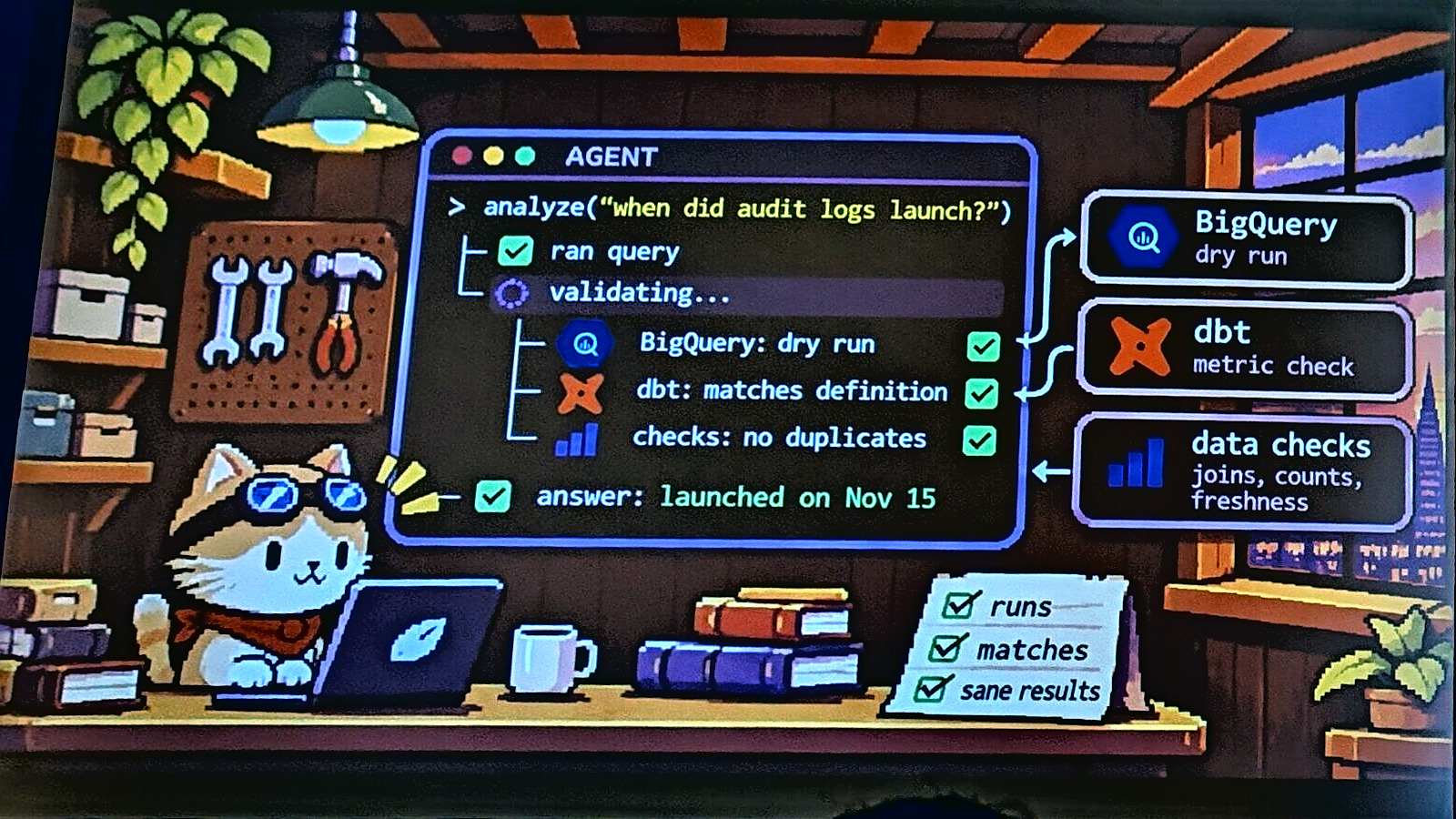
Well, there we go. All right. Another thing. Is making it so the agent is able to irrefutably prove what? The thing is, spelling is correct. There's a lot of ways you can do this. Turns out they're really good at proving these things. So if you're trying to remove like jitter in the UI, make sure that when you load, it's like nice and crisp. You can ask the agent to do something that no human would ever have the patience to do, which is take every single frame and compare them visually, and that's what I did.
Here. You can ask the agent to go make a ton of different versions of something. You can never ask a human to like you know if you ask a designer, go make nine iterations or nine styles of this. They're gonna get really annoyed. I know because I've worked with designers and I know they don't like that. But for the agent. Yeah, you know, you can have it make a ton of different things. This is the waveform for dictation.
In Amp, and this is one of the solutions to people who say, I don't like waiting on my agent. You know they're asking for one thing at a time, and then they say make this little change. You shouldn't do that. Go have it make a ton of things. At once, and you're going to get a lot more done.
00:10:58 — The bug-report loop
We have this magical system where if you report a bug in Amp, is anyone here reported a bug in Amp? All right, cool. I apologize for the bug, but. We have a system that is a full loop where, when you report a bug, we will fix it, of course. You know, Android app. We'll fix it. Obviously, with the agent, I think everyone does that now. Mostly, everyone. A lot of times, still the engineers are different from the support team, which is kind of crazy.
We'll send an email to the person thanking them. We give them free credits, which. Is oh, it's kind of nice. I think it sucks. I think it sucks when there's a bug in a product and the company doesn't apologize. I just think that's like morally wrong. And then what we'll do is we'll go through the logs. And this is something that no human would ever do by themselves. We'll see everyone else who is affected by that issue.
Because where there's smoke, there's fire. So you find the seventeen other people that hit that same obscure error. They remember it probably, and you proactively tell them. How many times have you got an email from some product that says, "Hey." I know that you saw an error yesterday, and that was really annoying. I'm really sorry about that. Here's ten dollars. We fixed it, and by the way, that.
It's a self-perpetuating cycle where then people who get that know that you care, and they're going to send more feedback in the future. And then you ship those all out, and then you know, and that's the cycle. That. People talk about vibe coated products being junk. Amp is basically 100 built with AI. And people say it's very high quality, and this is one of the things that you can do differently with an agent. But there's no way in L you can do this.
If you had to go through a PM or go to the team that owns this bug and the designers each time.
00:12:35 — Dictation
Dictation. Who dictates to their agents? Yeah, wow! That's that's pretty good. That's a lot more than I thought. It is the fastest way to get bits of information from your brain to the agent. And I think that there's probably something around it. Ushering in the return of remote work. Because I was just in an office today with Beyond another co-founder dictating, and it was very annoying. Dictation. If you're not doing it yet, you got to do it.
Just overcome the embarrassment, you know. Channel Nathan Fielder and tell yourself that you can withstand any amount of awkwardness as you talk.
00:13:16 — Building your own tools
We've hooked up our agent to a lot of different tools. I think a lot of companies have gotten here. You know to this point. We've been doing this in production for a long time, and what we found is. The more that we start using these tools, where just the agent is using it directly, we don't even need the software product on the other end, and it's. A very small number of products that we think actually have sticking power for us.
So you know we built some new things in Amp. For example, a CRM. And a year ago, you heard people talking about, oh, no one's going to vinecode Salesforce from scratch. And yeah, that's totally true. Why would you want to? It's have you ever used it? Would you be proud if you vibe coded that and that came out the other end, and also you use like two percent of the features of Salesforce?
So actually, you know, this people ridiculed this idea, but. Actually, would you code the two percent subset of Salesforce features? And then another two percent that integrate with the rest of your stack in the most perfect way because the agent is so good at that. And that you know four percent of Salesforce total. That's like the easy shit, and you know what you want out of that better than Salesforce, and you certainly don't want to spend your time talking to some Salesforce product manager and.
Hearing from them, I'm going to advocate with my PM and my executive team to get that on our Q four roadmap. All that bullshit. So compared to that, it's actually getting easier and easier to just build the tools that you want. From scratch and.
00:14:45 — SaaS starts to break down
This goes back to some of the existential, kind of dread, but also mind-blowing feeling that we felt when we first tried an agent. This. Is what we kind of thought would happen—that it would change everything about the soccer industry if. Salesforce, which is like the king cobra of SaaS. They had the most reliable customers, most reliable renewals, all that. They like invented the category. If we're starting to see, you know, why would we use them? Well. Everything is starting to fall, and all of SaaS starts to break down if you can no longer assume that you can pay a salesperson.
100K for closing a deal, and that deal is going to last for 10 years, and it's going to you know get bigger by a little bit. All of that is called into question now. So if you're in a software company. And that is how you ultimately make money. And you're trying to ring the bell. You're trying to raise the alarm here. Absolutely, raise it and get out of the cage.
That you are in, because, in my opinion. Once you have seen how the new kind of companies that are two orders of magnitude smaller. Where everyone can do everything, where everyone has skin in the game, then you know you don't want anything else.
00:15:58 — A new kind of company
And so this is what we call this new kind of company, where you know we take that old org chart, and now we just got twenty one people on Amp. We have no PMS. Everyone talks to customers. Brady is this guy who was an SDR at Sourcegraph, really smart guy. I love the guy. And one day he's like, I'm gonna make a wire ACH wire transfer thing, so customers can pay us. You know, if it's too big for a credit card, and I'm.
And he's like two years out of college, and he's just doing that. And nobody knows on the other end. It's like that old New Yorker cartoon on the internet. Nobody knows your dog. You know, nobody knows that he's an SDR. That we're all kind of you know devs and doing everything. But you can, and you also get people that are really real with customers, and I think sometimes customers need real talk.
So Alex Kemper on our team, you know, just today he was like, "Hey, you know, to a customer who wanted our stuff." That sounds like we're just going to get bogged down in a bunch of BS, and I don't think that's a good use of anyone's time. If you can get to a place where you have people that feel empowered to say that and to truly say the best thing for the customer.
That's great. You're not going to get that out of a salesperson who is commissioned. We have some people's favorite part. We have one meeting per week, and then everything else. The guidance is follow your energy. You couldn't run those companies like that. But if everyone at the company has a massive stake in the company, you know, take 100 and divide it by 21, you know. And all that you can actually trust people because again, when people have.
Get in the game. It makes them better at everything they do. It's like an incentive. To make them think, whole company. To make them do more. To make them work harder. And that's why I included Saturday and Sunday. As well on this, and we are shipping. Just you know, so much more. I think that you know Amp for many. People is a product that they love. We also have a great business, and we're serving as proof that this new kind of company.
That is profitable. That's more than a hundred million ARR. That is doing so. On a dollar in, dollar out, you know, basis, that's 40 to 50 times more efficient than old-fashioned companies.
00:17:57 — Get out of the cage
Here, that can work, and so if this is appealing to you, if you want to push your company in this direction. If you want to go start a company like this, then reach out. I'm happy to help. And my guidance is just get out of the cage. I've heard from so many people who say I hate that there's a gossip channel with the people in my company. We're all talking about the change.
You know what? The longer that you are in the gossip channel, the longer that you are at a company getting paid a lot of money, and you're really smart, and you're not doing shit about it. You're starting to become part of the problem, and the longer that you let yourself. Be just a developer with agents have completely changed the game. You're really hurting yourself. So. If this is you know the one thing that you take away, just get out of that cage.
Let agents really shape how you work, and get to a company that's willing to be shaped by the agents. Thank you, and if you want to try Amp. You can get up there. You can copy that. I've got more hats, so find me afterwards and. I'll probably be getting dinner at Chipotle or something. So come find me if you want to chat about all this stuff.