What Reflection AI offers to beat closed labs
What Reflection AI offers to beat closed labs
Summary
In this interview, Turing Post host Ksenia Se sits down with Ioannis Antonoglou, co-founder, president, and CTO of Reflection AI, to discuss the company’s ambitious goal of building frontier open-weight models to compete with closed labs like OpenAI and Anthropic. Antonoglou, a veteran of DeepMind who worked on AlphaGo, AlphaZero, and MuZero, explains that Reflection originally planned to focus on reinforcement learning for autonomous coding but pivoted to building a full-stack frontier model from scratch after realizing the Western open-source ecosystem lacked a sufficiently powerful base model.
Reflection raised more than $2 billion in its Series B to secure the compute needed for this effort, and has assembled a team drawn from Gemini, OpenAI, Meta, and Apple. Antonoglou frames Reflection as the only Western lab genuinely committed to building frontier open intelligence. He defines AGI simply as an agent that can do what a human does on a computer, and argues that no massive breakthroughs are needed — just better engineering, better methods, and better scaling of reinforcement learning trajectories.
The conversation also touches on how AI research has changed since AlphaGo in 2016, why the commercial engine problem has held back open models, Reflection’s approach to RL-aware pre-training across the full stack, and Antonoglou’s advice for young researchers. He recommends the book “The Idea Factory: Bell Labs and the Great Age of American Innovation” as a guide to understanding how innovation happens in organizations.
Highlights
”The Western Ecosystem Was Missing a Powerful Base Model”
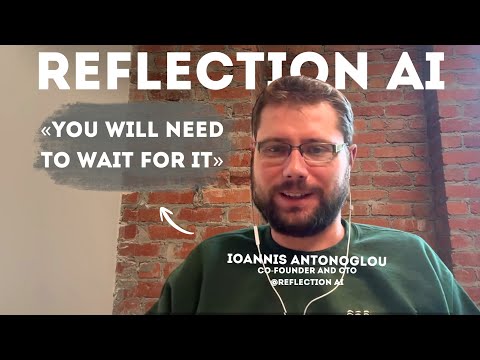
“What we saw is that especially with Llama not being a particularly good model, the whole Western ecosystem was missing a powerful base model that we could even use to do reinforcement learning at scale. We realized we were the only ones who could actually build it.” — Ioannis Antonoglou, 4:34
Clip command
yt-dlp --download-sections "*4:34-5:15" "https://www.youtube.com/watch?v=zd3B8sNNgmk" --force-keyframes-at-cuts --merge-output-format mp4 -o "western-ecosystem-missing-base-model.mp4"”Building These Models Is Like Building a Rocket”
“Building everything from the ground up, even if you’ve done it, even if you know what to do, it’s never easy. Building these models is like building a rocket. There are many ways things can go wrong, so you need your best rocket scientists to come in.” — Ioannis Antonoglou, 7:26
Clip command
yt-dlp --download-sections "*7:26-8:10" "https://www.youtube.com/watch?v=zd3B8sNNgmk" --force-keyframes-at-cuts --merge-output-format mp4 -o "building-models-like-rockets.mp4"”We Don’t Really Need Any Massive Breakthroughs”
“For me AGI is literally an agent that interacts with software in a computer and can really do what a human can do. In that sense, I think we don’t really need any massive breakthroughs. We just need better engineering, better methods, better combination of existing methods.” — Ioannis Antonoglou, 3:15
Clip command
yt-dlp --download-sections "*3:15-3:42" "https://www.youtube.com/watch?v=zd3B8sNNgmk" --force-keyframes-at-cuts --merge-output-format mp4 -o "no-massive-breakthroughs-needed.mp4"”Shane Told Me We’re Building AGI. I Was Like, This Is Insane. Let’s Do It.”
“Shane told me that we’re building AGI. I was like, okay, what’s AGI? And he told me, we want to build computers that can think and do things like humans. I was like, this is insane. Let’s do it. Where do I sign?” — Ioannis Antonoglou, 13:59
Clip command
yt-dlp --download-sections "*13:59-14:45" "https://www.youtube.com/watch?v=zd3B8sNNgmk" --force-keyframes-at-cuts --merge-output-format mp4 -o "insane-lets-do-it-deepmind.mp4"”The Only Metric That Really Matters Is Adoption”
“The main metric that matters is adoption. That’s the only metric that really matters. You just put it out there and ensure that people like it and they use it.” — Ioannis Antonoglou, 9:22
Clip command
yt-dlp --download-sections "*9:22-9:55" "https://www.youtube.com/watch?v=zd3B8sNNgmk" --force-keyframes-at-cuts --merge-output-format mp4 -o "adoption-only-metric.mp4"Key Points
- AlphaGo as a preview of modern AI (0:25) - Antonoglou draws parallels between AlphaGo’s multi-phase training (human data then RL) and modern pre-training/post-training paradigms, noting they were ahead of the curve in 2016
- Breakthroughs vs. engineering (2:20) - Whether we’re still in an era of breakthrough moments depends on your definition; Antonoglou argues we have most ingredients for powerful agents already
- AGI definition (3:12) - Antonoglou defines AGI simply as an agent that can interact with software and do what a human can do on a computer
- Pivot from coding to general model (4:16) - Reflection started focused on RL for autonomous coding but discovered the Western ecosystem needed a powerful open base model first
- Llama’s limitations (4:34) - Llama 4 was not a particularly good model, exposing a gap in the Western open-source AI ecosystem
- Building frontier models from scratch (5:08) - Reflection is now doing both pre-training and reinforcement learning end-to-end
- Coding agent limitations (6:11) - The main limitation of coding agents is they don’t have access to all the context that human engineers have
- $2 billion Series B (7:21) - Reflection raised over $2 billion in October 2025 to secure compute for building frontier models
- World-class team assembly (6:42) - The team includes people from Gemini, OpenAI, Meta, and Apple who joined for the open intelligence mission
- AI tools they use (7:52) - Reflection uses Claude Code, Cursor, and many internal tools they’ve built for their own needs
- General agentic model (9:58) - The model is a general agentic model, not just a coding model — coding, tool use, and agentic reasoning all feed into each other
- Commercial engine problem (8:42) - The reason open models haven’t matched closed labs is the lack of a commercial engine to support them, not the openness itself
- Scaling RL trajectories (10:44) - The most important RL research question is how to scale the length of agent trajectories so agents can take many steps and still learn effectively
- RL-aware pre-training (11:31) - Owning the whole stack allows Reflection to ensure pre-training is RL-aware and fully optimized end-to-end
- Book recommendation (15:19) - Antonoglou recommends “The Idea Factory: Bell Labs and the Great Age of American Innovation”
Mentions
Companies
- Reflection AI (0:00) - AI startup building frontier open-weight models, raised $2B+ Series B
- DeepMind (0:25) - Antonoglou’s former employer where he worked on AlphaGo/AlphaZero/MuZero
- OpenAI (5:36) - Mentioned as competitor in coding agents space
- Anthropic (5:36) - Mentioned for Claude Code, which Reflection uses
- Meta (6:52) - Team members recruited from Meta; also mentioned for Llama models
- Apple (6:52) - Team members recruited from Apple
- MiniMax (10:09) - Chinese AI lab also building general models, mentioned as comparison
- Lightspeed (3:44) - VC firm that led Reflection’s Series A in March 2025
- Bell Labs (15:19) - Subject of Antonoglou’s recommended book about innovation
Products & Technologies
- AlphaGo (0:25) - DeepMind’s Go-playing AI from 2016, described as a preview of modern AI training
- AlphaZero - Mentioned in video description as Antonoglou’s previous work at DeepMind
- MuZero - Mentioned in video description as Antonoglou’s previous work at DeepMind
- Llama (4:36) - Meta’s open model, criticized as not being particularly good
- Claude Code (7:58) - Anthropic’s coding tool, used by Reflection team
- Cursor (7:58) - AI coding editor used by Reflection team
People
- Ioannis Antonoglou (0:00) - Co-founder, president, and CTO of Reflection AI; ex-DeepMind
- Shane Legg (14:02) - DeepMind co-founder who told Antonoglou “we’re building AGI” when recruiting him
- Demis Hassabis (13:55) - DeepMind co-founder, mentioned alongside Shane Legg
Surprising Quotes
“We have all the ingredients or most of the ingredients in order to build really powerful agents that can do almost anything that the human can do on a computer, and that’s a form of AGI in that sense.” — Ioannis Antonoglou, 2:29
“The main reason why people haven’t managed to build frontier open models is because they haven’t managed to find a commercial engine to support open models. Being open doesn’t really stop you — it actually accelerates you.” — Ioannis Antonoglou, 8:42
“If they believe that AGI, which is such a powerful technology, should be accessible to everyone and should be democratized, there’s only one place that does that in earnest, and that’s Reflection.” — Ioannis Antonoglou, 14:55
“Back then AI had no money. You had to be a bit crazy to even try it. So the fact that they were crazy enough and ambitious enough and capable enough to just kickstart this revolution — you can sense it.” — Ioannis Antonoglou, 14:34
“I always say to people that they should try and join a startup instead of finding a big company after they graduate, because this is how you learn and this is how you grow.” — Ioannis Antonoglou, 13:14
Transcript
0:00 We want to build computers that can think and do things like humans. We raised more than $2 billion to actually have access to the compute we need. Building these models is like building a rocket. The main metric that matters is adoption. The secrecy and the time that you’re taking, do you think you will be able to match the closed labs?
0:25 If we go back to AlphaGo in 2016, that moment for the outside world felt like a miracle. For you as an engineer who works day and night in the trenches, what is the biggest change in how the progress actually happens now?
0:39 Well, I feel like the fundamentals for the most part have stayed the same. When we were building AlphaGo, it was an extremely challenging engineering project. It required scaling our models and scaling our training recipes to massive runs that weren’t the case back in 2016. Most people had a couple of GPUs and they were just training things back then. Now it’s the norm that anyone who wants to train these big models, either with pre-training or reinforcement learning, they use hundreds or thousands of GPUs. In that sense we were a bit ahead of the curve.
1:12 At the same time it was kind of a collaborative project. There were many of us working on it. Back then it was more common for a few researchers to work together and build something together, rather than big teams with project managers and deliverables, which is more of the case right now. So I’d say that in many ways AlphaGo and how we did our work back then is like a preview of what was to come and how things work now.
1:38 You even had different phases. AlphaGo was trained in different phases where you had training on human data, which is kind of equivalent to pre-training in a way, and then reinforcement learning, which is kind of what we call post-training now. And we had human testers to tell us the mistakes the model was making, which is again quite similar to how things are done now. And lots of compute. So I’d say that many of the ways that we structure ourselves or the ways we went about doing our research is actually more similar to how things are done now than how research used to happen back in 2016.
2:13 Are we still in the era of breakthrough moments or is it mostly messy operational work now?
2:20 It’s actually a good question and it boils down to what you consider a breakthrough. I think that for different people, different levels of discovery constitute a breakthrough. I think that we have all the ingredients or most of the ingredients in order to build really powerful agents that can do almost anything that a human can do on a computer, and that’s a form of AGI in that sense. It’s actually more of a matter of executing, finding the right methods, finding how everything fits together, and doing a lot of engineering and research.
2:53 For some other things we might need to innovate and come up with breakthroughs like different architectures or different learning algorithms. It really comes down to what you want to build and what’s your definition of AGI. Different labs and different people have different definitions and views on what might be missing.
3:12 What is your definition of AGI and superintelligence for that matter?
3:15 For me it’s something simpler. It’s literally an agent that interacts with software in a computer and can really do what a human can do. In that sense, I think we don’t really need any massive breakthroughs. We just need better engineering, better methods, better combination of existing methods, but not anything that’s really a game changer.
3:44 I think 2025 literally became the year of coding acceleration. And I want to read this from March 2025 when Lightspeed led your Series A: “Reflection AI is leveraging its deep expertise in reinforcement learning and large language models to solve autonomous coding and more broadly unlock the path to superintelligence.” So it’s almost a year since then — what did the last 12 months force you to rewrite in terms of building autonomous coding?
4:16 When we started we really believed that reinforcement learning is the next frontier and we wanted to focus on reinforcement learning. But if you want to do reinforcement learning at the frontier, you need to have an extremely powerful base model that you can post-train. You also need to have a model that you can then deploy safely.
4:34 What we saw is that especially with Llama not being a particularly good model, the whole Western ecosystem was missing a powerful base model that we could even use to do reinforcement learning at scale. One thing that changed is that we realized this limitation — we needed access to a more powerful open base model coming from a Western lab, and we also realized that we were the only ones who could actually build it. So we set out to do that, and this is why Reflection is now building frontier models from the ground up. We’re doing both pre-training and reinforcement learning.
5:12 How is it coming along? Lots of incredible things we’ll have to share this year. Any ideas where and how will it look? You have to wait for that.
5:21 Well, let’s talk about your agent then. You started with that as an autonomous agent for enterprise. What changed there in terms of all these different coding agents and systems being launched? Claude Code just celebrating one year. OpenAI also refocused to being more of a coding system, and Codex performing pretty well. What’s your agent? What are you working on now?
5:45 Yeah, so we’re actually building frontier open-weight models. You can think of an equivalent of the US dipstick, or agentic models as powerful as Claude or GPT-5. This is the focus of the company. In terms of coding, I still think that one of the main limitations of coding agents is that they don’t have access to all of the context that your engineers have access to.
6:20 At the same time, we’ve actually embarked on an extremely ambitious goal of building these models not just with reinforcement learning but from scratch with both pre-training and post-training, and we really decided to focus on that. So this is what we’re doing.
6:35 What are the main bottlenecks that you come across?
6:39 If you want to build frontier models, you need to first of all attract the right people and really grow out the team. We’ve actually attracted a world-class team. We have people from Gemini, people from OpenAI, people from Meta, Apple — all of the best labs and data providers. These are people who’ve done it before. They’ve built frontier models and they’ve actually joined us because of our mission of building open intelligence. And again, we are the only place which actually committed to that.
7:09 That’s one thing. Getting the resources you need in order to have the compute to build these models — that also required us to have a significant Series B in October where we raised more than $2 billion to actually have access to the compute we need.
7:26 Scaling in terms of engineering, building everything from the ground up — even if you’ve done it, even if you know what to do, it’s never easy. Building these models is like building a rocket. There are many ways things can go wrong, so you need your best rocket scientists to come in and do it, and have all the room and agency to actually do it. And we are extremely lucky that we’ve assembled this team and we are building these models.
7:50 What AI tools do you use yourself to accelerate?
7:52 Oh, we’re using all of the different AI tools and different ones are good at different things. We’re using Claude Code, we’re using Cursor, we’re using many internal ones that we’ve actually built. We have a whole host of AI tools that we’ve built for our own needs and we use them heavily.
8:11 So you’re currently working on the model, but also is there an application yet that you plan to work on based on this model?
8:17 The focus currently is just build the models. There’s going to be applications to follow after that, but all hands on deck. Building these models is challenging and it requires all of our mental focus.
8:26 That’s true. But also when we think about open-weight models, they are rarely up to speed with the closed labs’ models. The secrecy and the time that you’re taking — do you think you will be able to match the closed labs’ models?
8:42 The main reason why people haven’t managed to build frontier open models is because they haven’t managed to find a commercial engine to support open models. Being open doesn’t really stop you — it actually accelerates you. So for us the important thing is, since this will be our first models, to just make them the best open models out there. And at the same time we think that we will have everything else in place so that in the future we’ll close the gap and eventually become the lab that builds the best models in the world. This is the ambition of the company and this is the trajectory we’re on.
9:17 How do you plan to evaluate it? What is the actual metric you optimize for?
9:22 The main metric that matters is adoption. That’s the only metric that really matters. You just put it out there and ensure that people like it and they use it. And of course internally we have many evaluations. We make sure that we don’t just follow the benchmarks but have unseen evaluations, really try to ensure the evaluations match real-world use cases. We follow all the necessary steps, but once you’ve done that and you’ve built the models, you need to work closely with people who use them and ensure they like them more and use them more.
9:55 Are you still focusing on autonomous coding or it’s more like a general model?
9:58 It’s a general model. It’s a general agentic model. Why did you change that? Because we think that it is important that there is a general open model in the West and there isn’t one, so we have to build it.
10:09 I recently talked to MiniMax and they said that they also work on a general model but coding gives much more feedback immediately and it’s just a focus for them.
10:19 Coding is of course an extremely important vertical for us too. But the model is not just a coding model, it’s a general model. Agentic means in many ways coding, tool use, agentic reasoning — those are all capabilities that feed into coding. So yeah, it’s a general model. Definitely coding is a big part of it.
10:38 What are the parts of research you’re looking at in reinforcement learning? What is the most interesting for you there?
10:44 We’re looking at many things, some I can share and some I can’t at this point. But the most important thing is how do you scale — and I guess this is what everyone’s looking into — but how do you do the credit assignment correctly? How do you scale the length of the trajectory so that the agent can take many, many steps and still learn effectively from that?
11:05 Any other research directions that can be combined with reinforcement learning?
11:09 We’re looking into many things. Reinforcement learning can mean many things. It also means the use of synthetic data. It also means ensuring that you do pre-training in a way so that you can maximize your reinforcement learning downstream. We actually do research across the whole stack. The benefit of owning the whole stack is that you can optimize across it. You can ensure that your pre-training is RL-aware and that the mixtures, the data, the synthetic data — everything you do is actually fully optimized end-to-end. We have research efforts and projects across the stack.
11:47 Everything happens just so fast in AI. How do you follow?
11:52 Things happen fast and AI is moving extremely fast, and I’m extremely excited about that. I think it’s also important to be able to tell real progress from noise or from things people just share. I’ve been in AI since 2011, so the past 15 years, and in that sense I’ve actually seen all the different waves, all the breakthroughs that have actually happened in the past 15 years. So that makes me extremely bullish on how much we can achieve in the next 5 years because I’ve seen it. At the same time, it keeps me focused and I understand that the important thing is to just do your work and continue to sprint.
12:30 Because you have such amazing experience and you’ve been in AI and working on AGI for much longer than many people out there, what would be your advice to young people who are just starting, specifically researchers and machine learning engineers?
12:43 They should just do it. There’s a lot more work to be done. People should enter the field. It’s extremely exciting, it’s really fun. There are two different paths and I think they’re both valid, especially for younger people. They can be more risk-takers. I joined DeepMind when it was a small startup right out of college because I was young and I had a really high risk tolerance.
13:14 I always say to people that they should try and join a startup instead of finding a big company after they graduate, because this is how you learn and this is how you grow, and it’s really fun. This can also be true for more exploratory research. If they want to do something that deviates from the dominant paradigm, they should also try that. Maybe they care more about robotics or world models — they should definitely go for it.
13:36 At the same time, even in the dominant paradigm of foundational models, there’s a lot of work to be done in terms of how do we use our data better, scale our methods better, do credit assignment better. There are still many things that are unsolved, and we need bright young people to work with us.
13:54 When you joined DeepMind, what did Demis and Shane tell you that hooked you to AI so much?
13:59 They actually told me — I remember my first conversation with Shane — and Shane told me that we’re building AGI. I was like, okay, what’s AGI? And he told me, we want to build computers that can think and do things like humans. I was like, this is insane. Let’s do it. Where do I sign? I really appreciated the ambition of what they wanted to build, and also the fact that they were extremely mission-first, mission-aligned. They were really doing it because they really believed in it.
14:30 These people could have done something different. Back then AI had no money. You had to be a bit crazy to even try it. So the fact that they were crazy enough and ambitious enough and capable enough to just kickstart this revolution — you can sense it. It was coming from a place of really believing in what they were building.
14:47 Well, there is much more money in AI right now. What do you tell your people to hook them to AI?
14:52 I’m just telling them that if they believe in open science, if they believe that it’s important to have frontier open models, if they believe that AGI — which is such a powerful technology — should be accessible to everyone and should be democratized, there’s only one place that does that in earnest, and that’s Reflection.
15:10 Thank you. And the last question, my usual question about a book — the book that shaped you or seriously influenced you, and it can be from your childhood or recently.
15:19 There is a book. It’s called “The Idea Factory: Bell Labs and the Great Age of American Innovation.” I love this book. It’s about the history of Bell Labs and how it created and actually shaped American innovation. It teaches you a lot about systems and about companies and organizations and how innovation happens. Highly recommend that to our viewers.
15:40 I love history. I always think we can still learn a lot from that. Thank you so much. Thank you so much, too.