Eric Ries: How AI Disrupts Capitalism and What Comes Next
Eric Ries: How AI Disrupts Capitalism and What Comes Next
Summary
Eric Ries — the author of The Lean Startup, who about 15 years ago made the MVP and learning-by-experiment vocabulary that every builder now takes for granted — joins Ksenia to talk about his new book Incorruptible, which he frames as “the missing manual, the second half of what I wish someone had told me.” The core argument: the more successful a company becomes, the more valuable it is as a target. The more golden the goose, the greater the temptation to butcher it. Most builders, Eric included, were naive about what happens next. They get surrounded by people who know how to make money without creating value, and they’re expected to defer to them. Corruption in business, in his definition, is what our great-grandparents would have called this exact pattern: making money while no longer creating value. It shows up in flavors (food after PE takeover), in board meetings (“what’s the ROI?” when the highest-leverage decisions look like negative-ROI on a spreadsheet), and in the silent collapse of an organization’s ethos.
The core conceptual move of the book is from policy/strategy/org-chart language into a physics-of-organizations frame. Organizations live in financial gravity — a hostile environment that pulls them toward mediocrity through convergent evolution. The first two-thirds of the book is how to see, understand, and structurally resist that gravity. The last third, “To Bend the Light,” is the more ambitious claim: successful organizations become gravitational actors themselves and can pull the economy around them. Trust and love are not soft language — they are, in Eric’s framing, the electromagnetic force of organizations, small in scale but vastly stronger than gravity at the human scale. Brian Chesky (during Airbnb’s pandemic-zero moment) told him “at the end of the day, businesses are built on love and trust.” When a customer truly bonds with you, they’re no longer eligible to be part of your competitor’s TAM. That’s the most ruthless business strategy of all.
The conversation goes broader than business. Eric reads our moment as a battle for the soul of the economy and civic infrastructure, with mass institutional collapse — newspapers, parties, sports leagues, universities, big law, retailers, hotels. AI sweeping through is going to accelerate the chaos, especially because the regulating institutions that would normally absorb the shock are being dismantled. But that creates a builder-shaped hole: every collapsed institution has to be replaced, and the values encoded in the replacement are up for grabs. The bad version of AI is the cost-cutting-driven layoff frenzy currently being rewarded with rising stock prices (“really gross”). The good version is AI as a “mission guardian” — using LLMs’ superpower (summarization) to make organizational reality legible to leaders for the first time, verify that operating procedures align with stated mission, and build coherence and trust. He defines AGI by noting we already passed the 10-year-old definition; the goalposts just keep moving. His book recommendation is The Enlightened Capitalists by James O’Toole — 200 years of entrepreneurs trying to build a more enlightened capitalism and getting destroyed by the market.
Highlights
”The more golden the goose, the greater the temptation to butcher it”
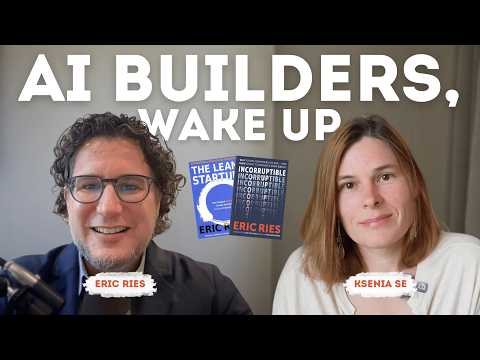
“As an organization becomes more successful, the more successful it is, the more valuable it becomes as a target. The more golden the goose, the greater the temptation to butcher it. So most of us as builders are frankly naive. I would put myself in this category too. I was totally naive about what would happen as the organization would become more successful.” — Eric Ries, 3:44
Clip command
yt-dlp --download-sections "*3:44-4:30" "https://www.youtube.com/watch?v=ypHhsCRWnWs" --force-keyframes-at-cuts --merge-output-format mp4 -o "golden-goose-target.mp4"”It’s always too early until it’s too late”
“The principle has a name, the name is this: it’s always too early until it’s too late. So it might seem like this is something to put off until later, in fact, if you talk to your lawyers or investors or bankers, they will oftentimes tell you, oh, that’s nice, you’re worried about your mission, that’s lovely, but why don’t you wait until some mysterious other time when it would be the right time. And then all of a sudden now it’s too late, you’ve lost the leverage, you don’t have the ability to do it.” — Eric Ries, 7:03
Clip command
yt-dlp --download-sections "*7:03-7:55" "https://www.youtube.com/watch?v=ypHhsCRWnWs" --force-keyframes-at-cuts --merge-output-format mp4 -o "always-too-early-until-too-late.mp4"”Financial gravity — you might say you don’t believe in it, but it believes in you”
“Organizations are all so similar to each other is that they’re experiencing convergent evolution in a hostile environment that is trying to warp them to a very specific plan. I call that force gravity, financial gravity. And just like the physical kind of gravity, you can say, well, I don’t believe in gravity, but guess what? Gravity believes in you as it proves every time you jump up in the air.” — Eric Ries, 12:00
Clip command
yt-dlp --download-sections "*12:00-12:50" "https://www.youtube.com/watch?v=ypHhsCRWnWs" --force-keyframes-at-cuts --merge-output-format mp4 -o "financial-gravity.mp4"”Trust and love are not soft-hearted marketing nonsense. They’re the most ruthless business strategy of all.”
“Yeah, trust and love are not some soft-hearted, like marketing nonsense. They’re actually the most ruthless business strategy of all, because if a customer truly has that lasting bond with you, they are no longer eligible to be part of the total available market of your competitors. That’s pretty cool.” — Eric Ries, 18:00
Clip command
yt-dlp --download-sections "*18:00-18:35" "https://www.youtube.com/watch?v=ypHhsCRWnWs" --force-keyframes-at-cuts --merge-output-format mp4 -o "ruthless-business-strategy.mp4"”When you replace newspapers with Google and Facebook, you don’t automatically get the same civic values”
“When you disrupt an institution and replace it with something else, like when you replace newspapers with Google and Facebook, you don’t automatically get the same civic values that you had before. In fact, you quite often get opposite values. And there’s, if you look at the social and human health consequences of local news deserts, it’s shocking.” — Eric Ries, 24:00
Clip command
yt-dlp --download-sections "*24:00-24:40" "https://www.youtube.com/watch?v=ypHhsCRWnWs" --force-keyframes-at-cuts --merge-output-format mp4 -o "newspapers-civic-values.mp4"”Executives are on TV practically mad with glee that they get to lay off so many people”
“These executives who are on TV all the time now like just practically like mad with glee that they get to layoff so many people and the fact that they’re being rewarded so handsomely with their stock price going up, and so it’s just the whole thing is is really gross. So I hope, I hope, I hope after the bubble passes, after the mania passes, we can actually get serious about how do we use this technology to enhance human creativity, to like to pursue growth and human flourishing, not just cost-cutting and human replacement.” — Eric Ries, 27:00
Clip command
yt-dlp --download-sections "*27:00-27:50" "https://www.youtube.com/watch?v=ypHhsCRWnWs" --force-keyframes-at-cuts --merge-output-format mp4 -o "mad-with-glee-layoffs.mp4"”An AI-enhanced mission guardian would make a lot of sense”
“The thing that they’re very, very, very best at, by far, is summarizing… So much of the modern management toolkit is really just a summarizing problem. What is my organization doing? You know, if I have 10,000 employees, I have no idea what’s going on… we could use it to build coherence, and in that case an AI enhanced mission guardian would make a lot of sense.” — Eric Ries, 27:26
Clip command
yt-dlp --download-sections "*27:26-29:50" "https://www.youtube.com/watch?v=ypHhsCRWnWs" --force-keyframes-at-cuts --merge-output-format mp4 -o "ai-mission-guardian.mp4"Key Points
- Incorruptible is the “missing manual” to Lean Startup (3:44) — The lesson nobody told Eric: success makes you a target
- Builders are naive about what success unleashes (3:44) — Surrounded by people who know how to make money without creating value
- Corruption defined (5:09) — Making money without creating value; what our great-grandparents would have called this
- Capital structure can have a flavor (5:30) — Food and restaurants taste worse after PE takeover; the change shows up in the product itself
- The most valuable decisions look like negative ROI on a spreadsheet (6:00) — Returns are intangible, costs are tangible
- “It’s always too early until it’s too late” (7:03) — The single most important principle; protect your mission before you have leverage to lose
- Future builders are the most important audience (7:55) — People who don’t have a company to protect yet can develop the ethos first
- A battle for the soul of the economy and civic infrastructure (9:30) — Decaying institutions and collapsing leadership norms; the work is bigger than business
- The system can’t last a minute if its builders refuse to abide by its norms (11:00) — That’s the discomforting good news
- Physics of organizations, not policy/strategy (11:19) — Look beneath surface characteristics to fundamental forces
- Financial gravity (12:00) — The hostile environmental force pulling organizations toward mediocrity through convergent evolution
- Organizations are biological, not mechanical (13:00) — They gain mass as they gain velocity; they become gravitational actors themselves
- Mission transmission / bend the light (13:30) — Successful organizations bend the economy around them; many do so accidentally with financialized values
- Brian Chesky during the pandemic (15:27) — Told Eric “businesses are built on love and trust” when Airbnb’s whole business went to zero
- The electromagnetic-force analogy (16:06) — Trust is 20-30 orders of magnitude stronger than financial gravity at the human scale; that’s why you can stand up against the gravity of a planet
- Trustworthiness is the most underrated asset in business (17:20) — Lower retention costs, higher revenue growth, lower capital costs, lower partnership friction
- A bonded customer leaves the competitor’s TAM (18:00) — The ruthlessness of love-and-trust as competitive strategy
- Milton Friedman / Adam Smith / John Locke’s defense of capitalism is being violated (18:30) — Voluntary, informed, uncoerced transactions create value; most modern transactions don’t qualify
- For-profit redefined as maximizing human flourishing (20:34) — Most corrupt money-making just hides costs in the future, in communities, in human health
- The humane-tech entrepreneur in tears (21:14) — Story of one founder who saw a famous billionaire dancing alone at a party hitting on a 20-year-old, totally alienated; broke down crying when Eric told him a more humane company was possible
- Massive institutional collapse all around (22:50) — Political parties, newspapers, sports leagues, universities, big law, retailers, hotels — all failing
- AI accelerates the chaos because the regulators are being dismantled (23:40) — Exhibit A: the very institutions that would absorb the shock are being burned down
- Builders must be ready to build the replacement infrastructure (23:52) — Like our grandparents did after their dark times
- Local news deserts as spillover (24:00) — Replacing newspapers with Google/Facebook didn’t preserve civic values; often inverted them
- Civic values in new infrastructure are up for grabs (24:30) — This generation gets to encode what comes next
- AGI goalposts move every time AI passes them (25:55) — Chess, Go, Turing test — we already passed the 10-year-old definition
- The cost-cutting reward loop is gross (26:35) — Executives rewarded for layoffs without being held accountable for downstream costs to brand, quality, society
- Code is Law (Lessig) (27:26) — But unlike law, code lacks human judgment; most organizations run two parallel operating systems (legal charter vs operational mission) and the legal one wins under pressure
- LLMs’ superpower is summarization (28:30) — Compression great, expansion (out of training) bad; most management is compression
- AI as mission guardian (29:30) — Build coherence between legal/operational/mission layers; verify that what leaders are told is actually true
- Book recommendation: The Enlightened Capitalists by James O’Toole (30:04) — 200 years of mission-driven entrepreneurs destroyed by the market; the antidote to naivety
Mentions
Books
- The Lean Startup (Eric Ries) (0:00) — His original book, ~15 years old
- Incorruptible (Eric Ries, new) (0:00) — The book under discussion
- The Enlightened Capitalists (James O’Toole) (30:04) — Case method of 200 years of would-be enlightened capitalists destroyed by markets
- Code is Law (Lawrence Lessig) (27:26) — Classic comparing legal codes and software code
Companies / Institutions
- Airbnb (15:27) — Eric helped Brian Chesky through the pandemic; the love/trust quote came out of that work
- Google / Facebook (24:00) — The disrupters of newspapers; case study of replacing institutions without civic values
- Private equity (generic) (5:30) — Repeatedly cited as the agent of value-destroying takeovers
People
- Eric Ries (0:00) — Guest; author of Lean Startup and Incorruptible
- Ksenia Se (0:00) — Host; mentions getting goosebumps during the conversation
- Ben Horowitz (0:00) — Called Lean Startup the most transformative shift from the dotcom era into modern times
- Brian Chesky (15:27) — Airbnb founder; source of “businesses are built on love and trust”
- Milton Friedman / Adam Smith / John Locke (18:30) — Theorists whose defense of capitalism Eric says the modern economy is violating
- Lawrence Lessig (27:26) — Author of Code is Law
- James O’Toole (30:04) — Author of The Enlightened Capitalists
Concepts
- MVP / Lean Startup / build-measure-learn (0:00) — Eric’s foundational vocabulary
- Financial gravity (12:00) — The hostile environmental force pulling organizations toward mediocrity
- Mission transmission / “Bend the Light” (13:30) — Successful organizations become gravitational actors themselves
- Ethos lessons / structural integrity (6:35) — How to keep an organization from giving in to outside pressure
- Spillover effects of institutional replacement (24:00) — News deserts as canonical example
- Mission guardian (AI-enhanced) (27:26) — Building coherence between legal, operational, and mission layers
- “Code is law” (Lessig) (27:26) — The parallel operating systems problem
- Total available market (TAM) (18:00) — Bonded customers leave competitors’ TAM
Surprising Quotes
“It was actually Brian Chesky, the founder of Airbnb, who, during the pandemic… gave me the line that at the end of the day businesses are built on love and trust. Like those are actually the two most fundamental forces or human elements that an organization is made up of.” — Eric Ries, 15:27
“If there was nothing but gravity in the universe, all matter would collapse into a black hole instantly. Luckily, there are these other forces that, though small in their scale, are actually stronger than gravity. You can actually prove this to yourself every time you stand up from a seated position.” — Eric Ries, 16:50
“He saw him like dancing alone at a party, hitting on some 20-year-old, you know, by himself because he’s totally alienated from his family and everyone who loved him. And he’s like, ‘What is the point? Is that gonna be me one day? Like, is that the best our industry has to offer?’” — Eric Ries (recounting a humane-tech entrepreneur’s story), 21:30
“If you go by the definition of AGI that we used 10 years ago, we’re obviously we’re bliss way past it, way past it. It’s ridiculous. Come on.” — Eric Ries, 26:22
“Most organizations have two parallel operating systems. They have a legal structure that claims this is what legally what they do, and then they have an operational structure that claims something different. The divergence between the two is actually usually quite extreme.” — Eric Ries, 27:26
Transcript
Ksenia Se: 0:00 If you ever heard terms like MVP, minimum viable product or lean startup, and assumed they had always existed, they actually have an author. About 15 years ago, Eric Ries fundamentally changed how startups build products, test ideas and manage uncertainty. His book The Lean Startup turned entrepreneurship into a more systematic discipline, centered around experimentation and learning. Ben Horowitz called it the most transformative shift from the dot com era into modern times. Now, Eric is introducing a very different idea, which is actually a second part without which lean startup should not exist. In his new book Incorruptible, he explores how organizations can stay trustworthy, coherent and human in a world increasingly shaped by AI, optimization and powerful incentives. So many things in this conversation felt important. A couple of times I honestly had goosebumps. Because if you truly care about the goodness of this world, about living in trust rather than in constant fear that every system is trying to extract something from you, then we need to think seriously about how corruption begins and how to resist it. And the best thing is that you and I can do it. Because now when so many of you are builders, this matters even more. You can build meaningful things. You can create companies, tools, products, institutions, you can even create standards. But the harder question is, how do you do that without betraying your own values once success arrives? This conversation is about startups, but also about capitalism, trust, AI, institutional collapse and the kind of world builders are about to shape. It’s also about love. I really think it’s important to watch. Enjoy.
Ksenia Se: 2:06 Hi Eric and welcome to Inference. I want to share a little doubt with you because my audience is mostly technical people, you know, machine learning engineers, data scientists, software developers, AI engineers. So at first I thought, well, Eric is interesting to me, but why would he be interesting to them? And then it dawned on me that currently everyone becomes a builder and we’re living in this complete, completely new world when building a company is not something mystical, but actually becomes very tangible. Do you expect your new book to arrive right at the moment when this new generation of builders is emerging?
Eric Ries: 2:49 Well, gosh, I mean, I, I wish I had that kind of prescience, you know, to time it that way, but, but the truth is I’ve been working on this book for several years and this is just as long as it took me to write it. It’s been a long odyssey, but I have been really heartened — and I really appreciate how many builders have gravitated to it and really like been incredible evangelists for it. So much so that I kind of feel like that’s the real heart of the audience for the book, you know, because of course it has plenty of fans and people in in more fancy ersatz settings and of course there’s a policy angle to it and there’s a venture angle to it and whatever, but to me the beating heart of it is as those who make things and who believe in making money by the making of things, what can we do to maintain that integrity even as we have success?
Ksenia Se: 3:34 Well, Lean Startup helped make entrepreneurship more scientific. What do you hope Incorruptible changes about how people build companies?
Eric Ries: 3:44 So I kind of think of this like the missing manual or the the second half of what I wish someone had told me. And it’s it’s very simple, like the idea of Lean Startup was very simple, if you if you strip away all the complexity at the end of the day, it’s that if you’re facing with high uncertainty, you should use the scientific method, you know, it’s not really that shouldn’t really be that controversial and yet that’s business. Here the thing that nobody told me that I wish someone had is simply that as an organization becomes more successful, the more successful it is, the more valuable it becomes as a target. The more golden the goose, the greater the temptation to butcher it. So most of us as builders are frankly naive. I would put myself in this category too. I was totally naive about what would happen as the organization would become more successful. And I’ve seen it over and over and over again where people, you know, they figure out some way to take control, to to manipulate, to make money without creating value. And we as builders, we’re surrounded by people who have this ethos, and yet we’re all supposed to pretend that it’s okay. That we think that all the different ways of making money are equally good, that we have supposed to in fact defer to those people in questions of business or strategy or marketing or whatever, when in fact quite often it is the the thing that made the company worth investing in, working at, partnering with in the first place was that builder’s intuition, the goal of creating more value than you capture.
Ksenia Se: 5:03 So in that sense, what does Incorruptible mean in the context of a company?
Eric Ries: 5:09 I think we should call this this phenomenon of companies eventually starting to make money without creating value, we should call that corruption. That’s what our grandparents and our great-grandparents and their grandparents would have called it. And yet in our modern world, we’ve kind of forgotten this. We’re as I said supposed to pretend that we think this is all okay. And so so many companies after they become successful, after they go public, after they get taken over by private equity, they they had an ethos of quality and now that gets lost. Think about how many how much how many restaurants or food products you’ve you’ve eaten where after the takeover the food is disgusting or worse. How can the capital structure of a company have a flavor? It’s actually like really endemic now in our economy. But you also see it in cases where it’s a little more subtle, where just in the meetings every day that you have with your team, with new people, old people, investors, board meetings, all these different meetings. You have this question of, should we do the right thing? And someone will say, well, what’s the ROI? Well, what does the spreadsheet say? And the problem is that the most valuable and important decisions an organization will ever make, they show up on the spreadsheet as negative ROI because the returns are intangible, but the costs are tangible. If we want to be able to maintain an ethos over time, to be incorruptible, we have to learn the leadership lessons, what I call the ethos lessons, of how to create that inner alignment so that we say, look, our goal every day is to be a trustworthy counterpart to everyone we touch. We have to study the integrity dimension, that is, we have to figure out how do we maintain structural integrity, not just of the product, but of the organization itself so that it doesn’t give in to temptation or to outside pressure.
Ksenia Se: 6:50 Do you think it’s mostly for the bigger companies? Because I’m asking because again, now when everyone can become a builder, how small should the company, you know, when when do you start to think about incorruptibility?
Eric Ries: 7:03 This book is very confusing to people from an audience perspective because I’ve had people say, how come there’s not any startup stories in this book? And I’ve had people say, how come there’s only startup stories in this book? Because it all depends on how you define startup and and of course, when we’re talking about longevity, we have to have some companies that are old, you know, because we have to look at the startup founding stories, the choices that were made, you know, in the 1920s that cause the company to still be alive and ticking today. So the most important principle in the whole book is actually not any of the specific techniques in the blueprint, although believe me, there are lots of specific techniques that I recommend, but rather the question of when should people pay attention to this? And the principle has a name, the name is this: it’s always too early until it’s too late. So it might seem like this is something to put off until later, in fact, if you talk to your lawyers or investors or bankers, they will oftentimes tell you, oh, that’s nice, you’re worried about your mission, that’s lovely, but why don’t you wait until some mysterious other time when it would be the right time. And then all of a sudden now it’s too late, you’ve lost the leverage, you don’t have the ability to do it. So I really think that every one of us as builders, even people I call future builders, most important audience are people who don’t even have a company or thing to protect yet. If we start to develop this ethos, this understanding of how business really was meant to operate, then we’re able to bring that into everything we do. And and already from the test readers we’ve had with the book, quite a few people have written me to say either this has revolutionized their job, like in their regular old business, you know, in a big company, you know, executive, board level job, or or it’s helped them to see a new entrepreneurial possibility that they wouldn’t previously have considered. And several companies have already been founded as a result of someone using the framework to say, wait a minute, here’s a business opportunity that was staring me right in the face, but I had the blinders on so I couldn’t see it.
Ksenia Se: 8:51 I have a few questions to unfold what you said because I was very lucky, I actually read the book and it’s very thought provoking and I recommend it to everyone. Everyone! But I have kind of bigger question about values because the companies that you described, they had very solid values. And I had a question, like, should we start with the family? How to build an incorruptible family? Is it relevant at all? You know what I mean about the values in general?
Eric Ries: 9:22 Yeah, so this is… this is a tricky thing and I try to stay in my lane, you know, because of course a lot of people were like, ‘Hey, you know, you want to write the lean guide to parenting?’ and all kinds of other books, which I, you know, lean dating, lean this, lean that. I try not to, you know, I’m… the general trend of taking business concepts and copy-pasting them into other dimensions of life is fraught. But, I do think it’s important not to see this as only a business thing. This is really a battle for the soul of our whole economy, and our whole civic infrastructure. Like, the society that we build together and share is under threat. It’s collapsing around us, actually. This is a time of decaying institutions and collapsing leadership norms, like, it’s not a good time. But if you look at the history of other bad times, dark times like these, what you’ll notice is that eventually people start to pull together and build a movement around a new idea. Like, the problem we have right now is we’re in such a negative place, such a polarized place, we can only critique what we have now. And there’s plenty to critique, it’s quite bad. But my goal with the book is to give people a new sense of a North Star, a new idea that can replace the outdated dogmas that we are struggling with now. And so I think when you start to see the world through that lens, yeah, it raises values questions, it raises moral questions about what is the purpose of a human life, what is the purpose of an organization, why do we work and for who? I try to end the book on an uplifting note, because I actually think most of the people listening to this right now, you have more power, more agency over this system than you realize. And right now that can actually feel very uncomfortable because you say, ‘Wait, am I complicit in this system?’ Yeah. That’s the bad news, you are. We all are. But the good news is it doesn’t… this system could not last one minute if its builders refused to abide by its norms. So if you want it to be different, you have that… you have that capacity to make it so.
Ksenia Se: 11:12 Yeah, the last part of your book is called ‘To Bend the Light’. Can you describe a little more what you mean by that?
Eric Ries: 11:19 Yeah, well, the book is not a traditional business book. It starts out that way; I wanted it to be comfortable to a business reader to pick it up and take a look. But if you read carefully, and especially as it goes, you will see that it breaks the conventions of the genre and becomes something different. No spoilers, but as a reward for those who do decide to read to the end. And my conceit with the book was to not focus on the surface characteristics of organizations, where we spend so much of our time talking policy, business model, strategy, org chart, even culture. Those things are important, absolutely. But I wanted to get at the physics of organizations. What are the forces, the fundamental forces that act on organizations and determine what they… can and can’t do. And when you look at it that way, you start to realize that part of the reason why organizations are all so similar to each other is that they’re experiencing convergent evolution in a hostile environment that is trying to warp them to a very specific plan. I call that force gravity, financial gravity. And just like the physical kind of gravity, you can say, well, I don’t believe in gravity, but guess what? Gravity believes in you as it proves every time you jump up in the air.
Eric Ries: 12:26 So too with organizations. There is a gravitational force that pulls them down into mediocrity. So the first two-thirds of the book are about how to grapple with this gravity. First how to learn to see it, understand where it comes from, what are its laws of transmission, and the second part especially is about the blueprint. How do we build a structure strong enough to resist this force? But organizations are interesting. When you try to find metaphors for them, people use all kinds of metaphors for what is an organization. And if you take the gravity metaphor seriously, you might conceive of it as a spaceship or a submarine, right? A bubble of its own atmosphere, a little machine that holds its own vision of utopia. This is how we think an organization should be. Here’s the power relationships between human beings according to us. This is our thing. But at the end of the day, organizations are not submarines or spaceships. They’re not machines at all. They are biological because they grow.
Eric Ries: 13:30 So imagine a spaceship that gained mass as well as velocity as it traveled. That’s kind of what an organization is, which means that over time, organizations don’t just become victims, passive recipients of this gravitational force. They become gravitational actors in their own right. They start to exert gravitational pull. And just as the gravity of a star or a black hole is strong enough that it can literally bend light around it, so too organizations achieve this particular form of what I call mission transmission. And so again, when we talk about the agency that builders have, it’s first of all we have our agency as individuals. Where do we choose to work? Who do we choose to buy from? Where do we choose to invest? We have our agency as leaders, you know, how do we run our team? What choices do we make for our product? You know, whether we choose to quit after an outrage and start our own company or stick it out and try to reform from the inside. But eventually, those of us who build will create gravitational structures. It’s inevitable. That’s what success means. And at those moments, we have to really decide, well, what are the values we want to transmit? And a lot of organizations, even the ones that are genuinely mission-driven, they inadvertently transmit a different, more financialized set of values than they themselves hold, not realizing that they are gravitational actors in this way. So, yes, to bend the light, the metaphor is to see the possibility of a whole new economy where organizations are pulling towards a mission-driven, more purpose-driven way of working, rather than having to resist the pull towards a more extractive, financialized economy.
Ksenia Se: 15:00 So the book has some language like mission, a lot about how to build business, strategy. There is also such words as love and trust, and these words are hard to I mean, I think some people perceive it with some Is it cheesy? What do we think about it? How do we approach saying these words and really delivering the message?
Eric Ries: 15:27 Yeah, I would have been among those who would be uncomfortable using that kind of language in a business context before. And I’ve been very fortunate to have business mentors who have set me straight on that point. Uh, and I tell, of course, many of their stories in the book. You know, it was it was actually Brian Chesky, the founder of Airbnb, who um during the pandemic, you know, I was uh spent a lot of time with him or in the years leading up to the pandemic and in the pandemic helping with a bunch of things at Airbnb. So I got to see the air the pandemic response up close and the turmoil, you know, obviously Airbnb, their whole business went to zero. It was it was very, very stressful and intense. And I interviewed him while it was happening and he gave me the line that at the end of the day businesses are built on love and trust. Like those are actually the two most fundamental forces or human elements that an organization is made up of.
Eric Ries: 16:06 And that was a thread on a sweater that I that I pulled on because I wanted to know if that was really true. And what does that what does that mean? And most of us can’t even really conceive in our cynical age what would it mean if an organization said I love you. Like what would that look like? But actually we we we can imagine it. Like if you can imagine an organization that felt it had a duty of care towards you, that wanted you to thrive. Wouldn’t you like to interact with such an organization? Like think of all the vendors you interact with. What if you didn’t have to worry that they were going to secretly stab you in the back? And it turns out this question has been extensively studied. There is this other fundamental force that makes organizations possible. If there was nothing but gravity in the universe, all matter would collapse into a black hole instantly. Luckily, there are these other forces that, though small in their scale, are actually stronger than gravity. You can actually prove this to yourself every time you stand up from a seated position, the electromagnetic force that your body generates is stronger than the entire gravitational mass of a planet like, I don’t know, 20, 30 orders of magnitude bigger than you. So there is a similar force in uh organizations. Again, this is not just my opinion, there’s a lot of research on this point. When people trust an organization, as employees, they have more loyalty. They uh you have better retention, they’re willing to take a lower salary, they are more likely like morale’s higher, revenue grows faster, so many things happen. When customers trust you, they’re more likely to stick with you after you make a mistake, they’re more likely to try your new products. When investors trust you, you can raise money at lower rates. When partners trust you, you have lower partnership costs. All manner of friction is erased in the presence of trust so much so that I actually think trustworthiness is the most underrated asset in all of business. So a lot of the book is about how to generate this most precious asset.
Eric Ries: 18:00 In order to do that, we’re going to have to get more comfortable using this language and just say yeah, trust and love are not some soft-hearted, like marketing nonsense. They’re actually the most ruthless business strategy of all, because if a customer truly has that lasting bond with you, they are no longer eligible to be part of the total available market of your competitors. That’s pretty cool.
Ksenia Se: 18:23 That sounds great. Do you think it changes the idea of capitalism or brings it back to the initial one?
Eric Ries: 18:30 Yeah, you know, the word capitalism today is so hotly debated. What does it even mean? That I don’t know. I think certainly if you read the theorists who have defended capitalism over the years, whether we’re talking about Milton Friedman or Adam Smith or John Locke, like this has been debated much — many, many, many times. I think the kind of economy we run today is violating the very simple moral logic that they articulated in defense of capitalism. And and you hear it in people even today when asked to account for some immensely destructive thing that is being done in the name of profit. That’s what’s so crazy. In the stories, I got a lot of stories in the book of companies, resources, people, communities being destroyed in the name of profit even though it’s profoundly unprofitable to do so. If you ask people, why should I put up with climate change or why should I put up with misinformation or some whatever social ill bothers you, people will say, well but capitalism’s done a lot of good. Capitalism lifted so many people out of poverty, capitalism does this, capitalism done that. You say, really? Are you sure? They say, yeah, if you press them hard, what about the critique that puts people over profits, what about you know, profits over people? What about this one? People will retreat eventually to the safe ground which says, well but hold on, when you say that making money, those who become wealthy are committing theft, that’s not right. When people voluntarily transact, when there’s no misinformation, when people are fully informed, when they’re uncoerced, both parties in the transactions are better off and so wealth is generated, not stolen. Doesn’t that sound nice? You know, like oh, that sounds good. But then we ask the question, how many transactions in today’s economy fit this description? And that’s when you start to see the problem. That we — we know what the moral logic of this system should be, but we permit many economic behaviors that violate it. And we’re so wrapped up in the political question of what should be allowed to be done that I think we’ve lost sight of the far more important question of what we as leaders ought to want to do. And once we settle that question, then we can settle the political questions which are all downstream of that choice.
Ksenia Se: 20:30 So what should we do?
Eric Ries: 20:34 Well, I think we should redefine what it means to be a for-profit company, to be one that maximizes human flourishing. And we realize that almost all of the corrupt ways of making money that we support today in our economy, they don’t actually create value. They’re not — they’re not profitable. They are just ways to hide the costs somewhere else, hide them in the future, hide them in a different community, hide them by not accounting for the negative costs that we impose on human health. …well-being. When we do that properly, we start to realize that that a for-profit company can be an immense force for good in the world. And in fact, the title of the book comes from a conversation I had with an entrepreneur, this is many years ago now, someone in the humane tech space. He wanted to to fix the problems he saw in the tech industry. He had he had met all these billionaires, he’d been around he’d worked at all these companies, and he just thought, “What is this all for?” He told me this story about meeting one of the very famous billionaire founders of one of the mega tech companies. And he saw him like dancing alone at a party, hitting on some 20-year-old, you know, by himself because he’s totally alienated from his family and everyone who loved him. And he’s like, “What is the point? Is that gonna be me one day? Like, is that the best our industry has to offer?” No. So he would try to build a more humane approach. Very successful now, um very proud of him. But at the time he was having a really hard time getting the company started because he said nobody would take it seriously. Every investor would kind of condescendingly be like, “Okay, yeah yeah, after you get product-market fit, after you this, after you’re serious about business we can talk about mission or whatever.” And when I told him, “Look, if you follow the blueprint that this — there was no book at the time, but now that this book lays out — you can become an incorruptible force for good.” He broke down in tears. He was like, “Nobody will talk to me about it and now I feel like I have permission to pursue it.” And that’s that’s what I want for everyone.
Ksenia Se: 22:25 It’s amazing. I wanted to read a little, just the two sentences from the book and ask you a question. “New technologies and changing values mean we are about to get a whole lot of institutional turnover where we choose it or not. The opportunities are massive, yet most entrepreneurs are blind to them.” What are those opportunities?
Eric Ries: 22:41 Oh, thank you for asking me about that. Yeah, if you talk to younger people today, they don’t have the reflexive deference or respect for institutions that older generations have. And I think that makes a lot of sense because the world that they are growing up into has this just been a time of institutional weakness and collapse all around us. Political parties, newspapers, you know, sports leagues — like just, there’s corruption everywhere and these organizations are just they’re failing their test. Universities, big law firms — like just think how sad — retailers, hotels, I mean just go on and on and on. You just see this like collapse everywhere. So we’re seeing a lot of turnover, a lot of turnover in in institutions. That’s true in brands — like every every brand that is destroyed by private equity or that, you know, goes public and destroys itself has to be replaced by something else. Every, you know, every governmental structure that is being burned to the ground will have to be rebuilt on new new principles. And then you have AI sweeping through, causing — like, the level of chaos that’s about to cause is dramatically higher than most people can imagine. Because we’re managing it very badly because, see exhibit A, because all of the institutions that would normally be called upon to regulate and support the disruption are just utterly being dismantled. So there’s a bad side of that, okay? That’s actually very dark.
Ksenia Se: 23:51 Mm-hm.
Eric Ries: 23:52 But we have to be ready. We need builders to be ready to build the replacement infrastructure. And that… One of the big things I have learned studying disruption now all these years is that when you disrupt an institution and replace it with something else, like when you replace newspapers with Google and Facebook, you don’t automatically get the same civic values that you had before. In fact, you quite often get opposite values. And there’s, if you look at the social and human health consequences of local news deserts, it’s shocking, actually. This is what in the research is called spillover effects, like all these unintended consequences of changing changing institutional structures in communities. So we’re going to have to reinvent practically every institution. And because of that, the values that will be encoded into that civic infrastructure is up for grabs. We get to choose, in the same way that our grandparents chose after the darkness that they lived through a past. They went on an institution building spree that we kind of can’t even imagine, but we’re going to have to summon that same dedication, that same skill, and that same commitment to human values if we want to get through this.
Ksenia Se: 24:57 That’s very interesting. And that means building all new standards, reinventing them?
Eric Ries: 25:04 Yeah, I mean, not necessarily everything. I think some things can be modernized and revitalized, but a lot of things have already collapsed. So I do think we’re going to have to find new solutions. Now the good news with technological disruption is the new technology gives you new tools. So although the kind of the collapse of the business models of the 20th century era organizations that depended on a certain, you know, certain particular configuration, journalism was paid for by classified ads, you know, like that when these things break, something new has to be has to be created in its place. And I think we have an opportunity to make sure that the organizations that take that do that replacement are committed to human flourishing and are not just another attempt at value extraction.
Ksenia Se: 25:39 You mentioned AI being very disruptive because of the institutions. What do you think about AGI? Because I talk a lot about AI, machine learning, AGI questions in my media publication. So I’m very curious what you think about it.
Eric Ries: 25:55 The funny thing, this has been happening with AI for almost 50 years now, that whenever you have an AI breakthrough, we redefine intelligence so that the breakthrough doesn’t count. So people used to say that about playing chess, but then they said, well, no, you know, then they said it about playing Go. Then they said it about, you know, the Turing test and tell you what, well, you know, whatever, whatever the AI can do is not intelligence by definition. So if you go by the definition of AGI that we used 10 years ago, we’re obviously we’re bliss way past it, way past it. It’s ridiculous. Come on. So now we know, but now we of course we redefine the goalposts elsewhere.
Eric Ries: 26:35 The downside of it of where we’re at now is that we’ve in our economy, we live in a time when people who cut costs are routinely rewarded without being held accountable for the downside consequences of the cost cutting to brand, to quality, to other things. So of course AI is being sold that way as a replacement for human creativity rather than as an augmenter of human creativity, which I think is fundamentally wrong. I mean and these executives who are on TV all the time now like just practically like mad with glee that they get to layoff so many people and the fact that they — they’re being rewarded so handsomely with their stock price going up, and so it’s just the whole thing is is really gross. So I hope, I hope, I hope after the bubble passes, after the mania passes, we can actually get serious about how do we use this technology to enhance human creativity, to like to pursue growth and human flourishing, not just cost-cutting and human replacement.
Ksenia Se: 27:19 I like your idea about mission guardians. Do you think AI can become a mission guardian?
Eric Ries: 27:26 Oh, now that’s a really good question. You know, it’s funny because Lawrence Lessig wrote a wrote a classic book called Code is Law, looking at the similarities between programming and and legal codes. And one of the things that’s really interesting is like one of the ways in which code is not law is that the law is designed to be implemented with human judgment. But as a result, most organizations have two parallel operating systems. They have a legal structure that claims this is what legally what they do, and then they have an operational structure that claims something different. The divergence between the two is actually usually quite extreme. A lot of companies have a mission statement to do something lofty, but then they have an actual legal charter, legal purpose that says they’re just going to maximize shareholder value, and when they come into conflict, it’s the legal code that dominates. I do think one of the things that AI would give us the the possibility to do would be to to look for coherence between all the different operating procedures of an organization, to to pay attention to deviations uh between them. You know, the current LLMs, they have many strengths, but the thing that they’re very, very, very best at, by far, is summarizing. When they’re doing compression, they’re amazing. When they’re doing expansion, they’re not as amazing, okay, right? Like because like by definition when they’re doing expansion, you’re taking them out of the training data, you know, taking them away from the training data into novel domains where they collapse. But when we’re compressing, when we’re summarizing, they’re wonderful. And so much of the modern management toolkit is really just a summarizing problem. What is my organization doing? You know, if I have 10,000 employees, I have no idea what’s going on. I literally don’t know what they’re doing. So I say, well everyone give me a report, and now I reread the reports. But first of all, there might be too many reports for me to read, but second of all, how do I know the reports are true? And then I gotta survey the customers, I gotta — you know, if I have 10 million customers, how do I survey them? Like there’s just this incredible amount of latent data that most managers are not able to see, most board members certainly are not able to see. And so most board level disputes or or disagreements, it’s not so much that we look at the same set of facts and disagree how to interpret. We don’t even have the same set of facts. We don’t really know what’s going on. So I think the possibility to build board level, managerial level understanding of what is really happening — we can of course use that for surveillance and control and all kinds of nasty things, but the flip side is we could use it to build coherence, and in that case an AI enhanced mission guardian would make a lot of sense.
Ksenia Se: 29:44 And to build trust.
Eric Ries: 29:46 And to build trust. Because you could start to verify that the information you’re being given is true, which is very difficult to do today.
Ksenia Se: 29:51 We’re coming to the end of our interview and uh always at the end I’m asking about a book that influenced you the most. Most, might be a recent book, or something from your childhood.
Eric Ries: 30:04 Gosh, I have so many books that I love, so many books. It’s — it’s really hard to choose. For this book, I owe a great debt to a book called The Enlightened Capitalists by James O’Toole. That’s like a case method book of 200 years of entrepreneurs and builders trying to build a more enlightened capitalism and then getting utterly destroyed by the market. So that’s part of how — helped me turn me onto the need for — for a little bit more sophistication and less naivety in this area. You know, for me personally, gosh, I — I — I couldn’t choose. There’s simply — there’s simply too many books that I love — that I love too much. It’s — it’s an impossible challenge. But in the new book, I did try to be very generous with the endnotes, so people who want to see all the different books, all the different sources that were cited, you’ll see lots and lots of good stuff in there.
Ksenia Se: 30:46 Thank you so much. Yeah, and I think the way you were looking back onto the history of capitalism and all that stuff, that helps to be grounded. Because if you just follow the news, it’s — it just craziness. But if you look back, not that many things changed, actually.
Eric Ries: 31:05 Exactly, exactly.
Ksenia Se: 31:06 Okay, thank you so much, was — was a pleasure.
Eric Ries: 31:07 Oh, my pleasure. Thanks very much. Take care.