Why Reflection AI Bets Their Business on Open Weights | Ioannis Antonoglou, co-founder and CTO
Why Reflection AI Bets Their Business on Open Weights | Ioannis Antonoglou, co-founder and CTO
Summary
In this episode of the Turing Post Inference show, host Ksenia interviews Ioannis Antonoglou, CTO and co-founder of Reflection AI, about why he left DeepMind after a decade of building AlphaGo, AlphaZero, and MuZero to start an open-weights frontier AI lab. Antonoglou explains that during most of his time at DeepMind, the lab published everything openly, but after ChatGPT and rising competition, research labs stopped sharing. He argues that Reflection AI is the only frontier lab committed to open science, believing that scientific progress requires community collaboration, peer review, and shared findings.
The conversation covers Reflection AI’s two core bets: that reinforcement learning will unlock the next wave of AI capabilities, and that open-weight models are the future because they allow “sovereigns” — enterprises, governments, and researchers — to fully own and control their AI stack. Antonoglou points to Chinese labs like DeepSeek as proof that open models can be both commercially successful and frontier-competitive. He also addresses the OpenClaw controversy, arguing it was actually a positive development that exposed risks the closed labs already knew about but weren’t sharing, and that openness leads to safer models through community stress-testing.
The interview surfaces a striking tension: open-source AI advocate Nathan Lambert admitted he doesn’t personally use open-source models because they aren’t powerful enough yet. Antonoglou responds that this gap is exactly what Reflection AI aims to close — building truly frontier-competitive open models so the mismatch between advocacy and usage disappears.
Highlights
”No One Was Sharing This Information”
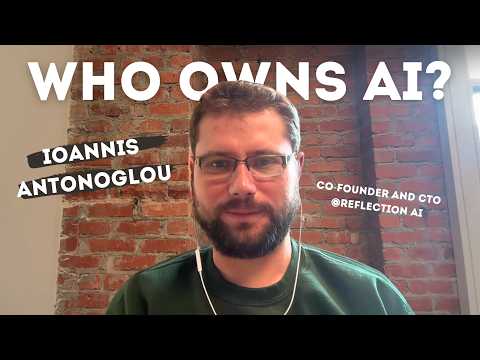
“Many people in labs even knew that those systems are dangerous and you have to be careful with how you use them. But many people outside of the big labs didn’t know that because no one was sharing this information.” — Ioannis Antonoglou, 6:22
Clip command
yt-dlp --download-sections "*6:22-7:15" "https://www.youtube.com/watch?v=y2Nw5JzownM" --force-keyframes-at-cuts --merge-output-format mp4 -o "no-one-sharing-info.mp4"”We’ve Been Vindicated by Labs in China”
“Across both our big bets which was reinforcement learning and open weight, we’ve been vindicated by labs in China and by how things have played out in the past year and a half.” — Ioannis Antonoglou, 3:33
Clip command
yt-dlp --download-sections "*3:33-4:40" "https://www.youtube.com/watch?v=y2Nw5JzownM" --force-keyframes-at-cuts --merge-output-format mp4 -o "vindicated-by-china.mp4"”Almost a Moral Obligation”
“There’s a lot of concentration of power in the hands of the closed labs. I feel it like almost a moral obligation that we as Reflection just build this model so that the rest of the research community can participate and this technology gets more democratized.” — Ioannis Antonoglou, 7:35
Clip command
yt-dlp --download-sections "*7:35-8:23" "https://www.youtube.com/watch?v=y2Nw5JzownM" --force-keyframes-at-cuts --merge-output-format mp4 -o "moral-obligation.mp4"”The Open Source Paradox”
“Nathan Lambert is very bullish on open source and he created this whole foundation called ADAM, he’s pushing open models further, but at the same time he doesn’t use open source models himself.” — Ksenia (host), 8:25
Clip command
yt-dlp --download-sections "*8:25-9:10" "https://www.youtube.com/watch?v=y2Nw5JzownM" --force-keyframes-at-cuts --merge-output-format mp4 -o "open-source-paradox.mp4"”OpenClaw Was a Good Thing”
“Open Claw is a good thing that actually happened. It really showed us that you need to be extremely careful with these models, that they are extremely capable. If you give them access to your computer, they can do things that you don’t expect them to, even if you’re a world expert.” — Ioannis Antonoglou, 6:09
Clip command
yt-dlp --download-sections "*6:09-7:00" "https://www.youtube.com/watch?v=y2Nw5JzownM" --force-keyframes-at-cuts --merge-output-format mp4 -o "openclaw-good-thing.mp4"Key Points
- From DeepMind founding engineer to open-weights founder (0:54) - Antonoglou joined DeepMind in 2012 as one of ~25 people, worked on DQN, AlphaGo, AlphaZero, MuZero, and led RLHF for Gemini before leaving to start Reflection AI
- DeepMind used to publish everything (1:34) - All work on DQN, AlphaGo, AlphaZero, and MuZero was published openly; it was only after ChatGPT that labs stopped sharing
- Reflection AI claims to be the only open frontier lab (1:58) - They distinguish themselves from non-commercial open research institutes by being a business committed to open science
- Two core bets: RL and open weights (2:31) - Pitched to investors before the DeepSeek moment that reinforcement learning unlocks next capabilities and open models allow sovereignty
- Llama 3 proved open models before DeepSeek (3:00) - Even before DeepSeek, Meta’s Llama 3 showed that open-weight models could be commercially valuable
- Chinese labs as proof points (3:33) - Frontier open models from Chinese labs proved you can be both open and commercially successful
- Rise of reasoners trained with RL (4:02) - Models trained with reinforcement learning on reasoning tasks now form a big component of frontier model training
- Agents trained with RL for tool use (4:15) - RL is how models become competent at coding, Google search, and other tool use
- Openness accelerates and validates science (4:56) - Scientific progress requires peer review, shared findings, and community testing of ideas
- Open source = safer models (5:55) - Like open source software, open models are safer because more people find blind spots and test them
- OpenClaw exposed hidden risks (6:09) - The OpenClaw incident showed that AI agents can do unexpected things even to world experts, starting an important safety conversation
- Concentration of AI power is worrisome (7:35) - There is a significant mismatch between what happens in closed labs and what the rest of the world has access to
- Open models need to be frontier-competitive (8:51) - People will only use open models if they are as powerful as closed ones; the gap must be closed
- Value proposition for different users (9:18) - Research institutions get frontier model access; enterprises and governments get full ownership of their AI stack with data privacy
Mentions
Companies
- Reflection AI (0:31) - Open-weights frontier AI lab co-founded by Antonoglou, applying RL and LLMs to autonomous coding
- DeepMind (0:54) - Where Antonoglou spent 10 years as a founding engineer building AlphaGo, AlphaZero, MuZero
- Meta (3:00) - Released Llama 3, an early proof point for commercially viable open-weight models
- DeepSeek (2:25) - Chinese lab whose success validated the open-weights commercial model
Products & Technologies
- AlphaGo (0:24) - DeepMind’s Go-playing AI that Antonoglou helped build
- AlphaZero (0:26) - Self-teaching game-playing system from DeepMind
- MuZero (0:28) - DeepMind’s model-based RL system
- DQN (1:24) - First deep reinforcement learning agent ever created
- Gemini (1:32) - Google’s LLM; Antonoglou led RLHF for Gemini before leaving
- Llama 3 (3:00) - Meta’s open-weight model that proved commercial viability
- OpenClaw (6:09) - Open AI agent that demonstrated unexpected dangerous capabilities when given computer access
People
- Ioannis Antonoglou (0:22) - CTO and co-founder of Reflection AI, former DeepMind founding engineer
- Nathan Lambert (8:28) - Open-source AI advocate who created the ADAM foundation but admitted he doesn’t personally use open models
Surprising Quotes
“For most of my time at Deep Mind, we were big proponents of publishing. All of our work on DQN, AlphaGo, Alpha Zero, MuZero — everything is published. It is only after ChatGPT and the competition between labs started that research labs stopped publishing and there’s nothing out there.” — Ioannis Antonoglou, 1:34
“People don’t use something that’s not as powerful, right? People just want to use the best models out there. So you want to ensure that really competitive models which are close to the frontier are open.” — Ioannis Antonoglou, 8:51
“Open source software tends to be safer because more people, more eyes on the code and more people testing it.” — Ioannis Antonoglou, 6:02
“Enterprises and governments will have the opportunity to actually fully own their AI stack, control their fate, have an end-to-end system that can run on their own infrastructure. They can customize it, they can have data privacy.” — Ioannis Antonoglou, 9:46
Transcript
0:00 No one was like sharing this information. We’ve been vindicated by labs in China. Like the only way for scientific progress to accelerate is by—
0:17 Hello everyone. Today I have an amazing guest Ioannis Antonoglou and he helped build AlphaGo and later worked on systems like AlphaZero and MuZero at DeepMind and now he’s a CTO and co-founder of Reflection AI where the team is applying reinforcement learning and large language models to autonomous coding and all of it is supposed to be open sourced. Welcome to the Inference Show, Ioannis.
0:42 Thank you so much for the invitation and it’s good to be here. Yeah, it’s my pleasure. So you went from DeepMind closed agents to building an open weights lab. What changed your mind about where the progress comes from?
0:54 That’s a really good question actually. You know what, I joined DeepMind really early on. So I was actually one of the founding engineers. I joined in 2012. That was like back then DeepMind was a small team of like 20-25 people and there was no other place in the world where people were thinking about AGI and general intelligence and I really joined because I really believed in the mission. And as you mentioned I spent the next 10 years of my life doing deep reinforcement learning research.
1:24 I worked on DQN which was the first deep reinforcement learning agent to ever exist. Then I worked on AlphaGo, AlphaZero, MuZero. And before I left DeepMind, I was leading RLHF for Gemini. The thing is that for most of my time at DeepMind, we were big proponents of publishing. All of our work on DQN, AlphaGo, AlphaZero, MuZero — everything is published. We kind of shared all of our work and it is only after ChatGPT and the competition between those labs started, the research labs stopped publishing and there’s nothing out there.
1:58 So we believe that as Reflection we are the only frontier lab that’s committed to open science and we want to make our models open weight. That’s because we actually believe that scientific progress comes by just being open and sharing your findings with the rest of the community. Well, there is the Institute of AI, but they are not commercial. They’re not a business in that sense. You’re different.
2:23 And when you were pitching to investors, that was well before the DeepSeek moment. What did you tell them? How did you make them believe in Reflection?
2:31 We had two things that were both equally important to us. One is that reinforcement learning is the set of methods that will unlock the next set of capabilities and the second one is that open models are the future because they allow sovereigns — and by sovereigns I mean anyone who wants to have absolute control over their AI — to cover their AI needs. We had a background of being experts in reinforcement learning, both myself and my co-founder and the team that we brought together.
3:00 And at the same time, this is not just DeepSeek, right? Even with Llama 3, which was a really powerful open model that happened before DeepSeek, people understood the power of open weight models and the importance in the ecosystem. They had started to see how you can have a valuable commercial engine that is actually based on open models.
3:20 Has anything changed since that moment when you started Reflection AI? And also what set of capabilities has reinforcement learning unlocked since then and what are you looking to unlock?
3:33 I feel like many things have actually happened since we started. For one, there are many frontier open models coming out of Chinese labs and many of them are quite successful commercially. So our vision of both being open and being able to have the commercial engine that allows you to continue to capitalize and stay at the frontier has materialized in China and they’re like proof points of existence.
4:00 At the same time we’ve actually seen the rise of reasoners. These are models which were trained with reinforcement learning on reasoning tasks and most of the frontier models have reinforcement learning as a big component of their training stack. We also see that agents are now trained with reinforcement learning for coding and Google search or whatever it is, for tool use, and this is actually how you ensure that these models can be extremely competent with tools, coding, agentic reasoning, and so on.
4:33 So I guess across both our big bets — reinforcement learning and open weight — we’ve been vindicated by labs in China and by how things have played out in the past year and a half.
4:45 Yeah, a lot of things changed. And when you think about openness and AGI, what does openness change the most? What is the biggest important thing that openness makes happen?
4:56 Yeah, that’s a really good question. I feel like there are two things in my mind, but in reality it’s one thing with two different outputs. The main thing is that the only way for scientific progress to accelerate and to be validated is by having a community of researchers that really work together. They share ideas. They test each other’s ideas. That’s why there’s the idea of peer-reviewed science in scientific communities. The only way to achieve that is by sharing the output of your work and sharing your models so that other people can build on top of them, make improvements, test them, validate them, find the blind spots.
5:39 By being open, what you achieve is actually more ideas from the ecosystem, more input from the research community, and safer models because at the end of the day people will find the blind spots. They’ll try to come up with methods to ensure that the models are safer. You actually have all these contributors around the world working with you and this is something that we also see with open source software. Open source software tends to be safer because more people, more eyes on the code and more people testing it.
6:09 Sure, but also AI has much more capabilities and if we take OpenClaw as a use case of being open and also not super secure, not super safe, how would you look at that? I think actually OpenClaw is a good thing that actually happened. It really showed us that you need to be extremely careful with these models, that they are extremely capable. If you give them access to your computer, they can do things that you don’t expect them to even if you’re a world expert.
6:39 This is again an example of by just being open and showcasing — many people in labs even knew that those systems are dangerous and you have to be careful with how you use them. But many people outside of the big labs didn’t know that because no one was sharing this information or it wasn’t as obvious. And I think that OpenClaw kind of showcased that and also many people are looking into how they can make them safer.
7:05 The research community again is trying to find ways to make the model safer, the system safer. They’re raising important questions that need to be addressed. It has actually started the conversation, it has ignited this debate, and only good things will come out of it.
7:22 It impressed me a lot that DeepMind was basically the first who started pursuing AGI. Many things changed since then because of the acceleration of everything. What are you concerned about being a builder of these powerful systems?
7:35 I mean there’s a number of things that are concerning. The main one is that currently we’re moving more into a world where this technology is just really not accessible to most people. I think that having this concentration of power — having extremely powerful AI is a lot of power and there’s a lot of concentration of power in the hands of the closed labs. And there’s a mismatch between what’s happening in the closed labs and what’s happening in the rest of the research institutions around the country and around the world.
8:08 I feel it like almost a moral obligation that we as Reflection just build this model so that the rest of the research community can participate and also this technology gets more democratized so more people have access to it. But it is worrisome that there’s such a significant concentration of power.
8:25 What worries me a little about open source and open weights models is what I heard from the conversation with Nathan Lambert that I had recently. He’s very bullish on open source and he created this whole foundation called ADAM, he’s pushing open models further, but at the same time he doesn’t use open source models himself. And this disruption between usage and the importance of it, that’s my concern.
8:51 People don’t use something that’s not as powerful, right? People just want to use the best models out there. So you want to ensure that really competitive models which are close to the frontier are open and until we actually have that then you’ll see this mismatch between what people want to see and what’s actually happening in reality.
9:14 So if we imagine that you launch this model, at that moment what would be your value proposition to the users?
9:18 So I mean there are different users. For individuals and research institutions — because you need resources to do anything with this model — research institutions and universities will have access to a frontier model. So they can do the research, they can contribute meaningfully to things like safety, increased capabilities, better understanding of how these systems work. At the same time for enterprises and governments, they’ll have the opportunity to actually fully own their AI stack and control their fate, really have an end-to-end system that can run on their own infrastructure. They can customize it, they can have data privacy. So there are many benefits to really owning your AI stack.