The Festival of Memory: When the Computers Were Women feat. Sora 2
The Festival of Memory: When the Computers Were Women feat. Sora 2
Summary
This special episode of Attention Span celebrates the forgotten history of women who were literally “computers” - the human calculators who laid the foundation for modern computing. Before machines took over the name, “computer” referred to people who performed mathematical calculations by hand, and these were predominantly women who worked for a fraction of men’s wages while making groundbreaking discoveries possible.
The video uses AI-generated imagery (Sora 2) to bring these pioneering women back to life, from Ada Lovelace who wrote the first computer algorithm in the 1840s, through the Harvard Observatory’s women astronomers who mapped the universe, to the ENIAC programmers and NASA’s “Hidden Figures” who calculated space mission trajectories. It traces this lineage through Grace Hopper, Margaret Hamilton, Radia Perlman, and Karen Sparck Jones, showing how their collective genius built the invisible infrastructure of our digital world.
The episode frames this as a “Festival of Memory” - appropriate for Halloween week - arguing that AI and modern computing represent not a break from the past but a resurrection of ideas dreamed by these visionary women. Their emphasis on teamwork and collective effort (“my girls are ready”) offers a model for how technology should be developed today.
Highlights
”Do you know who computers really were?”
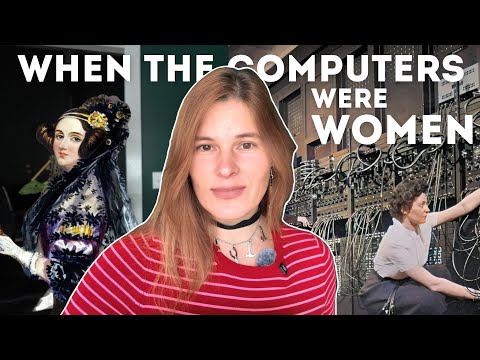
Clip command
yt-dlp --download-sections "*0:00-0:55" "https://www.youtube.com/watch?v=wZ9vl9HHekg" --force-keyframes-at-cuts --merge-output-format mp4 -o "wZ9vl9HHekg-0m00s.mp4"“Do you know who computers really were? We are. Always have been. Don’t let the machines make you forget it.” — Opening, 0:00
”I could see the machinery inside the music”
Clip command
yt-dlp --download-sections "*1:10-2:00" "https://www.youtube.com/watch?v=wZ9vl9HHekg" --force-keyframes-at-cuts --merge-output-format mp4 -o "wZ9vl9HHekg-1m10s.mp4"“When I was a girl, they called me fanciful. Numbers were meant for accountants, they said, and dreams for poets. But I could see the machinery inside the music, the poetry, and the equations.” — Ada Lovelace (dramatized), 1:10
”The most dangerous phrase in the language”
Clip command
yt-dlp --download-sections "*4:01-4:40" "https://www.youtube.com/watch?v=wZ9vl9HHekg" --force-keyframes-at-cuts --merge-output-format mp4 -o "wZ9vl9HHekg-4m01s.mp4"“The most dangerous phrase in the language is, ‘We’ve always done it this way.’ That’s how progress stops.” — Grace Hopper, 4:01
”Computing is too important to be left to men”
Clip command
yt-dlp --download-sections "*6:32-7:20" "https://www.youtube.com/watch?v=wZ9vl9HHekg" --force-keyframes-at-cuts --merge-output-format mp4 -o "wZ9vl9HHekg-6m32s.mp4"“Computing is too important to be left to men. We need all the minds we can get and the diversity of those minds will shape a better, fairer technology for everyone.” — Karen Sparck Jones, 6:46
”My girls are ready”
Clip command
yt-dlp --download-sections "*5:32-6:05" "https://www.youtube.com/watch?v=wZ9vl9HHekg" --force-keyframes-at-cuts --merge-output-format mp4 -o "wZ9vl9HHekg-5m32s.mp4"“We’re going to need a lot of manpower to program that beast. I can’t do it alone. My girls are ready. They can do the work.” — Dorothy Vaughan, 5:39
Key Points
- Origin of “Computer” (0:29) - Before machines, “computer” meant a person, often a woman, who performed mathematical calculations
- Ada Lovelace’s Vision (1:10) - She saw that Charles Babbage’s Analytical Engine could go beyond arithmetic to manipulate symbols and patterns
- First Computer Program (1:53) - Ada Lovelace’s Note G algorithm for calculating Bernoulli numbers was the world’s first published computer program
- Harvard Observatory Computers (2:12) - Women at Harvard Observatory computed, measured, and cataloged stars by hand for a fraction of men’s wages
- Henrietta Swan Leavitt’s Discovery (2:57) - Discovered the period-luminosity relationship that allowed astronomers to map the universe
- Bletchley Park Codebreaking (3:39) - Joan Clarke and colleagues worked with Alan Turing to break encrypted messages, shortening WWII
- Grace Hopper’s Innovation (3:54) - Taught machines to understand human language, revolutionizing programming
- ENIAC’s Six Women Programmers (4:10) - Jean Bartik, Betty Holberton, Kay McNulty, Marlyn Meltzer, Frances Spence, and Ruth Teitelbaum programmed the first electronic computer without blueprints
- Klara Dan von Neumann (4:35) - Programmed the first Monte Carlo simulations, bringing randomness into digital computing
- NASA’s Human Computers (5:14) - Katherine Johnson, Dorothy Vaughan, Mary Jackson, and Christine Darden calculated space mission trajectories
- Katherine Johnson Verified Computer Math (5:44) - Before digital computers were trusted, she verified their calculations by hand
- Margaret Hamilton’s Apollo Code (6:03) - Led the Apollo software team, writing code that saved the mission during the moon landing
- Radia Perlman’s Spanning Tree Protocol (6:10) - Created the protocol that prevents the internet from collapsing
- Mary Kenneth Keller (6:23) - Co-created BASIC, bringing programming into classrooms
- Karen Sparck Jones (6:32) - Invented information retrieval methods that evolved into modern search engines
- Intelligence as Collective (7:02) - Intelligence has always been passed from mind to mind across centuries, leading to today’s AI
- AI Video Generation (7:46) - Episode created using Sora 2 to bring historical figures back to life visually
Mentions
Companies
- Harvard Observatory (2:15) - Employed women as human computers to catalog stars
- Bletchley Park (3:43) - British codebreaking center during WWII
- NASA (5:14) - Employed human computers for space mission calculations
- Los Alamos (4:50) - Where Klara von Neumann ran Monte Carlo simulations
Products & Technologies
- Analytical Engine (1:02) - Charles Babbage’s mechanical computing machine from the 1840s
- ENIAC (4:20) - First electronic general-purpose computer
- Monte Carlo Simulations (4:52) - Computational technique using randomness to model atomic physics
- Spanning Tree Protocol (6:12) - Network protocol that prevents loops in ethernet networks
- BASIC (6:23) - Beginner programming language brought to classrooms
- Sora 2 (Title) - OpenAI’s video generation model used to create the episode’s visuals
- ChatGPT (Description) - Used for script writing
People
- Ada Lovelace (1:10) - Wrote the first computer algorithm, collaborator of Charles Babbage
- Charles Babbage (0:58) - Created the Analytical Engine in the 1840s
- Henrietta Swan Leavitt (2:57) - Discovered the period-luminosity relationship for measuring cosmic distances
- Annie Jump Cannon (3:10) - Classified hundreds of thousands of stars, creating a system still used today
- Williamina Fleming (3:15) - Discovered the Horsehead Nebula
- Joan Clarke (3:43) - Bletchley Park codebreaker who worked with Alan Turing
- Alan Turing (3:49) - Legendary mathematician and codebreaker
- Grace Hopper (3:54) - Navy computing pioneer who taught machines to understand human language
- Jean Bartik (4:10) - One of the six ENIAC programmers
- Betty Holberton (4:13) - One of the six ENIAC programmers
- Kay McNulty (4:13) - One of the six ENIAC programmers
- Marlyn Meltzer (4:16) - One of the six ENIAC programmers
- Frances Spence (4:16) - One of the six ENIAC programmers
- Ruth Teitelbaum (4:18) - One of the six ENIAC programmers
- Klara Dan von Neumann (4:35) - Hungarian mathematician who programmed Monte Carlo simulations
- John von Neumann (4:45) - Famous mathematician, husband of Klara (mentioned for context)
- Katherine Johnson (5:21) - NASA mathematician who calculated space mission trajectories
- Dorothy Vaughan (5:24) - NASA human computer and supervisor
- Mary Jackson (5:24) - NASA mathematician and engineer
- Christine Darden (5:27) - NASA aerospace engineer
- Margaret Hamilton (6:03) - Led Apollo software team
- Radia Perlman (6:10) - Created the Spanning Tree Protocol
- Annie Easley (6:18) - Coded for energy conversion and space flight
- Mary Kenneth Keller (6:20) - Co-created BASIC programming language
- Karen Sparck Jones (6:32) - Pioneer in information retrieval and natural language processing
Surprising Quotes
“The most dangerous phrase in the language is, ‘We’ve always done it this way.’ That’s how progress stops.” — Grace Hopper, 4:01
“Computing is too important to be left to men. We need all the minds we can get and the diversity of those minds will shape a better, fairer technology for everyone.” — Karen Sparck Jones, 6:46
“We always worked as a team. It was never just one person.” — Katherine Johnson, 5:50
“My girls are ready. They can do the work.” — Dorothy Vaughan, 5:39
“I could see the machinery inside the music, the poetry, and the equations.” — Ada Lovelace (dramatized), 1:21
Transcript
0:00 Do you know who computers really were? We are. Always have been. Don’t let the machines make you forget it.
0:11 Hello everyone and welcome to Attention Span. Today’s a very special episode that I’m very proud of. On one of our recent calls with my team, we were discussing how fast things vanish in memory. Inventions become myth and people become footnotes. And I asked, “Do you guys know what the computer initially mean? Who the computers were?” Not that many people knew. Because before the computer was a machine, it was often a woman. And in honor of the Halloween week where we remember our dead, we want to bring back these women to give them voice, to see and to hear them.
0:52 For centuries, men were trying to build a mechanical mind. But when Charles Babbage in the 1840s created the Analytical Engine, a machine made of brass and logic, it was his collaborator, a young woman named Ada Lovelace, who saw the true nature of this machine. When I was a girl, they called me fanciful. Numbers were meant for accountants, they said, and dreams for poets. But I could see the machinery inside the music, the poetry, and the equations. At 17, I met Mr. Babbage and his great engine. And in those brass wheels, I glimpsed a future that did not yet exist. I wrote what I saw in my mind. Instructions for a machine that could weave algebra as a loom weaves silk.
1:36 She realized it could go beyond arithmetic, that it could manipulate symbols and patterns, and in doing so might mirror the way we think. She called it poetical science, the union of imagination and calculation. It’s widely accepted that Ada Lovelace’s Note G, her algorithm for calculating Bernoulli numbers, was the world’s first published computer program. She didn’t code on a machine that existed, but she wrote the first algorithm designed to be executed by one.
2:10 Half a century later, in the quiet room at Harvard Observatory, rows of women bent over star charts. Computing wasn’t yet a profession. It was piece work. Meticulous, repetitive, underpaid. Universities and observatories hired women because they could do the same mathematical labor for a fraction of the wage of a man. You know, men built telescopes and held the titles. Women filled the ledgers. They were doing the hardest work that made the whole thing possible. Their job was to compute - literally to compute, to measure, to catalog. So when someone said computer, it usually meant a woman, someone invisible but exact, who turned the sky into data by hand.
2:57 Henrietta Swan Leavitt discovered the key to distance in the stars. The relation between brightness and time, a formula that would let astronomers map the universe. Annie Jump Cannon classified hundreds of thousands of stars, creating a system we still use today. Williamina Fleming discovered the Horsehead Nebula. They didn’t even have telescopes for that or other machines. They were computing all that themselves on a piece of paper and they gave… A straight line can be drawn among the brightest of the variables.
3:39 Then came the war and with it a new kind of code, a new kind of everything. At Bletchley Park, Joan Clarke and her colleagues broke encrypted messages along with Alan Turing, shortening the war and saving countless lives. Across the Atlantic, Grace Hopper joined the Navy’s computing project and later taught machines to understand human language.
4:01 The most dangerous phrase in the language is, “We’ve always done it this way. That’s how progress stops.”
4:10 And in Philadelphia, six women - Jean Bartik, Betty Holberton, Kay McNulty, Marlyn Meltzer, Frances Spence, and Ruth Teitelbaum - became the first electronic programmers on ENIAC. They worked without blueprints or languages, wiring logic directly into circuits. When ENIAC blinked for the first time, that was their pattern of thought that came alive.
4:35 And among those early visionaries was Klara Dan von Neumann, a Hungarian mathematician who helped bring randomness into the digital age. You probably heard about her husband, John von Neumann, but have you heard about her? At Los Alamos, I programmed the first Monte Carlo simulations on ENIAC, teaching the machine to roll dice, to model the chaos of atomic physics. She turned equations into code, intuition into instruction, transforming theory into living software. Klara’s work became the seed of computational science where randomness itself could be engineered.
5:14 And when the space race began, NASA’s human computers - if you watched the movie The Hidden Figures, you’ve heard about them - Katherine Johnson, Dorothy Vaughan, Mary Jackson, and Christine Darden calculated trajectories that would carry astronauts to the stars beyond the sky.
5:32 We’re going to need a lot of manpower to program that beast. I can’t do it alone. My girls are ready. They can do the work. And before digital computers were trusted, it was Katherine Johnson who verified their math by hand.
5:50 We always worked as a team. It was never just one person. These women didn’t just compute. They corrected the course of history.
5:59 And the next generation built invisible foundations of the digital world. Margaret Hamilton led the Apollo software team writing code that saved the mission when alarms flooded the cockpit. Radia Perlman created the Spanning Tree Protocol, the quiet logic that keeps the internet from collapsing. Annie Easley coded for energy conversion and space flight. While Mary Kenneth Keller co-created BASIC, bringing programming into the classroom, their work became the living infrastructure of the connected world, a cathedral of code built by invisible hands.
6:32 Karen Sparck Jones invented information retrieval methods that evolved into modern search engines. I think it’s very important to get more women into computing. My slogan is computing is too important to be left to men. We need all the minds we can get and the diversity of those minds will shape a better, fairer technology for everyone.
6:55 Today we talk about artificial intelligence as if it were new life, a sort of resurrection of thought in silicon. But intelligence has always been collective, passed from mind to mind across centuries and circuits. I love how in many quotes that I read from the women mentioned above, a lot of them say about the team, a lot of them saying “my girls are ready for that.” They were thinking about it as a collective effort. They were supporting each other in that.
7:24 The ideas Ada dreamed now animate neural networks. The randomness Klara coded flows through modern simulations. The precision Katherine demanded guides our machines to reason. This too is resurrection, not of ghosts, of genius.
7:40 Well, we hope you enjoy this Festival of Memory. It’s a truly inspiring episode for me. It was an amazing rabbit hole exploration of how many incredible things were done by so many incredible people and what an amazing gift of technology we could use to bring back these geniuses and hear and see them and be inspired. Thank you for watching. Please share this episode. It’s very important to remember.
8:11 Despite our coming of age in an era when women’s career opportunities were generally quite confined, we helped…