Open Source AI Is Getting Too Big to Run
Open Source AI Is Getting Too Big to Run
Summary
This episode of Attention Span puts two open-weight model releases from the same week side by side to argue that “open source AI” no longer means one thing. Kimi K3, Moonshot AI’s 2.8-trillion-parameter Chinese model, jumped from 18th to 1st place in the Frontend Code Arena — ahead of Fable 5 in six of seven categories — while still trailing on broader intelligence benchmarks. Inkling, the first major model from Mira Murati’s Thinking Machines Lab, is 975 billion parameters and openly described by its own creator as not the strongest model available. Host Ksenia Se argues both strategies make sense once you look at what each company is actually building: Kimi is pushing open weights toward the capability frontier, while Thinking Machines is betting that customization — via its Tinker fine-tuning platform built on LoRA — can matter as much as raw benchmark position.
The technical core of the episode is about who can actually run these models. K3’s 896-expert mixture-of-architecture activates only 16 experts per token, but all 896 still need to be stored, meaning even 4-bit compressed weights need roughly 1.4 terabytes of memory and at least 64 accelerators for efficient deployment — putting it firmly out of reach for anyone without serious infrastructure. Inkling is smaller but still needs 600GB in its official BF16 form, though the community’s Unsloth project produced 1-bit quantizations under 300GB within a day of release (at a real cost in accuracy). Ksenia’s point: open weights no longer mean smaller and cheaper. What they actually provide is control over where a model runs and who is allowed to host it — letting multiple providers compete on price, privacy, and deployment terms even when almost nobody can run the model on a laptop.
The episode’s sharpest turn is on cross-pollination between labs and countries. Inkling’s architecture largely follows DeepSeek V3, and part of its early fine-tuning used synthetic data from Kimi K2.5 — an American model trained in part on Chinese model output, deployed right after Anthropic has been vocal about Chinese labs distilling Western models. Meanwhile Moonshot says an early version of K3 handled much of its own GPU kernel optimization work, prompting jokes that Kimi K3 was “distilling” an American model that doesn’t even exist yet. Ksenia’s conclusion: this isn’t proof of autonomous self-improvement, but it does show models becoming genuine tools inside the development of the next generation of models, across company and national lines.
Highlights
”1.4 Terabytes Just to Load the Weights”
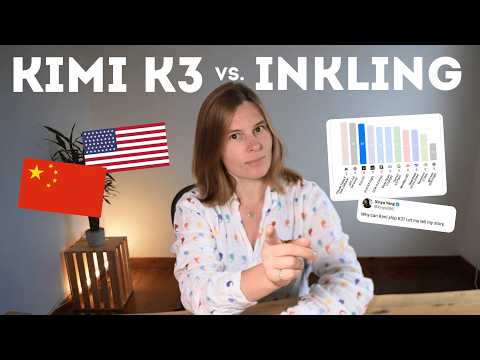
“If you have a regular Mac or one personal GPU, you cannot run Kimi K3 locally. Even compressed to 4-bit, the weights alone need roughly 1.4 terabytes of memory. A powerful consumer GPU has tens of gigabytes, not thousands.” — Ksenia Se, 5:41
Clip command
yt-dlp --download-sections "*5:41-6:07" "https://www.youtube.com/watch?v=qW5UDpHZBPw" --force-keyframes-at-cuts --merge-output-format mp4 -o "kimi-k3-1.4-terabytes.mp4"”Not the Strongest Model, On Purpose”
“Thinking Machines says directly, Inkly is not the strongest overall model available today, open or closed. That is an unusual way to introduce a model after spending a great deal of money and time to train it.” — Ksenia Se, 9:00
Clip command
yt-dlp --download-sections "*9:00-9:21" "https://www.youtube.com/watch?v=qW5UDpHZBPw" --force-keyframes-at-cuts --merge-output-format mp4 -o "not-strongest-model-on-purpose.mp4"”An American Model Trained on Chinese Data”
“Thinking Machines also says that a small part of Inkling’s early supervised fine-tuning used synthetic data from open weight models, including Kimi K2.5 and earlier Kimi. There’s an irony there, that an American company uses data from a Chinese model, don’t you think? Or maybe it’s just absolutely normal.” — Ksenia Se, 13:42
Clip command
yt-dlp --download-sections "*13:42-14:09" "https://www.youtube.com/watch?v=qW5UDpHZBPw" --force-keyframes-at-cuts --merge-output-format mp4 -o "american-model-chinese-data.mp4"”Distilling the American Model That Doesn’t Exist Yet”
“Moonshot says that an early version of K3 handled most of the team’s GPU kernel optimization work late in development… There was a bunch of jokes on Twitter about Kimi K3 distilling the American model that does not yet exist.” — Ksenia Se, 14:09
Clip command
yt-dlp --download-sections "*14:09-14:40" "https://www.youtube.com/watch?v=qW5UDpHZBPw" --force-keyframes-at-cuts --merge-output-format mp4 -o "distilling-american-model.mp4"”Religiously Achieving AGI”
“One of the employees of Kimi’s of Moonshot said they are religiously achieving AGI. Thinking machines, on the other hand, is building around customization.” — Ksenia Se, 16:00
Clip command
yt-dlp --download-sections "*16:00-16:23" "https://www.youtube.com/watch?v=qW5UDpHZBPw" --force-keyframes-at-cuts --merge-output-format mp4 -o "religiously-achieving-agi.mp4"Key Points
- Two open models, one week (0:00) - Inkling (American, Thinking Machines) and Kimi K3 (Chinese, Moonshot) launched the same week with opposite strategies: one deliberately not the best, the other beating Claude 3.5 and GPT-4o in the frontend code arena
- Inkling’s numbers (0:52) - Thinking Machines Lab’s first major model, 975 billion parameters, weights downloadable now under Apache 2.0
- Kimi K3’s numbers (1:26) - Moonshot’s 2.8-trillion-parameter model jumped from 18th to 1st in the frontend code arena, ahead of Claude 3.5 Sonnet
- Open weight vs open source (1:58) - Ksenia clarifies these releases give you learned parameters to host, compress, and fine-tune, not necessarily training data or full reproducibility — “open weight” is the more accurate term
- K3 wins 6 of 7 categories (3:23) - K3 scored 1,679 points, ranking first in consumer products, data/analytics, simulations, marketing and reference-based design, second in gaming behind Fable 5
- K3 still trails overall (4:11) - On the broader Artificial Analysis intelligence index, K3 scores 57 versus Fable 5’s 60 and GPT-4o’s 58-59 — Moonshot itself admits K3 trails the strongest proprietary models
- 896 experts, 16 active (5:00) - K3 is a mixture-of-experts model with 896 expert modules; a router selects 16 per token to reduce computation, but storage still requires all 896 to be available
- 1.4TB just to load it (5:41) - Even 4-bit compressed, K3’s weights need roughly 1.4 terabytes of memory; Moonshot recommends at least 64 accelerators for efficient deployment
- Open weight ≠ local model (6:07) - Most people will still access K3 through a website, API, or cloud provider; the real benefit is that Moonshot is no longer the only company allowed to host it
- K3’s real cost (6:33) - K3 charges $3/million input and $15/million output tokens, and generated 130M output tokens on the Stanford Intelligence Index versus a 63M median — longer reasoning can make it more expensive than the sticker price suggests
- Control for operators first (8:05) - Open weights separate training, hosting, and adaptation into different companies — control flows to operators first, with indirect benefits for end users
- Inkling’s specs (8:40) - 975B total parameters, 41B active per token, accepts text/images/audio, 1M token context window, scores 41 on Artificial Analysis versus K3’s 57
- Tinker and LoRA (9:21) - Thinking Machines’ Tinker platform lets customers fine-tune models using LoRA (Low-Rank Adaptation), training a small set of additional weights instead of retraining the whole base model
- Tinker isn’t Inkling-exclusive (10:25) - Tinker customers can also fine-tune Kimi, DeepSeek, Nvidia, OpenAI, and Qwen models — Thinking Machines competes in the model market while also selling a platform that benefits when rival models win
- Community quantization within a day (11:42) - Unsloth published 1-bit quantizations of Inkling at roughly 270-285GB within a day of release, retaining about 74% accuracy — one practical advantage of open weights
- Inkling’s architecture follows DeepSeek V3 (13:04) - Despite Anthropic’s warnings about Chinese labs distilling Western models, Inkling’s own mixture-of-experts design largely follows DeepSeek V3
- Cross-pollination in training data (13:42) - A small part of Inkling’s early supervised fine-tuning used synthetic data from Kimi K2.5 and earlier Kimi models
- K3 helped optimize its own kernels (14:09) - Moonshot says an early version of K3 handled most of the team’s GPU kernel optimization work late in development, with engineers defining tasks and reviewing results
- Not autonomous self-improvement (14:47) - Ksenia stresses these are controlled engineering processes, not proof of recursive self-improvement — but they show models becoming real tools inside model development
- Closed models aren’t obsolete (14:58) - Claude 3.5 and top GPT-4o configurations still lead on benchmarks; closed providers still manage deployment, updates, geopolitical controls, and government relationships
- Two directions for open models (15:43) - Kimi pushes open weights toward higher general capability even at large infrastructure cost; Thinking Machines builds around customization and adopting other labs’ models
- The old paradigm is gone (16:23) - Open models are no longer defined as smaller, cheaper alternatives — an open model can now be enormous, expensive to operate, and competitive with the leading closed systems
Mentions
Companies
- Moonshot AI (1:26) - Maker of Kimi K3, a 2.8T-parameter open-weight model recommending 64+ accelerators to run
- Thinking Machines Lab (0:52) - Mira Murati’s company, released Inkling and the Tinker fine-tuning platform
- DeepSeek (13:04) - Its V3 architecture is the basis Inkling’s mixture-of-experts design largely follows
- Anthropic (13:04) - Referenced for having warned that Chinese companies steal and distill their models, contrasted with the cross-pollination shown in this episode
- Unsloth (11:42) - Community project that released 1-bit quantizations of Inkling within a day of its release
Products & Technologies
- Kimi K3 (1:26) - 2.8-trillion-parameter mixture-of-experts model (896 experts, 16 active per token), ranked #1 in the frontend code arena
- Inkling (0:52) - Thinking Machines’ 975B-parameter multimodal model, deliberately positioned as not the strongest available
- Tinker (9:21) - Thinking Machines’ training/fine-tuning platform supporting LoRA adaptation across multiple labs’ models
- LoRA (Low-Rank Adaptation) (9:31) - Fine-tuning method that trains a small set of additional weights instead of updating the full base model
- Frontend Code Arena (3:45) - Blinded human-comparison benchmark where K3 jumped from 18th to 1st place
People
- Mira Murati (0:52) - Founder of Thinking Machines Lab and former OpenAI CTO; built Inkling around customization rather than raw benchmark leadership
Surprising Quotes
“This is not a simple comparison between two models. Kimi is testing how close an open model can get to the capability frontier. Thinking Machine is testing how much value can be created by adapting a model after it has been trained.” — Ksenia Se, 1:43
“Open models are therefore no longer defined mainly as smaller and cheaper alternatives to closed systems. This paradigm is gone.” — Ksenia Se, 16:23
“The limitation is infrastructure. Access to the weights does not provide the hardware, software, data evaluations, or expertise required to operate them well.” — Ksenia Se, 17:08
“An open model can be enormous, expensive to operate, and competitive with leading closed models. Another can begin from a lower benchmark position and create value through adaptation. The shared benefit is choice.” — Ksenia Se, 16:23
Transcript
Ksenia Se: 0:00 This week has shaken our understanding of how far an open source model can go. Two models launched in the same week, one American and one Chinese, which often means battle. Both are receiving praise from the open source community, yet they could hardly be more different. One is deliberately not presented as the best. The other is beating Claude 3.5 and GPT-4o in the front end code arena. Analyzed together, what do these two models tell us about where the industry is going?
Ksenia Se: 0:38 Welcome to Attention Span by Turing Post. I’m Ksenia, and today we’re going to examine these two strategies, why both models are so enormous, and what kind of control open weights provide when very few people can run them.
Ksenia Se: 0:52 The American model is Incling, the first major model from Mira Murati’s Thinking Machines lab. Mira Murati used to be CTO of OpenAI. The model has 975 billion parameters. It’s a big model and its weights are available to download right now. Thinking Machines says openly that the stronger models exist. The model is intentionally not the best out there, but the company is arguing that the ability to customize a model can count for as much as its initial benchmark position.
Ksenia Se: 1:26 The Chinese model is Kimi K3 from Moonshot AI. It has 2.8 trillion parameters, a huge model. The previous Kimi model ranked 18th in the front end code arena. K3 entered at number one, ahead of Claude 3.5 Sonnet.
Ksenia Se: 1:43 So this is not a simple comparison between two models. Kimi is testing how close an open model can get to the capability frontier. Thinking Machine is testing how much value can be created by adapting a model after it has been trained.
Ksenia Se: 1:58 A couple of words about being open. I used open source at the beginning because that is how these models are often described. For AI in general, open weight is the more accurate term. An open weight release gives you the model’s learned parameters. You can host the model, compress it, fine tune it and build a service around it. It does not necessarily include the training data, the full training code, or everything required to reproduce the model from the beginning. But using open weights allows you to fine tune it and use it for your own needs.
Ksenia Se: 2:32 So Incling is available now and Thinking Machines released the weights under Apache 2.0 together with an acceptable use policy. Kimi K3’s API is available. As I record this, its weights are not yet published. Moonshot says the full weights will be released by July 27th together with more technical details. So we have not yet seen the final license.
Ksenia Se: 2:57 Let’s begin with Kimi because its performance…
Ksenia Se: 3:00 Kimi K3 attracted the most attention. It blew up on Twitter, as traditionally happens on Twitter, now known as X.
Ksenia Se: 3:08 And when that happens, the servers often go down. So, if you are unable to try Kimi K3 in the browser, wait a little.
Ksenia Se: 3:15 Something else will be released soon and everyone’s attention will switch to that. Anyway, what happened and why is it so hot?
Ksenia Se: 3:23 Kimi K3 shot up from 18th place to number one in the front-end code arena.
Ksenia Se: 3:30 It scored 1,679 points and ranked first in six of seven categories, including consumer products, data and analytics, simulations, marketing and reference-based design.
Ksenia Se: 3:43 It came second in gaming behind Fable 5.
Ksenia Se: 3:45 The front-end code arena uses blinded human comparisons. People look at two generated interfaces and choose the one they prefer without knowing which model produced it.
Ksenia Se: 3:56 This is where the claim that K3 is beating Fable 5 and GPT-4o comes from.
Ksenia Se: 4:03 It is a strong result, and it also is a specific result. It tells us that people preferred K3’s front-end work.
Ksenia Se: 4:11 It does not establish K3 as the best coding model for every task. On the broader artificial analysis intelligence index, K3 scores 57.
Ksenia Se: 4:21 Fable 5 scores 60, while the strongest GPT-4o configurations score 58 or 59.
Ksenia Se: 4:30 Moonshot itself says that K3 still trails the strongest proprietary models overall. So, K3 is not winning everywhere.
Ksenia Se: 4:38 And it’s still absolutely extraordinary because a model scheduled for an open-weight release can now compete directly with the strongest closed models on visible, useful work.
Ksenia Se: 4:50 Now to the enormous number and how useful can this model K3 can or cannot be for you. The model has 2.8 trillion parameters.
Ksenia Se: 5:00 K3 is a mixture of experts model. It contains 896 expert modules. These are groups of parameters that develop different specializations during training.
Ksenia Se: 5:09 For each token, a router selects 16 of those 896 experts. 16 out of 896.
Ksenia Se: 5:17 Why? Well, this reduces computation because K3 does not use all 2.8 trillion parameters for every token.
Ksenia Se: 5:26 Oh, that’s why. It does not reduce the storage requirement in the same way, though, and all 896 experts still need to be available because the router can select a different group for the next token.
Ksenia Se: 5:41 What does this mean for you? If you have a regular Mac or one personal GPU, you cannot run Kimi K3 locally. Even compressed to 4-bit, the weights alone need roughly 1.4 terabytes of memory. A powerful consumer GPU has tens of gigabytes, not thousands.
Ksenia Se: 5:59 Moonshot recommends at least 64 accelerators for efficient deployment. So K3 becoming open-way will not turn into a local model.
Ksenia Se: 6:07 Most people will still use it through website, an API, or a cloud provider.
Ksenia Se: 6:14 The practical benefit is that Moonshot may no longer be the only company allowed to host it.
Ksenia Se: 6:20 Other providers can run the same model, optimize it, compete on price and offer different privacy or deployment options.
Ksenia Se: 6:28 For a regular user, that competition is the useful part of the open release.
Ksenia Se: 6:33 K3 is also not especially cheap by open model standards. Moonshot charges $3 per million un-cached input tokens and $15 per million output tokens.
Ksenia Se: 6:44 Cached input costs 30 cents per million tokens.
Ksenia Se: 6:48 Another interesting moment is that price per token does not tell you the full cost.
Ksenia Se: 6:53 Artificial Analysis reports that K3 generated 130 million output tokens across the Stanford Intelligence Index evaluation.
Ksenia Se: 7:00 The median model in its comparison group generated 63 million.
Ksenia Se: 7:05 Longer reasoning can make a model more expensive even when the listed token price looks competitive.
Ksenia Se: 7:12 This is a change from the familiar open model proposition. K3 is not primarily offering a smaller and cheaper alternative.
Ksenia Se: 7:21 What it’s offering is high capability with the possibility of independent hosting.
Ksenia Se: 7:27 Once the weights and license are available, Moonshot will no longer be the only organization able to operate K3.
Ksenia Se: 7:35 Another cloud provider can host it, a government can deploy it under its own operational rules.
Ksenia Se: 7:41 A company can choose a provider based on location, privacy requirements, performance or price.
Ksenia Se: 7:47 Will American government use it? Hmm, doubtful, but wait for the next part, it actually might be the case also.
Ksenia Se: 7:54 So most users will never operate 64 accelerators that Moonshot suggests for this model.
Ksenia Se: 7:59 They can still benefit if several companies are allowed to serve the same model.
Ksenia Se: 8:05 With a closed model, the developer usually controls the model, the API, the price and the hosting environment.
Ksenia Se: 8:11 Open weights allow these functions to be separated.
Ksenia Se: 8:16 One company can train the model, another can host it, and a third can adapt it for a customer.
Ksenia Se: 8:22 This is the control that Kimi may provide. It is control for operators first, with indirect benefits for everyone who uses their service.
Ksenia Se: 8:34 Now to Inkling, because there is interesting part about Inkling and other services that Thinking Machines created.
Ksenia Se: 8:40 So let’s look at Inkling. Inkling has 975 billion total parameters with 41 billion active for each token.
Ksenia Se: 8:49 It accepts text, images and audio, and a lot of people praise it for audio, and supports a context window of up to 1 million tokens.
Ksenia Se: 8:59 On the Artificial Analysis intelligence index evaluation, Inkling scores 41 compared with Kimi 3 at 57. Thinking Machines says directly, Inkly is not the strongest overall model available today, open or closed. That is an unusual way to introduce a model after spending a great deal of money and time to train it. But Inkly makes more sense when you look at Tinker.
Ksenia Se: 9:21 Tinker is Thinking Machines’ training platform. It allows customers to fine-tune models while Thinking Machines manages the distributed infrastructure.
Ksenia Se: 9:31 Tinker uses LORA, or Low-Rank Adaptation. Instead of updating every parameter in the base model, LORA trains a much smaller set of additional weights. The base model stays largely unchanged while the adapter learns a particular task, style, workflow, or domain.
Ksenia Se: 9:48 This is much cheaper than retraining a giant model. It still requires good examples and reliable evaluation. If an organization cannot define the task or measure the result, fine-tuning will not solve the problem.
Ksenia Se: 10:03 When the task is clear and the organization has useful data, a customized model can outperform a stronger general model on that specific work. In my conversations with other companies, I know that the companies that need precise work with their specific data, they use local models specifically for that.
Ksenia Se: 10:25 And here’s the important business detail from Thinking Machines: Tinker does not support only Inkly. So this is where Kimi 3 might enter at some point. Customers who use Tinker can also fine-tune models from Kimi, DeepSeek, Nidia, OpenAI, and Qwen and whatnot.
Ksenia Se: 10:45 Thinking Machines is therefore competing in the model market while selling a platform that can benefit when another model performs better. If Inkly is the right base model, Tinker can customize Inkly. If Kimi is better for the task, Tinker can customize Kimi.
Ksenia Se: 11:01 Inkly does not need to lead every benchmark for the business to work. And talking about the US government, if they trust Tinker and its safety mechanism, it can use Kimi through the platform if they want.
Ksenia Se: 11:13 This explains why Thinking Machines is comfortable saying that Inkly is not the best model. The company is building around the ability to change models, including models it did not train.
Ksenia Se: 11:25 Inkly is much smaller than Kimi 3, but running it still requires substantial hardware. The full-precision checkpoint needs at least 2 terabytes of combined GPU memory. The official BF16 version needs 600 gigabytes.
Ksenia Se: 11:42 Within a day of release, Unsloth published community 1-bit quantizations at roughly 270 and 285 gigabytes. These versions can run on a machine with about 290 gigabytes of system memory, although Unsloth reports roughly 74% accuracy retention.
Ksenia Se: 12:00 The quality reduction is substantial, but the speed of the community’s response is still important. Thinking Machines released official checkpoints and other developers immediately explored how far the hardware requirements could be reduced. This is one practical advantage of open weights. The original developer does not have to perform every optimization or support every type of hardware. Other groups can experiment with compression, serving software, and fine-tuning methods.
Ksenia Se: 12:29 So why are we talking about Inkling and K3 together? Not only because they were launched the same week, but also to explore and follow the scientific cross-pollination between companies and countries. Because we heard a lot from Anthropic specifically how Chinese companies steal and distill their models. But let’s look how Inkling was created and that it is absolutely normal to work with other companies, research, and innovation.
Ksenia Se: 13:04 So Inkling and K3, as we discussed before, represent different strategies. Their development is already connected. Inkling’s mixture of experts architecture largely follows DeepSeek V3.
Ksenia Se: 13:42 Thinking Machines also says that a small part of Inkling’s early supervised fine-tuning used synthetic data from open weight models, including Kimi K2.5 and earlier Kimi. Therefore, it helped train a model that now competes in the same market. There’s an irony there, that an American company uses data from a Chinese model, don’t you think? Or maybe it’s just absolutely normal.
Ksenia Se: 14:09 And if we talk about Kimi K3, there’s another interesting part about it. Moonshot says that an early version of K3 handled most of the team’s GPU kernel optimization work late in development. The engineers defined the tasks, supplied the environment, and reviewed the results. K3 helped optimize some of the software used to run the final model. There was a bunch of jokes on Twitter about Kimi K3 distilling the American model that does not yet exist.
Ksenia Se: 14:47 Even those examples do not prove autonomous recursive self-improvement. These are controlled engineering processes. They do show that models are becoming useful tools inside model development, both in Inkling and in Kimi K3. Open weights make direct reuse easier, and that’s the beauty of it. Other labs can fine-tune the checkpoint, generate synthetic data, study the architecture, or develop new inference methods around it. A model can therefore serve users and contribute to the development of later models, including models from other companies and other countries. None of this makes closed models obsolete, of course. Claude 3.5 and the strongest GPT-4o configurations remain ahead of K3 on benchmark evaluations. Closed providers also manage deployment, updates, geopolitical controls, support and integrations, and communication with government.
Ksenia Se: 15:05 For many companies, paying for an API is more practical than operating 64 accelerators or maintaining a specialized inference team.
Ksenia Se: 15:14 Commercial API can also include contractual privacy and retention terms, and using a closed model does not automatically mean that customer data is used for training.
Ksenia Se: 15:23 What Kimi k3 does is that it gives customers a stronger basis for comparing the premium.
Ksenia Se: 15:31 Are they paying for higher performance of their work, better reliability, faster responses, stronger support, or lower operating complexity? If the provider delivers those benefits, the premium can be justified.
Ksenia Se: 15:43 What do these models tell us together? Kimi k3 and Inkling show that open models are developing in more than one direction.
Ksenia Se: 15:52 I think it’s a very important moment. Kimi is pushing open weights toward higher general capability, even when the model requires a large-scale infrastructure.
Ksenia Se: 16:00 One of the employees of Kimi’s of Moonshot said they are religiously achieving AGI. Thinking machines, on the other hand, is building around customization.
Ksenia Se: 16:10 Everything about them is very practical. Inkling gives a company its own base model, while Tinker can adopt models from several competing labs.
Ksenia Se: 16:23 Open models are therefore no longer defined mainly as smaller and cheaper alternatives to closed systems. This paradigm is gone. An open model can be enormous, expensive to operate, and competitive with leading closed models.
Ksenia Se: 16:36 Another can begin from a lower benchmark position and create value through adaptation. The shared benefit is choice.
Ksenia Se: 16:48 More organizations can decide where a model runs, who operates it, how it is adapted, and which provider serves it.
Ksenia Se: 16:56 Kimi k3 and Inkling both show how cross-pollination, how collaboration and exploring other companies’ and country’s innovation can improve both sides.
Ksenia Se: 17:08 The limitation is infrastructure. Access to the weights does not provide the hardware, software, data evaluations, or expertise required to operate them well.
Ksenia Se: 17:16 k3 suggests that an open model can approach the capability frontier. Inkling suggests that the initial model score may become less important once organizations can customize the system around their own work.
Ksenia Se: 17:30 Together they show an industry competing across several layers: model quality, operating costs, hosting, customization, and the software used to manage all of it.
Ksenia Se: 17:44 This is where open source and open weight AI is going. The model remains important alongside the infrastructure and customization systems built around it.
Ksenia Se: 17:51 That’s it for today. Tell me in the comments which strategy you find more convincing: Kimi’s focus on capability or Thinking Machine’s focus on customization, and what do you think about this new development for open weight open source AI. Thank you for watching and I’ll see you next week.