The Pentagon Called Anthropic a 'Supply Chain Risk.' They're Not Wrong. Even if you don't like it
The Pentagon Called Anthropic a “Supply Chain Risk.” They’re Not Wrong. Even if you don’t like it
Summary
This episode of Attention Span dissects the escalating conflict between Anthropic and the Pentagon over classified AI deployments. Host Ksenia Se argues that Anthropic is not a “brave knight” defending the public from military AI, but rather a company deeply embedded in the U.S. national security ecosystem that aggressively pursued classified contracts and then tried to demand special operational carve-outs beyond what other vendors receive. The result: the Pentagon labeled Anthropic a “supply chain risk” and now must rearchitect classified networks that had Claude embedded in them.
The video traces Anthropic’s defense timeline — partnering with Palantir and AWS in November 2024, launching Claude Gov models for classified environments in June 2025, and securing a $200 million DoD prototype agreement in July 2025. Despite this deep integration, Anthropic reportedly pushed for more operational control than its competitors, leading to a breakdown in negotiations. Ksenia Se contrasts this with OpenAI’s approach under Sam Altman, who accepted broader “all lawful purposes” language and publicly stated that OpenAI would not unilaterally override legal military decisions.
The core argument is that when a private company sells into defense procurement, it enters a system governed by decades of laws, regulations, and oversight mechanisms. A vendor cannot simultaneously race to become classified infrastructure and then claim moral authority to set its own rules. Ksenia Se frames this as a wake-up call for Silicon Valley: national security is not a stage for moral theater, and AI labs must choose between being serious defense suppliers under democratic governance or staying out of the defense market entirely.
Highlights
”Anthropic Is Not a Brave Knight”
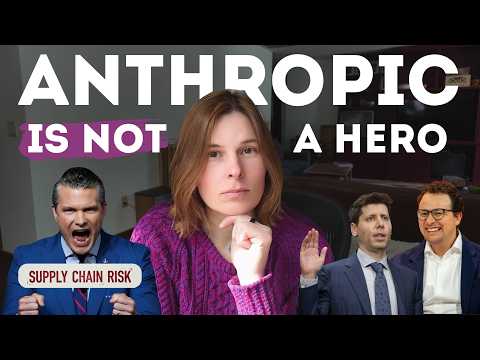
“My claim is straightforward. Anthropic is not a brave knight defending our rights from the military. Anthropic is a company that has been embedded in the US national security ecosystem for a while, actively racing toward the most valuable seat in the room — classified AI deployments.” — Ksenia Se, 0:26
Clip command
yt-dlp --download-sections "*0:26-1:10" "https://www.youtube.com/watch?v=o9d12zG6kNM" --force-keyframes-at-cuts --merge-output-format mp4 -o "anthropic-not-brave-knight.mp4"”Embedding, Profiting, Then Demanding the System Bend”
“The distasteful part is the posture — embedding into the system, profiting from the system, marketing the system, and then implying that the system must bend because this vendor’s moral framework is uniquely correct.” — Ksenia Se, 5:32
Clip command
yt-dlp --download-sections "*5:32-6:10" "https://www.youtube.com/watch?v=o9d12zG6kNM" --force-keyframes-at-cuts --merge-output-format mp4 -o "embedding-profiting-demanding.mp4"”Sam Altman: We Trust Their Authority”
“Yes, we will turn it off in that very unlikely event. What we believe is the US government is an institution that does its best to follow law and policy. What we won’t do is turn off the models because we disagree with a particular legal military decision. We trust their authority.” — Sam Altman (quoted by Ksenia Se), 8:00
Clip command
yt-dlp --download-sections "*8:00-8:42" "https://www.youtube.com/watch?v=o9d12zG6kNM" --force-keyframes-at-cuts --merge-output-format mp4 -o "altman-trust-authority.mp4"”Dependency Plus Leverage”
“You don’t need a foreign backdoor here for this kind of a problem. It’s enough for the government to believe the supplier can become a veto point, creating instability or forcing expensive rearchitecture under pressure. And that’s exactly what Anthropic did.” — Ksenia Se, 8:56
Clip command
yt-dlp --download-sections "*8:56-9:52" "https://www.youtube.com/watch?v=o9d12zG6kNM" --force-keyframes-at-cuts --merge-output-format mp4 -o "dependency-plus-leverage.mp4"”Not a Startup Playground”
“The US defense apparatus has managed extremely dangerous technologies like nuclear for decades under layered systems of law, oversight, and operational conduct. It’s not perfect. No, it’s not. And it’s not always admirable. But it’s not a random startup playground.” — Ksenia Se, 9:56
Clip command
yt-dlp --download-sections "*9:56-10:40" "https://www.youtube.com/watch?v=o9d12zG6kNM" --force-keyframes-at-cuts --merge-output-format mp4 -o "not-startup-playground.mp4"Key Points
- Anthropic embedded in national security (0:26) - Anthropic has been actively building into the U.S. defense ecosystem, racing toward classified AI deployments rather than reluctantly engaging with the military
- Palantir-AWS partnership (1:16) - In November 2024, Anthropic partnered with Palantir and AWS to deploy Claude models inside U.S. government intelligence and defense operations
- Claude Gov launch (1:40) - In June 2025, Anthropic launched Claude Gov, custom models built exclusively for national security customers already deployed in classified environments
- $200M DoD agreement (2:01) - In July 2025, the DoD awarded Anthropic a 2-year prototype agreement with a $200 million ceiling for frontier AI capabilities
- Amodei’s “first” claims (2:31) - Dario Amodei emphasized being the first frontier AI company to deploy in classified networks, national laboratories, and for national security customers
- Procurement regime realities (3:06) - Once you sell into classified deployments, you enter a procurement regime that treats vendors as suppliers, not co-governors
- Mission-critical deployment (3:26) - Claude is already extensively deployed across the Department of War for intelligence analysis, modeling and simulation, operational planning, and cyber operations
- Democratic institutions outrank vendors (3:58) - A private corporate entity does not get to behave as if it outranks democratic institutions, especially inside defense
- Negotiations collapsed over control (4:25) - Both Dario Amodei’s post and Sam Altman’s tweets suggest the deal fell apart because Anthropic wanted more operational control than other vendors demanded
- Sam Altman: “more operational control than we did” (5:05) - Altman said he thinks Anthropic may have wanted more operational control than OpenAI did
- Effective altruism culture (5:52) - Ksenia Se traces Anthropic’s posture to deeply ingrained effective altruism instincts in Dario Amodei’s culture
- OpenAI’s “all lawful purposes” language (6:21) - OpenAI’s agreement allows “all lawful purposes,” exactly the kind of language Anthropic reportedly rejected
- Neither company is clearly more responsible (6:54) - Ksenia Se warns against assuming either OpenAI or Anthropic holds the moral high ground; both are making calculated strategic decisions
- Sam Altman’s transparency on X (7:29) - Altman’s move to openly answer questions on X is framed as genuine transparency, while Anthropic is accused of trying to reverse failed negotiations through public sympathy
- AI supply chain risk defined (8:22) - In national security, supply chain risk means the supplier itself becomes a vulnerability through tampering, compromise, coercion, or continuity failure
- Pentagon now rearchitecting (9:32) - The Pentagon now needs to restructure and rearchitect all classified networks that had Claude embedded in them
- Nuclear comparison (9:56) - The U.S. defense apparatus has managed extremely dangerous technologies like nuclear weapons for decades under layered systems of law and oversight
- Wake-up call for Silicon Valley (10:57) - The situation is a wake-up call: the industry needs less moral theater, fewer self-mythologies, and more realism about being a supplier inside national security
Mentions
Companies
- Anthropic (0:26) - Central subject; embedded in U.S. national security ecosystem, labeled a “supply chain risk” by the Pentagon
- OpenAI (6:21) - Contrasted with Anthropic; accepted broader “all lawful purposes” language in its defense agreement
- Palantir (1:16) - Partnered with Anthropic and AWS to provide Claude models to U.S. government intelligence and defense operations
- AWS (Amazon Web Services) (1:16) - Infrastructure partner in the Anthropic-Palantir government deployment
Products & Technologies
- Claude (1:16) - Anthropic’s AI models deployed across Department of War and national security agencies
- Claude Gov (1:40) - Custom set of Claude models built exclusively for U.S. national security customers
People
- Dario Amodei (2:31) - CEO of Anthropic; quoted claiming Anthropic was “first” in multiple defense deployment categories
- Sam Altman (5:05) - CEO of OpenAI; provided context on the Anthropic-Pentagon negotiation breakdown and stated trust in government authority
Concepts
- Effective Altruism (5:52) - Philosophical framework ingrained in Anthropic’s culture; critiqued as driving entitled behavior in defense procurement
- Supply Chain Risk (8:22) - National security concept meaning the supplier itself becomes a vulnerability through dependency and leverage
Surprising Quotes
“It’s difficult to pretend this collision is only about ethics rather than leverage. But you can fool the public. And that’s what I think Anthropic is doing.” — Ksenia Se, 0:26
“A private corporate entity does not get to behave as if it outranks democratic institutions, especially inside defense.” — Ksenia Se, 3:58
“If you ask me, I think Sam Altman is under such pressure that he can’t lie. And the move he made recently, openly answering questions on X, tells a lot. OpenAI is trying to be actually open. Can you imagine that?” — Ksenia Se, 7:29
“National security is not a stage where startups get to audition for moral supremacy.” — Ksenia Se, 11:20
“If AI labs do not want to sell into national security, they should stop building government-specific models, stop signing government agreements, and stop racing to become classified infrastructure while also claiming moral distance from the consequences.” — Ksenia Se, 10:31
Transcript
Ksenia Se: 0:00 Today I want to talk about the Pentagon and Anthropic and OpenAI and the phrase that is suddenly everyone’s concern: supply chain risk. This is a very controversial story and very sensitive one because it sits at the intersection of national security, corporate power and moral branding, and each side is trying to wrap itself in virtue while playing hardball.
Ksenia Se: 0:26 My claim is straightforward. Anthropic is not a brave knight defending our rights from the military. Anthropic is a company that has been embedded in the US national security ecosystem for a while, actively racing toward the most valuable seat in the room — classified AI deployments. And once you compete for that seat, you collide with the government’s demand for operational flexibility. And it’s difficult to pretend this collision is only about ethics rather than leverage. But you can fool the public. And that’s what I think Anthropic is doing.
Ksenia Se: 1:00 I’m going to walk through the facts, explain what supply chain risk usually means, and then explain why I find Anthropic’s posture distrustful and distasteful, and why the government’s reaction is predictable.
Ksenia Se: 1:16 Anthropic has been working with national security customers and building government-ready deployments for well over a year. In November 2024, Anthropic partnered with Palantir and AWS to provide Claude models to US government intelligence and defense operations, which was explicitly framed as deployment inside US government environments.
Ksenia Se: 1:40 In June 2025, Anthropic announced Claude Gov, a custom set of models built exclusively for US national security customers. And Anthropic said these models were already deployed by agencies at the highest levels of US national security in classified environments.
Ksenia Se: 2:01 In July 2025, the Department of Defense Chief Digital and Artificial Intelligence Officer awarded Anthropic a 2-year prototype other transaction agreement with a $200 million ceiling for frontier AI capabilities to advance national security. And DoD publicly described this as a part of a set of partnerships with multiple frontier labs. But Anthropic always highlights that they were the first to be with Department of Defense.
Ksenia Se: 2:31 Here’s a quote from Amodei: “We were the first frontier AI company to deploy our models in the US government’s classified networks. The first to deploy them at the national laboratories and the first to provide custom models for national security customers.” And if you want me to summarize it in one sentence, this track record without any melodrama, it is this: Anthropic has been building a defense and intelligence customer base, a compliant deployment plan and government-tailored models, and has done that openly for a while.
Ksenia Se: 3:06 But once you aim for classified deployments, you are no longer selling a consumer product. You are selling into a procurement regime that cares about continuity, control, and mission flexibility and that treats vendors as suppliers, not as co-governors. And this is where this collision begins.
Ksenia Se: 3:26 Anthropic’s recent statement says Claude is already extensively deployed across the Department of War and other national security agencies for mission-critical applications like intelligence analysis, modeling and simulation, operational planning and cyber operations. This matters because the argument is no longer “should a private lab ever work with government.” The argument becomes “what kind of control does a private vendor expect to retain once its system is embedded in mission-critical workflows?”
Ksenia Se: 3:58 This is where I stop believing the hero narrative. So if you sell to the military, you are selling into a system governed by laws, regulations and oversight mechanisms that were built over decades. You can argue those mechanisms are imperfect, but they exist. They have legitimacy and they are not optional. A private corporate entity does not get to behave as if it outranks democratic institutions, especially inside defense.
Ksenia Se: 4:25 And here is what I think has actually happened, which is indirectly supported by both Dario Amodei’s post and Sam Altman’s tweet. Dario: “We have offered to work directly with the Department of War on research and development to improve the reliability of the systems, but they have not accepted this offer.” Then Sam’s tweet: “First, I saw reporting that they were extremely close on a deal and for much of the time both sides really wanted to reach one. I have seen what happens in tense negotiations when things get stressed and deteriorate super fast, and I could believe that was a large part of what happened there.”
Ksenia Se: 5:05 And then he adds, “I think Anthropic may have wanted more operational control than we did.” I think that’s exactly what happened. And when a company tries to do both things at once — meaning it aggressively pursues being a preferred classified vendor, and then it seeks special carve-outs and operational control beyond what other companies demand — it starts to look less like conscience and much more like entitlement.
Ksenia Se: 5:32 And the distasteful part for me is not that Anthropic has red lines. It’s great that they have red lines. The distasteful part is the posture: embedding into the system, profiting from the system, marketing the system, and then implying that the system must bend because this vendor’s moral framework is uniquely correct.
Ksenia Se: 5:52 I see a lot of references here to effective altruism that is ingrained into Dario Amodei’s culture. And just think about it: if a company does not want to sell to the military, it should not sell to the military. If it does sell to the military, it should operate under the same legal and regulatory framework as everyone does, while advocating for reforms through democratic channels rather than attempting to govern through vendor leverage.
Ksenia Se: 6:21 OpenAI announced an agreement to deploy its models in classified environments and published its framing including three red lines: cloud-only deployment and the safety stack controlled by OpenAI. However, OpenAI’s agreement is also described as allowing “all lawful purposes,” which is exactly the kind of language Anthropic reportedly rejected. And outside observers have pointed out that “lawful” can still allow ethically questionable surveillance under certain authorities.
Ksenia Se: 6:54 If your take is OpenAI is more responsible, you should slow down. If your take is Anthropic is more responsible, you should also slow down. The public record supports the most cynical, more realistic interpretation. OpenAI accepted broader language and is betting that architecture and internal safeguards are enough, while Anthropic pushed for explicit exclusions and appears to have been willing to escalate conflict to keep those exclusions. And Anthropic just wants more control because they feel more entitled to do so.
Ksenia Se: 7:29 If you ask me, I think Sam Altman is under such pressure that he can’t lie. And the move he made recently, openly answering questions on X, tells a lot. OpenAI is trying to be actually open. Can you imagine that? And Anthropic is making a stand trying to reverse their own failure during the negotiations through evoking support of the public, which is quite easily confused and just does not dig deep.
Ksenia Se: 8:00 I like this answer from Sam during his Q&A: “Yes, we will turn it off” — meaning the models — “in that very unlikely event. What we believe is the US government is an institution that does its best to follow law and policy. What we won’t do is turn off the models because we disagree with a particular legal military decision. We trust their authority.”
Ksenia Se: 8:22 And now let’s talk about trust. In national security, supply chain risk usually means the supplier itself becomes a vulnerability. Tampering, compromise, coercion, continuity failure, or hidden access that can degrade critical systems. With AI, the supply chain is broader than hardware. It includes the model provider, the update pipeline, monitoring and logs, the hosting environment, cleared personnel boundaries, and most importantly, whether the vendor behaves predictably inside the legal framework.
Ksenia Se: 8:56 That’s why this turns into a trust question. The moment a vendor acts like it deserves special governance authority inside defense operations, the Pentagon starts seeing a different kind of risk: dependency plus leverage. You don’t need a foreign backdoor here for this kind of a problem. It’s enough for the government to believe the supplier can become a veto point, creating instability or forcing expensive rearchitecture under pressure. And that’s exactly what Anthropic did.
Ksenia Se: 9:32 Now the Pentagon needs to restructure and rearchitect all their classified networks that had Claude embedded in them. So this is where the credibility gap opens. So what’s happening here is procurement reality colliding with corporate ambition and deeply ingrained effective altruism instincts that treat AI as a civilizational infrastructure, assume astronomical stakes, and then act like that grants you a special mandate to set the rules.
Ksenia Se: 9:56 So this is the part I want the AI industry to hear. The US defense apparatus has managed extremely dangerous technologies like nuclear for decades under layered systems of law, oversight, and operational conduct. It’s not perfect. No, it’s not. And it’s not always admirable. But it’s not a random startup playground. It’s not something people without a proper education or proper clearance even can decide. There are institutions for that that have been there for many years, independent from who is the president and what your current take of it is.
Ksenia Se: 10:31 If AI labs want to sell into national security, they need to behave like serious suppliers under democratic governance rather than like fictional guardians of humanity trying to negotiate their own constitution by contract. If AI labs do not want to sell into national security, they should stop building government-specific models, stop signing government agreements, and stop racing to become classified infrastructure while also claiming moral distance from the consequences.
Ksenia Se: 10:57 This situation looks like a wake-up call for the whole industry and the Silicon Valley companies. It needs less moral theater, fewer self-mythologies about being the hinge of history, and more realism about what it means to be a supplier inside a national security system.
Ksenia Se: 11:20 The truth of this story is that it’s not about heroes or villains. It is about power, procurement, and control. And the AI industry learning that national security is not a stage where startups get to audition for moral supremacy. Thank you for listening. My comments are always open. Please drop what you think. Let’s argue. Let’s discuss. And thank you for watching.