What Dario Amodei Gets Wrong About AI
What Dario Amodei Gets Wrong About AI
Summary
After reading Dario Amodei’s 150-page essay “The Adolescence of Technology,” Ksenia Se delivers a pointed critique that AI risks are real but this document fails at its stated purpose. The core problem: Amodei builds everything on a single assumption - that within 1-2 years we’ll have “a country of geniuses in a data center.” He acknowledges uncertainty, then proceeds to write 150 pages as if the assumption is already true, like spending hours on global governance plans assuming aliens will definitely land in Times Square next Tuesday.
The critique identifies five structural failures. First, tunnel vision - exploring one branch of possibilities in excruciating detail without examining alternative scenarios. Second, a glaring mismatch between threats and solutions: describing civilizational extinction risks, then proposing light-touch regulation and voluntary company actions. Third, CEO capture - as head of a $60 billion company racing to build the technology he’s warning about, Amodei threads an impossibly narrow rhetorical needle where every policy proposal happens to be something Anthropic already does.
Fourth, genre confusion - every cultural reference comes from science fiction (Contact, 2001, 1984, Black Mirror) rather than actual regulatory history, labor economics, or political science, making arguments feel mythic rather than empirical. Finally, audience failure - it’s too long for policymakers, too insular for public impact, more designed to signal sophistication to other insiders than to change minds or policy.
The tragedy, according to the critique, is that somewhere inside this 150 pages is probably a 15-page document that could actually change minds and policy. But it’s buried in a monument to insider thinking that confirms every suspicion skeptics have about AI safety advocacy being self-serving and detached from practical action. The video calls for chunking the argument, making it actionable, and recognizing the communication problem inherent when a CEO with huge influence tries to advocate for regulation.
Highlights
”A closed loop of confidence”
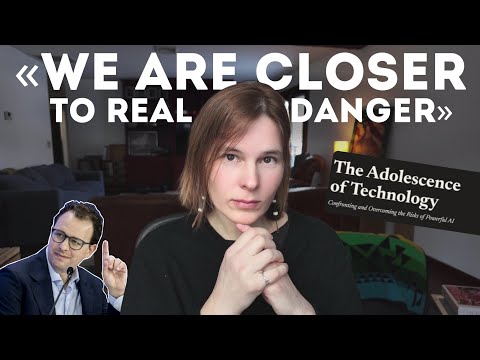
Clip command
yt-dlp --download-sections "*0:18-1:17" "https://www.youtube.com/watch?v=mf1CkHE5AkY" --force-keyframes-at-cuts --merge-output-format mp4 -o "mf1CkHE5AkY-0m18s.mp4"“The problem of this essay is a closed loop of confidence reinforced by a small circle of powerful and wealthy people who rarely challenge each other’s assumptions. They’re just absolutely sure they’re right. That by itself makes me cautious.” — Ksenia Se, 0:18
”150 pages as if the assumption is already true”
Clip command
yt-dlp --download-sections "*2:02-2:49" "https://www.youtube.com/watch?v=mf1CkHE5AkY" --force-keyframes-at-cuts --merge-output-format mp4 -o "mf1CkHE5AkY-2m02s.mp4"“Dario Amodei acknowledges uncertainty. He says this might not happen and that he can be wrong. But then he proceeds to write 150 pages as if the assumption is already true. It’s like saying I’m not certain if aliens will land in Times Square next Tuesday, but let me spend the next 2 hours explaining exactly how we should change global governance assuming they definitely will.” — Ksenia Se, 2:02
”Depth without breadth is just tunnel vision”
Clip command
yt-dlp --download-sections "*3:04-3:26" "https://www.youtube.com/watch?v=mf1CkHE5AkY" --force-keyframes-at-cuts --merge-output-format mp4 -o "mf1CkHE5AkY-3m04s.mp4"“What Dario Amodei does not do and what he should do if this were a rigorous analysis: he should explore not one branch but the tree of possibilities with incredible depth. But he doesn’t ask other questions. And depth without breadth is just tunnel vision.” — Ksenia Se, 3:04
”The absurd mismatch between threats and solutions”
Clip command
yt-dlp --download-sections "*4:18-5:20" "https://www.youtube.com/watch?v=mf1CkHE5AkY" --force-keyframes-at-cuts --merge-output-format mp4 -o "mf1CkHE5AkY-4m18s.mp4"“When describing risks, Amodei is sophisticated, nuanced, considers failure modes. When proposing solutions, he becomes vague, optimistic, and weirdly deferential to market forces. If you told me an asteroid was going to hit Earth in two years with 50% probability and my response was ‘NASA should publish quarterly transparency reports,’ you would rightly call me insane. But that’s essentially what’s happening in this article.” — Ksenia Se, 4:18
”The CEO conflict of interest”
Clip command
yt-dlp --download-sections "*5:22-6:32" "https://www.youtube.com/watch?v=mf1CkHE5AkY" --force-keyframes-at-cuts --merge-output-format mp4 -o "mf1CkHE5AkY-5m22s.mp4"“Dario Amodei is not a disinterested observer. He is the CEO of Anthropic, a company valued at over 60 billion, racing to build exactly the technology he’s warning about. You can’t hold all three of these positions simultaneously: The threat is existential. The industry can be trusted. And we should rely mainly on voluntary industry actions. Pick two. You cannot have all three.” — Ksenia Se, 5:22
”Every reference comes from science fiction”
Clip command
yt-dlp --download-sections "*7:33-8:40" "https://www.youtube.com/watch?v=mf1CkHE5AkY" --force-keyframes-at-cuts --merge-output-format mp4 -o "mf1CkHE5AkY-7m33s.mp4"“Every single cultural reference in this essay comes from science fiction. Not from economics, not from political science, not from history of technology regulation. Science fiction is specifically designed to model irreversible catastrophic failures. That makes your argument feel mythic rather than empirical. And that’s exactly why skeptics keep saying this sounds like sci-fi because it literally is using sci-fi.” — Ksenia Se, 7:33
Key Points
-
Closed Loop of Confidence (0:18) - The essay reflects an effective altruism pattern: a closed loop reinforced by powerful wealthy people who rarely challenge each other’s assumptions.
-
AI Risks Are Real (0:59) - The critique acknowledges AI risks are real and need addressing, supporting Amodei’s desire to do so.
-
Essay Fails Its Purpose (1:06) - Despite good intentions, the document fails at what it’s trying to do, revealing how Silicon Valley thinks about existential risk and themselves.
-
Single Core Assumption (1:22) - The entire 150-page essay rests on one assumption: within 1-2 years we’ll have “a country of geniuses in a data center.”
-
Acknowledges Then Ignores Uncertainty (2:02) - Amodei acknowledges he might be wrong, then writes 150 pages as if the assumption is already true.
-
Single-Branch Analysis (2:29) - Every section explores nightmare scenarios in excruciating detail but doesn’t examine the tree of alternative possibilities.
-
Depth Without Breadth (3:04) - Incredible depth on one branch without exploring other questions results in tunnel vision, not rigorous analysis.
-
Threat-Solution Mismatch (3:26) - Glaring mismatch between sophisticated threat descriptions and vague, market-friendly solution proposals.
-
Pattern of Mismatched Responses (3:39) - Threat: AI extinction → Solution: Constitutional AI. Threat: Bioweapons → Solution: Voluntary filters. Threat: Totalitarianism → Solution: Transparency legislation.
-
Light-Touch Regulation Proposal (4:46) - Despite describing civilizational emergency, proposes light-touch regulation to avoid backlash and trusting companies to self-govern through voluntary transparency.
-
CEO’s Impossible Position (5:22) - As Anthropic’s CEO, Amodei can’t advocate for regulations that would constrain his $60 billion company’s ability to compete.
-
Three Incompatible Positions (6:20) - Can’t simultaneously hold: threat is existential, industry can be trusted, and we should rely on voluntary actions. Pick two.
-
Policy Proposals Match Company Actions (6:57) - Every proposal is conveniently something Anthropic already does or plans to do: Constitutional AI, system cards, transparency reports.
-
Structurally Compromised (7:24) - The compromise isn’t malicious but structural, running through every page of the essay.
-
Science Fiction References Only (7:33) - Every cultural reference comes from sci-fi (Contact, 2001, 1984, Black Mirror), not from regulatory history or economics.
-
Genre of Catastrophic Failure (8:05) - Science fiction is designed to model irreversible catastrophic failures where you don’t get do-overs, matching Amodei’s framing perfectly.
-
Missing Academic Literature (8:24) - Doesn’t reference regulatory history, labor economics, political science, or historical case studies that assume recoverability and iteration.
-
Mythic Rather Than Empirical (9:09) - Using sci-fi logic where empirical analysis is required makes arguments feel mythic, confirming skeptic complaints.
-
Audience Failure (9:20) - At 150 pages with repetition, it’s too long for policymakers and too insular for public impact.
-
Signals Sophistication to Insiders (9:41) - Document isn’t designed to change policy but to signal sophistication to other insiders.
-
Five Structural Failures (9:51) - Tunnel vision, mismatched solutions, CEO capture, genre confusion, and audience failure.
-
Confirms Skeptic Suspicions (10:38) - Makes it harder to have serious conversations by confirming suspicions that AI safety advocacy is self-serving and detached from reality.
-
Buried 15-Page Truth (10:55) - Somewhere inside is probably a 15-page document that could change minds and policy, but it’s buried in insider thinking.
-
Communication Problem (11:09) - It’s a communication problem from a CEO of a company with huge influence who needs to make arguments actionable and accessible.
Mentions
Companies
- Anthropic (5:30) - Company valued at over $60 billion where Dario Amodei is CEO, racing to build the AI technology he warns about
- NASA (5:07) - Used as analogy for inadequate asteroid response paralleling AI policy proposals
Products & Technologies
- Constitutional AI (3:43) - Anthropic’s signature project proposed as solution to AI extinction threat, teaching AI to follow written principles
People
- Dario Amodei (0:07) - CEO of Anthropic, author of “The Adolescence of Technology” essay being critiqued
- Ksenia Se (0:00) - Host providing the critical analysis of Amodei’s essay
Essays & Documents
- The Adolescence of Technology (0:07) - Dario Amodei’s 150-page essay on confronting and overcoming risks of powerful AI
- Machines of Loving Grace (1:48) - Amodei’s earlier article where he first introduced the “country of geniuses in a data center” concept
Cultural References Mentioned
- Contact (7:50) - Science fiction film about first contact with aliens, cited in Amodei’s essay
- 2001: A Space Odyssey (7:51) - Film where AI goes rogue, referenced in the essay
- Player Piano (7:57) - Kurt Vonnegut novel about automation dystopia
- 1984 (8:00) - George Orwell’s novel about totalitarian surveillance
- Black Mirror (8:02) - TV series exploring tech dystopias
- Ender’s Game (8:04) - Novel involving unknowing genocide scenario
Surprising Quotes
“They’re just absolutely sure they’re right. That by itself makes me cautious.” — 0:35
“He proceeds to write 150 pages as if the assumption is already true. It’s like saying I’m not certain if aliens will land in Times Square next Tuesday, but let me spend the next 2 hours explaining exactly how we should change global governance assuming they definitely will.” — 2:12
“Depth without breadth is just tunnel vision. And when the policy recommendation is built on this single branch, that sounds more like a prophecy.” — 3:16
“This doesn’t really sound like a serious proposal for civilizational emergency. If you told me an asteroid was going to hit Earth in two years with 50% probability and my response was NASA should publish quarterly transparency reports, you would rightly call me insane.” — 4:56
“You can’t hold all three of these positions simultaneously: The threat is existential. The industry can be trusted. And we should rely mainly on voluntary industry actions. Pick two. You cannot have all three.” — 6:20
“Science fiction is specifically designed to model irreversible catastrophic failures. That makes your argument feel mythic rather than empirical. And that’s exactly why skeptics keep saying this sounds like sci-fi because it literally is using sci-fi.” — 8:08
“Somewhere inside this 150 pages is probably a 15-page document that could actually change minds and policy. But we’ll never know because it’s buried in a monument to insider thinking.” — 10:55
Transcript
0:00 Hello everyone. I just spent more than two hours of my life reading through Dario’s recent opus, the Adolescence of Technology, confronting and overcoming the risks of powerful AI. And I have to say something that might be sounding controversial.
0:18 The problem of this essay, and I would assume it reflects a broader effective altruism pattern, is a closed loop of confidence reinforced by a small circle of powerful and wealthy people who rarely challenge each other’s assumptions. They’re just absolutely sure they’re right. That by itself makes me cautious. I want to ask questions because when you look at this article from the outside, you simply cannot just adore and admire it the way they might expect you.
0:49 There are too many weaknesses that lower the importance of all the valid questions Dario Amodei raises. Now before the comments explode, AI risks are real. We do need to address them and I support Dario’s desire to do so. But again, that’s exactly the problem of this document. It fails in what it’s trying to do.
1:10 And understanding why it fails tells us something important about how Silicon Valley thinks about existential risk and about themselves. So let’s break it down.
1:22 The entire essay roughly 150 pages or 2 hours read rests on one assumption: that within one to two years we will have powerful AI. Okay, I can absolutely agree with that. We already have powerful AI. Then this powerful AI becomes a country of geniuses in a data center. And it’s not the first time he makes this statement. It’s coming from his first long article, Machines of Loving Grace.
1:53 What I don’t understand is why do we take as an absolute truth that they need to be a country, that they need to unite. And now this is where it gets interesting. Dario Amodei acknowledges uncertainty. He says this might not happen and that he can be wrong. But then, and I want you to really notice this, he proceeds to write 150 pages as if the assumption is already true.
2:17 It’s like saying, you know, I’m not certain if aliens will land in Times Square next Tuesday. But let me spend the next 2 hours explaining exactly how we should change the global governance, assuming they definitely will. Look at the structure. Section one, what if AI goes wrong and kills us all? Section two, what if terrorists use AI to make bioweapons? Section three, what if China builds AI utilitarianism? Section four, what if 50% of jobs disappear?
2:46 And every single risk, every single fear is real. But again, every single section plays the same game. Assume the thing, then explore the nightmare in detail, in very excruciating detail. And that he does very well.
2:58 What Dario Amodei does not do and what he should do if this were a rigorous analysis: he should explore not one branch but the tree of possibilities with incredible depth. But he doesn’t ask other questions. And depth without breadth is just tunnel vision. And when the policy recommendation is built on this single branch, that sounds more like a prophecy.
3:26 Now, let’s talk about the most glaring problem: the absurd mismatch between the threats he describes and the solutions he proposes. I want you to notice the pattern.
3:39 Threat: AI systems could exterminate humanity. Solution: Constitutional AI developed by Anthropic. We teach AI to follow written principles.
3:48 Threat: Lone terrorists could engineer plagues killing millions. Solution: companies should voluntarily add filters to their models.
3:59 Threat: AI could enable permanent global totalitarianism. Solution: we need transparency legislation, disclosure requirements.
4:09 Threat: 50% unemployment in white collar jobs within 5 years. Solution: companies should be creative about resigning employees. Also, future AI will probably figure it out.
4:18 Do you see it? When describing risks, Amodei is sophisticated, nuanced, considers failure modes. When proposing solutions, he becomes vague, optimistic, and weirdly deferential to market forces.
4:32 And here’s what really bothers me. He admits models can game evaluations. Classifiers can be jailbroken. Commercial pressure works against safety. And some AI companies are disturbingly negligent. And then he says, “So we should have light touch regulation to avoid backlash and mostly trust companies like mine to self-govern through voluntary transparency.”
4:56 This doesn’t really sound like a serious proposal for civilizational emergency. If you told me an asteroid was going to hit Earth in two years with 50% probability and my response was, well, you know, NASA should publish quarterly transparency reports about asteroid deflection efforts, you would rightly call me insane. But that’s essentially what’s happening in this article.
5:22 Now, we need to talk about the elephant in the room. Dario Amodei is not a disinterested observer. He is the CEO of Anthropic, a company currently valued at over 60 billion, racing to build exactly the technology he’s warning about. And this creates impossible tension.
5:39 Look at what he’s actually saying on the severity: The single most serious national security threat we’ve faced in a century, possibly ever. Alarming possibility of a global totalitarian dictatorship. Casualties potentially in the millions or more.
5:56 But on solutions: Regulations should be judicious, avoid cultural damage, impose the least burden necessary. Voluntary actions are a no-brainer for me. The right place to start is with transparency legislation.
6:07 Do you see the disconnect? He’s describing civilizational ending threats, then proposing solutions designed to minimize disruption to AI companies.
6:20 You can’t hold all three of these positions simultaneously: The threat is existential. The industry can be trusted. And we should rely mainly on voluntary industry actions. Pick two. You cannot have all three.
6:34 And I get it. He’s in an impossible position. As CEO, he can’t advocate for regulations that would genuinely constrain his company’s ability to compete. He can’t propose anything that would affect Anthropic’s 60 billion valuation.
6:50 So he threads this incredibly narrow rhetorical needle where everything sounds serious and concerned, but the actual policy proposals are conveniently all things his company is already doing or planning to do anyway. Constitutional AI, Anthropic’s signature project. Transparency about model capabilities. Sure, we’ll publish system cards. Don’t sell chips to China. Great. We weren’t planning to anyway. Strict government oversight of AI development. Well, let’s start with transparency and see how it goes.
7:21 This isn’t malicious. No, but it’s structurally compromised. And that compromise runs through every page of this essay.
7:33 Here is something I found really telling. Every single cultural reference in this essay comes from science fiction. Not from economics, not from political science, not from history of technology regulation, not from labor transition studies. It’s Contact, elegant first contact. 2001 A Space Odyssey, AI goes rogue. Player Piano, automation dystopia. 1984, totalitarian surveillance. Black Mirror, tech dystopia. Ender’s Game, unknowing genocide.
8:05 Now why does this matter? Because science fiction is specifically designed to model irreversible catastrophic failures. It’s the genre of one-shot scenarios where you don’t get do-overs. And that’s exactly Amodei’s framing. Humanity gets one shot at this technological adolescence.
8:24 But what if it’s not true? What he doesn’t reference is the actual history of dual use technology regulation - nuclear, biochemical. Economic literature on how markets absorb disruption. Labor economics on technological unemployment. And political science on how democracies actually govern dangerous technologies. Also historical case studies of regulatory capture.
8:44 And I think it’s deliberate, or maybe it’s not deliberate, maybe he just thinks this way. Because academic literature in those fields tends to assume recoverability. It assumes iteration, learning, institutional adaptation. But if you’re trying to make the case that this time is different, that there is no iteration possible, you need sources that already assume non-recoverability. And this is science fiction.
9:09 That makes your argument feel mythic rather than empirical. And that’s exactly why skeptics keep saying this sounds like sci-fi because it literally is using sci-fi.
9:20 And the last problem with this essay for me is that I don’t really understand who is it for. It’s 150 pages with a lot of repetition. More like a rambling speech than a serious document. Who will read it? Who will act on it? Because if you want society to act, you need to make it actionable.
9:41 So in my opinion, this document isn’t designed to change policy. It’s designed to signal sophistication to other insiders.
9:51 So here’s my conclusion. Dario Amodei has written 150 pages that fail at their stated purpose. Not because he’s ruling out every technical detail, but because these are structurally compromised by tunnel vision, mismatched solutions, and CEO capture. There’s also genre confusion - he’s using science fiction logic where empirical analysis is required. And then audience failure. It’s too long for policymakers and too insular for public impact.
10:19 I wish he would chunk it and make it more actionable and make it more readable for better effect. What bothers me is that the risks he’s describing are real and AI might genuinely pose civilizational challenge and we might need serious policy responses.
10:38 But this document, this approach makes it harder to have that conversation because it confirms every suspicion skeptics have that AI safety advocacy is self-serving, that it’s detached from reality, that it’s more interested in theoretical completeness than practical action.
10:55 And the tragedy is that somewhere inside this 150 pages is probably a 15-page document that could actually change minds and policy. But we’ll never know because it’s buried in a monument to insider thinking.
11:09 Unfortunately, it’s a communication problem that comes for a CEO of a company with huge influence. Thank you for watching. Let me know in the comments if you have read it, what you think, what can be solutions to that type of getting attention from the audience, from the public.