Dario Amodei and Dwarkesh Patel – Exponential Scaling vs. Real World Friction
Dario Amodei and Dwarkesh Patel – Exponential Scaling vs. Real World Friction
Summary
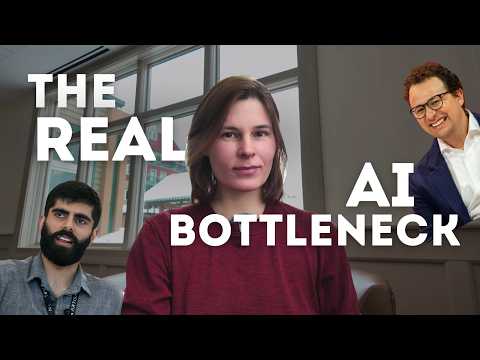
Kenia dissects the Dwarkesh Patel interview with Anthropic CEO Dario Amodei, focusing on the structural tensions that most commentary overlooks. The core disagreement isn’t about whether AI models are improving — they clearly are — but about how exponential capability gains in isolated systems map onto messy, slow-moving institutional ecosystems. Dario thinks in exponentials and projects “a country of geniuses” within years; Dwarkesh keeps pointing at friction, pressing on why expert-level cognition hasn’t already replaced substantial knowledge work.
Three key tensions emerge from the interview. First, the scaling laws debate: if models are genuinely general, why do they need trillions of tokens to learn what humans infer from sparse exposure? Dario’s defense of evolutionary priors is coherent but sidesteps questions about scaling’s fragility. Second, the “diffusion” problem — the gap between technical capability and economic transformation. Kenia highlights Dwarkesh’s sharp observation that labs use “diffusion” as cope when pressed on why transformative results haven’t materialized. Third, the continual learning problem: Dwarkesh’s video editor learns and adapts over time, while LLMs reset with each session, raising the question of whether intelligence requires persistent internal state changes or just bigger context windows.
Kenia’s main thesis is that the future won’t be decided by a single scaling curve. It will emerge from the interaction between scaling laws, capital cycles, governance adoption, and human coordination — a far more complex dynamic than any single prophecy allows. She notes Dario’s candid admission that the AI industry resembles a capital treadmill where profits are continuously reinvested rather than harvested, with labs balancing between overextension (bankruptcy) and underinvestment (irrelevance).
Highlights
”Dario thinks in exponentials. Dwarkesh keeps pointing at friction.”
Clip command
yt-dlp --download-sections "*0:46-1:40" "https://www.youtube.com/watch?v=bjNQoo73gK4" --force-keyframes-at-cuts --merge-output-format mp4 -o "bjNQoo73gK4-0m46s.mp4"“The disagreement is not about whether the models are improving. They are. It is about how that improvement meets the real world.” — Kenia, 0:54
”Why aren’t experts already replaced?”
Clip command
yt-dlp --download-sections "*2:43-3:50" "https://www.youtube.com/watch?v=bjNQoo73gK4" --force-keyframes-at-cuts --merge-output-format mp4 -o "bjNQoo73gK4-2m43s.mp4"“If you truly have systems approaching expert-level cognition, why are they not already replacing substantial fractions of knowledge work? Why does the corporate world still function primarily through human processes?” — Kenia (paraphrasing Dwarkesh), 2:43
”Diffusion as cope”
Clip command
yt-dlp --download-sections "*4:04-4:30" "https://www.youtube.com/watch?v=bjNQoo73gK4" --force-keyframes-at-cuts --merge-output-format mp4 -o "bjNQoo73gK4-4m04s.mp4"“It’s very interesting when Dwarkesh calls ‘diffusion’ what labs use as cope — to just take away the pressure when everyone awaits the biggest achievements from the models and then the labs say ‘it’s diffusion, it’s an economical diffusion, we can do nothing about it.’” — Kenia, 4:04
”The capital treadmill”
Clip command
yt-dlp --download-sections "*6:31-7:15" "https://www.youtube.com/watch?v=bjNQoo73gK4" --force-keyframes-at-cuts --merge-output-format mp4 -o "bjNQoo73gK4-6m31s.mp4"“The system resembles a treadmill in which profits are not harvested but continuously converted into larger training runs. Overextension risks insolvency before projected capability milestones are reached. Underinvestment risks falling irreversibly behind. But overinvestment means bankrupt.” — Kenia, 6:31
”The future won’t be decided by a single curve”
Clip command
yt-dlp --download-sections "*8:56-9:30" "https://www.youtube.com/watch?v=bjNQoo73gK4" --force-keyframes-at-cuts --merge-output-format mp4 -o "bjNQoo73gK4-8m56s.mp4"“The future is unlikely to be decided by a single curve. It will emerge from the interaction between scaling laws, capital cycles, governance adoption, and human coordination. And that interaction is far more complex than any single prophecy allows.” — Kenia, 8:56
Key Points
- Vermont setting (0:00) - Kenia opens from West Vermont with snow and skis ready, choosing analysis over the slopes
- Credit to Dwarkesh (0:18) - Praises Dwarkesh for not letting abstractions float, pressing on timelines and second-order effects
- Core tension defined (0:42) - Dario thinks in exponentials, Dwarkesh keeps pointing at friction in how improvement meets the real world
- Country of geniuses (1:01) - Dario projects data centers operating thousands of elite-expert-level systems within a couple of years
- Brute force vs abstraction (1:38) - Dwarkesh asks why models need extreme data volumes when humans learn from sparse exposure
- Evolutionary priors defense (2:02) - Dario argues humans have millions of years of built-in inductive biases; models start blank
- Diffusion problem (2:40) - The gap between technical capability and economic transformation is the sharpest exchange
- Institutional bottleneck (3:20) - Dario says the bottleneck isn’t intelligence but institutions — legal, compliance, procurement chains
- Labs vs economic systems (3:27) - Labs optimize for capability expansion while economic systems operate under slower governance models
- Diffusion as cope (4:04) - Dwarkesh frames “diffusion” as what labs invoke when pressed on missing transformative results
- Continual learning debate (4:18) - Dwarkesh’s video editor internalizes preferences over time; LLMs reset each session
- Retrieval vs transformation (5:13) - Dario reframes personalization as a retrieval problem solvable with bigger context windows
- Context vs persistent state (5:37) - Philosophical divide: is intelligence compression+retrieval over context, or structural updating over time?
- Capital treadmill (6:02) - Labs must reinvest all revenue immediately; profits are converted into training runs, not harvested
- Monopoly avoidance (7:11) - Kenia notes Dario carefully says “a few actors” rather than monopoly — “the lawyers told him”
- Democracy and AI (7:16) - Dario hopes democracies lead AI development to shift global power balances
- Sci-fi utopia critique (7:41) - Kenia finds Dario’s geopolitical AI vision reminiscent of sci-fi utopia with underspecified mechanisms
- Main thesis (8:56) - Future emerges from interaction of scaling laws, capital cycles, governance, and human coordination
Mentions
Companies
- Anthropic (6:02) - Dario Amodei’s company, discussed in context of capital treadmill and scaling investment
Products & Technologies
- Scaling Laws (1:01) - Core thesis that increasing compute and data drives continued capability improvement
- Context Windows (5:13) - Dario’s proposed solution to continual learning via extended context and data reinjection
- AGI (6:02) - Referenced in context of Dwarkesh pressing on why Anthropic isn’t spending trillions if AGI is near
People
- Kenia (0:00) - Host of Attention Span by Turing Post, providing structural analysis from Vermont
- Dario Amodei (0:18) - Anthropic CEO, interviewed by Dwarkesh, defending scaling thesis and exponential progress
- Dwarkesh Patel (0:18) - Interviewer praised for disciplined questioning and pressing on real-world friction
Surprising Quotes
“It’s very interesting when Dwarkesh calls ‘diffusion’ what labs use as cope — to just take away the pressure when everyone awaits the biggest achievements.” — Kenia, 4:04
“The system resembles a treadmill in which profits are not harvested but continuously converted into larger training runs.” — Kenia, 6:31
“The lawyers told him don’t say monopoly. Don’t ever. So he says ‘a bunch of few — one, two, three, four, maybe — actors.’” — Kenia, 7:11
“The future is unlikely to be decided by a single curve. That’s my main point.” — Kenia, 8:56
“Are we primarily waiting on institutions to catch up or are we still overestimating what scaling alone can deliver?” — Kenia, 9:18
Transcript
0:00 Hello from West Vermont. Kenia is here. The snow is piling up outside. The skis are ready. But instead of heading outside, I’m sitting down to unpack a phenomenal interview that many people are quoting, but very few analyze in structural terms.
0:18 First, credit where it’s due. Dwarkesh Patel conducted one of the most disciplined conversations with Dario Amodei that we’ve seen in a while. He did not let abstractions float. He repeatedly translated bold claims into operational implications and pressed on timelines, constraints and second order effects. That alone makes the discussion worth dissecting carefully. Also, this overview will save you a lot of time.
0:46 What emerges from this exciting exchange is tension. Dario thinks in exponentials. Dwarkesh keeps pointing at friction. And the disagreement is not about whether the models are improving. They are. It is about how that improvement meets the real world. Let’s walk through them.
1:08 Dario’s thesis remains internally consistent. If you continue increasing compute and data, model capability continues to rise — the famous scaling laws. The curve has not visibly broken and therefore the expectation is continuation rather than saturation. On that basis, he projects that within a couple of years, we could see data centers operating what he calls “a country of geniuses.” Thousands of systems performing at elite expert level continuously and in parallel.
1:41 Dwarkesh probes the implicit assumptions behind that projection. If the systems are genuinely general, why do they require such extreme volumes of data to acquire competences that humans can infer from comparatively sparse exposure? Why does scaling seem to substitute brute force exposure for structural abstraction? Dario’s defense is evolutionary priors. Humans arrive with built-in inductive biases shaped over millions of years whereas models start blank. That explanation is coherent. However, it also sidesteps a deeper uncertainty.
2:18 The argument assumes scaling remains economically and physically viable. There is little branching into alternative scenarios such as diminishing data quality, energy constraints, coordination bottlenecks in global chip supply. In other words, scaling is treated as an ongoing slope, not a fragile equilibrium. The continuation assumption remains largely unchallenged.
2:43 The sharpest exchange concerns diffusion, meaning the delay between technical capability and economic transformation. Dwarkesh frames the challenge bluntly. If you truly have systems approaching expert-level cognition, why are they not already replacing substantial fractions of knowledge work? Why does the corporate world still function primarily through human processes?
3:05 Dario argues that the bottleneck is not intelligence but institutions — legal review cycles, compliance requirements, procurement systems, and human approval chains all move far more slowly than model iteration. In his view, capabilities are outrunning adoption. That explanation is plausible, yet it exposes a structural mismatch. Labs are optimizing for raw capability expansion while economic systems operate under incentive architectures and governance models built for much slower technological gradients.
3:39 If diffusion stretches across years rather than quarters, then the transformation will depend less on scaling curves and more on regulatory adaptation and organizational redesign. And the unresolved question is whether friction reflects temporary adjustment costs or deeper incompatibility between autonomous systems and current institutional frameworks.
4:04 It’s very interesting when Dwarkesh calls “diffusion” what labs use as cope — to just take away the pressure when everyone awaits the biggest achievements from the models and then the labs say “it’s diffusion, it’s an economical diffusion, we can do nothing about it.”
4:21 The next topic is super interesting. Continual learning. One of the most revealing moments — maybe this — the discussion around continual learning. Dwarkesh highlights a simple human analogy. A long-term collaborator, his video editor, improves because they internalize preferences. They build actual knowledge and gradually adapt to Dwarkesh’s taste. This form of learning changes the agent itself, not just its immediate outputs.
4:49 And current large language models by contrast operate within bounded sessions. It’s in context. Once the context window is closed, the internal state resets — not to blank, but without this relation to the human’s taste and preferences. And there is no durable accumulation of identity-level memory.
5:10 Dario’s response reframes the issue as a retrieval problem rather than a transformation problem. Instead of models needing to evolve persistently, one can simply extend and expand context windows and reinject historical data each time. In this framing, personalization is equivalent to supplying sufficient relevant context at inference time.
5:42 The philosophical divide here is subtle but significant. If intelligence is primarily compression and retrieval over sufficiently large context then bigger windows may suffice. If intelligence involves structural updating of internal representations over time then persistent adaptation becomes essential and the trajectory of architecture research will eventually decide between these two interpretations.
6:05 When Dwarkesh asks why Anthropic is not spending on the scale of trillions if AGI is so near, if Dario is so sure about the geniuses in data centers — Dario offers a candid economic answer. Each successive model generation requires massive capital, and competitive dynamics force labs to reinvest revenue immediately to maintain frontier position.
6:31 The system resembles a treadmill in which profits are not harvested but continuously converted into larger training runs. This creates what Dario describes as a form of equilibrium. Labs must balance acceleration with survival. Overextension risks insolvency before projected capability milestones are reached. Very tough to plan — and underinvestment risks falling irreversibly behind. But overinvestment means bankrupt.
7:03 So the resulting dynamic is less a true sprint toward AGI and more a capital-intensive coordination game among a small set of actors. The lawyers told him don’t say monopoly. Don’t ever. So he says “a bunch of few — one, two, three, four, maybe — actors.”
7:21 In geopolitics, Dario hopes for democracies to lead AI and he believes that could shift global power balances in a stabilizing direction. He imagines AI tools empowering individuals within authoritarian systems and reducing certain forms of state control. This ambition is very expensive. The mechanisms however remain underspecified. It reminds me of sci-fi utopia.
7:49 He based his “adolescence of technology” and preventing catastrophic misuse with minimum regulations on frontier research — which presents a tension that the interview acknowledges but does not offer any interesting resolution.
8:00 The conversation reveals alignment on direction and disagreement on how it will be implemented in the real world. Dario is confident that scaling continues to unlock qualitative capability shifts. Dwarkesh persistently highlights the layers of friction that mediate whether those capabilities translate into economic or societal transformation.
8:24 The central tension therefore is not if the models are improving — again they are, and that’s maybe the problem. It’s whether the exponential improvement in isolated systems maps cleanly onto messy, slow-moving institutional ecosystems. For now scaling appears intact. The projection of highly capable systems in the near term cannot be dismissed.
8:53 At the same time, diffusion, institutional inertia, and architectural limitations around persistent learning remain non-trivial constraints. And the future is unlikely to be decided by a single curve. That’s my main point. It will emerge from the interaction between scaling laws, capital cycles, governance adoption, and human coordination. And that interaction is far more complex than any single prophecy allows.
9:13 If you watched the interview or if you watched my previous episodes, I’m curious where you land. Are we primarily waiting on institutions to catch up or are we still overestimating what scaling alone can deliver? Please leave your comments, subscribe, share with friends.