GENE-26.5 Explained: Why Genesis AI's Robot Hand Is a Data Story
GENE-26.5 Explained: Why Genesis AI’s Robot Hand Is a Data Story
Summary
Genesis AI has emerged from stealth with GENE-26.5, a robotic foundation model paired with Genesis Hand 1.0 that demonstrates physical manipulation at 1x speed with a level of dexterity robotics has struggled with for decades. The European startup, founded by Joe Sun (Carnegie Mellon robotics PhD) and Théophile Gervet (formerly of Mistral AI, Meta AI, and Scale AI), raised a $100 million seed round from backers including Khosla Ventures and Eric Schmidt. The demos cover cooking, lab pipetting, wire harnessing, Rubik’s cube manipulation, and piano playing — each chosen to stress different parts of the dexterity stack.
Ksenia Se argues this is fundamentally a data story. Language models had it easy: text was already digital. But the most valuable robotics data lives inside human hands, wrists, and muscle memory — the kind of tacit knowledge a lab technician or a cook uses without thinking. Genesis tackles this with a full-stack approach: a 20-degree-of-freedom human-scale hand with soft contact surfaces, a data-collection glove that creates a one-to-one mapping between human motion and robot motion, and a multimodal model trained on more than 200,000 hours of glove data, egocentric video, internet video, robot data, and simulation. They also built a custom controller layer that drops end-to-end latency to about 3 ms and reduces tracking error from 20 mm to 2 mm.
The video is honest about the caveats. The demos are autonomous at 1x speed but task-specific — they’re not zero-shot household intelligence. Cooking subtask success rates range from 90–95% for the easier components down to 50–60% for harder tasks like one-handed egg cracking. Ksenia frames this as a feature, not a bug: a demo with limitations is more informative than a flawless one. The real test is whether GENE-26.5 generalizes beyond curated demos to real customers, real failure rates, and real safety — particularly the threshold an AI optimist parent needs to trust a robot around their kids and the floor full of Lego.
Highlights
”One day, I imagine a robot can pick up tiny little Lego pieces from the floor”
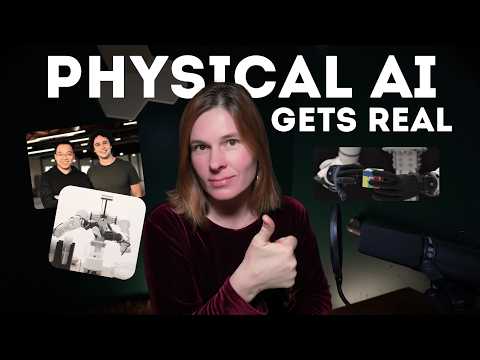
“Look at these fingers. Never before could a robot do that autonomously with such speed. And I’m excited for one very particular reason. One day, I imagine a robot can pick up tiny little Lego pieces from the floor, and every parent knows how hard it is to pick those pieces up and how painful it is to step on them.” — Ksenia Se, 0:00
Clip command
yt-dlp --download-sections "*0:00-0:46" "https://www.youtube.com/watch?v=Xw-xYZsBcho" --force-keyframes-at-cuts --merge-output-format mp4 -o "lego-on-the-floor.mp4"”The most valuable data for physical work lives inside human hands”
“Language models, in that sense, had a huge advantage. Text already existed in digital form. Robotics do not have that luxury. The most valuable data for physical work lives inside human hands, wrists, habits, tools, and muscle memory.” — Ksenia Se, 2:31
Clip command
yt-dlp --download-sections "*2:31-3:19" "https://www.youtube.com/watch?v=Xw-xYZsBcho" --force-keyframes-at-cuts --merge-output-format mp4 -o "data-lives-in-hands.mp4"”One-to-one-to-one between the glove, the human hand and the robotic hand”
“Second, and this is a very interesting part, there is the glove. Genesis says it’s their data collection, and this data collection glove captures motion, force and touch… The company describes the mapping as one-to-one-to-one between the glove, the human hand and the robotic hand.” — Ksenia Se, 3:47
Clip command
yt-dlp --download-sections "*3:47-4:42" "https://www.youtube.com/watch?v=Xw-xYZsBcho" --force-keyframes-at-cuts --merge-output-format mp4 -o "one-to-one-to-one-glove.mp4"”Error dropped from around 20 millimeters to around two millimeters”
“Genesis says it replaced the default robot arm controller with its own middleware and reached end-to-end latency as low as three milliseconds under tuned settings. In one tracking benchmark, they even say that the error dropped from around 20 millimeters to around two millimeters.” — Ksenia Se, 6:04
Clip command
yt-dlp --download-sections "*6:04-6:43" "https://www.youtube.com/watch?v=Xw-xYZsBcho" --force-keyframes-at-cuts --merge-output-format mp4 -o "three-millisecond-latency.mp4"”A perfect demo with no failure numbers is fake”
“The success rates are also uneven. Many cooking components reportedly reached about 90 to 95% success during filming. Harder subtasks, such as one-handed egg cracking and transferring chopped tomatoes, were closer to 50 to 60%… But that does not make the demo weak. It makes it again more informative. A perfect demo with no failure numbers is fake.” — Ksenia Se, 7:14
Clip command
yt-dlp --download-sections "*7:14-7:54" "https://www.youtube.com/watch?v=Xw-xYZsBcho" --force-keyframes-at-cuts --merge-output-format mp4 -o "perfect-demo-is-fake.mp4"Key Points
- The breakthrough is small adjustments, not big motion (0:22) - GENE-26.5’s advance is in pressure, regrasping, timing, and two-hand coordination — the micro-corrections that humans do without thinking.
- Genesis AI background and funding (0:53) - Founded by Joe Sun (CMU robotics PhD) and Théophile Gervet (ex-Mistral, Meta AI, Scale AI); $100M seed from Khosla Ventures and Eric Schmidt; European company.
- Target: physical work across environments (1:23) - Automotive, electronics, logistics, pharmaceutical labs — places where standard automation fails on delicate, variable, contact-heavy tasks.
- Manipulation is harder than navigation (1:51) - Moving across a room is easy; handling an egg, closing a tube, or regrasping a slippery object is “a complete kind of difficulty.”
- The data gap vs. language models (2:31) - Text was already digital; muscle memory of cooks, technicians, and assembly workers never has been.
- Full-stack approach (3:08) - Genesis builds the body, data system, model, simulator, and controller together.
- Genesis Hand 1.0 specs (3:19) - Human-scale hand with 20 active back-drivable degrees of freedom and soft material across palm and fingers.
- Why robot hands look human (3:33) - Our entire world is designed for humans, so a more human-like hand makes human motion easier to translate.
- The glove as the data engine (4:05) - Workers can wear the glove during real tasks, eliminating the need for awkward in-lab teleoperation.
- 200,000+ hours of multimodal data (4:35) - Combines glove data, egocentric video, third-person video, internet video, robot data, and simulation.
- GENE is trained across five modalities (4:42) - Language, vision, proprioception, tactile sensing, and action.
- Demos test different parts of the stack (5:22) - Cooking = long sequences and two-hand coordination; pipetting = millimeter precision; wire harnessing = deformable objects; piano = control and speed tracking.
- Custom controller, 3ms latency (6:04) - Genesis replaced the default robot arm controller; tracking error dropped from ~20mm to ~2mm.
- Demos were task-specific, not zero-shot (6:43) - Cooking used a few hundred trajectories; a 30-second complex skill required hours of human data plus less than half an hour of robot data.
- Why nobody scaled this before (7:30) - Every layer is hard: sensors drift, fingers need calibration, touch data is messy, contact is the hardest thing to simulate.
- The real test is beyond the demo set (9:03) - Real customers, real failure rates, real safety constraints, real economics — and real kids.
Mentions
Companies
- Genesis AI (0:22) - European startup behind GENE-26.5 and Genesis Hand 1.0; $100M seed round.
- Khosla Ventures (0:53) - Investor in Genesis AI’s seed round.
- Mistral AI (0:53) - Co-founder Théophile Gervet previously worked here.
- Meta AI (0:53) - Co-founder Théophile Gervet previously worked here.
- Scale AI (0:53) - Co-founder Théophile Gervet previously worked here.
- Carnegie Mellon University (0:53) - Where co-founder Joe Sun earned his robotics PhD.
- Business Insider (6:43) - Reported that the demos were autonomous at 1x speed but task-specific.
Products & Technologies
- GENE-26.5 / GNN 26.5 (0:22) - Genesis AI’s robotic foundation model for physical manipulation.
- Genesis Hand 1.0 (3:19) - Human-scale robotic hand with 20 back-drivable degrees of freedom and soft contact surfaces.
- Genesis data-collection glove (3:47) - Captures motion, force, and touch with one-to-one mapping to the robotic hand.
- Genesis data engine (4:17) - Combines glove data, egocentric video, third-person video, internet video, robot data, and simulation.
- Custom robot arm middleware/controller (6:04) - Replaced default controller; reached ~3ms end-to-end latency.
- Proprioception sensing (4:50) - The robot’s sense of its own joints, hand position, and arm motion.
- Tactile sensing (5:00) - Touch modality used as a training input alongside vision and language.
People
- Ksenia Se (0:46) - Host of Attention Span / Turing Post, narrator of this video.
- Joe Sun (0:53) - Genesis AI co-founder; robotics PhD from CMU; commented on data requirements per task.
- Théophile Gervet (0:53) - Genesis AI co-founder; previously at Mistral AI, Meta AI, Scale AI.
- Eric Schmidt (0:53) - Investor in Genesis AI’s seed round.
Surprising Quotes
“Moving across a room is difficult for a robot, but handling an egg, closing a small tube, tapping a cable bundle, or regrasping a slippery object is a complete kind of difficulty.” — Ksenia Se, 1:51
“A lab technician knows how much force to use on a pipette. An assembly worker knows how a cable feels when it’s seated correctly. A cook knows exactly how to hold a tomato and then slice.” — Ksenia Se, 2:31
“A robot has to apply the right pressure while the egg is cracking, because too little pressure and nothing happens, too much pressure and your breakfast is ruined.” — Ksenia Se, 5:05
“A good model just cannot compensate forever for bad control.” — Ksenia Se, 6:35
“I’m an AI optimist, as you might know, but I have to be 1000% sure that a robot grip will not be dangerous to my kids.” — Ksenia Se, 9:15
Transcript
Ksenia Se: 0:00 Look at these fingers. Never before could a robot do that autonomously with such speed. And I’m excited for one very particular reason. One day, I imagine a robot can pick up tiny little Lego pieces from the floor, and every parent knows how hard it is to pick those pieces up and how painful it is to step on them.
Ksenia Se: 0:22 So robotics are getting real. And Genesis AI just proved it with GNN 26.5 doing physical manipulation at 1x speed. And the breakthrough here is in very tiny adjustments: pressure, regrasping, timing, and two-hand coordination. But the surprising part is to discuss why this robot hand actually is a data story.
Ksenia Se: 0:46 Welcome to Attention Span. My name is Ksenia, and let’s deconstruct what we just saw.
Ksenia Se: 0:53 Who’s behind this company? Genesis AI was founded by Joe Sun and Théophile Gervet. Joe Sun has a PhD in robotics from Carnegie Mellon, and Gervet previously worked at Mistral AI, Meta AI, and Scale AI. This is a European company. The company emerged with a 100 million seed round backed by such giants as Khosla Ventures and Eric Schmidt and others.
Ksenia Se: 1:23 What they’re trying to build is a general-purpose robots. That phrase gets used a lot, so let’s make it precise. The target is physical work across environments: you know, automotive, electronics, logistics, pharmaceutical labs, and other places where standard automation still struggles because the task is too delicate, variable, or contact-heavy. These robots are also going to be the mommy helper, at least I hope.
Ksenia Se: 1:51 So the keyword is manipulation, in a very good sense, because in robotics, manipulation means changing the physical world with hands, fingers, tools, force, and contact. Moving across a room is difficult for a robot, but handling an egg, closing a small tube, tapping a cable bundle, or regrasping a slippery object is a complete kind of difficulty. So the reason is that physical work depends on tiny corrections. A human does them without thinking, you know, you feel that object is slipping, so you change grip, you adjust pressure, you move the tool by a few millimeters. None of this bothers you when you do it, but it becomes extremely difficult when a robot has to do it.
Ksenia Se: 2:31 This is the problem Genesis is tackling. Language models, in that sense, had a huge advantage. Text already existed in digital form. Robotics do not have that luxury. The most valuable data for physical work lives inside human hands, wrists, habits, tools, and muscle memory. A lab technician knows how much force to use on a pipette. An assembly worker knows how a cable feels when it’s seated correctly. A cook knows exactly how to hold a tomato and then slice.
Ksenia Se: 3:00 That knowledge has been with us for forever, but most of it has never been recorded in the form a robot can learn from.
Ksenia Se: 3:08 The difference in the approach is that Genesis is trying to build a whole stack. They are building the body, the data system, the model, the simulator, and the controller together.
Ksenia Se: 3:19 First, there is the hand. Genesis Hand 1.0 is a human-scale robotic hand with 20 active back-drivable degrees of freedom. It has soft material across the palm and fingers to make contact more similar to human skin.
Ksenia Se: 3:33 Have you ever thought why robot hands resemble human hands so much? It is because our whole world is created for humans. And if the robot hand is physically closer to human hand, then human motion becomes easier to turn into robot motion.
Ksenia Se: 3:47 Second, and this is a very interesting part, there is the glove. Genesis says it’s their data collection, and this data collection glove captures motion, force and touch.
Ksenia Se: 3:59 The company describes the mapping as one-to-one-to-one between the glove, the human hand and the robotic hand.
Ksenia Se: 4:05 That is the crucial idea. The hand is the actuator, but it’s also part of the data strategy. If a worker can wear a glove while doing real work, Genesis can collect demonstrations from actual tasks.
Ksenia Se: 4:17 The data does not have to come only from a person awkwardly tele-operating a robot in a lab. Genesis says its data engine combines glove data, egocentric video, third-person video, internet video, robot data and simulation.
Ksenia Se: 4:35 It also says it has collected more than 200,000 hours of multimodal data. That’s outstanding.
Ksenia Se: 4:42 Third, there is the model. Gene is trained across language, vision, proprioception, tactile sensing and action.
Ksenia Se: 4:50 Proprioception means the robot’s sense of its own body. Think of it, it’s crazy. Where the joints are, what the hand is doing, how the arm is moving.
Ksenia Se: 5:00 Tactile sensing means touch. Action means the output has to become movement in the world.
Ksenia Se: 5:05 This is where physical AI is so different from generative AI. A language model can produce a sentence and you can edit this sentence. A robot has to apply the right pressure while the egg is cracking, because too little pressure and nothing happens, too much pressure and your breakfast is ruined.
Ksenia Se: 5:22 The demos are designed to test different parts of that stack. Cooking tests long sequences to use force and coordination between two hands.
Ksenia Se: 5:32 Lab pipetting tests millimeter-level precision. Wire harnessing tests deformable objects, because cables bend and resist. And multi-object grasping tests whether one hand can maintain several different contacts at once.
Ksenia Se: 5:44 The Rubik’s cube test is not new. In this situation, it also tests in-hand manipulation under geometric constraints.
Ksenia Se: 5:52 Piano is, first of all, very pleasant, but also mainly a control test, speed tracking and finger coordination.
Ksenia Se: 5:59 When you look at demo like this…
Ksenia Se: 6:00 It suddenly becomes much more informative. There is also an important control layer.
Ksenia Se: 6:04 Genesis says it replaced the default robot arm controller with its own middleware and reached end-to-end latency as low as three milliseconds under tuned settings.
Ksenia Se: 6:14 In one tracking benchmark, they even say that the error dropped from around 20 millimeters to around two millimeters.
Ksenia Se: 6:20 It’s huge, because in robotics, delay changes the task. If the controller is late, the object has already moved.
Ksenia Se: 6:28 If the hand overshoots, the object slips. If the movement is imprecise, the model learns from a distorted version of reality.
Ksenia Se: 6:35 And a good model just cannot compensate forever for bad control. So, of course, this model and this robot is not ideal. There are caveats.
Ksenia Se: 6:43 Business Insider says that these demos were autonomous and at 1X speed, but they were trained for specific tasks.
Ksenia Se: 6:52 They were not broad zero-shot household intelligence. Joe Sahn said that the cooking demo used a few hundred trajectories and the 30-second complex skill required a few hours of human data plus less than half an hour of robot data.
Ksenia Se: 7:03 The success rates are also uneven. Many cooking components reportedly reached about 90 to 95% success during filming. Harder subtasks, such as one-handed egg cracking and transferring chopped tomatoes, were closer to 50 to 60%.
Ksenia Se: 7:14 But that does not make the demo weak. It makes it again more informative. A perfect demo with no failure numbers is fake.
Ksenia Se: 7:21 A demo with limitations tells us what has improved and what remains brittle. With that, we can actually see how far we moved forward with robotics development.
Ksenia Se: 7:30 So you might ask, why hasn’t this scaled before? Why hasn’t everyone done it already? Because every layer in this stack is hard.
Ksenia Se: 7:38 And dexterity does not like shortcuts. A simple gripper can be cheap and reliable because it has a narrow job, and a human-like hand gives you much richer motion.
Ksenia Se: 7:46 But it also creates many more ways to fail. Sensors drift, fingers need calibration, and touch data is messy.
Ksenia Se: 7:54 A tiny delay can turn a careful grasp into a dropped object. Simulation helps, but contact is the hardest place to fake reality.
Ksenia Se: 8:03 Friction, softness, slipping, pressure, and all the small physical annoyances that make the real world so harsh and that blow every researcher’s mind and keep them up at night.
Ksenia Se: 8:11 People have tried pieces of this stack to put together for robotics for years.
Ksenia Se: 8:16 Genesis is interesting exactly because it treats the hand, glove, model, simulator, data engine, and controller as one connected system.
Ksenia Se: 8:24 Here is the connection I want you to keep. Genesis AI is worth watching because it treats dexterity as a full stack problem.
Ksenia Se: 8:32 For years AI advanced fastest where data was already digital. Robotics lagged because the most useful data was locked inside physical work. Gene 26.5.
Ksenia Se: 9:00 is an early attempt to unlock the data.
Ksenia Se: 9:03 And the next question is whether this works beyond the demo set with real customers, real failure rates, real safety constraints and real economics. And real kids.
Ksenia Se: 9:15 I’m an AI optimist, as you might know, but I have to be 1000% sure that a robot grip will not be dangerous to my kids.
Ksenia Se: 9:23 It’s still a long way to fully autonomous and trustworthy household robots, but what Genesis showed with Gene is very promising.
Ksenia Se: 9:31 Thank you for watching, let me know what you think, I would love to talk with you in the comments section.