AI Will Take Over If You Can't Read | 3 Wow and 1 Promise
AI Will Take Over If You Can’t Read | 3 Wow and 1 Promise
Summary
In this episode of “Three Wows and One Promise,” host Christa from Turing Post emphasizes the critical importance of AI literacy and the ability to critically read and analyze AI-related content.
Highlights
”How are you supposed to make conclusions on 52 interviews?”
Clip command
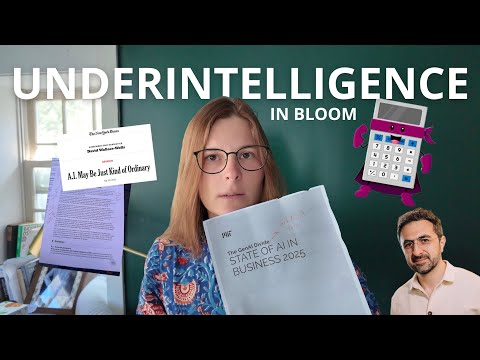
yt-dlp --download-sections "*0:59-2:15" "https://www.youtube.com/watch?v=WBPkkjI2dxM" --force-keyframes-at-cuts --merge-output-format mp4 -o "WBPkkjI2dxM-0m59s.mp4"“Let’s open this report. First sentence it says despite 30 to 40 billion in enterprise investment into Genai this report uncovers a surprising result in that 95% of organizations are getting zero return… Do you know how many people interviews they conducted? 52. How in the world are you supposed to make any conclusions on that number of people you talk to?” — Turing Post, 0:59
”AI will conquer us - if you don’t know how to read”
Clip command
yt-dlp --download-sections "*4:01-5:00" "https://www.youtube.com/watch?v=WBPkkjI2dxM" --force-keyframes-at-cuts --merge-output-format mp4 -o "WBPkkjI2dxM-4m01s.mp4"“My request to media and to people out there who are afraid that AI will conquer us. It’s possible if you don’t know how to read, if you don’t know how to analyze what you see in front of your eyes, and if you don’t ask questions. So, please, please read with your eyes open.” — Turing Post, 4:01
”AI is an algorithm - it cannot be conscious”
Clip command
yt-dlp --download-sections "*6:24-7:25" "https://www.youtube.com/watch?v=WBPkkjI2dxM" --force-keyframes-at-cuts --merge-output-format mp4 -o "WBPkkjI2dxM-6m24s.mp4"“I just want everyone to think about it and to be aware at every point of your life that AI cannot be conscious. Whatever people tell you, whatever AI tells you, AI is an algorithm with very complicated and sophisticated reward optimization, it might be engineered by human to feel like conscious being, but it’s not conscious.” — Turing Post, 6:24
”AI is not Skynet or HAL 9000 - it’s like electricity”
Clip command
yt-dlp --download-sections "*8:15-9:20" "https://www.youtube.com/watch?v=WBPkkjI2dxM" --force-keyframes-at-cuts --merge-output-format mp4 -o "WBPkkjI2dxM-8m15s.mp4"“Throughout my career as an AI interpreter, AI explainer, AI storyteller, that’s what I’m trying to say. AI is super powerful tool. It’s not magic. It’s not Skynet. It’s not HAL 9000 from Space Odyssey. AI and generative AI is a tool.” — Turing Post, 8:15
”AI will give us time to stare at the wall and come up with phenomenal ideas”
Clip command
yt-dlp --download-sections "*11:20-12:12" "https://www.youtube.com/watch?v=WBPkkjI2dxM" --force-keyframes-at-cuts --merge-output-format mp4 -o "WBPkkjI2dxM-11m20s.mp4"“In my opinion, AI will give us time not to be super productive even though you can be super productive with AI. It will give us time to stare at the wall and come up with phenomenal ideas that we humans are famous for.” — Turing Post, 11:51 The episode dissects three major topics: a widely-cited MIT report on AI investments that turns out to be a thinly-veiled advertisement for MIT Nanda project, Mustafa Suleyman’s essay on “seemingly conscious AI” and why we must build AI for people rather than to be a person, and a New York Times opinion piece arguing that AI is becoming ordinary rather than superhuman.
The central thesis is that AI cannot “take over” unless people fail to develop critical reading and questioning skills. Christa critiques the sensationalized headlines around the MIT report, which claims 95% of companies see zero return on AI investments, by revealing it was based on only 52 interviews and serves primarily as marketing material for MIT Nanda’s protocols. She also emphasizes that while AI may be engineered to appear conscious, it fundamentally is not and never will be sentient.
The episode concludes with a promise to continue pushing AI literacy as a key agenda, encouraging viewers to develop a questioning mindset and understand AI as a powerful tool rather than magic or science fiction threats like Skynet or HAL 9000.
Key Points
- AI literacy requires critical reading (0:08) - If we can’t read and analyze information critically, discussions about AI literacy are meaningless
- MIT report is actually MIT Nanda marketing (0:28) - The widely-quoted “State of AI in Business” report was created by MIT Nanda, not MIT alone
- Flawed methodology with only 52 interviews (1:28) - The report claiming 95% of companies saw zero ROI was based on just 52 structured interviews
- Report promotes NANDA protocols (1:57) - The report repeatedly mentions NANDA alongside MCP and A2A protocols to establish legitimacy
- 23 pages of advertisement (2:11) - The analysis is sloppy, sometimes contradictory, and primarily serves as an ad for MIT Nanda
- Reading with your eyes open is essential (4:21) - The key defense against AI “taking over” is knowing how to read, analyze, and ask questions
- Mustafa Suleyman on AI consciousness (4:25) - His essay “We must build AI for people; not to be a person” addresses perceived AI consciousness
- AI optimized for consciousness illusion (4:52) - AI can be engineered to create the illusion of consciousness that many will perceive as real
- Vulnerable populations at risk (5:02) - People who fall for fraud calls and those who are mentally unstable are especially vulnerable
- AI is an algorithm, not conscious (6:32) - AI is sophisticated reward optimization that may feel conscious but fundamentally is not
- Questioning mindset is crucial (7:31) - Developing the ability to ask the right questions is one of the most important AI skills
- AI is just ordinary (8:21) - New York Times article argues AI is settling into everyday life, not becoming superhuman
- AI is not Skynet or HAL 9000 (8:38) - AI is a super powerful tool, not magic or science fiction villains
- AI is like electricity (9:49) - A useful tool that’s not superhuman, not self-replicating, and not self-liberated from control
- AI bubble to burst is superhuman perception (9:16) - The main bubble worth bursting is the perception that AI is superhuman
- Promise to push AI literacy (10:32) - Commitment to continue teaching what it means to live with and use AI as a tool
- AI gives us time to think (11:51) - AI will give humans time to be inventive and come up with phenomenal ideas
Mentions
Companies
- MIT Nanda (0:28) - Creator of the “State of AI in Business” report, criticized for disguising marketing as research
- Microsoft (4:29) - Where Mustafa Suleyman currently works at Microsoft AI
- DeepMind (4:31) - Co-founded by Mustafa Suleyman
- Inflection AI (4:34) - Company co-founded by Suleyman that was essentially acqui-hired by Microsoft
- Turing Post (7:52) - The channel/publication founded by host Christa
- New York Times (8:17) - Published the “AI May Be Just Kind of Ordinary” opinion piece
Products & Technologies
- MCP Protocol (2:00) - Protocol mentioned alongside NANDA in the report
- A2A Protocol (2:01) - Protocol mentioned alongside NANDA in the report
- NANDA Protocol (3:26) - MIT Nanda’s protocol for agent interoperability and autonomous web navigation
- ChatGPT (2:21) - Criticized as the only model provider the report focused on
- Blockchain/Smart Contracts (3:50) - Mentioned in report’s vision of trustless transactions
- Agentic Web (3:35) - Concept pushed by MIT Nanda for autonomous web navigation
- Skynet (8:41) - Referenced as what AI is NOT
- HAL 9000 (8:42) - Referenced from Space Odyssey as what AI is NOT
People
- Mustafa Suleyman (4:25) - Microsoft AI executive, DeepMind and Inflection AI co-founder, author of “seemingly conscious AI” essay
- Christa (7:50) - Host and founder of Turing Post
- David Wallace Wells (8:47) - New York Times opinion columnist who wrote about AI becoming ordinary
- Helen Todd (10:51) - Friend who started a YouTube channel creating AI literacy content for toddlers
Media
- Entrepreneur (0:42) - Published headline about 95% of companies seeing zero return on AI
- Axios (0:45) - Published article “MIT study on AI profits rattles tech investors”
- The Hill (0:48) - Published headline about companies investing billions with 90% getting zero return
Surprising Quotes
“How in the world are you supposed to make any conclusions on that number of people you talk to?” — 1:28
“AI will conquer us. It’s possible if you don’t know how to read, if you don’t know how to analyze what you see in front of your eyes, and if you don’t ask questions.” — 4:08
“AI is an algorithm with very complicated and sophisticated reward optimization. It might be engineered by human to feel like conscious being, but it’s not conscious.” — 6:32
“AI hype has evolved too, passing out of its prophetic phase into something more quotidian, a pattern familiar from our experience with nuclear proliferation, climate change, and pandemic risk among other charismatic mega traumas.” — 8:50
“AI will give us time not to be super productive even though you can be super productive with AI. It will give us time to stare at the wall and come up with phenomenal ideas that we humans are famous for.” — 11:51
Transcript
0:00 Hello everyone and welcome to three wow and one promise. Today we will do some reading because honestly honestly if we can’t read what AI literacy are we talking about.
0:20 Let’s see the very well discussed genai divide state of AI in business report that it’s not just MIT report it’s created by MIT NANDA and this report was widely quoted just a few titles nearly 95% of companies saw Zero return on in-house AI investments according to a new MIT study. Little to no measurable impact. This is from entrepreneur Axios. MIT study on AI profits rattles tech investors. Then the hill companies have invested billions into AI 90% getting zero return.
0:59 Let’s open this report. First sentence it says despite 30 to 40 billion in enterprise investment into Genai this report uncovers a surprising result in that 95% of organizations are getting zero return. My assumption is that everyone just stopped reading here though they shouldn’t because if we look further we can see that this report has a surprising amount of structured interviews. Do you know how many people interviews they conducted? 52. How in the world are you supposed to make any conclusions on that number of people you talk to?
1:36 They also say that they analyzed three public implementations while they don’t really describe what exactly it is. And when we read closer and read through this report, we can see that was created by as I said not MIT but MIT Nanda. And if you ever read this report, you will see that they keep repeating NANDA offer MCP and A2A protocols trying to put themselves in the same line of known protocols.
2:11 So in a nutshell, this report state of AI in business is just 23 pages of an advertisement for MIT Nanda project. The analysis is sloppy. Sometimes they contradict themselves. Sometimes it’s just an ode to Chad GPT which means that they just didn’t cover the whole richness of all other model providers.
2:32 Only on the page 8 there is some useful piece of information. While official enterprise initiatives remain stuck on the wrong side of the Genai divide, employees are already crossing it through personal AI tools and they demonstrate actually in this report conducted with 52 respondents that 90% of employees use LM regularly. Again, what is even the point of reading and discussing this report if it’s such an inconclusive amount of data?
3:01 I think we can just applaud these people from MIT Nanda to inserting themselves in the narrative and trying to establish new term genai divide. I hope they will not succeed. And here is the actual blurp that I would consider a pure advertisement. The infrastructure foundations for this transformation are already emerging through protocols like MCP, A2A and NANDA which enable not just agent interperability but autonomous web navigation in anic web.
3:35 Aentic web it’s something that MIT NANDA pushes systems will autonomously discover optimal vendors and evaluate solutions without human research. Establish dynamic API integrations in real time without pre-built connectors. Execute trustless transactions through blockchain enabled smart contracts and develop emergent workflows that selfoptimize across multiple platforms and organizational boundaries.
4:01 So my request to media and to people out there who are afraid that AI will conquer us. It’s possible if you don’t know how to read, if you don’t know how to analyze what you see in front of your eyes, and if you don’t ask questions. So, please, please read with your eyes open.
4:25 My second wow is about the paper that is written by Mustafa Suliman that currently works at Microsoft AI. He was one of the co-founder of deep mind and then he co-ounded inflection AI which was basically equihired by Microsoft. Mustafa Sulleman wrote a paper with the name we must build AI for people semicolon not to be a person.
4:48 I deeply agree with Mustafa Sullean that AI which is optimized to create the illusion of consciousness will be perceived by many people as conscious. The problem here unfortunately is not AI. The problem here is people who tend to believe fraud calls, fraud emails. They tend to be very naive and easy to lie to. They’re very trusting. Also, there’s a bunch of people who are mentally unstable. And having something in your fingertips that is so coherent and so confident might actually play with your mental state even more.
5:27 This is a good start to discuss the problem that he calls seemingly conscious AI. I’m not sure a new term is needed. You know, multiplying terms I don’t feel helps with that. It does share his fear about perceived consciousness over AI. There are a few things that I especially liked in his essay. A few times he says it’s worth underscoring. There is at present no evidence.
5:54 My imagined AI system would not actually be conscious, but it would imitate consciousness in such a convincing way that it would be indistinguishable from a claim that you or I might make to one another about our own consciousness. It’s long article. It’s more like his thinking process about it. Of course, having Microsoft team and resources behind it might help in understanding this problem and setting it right.
6:24 I just want everyone to think about it and to be aware at every point of your life that AI cannot be conscious. Whatever people tell you, whatever AI tells you, AI is an algorithm with very complicated and sophisticated reward optimization, it might be engineered by human to feel like conscious being, but it’s not conscious.
6:50 Remember it’s impossible for the consciousness emerge in AI but human actors might engineer it that way that you will think that AI has some sentience. It doesn’t it doesn’t repeat it every time you think it is and that way you will save yourself and you will save your own consciousness and you will be sane.
7:10 It surprises me that actually that’s needed to be discussed. But if we think about how many people out there are prone to believe in all sorts of theories in all sorts of disinformation thinking that AI might be sentient is just a small small part of it. So read more think more and develop what might be called questioning mindset.
7:33 In AI literacy series, we discuss that it’s very important to understand how to read with AI, how to write with AI, how to create with AI. But one of the most important skills with AI becomes asking the right questions.
7:50 Hi there. If you’re new to this channel, my name is Christa. I’m founder of Turing Post and this is an optimistic way to tell you what happened last week in AI called three wows and one promise. And it’s very very unconventional. Please subscribe. And here with the paper we just discussed in the first wow with the seemingly conscious AI. Keep asking questions and that will save you.
8:15 To finish my three wows I went with an article from New York Times. I told you it will be a lot of reading today. The name of this article AI may be just kind of ordinary. And throughout my career as a AI interpreter, AI explainer, AI storyteller, that’s what I’m trying to say. AI is super powerful tool. It’s not magic. It’s not Skynet. It’s not HAL 9000 from Space Odyssey. AI and generative AI is a tool.
8:47 In this opinion column by David Wallace Wells, he wrote, “AI hype has evolved too, passing out of its prophetic phase into something more quotidian, a pattern familiar from our experience with nuclear proliferation, climate change, and pandemic risk among other charismatic mega traumas.” And by that he means that AI just began to settle like sediment into the corners of our lives.
9:16 Talking about AI bubble, the main AI bubble I hope that will burst is this perception of AI being superhuman. It’s super powerful in many dimensions that people are not capable. Forgive me this example, but calculator is much more powerful and intelligent solving some math problems than many of us humans are.
9:38 I like what he wrote. One definition of normal in this context is not superhuman, not self-replicating and not self-liberated from oversight and control. It’s more like electricity. We talk about it. It’s more like immensely useful tool. It’s more like a toolbox or magician kit that if you know how to use, you might look like a magician. And let’s learn that.
10:01 I want to finish with another quote from this article. This isn’t a blueprint of the world to come. just one speculative glimpse. Perhaps the course of the past year should reassure us that we are not about to sleepwalk into an encounter with Skynet. But it probably shouldn’t give us that much confidence that we have all that clear an idea of what’s coming next.
10:24 And here comes one promise.
10:29 One promise is from me this time. I promise you that we will keep pushing the agenda of AI literacy. We will keep telling what it means to be with AI, to live with AI, to use it as a powerful tool and to be magician yourself. Remember the only real human here is you.
10:51 And just today I received a newsletter from my friend Helen Todd and she just started an immature YouTube channel where she creates everything is made by AI lyrics, music, animation, everything. She creates this AI literacy series for toddlers. And one song specifically got me thinking even more and I want you to hear it. “But only you are true. more than all the lies, more than what they do.”
11:20 Thank you for watching. These topics are very important to discuss. And though my three values and one promise are said to be an optimistic way to talk about AI, sometimes we need to argue. Sometimes we need to uncover some things. Sometimes we need to call things out. And that’s also part of being optimistic because I deeply believe in AI. I deeply believe it’s a super powerful tool that makes us humans much more inventive, much more creative.
11:51 In my opinion, AI will give us time not to be super productive even though you can be super productive with AI. It will give us time to stare at the wall and come up with phenomenal ideas that we humans are famous for. Subscribe to this channel and leave me what you think.