My kids will never be smarter than AI | 3 Wow and 1 Promise
My kids will never be smarter than AI | 3 Wow and 1 Promise
Summary
This episode of “3 Wow and 1 Promise” covers three major AI developments from the week. The first wow explores how Sam Altman’s journey into parenthood has shifted his perspective on AI, moving from abstract AGI discussions to more practical considerations about how children will grow up with superintelligence as a natural part of their world. Altman’s podcast appearances reveal a more human side as he contemplates what AI-enhanced capabilities will mean for the next generation.
The second wow features Andrej Karpathy’s bullish talk at Y Combinator about “Software 3.0” - a new computing paradigm where LLMs act as operating systems and English becomes the hottest programming language. Karpathy draws parallels to the 1960s computing era, suggesting we’re at a ground floor opportunity to rebuild everything. He advocates for partial autonomy products (the “Iron Man suit” analogy) and emphasizes the need for new GUIs designed for AI-native interactions.
The third wow reveals China’s AI gold rush through their mandatory AI registry showing over 3,700 generative AI tools, with more than 50% being foundation models. This contrasts sharply with the West’s focus on a handful of major AI labs. The promise section showcases Midjourney’s new video generation capability, which despite being only 5 seconds long, demonstrates aesthetically beautiful and consistent results.
Highlights
”My kids will never be smarter than AI”
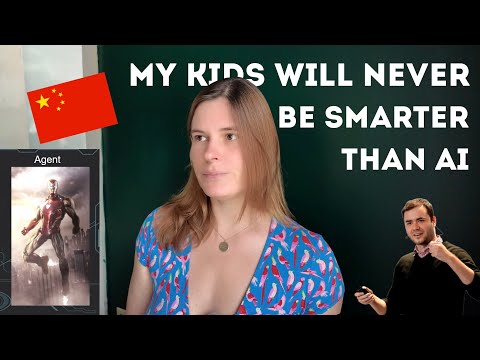
Clip command
yt-dlp --download-sections "*1:18-2:15" "https://www.youtube.com/watch?v=T-9QO2SwX8s" --force-keyframes-at-cuts --merge-output-format mp4 -o "T-9QO2SwX8s-1m18s.mp4"“Sam Altman became a parent and that changed his vision about AI. He’s not talking that much about AGI anymore. He’s talking about super intelligence, but becoming a parent made this shift in his understanding on what you should pay attention to and it’s much more practical.” — Ksenia, 1:18
”We are in the 1960s era of computing all over again”
Clip command
yt-dlp --download-sections "*4:37-5:45" "https://www.youtube.com/watch?v=T-9QO2SwX8s" --force-keyframes-at-cuts --merge-output-format mp4 -o "T-9QO2SwX8s-4m37s.mp4"“He believes we are in the 1960s era of computing all over again meaning that it implies massive ground floor opportunity to rebuild everything. He says also that there is a huge amount of software to rewrite and write from scratch.” — Ksenia on Andrej Karpathy, 4:37
”English is becoming the hottest programming language”
Clip command
yt-dlp --download-sections "*4:26-5:15" "https://www.youtube.com/watch?v=T-9QO2SwX8s" --force-keyframes-at-cuts --merge-output-format mp4 -o "T-9QO2SwX8s-4m26s.mp4"“He again highlights that now English is becoming the hottest programming language because you can just talk to your program in the natural language.” — Ksenia on Karpathy, 4:26
”Agents as people’s spirits on the internet”
Clip command
yt-dlp --download-sections "*7:17-8:30" "https://www.youtube.com/watch?v=T-9QO2SwX8s" --force-keyframes-at-cuts --merge-output-format mp4 -o "T-9QO2SwX8s-7m17s.mp4"“He calls agents ‘people’s spirits on internet’ and that’s something from Miyazaki almost - that there are these spirits of us on internet that will be able to act from our behalf as our spirits.” — Ksenia on Karpathy, 7:17
”China’s 3,700 generative AI tools”
Clip command
yt-dlp --download-sections "*9:29-10:58" "https://www.youtube.com/watch?v=T-9QO2SwX8s" --force-keyframes-at-cuts --merge-output-format mp4 -o "T-9QO2SwX8s-9m29s.mp4"“What if I tell you that there’s a country with a public list with over 3,700 generative AI tools and that country is China. And thanks to its mandatory AI registry, we can finally see what their AI gold rush actually looks like.” — Ksenia, 9:29
Key Points
- Sam Altman’s Parenthood Shift (1:18) - Becoming a parent changed Altman’s focus from abstract AGI to practical considerations about how children will use AI
- Podcast Tour Strategy (2:41) - Altman is intentionally building a new narrative through podcasts while restructuring OpenAI’s Microsoft deal
- Software 3.0 Paradigm (3:41) - Karpathy describes LLMs as a new type of computer or operating system representing software 3.0
- 1960s Computing Analogy (4:37) - We’re at a ground floor opportunity similar to early computing, with massive software to rewrite
- Capabilities Overhang (5:01) - LLMs are hugely capable but we still don’t know what we’re going to do with them
- Iron Man Suit Analogy (5:56) - Karpathy advocates for partial autonomy products that augment rather than replace humans
- Generation Verification Loop (6:11) - Massive opportunity in tools like Cursor or Perplexity for human-AI collaboration
- Custom GUIs Needed (6:31) - We haven’t discovered good GUIs for AI - “reading text is effortful but looking at stuff is fun”
- Building for Agents (7:41) - We’re redesigning our digital world to be natively understood and manipulated by AI agents
- China’s Massive AI Registry (9:29) - Over 3,700 generative AI tools registered, 50%+ are foundation models
- China’s Diffusion Strategy (10:38) - The real contest is about who can weave AI into their economy fastest
- Midjourney Video Launch (11:14) - New video capability shows aesthetically beautiful and consistent 5-second clips
Mentions
Companies
- OpenAI (0:24) - Sam Altman’s company behind ChatGPT and cyber-physical ecosystem
- Tesla (3:25) - Where Karpathy was first director of AI
- Microsoft (3:01) - OpenAI attempting to restructure deal
- Anthropic (10:12) - Mentioned alongside OpenAI and Google
- Google/Meta (10:16) - Western AI labs compared to China’s approach
- Midjourney (11:14) - Launched video generation capability
- Gradient Flow (10:30) - Published analysis of China’s AI registry
People
- Sam Altman (0:06) - OpenAI CEO who recently became a parent
- Andrej Karpathy (3:18) - Former Tesla AI director, OpenAI founding member
- Jack Altman (0:39) - Sam’s brother who hosted him on podcast
- Andrew Mayne (1:03) - Hosts new OpenAI podcast
- Ben Lorica (10:30) - Gradient Flow author covering China’s AI registry
- Elon Musk (2:52) - Referenced in Altman’s narrative building
Products & Technologies
- ChatGPT (1:46) - OpenAI’s flagship product
- DeepSeek (4:23) - Open source model mentioned by Karpathy
- Llama (4:23) - Meta’s open source model
- Cursor (6:17) - AI coding tool exemplifying generation-verification loop
- Perplexity (6:17) - AI search tool mentioned for human-AI collaboration
Surprising Quotes
“Kids born now will just think the world always had extremely smart AI and they will use it incredibly naturally and they will look back at this as like a very prehistoric time period.” — Sam Altman via Ksenia, 2:04
“Reading text is effortful but looking at stuff is fun. It’s just a highway to your brain.” — Andrej Karpathy via Ksenia, 6:49
“The single biggest surprise - over 50% of those thousands of tools are foundation models. Let that sink in. Here we focus on OpenAI, Anthropic, Google, Meta. In China, there are hundreds of companies… all building their own models from ground up.” — Ksenia, 10:07
“The real contest isn’t just about creating the single smartest model. It’s about diffusion. Who can weave AI into their economy the fastest and the best way?” — Ksenia, 10:40
Transcript
0:00 Oh, hello there. My kids will never be smarter than AI. It’s Sam Altman who said that. And if you think he’s pessimistic about the future, you get it completely wrong. He says that he’s super excited about his kids becoming super capable with the help of AI.
0:22 Well, we don’t intend to have Sam Altman on every three WOW and one promise, but he went on some sort of a publicity tour weeks before he published this gentle super intelligence post that we covered and then last week he went to two podcasts at least. One his brother Jack and you should watch it because it’s very interesting to see Sam Altman alive for the first time. He’s smiling there. He’s relaxed, but it’s hard to listen to them. You should watch it because when you listen to the podcast, it’s like, who is talking? They have absolutely similar voices. Creepy.
1:00 And then the second podcast that he went to was a new podcast by OpenAI led by Andrew Mayne. And there Sam Altman said a few very interesting things. And I’m going to focus on one thing that made me say, “Wow.”
1:18 Sam Altman became a parent and that changed his vision about AI. He’s not talking that much about AGI anymore. He’s talking about super intelligence, but becoming a parent made this shift in his understanding on what you should pay attention to and it’s much more practical. He’s talking much more about science breakthroughs that AI will enable. And that’s something that is amazing because he is the guy behind ChatGPT behind all the projects that OpenAI tries to put together in terms of this as we mentioned cyber physical ecosystem.
1:57 And now having kids he’s constantly asking these questions - what my kids are going to do with AI, how they going to develop. Kids born now will just think the world always had extremely smart AI and they will use it incredibly naturally and they will look back at this as like a very prehistoric time period.
2:17 He is telling a funny story about how he used to Google everything and everyone would dismiss him as like oh you know this kid is googling everything, nothing special will come out of him and now he’s Sam Altman who you know pulling in all these companies all these monies building a crazy data center and then building a narrative.
2:41 So that’s another interesting thing about him and going to all these podcasts. He always was famous for building narratives and involving people in them. That’s how he got Elon Musk I believe. And now he is posting blog posts. He’s going to all these podcasts while trying to pull out of the deal with Microsoft. He’s intensely intentionally building this new narrative about him and OpenAI and super intelligence. But that made him human. This talk about kids actually made him much more closer to me as a parent. So I thought that was wow.
3:18 This wow is a talk by Andrej Karpathy. He was the first director of AI at Tesla. He is a founding member of OpenAI though he’s not with OpenAI anymore and he gave a talk at Y Combinator. The way he works is by analogy. So he analyzes what happens with software and AI world is basically a software 3.0. Now he is excited about this new world.
3:51 There’s a quick summary that I wanted to give you about what Andrej Karpathy is bullish about. First the dawn of new computing era. This is what he calls software 3.0. He’s fundamentally excited about this emergence of new programming paradigm where LLMs act as a new type of computer or operating system. He gets all these analogies how they were closed operating system how there’s Linux and now how we have all this you know proprietary models by OpenAI and Anthropic and then we have DeepSeek and Llama and all that stuff. There’s a lot of similarities.
4:26 He again highlights that now English is becoming the hottest programming language because you can just talk to your program in the natural language. The interesting thing he said is that he believes we are in the 1960s era of computing all over again meaning that it implies massive ground floor opportunity to rebuild everything. He says also that there is a huge amount of software to rewrite and write from scratch.
4:55 That’s an interesting moment here to contemplate because if we are in the very very beginning though there is so much capabilities. Remember about capabilities overhang from the first video. LLMs are hugely capable. The progress is unstoppable but we still don’t know what we’re going to do with them. And that’s being like in a stone age of LLMs.
5:17 Listening to Sam Altman again who is saying my kids will grow up vastly more capable than we grew up and able to do things that we cannot imagine. There are so many great minds thinking about LLMs and models and building with them and using that for science and still we cannot even imagine what capabilities we will be able to apply to our lives in let’s say 5 years.
5:44 Another thing that Andrej Karpathy said that was interesting and very aligns with how I think about it is partial autonomy products. His analogy is the Iron Man suit. He’s very bullish on building applications that augment human capabilities rather than trying to fully replace them. And that’s totally how I think about AI. It’s all about augmentation. We are going to be enhanced by this amazing tool.
6:11 And he mentions the generation verification loop, a massive opportunity in creating tools like Cursor or Perplexity that speed up the collaboration between a human verifier and an AI generator. By the way, here I have a paper because in the world of progress, paper is still the coolest thing.
6:30 He also mentions custom GUIs. He strongly believes in the power of graphical user interface. He says that we have not yet discovered a good GUI because that will help us to make AI outputs understandable and auditable. He says reading text is effortful but looking at stuff is fun. It’s just a highway to your brain. So what is the next GUI right? What is this interface that will allow us to use LLMs in different level as a highway to our brain?
7:00 The Iron Man suit, the autonomy slider. He’s bullish on products that allow users to control the level of AI autonomy from simple augmentation to more agentic behavior like the Iron Man suit which can be both a tool and an agent.
7:17 The other thing that stuck with me is how he calls agents. He calls them people’s spirits on internet and that’s something from Miyazaki almost that there are these spirits of us on internet that will be able to act from our behalf as our spirits. Someone needs to write a book about it please, some cool young adults book. I’m waiting for it.
7:39 Of course he mentions the democratization of vibe coding. The most important thing that he said was this new environment where we need to build for agents. We are redesigning our digital world to be natively understood and manipulated by AI agents. It’s not for humans anymore. It’s not click this button that we understand. It’s about making a special language, special ecosystem for agents and models to be able to do whatever we want them to do.
8:09 Now, it’s not that the computer tells us what to do because that was usually our communication with computers. But now we in a natural language tell agents what to do and they need to understand how to navigate the whole internet to be able to do what we ask them.
8:29 In short, Karpathy is very bullish on the entire new ecosystem that we’re going to build. It’s not built yet. So there is a lot of opportunities. And he says that it’s important to understand all three systems. Software 1.0, software 2.0, and the new one software 3.0. It’s a little bit in conflict with what he says about vibe coding and democratizing everything because if you do need to understand these three systems, you need to have a very different set of skills and knowledge.
8:58 But in general, it’s a very bullish view, a blueprint for the next epoch of software 3.0 and agents who read our internet and act as our internet spirits.
9:13 The third W comes from a far away country. We have the blueprint for new software and new vision for the future, right? But this isn’t happening in vacuum. And that leads to my final and maybe most surprising wow moment of the week. A look inside China’s AI gold rush.
9:34 While in the west, we track something about dozen AI labs. What if I tell you that there’s a country with a public list with over 3,700 generative AI tools and that country is China. And thanks to its mandatory AI registry, we can finally see what their AI gold rush actually looks like.
9:55 You can say that America probably has a lot of generative tools as well. But the wow thing about is that China has 50% of these registered generative AI tools as models. And the single biggest surprise over 50% of those thousands of tools are foundation models. Let that sink in.
10:12 Here we focus on OpenAI, Anthropic, Google, Meta. In China, there are hundreds of companies, tech giants, startups, state-owned enterprises, university-backed companies. They all building their own models from ground up.
10:28 And an article from Gradient Flow by Ben Lorica who called it out, they call it massive scrum. And that’s the perfect word for it. And this reveals China’s true strategy. The real contest isn’t just about creating the single smartest model. It’s about diffusion. Who can weave AI into their economy the fastest and the best way?
10:52 And this registry is hard evidence that China is building a massive messy engine to do exactly that. So there you have it. From the 1960s computing era all over again to a CEO’s vision shaped by parenthood, which is so surprising, to a country building hundreds of foundation models at once.
11:14 Today we’re looking at Midjourney. Midjourney just launched their video capability and they are famous for very aesthetic looks, detailed. So, how does their video work? Let’s see. This is the website that tells you about their new video creation with Midjourney. Looks fun. Let’s go to the create pad.
11:41 I played with it a little. This is the image from ChatGPT and I just asked to animate it. That’s pretty cool. Let’s just say that it’s amazing. I have other examples here. I created, I used our favorite prompt from Triangle veil. It’s about two pilots in an intense moment and it’s pretty good. It’s very, you know, lifelike and even the animation of it except this jerky head movement is super cool. It’s aesthetically beautiful. The way the people look on every video is very consistent.
12:20 I read the news that Midjourney 5-second video is just the beginning of this journey. So that’s why I put it this in the promising category. But to tell you the truth, Midjourney is just awesome. Try it out.
12:31 And thank you for watching. Please don’t forget to subscribe and let me know what you think. I always appreciate your comments and I reply to each and one of them. Thank you. Stay tuned and stay in tune with AI exploration, development, and this crazy world we live in.