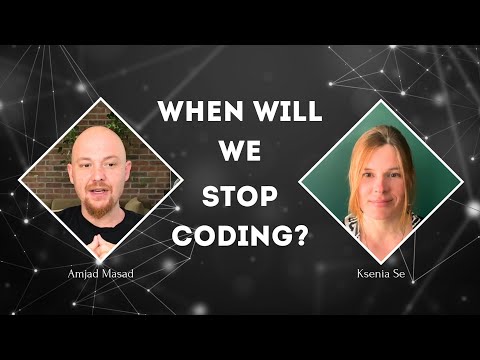
When Will We Stop Coding? A conversation with Amjad Masad, CEO and co-founder @ Replit
When Will We Stop Coding? A conversation with Amjad Masad, CEO and co-founder @ Replit
Summary
In this thought-provoking episode, Amjad Masad, CEO and co-founder of Replit, discusses his controversial shift from championing coding literacy to now telling people they don’t need to learn to code. Having been the first employee at Codecademy and then building Replit into a unicorn company, Amjad explains that the rapid progress in AI means that within perhaps two years, agents will become the next stage of programming abstraction - just as we moved from punch cards to assembly to C to Python to JavaScript.
The conversation covers Replit’s evolving vision of being an “AI habitat” - an environment where agents can build software using open-source tools. Amjad shares real examples of businesses built entirely with Replit agents, including a $1 million ARR enterprise that was built in just 4 hours. He predicts the rise of billion-dollar “solo founder” startups and argues that every startup today is essentially an AI startup. The discussion also touches on his views on AGI (he believes it will be software agents that can work autonomously for extended periods) and his philosophy that AI will democratize access to opportunity by lowering the skills and capital needed to build software.
When asked about the MCP vs A2A protocol debate, Amjad declares that “MCP won already” - drawing parallels to how Bitcoin maintains dominance over Ethereum despite technical arguments for the latter.
Highlights
”People Shouldn’t Learn to Code”
Clip command
yt-dlp --download-sections "*0:00-0:55" "https://www.youtube.com/watch?v=PlDeqGQZ0CQ" --force-keyframes-at-cuts --merge-output-format mp4 -o "PlDeqGQZ0CQ-0m00s.mp4"“And now you’re saying people shouldn’t even learn to code. Turned out to be a very controversial statement. The main thing that changed was the progress in AI. Code is a means to program. It is not programming. It’s actually very tedious. There’s all these syntax issues with it. And I think agents are the next stage as we’ve gone to higher levels of abstraction since the start of computing.” — Amjad Masad, 0:00
”$1 Million ARR in 4 Hours”
Clip command
yt-dlp --download-sections "*5:05-6:00" "https://www.youtube.com/watch?v=PlDeqGQZ0CQ" --force-keyframes-at-cuts --merge-output-format mp4 -o "PlDeqGQZ0CQ-5m05s.mp4"“There’s a story a few days ago that the CEO of the company… he built his entire product on Replit agents. It’s actually a million dollar ARR business. So he has over a million in recurring revenue and he built the entire product, the MVP, in 4 hours.” — Amjad Masad, 5:05
”MCP Won Already”
Clip command
yt-dlp --download-sections "*17:00-17:45" "https://www.youtube.com/watch?v=PlDeqGQZ0CQ" --force-keyframes-at-cuts --merge-output-format mp4 -o "PlDeqGQZ0CQ-17m00s.mp4"“I think MCP won already. You only need a slight edge with open source protocol and you’re just zooming - it’s really hard to catch up. Bitcoin and Ethereum - Ethereum will never catch up even though you can argue it’s a better system. There’s a first mover advantage that accumulates over time.” — Amjad Masad, 17:00
”Consciousness as a Strange Loop”
Clip command
yt-dlp --download-sections "*18:15-19:15" "https://www.youtube.com/watch?v=PlDeqGQZ0CQ" --force-keyframes-at-cuts --merge-output-format mp4 -o "PlDeqGQZ0CQ-18m15s.mp4"“There’s a book called ‘I Am a Strange Loop’ and his whole thesis is that consciousness is an emergent component of a system that can self-reflect. The moment you can loop on yourself and self-reflect and have a model for yourself, you’re actually conscious.” — Amjad Masad, 18:15
”Access to Opportunity”
Clip command
yt-dlp --download-sections "*19:22-20:10" "https://www.youtube.com/watch?v=PlDeqGQZ0CQ" --force-keyframes-at-cuts --merge-output-format mp4 -o "PlDeqGQZ0CQ-19m22s.mp4"“One of the paradoxes of the internet is it was supposed to be this great equalizer where no matter where you are, you should be able to contribute and make money. But the wealth really concentrated in Silicon Valley. I think with AI it’s going to be deflationary on many things including creating software - the costs will go down and there’s going to be more opportunity for people in emerging markets.” — Amjad Masad, 19:22
Key Points
- Code is Not Programming (0:45) - Code is a means to program but is tedious with syntax issues; agents are the next abstraction level after JavaScript
- Two Year Timeline (1:30) - Amjad originally thought it would take 5-10 years, but now believes agents will replace coding in about 2 years
- Cognitive Dissonance (2:08) - His identity was wrapped in coding literacy, making the shift difficult to accept
- Replit Agent V2 (2:30) - Building infrastructure first, now seeing the quality get better and better
- Key Technical Needs (3:25) - Agents need better test writing, long-term planning, and ability to maintain larger codebases
- Vibe Coding vs No-Code (5:47) - Unlike no-code platforms with limited primitives, Replit gives agents open-source tools and languages
- Billion-Dollar Solo Startup (7:28) - Predicts the first billion-dollar company will be built by a solo founder with AI agents within 2 years
- Every Startup is AI Startup (9:13) - AI is like the internet in 1999 - if you’re not incorporating it, you’re falling behind
- Problem-Solver Founders (10:05) - New entrepreneurs will be problem-solvers who may never learn to code, similar to traditional business people
- AGI Definition (11:24) - Modern labs define AGI as a software agent that can work for a day or two to solve a problem autonomously
- No Doom (13:40) - Doesn’t see much risk from AI; believes it will be net positive for society
- AI Habitat Vision (14:04) - Replit’s goal is to be the best environment for agents to build software
- Open Source Philosophy (15:11) - Using open-source tools is better for agents and creates standard applications
- Community Bounties (16:20) - Vision for agents to provision services and pay community members
Mentions
Companies
- Replit (0:15) - Amjad’s unicorn company building an AI-powered development platform
- Codecademy (0:30) - Where Amjad was the first employee, championing coding literacy
Products & Technologies
- Replit Agents (2:30) - AI agents that can build software autonomously
- MCP (Model Context Protocol) (17:00) - Protocol that Amjad believes has already won
- A2A (17:04) - Competing protocol to MCP
- O series / R1 series (19:10) - AI models with reflection capabilities
People
- Amjad Masad (0:00) - CEO and co-founder of Replit
- Douglas Hofstadter (17:57) - Author of “Godel, Escher, Bach” and “I Am a Strange Loop”
Books
- Godel, Escher, Bach (17:57) - Hofstadter’s book about AI and consciousness
- I Am a Strange Loop (18:15) - Hofstadter’s thesis on consciousness as emergent self-reflection
Surprising Quotes
“I used to think it’s going to take five to ten years, but with the progress in AI, I think it’s going to take perhaps two years.” — 1:30
“The first billion-dollar company with a solo founder - I’m calling this within two years.” — 7:40
“Programmers used to do punch cards and then started doing assembly and then C and Python and then JavaScript. And I think agents are the next stage.” — 1:00
“There are AI systems now that claim to be better than the transformer but it’s really hard to catch up because the transformer is good enough and everyone’s investing in it.” — 17:25
“Almost my identity is wrapped in this idea of coding literacy. It’s hard to change that.” — 2:15
Transcript
0:00 And now you’re saying people shouldn’t even learn to code, right? Modern labs change the definition of AI. So you’re going to get a software agent that can work for a day or two to solve a problem. AGI is going to be sort of… Hi, I’m Jad. So nice to meet you. I’m fascinated with your story and the story of Replit. And you once championed coding literacy first in Codecademy as the first employee and then in Replit, a unicorn company. And now you’re saying people shouldn’t even learn to code right? So what changed?
0:45 Yeah, turned out to be a very controversial statement. The main thing that changed was the progress in AI. I’ve always thought that there is that agents are going to be in a wave of programming. So code is a means to program. It is not programming, you know. So it’s actually very tedious. There’s all these syntax issues with it and all these problems. And by the way, we’ve gone to higher levels of abstraction since the start of computing. Programmers used to do punch cards and then started doing assembly and then C and Python and then JavaScript. And I think that’s the next stage - as agents.
1:30 And I used to think it’s going to take five to ten years, but with the progress in AI, I think it’s going to take perhaps two years. I did say that there are certain engineers that would still have to write code and especially certain things where you need precision and you need provability. And you know, if you go do computer science, I still think it’s useful. But anyone who is more interested in building applications doesn’t need to learn how to code.
2:08 Do you remember - was there like a particular moment of realization when you understood there will be some people really hard on code and then the majority just doing it? Almost my identity is wrapped in this idea of coding literacy. It’s hard to change that. I think the first time I felt that was when I tried Chad GPT and realized that it can write code pretty well. But I was like, “No, I don’t think this is going to really replace programming.” But then it gets better and better.
2:45 We had a little bit of an advantage at Replit because we built the entire infrastructure first. So we can build new features very quickly. So we were able to actually deploy agents very early. And it’s only getting better and better. So basically I’m taking my own red pill every day when I see how much better the quality and the user experience get.
3:25 What tech still needs to improve for agents to be really good? Yeah, models can write a small unit of code pretty well. What they can’t do yet is write good tests. Like they can write a test, but the test is not a real test because the test kind of does what the model already expected the code to do, versus humans who can think of all the edge cases that can happen. There’s also long-term planning. Like planning over a longer period of time of what you want to do and maintaining a larger code base is still hard.
4:10 But again, we have compute advantage. We can run the software, see it it’s working or not, and iterate on it. So even when the model makes mistakes, it self-corrects. So the number of errors they make over time has gone down significantly. And this is just the nature of these things. The quality gets better and better.
4:47 Do Replit agents actually work? Does it work? Yeah, there’s many real businesses built on Replit agents. So people say this is my side hustle, like some project, but like there’s real businesses. There’s a story a few days ago that the CEO of a company - he built his entire product on Replit agents. It’s actually a million dollar ARR business. So he has over a million in recurring revenue and he built the entire product, the MVP, in 4 hours.
5:30 And he just talked about it and sort of just went around the internet and people were like, “Wow this is insane.” And we’re seeing more and more of these businesses and companies built on Replit.
5:47 Is there like a certain term for this? Like vibe coding? It’s a bit like vibe coding. It’s a bit like no-code but it’s different. No-code was like limited set of primitives that you can do things with. So you have this small box and you can only express things that are supported by this box. And that’s why no code, a lot of the time, becomes custom code. So you start no-code, then you realize you need something else, you hire a developer and then they would migrate you to something else. That’s kind of what a lot of the no-code systems are doing.
6:30 Whereas with Replit, we’re like, “Okay, we’re just going to give the agent open-source tools and open source languages and have it create apps based on open source stack.” I think that’s better for the agent. I think that’s better for the world because applications are standard applications that kind of run on any Linux machine.
7:00 As for community, community has been an integral part of Replit’s growth. People shared applications and remixed them and did a lot of really great things in terms of sharing. We have a way to list bounties or problems on the site and allow other people in the community to help you with your code.
7:28 I don’t think we’ve achieved the true potential there. And I think I’ve always imagined a world where there’s an ability to transact naturally inside a platform like ours where the agents can provision services and pay people in the community based on those services. I think there’s a much better way to compose a software community where there’s like a win-win-win scenario - win for Replit, win for the community, and win for the end user.
8:10 Talking about the first billion-dollar company with a solo founder - I’m calling this within two years. Yeah. Someone’s going to build a billion-dollar company just with agents. No other employees? No other employees. Maybe some contractors. Maybe some contractors. Yeah, you know, people that you hire maybe like lawyers, accountants, all those people. But the actual software? All agents.
9:13 Every startup is an AI startup now. Just like in 1999, every company was an internet startup. The internet was the thing. And if you’re a startup now and you’re not thinking about how AI might be incorporated into your product, you’re probably falling behind.
10:05 The rise of the problem-solver founder - we used to think of this dichotomy between technical co-founders and business co-founders. I think you’re going to see a new type of founder that is neither. They’re just a problem solver that may never learn to code but they use agents and AI to build software. They’re much closer to traditional business people than to programmers.
11:24 What AGI really means - I think modern labs change the definition of AI. So you’re going to get a software agent that can work for a day or two to solve a problem. That’s kind of what they mean. It’s sort of a software agent that’s more autonomous. So you give it a task and it can work for much longer than a few minutes. We’re talking hours, maybe a day, maybe two days. And it can interface with the outside world. It can browse the internet, it can use tools, and it can actually make progress.
13:40 No doom, just smarter tools. I don’t see much risk from AI. I think it’s going to be net positive for society. I think the doom scenarios are overblown. I see it more as just smarter and smarter tools that we’re going to use to build things.
14:04 Replit’s vision is to be the AI habitat. The best environment for agents to build software. We want to be the place where agents live and work and build things.
15:11 Open source and community at Replit - we believe strongly in open source. Using open-source tools is better for the agent because there’s more data, more examples. It’s better for the user because they get standard applications. It’s better for the world because knowledge is shared.
17:04 What’s your take on MCP and A2A? Is it going to be a protocol war or are they going to complement each other? I think MCP won already. Already won. Yeah, you only need a slight edge with open source protocol and you’re just zooming - it’s really hard to catch up. Bitcoin and Ethereum - Ethereum will never catch up even though you can argue it’s a better system. There are AI systems now that claim to be better than the transformer but it’s really hard to catch up because the transformer is good enough and everyone’s investing in it. So you just need a slight edge and you’re off to the races. There’s a first mover advantage that accumulates over time. So I think MCP won.
17:54 You’re an avid reader and have talked about philosophy of mind and sci-fi that influenced your thinking. What is a particular book or idea that profoundly shaped your vision about how you think about AI and AGI? You know, a lot of people in tech read Douglas Hofstadter. There’s a book called “Godel, Escher, Bach” - a very interesting book about AI and consciousness and mind but it’s very winding and requires a lot of work to go through it.
18:15 But there’s another book called “I Am a Strange Loop” and his whole thesis is that consciousness is an emergent component of a system that can self-reflect. So the moment you can loop on yourself and self-reflect and have a model for yourself, you’re actually conscious. And he makes a very good argument for it. He uses a lot of analogies to arrive at these conclusions.
18:55 But I actually ended up being less convinced. I think it’s a great book and it’s one of the best books to try to explain consciousness in the current scientific consensus. So I think you can come out of it either fully convinced - and that would make you someone who thinks that AGI is going to come very soon because it seems like you just need an AI that can reflect, and we have the O series and R1 series to know how to reflect - or being less convinced. But it’s an amazing read. It’s very poetic too.
19:23 What excites you the most about this AI-powered world that you’re helping build? I think access to opportunity. One of the paradoxes of the internet is like it was supposed to be this great equalizer where no matter where you are and what resources you have, you should be able to contribute to the internet and make money on it. But instead, the wealth really concentrated in Silicon Valley in this geographic area.
19:50 I think part of the reason is the skills and capital needed to build anything is still very high. And I think with AI it’s going to be deflationary on many things including creating software - the costs will go down. And therefore there’s going to be more opportunity for people in emerging markets to be tech entrepreneurs and build great businesses.
20:15 Yeah, I certainly hope so. Thank you so much. Thank you for your time. My pleasure. And thank you for joining me today.