Beyond the Code: The Books That Shaped the Minds of AI Leaders
Beyond the Code: The Books That Shaped the Minds of AI Leaders
Summary
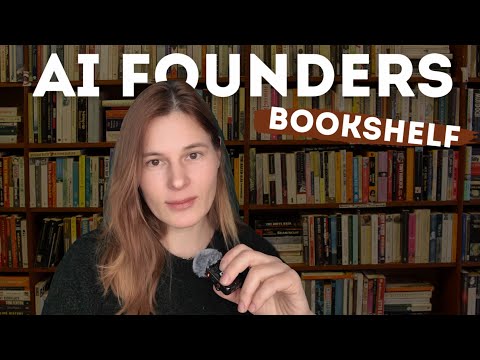
This video presents a curated reading list compiled from conversations with AI founders, engineers, and researchers, organized into five thematic categories: The Code of Consciousness (philosophy and AI), The Mathematical Mind (math as creative art), Speculative Futures (science fiction), Blueprint for Builders (business and leadership), and The Human Story (literature and history). The host presents book recommendations as a holiday gift to viewers, featuring insights from prominent tech leaders including Amjad Masad (Replit), Carina Hong (Axiom Math), Eric Boyd (Microsoft), Linda Tong (Webflow), Amr Awadallah (Vectara), and many others.
The recommendations reveal how deeply literature, philosophy, and science fiction have influenced the people building today’s AI technologies. From Douglas Hofstadter’s explorations of consciousness to Isaac Asimov’s Foundation series, from Hardy’s mathematician’s apology to Steinbeck’s East of Eden, these books demonstrate that the minds shaping AI draw inspiration from far beyond technical domains. Each interviewee shares personal stories about how specific books transformed their thinking about leadership, creativity, consciousness, and the human condition.
The video emphasizes that understanding where AI is heading requires looking at the stories, philosophies, and mathematical theories that formed the people behind the technology. Whether it’s learning about the “power of text” from Umberto Eco’s 1980s novel or finding leadership lessons in Ender’s Game, these recommendations offer a window into the ideologies driving today’s technological breakthroughs.
Highlights
”Consciousness emerges from systems that can self-reflect”
Clip command
yt-dlp --download-sections "*1:37-2:35" "https://www.youtube.com/watch?v=E0jSj8oRFqo" --force-keyframes-at-cuts --merge-output-format mp4 -o "E0jSj8oRFqo-1m37s.mp4"“There’s a book called I Am a Strange Loop and his whole thesis is that consciousness is an emergent component of a system that can self-reflect. So the moment you can loop on yourself and self-reflect and have a model for yourself you’re actually conscious.” — Amjad Masad, 1:37
”The power of text predicted LLMs”
Clip command
yt-dlp --download-sections "*4:15-5:15" "https://www.youtube.com/watch?v=E0jSj8oRFqo" --force-keyframes-at-cuts --merge-output-format mp4 -o "E0jSj8oRFqo-4m15s.mp4"“Even though it was written like in 1980s long before any AI happened, basically what it describes is the power of the text and the power of literally letters. It describes how actually the simple sequence of letters, the simple text can create by itself the whole new concepts, the whole new societies, the whole new religions.” — Olga Megorskaya on Foucault’s Pendulum, 4:15
”He could never defeat an enemy unless he loved them”
Clip command
yt-dlp --download-sections "*11:27-12:25" "https://www.youtube.com/watch?v=E0jSj8oRFqo" --force-keyframes-at-cuts --merge-output-format mp4 -o "E0jSj8oRFqo-11m27s.mp4"“One of the lines in it is he could never defeat an enemy unless he loved them because it’s once you love someone that you really understand their weakness. And it’s like one of the most beautiful lines in this book.” — Anneka Gupta on Ender’s Game, 13:35
”The biggest fiction of all is money”
Clip command
yt-dlp --download-sections "*20:39-21:35" "https://www.youtube.com/watch?v=E0jSj8oRFqo" --force-keyframes-at-cuts --merge-output-format mp4 -o "E0jSj8oRFqo-20m39s.mp4"“One of the key insights they have in this book, it’s our ability to believe in stories in fiction… And one of the funny lines they have in the book is the biggest fiction of all that we all believe in is money. Holding like a $100, that sheet of paper has no value. If you go to a monkey and give them $100 and a banana, they will take the banana every time.” — Amr Awadallah on Sapiens, 20:39
”Breakthroughs come from years of grinding”
Clip command
yt-dlp --download-sections "*14:01-15:00" "https://www.youtube.com/watch?v=E0jSj8oRFqo" --force-keyframes-at-cuts --merge-output-format mp4 -o "E0jSj8oRFqo-14m01s.mp4"“It’s super interesting reading about the daily rituals of these people because you realize that the insight or the art or the breakthrough whatever it might be were created not from a single insight but really from many years of grinding away and iterating on things before they found that insight.” — Ulrik Hansen on Daily Rituals, 14:01
Key Points
-
Five Categories of Books (0:30) - The reading list is organized into: Code of Consciousness (philosophy), Mathematical Mind (mathematics), Speculative Future (sci-fi), Blueprint for Builders (business/leadership), and Human Story (literature/history)
-
Consciousness and Self-Reflection (1:37) - Amjad Masad discusses “I Am a Strange Loop” by Douglas Hofstadter, which argues consciousness emerges from systems that can self-reflect
-
The Beginning of Infinity (2:58) - Discussion of David Deutsch’s book about human intelligence and the ability to produce explanations that are “hard to vary”
-
Power of Text (4:15) - Olga Megorskaya shares how Umberto Eco’s “Foucault’s Pendulum” (1980s) predicted the power of text and sequences of letters to create new concepts, societies, and religions - directly relevant to LLMs today
-
Algebraic Geometry as Theory Building (6:15) - Carina Hong recommends “The Rising Sea” by Ravi Vakil as an example of theory-building mathematics versus problem-solving mathematics
-
Proofs from THE BOOK (7:32) - The Erdos concept that God has a book of the best mathematics, making mathematicians “truth seekers” and “messengers”
-
Foundation Series Influence (8:27) - Multiple AI leaders cite Asimov’s Foundation series as deeply influential, with concepts now “happening in front of our eyes”
-
Listening to Noise (9:20) - “Harvest of Stars” by Poul Anderson teaches that what seems like noise might actually be important communication
-
Sci-Fi Leading to Building (10:42) - Linda Tong shares how her love for sci-fi led her to become a builder, as it helps imagine alternative realities and think about the future
-
Ender’s Game on Leadership (11:27) - Anneka Gupta rereads the Ender’s Game series annually for its lessons on empathetic leadership and influence over authority
-
Daily Rituals (14:01) - Ulrik Hansen recommends “Daily Rituals: How Artists Work” which reveals breakthroughs come from years of grinding, not single insights
-
Happiness Before Success (15:53) - “The Happiness Advantage” reveals that happiness leads to success, not the reverse
-
Endurance and Leadership (16:45) - Renen Hallak recommends “Endurance” about Shackleton’s expedition for lessons on leadership, hope, and the human spirit
-
The Mom Test (18:00) - Shawn Shen recommends this book for learning how to ask customers the right questions about what they really need
-
Sapiens on Fiction and Money (20:39) - Amr Awadallah shares Sapiens’ insight that humans’ unique ability to believe in fiction (like money) separates us from other creatures
-
Once a Runner on Excellence (22:42) - Zach Lloyd recommends this seminal running book for showing what it takes to go all-in on achieving greatness
Mentions
Companies
- Replit (1:37) - Amjad Masad is CEO and co-founder
- Axiom Math (6:15) - Carina Hong is co-founder and CEO
- Toloka (4:15) - Olga Megorskaya is CEO
- Microsoft (2:58) - Eric Boyd is CVP of AI Platform
- Webflow (10:42) - Linda Tong is CEO
- Vectara (8:27) - Amr Awadallah is founder and CEO
- Block (9:20) - Alex Hancock is Senior Software Engineer, member of MCP team
- Warp (22:42) - Zach Lloyd is founder and CEO
- Encord (14:01) - Ulrik Hansen is president and co-founder
- VAST Data (16:45) - Renen Hallak is founder and CEO
- NVIDIA (9:20) - Spencer Huang is product lead for robotics software
- Rubrik (11:27) - Anneka Gupta is Chief Product Officer
- OpenAI (11:09) - Ben Goodger is head of engineering for ChatGPT Atlas
- Memories.ai (18:00) - Shawn Shen is founder
- Predibase (14:01) - Devvret Rishi is CEO and co-founder
- Pinecone (20:39) - Edo Liberty is founder and CEO
- Stanford Law (20:00) - Where Carina Hong studied law and economics
- Harvard (15:53) - Where Shawn Achor studied behavioral psychology
Products & Technologies
- Large Language Models (LLMs) (5:57) - Referenced in context of the power of text predicting LLM capabilities
- O Series and R1 Series (2:51) - AI models that can reflect, referenced in discussion of consciousness
- Cryptography (8:09) - Number theory breakthroughs have implications in cryptography
- AGI (2:44) - Discussed in context of when AI might achieve consciousness through self-reflection
- Model Context Protocol (MCP) (9:20) - Alex Hancock is a member of this team at Block
People
- Douglas Hofstadter (1:41) - Author of “Godel, Escher, Bach” and “I Am a Strange Loop”
- David Deutsch (3:00) - Physicist and quantum computing pioneer, author of “The Beginning of Infinity”
- Umberto Eco (4:27) - Author of “Foucault’s Pendulum”
- Ravi Vakil (6:21) - Author of “The Rising Sea” algebraic geometry textbook
- G.H. Hardy (8:12) - Author of “A Mathematician’s Apology”
- Paul Erdos (7:39) - Mathematician who said God has a book of the best mathematics
- Isaac Asimov (8:27) - Author of Foundation series and I, Robot
- Poul Anderson (9:12) - Author of “Harvest of Stars”
- Aldous Huxley (11:14) - Author of “Brave New World”
- Orson Scott Card (11:41) - Author of Ender’s Game series
- Mason Currey (14:21) - Author of “Daily Rituals: How Artists Work”
- Shawn Achor (15:56) - Harvard psychologist, author of “The Happiness Advantage”
- Ernest Shackleton (16:55) - Subject of “Endurance” about the South Pole expedition
- Rob Fitzpatrick (18:42) - Author of “The Mom Test”
- A. Mitchell Polinsky (20:14) - Law and economics professor at Stanford
- Yuval Noah Harari (20:45) - Author of “Sapiens”
- John Steinbeck (21:40) - Author of “East of Eden”
- John L. Parker Jr. (23:08) - Author of “Once a Runner”
- Aristotle (15:26) - Quoted: “We are what we repeatedly do. Excellence then is not an act but a habit.”
- Mark Twain (14:45) - Featured in “Daily Rituals”
- Isaac Newton (14:45) - Featured in “Daily Rituals”
Surprising Quotes
“He could never defeat an enemy unless he loved them because it’s once you love someone that you really understand their weakness.” — 13:35
“The biggest fiction of all that we all believe in is money. Holding like a $100, that sheet of paper has no value. If you go to a monkey and give them $100 and a banana, they will take the banana every time.” — 21:19
“We are what we repeatedly do. Excellence then is not an act but a habit.” — 15:26
“What you might consider noise is actually something that could be extremely important. And so you have to listen to a lot of things. You just have to figure out how to identify what noise is.” — 9:45
“Good leadership is not one of authority. It’s one of influence.” — 13:51
Transcript
0:00 When I was growing up, there was a saying that the best gift is a book. And I totally agree with that. So, as my gift to you during this holidays, I want to offer you a list of books that came from the conversations with AI innovators, builders, and researchers. It’s always a revealing moment, a moment of fascination when person tells you what book has shaped them or influenced them. Maybe recently, maybe when they were growing up.
0:30 In the list that you are about to see is five categories. The first category is the code of consciousness and these are philosophical books that think about what is consciousness. The second category is the mathematical mind and if you love math these are the books that you need to read or if you want your children to be engaged and love math definitely buy them these books. The third category is the speculative future and it’s all about sci-fi. And you think about it, sci-fi actually influenced most of AI builders. These books gave them thought how to think about the future. The fourth category is blueprint for builders. If you build a company, if you think about leadership, if you think about business, these books are for you. And the last category, but not slightly less important, is about humanity, is about human story. It’s literature and history. It is not related to AI or business or anything, but it’s an internal story that gives you this connection to every other human on earth. I hope you will enjoy it.
1:37 You know, a lot of people in tech read Douglas Hofstadter. There’s a book called Godel, Escher, Bach which a very interesting book about AI and consciousness and mind but it’s very winding and requires a lot of work to go through it but there’s another book called I Am a Strange Loop and his whole thesis is that consciousness is an emergent component of a system that can self-reflect so the moment you can loop on yourself and self-reflect and have a model for yourself you’re actually conscious and he makes a very good argument for it, like very interesting. He uses a lot of analogies to arrive at these conclusions, but I actually ended up being less convinced. I think that it’s a great book and it’s one of the best books to try to explain consciousness in the current scientific consensus. So I think you can come out of it either fully convinced and that would make you someone who thinks that AGI is going to come very soon because it seems like you just need an AI that can reflect and we have the O series and R1 series to know how to reflect being less convinced that’s but it’s an amazing read. It’s very poetic to it.
2:58 Yeah. So, I’m reading this book called The Beginning of Infinity by David Deutsch, who’s like this pretty famous physicist who’s also like a quantum computing person. It’s a pretty cool book. It’s taken me a long time to get through it because it’s a pretty dense book. Like, he’s a very very smart guy. I don’t know. Have you read this book? It started. You started. I think it’s really fascinating. Like my background even before I did engineering I have like a philosophy of science degree and so you know it’s a lot about like what makes human intelligence special he’s like human intelligence and the ability to like produce explanations that are hard to vary is a really really powerful physical thing in the world and like talks about sort of the nature of progress and what that enables. He talks a bunch about like quantum physics and he’s like a subscriber to like the multiverse theory of the universe and so I don’t know it’s a really it’s like one of these books that’s kind of like all-encompassing explanation type book which I think like Guns, Germs, and Steel is one that I read a long time ago that’s kind of in that camp or like Godel, Escher, Bach is another one by Douglas Hofstadter that’s another that’s in that camp. So it’s one of these really cool like I’m going to give you my whole worldview type books. I do recommend thinking it will change the way you think about the world a little bit.
4:15 You know, I recently was thinking about that and probably this is not the most common answer because my favorite book is a purely fictional one and this is Umberto Eco’s Foucault’s Pendulum. And this is a book that has lots of cultural references and lots of layers inside it. But one of the layers that hit me recently and I did not think about it when I first read it like many years ago but when I reread it recently I was just astonished by that even though it was written like in 1980s long before any AI happened. Basically what it describes on one of its levels is the power of the text and the power of literally letters. It describes how actually the simple sequence of letters, the simple text can create by itself the whole new concepts, the whole new societies, the whole new religions and ultimately the questions of life and death of particular people. And the whole story of this book is about it all starts with people finding some small piece of paper with some letters written on it. And depending on how you like fill in the gaps between those letters, you can think of it as a starting point of some secret societies and hidden treasures and whatnot. Or it can be a simple note that a wife wrote to her husband to pick up some products on the market. And these are two very different trajectories that can be generated out of the one simple sequence of the letters. And if you think about it, this is what we are observing now with large language models. And this is the fascinating power of the text that back like 50 years ago it was a pure fictional intellectual exercise and now…
6:15 For the math books, I think algebraic geometry textbooks. So some people use Hartshorne, some people use Ravi Vakil’s The Rising Sea. I use The Rising Sea just because I’m like not smart enough to understand Hartshorne like The Rising Sea has a lot more very sort of illustrative examples is a book that sort of formed me. It helps me understand what Grothendieck building once you introduce the concept of schemes you’re able to understand things in a different completely different perspective and algebraic geometry is I think a perfect example of a theory building rather than problem solving type of mathematics. On the other hand, I think there are books such as Davenport, right, on analytic number theory introduces a lot of tricks to help you problem solve, to help you set bounds. There are Gauss sums kind of argument, Cauchy-Schwarz inequality type of arguments to help you calculate or you know when you see an inequality in analytic number theory they’re almost like reflexes in your brain what next right in that way has sort of changed math to a more finite search space like Go and chess rather than like an infinitely exploring one so I think these two books you know each teach me like a very different lesson.
7:32 And when I was a kid I love Proofs from THE BOOK like it was wonderful the idea that God has a book and this is like Erdos quote that God has a book of the best mathematics and then there are like proofs from the book that we can now read feels almost like a very spiritual experience for me in that mathematicians are almost like truth seekers messengers they climb ladders to pick on the sweetest apples and then spread it to humanity right to bolster these theoretical truth into different things, right? Plant a really great number theory breakthrough and then you have implications in cryptography, right? What Hardy used to apologize for and he’s a mathematician’s apology, a sarcastic apology that well my math is just totally useless turned out to be quite useful in fact war. That’s just fascinating to me.
8:27 The fiction book is the Foundation series. So the Foundation series which came many many years ago really inspired me when I was reading it as a young kid and if you look at some of the concepts as predicted it’s happening in front of our eyes right now. So it’s truly truly amazing series. I have no doubt it has inspired many of us to be in the fields that we’re working on right now.
8:48 I think one of the most impactful books for me well I guess there would be two. The first one is the Foundation series. I think Asimov’s Foundation series was not only an extremely important literary work for science fiction, but it was also one of the best novels or a set of novels that at least had a set of psychology and really evaluated the human condition. It shows what happens when we don’t have necessarily a singular goal and it shows you what happens when people fracture. The other one would be Harvest of the Stars by Poul Anderson. It’s an older book. He’s, you know, he can be kind of dry. If you can get through the first 100 pages, then you’re going to be really rewarded. That one was a lesson in there are a lot of ways to define what intelligence is, but there’s a lot of ways that we are inherently trained to ignore noise. And there’s this bit where the crew is coming up on the disc of a black hole and they’re starting to receive all these weird signals and they start realizing these are not intermittent signals. It’s actually some type of being that actually is trying to communicate in binary. Whether or not this is something that could be feasible, the lesson behind it is that what you might consider noise is actually something that could be extremely important. And so you have to listen to a lot of things. You just have to figure out how to identify what noise is, right? And that’s probably one of the biggest lessons that I got from that book.
9:57 Like I said, I’m a big science fiction reader. There’s not probably just one. I do feel like related to AI, the Isaac Asimov’s I, Robot series was so influential to me growing up because the thing that I love about sci-fi is that it helps you imagine so many alternative realities and what they could mean. And what I specifically love about Asimov books, not just I, Robot, the rest of his books, is that they’re very philosophical as well. And so there’s so much that it makes you think about in terms of ethics and how would you handle these very different kinds of situations that you know it’s hard to predict. They’re very different, right? They’re not things situations that you’re dealing with today. And I think like honestly my love for sci-fi is what led me into being a builder because I love thinking about the future. Now some futures are probably too far ahead for what I need to think about today. But I find that so exciting and trying to think about and predict what the future could look like even in small increments and then thinking about how we can innovate and solve those kinds of newer problems that are going to be emerging in new ways using the latest and greatest technology.
11:09 You know, on the fiction side, like I tend to gravitate towards science fiction and so, you know, it’s the high school book. My son just read it, but Brave New World is always a book where you’re just like dystopian societies are always fun and entertaining, but just sort of thinking about like, you know, what if society sort of went in a particularly different direction like what you play these things to their logical conclusion.
11:27 You’re going to now think that I’m like a total alien. My favorite book and my favorite series I read, so I read this entire series every single year. I’ve been doing it since god since I was like in elementary school or middle school. I don’t know if you’ve ever read Ender’s Game by Orson Scott Card. I love sci-fi but Orson Scott Card wrote Ender’s Game and it’s a four-part series. It’s Ender’s Game, Speaker for the Dead, Xenocide, and Children of the Mind. And then there’s a four-part parallel series called Ender’s Shadow. And it’s like, you know, Shadow of the Hegemon, Shadow of the Giant, Shadow, and the full Shadow series, but there’s about eight books in the official collection. Technically, there’s a couple more that were added, but I reread them all every year, like religiously. Ender’s Game is about this six-year-old boy who is sort of trained to go into space and save humanity. And he and a team of other children are trained at this thing called Battle School in space. And they go battle what’s called the buggers, which are like these sort of ant-like alien species that, you know, had attacked Earth a long time ago and they’re now like flying out there to defeat the buggers once and for all.
12:33 But what’s so interesting about the series is you see what leadership development looks like through a child’s eyes and you see how humanity actually has you know determined that the best people to protect the world are these children these brilliant children that they ship into space they manipulate them but they teach them you know the art of war and theory and strategy and like ultimately they train this kid Ender to become the leader the you know leader of the world leader of this battle school and he is empathetic. He’s kind. He is absolutely brilliant. He perseveres even though at the time he’s the smallest. Like some of these kids are like, you know, 10, 12, 13 years old. He’s a six-year-old that’s going into space to save the world. I love this book because you see how a child is sort of observing, you know, the concept of war and battle and like how he assimilates with other children, builds friendship, builds loyalty, builds followership, and then ultimately is a leader that they would all select to save humankind. And he takes on this burden of leadership and his biggest strength is his empathy. Like one of the lines in it is he could never defeat an enemy unless he loved them because it’s once you love someone that you really understand their weakness. And it’s like one of the most beautiful lines in this book and it’s such an awesome book in general. It’s like really fun. Don’t watch the movie. The movie is terrible.
13:48 It’s such a great book. I read that a lot because I think about the importance of like good leadership. Good leadership is not one of authority. It’s one of influence. And like that book is probably through and through one of the best examples of it.
14:01 Yeah, I’ve read so many like good books over the years like how to like pinpoint exactly which one has like shaped my thinking the most. I think a more recent book that I’ve read that is like definitely like made me like think a lot about like my own like life and like how I have developed in my career is a book called Daily Rituals, How Artists Work by Mason Currey. And so he like I think was like writing a column in like a newspaper and then he started like writing about like the daily routines of like people and so he kind of took that to an extreme and looked at like what would be some of the like you know the foremost like artists and thinkers in history. So there’s like I think maybe like 150 like different people like in the book. So I definitely encourage like people reading it but it would include the likes of like Mark Twain, Isaac Newton, and it’s super interesting reading about like the daily rituals of these people because you realize that the insight or the art or the breakthrough whatever it might be right or like the new law of physics or whatever that they discovered were created not from a single insight but really like from many years of grinding away and iterating on things before like they found that insight.
15:11 Either before things actually started working and there is just a lot of analogy right to like building a company it’s also like people always think that these things are like overnight successes but the reality is like these things are like many many years in the making I think it kind of like correlates nicely with this quote from Aristotle which is we are what we repeatedly do excellent then is not an act but a habit and I think that is like definitely true for like most things right so doing the same thing over and over again every day and that’s like how you create the breakthroughs I think that’s how the AI breakthroughs were created like was how like every single breakthrough in the past was created and I think that’s just something that is I think very pertinent to like company building and research and like the new discoveries in artificial intelligence and beyond.
15:53 A book that I like is it’s called The Happiness Advantage by Shawn Achor. And so it’s a psychologist at Harvard that basically studied behavioral psychology in the context of like organizations oftentimes. But what he found was it wasn’t necessarily that success brought happiness in all cases. It was that happiness actually made you much more likely to be successful. The book really covered two key things. The first was how just having more positive and happy outlook allows you to be able to do better in terms of the different tasks that you’re trying to do, whether it’s work or personal. And the second is like ways that you can sort of I don’t want to say hack happiness. That sounds very San Francisco biohacking, but the way that you can essentially put yourself in a position to be a lot happier without having to be relying on these external factors. I think the happiness advantage is definitely one that I think I really enjoyed kind of as an overall read and kind of an idea that also extends towards both personal and professional work.
16:45 There’s a book I read many years ago that is sort of I still come back to often just thinking about it. I reread it again recently. I actually bought it for some people on the team. It’s called Endurance. It’s the South Pole expedition by Ernest Shackleton and his team that starts with Absolute Disaster, boat being stranded obviously at the southern sea. It’s a well-known tale. It’s an unbelievable journey. But for me as a CEO, there are so many different lessons there on leadership, on hope, on resourcefulness, on heart, just limits of the human spirit. Just imagining people going through what they’re going through is sort of like all inspiring. There’s just something about the human spirit there that is incredibly inspiring.
17:29 You know, there’s books on sort of like how to interact with people. I find have been really important. And so there’s a book called Crucial Conversations which is about how to have those hard conversations, right? This is going to be a tough emotionally charged topic. And you know, it’s one of those books where you’re reading it and you’re like, “This is going to change the way I talk to my wife.” Like this is like important information, but like you know, just sort of knowing how do I bring up the subject, how do I have that interaction? I think that’s a super important skill. And so from a professional life, that’s one that certainly I go back to a lot.
18:00 I come from the research background. I come from the academia background. I always think that it’s about technology push but not the market pull. So we started with the technology. We built our product around the technology. But I think that’s right to do in the first place, right? But now once we launched our product which is wrapper of technology and when we get a lot of customers now I think what is really important is to listen to the customers trying to figure out what they need. We are building the product around the customer needs not around the technology or now we’re building the technology from the customer needs too right so there was a book that I think I mean a lot of sales people probably have read about it which all product managers too which is called The Mom Test yeah so it’s basically tells you how to really ask good questions to your target users about what are the things that they really need what the things that they really want and the things that they will potentially pay for. So this is quite important book for me. I think in my current stage building technology, we want to build a technology that people want, right? We don’t want to build a technology that people doesn’t want.
19:11 Sometimes people just don’t know what they want. Yeah, that is true. The Mom Test actually gave some good examples around that you actually don’t ask what do you want. You ask what is the way that you’re currently doing this. You don’t tell them the solution straight away. It’s so like solution neutral sort of problem. You ask them about their current ways of doing this the current sort of solutions. How should you find about this? So you don’t propose your solution first because if you propose their solution first either you know they will say it’s cool but they don’t really use it or they will say why car is better than a horse right horse is fast enough. But ultimately I think it is building something that people want people need and really make deep dive into what they really need but asking good questions. I think that is really important.
20:00 On the non-math side. I love actually a lot of humanities and social science things. I did law school for two years before I took the… That’s why you like Thomas Wolfe. Yeah. Yeah. I love reading about law and economics. Like I think like Mitchell Polinsky’s work is really wonderful and having him as my professor in the law economics seminar at Stanford Law is a great experience like learning from those who write the textbooks mathematically modeling the effect of certain laws and policies on deterrence versus like you know retribution or like you know is actor that’s just fascinating to me.
20:39 The non-fiction book I’m going to pick is Sapiens. And Sapiens had an amazing lesson in it by Yuval Noah Harari. And the most amazing lesson in it was what separates humans from all other creatures out there from why are humans able to dream and achieve so much compared to gorillas and monkeys and lions and giraffes and dolphins and whales. And one of the key insights they have in this book, it’s our ability to believe in stories in fiction. So going back to the Foundation, like we’re one of the very few, if not the only creature that can believe in fiction so much that we think it’s real, right? And one of the funny lines they have in the book is the biggest fiction of all that we all believe in is money. Holding like a $100, that sheet of paper has no value. If you go to a monkey and give them $100 and a banana, they will take the banana every time. But we humans, we love that $100 because we believe in the story behind it so much.
21:35 So, a book that I read recently that really moved me, it was a recommendation from my wife and it was East of Eden by John Steinbeck. I think it was probably the most beautiful poignant writing that I’ve read in that sense. It felt, you know, cinematographic. I don’t know if that’s a word. In a way, but just like the feeling of like the Salinas Valley and like how that felt at that time, at that point in time was really quite of course a gripping tale of, you know, the personalities involved. This is less about the world of technology and more just about the relationships that we have as people you know with each other and some of the oldest you know types of relationships the relationships between siblings and family and all that kind of stuff. But I think that those relationships are really important. I was really moved by that and I enjoyed reading it. If anyone hasn’t read that, I recommend it.
22:42 I have to go to another big piece of my life which is running competitive distance running. So, I run track and field and cross country and road races. And I’ll call out the book Once a Runner. If you ask a runner, ask anybody who runs track and field, they’ll know this book. It’s a seminal book about running and one that I constantly go back to for inspiration when I’m building up to a big race. Give me little details like what are the main lessons you learned from that? The idea of kind of going all into something, right? So, the protagonist in the book, it’s written by a guy named John Parker and John Parker was a sub-4 miler in high school or college. The protagonist of the book. It’s not him, but it’s a character that’s based around him and his pursuit of running a mile under four minutes. What I like about the book is that it’s just it shows the importance of if you really if you want to achieve something, if you want to do a great job at something, right? If you don’t want to just do a good job, but like you want to be excellent, you want to run the sub-4 mile, what it requires, what it really looks like for somebody to go all-in on something and to dedicate their life to it. I just find a great deal of inspiration from that idea of picking something that’s important to you and structuring your life around it so that you can achieve greatness.
23:50 On the literature side, there’s this book about sort of a generation of Chinese writers and artists they all live in the same hutong complex in Beijing and it’s almost like the just like the French salon in Renaissance time. These people communicate ideas and bridge between different fields. The one who’s an architect can say something that somehow inspires, the one who creates beautiful artworks and the craftsmanship that flows through this conversation and how they were almost kind of collectively having pain and suffering during the Cultural Revolution. I think that was another book that’s sort of shaped my personality in that I always aspire for art for artistic expressions and creations and I think that math and intuition is closer to arts than to science. How do we sort of scientifically understand that? It’s fascinating. The book is called Old Tales of Dayaobao. It’s about like specifically that location, that address. So, I think it’s a very interesting book.
24:57 Thank you for watching. I hope you enjoyed this list and these recommendations. And I hope you find something that you haven’t read before. I’m one of these people who always needs more recommendations and more books. It’s never enough books. This feeling of turning pages is just magical. I hope 2025 was kind to you and I wish to you in 2026 to have an abundance of ideas to be able to execute on them and to always tell a good story. Please subscribe, share, like, you know the drill and overall be kind and happy. I wish you a wonderful, wonderful new year.