Satya Nadella, Dwarkesh Patel, Dylan Patel – scaling, scaffolding, and the sovereignty scam
Satya Nadella, Dwarkesh Patel, Dylan Patel – scaling, scaffolding, and the sovereignty scam
Summary
This Turing Post “Attention Span” episode provides an analytical breakdown of Dwarkesh Patel’s interview with Satya Nadella, CEO of Microsoft, with Dylan Patel from SemiAnalysis as co-interviewer. The host highlights that this is a rare instance where a corporate CEO is genuinely challenged by pointed questions, noting that Nadella’s body language often reveals more than his carefully crafted corporate responses. The interview took place at Microsoft’s Fairwater 2 facility in Atlanta, described as possibly the most powerful AI facility in the world.
The analysis distills Microsoft’s AI strategy as articulated by Nadella: the “wrapper era” is dead, replaced by deep native integrations; Microsoft will use OpenAI models for seven more years while developing their own MAI family; Azure is becoming model-agnostic; and Microsoft’s long-term vision is to become infrastructure for autonomous agents. The host identifies several contradictions in Nadella’s statements, particularly around multi-model futures versus exclusive OpenAI leverage, and claims about globalization ending while simultaneously pitching US-led AI factories worldwide.
The most intense moments come when Dylan Patel presses Nadella on Microsoft’s capacity decisions, questioning why they paused data center expansion while competitors like Oracle, Google, Meta, and AWS snapped up those sites. The host suggests that Nadella’s body language during these exchanges reveals more about Microsoft’s strategic concerns than his verbal answers do.
Highlights
”There’s no birthright here”
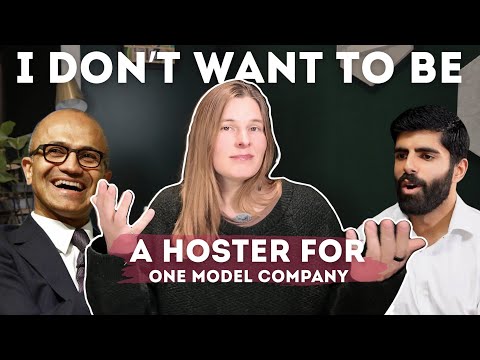
Clip command
yt-dlp --download-sections "*4:07-4:55" "https://www.youtube.com/watch?v=Bqou0T-Wxnk" --force-keyframes-at-cuts --merge-output-format mp4 -o "Bqou0T-Wxnk-4m07s.mp4"“But you’ve gone from near 100% or certainly way above 50% to, you know, sub 25% market share in just one year. What is the sort of confidence that people can get that Microsoft…” “There’s no, again, it goes back a little bit to sort of there’s no birthright here that we should have any confidence other than to say hey we should go innovate.” — Satya Nadella, 4:07
”Sovereignty in chips is a bit of a scam”
Clip command
yt-dlp --download-sections "*8:19-9:05" "https://www.youtube.com/watch?v=Bqou0T-Wxnk" --force-keyframes-at-cuts --merge-output-format mp4 -o "Bqou0T-Wxnk-8m19s.mp4"“Sovereignty in chips is a bit of a scam. Countries still end up buying them from Taiwan because reality beats politics.” — Dylan Patel, 8:28
”It’s run anywhere as long as anywhere means Azure”
Clip command
yt-dlp --download-sections "*7:18-8:10" "https://www.youtube.com/watch?v=Bqou0T-Wxnk" --force-keyframes-at-cuts --merge-output-format mp4 -o "Bqou0T-Wxnk-7m18s.mp4"“Satya keeps emphasizing that OpenAI API is stateless and can theoretically run anywhere and everywhere. But then explains that every meaningful partner who uses it will still end up on Azure. Stateless or not, the gravity pulls everything back into Microsoft’s cloud. It’s run anywhere as long as anywhere means Azure.” — Host analysis, 8:00
”You can learn more from Satya’s body language”
Clip command
yt-dlp --download-sections "*10:16-11:10" "https://www.youtube.com/watch?v=Bqou0T-Wxnk" --force-keyframes-at-cuts --merge-output-format mp4 -o "Bqou0T-Wxnk-10m16s.mp4"“You can learn more about the future of AI and Microsoft from Satya’s body language in this conversation than from some of the actual answers.” — Host, 10:59
Key Points
-
Attention Span Series Introduction (0:00) - Host explains this episode analyzes layers beyond the surface conversation in Dwarkesh’s interview with Satya Nadella
-
Dylan Patel’s Role (0:33) - Dylan from SemiAnalysis likely trained Dwarkesh on numbers and conversation patterns, making this interview more incisive than typical CEO interviews
-
Fairwater 2 Facility Tour (1:20) - Interview opens at Microsoft’s Atlanta facility, described as the most powerful AI facility in the world, where Nadella appears comfortable and proud
-
AI as Guardian Angel Metaphor (2:25) - Nadella shares Raj Reddy’s metaphor for AI as cognitive amplifier; Reddy was a 1994 Turing Award winner and CMU Robotics Institute co-founder
-
Coding Agent Competition (3:14) - Dylan presses on whether Microsoft can stay competitive as Copilot faces rivals like Claude Code, Cursor, and Cognition
-
First Defensive Moment (3:54) - At 19:13 in the original interview, Nadella crosses his arms for the first time after being pressed on market share decline from 100% to sub-25%
-
Scaffolding vs. Model Power Question (4:33) - Core tension: does long-term power sit with the scaffolding layer (tools, data, orchestration) or with model companies like OpenAI and Anthropic?
-
Microsoft’s AI Timeline Strategy (5:12) - Four pillars: wrapper era is dead, seven more years of OpenAI models while building MAI, Azure becomes model-agnostic, Microsoft becomes agent infrastructure
-
Computers for Agents (6:02) - Microsoft’s future is provisioning computers, security, and storage for agents; per-user economics becomes per-user plus per-agent
-
Multi-Model Future Prediction (6:27) - Nadella believes no single model will dominate all domains, geographies, and segments; compares to database market diversity
-
OpenAI API Contradiction (7:18) - While emphasizing the API is “stateless” and can run anywhere, Nadella admits partners will end up on Azure anyway
-
Sovereignty Scam (8:25) - Dylan notes chip sovereignty is a scam since countries still buy from Taiwan; Nadella pitches US-led AI factories globally while claiming globalization is over
-
Trust as Differentiator (9:15) - Nadella argues trust in the company and country behind it will ultimately win the world market, not just model quality
-
MAI Team Tension (9:45) - Contradiction noted: Nadella talks about building world-class superintelligence team while their flagship MAI model debuted at rank 36 on Chatbot Arena
-
The Biggest Grill (10:18) - Most brutal stretch where Dylan asks why Microsoft paused capacity while competitors snapped up data center sites
-
Oracle Overtaking Microsoft (10:45) - Question raised about how Oracle went from one-fifth Microsoft’s scale to possibly overtaking them by 2027
Mentions
Companies
- Microsoft (0:26) - Subject of the interview; strategy and contradictions analyzed throughout
- SemiAnalysis (0:33) - Dylan Patel’s company; semiconductor and AI analysis firm
- OpenAI (4:52) - Microsoft’s AI partner; exclusive API rights discussed
- Anthropic (4:55) - Mentioned as model company whose margins are rising
- GitHub (3:38) - Nadella’s deflection about competitive advantage in coding
- Google (10:39) - Snapped up data center sites Microsoft abandoned
- Meta (10:39) - Snapped up data center sites Microsoft abandoned
- AWS (10:42) - Snapped up data center sites Microsoft abandoned
- Oracle (10:42) - May overtake Microsoft in scale by 2027
- Carnegie Mellon University (2:37) - Raj Reddy co-founded the Robotics Institute there
- Cognition (3:27) - Mentioned as competitor in coding agent market
Products & Technologies
- Copilot (3:21) - Microsoft’s AI assistant, facing strong competition
- Claude Code (3:24) - Mentioned as rival to Copilot in coding agent space
- Cursor (3:27) - Mentioned as competitor to Microsoft in coding
- Azure (5:39) - Microsoft’s cloud platform becoming model-agnostic
- MAI (5:37) - Microsoft’s internal AI model family being developed
- Excel agents (5:20) - Example of deep native integration in Microsoft products
- Chatbot Arena (10:12) - Benchmark where MAI model debuted at rank 36
- Fairwater 2 (1:26) - Microsoft’s AI data center facility in Atlanta
People
- Satya Nadella (0:26) - CEO of Microsoft, subject of the interview analysis
- Dwarkesh Patel (0:06) - Podcast host who conducted the original interview
- Dylan Patel (0:33) - SemiAnalysis analyst who co-interviewed and asked challenging questions
- Raj Reddy (2:31) - 1994 Turing Award winner, source of guardian angel AI metaphor
- Allen Newell (2:44) - AI pioneer from same generation as Raj Reddy
- Herbert Simon (2:44) - AI pioneer mentioned in context of Raj Reddy’s generation
- John McCarthy (2:47) - AI pioneer mentioned in context of Raj Reddy’s generation
- Mustafa Suleyman (10:03) - Part of Microsoft’s superintelligence team
- Nando de Freitas (10:05) - Part of Microsoft’s superintelligence team
Surprising Quotes
“Your framing of this seems quite different than sort of the, I would say, the AI bro who is quite, um, you know, AGI is coming.” — 2:12
“There’s no birthright here that we should have any confidence other than to say hey we should go innovate.” — 4:18
“It’s run anywhere as long as anywhere means Azure.” — 8:00
“Sovereignty in chips is a bit of a scam. Countries still end up buying them from Taiwan because reality beats politics.” — 8:28
“You can learn more about the future of AI and Microsoft from Satya’s body language in this conversation than from some of the actual answers.” — 10:59
Transcript
0:00 Welcome to Attention Span. It becomes a tradition when Dwarkesh publishes his new podcast. I sort of have to watch it now to see beyond the conversation to see the layers that it consists of. And this episode is going to be fun. Not that many times, maybe even never, you can see Satya Nadella, CEO of Microsoft, being grilled by an analyst.
0:33 How lucky Dwarkesh was that Dylan Patel from SemiAnalysis was right next to him. And I actually think that Dylan probably not exactly scripted the whole conversation but for sure trained Dwarkesh on numbers and on the whole pattern of the conversation. It’s a great conversation and the funny thing about it is that you actually don’t have to watch the whole hour and 28 minutes because there is a lot of corporate language.
1:02 But if you do watch it, I want to point out a few things that you might find interesting. Also, I will distill some main points for you if you don’t want to watch it. And the main thing is when you notice the body language, sometimes it tells a lot.
1:20 The interview opens up with a tour of Fairwater 2 in Atlanta. This is probably the most powerful AI facility in the world right now. Satya is animated, comfortable, almost proud. He flexes numbers. This is the part he enjoys. And then we are in a studio and he had no idea that he’s going to be grilled. Though the questions to the interview most likely have been sent before in advance because Satya says an interestingly framed sentence: “So that goes back a little bit to I think the dialogue we’ll have.”
1:57 He’s not expecting what’s going to follow. First 19 something minutes are not very interesting. Dylan probably as an homage to Dwarkesh Patel’s obsession about AGI asks about it, but the way he did it made me laugh: “Your framing of this seems quite different than sort of the, I would say, the AI bro who is quite, um, you know, AGI is coming.” Thank you Dylan.
2:21 Answering to that, Satya shares an amazing metaphor for AI as a guardian angel or cognitive amplifier. This metaphor belongs to Raj Reddy, Turing Award winner in 1994. He’s also co-founder of Carnegie Mellon University Robotics Institute and he is from the same generation as Newell, Simon, and McCarthy.
2:49 After this, Satya, Dwarkesh, and Dylan spent more than 10 minutes just throwing words at each other in this mostly corporate stuff which can be summarized as Dwarkesh pushes the AGI as economic revolution angle and Satya keeps pulling it back to corporate reality which means diffusion workflows and how productivity actually shows up in the real world.
3:14 In the middle of that, Dylan tries to press him on whether Microsoft can stay competitive now that Copilot is not the only agent and has strong rivals like Claude Code and Cursor and Cognition and others and whether Microsoft still has any real advantage as the coding agent market explodes. But Satya dodges this question saying how good GitHub is, how everyone is on GitHub and how happy he is for his competitors.
3:44 Right? Satya Nadella who looks like a warrior and is a brilliant business shark. The real tension starts at 19:13 when Satya crosses his arms for the first time and comes off noticeably defensive. But of course, Satya being Satya immediately switches to the corporate language.
4:07 “But you’ve gone from near 100% or certainly way above 50% to, you know, sub 25% market share in just one year. What is the sort of confidence that people can get that Microsoft…” “There’s no, again, it goes back a little bit to sort of there’s no birthright here that we should have any confidence other than to say hey we should go innovate.”
4:29 Which is like blank, no tangible answers. At 24:27 Satya closes up again because Dylan insists on the explanation of the core tension: does long-term power sit with the scaffolding layer, the tools, data, and orchestration, because there will always be many interchangeable models, right? Or does it sit with the model companies themselves like OpenAI and Anthropic since their margins are rising fast and the model is turning into the real IP.
5:04 Again, there is some corporate stuff, but soon enough Satya Nadella starts sharing some very interesting information. What he lays out is basically Microsoft’s timeline and AI strategy. First, the wrapper era is dead. The real game is deep native integration like Excel agents living in the middle tier.
5:25 Second, Microsoft runs on two model tracks. Seven more years they’re going to use OpenAI models and he’s going to suck every possible juice out of it. Meanwhile, developing their own MAI family. Third, Azure becomes model agnostic supporting OpenAI, MAI, Anthropic, Groq, open source, everyone.
5:45 And long-term, Microsoft stops being just a tool company. It becomes the infrastructure for autonomous agents, providing them with computers, identity, security, storage, and observability. That’s his real roadmap. Sounds great.
6:02 So, what does it mean? Computers for agents. Satya sees Microsoft’s future in provisioning computers, security, storage for agents as well as people. And the interesting moment here is that per-user economics becomes per-user plus per-agent. The scaffolding survives even if the model acts like a worker.
6:27 They talk about one model dominating versus a world with many models. And Satya is quite explicit. He does not think one model will rule all domains, all geographies, and all segments. The design space is so large that there will be many. And this model discussion brings us to the contradictions and controversies that I noticed in this interview. And as body language tells you more than words, contradictions and controversies also tell you a lot.
6:58 First: multi-model, no winner takes all versus exclusive OpenAI leverage. Satya says there won’t be one dominant model. It’s like databases. Many types, many use cases. “There is not one model that is getting deployed broadly. In fact, there’s multiple models that are getting deployed. It’s kind of like databases, right? It’s always the thing. It’s like, hey, can one database be the one that just is used everywhere? Except it’s not.”
7:24 But Microsoft locks in exclusive stateless API rights with OpenAI. And there is a quite hilarious moment in the interview about that because Satya keeps emphasizing that OpenAI API is stateless and can theoretically run anywhere and everywhere. But then explains that every meaningful partner who uses it will still end up on Azure. Stateless or not, the gravity pulls everything back into Microsoft’s cloud. It’s run anywhere as long as anywhere means Azure.
8:04 So verbally, he’s anti-winner take all. Structurally, he’s making a very concentrated bet on one frontier lineage and trying to centralize that traffic on Azure.
8:19 The next contradiction is very interesting. It’s globalization is over versus AI factories as global US export. Dylan says it outright that sovereignty in chips is a bit of a scam. Countries still end up buying them from Taiwan because reality beats politics. At the same time, Microsoft is busy building Azure AI factories around the world, which looks more like globalization than deglobalization.
8:46 Satya replies: “Look, globalization was fantastic. It helped the supply chains be globalized and be super efficient, but there’s such a thing called resilience.” And this is this contradiction. Globalization is over, but at the same time, he pitches US-led AI factories all over the world as the best marketing for America, American capital, American hyperscalers, American tech stack everywhere. That sounds great, but it’s globalization.
9:13 And also, he’s very explicit about one thing. He thinks that what actually will win the world is trust. Not just model quality but trust. Can countries trust the company and the country itself behind it to be long-term partner and supplier? He says that that may be the thing that will win the world. Even if the current president is doing something right for tech industry, there are abstain files and so many lies. What trust exactly are we talking about? Just a question.
9:45 And there’s also a model tension, specifically MAI tension. Satya keeps talking about building a world-class superintelligence team that sounds like he admits that the current team fell behind. Yet in the same breath, he describes that same team as the core of the superintelligence effort. Mustafa Suleyman, Nando de Freitas, and others. Even though their flagship MAI model debuted around rank 36 on Chatbot Arena, they somehow didn’t ask about this contradiction at all.
10:16 And then comes the biggest grill. The most brutal stretch comes between 50 minutes and 1 hour plus minus. Satya folds his arms. His voice rises. He can actually be pretty loud. At one point, he’s literally picking at his nails while Dylan Patel goes down the list.
10:36 Why did Microsoft pause capacity? Why give up data center sites that Google, Meta, AWS, and Oracle immediately snapped up? How did Oracle go from one fifth Microsoft scale to possibly overtaking them by 2027? And did Microsoft accidentally create a new hyperscaler by stepping back?
10:59 And at that moment, you can learn more about the future of AI and Microsoft from Satya’s body language in this conversation than from some of the actual answers.
11:09 Conclusion. It is a phenomenal interview. Finally, this corporate shield was broken by some simple questions, just clarifications, just numbers. And if not for Dylan, this interview would be bleak and Microsoft corporate related. He made it almost into a show and thanks to him for that. I hope this distillation of their conversation was useful and please leave your comments and share it with your friends. I would love your feedback.