Sam Altman: "We do not want government guarantees for our datacenters". What is he actually saying?
Sam Altman: “We do not want government guarantees for our datacenters”. What is he actually saying?
Summary
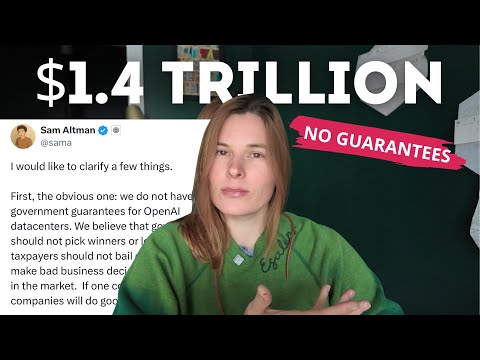
This video analyzes Sam Altman’s detailed Twitter post about OpenAI’s infrastructure spending plans and position on government involvement. Altman claims OpenAI does not want government bailouts or guarantees for its data centers, yet simultaneously proposes that governments should build their own “strategic reserve of compute” similar to strategic oil reserves. The host, Christena from Turing Post, unpacks the seeming contradiction in Altman’s statements.
The video explores OpenAI’s commitment to spend up to $1.4 trillion on infrastructure through 2033 - a figure three times larger than Denmark’s GDP. Altman attempts to answer three key questions: how will they pay for it, whether this makes OpenAI too central to fail, and why invest aggressively rather than scaling gradually. The host draws historical parallels to 19th century railroads, the nuclear industry, and the CHIPS Act, noting how each represented a blending of private capital and public infrastructure.
The analysis reveals a deeper tension between private ambition and public risk. While Altman insists the market should handle any failure, the sheer scale of the infrastructure commitment makes OpenAI look more like a state actor than a private company. The video concludes by noting that when a $1.4 trillion belief-driven investment becomes reality, it transforms from mere conviction into the system itself.
Highlights
”How Do You Build the Future Economy Without Becoming Too Big to Fail?”
Clip command
yt-dlp --download-sections "*0:00-0:55" "https://www.youtube.com/watch?v=5-7QpZsffiI" --force-keyframes-at-cuts --merge-output-format mp4 -o "5-7QpZsffiI-0m00s.mp4"“How do you build the future economy without becoming too big to fail?” — Turing Post Host, 0:00
”Governments Should Build Compute Reserves Like Strategic Oil Reserves”
Clip command
yt-dlp --download-sections "*2:36-3:30" "https://www.youtube.com/watch?v=5-7QpZsffiI" --force-keyframes-at-cuts --merge-output-format mp4 -o "5-7QpZsffiI-2m36s.mp4"“Governments should build their own compute reserves like strategic oil reserves, but for intelligence.” — Sam Altman (paraphrased), 2:45
”When a Company Signs Up for a Trillion, the Market Looks Like a State”
Clip command
yt-dlp --download-sections "*4:20-5:15" "https://www.youtube.com/watch?v=5-7QpZsffiI" --force-keyframes-at-cuts --merge-output-format mp4 -o "5-7QpZsffiI-4m20s.mp4"“When a company signs up for more than a trillion in infrastructure, the market starts to look more like a state itself.” — Turing Post Host, 4:32
”When $1.4 Trillion Belief Becomes Reality, It Becomes the System”
Clip command
yt-dlp --download-sections "*6:25-7:10" "https://www.youtube.com/watch?v=5-7QpZsffiI" --force-keyframes-at-cuts --merge-output-format mp4 -o "5-7QpZsffiI-6m25s.mp4"“It’s one thing to believe in something without proof. But when that belief drives $1.4 trillion of investment, it’s no longer just belief. It becomes the system itself.” — Turing Post Host, 6:32
Key Points
-
The Central Paradox (0:00) - How do you build the future economy without becoming too big to fail? This is the core question Altman tried to address this week.
-
$1.4 Trillion Infrastructure Commitment (0:20) - OpenAI is planning $1.4 trillion of infrastructure spending over the next 8 years through 2033.
-
Post Format Analysis (0:46) - Altman’s post reads like a CEO open letter - half financial disclosure, half national strategy memo.
-
Strategic Reserve of Compute (1:02) - Altman suggests governments should build their own AI infrastructure like a strategic reserve of compute - a new term in the AI economy.
-
Three Times Denmark’s GDP (1:41) - The $1.4 trillion commitment is three times larger than Denmark’s entire GDP.
-
The Capitalist Framing (2:24) - If OpenAI fails, others will fill the gap - that’s the market-based argument Altman makes.
-
Government Compute Reserves (2:43) - Governments should build compute reserves like strategic oil reserves, with benefits flowing to citizens rather than private firms.
-
Semiconductor Fabrication Exception (3:05) - The only area where loan guarantees make sense is semiconductor fabrication, relating to the US-China competition.
-
2025 Revenue Projection (3:35) - OpenAI expects to end 2025 with $30 billion in annualized revenue and grow to hundreds of billions by 2030.
-
Future Revenue Categories (3:56) - Compute sales, enterprise AI, robotics, and scientific discovery are expected to bring the needed revenue.
-
Build Now Logic (4:12) - Build capacity now because by the time it’s needed, it will already be late.
-
Market as State (4:35) - When a company commits to a trillion in infrastructure, the market starts to look more like a state itself.
-
Historical Parallels (4:39) - Railroads of the 19th century, nuclear industry, and CHIPS Act all represent government-private co-building of economic infrastructure.
-
Intelligence as Industrial Resource (5:07) - The strategic resource of compute represents a recognition that intelligence becomes itself an industrial resource.
-
AI as Public Utility (6:12) - If Altman is right, this is the early stage of a new kind of public utility that everyone will need in just a few decades.
-
Conviction Without Guarantees (6:27) - Altman’s position is conviction without guarantees - if he’s wrong, the market corrects, not taxpayers.
-
Belief Becomes System (6:38) - When a $1.4 trillion belief-driven investment becomes reality, it’s no longer just belief - it becomes the system itself.
Mentions
Companies
- OpenAI (0:20) - The subject of the video, planning $1.4 trillion infrastructure investment
- Nvidia (5:14) - Mentioned in context of financing and circular deals with OpenAI
- Turing Post (0:35) - The publisher of this analysis video
Products & Technologies
- GPUs (1:23) - Graphics processing units essential for AI training
- Data Centers (1:23) - Physical infrastructure for AI compute
- Frontier Foundation Models (1:17) - Advanced AI models that cost billions to train
- Strategic Reserve of Compute (1:05) - Proposed government-owned AI infrastructure concept
- Semiconductor Fabrication (3:09) - Chip manufacturing where loan guarantees may be justified
- Enterprise AI (3:56) - Business-focused AI applications
- Robotics (3:56) - Future revenue category for OpenAI
People
- Sam Altman (0:08) - CEO of OpenAI, author of the analyzed Twitter post
- Christena (0:31) - Host of Attention Span, writer at Turing Post covering ML and AI infrastructure
Policies & Acts
- CHIPS Act (4:52) - Recent US legislation for semiconductor manufacturing subsidies
Countries
- China (3:14) - Mentioned in context of US-China AI competition
- United States (3:14) - Mentioned in context of onshoring supply chains
- Denmark (1:44) - Referenced for GDP comparison ($1.4T is 3x Denmark’s GDP)
Surprising Quotes
“How do you build the future economy without becoming too big to fail?” — 0:00
“Governments should build their own compute reserves like strategic oil reserves, but for intelligence.” — 2:45
“When a company signs up for more than a trillion in infrastructure, the market starts to look more like a state itself.” — 4:32
“Build capacity now because by the time it’s needed, it will already be late.” — 4:16
“It’s one thing to believe in something without proof. But when that belief drives $1.4 trillion of investment, it’s no longer just belief. It becomes the system itself.” — 6:32
Transcript
0:00 How do you build the future economy without becoming too big to fail? That’s the paradox Sam Altman tried to explain this week. He went online and wrote, “We don’t want government guarantees.” Then he said something bigger. He said that the OpenAI is planning $1.4 trillion of infrastructure over the next 8 years. Let’s unpack what that means.
0:31 Welcome to Attention Span. My name is Christena. I’m writing Turing Post and I’m covering machine learning and AI infrastructure for the last 6 years. This week we’re discussing the post coming straight from Sam Altman’s Twitter. This very long and detailed post reads like a CEO open letter. Half financial disclosure, half national strategy memo.
0:55 Altman insists OpenAI does not want bailouts but also says that the government should consider building their own AI infrastructure like a strategic reserve of compute. This is a new term in the AI economy. So what’s really happening here? What does he propose?
1:13 As you know training frontier foundation models cost tons and tons and tons of billions in GPU energy and data centers. But Altman insists the bigger risk is too little compute, not too much. Hence locking in multi-year capacity. OpenAI’s commitment through 2033 could total in $1.4 trillion. It’s three times bigger if you think about it than Denmark GDP.
1:48 That raises three questions. How will they pay for it? Will it make OpenAI too central to fail? Why invest fast ahead instead of scaling gradually? Altman tries to answer all three questions and his answers reveal how the AI economy is mutating into an infrastructure race.
2:10 The question number one, how will they pay for it? So, as they say, OpenAI doesn’t want taxpayer money and taxpayer guarantees for its data centers. If the company fails, others will fill the gap. That’s the capitalist framing. Sam Altman makes a point on it. It’s capitalism. So if one company fails, there will be bunch of others who will fill the gap.
2:36 Will it make OpenAI too central to fail? And it’s kind of a little bit contradictory with his first statement. I feel like that’s how he explains it. Governments should build their own compute reserves like strategic oil reserves, but for intelligence and in that case the benefits should flow to citizens not to private firms. Lower cost of capital, public ownership, national priority.
3:02 Why invest fast ahead and not scale gradually? The only area where loan guarantees make sense he says is semiconductor fabrication and it relates to the constant battle between China and US who is first in this AI race. And that’s important because supply chain in the US wants to be onshore to be able to win in this race and he says that that’s an industrial policy not corporate insurance.
3:30 And finally he explains the spending. OpenAI expects to end 2025 with $30 billion of annualized revenue and grow to hundreds of billions by 2030. Hundreds of billions are still not 1.4 trillion. He doesn’t explain that, but he says that compute sales, enterprise AI, robotics, scientific discovery, categories that don’t exist yet, but will, will bring this money into the company.
4:04 So though he does not explain how hundreds of billions goes into a trillion, this is his growth logic behind trillion dollar commitments. Build capacity now because by the time it’s needed, it will already be late.
4:20 But underneath this post lays a deeper controversy and deeper tension between private ambition and public risk. Altman says if OpenAI fails, the market should handle it, right? But when a company signs up for more than a trillion in infrastructure, the market starts to look more like a state itself.
4:39 We’ve seen versions of this before. The railroads of the 19th century built with private capital and public land grants, the nuclear industry with government insurance as the backdrop, and more recently the chip fabs under CHIPS Act. Each time the governments and companies co-build the next layer of the economy and each time the balance between sovereignty and dependency shifts.
5:03 So Altman’s strategic resource of compute might be the next layer. A recognition that intelligence becomes itself an industrial resource. Meanwhile, reporting of Nvidia OpenAI financing and circular deals explains why the market keeps asking where public risk begins and ends.
5:25 And by the way, we just published a deep dive into GPU becoming a new currency. It’s certainly worth checking if you want to understand the bigger picture.
5:35 Altman closes his post by describing the scale of the bet. OpenAI is racing to build the backbone of an AI powered economy. He sees it as one of the most important things in the current age. Data centers, chips, energy before the demand wave peaks. He says we need to be ready before it all becomes just a massive massive massive demand.
6:01 His vision is the world of abundance for everyone and cheap AI like electricity where compute becomes as accessible as electricity. And if he’s right, this is the early stage of a new kind of public utility that everyone will need in just a few decades. But if he’s wrong, the market will correct, not the taxpayers. That’s his vision.
6:25 So here is the line that he tries to draw, conviction without guarantees. But the thing here is that it’s one thing to believe in something without proof. But when that belief drives $1.4 trillion of investment, it’s no longer just belief. It becomes the system itself.
6:46 Thank you for watching. Let me know what you think. I hope you will read the deep dive about GPU as new currency. I think it’s a very interesting paradigm to think through and to use as you’re thinking about the markets and the states and what’s happening in AI. Please leave your comments and share.