Kimi K3 Just Sold Out. Then It Got Political
Kimi K3 Just Sold Out. Then It Got Political
Summary
This episode of Attention Span tracks a single wild weekend in the open-model race. On Sunday, Moonshot AI paused new consumer subscriptions to Kimi K3 — the world’s largest open model — just three days after launch, after demand pushed its GPU capacity to the limit. Host Ksenia Se explains why this “sell out” is really an economics story: K3’s flagship use case is agentic coding sessions that run for hours making repeated tool calls, so every new subscriber is a continuous compute obligation, not a one-off query. With Moonshot preparing a Hong Kong IPO at a potential $30B+ valuation and ARR climbing from $200M to $300M between April and June, a model too popular to sell becomes a persuasive pitch to investors rather than a failure — and the July 27 open-weights release becomes an overflow valve that lets large customers self-host instead of waiting in Moonshot’s queue.
The same weekend carried a bigger political story. On Friday, Xi Jinping opened the World AI Conference in Shanghai and urged the world to embrace open-source AI as a public good, alongside the launch of a new Shanghai-based international body (WAICO) joined by 29 countries — notably excluding the US and Europe. On Saturday, Alibaba teased a 2.4-trillion-parameter Qwen model with a promise to release it openly, despite Alibaba holding a roughly 36% stake in Moonshot — meaning these aren’t unrelated companies but one ecosystem escalating openness in the same direction, in public, days apart. Ksenia lays out three converging logics behind China’s open-weight push: commercial (closed Chinese APIs have no path to distrustful Western enterprise customers), industrial (giving away models for free builds inference demand for domestic chips like Huawei’s, where China can already compete even while depending on Nvidia for training), and diplomatic (Xi’s speech turns model releases into foreign policy and a rival infrastructure offer to the US subscription model).
The episode closes on Monday morning’s twist: Axios reported the Trump administration is showing signs it could move to ban cutting-edge Chinese AI models. Ksenia argues such a ban could reach hosted APIs, app stores, and procurement — but not the weights themselves, which become downloadable, copyable files the moment they’re published. The constraint on open AI, she argues, has moved twice in one weekend: from capability to compute, and now from compute to permission.
Highlights
”896 Experts, 16 Activated Per Token”
“Remember the 2.8 trillion parameters from last week? The router activates only 16 out of 896 experts per token, but all of them still have to be stored and served.” — Ksenia Se, 2:29
Clip command
yt-dlp --download-sections "*2:29-2:52" "https://www.youtube.com/watch?v=-zxxo7_KPOs" --force-keyframes-at-cuts --merge-output-format mp4 -o "kimi-k3-896-experts.mp4"”Proof of Demand, Right Before a Listing”
“A model too popular to sell is an unusual pitch to investors. It is also a persuasive one. The shortage becomes proof of demand, right before a listing.” — Ksenia Se, 3:16
Clip command
yt-dlp --download-sections "*3:16-3:54" "https://www.youtube.com/watch?v=-zxxo7_KPOs" --force-keyframes-at-cuts --merge-output-format mp4 -o "proof-of-demand-before-listing.mp4"”Jensen Huang Is Pissed Because of That”
“Open weights therefore become a distribution strategy for technical standards, developer habits and international relations. Jensen Huang is pissed because of that.” — Ksenia Se, 7:06
Clip command
yt-dlp --download-sections "*7:06-7:25" "https://www.youtube.com/watch?v=-zxxo7_KPOs" --force-keyframes-at-cuts --merge-output-format mp4 -o "jensen-huang-pissed.mp4"”A Product vs. a Sphere of Influence”
“If the American offer to the world is intelligence as a subscription, the Chinese offer is now intelligence as infrastructure. Something you are given, run yourself, and build on. One is a product, the other is a sphere of influence.” — Ksenia Se, 9:24
Clip command
yt-dlp --download-sections "*9:24-9:52" "https://www.youtube.com/watch?v=-zxxo7_KPOs" --force-keyframes-at-cuts --merge-output-format mp4 -o "product-vs-sphere-of-influence.mp4"”A Ban Cannot Reach the Weights Themselves”
“It cannot reach the weights themselves. After July 27th, when Kimi K3 promised to publish their weights, those weights will become files. Downloadable, copyable, and runnable by anyone with the right hardware.” — Ksenia Se, 10:43
Clip command
yt-dlp --download-sections "*10:43-11:08" "https://www.youtube.com/watch?v=-zxxo7_KPOs" --force-keyframes-at-cuts --merge-output-format mp4 -o "ban-cannot-reach-weights.mp4"Key Points
- Kimi K3 sells out in 48 hours (0:00) - Moonshot AI paused new Kimi K3 subscriptions three days after launch after demand pushed GPU capacity to its limit (“our GPUs are feeling it”)
- The weekend’s four events (0:29) - Xi Jinping endorsed open-source AI at WAIC on Friday, Alibaba teased a 2.4T-parameter open Qwen model on Saturday, K3 sold out on Sunday, and Axios reported possible US bans on Monday
- Weights not out yet (1:23) - Kimi K3’s weights are promised for July 27th; until then it exists only as a hosted service on Moonshot’s own clusters
- Two-tier membership split (1:51) - Moonshot split membership into a web/app tier and a separate “Kimi Code” tier for programming workflows, signaling different compute economics
- Agentic coding as the compute sink (2:03) - An agentic coding session can run for hours with repeated tool calls and enormous context, making each coding subscriber a continuous compute obligation rather than a one-off query
- 896 experts, 16 activated (2:29) - K3’s 2.8 trillion parameters route through only 16 of 896 experts per token, but all experts still must be stored and served
- Moonshot’s Hong Kong IPO (2:52) - Moonshot is preparing a Hong Kong IPO at a potential valuation above $30 billion, with ARR reportedly reaching $300 million in June, up from $200 million in April
- Shortage as investor pitch (3:16) - Read against the IPO numbers, the sell-out becomes proof of demand right before a listing rather than a failure
- Open weights as overflow valve (3:33) - The July 27 weights release lets large customers run K3 on their own hardware and skip Moonshot’s queue entirely, serving as a capacity release valve
- Databricks feels the squeeze too (3:54) - Databricks’ CEO said demand for hosting open-source models like Kimi has been so strong the company is running out of GPUs across multiple regions
- Qwen 2.5 teased at 2.4T parameters (4:24) - Alibaba announced a multimodal Qwen 2.5 model, claimed to be second only to Claude 3.5 Sonnet, and unusually promised to release it open-weight
- Alibaba owns ~36% of Moonshot (5:03) - Alibaba and Moonshot are not unrelated competitors but one ecosystem escalating openness in public, days apart
- Xi Jinping’s WAIC keynote (5:27) - Xi attended Shanghai’s World AI Conference for the first time, framing China’s open models as a public good and urging countries to seize the “historical opportunity” of open-source AI
- WAICO launches with 29 countries (5:52) - The Shanghai-based World Artificial Intelligence Cooperation Organization launched with 29 member countries including ASEAN, the African Union, and BRICS — the US and Europe were not included
- Chip constraints shape the strategy (6:27) - US export controls constrain China at the advanced chip layer, giving Beijing incentive to make the model layer portable and hard to contain instead
- Three converging logics (7:53) - Ksenia identifies commercial (closed Chinese APIs can’t win distrustful Western customers), industrial (free models build inference demand for domestic chips), and diplomatic (Xi’s speech turns releases into foreign policy) logics all pointing toward openness
- Free model, locked-in compute (8:59) - Giving away the model builds the market for domestic inference hardware like Huawei’s chips, where China can already compete even while still depending on Nvidia for training
- Different from the DeepSeek moment (9:52) - Unlike last year’s DeepSeek moment, this alignment of openness now has capital, chips, and the Foreign Ministry behind it
- Axios reports possible US ban (10:02) - The Trump administration is reportedly showing signs it could move toward banning cutting-edge Chinese AI models, reigniting earlier de facto ban efforts
- What a ban can and can’t reach (10:35) - A ban could reach hosted APIs, app stores, government procurement, and enterprise compliance — but not the downloadable weight files themselves
- From capability to compute to permission (11:08) - The constraint on open AI moved twice in one weekend: first from capability to compute (GPUs are now the bottleneck), then from compute to permission (who is allowed to choose a model)
Mentions
Companies
- Moonshot AI (0:00) - Maker of Kimi K3; paused subscriptions after a GPU-capacity sellout while preparing a Hong Kong IPO
- Alibaba (0:41) - Teased a 2.4-trillion-parameter open Qwen 2.5 model; holds a roughly 36% stake in Moonshot
- Databricks (3:54) - Hosts open-source models like Kimi for customers; CEO said demand is outrunning available GPUs across regions
- DeepSeek (3:00) - Cited as a Moonshot competitor also raising capital specifically to buy compute
- Huawei (6:37) - Showcased newest AI computing systems at WAIC; domestic inference chips positioned to benefit from China’s open-model push
- Nvidia (6:27) - Chinese labs still depend heavily on Nvidia for training compute even as they push inference to domestic chips
Products & Technologies
- Kimi K3 (0:00) - Moonshot’s 2.8-trillion-parameter open model (896 experts, 16 active per token); weights promised July 27th
- Kimi Code (1:51) - Separate Moonshot membership tier for agentic coding workflows, split from the general web/app tier
- Qwen 2.5 (4:24) - Alibaba’s teased 2.4-trillion-parameter multimodal model, claimed to rival Claude 3.5 Sonnet, promised as open-weight
- WAICO (World AI Cooperation Organization) (5:52) - New Shanghai-based international body launched with 29 member countries around AI training, standards, and governance
People
- Xi Jinping (0:29) - Opened the World AI Conference in Shanghai, framed open-source AI as a public good and foreign-policy pillar
- Nathan Lambert (4:47) - Open model researcher who noted a shift in how Chinese labs decide what to release openly
- Jensen Huang (7:06) - NVIDIA CEO invoked as being displeased by open weights becoming a distribution strategy that could reduce chip lock-in
Surprising Quotes
“An AI model sold out is a strange sentence, I agree, but it’s a good one because it catches your attention.” — Ksenia Se, 1:23
“For Chinese labs, openness is not generosity, it’s the only distribution channel that works.” — Ksenia Se, 8:14
“Give away the model and you build the market for your own hardware underneath it. The model is free, the compute is where you can get locked in.” — Ksenia Se, 9:00
“A ban would not remove Chinese models from the world. It would decide which developers build on them openly and which build on them without saying so.” — Ksenia Se, 10:57
Transcript
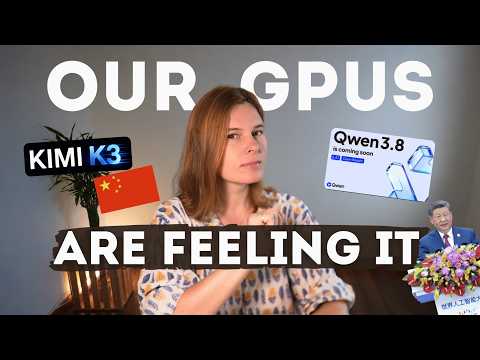
Ksenia Se: 0:00 On Sunday, the world’s largest open model sold out. Moonshot AI paused new subscriptions to Kimi K3, three days after launch. Demand over 48 hours had pushed close the limits of its computing capacity. Their exact words are “our GPUs are feeling it”.
Ksenia Se: 0:18 Last week I asked, who can run those enormous open models? The first answer came faster than I expected, actually. For a moment there, not even the company that built one.
Ksenia Se: 0:29 And the sell-out is only the smallest event of the weekend. On Friday, Xi Jinping personally opened China’s largest AI conference and told the world to embrace open-source AI.
Ksenia Se: 0:41 On Saturday, Alibaba teased its 2.4 trillion parameter model and promised to release it openly.
Ksenia Se: 0:50 And on Monday morning, Axios reported that the Trump administration is showing signs it could ban Chinese models entirely. In only four days, a lot of things happened and changed about what’s going on with the open model race in the whole world.
Ksenia Se: 1:07 Welcome to Attention Span by Turing Post. My name is Ksenia and today we’re going to look at what sold out, why the shortage serves both Moonshot and Beijing, and why Washington’s answer may be a bad one.
Ksenia Se: 1:23 An AI model sold out is a strange sentence, I agree, but it’s a good one because it catches your attention. Let’s see what exactly does it mean. The weights of Kimi K3 are not out yet. They are promised for July 27th.
Ksenia Se: 1:38 Until then, K3 exists only as a hosted service on Moonshot’s own clusters. When usage exceeded forecasts within 48 hours of launch, Moonshot suspended new consumer subscriptions.
Ksenia Se: 1:51 Existing subscribers are well protected. New spots will reopen in batches as capacity is added. Moonshot also split its membership into two tiers, one for the web and app products, and a separate Kimi Code membership for programming workflows.
Ksenia Se: 2:03 That split is an important signal because it signals about economics. K3 was built for exactly the workflows that consume the most inference. An agentic coding session can run for hours, making repeated tool calls and holding enormous context.
Ksenia Se: 2:18 And the regular chat user maybe asks a couple of questions and leaves. So every new coding subscriber is not just a user for the model, each one is a small continuous compute obligation.
Ksenia Se: 2:29 And remember the 2.8 trillion parameters from last week? The router activates only 16 out of 896 experts per token, but all of them still have to be stored and served.
Ksenia Se: 2:44 When the flagship use case is a model working on its own for hours, capacity runs out fast. Now the part that I find most interesting.
Ksenia Se: 2:52 This is an economics story. Moonshot, the company behind Kimi models, is preparing a Hong Kong IPO.
Ksenia Se: 3:00 The potential valuation is above $30 billion. Annual recurring revenue reportedly reached $300 million in June, up from $200 million in April. Competitors including DeepSeek are also raising capital specifically to buy compute.
Ksenia Se: 3:16 Now, when you read those numbers together, the pause does not look like a failure anymore. Quite the opposite. A model too popular to sell is an unusual pitch to investors. It is also a persuasive one. The shortage becomes proof of demand, right before a listing.
Ksenia Se: 3:33 The July 27 weights release feeds this logic too. Once the weights are public, larger customers can run Kimi on their own hardware and skip the queue entirely. Open weights become the overflow valve for Moonshot’s own capacity problem. Customers with infrastructure serve themselves. Moonshot’s clusters serve everyone else.
Ksenia Se: 3:54 And last week we asked, what are open weights for if you cannot run the model yourself? Here is a concrete answer. They’re for people who can, and this weekend showed that even the model’s creator needs those people to exist. But even them are feeling GPU constraints. This is the latest message from Databricks CEO.
Ksenia Se: 4:15 We host open-source models such as Kimi and offer them to our customers. Demand has been so strong that we are running out of GPUs across multiple regions.
Ksenia Se: 4:24 And while Moonshot was rationing GPUs, Alibaba announced Qwen 2.5 with potentially 2.4 trillion parameters, multimodal, claimed to be second only to Claude 3.5 Sonnet. And this is an unusual part for Qwen, they’re going open weight.
Ksenia Se: 4:47 This is just a promise for now, a preview and a promise, because every capability claim attached to Qwen 2.5 right now is unaudited. But the strategic signal is very important even without the data. Qwen’s biggest MoE models have stayed closed in recent generations. Open model researcher Nathan Lambert pointed out that something is changing in how Chinese labs decide what to release.
Ksenia Se: 5:03 And one more detail, Alibaba holds a stake of roughly 36% in Moonshot. So these are not two unrelated companies racing. This is one ecosystem escalating in public, days apart, in the same direction towards open. Why the same direction?
Ksenia Se: 5:27 Because three days before the show, the direction was announced from the biggest stage China has. On Friday, Xi Jinping attended the World AI Conference in Shanghai for the first time and delivered the opening keynote. He urged countries to seize the historical opportunity of open-source AI. He framed China’s open models as a public good, and then another thing was announced alongside the speech, because 29 countries had agreed to establish the Shanghai-based World Artificial Intelligence Cooperation Organization.
Ksenia Se: 6:00 Open weights, or I’ll call it Waco, W-A-I-C-O. Xi promised 5,000 AI training opportunities and application centers with groups including ASEAN, the African Union and BRICS. The USA and Europe were not included.
Ksenia Se: 6:14 Waco does not require its members to adopt Chinese models, but it gives China an institutional form for the training, standards and governance discussions that shape which ecosystems gain adoption.
Ksenia Se: 6:27 American export controls still constrain China at the most advanced chip layer, which gives Beijing an incentive to make the model layer portable, inexpensive to adopt, and difficult to contain.
Ksenia Se: 6:41 A downloadable model can run on another country’s infrastructure, support local services and reach developers without a Chinese cloud.
Ksenia Se: 6:54 Waco training programs and standards discussions can provide institutional channels around that technology. So when countries train engineers and build products around Chinese model families, China gains influence even if they host the models themselves.
Ksenia Se: 7:06 Open weights therefore become a distribution strategy for technical standards, developer habits and international relations. Jensen Huang is pissed because of that.
Ksenia Se: 7:17 This is Xi Jinping’s clearest articulation yet of China’s ambition to shape global AI governance.
Ksenia Se: 7:25 The same conference showcased Huawei’s newest AI computing systems and the chip crunch immediately strengthened the argument for domestic inference chips.
Ksenia Se: 7:37 So assemble the week from Beijing’s side. The head of state declares open models a pillar of foreign policy on Friday. The country’s top open model sells out over the weekend. The largest tech company announces its biggest model ever will be open.
Ksenia Se: 7:53 Which raises the real question: what is the plan here? And here’s my read, and it works on three levels.
Ksenia Se: 7:59 The first level is commercial and it’s the simplest level. A closed Chinese model has no path to global customers. That’s clear. No Western enterprise would send its data to a closed Chinese API that also trails the frontier.
Ksenia Se: 8:14 Open weights dissolve that objection. You can inspect the model, host it yourself and keep your data in your own building. For Chinese labs, openness is not generosity, it’s the only distribution channel that works. And it is working now. Chinese models have reportedly been overtaking American ones in monthly open model token use.
Ksenia Se: 8:37 The second level is industrial. Almost every company builds their own base models in China because controlling the stack is the default instinct.
Ksenia Se: 8:46 Open first is the practical extension of that. Releases bring feedback, ecosystem and talent. And Chinese labs still depend on Nvidia for training heavily. Everyone wants more of those chips than they can get.
Ksenia Se: 8:59 But inference is different, and inference is where Huawei and a dozen domestic chip lines can already compete. And a free, popular open model generates exactly one thing at scale, inference demand. So give away the model and you build the market for your own hardware underneath it. The model is free, the compute is where you can get locked in.
Ksenia Se: 9:11 And the third level is the state. Xi Jinping’s speech turned a commercial equilibrium into foreign policy. Models as a public good, training programs for the Global South, a new international organization headquartered in Shanghai.
Ksenia Se: 9:24 If the American offer to the world is intelligence as a subscription, the Chinese offer is now intelligence as infrastructure. Something you are given, run yourself, and build on. One is a product, the other is a sphere of influence.
Ksenia Se: 9:39 So the plan as far as I can see is not a directive from the top. It’s three logics: distribution, hardware, and diplomacy that all point in the same direction. And the state has now noticed they aligned.
Ksenia Se: 9:52 That alignment is what makes this different from the DeepSeek moment last year. This time, openness has capital, chips, and the Foreign Ministry behind it.
Ksenia Se: 10:02 Which brings us to Monday morning. Today morning, according to Axios, the Trump administration is showing signs it could ban cutting-edge Chinese AI models.
Ksenia Se: 10:13 Parts of that administration have attempted de facto bans on foreign open source models before. Kimi’s rise last week is reportedly reigniting those efforts.
Ksenia Se: 10:25 I will hold my judgment until there is a policy to read. But it’s worth mentioning what a ban of an open model can and cannot reach.
Ksenia Se: 10:35 It can reach hosted APIs, app stores, government procurement, and enterprise compliance departments.
Ksenia Se: 10:43 It cannot reach the weights themselves. After July 27th, when Kimi K3 promised to publish their weights, those weights will become files. Downloadable, copyable, and runnable by anyone with the right hardware.
Ksenia Se: 10:57 A ban would not remove Chinese models from the world. It would decide which developers build on them openly and which build on them without saying so.
Ksenia Se: 11:08 So in one weekend, the constraint on open AI moved twice. First from capability to compute — the models are strong enough now that the bottleneck is GPUs. Then from compute to permission. Because the next question about the model you use may not be whether it is good enough or whether you can afford to run it, but whether you will be allowed to choose it at all.
Ksenia Se: 11:29 The weights drop on July 27th. What governments do after that may shape this race more than any benchmark.
Ksenia Se: 11:37 That’s it for today. Please tell me in the comments which constraint do you think decides this race: compute or policy? And thank you for watching. I’ll see you at the end of this week.