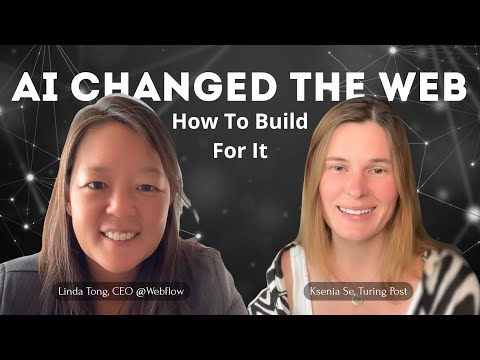
AI CHANGED THE WEB. Here's How to Build for It | A conversation with Linda Tong, CEO of Webflow
AI CHANGED THE WEB. Here’s How to Build for It | A conversation with Linda Tong, CEO of Webflow
Summary
Linda Tong, CEO of Webflow, discusses the fundamental shift happening on the web as AI bots and agents become a major portion of website traffic. She explains that some sites now see up to 90% bot traffic, and this trend is accelerating rapidly toward becoming the majority of all web traffic by year’s end. The conversation explores what this means for businesses and how they need to adapt their web presence for both human and AI audiences.
The discussion delves into the emerging concept of AEO (Agentic Engine Optimization), which Tong describes as the new SEO for AI-powered chatbots and agents. Unlike traditional SEO, AEO emphasizes authenticity, content freshness, site structure clarity, and references from platforms like Reddit. Tong argues that blocking bots is not an option - instead, businesses need to make their sites easily understandable and indexable by AI systems while also considering how to enable agents to take actions on their sites through APIs and MCPs.
Tong shares her vision for a hybrid future where websites serve dual purposes: delighting humans with visual experiences while providing semantic, structured data for AI agents. She discusses Webflow’s plans to evolve beyond just website creation into helping businesses build dynamic, personalized experiences that transform based on each visitor. The conversation concludes with Tong’s recommendation of “Ender’s Game” as a leadership philosophy guide, emphasizing empathy and kindness as leadership strengths, and her call for building “kind AI.”
Highlights
”Bot traffic will be the majority by year’s end”
Clip command
yt-dlp --download-sections "*1:57-2:25" "https://www.youtube.com/watch?v=-zgvAukEDFE" --force-keyframes-at-cuts --merge-output-format mp4 -o "-zgvAukEDFE-1m57s.mp4"“It started way like over a year ago. We started seeing these trends early last year. It became wildly disruptive last summer and like I’ve only seen it increase. If I were to follow the trend lines of what I’m seeing, it’s going to be a majority of traffic by the end of this year.” — Linda Tong, 1:57
”We need agent-optimized sites”
Clip command
yt-dlp --download-sections "*5:19-6:15" "https://www.youtube.com/watch?v=-zgvAukEDFE" --force-keyframes-at-cuts --merge-output-format mp4 -o "-zgvAukEDFE-5m19s.mp4"“The same way that mobile came on the scene in 2009 and people were like ‘oh I need a mobile optimized site,’ I think we are going to need agent optimized sites - sites that are built to interact with these agentic workflows and these different LLMs that are trying to really understand and sort of index these sites.” — Linda Tong, 5:19
”Don’t block bots - it’s the new SEO”
Clip command
yt-dlp --download-sections "*3:23-4:10" "https://www.youtube.com/watch?v=-zgvAukEDFE" --force-keyframes-at-cuts --merge-output-format mp4 -o "-zgvAukEDFE-3m23s.mp4"“Some people were like ‘Oh, should I just block it?’ And I’m like, ‘No, don’t block it.’ This is now what people are calling AEO or GEO or AIO - it’s finding a way to SEO these AI-backed chatbots. Being available to be referenced and indexed is super important.” — Linda Tong, 3:23
”It’s silly to show everyone the same website”
Clip command
yt-dlp --download-sections "*14:35-15:35" "https://www.youtube.com/watch?v=-zgvAukEDFE" --force-keyframes-at-cuts --merge-output-format mp4 -o "-zgvAukEDFE-14m35s.mp4"“When you go online, it’s kind of silly to see the same Gap. It’s not like you have a brick-and-mortar store and you can only fit it within 2500 square feet. It should be highly dynamic because the web doesn’t have those constraints. But for some reason, we’ve applied physical constraints to what the web should be.” — Linda Tong, 14:35
”The Ender’s Game leadership philosophy”
Clip command
yt-dlp --download-sections "*24:35-25:45" "https://www.youtube.com/watch?v=-zgvAukEDFE" --force-keyframes-at-cuts --merge-output-format mp4 -o "-zgvAukEDFE-24m35s.mp4"“One of the lines in it is he could never defeat an enemy unless he loved them because once you love someone that you really understand their weakness. Good leadership is not one of authority. It’s one of influence. That book is probably through and through one of the best examples of it.” — Linda Tong, 24:35
Key Points
- Bot traffic shift (1:10) - Some sites see 90% bot traffic, others 90% human - but the trend toward bots is accelerating rapidly
- Good bots vs bad bots (2:32) - Good bots from LLMs index your site to reference in chatbot responses; blocking them is counterproductive
- AEO emergence (3:42) - Agentic Engine Optimization uses different weightings than SEO: site structure, content freshness, Reddit references
- Agent-first sites (5:33) - Like mobile-optimized sites emerged in 2009, we now need agent-optimized sites
- What agents need (6:49) - Easy data reference, clear site architecture, understanding of links across the internet
- Content freshness matters (8:23) - Sites with authentic, opinionated, recently updated content rank higher with AI agents
- MCPs for agent actions (9:01) - People are using MCPs to enable agents to take actions on sites, but APIs may be the longer-term solution
- Hybrid UX vision (10:05) - Websites will likely need both visual human experiences and semantic agent interfaces
- Human-in-the-loop (10:51) - Full automation is unlikely; we’ll stay in a hybrid mode where humans collaborate with agents
- Conversational web building (12:10) - Natural language will be another mechanism for creating websites alongside visual builders
- Dynamic personalization (14:15) - The real opportunity is websites that transform for each visitor based on context
- SEO not dead (18:45) - SEO and AEO will coexist; AEO adds another body of work rather than replacing SEO
- AEO vs SEO differences (20:05) - AEO emphasizes authenticity, Reddit references, content freshness vs traditional SEO’s keyword/link focus
- Every model is different (21:30) - AEO isn’t consistent across Gemini, ChatGPT, Claude - each has different weightings
- AGI and software (22:12) - AGI will fundamentally change how we interact with software but still need human direction
- Fearless disruption (23:30) - Webflow must wildly disrupt itself to stay relevant; disruption is painful but necessary
- Kind AI needed (27:00) - The discourse lacks discussion of kind AI; empathy and kindness matter in AI development
Mentions
Companies
- Webflow (0:36) - $4 billion no-code web development platform that Linda Tong leads
- Google (3:38) - Referenced for traditional SEO and site indexing
Products & Technologies
- AEO/GEO/AIO (3:45) - Agentic/Generative/AI Engine Optimization - the new SEO for AI chatbots
- MCP (9:08) - Model Context Protocol for enabling agents to take actions on sites
- Claude (11:40) - AI mentioned for website building experiments
- CUDA - Nvidia’s platform for GPU computing (mentioned in historical context)
People
- Andrej Karpathy (0:54) - Referenced for coining “human spirits on the internet” to describe AI bots
- Orson Scott Card (24:10) - Author of Ender’s Game series, Linda’s favorite books
Concepts
- Reddit (4:34) - Ranks highly in AEO weighting as an influence source
- Ender’s Game (24:10) - Book series about leadership through empathy that Linda rereads annually
Surprising Quotes
“Some might actually be 90% bots, 10% human. So it’s pretty inconsistent across the board.” — 1:30
“How many of the things am I actively using? It’s like a very small subset. Did I just create all this internet garbage? The answer is yes, I did.” — 16:35
“We’re going to have to wildly disrupt ourselves and disruption is painful and it’s scary… but I fundamentally believe that if we’re trying to do something that is inherently valuable for humans and for businesses, we’ll find a way through it.” — 23:30
“He could never defeat an enemy unless he loved them because once you love someone you really understand their weakness.” — 24:55
Transcript
0:00 Is it true that traffic now is not only humans? There’s good and bad bots. And so you want to make sure that those bots can in fact crawl your site. Things that you might do to drive AEO, does that hurt your SEO score? We’re all so excited to see what we can create.
0:24 Hi Linda, and welcome to Inference Show by Turing Post. I’m very happy to have you here. Very stoked to be here. Thank you for making time and excited to chat with you. You’re leading Web Flow, a 4 billion no code web development platform and you’re leading it through amazing times. It’s a total AI transformation. Oh yeah.
0:48 So my question is there’s a new species online now, right? Not quite APIs, not quite people, more like as Karpathy called it and I love it, human spirits on the internet. Is it true that traffic now is not only humans? Do you see these spirits and when did this shift start?
1:06 Absolutely. It’s interesting because what people are looking for is like a hard fact of what percentage of traffic is human and what percentage are spirits or bots. I see very mixed patterns across the board down to every individual site. So some sites will be heavily human - 90% of the traffic might be human, 10% might be bots or spirits. Some might actually be 90% bots, 10% human. So it’s pretty inconsistent across the board. But I am seeing in many situations a growing percentage of overall traffic to any site. And also from a distribution perspective, any percentage of the top of funnel referring traffic is coming from either bots or chatbots that are starting to really direct a good chunk of internet traffic.
1:57 When did it start? Actually, it started way like over a year ago. We started seeing these trends early last year. We started seeing small peaks and stuff here and there. It became wildly disruptive last summer and I’ve only seen it increase. And so if I were to follow the trend lines of what I’m seeing, it’s going to be a majority of traffic by the end of this year, but it’s been a growing trend. This isn’t new by any means.
2:22 Interesting. So what do you do with it? Does it influence you? Seriously? Absolutely. First, it’s really important to understand what is it. When we think about bot traffic, there’s good and bad bots. We’ve always had bots. This isn’t a new concept. There are bad bots that do nefarious things to your sites. But now this concept of good bots - these good bots could be from major LLMs, bots that are trying to index your site, understand you, and help reference you in response to queries coming in through chatbots.
3:00 You want to make sure that those bots can crawl your site and interact with it and understand it. We’re seeing a significant increase because as more and more companies build their own models and their own chat search functionality, it is creating more and more of these agents that are ultimately interacting with and crawling websites.
3:23 Some people were like “Oh, should I just block it?” And I’m like “No, don’t block it.” Because a lot of what we used to do as a company when the majority of our traffic was search traffic and organic search - you wanted Google to index your site. This is the entire concept behind SEO. This is now what people are calling AEO or GEO or AIO - finding a way to SEO these AI-backed chatbots.
3:55 Being available to be referenced and indexed is super important and ensuring that they have access to your site is key. So blocking them is not an option. However, understanding how they index and understand your site and then surface it is key. The same way that we’ve reverse engineered search to figure out how to SEO our way into the top page of search results, there is a new opportunity to reverse engineer how these different models are indexing us in these chat results.
4:25 It uses very different weightings - your site structure, how your content is distributed, the freshness of your content, references to things outside of owned and operated properties like social or influence sources. Reddit ranks really highly in terms of weighting. There are a lot of considerations in terms of how you want to optimize your site to interact with these bots and effectively help you rank in this new AEO GEO AIO world.
4:47 This is the very beginning of it. We still don’t know how to interact with them and how to let them interact with the software. Do you think LLM text instead of raw HTML, CSS, JavaScript - is this a way to speak directly to agents? Also clickable URLs are not possible for agents - that needs to be changed. When you think about this changing of the infrastructure and how you help build websites for other people, what is your action plan to build websites for agents?
5:20 It’s still early days. Something that I believe deep down is the same way that mobile came on the scene in 2009 really and started to blow up through 2010 and beyond, and people were like “oh I need a mobile optimized site.” I think we are going to need agent optimized sites - sites that are built to interact with these agentic workflows and these different LLMs that are trying to really understand and index these sites.
5:47 I think the structure of that will be fundamentally different and we need a new version of what is a website that is specifically catered to that audience - the type of information it’s consuming, the way it wants to interact, whether you actually want these agents to take action on your site. Sites were designed today for humans and not agents. We have to think about them as a different audience that is still trying to accomplish the same goal but has a fundamentally different way of working.
6:10 That’s something we’re thinking deeply about at Web Flow - how do we actually build an agent first site and what does that look like and how do we make it seamless? Because it’s already complex enough to build a website and think about all these different breakpoints from mobile to tablet to web to other device types. It’s a lot of work. And now we’re adding a whole new experience that they have to keep in the back of their mind and build for.
6:49 For agents, probably the biggest thing is an easy way to reference data. Sites that have deep site architectures that are really convoluted, that have mixed publishing points with differentiated content - these agents are really trying to consume the site structure, the brand principles, and the context of the site. There are better ways to deliver that. Similar to how people build site maps today, there are much easier ways to actually surface that information versus forcing these agents to crawl every single page.
7:26 Right now human interactions are highly catered to delight and sharing experiences and rich content. When agents are actually scripting the site, they’re just skipping it but still hitting it. It’s creating bandwidth consumption - an expensive action. There is a need to create a simplified view of what a site is and what’s on it and how information is structured that’s much easier to consume.
7:51 The other thing that’s really important is how you think about links because your site is only one asset. How do you think about your representation on the internet where you’ve distributed content, where you have other sites and experiences? Because ultimately these agents are trying to understand your business and brand and this is just one asset. Finding ways to represent that in a meaningful way can help tell a consistent story and surface your digital experiences more effectively.
8:20 And then there’s a strong weighting towards recency. Sites that are actively managed and maintained and are fresh and have authentic real opinionated content on them are just going to rank higher than sites that haven’t been touched in a long time. There is a need to empower teams to go faster to really tell their stories more effectively and move with a level of speed that frankly didn’t exist before so that they can stay relevant.
8:55 That’s mostly about reading the information - what about action? How do you make agents click that button? Part of it is user experience. Whether it’s APIs or do you want to actually build an MCP that an agent can interact with to take specific actions on your site or product. Right now people are leveraging MCPs mostly to build capabilities for agents to actually start to interact with your site. They’re still convoluted - the MCP is layered on top of your human user journey.
9:30 APIs were actually designed to be the way that you can go direct to the source and call the action you want. Understanding which ones you want to make available to an agent and actually publishing maybe a manifest of sorts that can unlock what actions you want people to take - that’s something people are trying to simplify with an MCP. That’s probably the midterm solution. But longer term, agentic platforms that are specifically hooked into those actions are likely what’s going to take hold.
10:06 Do you think it will be like dual outputs - visual and user experience for humans and semantic for LLMs and agents? Possibly. I actually think it’s going to be more of a hybrid. The reason why AI has taken off is because the human specific interactions weren’t cutting it. If those were enough, I don’t think we would actually seek alternative solutions. People complain about enterprise SaaS software all the time. And now with AI you’re like “oh I can make it so easy.”
10:40 There is a very real need to simplify these activities. And I think there’s still a world where there isn’t full trust such that you’re like “just have an agent do everything for me and I’m going to sit back and do nothing.” That’s a human in the loop interaction. I think we’re likely going to be in a hybrid mode for quite some time. The dream state is can it be totally automated and agentic and can we all just go watch Netflix every day? But my suspicion is we’re likely going to be in a hybrid world.
11:10 What that means is you’re going to want agentic workflows but you’re going to want those to interact with a user experience that is human-oriented - something that is a little bit more visual and easy to understand and interact with such that the way we collaborate with agents can feel human natural, but where there’s overhead or task-oriented work, agents can start to automate that such that the interaction is intentional and purposeful where a human is needed.
11:40 I was playing with Claude trying to build a website and you can tell it “no I don’t like this color, it sucks, give me color of a sea in the morning under the light of a sun” and it gives you something more or less right. So this very conversational - you have AI agent builder, AI site builder and it has a prompt you can edit but it’s not a conversation. Do you think to make Webflow conversational - merging these two entities, agentic humans conversations?
12:12 I can’t announce anything but we are… Our vision as a company - Webflow’s been around since 2012 and the vision is actually quite revolutionary. We want to bring developer superpowers to everyone. We get branded as a no-code platform because that was the movement but the core thesis is that everyone should be able to build for the web and ultimately everyone should be able to create.
12:45 The power of humans is our innate ability to be creative and have ideas and imagine what the future could look like. What Webflow is here to do is unlock that and be a partner to human creativity and start to take those ideas and turn them into reality. The way we started was with a visual builder that allowed people who did not know how to code to visually create incredible powerful websites that match the power of code.
13:15 Now with AI it just accelerates that vision. It’s a different format - instead of visually or maybe paired with visually, you can now articulate what you want, you could speak it, you could type it. I actually think there’s a further version where I might want to interact with it - can I actually draw something or visually interact with it and actually unlock creativity? Natural language and text is another mechanism. The hybrid of those could be another. There’s a lot we’re working on.
14:15 Building a website with AI is a lightweight thing that is already here today that will get better. But I think we’re in this creation phase right now. You should be able to say “I have a conversation, I’m building this business and I want a website that does these things and reflects the power of this brand and evokes this emotion.” We can do that today and the results may vary. What you articulate and what you get is going to get very close to perfect.
14:45 Where we aren’t spending enough time talking is once you’ve created the website. The web is so much more exciting now because of AI. We went from a world where you would publish a static website and millions of people would come to it and they’d all get the same experience. It feels so silly because the constraints aren’t there.
15:05 Imagine e-commerce - you go into the Gap today. We all go in, it’s laid out the same way, there’s racks in the same place, the same clothing. As they add a new item, they just put it on a new rack. They can only change it so much because the confines of the building are the same. When you go online, it’s kind of silly to see the same Gap. It’s not like you have a brick-and-mortar store that you can only fit within 2500 square feet. It should be highly dynamic because the web doesn’t have those constraints. But for some reason, we’ve applied physical constraints to what the web should be.
15:50 People have thought “why can’t I be more dynamic?” We’ve run into this issue where they’re like “I just don’t have the time - it’s so much work just to build a website.” What AI has done is unlocked this capability that we can go faster, that we can actually bring dynamism to the web. We can have a different experience for you versus me based off your geo, whether you’ve been there before, the information I know about you. And every time you come back, that experience starts to cater more effectively to you.
16:30 That is the thing that’s most exciting because once I’ve built my website, I want it to be constantly transforming for the audience that’s coming to create hyperpersonalized experiences. I shouldn’t be treating every visitor the same - I should treat them as very different individuals who have very different purposes and goals.
17:05 You can add wearables to it and glasses because how it will look when you look through glasses is a completely different experience and view. That’s super exciting. Right now I think we’re all so excited to see what we can create. We’ll then get to the phase where we can talk about dynamic experience.
17:30 If you look at all my accounts I’m playing with everything out there. I’ve built like so many websites on every single service. I’ve built like 70 apps across the different app builders. But the real question is did I just create all this internet garbage? The answer is yes, I did. How many of the things am I actively using? It’s like a very small subset. But the things I’m actively using - those are the prime products that go into this next phase of dynamic experience. It’s this iteration moment where I’m going to nurture these products and build sustaining value.
18:10 That’s where from a Webflow perspective, as we help people build sites that’s fantastic, and I want to make it really easy for anyone to build a website, but I want to make it even easier for those websites to have sustaining value. I want to add on through the entire lifecycle of experience - how do you drive dynamic catered experiences, leverage insights, run experimentation, think about managing assets and distribution of content? That’s the cool challenge.
18:45 I wanted to go back to SEO. Everybody’s still optimized for SEO. Do you think SEO is actually dead? What’s the next step and how do you explain to people that they should optimize for other things? It’s funny - maybe this is aging me but I don’t think SEO is dead. It’s convenient because anytime a new technology comes around we’re like “this is dead.” I remember when Spotify came out and people said “Radio is dead.” Radio is still a multi-billion dollar industry. Everyone said “print is dead” - no, it’s going stronger than ever.
19:25 I don’t believe one thing comes in and the other thing is gone. I think what we’re about to do is what we’ve done with most technology shifts - now that we have a completely new methodology to do what we did before which is search, it is creating a bifurcation. You’re still going to get organic search traffic, you’re still going to have to think about SEO - that doesn’t go away. But now you have to take part of your brain and think about AEO or GEO - whatever new format comes out, you’re going to have to optimize for that.
20:00 All it does is add a body of work. We thought about SEO with our websites. Now we have to think about SEO with our websites and AEO. The question is does one start to challenge the other? Things you might do to drive AEO - does that hurt your SEO score? Those are the things I’m thinking about a lot and helping our customers navigate.
20:25 The principles of SEO have always been around how you think about keywords, creating enough links that give you more strength, reference points where links are pointing. AEO is a lot more weighted around authenticity - it looks at your content, how authentic your content is, how you’re being referenced on other channels like Reddit gives you a higher rating, Quora gives you a higher rating, the freshness of your data, how easy it is to understand your site structure. They’re very different things you have to optimize for.
21:00 You’re thinking about two entire sets of things. Luckily we haven’t seen where one hurts the other yet, but they are going in different directions in terms of how they rank authenticity. That’s very interesting. We’ll need to create a guide. Do you have a guide?
21:20 We don’t have an official guide but we put out a couple of best practices - webinars and blogs with summaries. The reason we don’t have an official guide is unlike most technology changes, every few days now you’re seeing new models and every model has a very different methodology. Your AEO isn’t consistent because they don’t all work the same way. You have to think about how Gemini is thinking about this versus ChatGPT versus Claude.
21:55 We’re early days as a society on understanding exactly how this is going to look. Even models are still continuously adjusting their weightings. The folks who are going to do well are the ones testing constantly and iterating. We have a couple best practices but we’ll see if they’re still best practices in three weeks.
22:12 We talk a lot about agents talking to agents and human level intelligence and super intelligence. What is AGI for you and if AGI will happen - will it be able to design, write code, deploy products and websites? Would it use a tool like Webflow or will it replace it?
22:35 I’ll step back - what is AGI and what is the role of AI within humanity? My personal belief is that with AGI it is ultimately an accelerant and a partner to humans. The thing that makes us unique as a species is we are inherently creative and opinionated and dynamic and we constantly change. AI has been built to reflect human intelligence and synthesize it at levels of capacity well beyond what we’ve ever seen before. With AGI it’s the ability to iterate off that and actually generate and create. I think it’ll mimic human behaviors but I don’t fundamentally believe it will replace them.
23:15 If I apply that at a software level, AGI will fundamentally change the experience of how we interact with software to accomplish a task. It could potentially accomplish the majority of the task. But I believe it will still need some amount of direction or perspective from a human lens. Will Webflow exist? I hope so. Will Webflow today as we interact with it exist? Probably not - it’ll be fundamentally different. But what we look to accomplish - helping people represent their digital experiences and tell their stories - has lasting value.
23:45 It’s so hard to stay that flexible in such changing times. Part of it is you have to be fearless. What does that mean for the business? We’re going to have to wildly disrupt ourselves and disruption is painful and scary. There are huge risks to what happens to your revenue. But I fundamentally believe that if we’re trying to do something that is inherently valuable for humans and for businesses, I think we’ll find a way through it. It’ll just be a really interesting journey to get there.
24:19 What book shaped you as a person? It can be a book that helps you with business or completely unrelated. You’re going to think I’m a total alien. My favorite series that I read every year since elementary or middle school - Ender’s Game by Orson Scott Card. It’s a four-part series: Ender’s Game, Speaker for the Dead, Xenocide, and Children of the Mind. And there’s a parallel series called Ender’s Shadow. There’s about eight books in the official collection.
24:55 Ender’s Game is about a six-year-old boy who is trained to go into space and save humanity. He and other children are trained at Battle School to defeat the “buggers” - ant-like alien species. What’s interesting is you see leadership development through a child’s eyes. You see how humanity determined that the best people to protect the world are brilliant children. They train this kid Ender to become the leader of the world. He is empathetic, kind, absolutely brilliant. He perseveres even though he’s the smallest.
25:45 I love this book because you see how a child observes the concept of war and battle, how he builds friendship, loyalty, followership, and ultimately is a leader they would all select to save humankind. He takes on this burden of leadership and his biggest strength is empathy. One of the lines is “he could never defeat an enemy unless he loved them because once you love someone you really understand their weakness.” It’s one of the most beautiful lines.
26:20 I read that a lot because I think about the importance of good leadership. Good leadership is not one of authority - it’s one of influence. That book is probably through and through one of the best examples of it.
27:00 You mentioned kindness and I think what we really lack in the discourse is a kind AI. Yeah, absolutely. Maybe that’s what we need to build next. That would be wonderful. Thank you so much for this conversation. It was a lot of fun and super interesting. Of course. Thank you so much for making the time.