The Defense Tech Startup YC Kicked Out of a Meeting is Now Arming America | E2280
The Defense Tech Startup YC Kicked Out of a Meeting is Now Arming America | E2280
Summary
In this Friday TWIST episode, Jason Calacanis, Alex Wilhelm, and Lon Harris dig into the strategic shift sweeping big tech: KPMG, Meta, and Nike all announced ~10,000-person layoffs, and Calacanis frames it as a “machines over people” inflection point. He argues that capital allocators like Zuckerberg are choosing AI infrastructure over headcount, and that displaced knowledge workers should pursue “distraction” problems — markets too small (under 10%, 5%, even 1% of revenue) for incumbents like Google, Apple, Amazon, or Tesla to chase. The hosts also tee up a multi-month focus on Small Language Models (SLMs) and Vertical SLMs, expanding on the Ollama and Bittensor coverage that has run through the show.
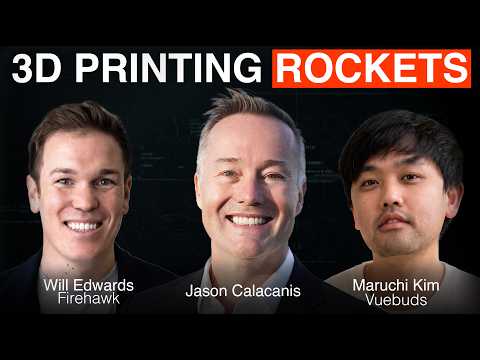
The first guest is Will Edwards, founder of Firehawk Aerospace, the defense-tech startup that Y Combinator famously kicked out of an in-person interview in 2020 for being “defense” — and which is now selling 3D-printed solid rocket motor (SRM) propellant to the Army, Air Force, Hanwha, and Raytheon. Edwards explains how their co-kneader feedstock turns a $30 million mixer + 12-hour batch + 2-month cure into a stamped or printed grain produced in minutes, 5x-ing US base bleed motor capacity, removing humans from a deadly ammonium perchlorate process, and addressing the missile shortage exposed by the Iran conflict. He’s just acquired a 640-acre missile integration facility in Mississippi and frames defense as a 24-month window to become relevant before a decade-long growth cycle locks in.
The second guest is Maruchi Kim, the PhD-graduate creator of Viewbuds — earbuds with stitched front-and-back cameras that pair with an on-device AI model. Calacanis pitches him on a series of go-to-market wedges (translation in foreign pharmacies, security/safety alerts for joggers and skiers, vision-impaired reading via Speechify-style narration, kids’ Apple-Watch-style safety wearable) and offers him an accelerator slot. The episode closes with riffs on Pilatus PC-24 jets that can land on dirt roads, Tesla FSD atrophy, and the Plaud NotePin S as a wearable conversation-capture tool.
Highlights
”Zuckerberg has decided machines over people”
“Amongst the most savvy individuals in industry today, Zuckerberg has decided machines over people. Machines over people. Let me say it one more time: I’d rather have more machines than people. And this is, you know, I think a critical, crucible moment that we’re going to keep seeing.” — Jason Calacanis, 7:26
Clip command
yt-dlp --download-sections "*7:26-8:25" "https://www.youtube.com/watch?v=RT09WX9_hqY" --force-keyframes-at-cuts --merge-output-format mp4 -o "twist-machines-over-people.mp4"One company’s distraction is another’s infinite money glitch
“A 100 million, a 500 million, a billion, or a 5 billion dollar opportunity for Google, Apple, Microsoft, Amazon, Tesla is not an opportunity, it’s a distraction. So just keep that in your head. Big companies see that as a distraction, little companies see that as an infinite amazing, infinitely amazing opportunity.” — Jason Calacanis, 10:31
Clip command
yt-dlp --download-sections "*9:46-11:50" "https://www.youtube.com/watch?v=RT09WX9_hqY" --force-keyframes-at-cuts --merge-output-format mp4 -o "twist-distraction-rule.mp4"YC kicked Firehawk out for being defense
“We told Y Combinator that we were working on defense and they kicked us out of the in-person interview essentially. And now you’ve seen that they are, yeah, putting people in left and right. So, yeah, it was a bad time to start but I’m glad we got started then.” — Will Edwards, 15:42
Clip command
yt-dlp --download-sections "*15:42-16:45" "https://www.youtube.com/watch?v=RT09WX9_hqY" --force-keyframes-at-cuts --merge-output-format mp4 -o "twist-yc-kicked-out-defense.mp4"Two months to five minutes: 3D-printing rocket propellant
“We’re taking a two-month process and cutting it down to a batch every five minutes or maybe as long as six hours. We’re essentially 5x-ing the United States’ ability to produce a key motor like a base bleed, and we’re removing humans out of the equation. So we’re making it safer, and at the same time we’re cutting costs in half.” — Will Edwards, 20:42
Clip command
yt-dlp --download-sections "*20:42-21:45" "https://www.youtube.com/watch?v=RT09WX9_hqY" --force-keyframes-at-cuts --merge-output-format mp4 -o "firehawk-3d-propellant.mp4"A 24-month window to become relevant in defense
“There is a race to become relevant in about 24 months. And then from there, if you can do that, there’s a huge market. I think we’re going to see a lot of multi deca-billion dollar companies come out of these next few years.” — Will Edwards, 23:51
Clip command
yt-dlp --download-sections "*23:51-24:35" "https://www.youtube.com/watch?v=RT09WX9_hqY" --force-keyframes-at-cuts --merge-output-format mp4 -o "firehawk-24-month-window.mp4"Smart glasses hit a cultural wall, earbuds didn’t
“When Google Glass came out like over a decade ago they really hit a cultural wall. People really don’t want to wear a camera on their face. But we want to put that same visual AI into the device over a billion people wear every day already. We’re not really trying to compete with smart glasses, we’re trying to deploy AI into a wearable that people already use every day.” — Maruchi Kim (via Viewbuds segment), 43:31
Clip command
yt-dlp --download-sections "*43:31-44:30" "https://www.youtube.com/watch?v=RT09WX9_hqY" --force-keyframes-at-cuts --merge-output-format mp4 -o "viewbuds-cultural-wall.mp4"Key Points
- The “machines over people” thesis (7:26) - Meta, KPMG, and Nike all announced ~10k layoffs while reallocating capital to AI infrastructure
- Meta’s Chief People Officer quote (5:37) - Lon reads Janelle Gale’s memo: layoffs “to allow us to offset the other investments we’re making” — explicitly funding AI chip deals like the new Amazon Graviton agreement
- The 10%/5%/1% distraction rule (9:46) - Find a problem that’s under 10% of a giant’s revenue; under 1% is the sweet spot where they can’t justify their best people
- Amazon brick-and-mortar as a “distraction” failure (10:21) - Disastrous because consumers didn’t go; example of how big companies fail at side projects
- SLMs and VSLMs as the next theme (0:15) - After Ollama and Bittensor, Calacanis is pointing TWIST listeners at small/vertical language models running locally on Macs and Dell GB300 workstations
- Firehawk’s co-kneader feedstock (17:04) - Replaces $30M mixers and 12-hour batches with extruded energetic pellets that are stamped or 3D-printed into solid rocket motor grains
- Iran war exposed missile shortages (21:28) - First seven weeks of the conflict consumed a major chunk of US missile inventory, motivating new domestic production
- 640-acre Mississippi facility (21:46) - Currently produces 50,000 motors/year, scaling to 120,000/year, with primes Hanwha and Raytheon as partners and cap-table investors
- 1% transformed: how far the US military is into modernization (25:05) - Edwards estimates only ~1% of the $1.5T proposed budget reaches startups; “Ghost Murmur” tracking-by-heartbeat is still a Lockheed prime tool, not a startup
- Components-business thesis for defense (28:05) - Mastering propellant unlocks artillery shells, rockets, missiles, and drone-replacement munitions; Ukraine fired ~14M artillery shells before drones took over by necessity
- “Gas station of rocket motors” (31:03) - Feedstock-and-printers model means anyone in Korea or Europe could stand up a workshop with Firehawk’s materials
- Pilatus PC-24 + Cessna autoland (34:20) - Single-pilot jets, push-button autoland in actual heart-attack rescue cases, parachutes, and PlaneSense / Surf Air membership models for the Bay Area / Austin / LA triangle
- Tesla FSD atrophy (36:29) - Calacanis admits “I was partially paying attention” when his FSD hit cones; 99% disengage rate has trained drivers to drift
- Viewbuds technical core (41:11) - PhD project bridging wearables and deep-learning networks; a $1-2 camera module + firmware that streams to a host device + open-source models that only became usable last year
- Platform vs. vertical Viewbuds business model (42:32) - License software/reference HW to OEMs (Bose, Sony, Apple) rather than build a new audio brand; Calacanis predicts a $50M acqui-hire flip
- Translation, safety, vision-impaired reading (45:43) - Foundation use cases: scanning Japanese pharmacy aisles, “on your six” safety alerts for joggers and skiers, Speechify-style book reading for grandmas with cataracts
- “Today’s toys are tomorrow’s innovations” (54:54) - Calacanis’s angel-investing credo: never underestimate tinkerers, because the orthodontic retainer monitor and Viewbuds are how breakout products begin
- GLP-1s have collapsed in price (37:54) - From ~$2,400/month four years ago to ~$150-200/month now; “Slim Cal / J-Ranch” branding update from “Fat Cal”
- Bluetooth bandwidth limits AI hardware (54:09) - Two cameras barely streamed over Bluetooth; Wi-Fi draws too much power; the constraint pushes intelligence onto the buds themselves
Mentions
Companies
- Meta (5:05) - Layoffs to fund AI infrastructure; new Amazon Graviton chip deal; Muse Spark proprietary model
- KPMG (5:05) - Announced 8-10k layoffs same day as Meta
- Nike (5:18) - Also announced layoffs in the same news cycle
- Amazon (5:37) - Multi-billion-dollar Graviton chip deal with Meta; brick-and-mortar bookstore retreat as “distraction” example
- Firehawk Aerospace (14:45) - Will Edwards’s defense propellant startup, Dallas-based, 640-acre Mississippi facility
- Y Combinator (15:42) - Kicked Firehawk out of the in-person interview in 2020 for being defense
- Hanwha Defense (22:32) - Korean prime, Firehawk cap-table investor and integration partner
- Raytheon (22:32) - Prime partner; Firehawk supplies propellant for their end systems
- Lockheed Martin (25:41) - Built Ghost Murmur, the heartbeat-tracking CIA tool used to extract a pilot from dense foliage
- Aragon (0:45) - SLM-focused startup previously on TWIST
- Neurometric (2:00) - Rob May’s small language model company
- Pilatus (32:30) - Swiss maker of the PC-12 turboprop and PC-24 single-pilot jet with parachute system
- PlaneSense (33:00) - PC-24 fleet operator covering Austin, Bay Area, LA, Nevada
- Surf Air (33:15) - Membership-based regional jet service that originally used PC-24s
- Tesla (35:32) - FSD comparison; Calacanis’s Tesla nearly hit cones in the rain
- Apple (45:43) - Maruchi Kim’s prior employer (5 years on AirPods Max and AirPods Pro 2)
- Bose, Sony (42:32) - Established audio OEMs Viewbuds would license to rather than compete with
- Whoop, Fitbit (50:18) - Comparison for how a wearable platform finds its 3-4 core use cases
Products & Technologies
- Solid Rocket Motors (SRM) (15:08) - Sealed grain that sits in a steel case for 10 years and fires on command, vs. liquid fuel
- Co-kneader feedstock + ammonium perchlorate + LEGO plastic (17:50) - Firehawk’s pellet stock that gets stamped or printed into grains
- Ghost Murmur (25:41) - Lockheed CIA heartbeat-tracking tool that found a downed pilot under dense foliage
- Meta Muse Spark (6:57) - Meta’s first proprietary AI model, now live at meta.ai
- Ollama (0:30) - Local-model runtime that’s been a recurring TWIST theme
- Plaud NotePin / NotePin S (12:46) - Wearable conversation-capture pin sponsoring TWIST
- Viewbuds (39:42) - Maruchi Kim’s earbuds with stitched cameras streaming a monochrome 324x239 image
- Pilatus PC-12 / PC-24 (32:30) - Single-pilot turboprop and jet capable of dirt-road landings
- Cessna autoland button (34:20) - Push-button emergency landing already used in a real heart-attack scenario
- GLP-1s / Ozempic (37:54) - Weight-loss drugs now ~$150-200/mo via ro.co/twist
- Speechify (48:52) - Used as a metaphor for Viewbuds’ grandma-reads-physical-book use case
- Slopes (53:28) - Apple Watch app for skiing analytics; cited as a model for AirPods-case-as-compute
People
- Mark Zuckerberg (7:00) - “Decided he’d rather have more machines than people”; Jeremy Strong reportedly playing him
- Janelle Gale (5:37) - Meta Chief People Officer who explicitly tied layoffs to AI infrastructure spend
- Ron Jones (15:42) - Will Edwards’s co-founder who was 3D-printing rocket fuel out of LEGO plastics in his garage in 2019
- John Ratcliffe (27:21) - CIA Director quoted on the Ghost Murmur pilot rescue
- JFK Jr. (34:30) - Calacanis recalls meeting him; recounts the spatial-disorientation tailspin that killed him
- John Perry Barlow (34:30) - EFF founder Calacanis had drinks with alongside JFK Jr.
- Edwin Chen, Aravind Srinivas (3:10) - Recent guests on This Week in AI, called out as standout episode
- Rob May (2:00) - Neurometric founder working on small language models
- Maruchi Kim (39:42) - Viewbuds creator; ex-Apple AirPods engineer; PhD just completed
- Neil Young (57:51) - Founded Pono streaming service over MP3 quality complaints; cited on hi-fi audio
- Gwyneth Paltrow (48:10) - Ski-collision lawsuit cited as Viewbuds-could-have-helped use case
- Elon Musk (15:42) - Edwards explicitly didn’t want to compete with Elon in space; FSD discussion later
Surprising Quotes
“If you really look at those kind of examples, Uber, they need to wait 10 years for the market to arrive, then they’ll make an acquisition, etc. Those Amazon stores, those brick and mortar stores — disastrous.” — Jason Calacanis, 10:13
“Everything that you probably just mentioned was built by the primes… there’s not one startup that is being used to raid a presidential facility and get a president out of that country that’s using any tools like that. No money is going to the startups at this point out of that $1.5 trillion proposed budget.” — Will Edwards, 25:05
“It’s like you get into a normal car and you’re like, I — I shouldn’t be trusted with this. Why am I driving this car? I should not be trusted behind the wheel.” — Will Edwards on Tesla FSD atrophy, 37:03
“The hard part about building a missile or a rocket is building the motor. Hard part about building the motor is producing the propellant. So once we master that foundational piece, the world’s our oyster for what we can build.” — Will Edwards, 28:05
“Today’s toys often become tomorrow’s innovations and tomorrow’s breakout products that change the world. I get the sense that this could be one of those.” — Jason Calacanis on Viewbuds, 54:54
Transcript
Jason Calacanis: 0:00 Zuckerberg has decided he’d rather have more machines than people. We’re going into a doomsday scenario because of AI. The race is afoot.
Alex Wilhelm: 0:08 So there’s a race to become relevant in about 24 months. I think we’re going to see a lot of multi-deca-billion dollar companies come out of these next few years.
Jason Calacanis: 0:15 One person’s like infinite money glitch opportunity is another person’s distraction. There’s an infinite number of problems in the world to be solved. It’s going to be fine, folks, you’re going to be able to find those problems, but you must change your mindset. All right everybody, it’s Friday, April 24th. It’s TWIST. He’s Lon Harris, I’m Jason Calacanis. It is AO88, yeah, three months after we started talking about Ollama here on the program. And we keep talking about it, although there’s many more competitors now, and so we are really turning around the corner here Lon on the program. And the next thing I would like to make a focus for us, we’ve been really focused on Bittensor, super focused on Ollama. The next piece I think is SLMs, the small language models. And so this is something we had Aragon on, they’re making SLMs. We’ve had other folks on talking about VSLMs, vertical small language models, i.e. here’s one just for marketing, here’s one just for, you know, learning a foreign language or math. We do think with the hardware profile opening up on Macs specifically, but also Dells with their GB300 or 3000, their new workstation that they’ve announced.
Lon Harris: 1:36 300.
Jason Calacanis: 1:36 300. The future for startups is going to be local models that you own. Open source models as a foundation that are then trained on your data and then published or built, and then some post-training. And that’s going to be really difficult for people to do today, just like setting up Ollama, difficult for people to do. But I do think as we turn around the corner, we’re going to see that become a reality and that’s one of the things we’re going to be talking about here on This Week in Startups. We also had Rob May from Neurometric, they’re also working on small language models. So already kind of a mini theme through the month of April that we’ll be expanding on in May.
Lon Harris: 2:21 Yes.
Jason Calacanis: 2:22 And we have a sister program here as the This Week in Calacanis Media Empire starts anew. The new empire, I’ve built this empire a couple of times here. Just three times. But for podcasts, for Inside, for this, for that. But we realized there’s a ton of opportunity to use the roundtable format that I’ve kind of perfected here on this program, This Week in Venture Capital, This Week in AI, and All In, of course, and pull that string. So if you go to thisweekinai.ai, you’ll see 10 episodes of our newest show, This Week in AI. We’re going to publish the first half of the show to the This Week in Startups feed. for the rest of the year. So you’ll get reminded of that, but go check out This Week in AI. We’ve had extraordinary guests on the program.
Alex Wilhelm: 3:10 Yeah, last week’s episode with Edwin Chen and Aravind Srinivas, incredible. Such an in-depth conversation, but I was able to follow it as just a regular guy who is not training models all day.
Jason Calacanis: 3:21 I was thinking about layoffs and just yesterday, you know, keep having this debate. Are we going to have tons of new jobs created? Are we going to have tons of jobs? And there’s this P-doom, which is like how sure are you that we’re going into a doomsday scenario because of AI? And I’m watching a lot of blue hairs and gray beards and business people all debate their P-dooms, right? I’m not saying you’re a gray beard yet, but you got a little sprinkled in there. Gray beards usually are like the Fortran developers.
Alex Wilhelm: 3:53 The ancient ones.
Jason Calacanis: 3:59 And you know, some of them are saying 50%, some are saying 80%, some are saying 20% chance of doom. I think it’s like a bit hyperbolic. You don’t have to really worry too much about that because you have no control, for a start, as a person not building these things. And even if you are a person building these things, the race is afoot. It’s a global race. Everybody’s building this. So let’s just assume we’re going to not just perfect AGI, but we’re going to get to super intelligence. And the super intelligence will look at humans’ level of intelligence and think kitten, you know, bulldog.
Alex Wilhelm: 4:33 Well, it’s like the end of Her, when Samantha is like, listen, I don’t want to be in love with you anymore. I’ve advanced to a place beyond your comprehension. All of us AIs are going to go off somewhere and just do our own thing. We don’t need you anymore.
Jason Calacanis: 4:46 So, you know, that one was like, that’s not a doom scenario. It’s a sad scenario. Like the humans are like, oh, we kind of liked you.
Alex Wilhelm: 4:54 Yeah, they’re going to leave us behind, yeah.
Jason Calacanis: 5:05 KPMG, Meta, and one other company yesterday all announced in the ballpark of 10,000, 8 to 10,000…
Lon Harris: 5:18 Was it Nike? They also announced some layoffs.
Jason Calacanis: 5:20 Okay, Nike probably. They’ve got, you know, and there’s this idea that this is AI washing. Okay, sure, maybe.
Lon Harris: 5:37 Well, there’s also the, like in Meta’s case, it’s just like Oracle a month or two ago, they’re doing the AI layoffs not because like oh, these AI tools we don’t need all these people, they have to pay for the AI infrastructure investments they’re making and they’re doing that. But Meta said that almost, I have it here in the docket because I thought it was so interesting. Chief People Officer Janelle Gale, here’s her quote from the memo: ‘We’re doing this as part of our continued effort to run the company more efficiently,’ so that’s we can afford to, you know, get rid of people, ‘and to allow us to offset the other investments we’re making.’ So she’s kind of coming right out and saying like they’re spending so much on all of these chips, they just made a new deal with Amazon yesterday for multi-billion dollar deal for more of their Graviton chips. So… Whether or not the AI actually takes over these people’s jobs, these people have to go to pay for the AI.
Jason Calacanis: 6:06 That is the exact point that I was going to get to.
Lon Harris: 6:09 Oh, sorry.
Jason Calacanis: 6:10 No, it’s great that you teed it up as you did. Because it’s not abundantly clear when you say it like that, but it does relate to P-Doom. Which is to say, given a choice, a capital allocator, one of the top war chests in the industry, one of the top money-printing businesses, they could keep adding staff, they’re massively profitable. They could not lay people off, they’re massively profitable. But they have to think strategically, looking at the chessboard, given their competition, Google obviously for the ad networks, the two competing ad networks even though they have different product bases, and then the future product, which is obviously letting people do queries and ask questions and use AI, which now they’ve released at Meta, their first proprietary model.
Lon Harris: 6:57 Right, Muse, Muse Spark.
Alex Wilhelm: 6:59 Yeah.
Jason Calacanis: 7:00 Yeah, and it’s… I think you can see it at meta.ai. Nobody’s using it, okay, but they can funnel a lot of people into there. So Zuckerberg—
Lon Harris: 7:07 Aka Jeremy Strong.
Alex Wilhelm: 7:09 His performance is going to be amazing in this one, I’m sure.
Lon Harris: 7:13 I’m sure he’s going to kill that one.
Alex Wilhelm: 7:15 I mean no, no, no, there’s people literally talking who have seen the performance who are saying it’s like he just give him the Oscar now, and this is the scariest, you know, acting we’ve ever seen in terms of accuracy.
Lon Harris: 7:25 Uncannily.
Jason Calacanis: 7:26 Yeah. But amongst the most savvy individuals in industry today, Zuckerberg has decided machines over people. Machines over people. Let me say it one more time: I’d rather have more machines than people. And this is, you know, I think a critical, crucible moment that we’re going to keep seeing. So before you get really sad about it, there’s an infinite number of problems in the world to be solved. It’s not going to happen in our lifetime that they’ll all get solved, because many of them require real-world work, many of them require a human touch, humans will be in the loop. I’m not talking 50 or 100 years from now, I’m just talking in the next 30 years, 40 years. It’s going to be fine, folks. You’re going to be able to find those problems, but you must change your mindset. And here we are on This Week in Startups, you can, if you were laid off from KPMG or Meta—very sorry about that happening to you, very sorry about government workers who are getting paid three or four hundred thousand dollars in these crazy positions we’re hearing about, like literally—I mean, I don’t mean to make light of it, but there’s a woman who was featured in this New York Times story who worked at one of these NGOs making 400,000, she’s interviewing for $20 an hour jobs, which just shows you like there was kind of a mismatch here in terms of people’s market value. Okay, so you have identified a real problem and you put together a solid solution and a business model that you believe in, so you’re all set.
Lon Harris: 9:00 set to launch your new company, right? Ah, not so fast. If you want investors and potential customers to take your new business seriously, you need to consider forming a Delaware C Corp, and that’s where Northwest Registered Agent comes in. They’re going to give your new company a real identity. That means an address for your public filings, a domain, a custom website, a business email, and of course, a phone number. And that’s going to take just 10 minutes and 10 clicks. They don’t charge hidden fees, customer service is available around the clock. They’re not overwhelming your inbox with spam, and they make it easy to cancel at any time. So, get all the advantages of a Delaware C Corp, independent regardless of where in the US you’re operating from. Visit northwestregisteredagent.com/twist for more details, and the links are in the show notes.
Jason Calacanis: 9:46 To put it all aside, you will have no choice but to start thinking entrepreneurial if you were laid off from a USAID government job, from Meta, from KPMG. Find the two smartest people you know who got laid off, or even who’re still working there, and then look for those problem sets. You got to look for a problem set that is too small, in other words, it’s less than 10% of the revenue of the company. So if less than 10% the revenue of the company, that major company’s going to have a hard time focusing on it, let alone if it’s under 5% or the ultimate sweet spot, under 1%. When a product is under 1% of an organization’s revenue, under 5%, under 10%, it’s just not a priority.
Alex Wilhelm: 10:12 Right.
Jason Calacanis: 10:13 You can’t put your smartest people if you’re Amazon on something tiny like, I don’t know, this nascent Airbnb company, Whole Foods, right? And if you really look at those kind of examples, Uber, they need to wait 10 years for the market to arrive, then they’ll make an acquisition, etc.
Alex Wilhelm: 10:21 Right. Those Amazon stores, those brick and mortar stores, they were trying to do that for a little while.
Jason Calacanis: 10:27 Disastrous.
Alex Wilhelm: 10:28 Because it didn’t people weren’t going, people weren’t doing it.
Jason Calacanis: 10:31 And it might be because hey it was a billion dollar opportunity. Now let’s pause there. A 100 million, a 500 million, a billion, or a 5 billion dollar opportunity for Google, Apple, Microsoft, Amazon, Tesla is not an opportunity, it’s a distraction. So just keep that in your head. Big companies see that as a distraction, little companies see that as an infinite amazing, infinitely amazing opportunity.
Alex Wilhelm: 11:35 Yeah.
Jason Calacanis: 11:37 Yeah. So one person’s like infinite money glitch opportunity is another person’s distraction, which means start a company or join a company.
Alex Wilhelm: 11:43 Yeah.
Jason Calacanis: 11:44 Yeah. I know this sounds like I’m talking my own book because I invest in them. No, I’ve already made my money, I can retire anytime. I’m just telling you sincerely.
Lon Harris: 11:55 Yeah, I… and you can give me the whole thing. You’re… I’m not built for startups, oh you know not everybody…
Jason Calacanis: 12:00 Kids are not motivated. Not you, I’m just saying, people, that is the number one thing people say, ‘Oh, startups are a fraud, oh this.’ Listen, when I say startups, I mean including mom and pop shops in here, I’m including three people doing services, I’m not talking just about venture-backed startups, any startup. All startups matter.
Alex Wilhelm: 12:16 And that’s what I was going to say is I think there is still so much AI doomerism, but one great thing about AI is if you did want to start your own business or your own company or start doing something, it can help teach you all the parts of doing that that you didn’t already know. Like, it’s so daunting to think about, you know, even if I had some skills, like ‘Oh, I should just start my own business,’ but like I don’t know how to do all of the little pieces that go along with that. Well, Claude does, you could ask Claude. And like I do think people are missing that part of the opportunity.
Jason Calacanis: 12:46 They are missing that part of the opportunity. The other opportunity they’re missing is to record all this and all your conversations with your friends, with permission, using Plaud. And so here it is folks, I’m just going to put my Plaud pin on you. You’re already wearing yours.
Lon Harris: 12:57 I got mine.
Jason Calacanis: 12:59 Yours stands out like a sore thumb. You got the silver on a black jacket.
Lon Harris: 13:03 I got a little more subtlety going here. I went with the gunmetal gray. And then I just press my button, boom, I got a nice little red light, I’m recording. And this has been magical for me. When I put it into this little base, it automatically syncs and charges. And so every day or so, I pop it in here, I charge, I sync, and then I, on my calendar, have times to review my notes and review my bookmarks. Those two things let me come back to all these ideas I have and then reassess them. So I capture them in the moment, then I reassess them. An amazing product, an incredibly affordable price, made even better by a promo code given…
Jason Calacanis: 13:53 That’s true and exclusively to our listeners here at TWiST. You check it out at plaud.ai/twist and if you use the code TWIST, exclusive for our listeners, you’re going to get an extra 10% off your Plaud NotePin or your NotePin S. This is the S. I think you go with the S personally.
Alex Wilhelm: 14:11 That’s the one that has the button in it, right?
Jason Calacanis: 14:12 Exactly. It’s the one with the button. It’s the more advanced one. It’s the higher end one for your serious… I mean listen, Lon’s balling these days, I’m paying Lon a fortune here and yeah, he’s doing well for himself. Now he’s big-shotting me.
Lon Harris: 14:23 I make a comfortable living. I do okay.
Jason Calacanis: 14:26 He makes a comfortable living. All right, let’s get started. We have a guest and let’s get to it. And remember next week and in coming weeks, we’re going to really focus in on those SLMs and vertical, and I want it to like have a little how-to of like maybe some people on our team, the This Week in AI team, can come on the This Week in Startups team and can show actually building one.
Alex Wilhelm: 14:45 That sounds awesome. I love that. We can talk to some of our Subnet friends about building a small language model. But let’s move on to our first guest. He is the founder of Firehawk Aerospace, they are building rocket engines for defense, specifically… Solid rocket motors with 3D printed propellant Jason we’re going to talk all about it with Will Edwards of Firehawk. Will, thanks for joining.
Will Edwards: 15:08 Guys, thanks for having me. I know you like to talk about SLMs, but I guess we’re going to talk about SRMs.
Alex Wilhelm: 15:13 SRMs.
Jason Calacanis: 15:14 Mixing it up.
Alex Wilhelm: 15:15 Oh wait, what is SRM? Explain.
Will Edwards: 15:18 Solid rocket motors.
Alex Wilhelm: 15:19 Got it, SRM. Yes. We it’s acronym central here. Tell us a little bit-
Lon Harris: 15:23 you started about four years ago, five years ago I think on this project. So this is before military tech was like so in favor and there was a lot of attention, but tell us founding story wise how you came to this opportunity and what you’re building.
Will Edwards: 15:42 Yeah, I mean so I was in Santa Monica. I had a small HR company, software company, and my co-founder, a guy named Ron Jones, was printing rocket propellant, rocket fuel at the time, out of Lego plastics out of his garage and he wanted to build a space company because that was really in vogue. Uh this was about 2019. And I just saw a huge opportunity in defense. I thought that if we focused all of our attention, one, we won’t be competing with Elon, uh never really want to do that, and two, uh I saw just that defense was going to blow up and there’s a great opportunity to get early dollars to develop our technology. So in 2020 I convinced him to go from space to defense. Uh and you’re right, defense was not popular back then. You know, we told Y Combinator that we were working on defense and they kicked us out of the in-person interview essentially. And now you’ve seen that they are, yeah, putting people in left and right. Uh so, yeah, it was a bad time to start but I’m glad we got started then.
Alex Wilhelm: 16:46 So explain to us um what 3D printed propellant is. I mean we understand what 3D printers are, we understand propellant, fuel, 3D printers make something. How does a 3D printer print jet fuel? Uh explain, yeah.
Will Edwards: 17:04 So it’s for for rocket motors, for like missiles, that’s really what we’re building for, or artillery shell motors. They use a solid grain. Um it looks actually a little bit like this, uh but it’s a solid grain that you can just stick into a a steel case, stick that in the ground, forget about it for 10 years and you can press the button. Unlike liquid fuel, which has to be fueled up moment before take-off. Uh but what we do differently is is the industry today, the way you make propellant is you have a 30 million dollar mixer, you fill it up with this honey-like substance, it mixes for about 12 hours, then you have 5000 pounds of propellant, you pour that into a mold, put it into an oven, two months later you might have rocket propellant. What we do is we actually make this feedstock, so it’s a very energetic pellet that comes out of a machine called a co-kneader, and so it’s not liquid- It’s not going to solidify accidentally in your $30 million mixer and shut your facility down. It’s just a feedstock and what we do from there is essentially upload the G-code of the grain we want to make, if it’s whatever diameter rocket or artillery shell motor, and we either print it or we stamp it out. Yeah, and you can see here this is the co-kneader. And what it’s doing is it’s smashing everything together until it’s homogeneous: the ammonium perchlorate, the LEGO plastic. This is where it gets stored and from here we take it to our compression molder. And the cool thing about this facility is it’ll be able to make about 2 million pounds of propellant a year. That’s a huge amount of energetics. And once it goes here, the official word for this is the dumper. That’s what they call it.
Jason Calacanis: 18:52 Okay, very technical term. We’re seeing a bin dumping all these pellets and then the pellets are getting mashed into, you know, little cylinders.
Will Edwards: 19:01 That’s a motor for an artillery shell right there.
Jason Calacanis: 19:04 Amazing. Yeah. So that’s fascinating and what’s important, I think, when I hear you talk about this, is putting propellant into a rocket in the field sounds some combination of slow, painful, dangerous, unstable—I mean, I’m inferring here based on what you’ve said—and that having this one that’s shelf-stable that you could put into a bunker and 10 years later still fire and not have that complication is a major win for troops on the front line, yeah? If you’ve got an engineering team at your company, I’m betting there’s a solid chance they’re spending far too much time on infrastructure. You need your team building your product to delight your customers, not configuring your virtual network. Render is the all-in-one cloud platform for developers that allows you to deploy, scale and secure your apps and agents with zero ops. Most cloud platforms ask you to split your focus between product and infrastructure, or they force you into platform constraints that you know you’ll outgrow in six months. But just connect your GitHub repo to Render and you are live, L-I-V-E. Web services, cron jobs, managed Postgres, the whole stack in one platform. It’s time to find out why five million developers are already using Render. Go to render.com/twist and apply for the Render Startup Program. You’ll get anywhere from $500 to $100,000 in free credits, depending on your stage and who your backers are. That’s render.com/twist.
Will Edwards: 20:42 Yeah, I would say so. So I mean again, we’re taking a two-month process and cutting it down to a batch every five minutes or maybe as long as six hours. But really the other neat thing is we’re really removing humans from the process because this is a dangerous process still. Ammonium perchlorate is a dangerous material to work. work with. So what we’re doing is we’re essentially 5x-ing the United States’ ability to produce a key motor like a base bleed, and we’re removing humans out of the equation. So we’re making it safer, and at the same time we’re cutting costs in half. So we’re making it significantly cheaper.
Alex Wilhelm: 21:16 Yeah, and this is, Lon, I think, the main change in the battlefield is smaller, more affordable rockets, yeah, and devices.
Lon Harris: 21:28 Well, and we’re also—we’re facing a missile shortage in America. This has been a huge news during the sort of the Iran conflict, that the first seven weeks of the Iran war, we used up a whole bunch of our missile supply. So I feel like it’s very timely to be figuring out ways to restock our missiles in a more efficient and cost-savvy way.
Will Edwards: 21:46 Exactly. And like in Mississippi, I have—we just acquired a 640-acre missile integration facility. We can make about 50,000 a year, but we’re building that up to make 120,000 a year. So we’re really looking to join—join the fight and help out and build systems that are needed.
Jason Calacanis: 22:04 How does your business work? You sell to the US government, you sell to resellers who then integrate it into their product, or are you Tony Stark-ing this and anybody who’s got a democracy or is not on a commie list, you can sell to? How does it work?
Alex Wilhelm: 22:20 Not to the Ten Rings. Do not sell to the Ten Rings.
Lon Harris: 22:23 Please. And not also—not Spectre from the 007 franchise.
Alex Wilhelm: 22:26 And not to the Legion of Doom from the DC franchise.
Will Edwards: 22:29 Or Nick Cage in Lord of War, you know, we’re trying to avoid all of that.
Jason Calacanis: 22:31 All of those.
Will Edwards: 22:32 So we work directly with the Army, the Air Force. We have prime partners—I mean, we work with Hanwha, Raytheon, they’re all either on our cap table or we’re doing partnerships with them. We have a new one that we’ll be announcing in the next couple of weeks. And so if it’s not going to the states, what we’re doing is we’re providing it to one of the major defense companies, they integrate it into their end system, and then they go and sell it to whomever the United States has given them the thumbs up on.
Alex Wilhelm: 22:55 So you don’t have to at this point in your startup go circle the globe and talk to everybody in the UAE or Saudi or Israel or France and make those sales. You could, but you have these other primes who would then incorporate your product into their offering, yeah?
Will Edwards: 23:12 Absolutely. I mean, we’ve done that, but we’re—we’re usually a support system. So we’re standing behind the big dog and then we’re addressing, you know, their questions when they have them for us.
Alex Wilhelm: 23:25 Knowing what you know about what’s happening in the world, how—if we have to reimagine the American military, how far are we percentage-wise into this lighter, faster, scalable, tech-first, AI-first transformation of the military? How much longer do we have? And then juxtapose it with where China’s already at.
Will Edwards: 23:51 Two kind of different answers, but they’re the same. I think we have a decade more of growth. A lot of these companies that we see now and hear about… They are going to grow for quite a while and then they will establish themselves in the markets, won’t disappear. But I also think that if you’re not relevant within the next two years, you won’t be relevant during that growth phase. So the government is sitting there picking the companies that have scaled, that have built a technology and starting to put them into their decade long programs. So there is a race to become relevant in about 48 months, um, 24 months I mean. And then from there, if you can do that, there’s a huge market. I think we’re going to see a lot of multi deca-billion dollar companies come out of these next few years.
Lon Harris: 24:30 On the overall percentage of the transformation of the military, you know, just from the outside looking in, feels like when we’re getting into these military operations of late, we’re just starting to see the new tech be talked about, maybe because Trump loves talking about it and he just— I mean, perhaps the military doesn’t want him talking about the, you know, blow your ear drums out crazy sonic weapon or, you know, there was a laser dome that apparently was used to protect Israel and that’s I think been confirmed and then he said it’s really not Israel’s dome, it’s the US’s dome, Israel’s taking a little bit of credit for our munitions. How far are we— and I would suspect if we’re starting to hear about these things in the battlefield, they are in fact, you know, we’re well on our way to just redoing the entire military. So just percentage-wise, like where are we? What innings of a baseball game? In the first inning? The fifth inning? Where are we at with transforming the US military from, you know, really expensive munitions and solutions to the more nimble AI-first ones?
Will Edwards: 25:05 1%. I mean everything that you probably just mentioned was built by the primes. Ghost Murmur’s Lockheed, like there’s not one startup that is being used to raid a presidential facility and get a president out of that country that’s using any tools like that. I mean these are the primes. And until like a new actual prime pops up, we’re the same old industrial base, which again, I think just leaves time for incredible growth in this sector to start paving the way. But look at the budgets. No money is going to the startups at this point out of that $1.5 trillion proposed budget. Nothing’s going to it. And if you look at the comps of what these startups are doing in their valuations compared to the incumbents, it’s almost laughable that you can compare these companies right now. So I think there’s a lot of growth and a lot of growing pains that we’ll have to face. But again, that’s just opportunity.
Lon Harris: 25:41 And Ghost Murmur is this CIA tool developed by Lockheed Martin, from what I understand, and does something… well, no, Murmur is to go— yeah, to find people’s heartbeats, right? That’s how they tracked that pilot.
Will Edwards: 25:52 Yeah, that’s how they track that pilot. They could find him even in like dense foliage or underneath structures.
Lon Harris: 25:57 That’s how they tracked that pilot, yeah.
Alex Wilhelm: 27:00 Which is just insane when you think about it, Lon. We have a tool that lets us find any human, uh, yeah, at a fidelity that seems like Superman, uh, like listening to the entire globe or Professor X. It’s kind of crazy.
Lon Harris: 27:21 CIA Director John Ratcliffe said the pilot remained invisible to the enemy, but not to the CIA, because they had Ghost Murmur.
Alex Wilhelm: 27:28 That’s terrifying, but it’s also cool technology to know that the United States can build that, and the Primes are building that. So they get poked fun of a lot, but there’s some incredible technology coming out of them.
Jason Calacanis: 27:41 I guess my question would be, we hear so much today about drones, that, I mean, when I picture modern warfare now, I’m thinking about all these drone swarms that have been doing all the heavy lifting in sort of Ukraine and elsewhere. So where do missiles sort of fit into that stack? Like why are missiles still so important, and looking ahead 10, 20 years, are missiles still going to be sort of at the core of our arsenal?
Will Edwards: 28:05 Absolutely. So, so my big belief in defense is it’s a components space business. Like Firehawk, obviously we build missiles and rockets. But we weren’t- the hard part about building a missile or a rocket is building the motor. Hard part about building the motor is producing the propellant. So once we master that foundational piece, the world’s our oyster for what we can build. And the reason why drones became so popular is because in Ukraine, they shot off about 14 million artillery shells. That was, artillery shells were about 75% of all of the, you know, death tolls in Europe. It was the lowest cost to kill, and when they ran out of the artillery shells, they had to make use of something else, and that was drones. So as soon as the drone- or the artillery capacity comes back up, I mean, it’s always going to be relevant.
Jason Calacanis: 28:52 What’s on the roadmap for you when you solve this problem? Is there dual use here that this, you know, 3D printing of this fuel source could be used in other non-military applications, or do you just look at, hey, what’s the next logical, you know, evolution of this 3D printed material?
Alex Wilhelm: 29:11 We’ve got some breaking news to announce. Agree.com has just surpassed 100,000 users. And guess what, folks? That list includes my team here at Launch. And that’s because Agree is the number one fastest way to go from contract to cash. Agree is the all-in-one solution, and it’s got all of your needs in one place. This means gathering those e-signatures for invoicing, billing, payments, and revenue recovery. The average time from contract sent to signed with Agree is under seven hours. And get this: 99.64% of all invoices on their entire platform are paid within just 10 days. And this is thanks to their agentic payment reminder. That’s right, a very soft, easy AI voice agent automatically detects missed payments and sends polite nudges.
Jason Calacanis: 30:00 So you get that money in your account faster so you can keep running your business. So if you want to stop chasing invoices, go right now to agree.com and tell them your boy JCal sent you and you’ll get 50% off.
Will Edwards: 30:13 You know, I think we’re going to acquire companies that are adjacent to what we’re doing. Might not be in the material science propellant. Yeah, we’ve been approached for using our technology for oil and gas, like using that to help with fracking, but I’m not certain that that’s the best use of our time. We are so focused on, like, I want to be the biggest propellant maker in the United States, the most efficient one at least. And artillery shells, rockets, missiles… I mean, it’s such a massive market that needs to be addressed that I can’t take my attention away from it yet. I’m really not thinking about it.
Jason Calacanis: 30:48 And that propellant, the core ingredients of it are available here in the United States in bulk. It’s not like a scarce set of chemicals, is it?
Will Edwards: 31:03 Very… it’s available anywhere. And the other cool part, and this was what we did different, is I know people have tried to 3D print propellant in the past. What they did is they tried to make custom printers that could print traditional rocket propellant. So you have to become a printer company. It actually doesn’t really work out very well. We made this feedstock that, yes, everything’s readily available, but I can send that feedstock to Korea, I can send it to Europe, and the printers that are over or, you know, abroad would work to print our grains or to compression mold our small motors. So it’s very… everything is very achievable to stand up your own workshop anywhere. And we kind of want to be the gas station of rocket motors and propellant around the world. We think that’s a cool vision.
Jason Calacanis: 31:53 Yeah. It’s going to be a great way to describe this on YouTube. People will understand it, I think, a lot easier. Make a note of that, editor, that’s great. Yeah. All right, listen, continued success. Thank you for protecting the homeland and sharing with us. I’m sure you’re hiring. Where are you based and what positions are you hiring for, and where can people find out more?
Will Edwards: 32:00 So we’re in Dallas, Texas. Engineers. We’re going to be hiring a lot of technicians in Oklahoma. We just opened up that big facility in Mississippi. So Mississippi, Texas, and Oklahoma.
Jason Calacanis: 32:12 Wow. So you get to just zip between those three cities. Beautiful. Direct flights from DFW everywhere. Yeah.
Will Edwards: 32:16 Yeah. Wow. I mean, I think at the rate you’re going, I’m going to go right ahead and recommend a PC-24 or Phenom 300 corporate jet card for you, save a little time.
Jason Calacanis: 32:22 PJ time. PJ time. Best out, let me know. Yeah, deal.
Will Edwards: 32:30 Yeah. PC-24 is the winner, I think. It’s the workhorse that… it’s the company Pilatus. They make the PC-12, which is their, like, Swiss turboprop, incredibly safe, like, landed on a commercial air strip, recreational air strip, your backyard air strip, or on like a dirt road. Like, it’s made for all of those. Then they released their first jet, which is the PC-24, and it is…
Jason Calacanis: 32:59 the single pilot capable jet version of that ruggedness. So you can literally land it on a dirt road in the middle of nowhere. It’s a very cool plane. It’s got a cargo, you can literally load a cargo pallet into the back of it with a forklift, but it’s for, you know, families going skiing or corporate executives and it’s got like some of the lowest hourly cost and I’ve chartered one before here it is, the PC-24. Um, I think you can operate these for, you know, if you own the plane, $4,000 an hour, and if you charter it, 10k an hour, but they’re going to change the world these um, smaller planes, mid-size jets I guess is what they’re called, and they’re going to be available like Surf Air used the first one, PC-24, for those routes between Los Angeles and you could buy a membership and it was like 500 bucks a seat. This next one is going to be like the next level up. There’s a company called PlaneSense that has a fleet of these PC-24s and I think Austin, Bay Area, LA is kind of their little triangle in Nevada.
Will Edwards: 33:52 Oh I see, it’s like a— it’s like a time-share but for a jet.
Jason Calacanis: 33:58 I mean, you could— you could buy shares in it or you could just buy hours. You have both of those options. So, it’s this— you know, without making it a commercial for any of those folks, it’s just a new layer of aviation beneath the $30 million planes down to these like $10 million planes um, that, you know, have a long lifespan and they’re safe. All right brother, great to see you.
Lon Harris: 34:19 Yeah.
Jason Calacanis: 34:20 We— we just have to figure out air traffic control. Also the safety on these things is incredible now. I don’t— I don’t know if you’ve seen, um, I think it’s Cessna now has a button you can press, land the plane.
Alex Wilhelm: 34:28 Oh yeah.
Jason Calacanis: 34:30 So if your pilot has a heart attack, you press the button. Or tragically, you know, JFK Jr. I’m watching that love story, I don’t know if you— you’ve seen it Will? I’m— I’m only a couple of episodes in, but I— I had met JFK twice in New York, once at a Knicks game and once I had drinks with him and John Perry Barlow, rest in peace, from the founder of the EFF. And, you know, he died unnecessarily. He— he wasn’t rated for instrument rating and he went into some, you know, choppy weather and got that— I don’t— I forgot the name of the term when you lose your spatial ability to understand where you’re at, but got into the literal death spiral where he couldn’t get out of that.
Alex Wilhelm: 35:00 Tailspin… a tailspin.
Jason Calacanis: 35:02 Well, he got into a tailspin, kind of death spiral thing, because they have the tracking. But if he had had that button, the second he was like, ‘I don’t know what’s going on here,’ could just click the button.
Will Edwards: 35:12 Let the AI land for you, yeah.
Jason Calacanis: 35:14 And they’ve used it now. It actually got used last year by a family, pilot had literally the scenario, heart attack, passed out, they pressed the button, it landed. It was a real-world scenario. They’ve done plenty of tests of it. And then the Pilatus, the other one has the parachute in it. We’re probably 5-10 years away from just you’re going to be able to own one of these jets and not have a pilot. You still would, but you wouldn’t need to, which is pretty crazy.
Alex Wilhelm: 35:32 It’s like the Tesla FSD of aircraft.
Jason Calacanis: 35:36 It’s like, yeah, it’s like my self-driving Tesla. That’s awesome. Which I— which almost killed me the other— not killed me, I almost got in a— An accident.
Lon Harris: 36:01 What if Elon’s watching? Don’t say that.
Will Edwards: 36:03 Well no, I— it— he— he tells people to be vigilant and he’s taking his time. It’s only one out of 20 times now I have to disengage. Last year, I think it was probably one out of five, one out of 10 rides I would wind up disengaging. Sometimes critical, sometimes non-critical. But it didn’t see those little white sticks in the road well and it just, in the rain, just drove right into the cones. It went pop-pop-pop-pop-pop. And I was paying attention…
Jason Calacanis: 36:29 …but let’s just say maybe I was partially paying attention, which is what this technology does to you. You just, you kind of drift because it’s so perfect. You’re like, okay, it’s perfect. Pop-pop, I hear the first one hit, I just take the steering wheel over. So be careful out there folks. You still have to, we’re 99 percent. I don’t know what your experience— what— you— do you track your percentage of miles?
Will Edwards: 36:51 Oh, yeah. I mean, I would say 99’s about right. I mean, but it does— it does make it harder to rent a car. I rented a non-self-driving car and drove three hours. That was…
Alex Wilhelm: 36:59 Oh my God.
Jason Calacanis: 37:00 Terrifying?
Will Edwards: 37:01 Yeah.
Jason Calacanis: 37:02 Yeah.
Will Edwards: 37:03 Literally, this is what I hear from folks now. It’s like you get into a normal car and you’re like, I— I shouldn’t be trusted with this. Why am I driving this car? I should not be trusted behind the wheel.
Lon Harris: 37:19 Alright, well we’ll drop you off, Will. Thanks for coming on the show. Have a great weekend.
Will Edwards: 37:21 Thanks guys. Have a great weekend.
Jason Calacanis: 37:23 It’s like they say if you write with ChatGPT, you forget how to like do it for real, maybe it’s the same thing, you’re forgetting how to drive.
Lon Harris: 37:27 Atrophy. Atrophy.
Alex Wilhelm: 37:28 Well, before we— we’ve got another great guest. We’ve got— you remember ViewBuds, we talked about ViewBuds, the earbuds that can…
Lon Harris: 37:34 Yeah, they were on the show, it was a college project.
Alex Wilhelm: 37:38 Yeah, but we haven’t— we— we showed them off, but we’ve actually got Maruchi Kim, the creator, he’s coming up in just a moment.
Lon Harris: 37:44 Oh, you’re kidding! Oh, great, terrific. But before we get to that, I think we should talk about another magical innovation that you’ve been enjoying, GLP-1s, Jason.
Jason Calacanis: 37:54 Oh, well, listen. Everybody’s like J-Cal, you look like you are younger than ever, you look great. Fat Cal is gone. Chubby J is gone. It’s now Slim Cal. It’s J-Ranch. I took GLPs for the last four years. Ro.co/twist to go right to the front of the line. They’ll check if you have insurance. You can get into it, I think the lowest offering, the starting price if you don’t have insurance might be as low as 150, 200 bucks now. And it’s gotten to the point where this is so affordable that there’s no reason to not consider it. There was a reason to not consider it when I started taking them. Four, five years ago when I first tried Ozempic, kid you not, they wanted to bill me 2400 dollars a month, which you know, it’s like 30,000 dollars a year, which hey, that’s a pretty steep price here. It’s like somebody’s apartment rent or their mortgage payment. So it’s a bit much, yeah, and it was basically became something for people who either had diabetes and could…
Alex Wilhelm: 39:00 get it covered under insurance but now this has come down in price. The companies that make the GLPs have decided to expand the market and insurance companies are realizing, ‘Hey, if you can lower the overall obesity rate, you’re going to have less healthcare costs down the road.’ So everybody’s aligned.
Lon Harris: 39:19 But you need a place, a partner that’s going to manage this process for you. Nice and quick. You could start it literally—you could pause this podcast and go to ro.co/twist, do all the work, or you can listen while you fill out your forms, and they check: ‘Do you have insurance?’ If you don’t have insurance, it’s not covered for whatever reason, boom, they move you on and you get a really great price. So thank you to ro.co.
Jason Calacanis: 39:33 Go to ro.co/twist for your free insurance check, that is ro.co/twist.
Lon Harris: 39:41 All right, Jason.
Jason Calacanis: 39:42 Easy. Let’s bring on our next guest. He’s the creator, as we said, of the viral Viewbuds. These are earbuds with a camera that have very low power draw. You run a AI model on your device or your laptop and then you can interact with the world through your Viewbuds, much like the Meta Ray-Bans but easier, faster, quicker, cheaper, everything. Maruchi Kim, thanks for joining us.
Will Edwards: 40:13 Hey, thanks Lon and Jason. Thanks for having me on.
Jason Calacanis: 40:21 All right, you know, we saw what you built and I just thought, ‘Wow, that’s brilliant.’ Um, you have a pair of AirPods essentially, ear—and you get nice audio from them, but you put cameras into them. The cameras stitch together and you get a nice, I’m assuming 180 to 360 view. I’m not sure where you’ve got it right now, but if you have the cameras facing forward, you could obviously have them facing back. And you’re able to take a snapshot, use AI in real time to help people navigate and understand the world, which means you don’t have to take out your phone and you don’t have to wear creepy glasses. And people are already wearing AirPods as like a standard. So this to me feels like you created a Tesla with its, you know, safety cameras all around it, but for humans. So how’d you come up with the idea and explain technically how it works?
Will Edwards: 41:11 Yeah, I mean, you kind of sold it better than I typically sell it to my friends. But, Viewbuds kind of started basically at when I started the PhD. Um, a lot of my dissertation and my thesis focused around bridging wearable technology with deep learning, deep learning networks. And so, as AI advances and it continues to advance rapidly over the past few years, I think getting people to be able to connect with these models faster and more seamlessly is going to become extremely critical. And so, we actually considered bringing cameras onto earbuds very early on in the program, but at the time there was not a really strong use case for AI and like that wasn’t around. And so, it was very much, okay, we put cameras on earbuds, but but now what? And so, um, just last year, a lot of these big companies started open sourcing their models. And so that’s kind of what enabled this sort of end-to-end interaction to start.
Jason Calacanis: 41:58 So, how are you thinking… …about this project and its commercialization or is this just you know a fun skunkworks project to do at school.
Will Edwards: 42:08 Uh so I graduated this was actually my last project in the program and when I initially joined the PhD I was actually trying to find something that I can incubate into a startup and so maybe this will be it. We’ll see.
Jason Calacanis: 42:21 Tell me more about how you think this might get commercialized. Who would be your ideal customer profile and what do you think the reasonable price point is for this?
Will Edwards: 42:32 Yeah I think there’s actually two sort of business options for this kind of system. Um the the straightforward one would be you know develop earbuds in house, put cameras in them, sell them but then you suddenly hit this problem of okay now we have to build an audio brand we have to compete with every other OEM out there. Bose is strong, Apple is strong, there’s Sony’s strong, there’s lots of audio companies right. And so I’ve been thinking about this a lot and I think you know what’s what would be better is if I could provide a platform that OEMs could partner with and I would provide reference hardware license the software and essentially be able to scale with other OEMs as this technology gets adopted.
Jason Calacanis: 43:00 Well if you do that you’re going to quickly sell the company because what will happen is Sony or Bose or Apple will say hey you’ve got a six to 18 month lead on whatever we’re going to build so if we just take this company out for 50 million dollars and get the team in here we’re going to sell 5% more headsets so that’s what you actually really have to think about is you have a lead and do you want to build a company for the next 10 or 20 years or do you think there’s an opportunity to flip it because this is everybody has a similar idea here right like this is not you’re not the only person who’s thought of putting cameras in this location. So yeah the application layer would be super important. How explain to the audience how this is a better opportunity than wearing Meta glasses. Why is this a better opportunity than Meta glasses.
Will Edwards: 43:31 Yeah smart glasses they’re trying to solve a real problem right they’re trying to give AI the ability to see what you see um but I think when Google Glass came out like over a decade ago they really hit a cultural wall. Uh people really don’t want to wear a camera on their face um but we want to put that same visual AI into the device over a billion people wear every day already. Uh and so that’s kind of I think the advantage here we’re not really trying to compete with smart glasses we’re trying to deploy AI into a wearable that people already use every day.
Jason Calacanis: 44:00 You think it’ll cost 500 dollars for a good pair of these 300 dollars if you were going to do it as an independent company you were going to produce say a thousand of them in the first run have you gone to Shenzhen have you started like researching what the you know uh BOM is Bill of Materials not build of materials Bill of Materials.
Will Edwards: 44:11 Yeah. Um yeah I’ve been to China I was actually at Apple for five years working on… on AirPods Max and AirPods Pro 2. Um, also, well, that’s relevant. Um, I think the 300 might be extreme. I haven’t really done the math yet to see what what the cost of one of these would be, but um the the camera module itself is actually only about one to two dollars and um there’s a little extra silicon in there to make everything to tie everything together but a lot of the bulk of the challenge is getting the firmware and getting the software to be able to stream reliably to a host device.
Jason Calacanis: 45:28 Well and I had a couple of ideas here for very interesting applications and customers. Yeah. I wanted to let you go first, but when you see this, what comes to mind as a customer who—
Will Edwards: 45:43 Oh, I’ll tell you—I have—I had the first thing that popped into my head. When we went to Japan, one of the first things I did was I wanted to get, uh, fiber. I like to take a little fiber supplement every day.
Jason Calacanis: 45:54 Okay, yeah, you’re an old man.
Will Edwards: 45:55 I’m an old man. Uh, old juice. That’s what we have to—
Jason Calacanis: 45:57 Just use that now.
Will Edwards: 45:58 Exactly. And I didn’t want to fly with all that powder, looks weird, so that that was like my first stop. And the Japanese pharmacy aisle is the most intimidating. It’s got little boxes, it’s all in a—in another language. Nothing is in English.
Alex Wilhelm: 46:12 Tiny font.
Will Edwards: 46:13 Tiny font. It was so bewildering. Uh, a lady took pity on me and just saw me—a customer at the pharmacy saw me, took pity on me, helped me out, helped me find the thing. But if I had Viewbuds, I could have just scanned with my eyeballs and been like, which one of these is the fiber?
Jason Calacanis: 46:29 So language translation and travel is huge.
Alex Wilhelm: 46:32 Incredible. That would be such a breakthrough.
Jason Calacanis: 46:35 So this is an obvious great one. Um, the one I was thinking of was security and safety.
Lon Harris: 46:46 Hmm.
Jason Calacanis: 46:47 You’re a woman, you’re running in Central Park. Uh, you’re a kid walking home from school in Japan. You don’t have to worry, maybe here you do. Um, and having the ability to see behind you as a person on a bicycle, as a person who’s skiing, as a person who’s jogging and could be attacked, or a person even walking through a city, the ability to have your own security system that would alert you to somebody who is quickly approaching you and blare an alarm and then just say to you, on your six, on your eight, on your four, five feet, four feet, three feet, beep beep beep beep. Like, okay, yeah, it’s my friend, they’re coming up from behind to surprise me and give me a hug. Okay.
Will Edwards: 47:30 Right.
Jason Calacanis: 47:31 But otherwise, when you’re skiing, knowing that there is a downhill skier—the the uphill skier’s responsible for the downhill skier. As a downhill skier, you’re constantly living in fear of a downhill—of the uphill skier, the one who’s above you, going too fast and you’re making some nice gingerly turns and they just hit you in the. That’s how most injuries occur on the mountain, most fatalities are either two people crashing into each other or one person crashing into a tree. So I was just thinking safety is the other one, um, from all—
Will Edwards: 48:00 different aspects of it, personal safety, skiing safety, bike safety, so many different applications just in that.
Jason Calacanis: 48:10 Could have saved Gwyneth Paltrow so much hassle, that whole trial she could have gotten out of.
Will Edwards: 48:14 Oh, yeah, when that is part of what happens is people bump into each other on the slopes. Okay.
Jason Calacanis: 48:19 So what have you been thinking about in terms of the first commercialization of this? Have you started to study that since you want to go the entrepreneurial route?
Will Edwards: 48:27 Yeah, I think you guys touched on some core like what I like to call foundation use cases for wearable visual intelligence, right? And so I mean another strong use case is helping vision impaired, or people who have low vision to read books. I have a grandma and when I told my mom about this project, she was saying my grandma would love it because she’s currently unable to read books because of cataracts and things like that.
Alex Wilhelm: 48:52 Wow. Wow. I’ve never heard of read books as a concept. You buy the audiobook. But even with these or with meta glasses, if you open a book, you could literally have Speechify reading it to you. Oh my god, that’s an incredible use case.
Will Edwards: 49:09 Exactly. And I think for my grandma at least, like she’s pushing 90, right? She’s not going to know how to open Spotify or Apple Books and download the audiobook, right? She’s used to having tangible goods and interacting with those every day. And so I think this technology would be really helpful for her.
Lon Harris: 49:25 Yeah, that’s cool.
Will Edwards: 49:26 Exactly. And I think… But yeah, regarding Viewbots, right now it’s sort of a question-answer oracle, right? You ask a question, get an answer back, but I think as this technology improves, we’re going to start to see something like proactive intelligence. You can imagine gentle reminders for like when you forget your keys or you pick up the item at a grocery store and, you know, an Amazon agent is immediately like, hey, you sure you want to buy this here? It’s actually cheaper if you buy it online. And so I think there’s going to be a growing space of AI applications and so I think what’s going to happen is if this can become a platform and we can open some sort of wearable AI App Store that opens it for developers to create these niche but profound strong applications like skiing. It’s going to be really tough to implement every single one of these as a solo company, right? And so you want to open that option for developers and bring them onto the platform.
Jason Calacanis: 50:18 Yeah, the App Store of these would be amazing. But you know, if you look at a product like Whoop or Fitbit, they quickly found three or four use cases that people really care about. In their cases, you know, the pedometer, sleep, heart rate, stress monitoring, these things are all kind of very quickly coalesced around a really great product that you would spend $200 a year on. So I think you’ve got a great GoPro angle and then you’ve got the kids angle. Kids now are buying Apple Watches, what parents do for safety. They get the LTE Apple Watch so you have GPS and you can do a call with your mom or dad or you can text with them or you can call an Uber. So they kind of, you know, hand set up a watch. for kids, it’s like a big deal. So, really interesting. If you want to go to an incubator, I know a guy running one. I know a couple of guys running them. I’m super fascinated by what you’re doing. Come to an accelerator, mine or another, and just do a dev run of a thousand or five hundred of these for a thousand dollars and start getting people excited about what the possibilities are. And there’s, there’s got to be a thousand developers out there who would want to start playing with this. I think you got a clear path to making an interesting company.
Will Edwards: 51:28 Thanks, Jason.
Lon Harris: 51:29 So, I was just going to say, it does feel like to me a real proof of concept of like, we were locked into this idea that visual AI has to be this camera that you’re somehow affixing to your front so that it can see everything. And I thought this was such an interesting idea that it could be more subtle, like a thing you’re already wearing could just have a little camera in it and now you can see the world.
Will Edwards: 51:48 Thanks Lon, yeah and Jason, yeah, I’d love to chat with you after the podcast or touch base with you.
Jason Calacanis: 51:54 They’ll give you my phone number right now and we’ll talk to you after. No, no, no. I mean, listen, I’m not the king of France over here. I just, people are like, oh, I schedule a call with you, I’m like, or you could just, I give you my phone number and you call me on the phone.
Lon Harris: 52:07 We’ll connect you guys. I want to share one more thing. I was checking out Marucci’s website and he’s got a page. He’s like an inventor. I’m going to try to share my screen again. Hopefully it works this time. He’s got all of these different kinds of products and gadgets that he’s made. There’s one I wanted to draw everyone’s attention to that if my mom could have hooked me up with an orthodontics wearable that would monitor my daily retainer usage, this would have changed her—
Jason Calacanis: 52:31 Smart retainer?
Lon Harris: 52:32 This would have changed her entire life. Every day it was like, Lon, are you wearing your retainer? But I would go to work, go to school all day, she wouldn’t know if I was wearing it. A way to electronically monitor my retainer usage would have changed her whole life.
Jason Calacanis: 52:45 Genius. Absolute genius.
Alex Wilhelm: 52:49 I think also, has anybody created a Pixel Buds or AirPods case, or the Sonys are really good, I use the Sonys right now, WF-M, whatever they are, 05s. Has anybody created a case that has intelligence in it and an internet connection and Wi-Fi so that you could leave the home with the AirPods and the case and be online and get that experience like the Apple Watch has, and if you leave your phone behind, it’s just kind of operating outside of your phone. Has anybody ever built anything like that that you know?
Will Edwards: 53:23 I don’t know of any. Yeah, but these are also things that I’ve been thinking about in the back of my mind.
Alex Wilhelm: 53:28 I think this is like could be an incredible asset because when I go skiing, I use a product called Slopes. And when I would use my Apple Watch, I would fire up Slopes on my watch. I didn’t need to have my phone with me if I didn’t want to, I would, but I could run it on Slopes, it had GPS. And I think that’s going to be like a next piece of this, because you need extra batteries. The Slopes really great product and it tracks how many days you ski, what route, your speed on certain routes. It’s kind of Strava for whatever, but if that case could be pretty big, it could be like the pack of a cigarette and you could have three—
Jason Calacanis: 54:00 60 views. You’ve got cameras front and back. Have you considered or is it just too bulky, too short battery life to have the cameras facing front and back?
Will Edwards: 54:09 It could be possible to drop two cameras. I think the challenge there would be then the wireless link between the earbuds and the phone. We barely got two cameras working streaming over Bluetooth, right? And so one of the challenges with bringing this to earbuds is the fact that there’s no higher bandwidth protocol like Wi-Fi because that just draws too much power.
Jason Calacanis: 54:31 Wi-Fi draws too much power, you may not want it in your ears either. So that is a key, which then speaks to intelligence on the AirPods or on the pods themselves. Yeah. All right, we’ll drop you off Maruchi, Kim, and let’s keep the show moving. Great job, man. That’s a great get. Thank you for getting another guest that I was fascinated by.
Lon Harris: 54:53 We do what we can.
Jason Calacanis: 54:54 But you know, just give people a little angel investor advice. Never underestimate anyone is a credo I live by as an angel investor. Why do I live by the credo never underestimate anyone? The people who have the chutzpah and who build things without permission just because they like to tinker or they have some motivation to itch a scratch that they alone have or fix a problem that frustrates them or they see in the world and they think should have been solved already. Well, those people by definition have separated themselves from the rest of humanity. They’ve moved from the people who are non-playing characters who don’t build anything in the world to the group of people who build things in the world. They’ve moved from passive to active. That is like the great first step. And then there’s a step of active to company builders, right? And you know, you could be active and tinkering, but then to want to scale and use the company format in venture capital, that basically is like saying, ‘You know, I want to be in the big leagues. I want to go to the NBA or WNBA. I want to be a Navy SEAL. I want to open a restaurant, you know, in New York City. I want to be on Broadway.’ You wrote the screenplay, you did the short, but now you want to make the movie, right? And so right before people get very serious about venture capital, they are exactly like Mr. Kim who we just had on. They’re tinkering. They’re making the orthodontic thing, they’re, you know, making these camera buds, they’re doing all kinds of interesting projects. And the people who do projects and tinker, today’s toys often become tomorrow’s innovations and tomorrow’s breakout products that change the world. I get the sense that this could be one of those.
Alex Wilhelm: 56:45 I mean this is what you see I think with so many of these AI tools is at first it’s you have to play, you have to tinker, you have to just get interested in it and goof around with it and that’s how you figure it out. I don’t know if there is a way to figure it out without playing first. doing that necessarily at this point.
Will Edwards: 57:02 Yeah, it’s… it’s part of the process.
Lon Harris: 57:05 Yeah, that’s how you unlock knowledge with technology I think is it’s… somebody can explain it to you all day, but it’s really the trial and error is where you unlock things and learn things.
Jason Calacanis: 57:14 Well, he unlocked that it’s really hard to get the images… you know, you can’t even listen to a high-fidelity song on AirPods or a phone over Bluetooth, which is why I use… and we’ll talk about in off duty, I use certain hardware, certain stack of hardware and high-fidelity hardware in order to experience hi-fi music, which is 20, 30, 40 times as large of a file size, which means it cannot go over MP3. If you’re listening to MP3s over Bluetooth, you’re listening to 10 to 50% of the quality.
Lon Harris: 57:51 Right, that’s why Neil Young was like, ‘I know, I’m founding my own streaming service, Pono,’ because this drove him crazy.
Jason Calacanis: 57:57 And hardware.
Alex Wilhelm: 57:58 One last word on Ubi, they stream a monochrome 324 by 239 image. That’s how they keep it so small. So it does miss some fine details, you could be like, ‘what’s that thing way over there in the distance,’ but for close-up stuff, you know, it’s good enough.
Jason Calacanis: 58:12 Great, we’ll see you all on Monday on This Week in Startups Friday. Do me a favor, check out thisweekinai.ai, sign up for the email, follow us, you know we’ve got to wake up the YouTube channel, so any comments you put under there, you subscribe, you put on alerts, if you thumbs up a video, if you save a video to a playlist to watch later, all of that gives a little signal that YouTube should pay attention to what we’re doing, and we’ll see you all on Monday, bye-bye.