Why People in The Coldest Places Wear Yellow Mittens.
Why People in The Coldest Places Wear Yellow Mittens.
Summary
Michael Kristy explores the history and engineering behind the world’s most famous mitten styles, tracing a design formula that has remained unchanged for over 300 years. The video focuses on two legendary categories: felted wool mittens (like the Austrian Dachstein) favored by ice climbers and fishermen, and the iconic yellow leather “chopper” mittens ubiquitous in Minnesota, Wisconsin, and Canada. He begins with an outdoor test of Dachstein mittens in near-freezing water, demonstrating how felted wool gains an “ice skin” that actually improves its insulating properties.
The video credits Indigenous peoples — particularly the Inuit and Anishinaabe — as the true architects of cold-weather handwear technology. The Inuit perfected double-layered mittens using seal skin and caribou hide, while the Anishinaabe and Great Lakes tribes mastered buckskin processing through traditional smoke-tanning that made the leather soft, stretchy, silent, and resistant to stiffening when wet. Michael explains that the signature yellow color of modern work mittens is a direct legacy of this smoke-tanning process, which manufacturers later mimicked with dyes because customers associated the yellow color with quality.
The culmination of mitten technology came in the 1700s-1800s when North American loggers combined both traditions into the “chopper” mitten: a durable leather outer shell over a removable wool knit liner. This formula solved the weaknesses of each material individually and has proven so effective that despite 300 years of technological advancement, including modern neoprene cuffs and lobster-claw designs, the basic leather-over-wool construction remains the gold standard for extreme cold.
Highlights
”The humble mitten — one object humanity has really not improved”
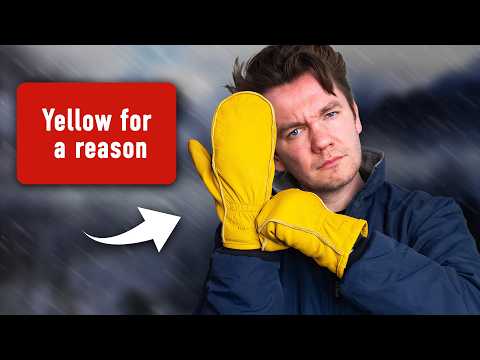
“The humble mitten. One of the objects humanity has really not improved for forever.” — Michael Kristy, 0:00
Clip command
yt-dlp --download-sections "*0:00-0:28" "https://www.youtube.com/watch?v=uI9IVadeONc" --force-keyframes-at-cuts --merge-output-format mp4 -o "mitten-not-improved.mp4"”Fishermen’s wives knit mittens 30% too big”
“New England fishermen’s wives would knit their husbands a pair of mittens that were about 30 percent too big for their hands. Then every single day that fisherman on his way steaming out would get his mittens soaking wet in warm water and stomp on them on the deck until they shrunk down to the correct size.” — Michael Kristy, 1:21
Clip command
yt-dlp --download-sections "*1:21-1:56" "https://www.youtube.com/watch?v=uI9IVadeONc" --force-keyframes-at-cuts --merge-output-format mp4 -o "fishermen-oversized-mittens.mp4"”They had to actually chew the leather to make it soft”
“The Inuit people, because of where they lived and the materials they had around them, had to process leather in a very, very specific and intensive way. They were scraping fat and blubber and everything off from seals. They had to actually chew the leather to make it soft enough to work with.” — Michael Kristy, 4:21
Clip command
yt-dlp --download-sections "*4:21-4:52" "https://www.youtube.com/watch?v=uI9IVadeONc" --force-keyframes-at-cuts --merge-output-format mp4 -o "inuit-chew-leather.mp4"”The yellow comes from the smoking process”
“All of these leathers are yellow because of the smoking process that I talked about before. When the leather was first processed, it was basically white and then the smoke turned it this color.” — Michael Kristy, 7:34
Clip command
yt-dlp --download-sections "*7:34-7:59" "https://www.youtube.com/watch?v=uI9IVadeONc" --force-keyframes-at-cuts --merge-output-format mp4 -o "yellow-from-smoke.mp4"”300 years we haven’t come up with something better”
“But through all of that and with all of that at the end of the day we’re still just following that same formula of wool or synthetic material nowadays and leather. 300 years we haven’t come up with something that’s better for most people which is crazy.” — Michael Kristy, 11:23
Clip command
yt-dlp --download-sections "*11:05-11:34" "https://www.youtube.com/watch?v=uI9IVadeONc" --force-keyframes-at-cuts --merge-output-format mp4 -o "300-years-same-formula.mp4"Key Points
- Oldest intact mittens (0:04) - Found in Iceland, belonged to a child around the year 900
- Dachstein mittens (1:05) - Austrian felted wool mittens loved by ice climbers for warmth, wind and water resistance
- Ice skin technique (1:13) - Some climbers say Dachsteins don’t get good until they develop an ice skin from climbing all day
- Fishermen’s felting method (1:21) - New England fishermen’s wives knit oversized mittens to be stomped down daily in warm water
- Buff/shag mittens (1:56) - 19th century Adirondack mittens, possibly the warmest knit wool mittens ever made
- Inuit poaluk mitten (4:06) - Double-layered mitten with seal skin outside and fur-on caribou hide inside
- Anishinaabe buckskin (6:28) - Great Lakes tribes perfected soft, stretchy, silent leather processing
- Smoke-tanning creates yellow (7:34) - Originally white leather turned yellow through traditional smoking process
- First Sears record (7:43) - Yellow mittens first documented for sale in 1902 Sears catalog
- Cowhide vs buckskin (7:59) - Modern cowhide nearly closes the gap with buckskin at lower cost
- Wool strengths and weaknesses (9:44) - Naturally insulating and warm when wet, but not durable for heavy work
- Leather strengths and weaknesses (9:55) - Durable, windproof, but not naturally insulated
- Chopper mitten formula (10:55) - Leather outer over wool inner, perfected in 1700s-1800s logging industry
- M-1949 US Army mittens (10:55) - Military extreme cold mittens follow the same chopper formula
- Lobster claw design (11:05) - Originally designed so you could shoot a gun easier
Mentions
Companies
- Dachstein (1:05) - Austrian felted wool mitten maker
- L.L. Bean (10:55) - Makes buckskin chopper mittens
- Hestra (11:05) - Swedish glove maker with ski pole reinforcements
- Kinco (11:05) - Yellow work mitten manufacturer
- Filson (11:05) - Two discontinued mitten models mentioned
- Frost River (11:05) - Pennsylvania chopper mittens in waxed canvas
- Raber (11:05) - Canadian-made “garbage mittens” for extreme cold
- Sears (7:43) - First documented seller of yellow mittens in 1902
Products & Technologies
- Buckskin (6:28) - Traditional deer-skin leather, gold standard for glove material
- Felted wool (1:38) - Thickest, warmest wool mittens possible from shrinking process
- Chopper mittens (10:55) - Leather outer + wool liner, 300-year-old design
- M-1949 mittens (10:55) - US Army extreme cold weather mittens
People & Cultures
- Inuit (4:06) - Masters of double-layered seal skin and caribou hide mittens
- Anishinaabe (6:17) - Great Lakes people who perfected buckskin processing
- Yupik (3:41) - Indigenous people who contributed to mitten development
- Sami (10:04) - Combined reindeer leather outers with knit inners
- Cree (3:41) - Indigenous people who contributed to mitten technology
Surprising Quotes
“These are some of the oldest intact mittens ever found. They belong to a child in Iceland around the year 900. You can tell they were for a child because even 1100 years ago parents were like, ‘Okay, you lost the mittens?’” — Michael Kristy, 0:04
“I found them on eBay for a hundred bucks and I bought them and I’m going to donate them to a museum. How cool is that?” — Michael Kristy, 2:22
“Obviously that got superseded by machines that now use metal teeth to mimic the same thing going on.” — Michael Kristy, 4:32
“By that time people associated the color yellow with buckskin mittens and good quality, so manufacturers dyed their stuff yellow to match.” — Michael Kristy, 7:43
“This lobster claw was originally made so you could shoot a gun easier.” — Michael Kristy, 11:05
Transcript
Michael Kristy: 0:00 The humble mitten. One of the objects humanity has really not improved for forever. These are some of the oldest intact mittens ever found. They belong to a child in Iceland around the year 900. You can tell they were for a child because even 1100 years ago parents were like, “Okay, you lost the mittens? Not a- Nope, mommy’s not mad at all. You used your super sight and couldn’t find them? And you- okay.”
Michael Kristy: 0:22 Today, we are focused on two of the most famous forms of mittens ever created: the yellow mitten and the ice mitten, for lack of a better term. We shall begin by testing one of them. Ambient temperature outside, 30 degrees on the dot. But for today’s purposes, we care specifically about the temperature of the water. Okay, small problem with our experiment. I am currently standing on the river that I wanted to test the temperature of. Drat. Oh, okay, that’s- We’ll find other water. I think I saw a little puddle somewhere else.
Michael Kristy: 0:46 Stupid, stupid moron Michael didn’t think the river- It’s just simple math if the temperature’s not- You had such a good idea before you checked the temperature in the morning before you went outside. Ambient temperature outside, 30 degrees. Temperature of the water: 34.2 degrees Fahrenheit, 1.2 degrees Celsius. Okay, not as climactic as I envisioned, but here we go.
Michael Kristy: 1:05 These are Dachstein mittens, loved by ice climbers because they’re extremely warm, wind resistant, water resistant, and flexible. Some climbers say they don’t get good until they get an ice skin on them from climbing all day. Fishermen also did something very similar with their mittens. Yeah! New England fishermen’s wives would knit their husbands a pair of mittens that were about 30 percent too big for their hands. Then every single day that fisherman on his way steaming out would get his mittens soaking wet in warm water and stomp on them on the deck until they shrunk down to the correct size.
Michael Kristy: 1:38 I’m trying to do that with these right now. Hopefully you could see the size difference. Felted wool mittens are some of the thickest, warmest wool mittens that you could possibly make. But they’re not the warmest wool mittens you can make.
Michael Kristy: 1:56 The warmest knit wool mittens probably came in the 19th century in the Adirondacks, Maine, Massachusetts, or Vermont. They were called buff mittens or shag mittens. Very, very cool. There’s not a lot of information about them. There’s sparse pictures and paintings that show a buff mitten on the ground or something like that. They’re in museums, there’s stuff like that about them. And I have a pair. I found them on eBay for a hundred bucks and I bought them and I’m going to donate them to a museum. How cool is that?
Michael Kristy: 2:30 That is one type of extremely famous super popular mitten that you see everywhere. But there’s another type of mitten that is even more popular. That is very, very famous in Minnesota, in Wisconsin, in South Dakota, in Maine, that I am going to put on my hand right now. But the thumb is a little mispositioned. The extremely famous and legendary yellow mitten. What’s so great about it? Why does everybody in Minnesota and Canada and all the really cold places wear it? And why is it so warm?
Michael Kristy: 2:51 Those two styles of mitten set the formula for mittens forever. They’ve never changed. This style of mitten is around 300 years old. And why haven’t they changed? Well, 300 years ago something happened that basically made- So, the perfect mitten was figured out. Before that, there were two different ones, and then there was one. And so, we will be splitting the perfect mitten up into its two halves and dissecting each one. I broke this video into three easy-to-digest parts.
Michael Kristy: 3:22 Who put the yellow in these yellow mittens? I’m wearing two different mittens for very important reasons. This is the gold standard in yellow mitten material. This is the modern version. We use this modern version because it’s a lot cheaper and almost as effective, but it’s not as good as the original. As you could probably see, the leather between the two looks very different.
Michael Kristy: 3:41 Indigenous people in northern areas wrote the rule book on leather mittens. We have the Inuit, the Yupik, the Sami, Alaskan Native, uh, Cree, goodness there’s quite a lot of tribes that really contributed to the world of mittens. They wrote the rule book on what makes a good mitten because they did not change quality for big machines or anything like that, so their stuff was insane.
Michael Kristy: 4:06 If we start with the Inuit people, they are masters at making a double-layered mitten called the poaluk. That’s a very important mitten with seal skin on the outside, caribou hide on the inside with the fur still on, facing your hand. The Inuit people, because of where they lived and the materials they had around them, had to process leather in a very, very specific and intensive way. They were scraping fat and blubber and everything off from seals. They had to actually chew the leather to make it soft enough to work with. Obviously, that got superseded by machines that now use metal teeth to mimic the same thing going on.
Michael Kristy: 4:41 But the thing to note is that they got their insulation from the actual leather itself. They left the hair on the caribou to keep their hands warm. They didn’t put something else in the mittens on those double mittens.
Michael Kristy: 6:17 Now if we go south from that and we focus on the Anishinaabe people, which by the way if I say something wrong or something like that, I researched, practiced pronunciation as hard as I possibly could, not perfect. Sorry if there’s a mistake. The Anishinaabe people and tribes around the Great Lakes focused on buckskin, deer-skin, moose, elk, which all of those are premiere glove leather. Like this right here, this is buckskin.
Michael Kristy: 6:39 The characteristics of buckskin and elk and moose and everything combined with the way it was processed make it extremely soft, very stretchy, silent when you’re moving around so if you’re hunting it doesn’t creak. Breathable, easy to repair because the leather is so soft, it was easy to pierce, and most importantly in the winter, well I guess in general, if it got wet it didn’t stiffen up over time, so it always stayed soft, pliable, and stretchy. It’s really great for what you needed.
Michael Kristy: 7:03 All of these hides that were tanned and processed in the traditional way were legendary because of all the work it actually took to make it. You had to agitate the leather as it was tanning, then you had to put it over smoke so that way it didn’t stiffen up and harden because it broke down all the fibers inside so they didn’t glue together. It took a lot of time, and because of the characteristics of buckskin, moose, and elk, it also took an expert to say, ‘Okay, this leather is a little stretchier here, this one is soft like this, this one’s a little dryer so I need to process it this way exactly.’ But it paid off in spades.
Michael Kristy: 7:34 All of these leathers are yellow because of the smoking process that I talked about before. When the leather was first processed, it was basically white and then the smoke turned it this color. And I’m assuming by the time that these were sold in places like Sears and stuff like that, with the first version being seen in 1902, it could have been sold before that but there’s not a lot of records of it. By that time people associated the color yellow with buckskin mittens and good quality, so manufacturers dyed their stuff yellow to match. I would assume.
Michael Kristy: 7:59 Obviously now in 2026 with modern tanning processes and machines that can agitate stuff and things like that, usually the gap is almost closed. Buckskin is still probably a superior leather, but cowhide is way cheaper, way easier to get, way easier to work with, and this is soft, treated to be very water resistant, tough, durable, and more consistent throughout. Pigskin is also another alternative that is used that is very soft, has similar qualities to buckskin and stuff like that, but obviously way cheaper because a lot more people eat pork and stuff like that.
Michael Kristy: 8:35 So the yellow mitten was considered to be the gold standard of quality, but the reason that I mentioned the Falu is because of the insulation that goes inside of the mitten. We have the gold standard of the outside of the mitten, but the inside’s not so easy. I actually, I shouldn’t put it like that. There were many, many, many solutions. You could stuff the mittens with grasses or buffalo down, like the undercoat of a buffalo, which is incredibly warm, or you could just use animal hides and furs themselves to keep your hands warm.
Michael Kristy: 9:00 But if you combine the perfect outer with the perfect inner… Men outer with a specific little animal that bounces around, in some cases eats kelp, in other cases eats alfalfa, in other things you get kind of the world’s most loved mitten, the mitten that everybody likes, the yellow most famous Minnesota mitten. I’m saying Minnesota obviously we’ll get, it’s not just Minnesota but we’ll get there in a second. People that had sheep absolutely loved sheep and while of course everybody was kind of working on leather at the same time if you had sheep available to you you were like let’s not focus solely on leather let’s put a lot of thought into this.
Michael Kristy: 9:31 People that have a ton of sheep’s wool are figuring out how could we develop the best strongest most durable mittens possible and people with a ton of leather are figuring out the same thing but with their materials that are more readily accessible to them. But they both have downsides. Naturally insulating, it’s warm immediately, you don’t need to add anything else. Also very good when it’s wet, it keeps your hand warm, but if you’re swinging an axe or doing crazy work, not very durable so you need to keep remaking these all of the time.
Michael Kristy: 9:55 On the other hand we have something that is not naturally insulated but very very durable, windproof, not so good in the water but still doesn’t creak and freeze up if it gets wet.
Michael Kristy: 10:04 So now if we fast forward to the 1700s and the 1800s in the US specifically, similar stuff was actually happening around the world, the Sami people were combining their reindeer outers with knit inners, but we have a massive logging industry in the US where people are swinging axes all day long. They need something to protect their hands and keep them warm. We also have knitting everywhere. It’s cheap, it’s fast, you can do it at home, you can make mittens all day long.
Michael Kristy: 10:32 So we make an over mitten like the Pualu but with different materials. This helps you grip an axe, protects your hands, also you can take this off or if a machine grabs your hand this comes off and you still have this mitten underneath it so if you need to vent your hands during the day but not freeze them off you have wool. And at the end of the day you take the wool mittens you put them by the stove they dry off for the next day or you rotate the mittens out.
Michael Kristy: 10:55 So what do you call your mittens? Choppers. This is a chopper mitten. These are choppers, L.L. Bean ones are choppers, technically the M-1949 US Army extreme cold mittens, choppers. We’ll look at how insanely far we have come in leather mitten technology. We have strategic leather reinforcements all over the mitten so you can hold ski poles. We have this lobster claw that was originally made so you could shoot a gun easier. Neoprene cuffs, really cool applied logo things.
Michael Kristy: 11:23 But through all of that and with all of that at the end of the day we’re still just following that same formula of wool or synthetic material nowadays and leather. 300 years we haven’t come up with something that’s better for most people which is crazy.