83 Years Ago, Britain Made a “Cotton Gore-Tex.” Why Don’t We Use It?
83 Years Ago, Britain Made a “Cotton Gore-Tex.” Why Don’t We Use It?
Summary
Michael Kristy digs into the tangled history of Ventile, the ultra-dense WWII-era cotton fabric that’s often billed as a natural precursor to Gore-Tex. The story starts with Winston Churchill’s genuinely 1940s solution to a genuinely 1940s problem: rocket-catapulting Hawker Hurricanes off merchant ships to fight off German bombers, which left pilots with no runway to land on and about two minutes to live once they ditched in the freezing North Atlantic. The British Cotton Industry Research Association (the Shirley Institute) was tasked with solving that problem and came up with Ventile — a fabric woven so tightly from long-staple cotton that its fibers swell shut when wet, physically blocking water while staying breathable. The Mark 7 Ventile immersion suit arrived in 1951, six years after the war it was designed for had already ended.
From there, Michael goes hunting for the truth behind a decade of contradictory online claims, starting with a 13-year-old pair of viral blog posts (“Ventile: Fact or Fiction?” and “Ventile: The Ugly Facts They Don’t Tell You”). He walks through the pre-Ventile lineage of dense-weave cottons (Burberry Gabardine, Grenfell cloth), the physics of the swelling weave versus Gore-Tex’s fixed micro-membrane, and the hard numbers: Ventile tops out around 500-900mm of hydrostatic head pressure versus Gore-Tex’s 20,000mm+, and a Canadian research paper found that real-world Ventile immersion suits leaked so badly that some pilots refused to wear them. Yet a properly built double-layer suit worked, and Ventile still extended survival time tenfold and saved an estimated 80% of ejected pilots — earning it the description “Gore-Tex’s dad.”
The video’s biggest reveal comes when Michael tests water beading on his own 1950s RAF Ventile flight suit and finds it beads immediately — contradicting the popular myth that vintage Ventile was always untreated. Digging up a 1951 trade article by T.R. Harding, he finds proof that commercial Ventile garments were being treated with Velan and Zelan water-repellent finishes as early as 1951, and that a “vintage Ventile” flight suit he’d verified through two separate listings turns out to actually be Gabardine based on its weave. He closes out by dosing a pair of cutoff jorts, a t-shirt, and a Carhartt jacket with Nikwax Wash-In Cotton Waterproofer to show that the same DWR trick behind Ventile’s legendary beading can be replicated on ordinary cotton — just less durably.
Highlights
”Winston Churchill had the most 1940s idea of all time”
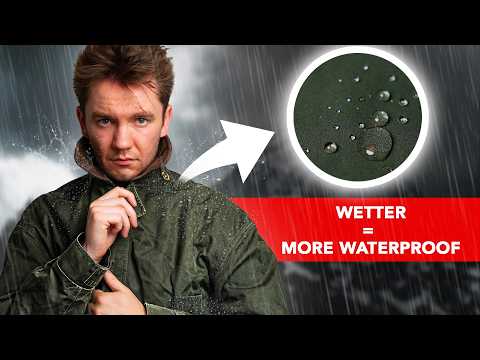
“And Winston Churchill had the most 1940s idea of all time. He was like, ‘Okay, so why don’t we just add a rocket-fueled catapult to merchant ships and just fire a Hawker Hurricane at the Germans?’” — Michael Kristy, 0:44
Clip command
yt-dlp --download-sections "*00:44-01:38" "https://www.youtube.com/watch?v=ZYitFMuxj3k" --force-keyframes-at-cuts --merge-output-format mp4 -o "churchill-rocket-catapult.mp4"”They have about two minutes before they die from hypothermia”
“And that creates a new problem. Pilots are landing in the North Atlantic and when they land in those waters, they have about two minutes before they die from hypothermia.” — Michael Kristy, 1:21
Clip command
yt-dlp --download-sections "*01:21-02:03" "https://www.youtube.com/watch?v=ZYitFMuxj3k" --force-keyframes-at-cuts --merge-output-format mp4 -o "two-minutes-before-hypothermia.mp4"”Ventile is water-resistant with its holes”
“Throughout time, and even today in modern times, waterproof and water-resistant fabrics are about blocking the holes, but Ventile is water-resistant with its holes.” — Michael Kristy, 6:20
Clip command
yt-dlp --download-sections "*06:20-06:58" "https://www.youtube.com/watch?v=ZYitFMuxj3k" --force-keyframes-at-cuts --merge-output-format mp4 -o "water-resistant-with-its-holes.mp4"”Many brand new suits leaked so badly…”
“The quality control on the manufacturing of suits was poor. Many brand new suits leaked so badly that the subjects had to be physically lifted out of the water after only a short immersion and some groups of people even refused to wear them.” — Michael Kristy, 15:54
Clip command
yt-dlp --download-sections "*15:54-16:41" "https://www.youtube.com/watch?v=ZYitFMuxj3k" --force-keyframes-at-cuts --merge-output-format mp4 -o "suits-leaked-so-badly.mp4"”Ventile is Gore-Tex’s dad”
“It may be considered as the first application of waterproof breathable fabrics. Ventile is Gore-Tex’s dad. And if for some reason Gore-Tex didn’t exist, I think we’d still be wearing something very similar, even if synthetic materials also didn’t exist.” — Michael Kristy, 20:13
Clip command
yt-dlp --download-sections "*20:13-20:49" "https://www.youtube.com/watch?v=ZYitFMuxj3k" --force-keyframes-at-cuts --merge-output-format mp4 -o "ventile-is-gore-tex-dad.mp4"”The first ever Iron Snail fabric historic fact”
“Okay, so we had a bit of an issue and I was like ‘crap, I don’t understand Ventile, I don’t know how it works because the water is beading up on this 1950s untreated flight suit’. And then I was like ‘oh wait a minute, this might be the first ever Iron Snail fabric historic fact that we have ever discovered.’” — Michael Kristy, 21:50
Clip command
yt-dlp --download-sections "*21:50-22:36" "https://www.youtube.com/watch?v=ZYitFMuxj3k" --force-keyframes-at-cuts --merge-output-format mp4 -o "first-iron-snail-historic-fact.mp4"Key Points
- Ventile’s WWII origin story (0:26) - Developed at Winston Churchill’s request after German bombers exposed the British navy’s lack of carrier ships.
- The rocket-catapult problem (0:44) - Catapulting Hawker Hurricanes off merchant ships solved one problem and created another: pilots had nowhere to land.
- Two minutes to hypothermia (1:21) - Pilots ditching in the North Atlantic had roughly two minutes before dying of exposure.
- The Shirley Institute’s brief (2:03) - The British Cotton Industry Research Association was asked to apply cotton’s moisture-swelling property to survival gear.
- Mark 7 Ventile immersion suit, 1951 (2:31) - Introduced six years after WWII ended, missing the war it was built for.
- A decade of online mythology (3:21) - A 13-year-old pair of viral blog posts (“Fact or Fiction?” and “The Ugly Facts They Don’t Tell You”) kicked off years of contradictory Ventile claims.
- Pre-Ventile waterproofing methods (6:39) - Wax/oil-coated cottons (Barbour, sailors’ sails) and indigenous techniques from Mesoamerica, North America, and China predate Ventile by centuries.
- The Macintosh raincoat (7:25) - Charles Macintosh’s 1800s rubber-sandwich raincoat, the ancestor of laminated membrane construction still used today.
- How the swelling weave works (8:35) - Dry Ventile has ~10 micron gaps; wet, hydrophilic cotton fibers swell to close gaps down to 2-3 microns, about half a red blood cell.
- Ventile’s cousins: Gabardine and Grenfell cloth (9:29) - Burberry’s Gabardine (1879) and Grenfell cloth (1931) were dense-weave predecessors that relied on DWR coatings, not swelling.
- The DWR secret ingredient (10:13) - Durable water repellent finishes, not the weave alone, are why dense cottons like Grenfell and Burberry beaded water.
- Hydrostatic head pressure explained (14:23) - The standard test straps fabric to a tube and measures how many millimeters of water column it holds before leaking.
- Gore-Tex vs. Ventile by the numbers (15:16) - Gore-Tex runs ~20,000mm+; Ventile’s best recorded tests were 500-900mm, 22-40x weaker.
- The Canadian immersion-suit study (15:54) - Real-world Ventile suits often leaked catastrophically due to poor construction, defects, and body oils blocking the swelling.
- Double-layer Ventile actually worked (18:49) - A single Ventile layer failed under impact pressure, but a properly built double layer kept pilots alive.
- Swiss lab findings on low-rated fabrics (19:17) - Fabrics rated below 120mm still tested fully waterproof in simulated rainfall when closely woven and DWR-treated.
- Ventile’s real legacy: 80% survival, 10x longer (19:50) - Extended pilot survival time tenfold and saved an estimated 80% of those who ejected — earning it the “Gore-Tex’s dad” label.
- Testing his own 1950s Ventile flight suit (21:23) - Water beads immediately on Michael’s vintage RAF flight suit, contradicting the “always untreated” myth.
- T.R. Harding’s 1951 article (22:36) - Documents Ventile being commercially dyed and treated with Velan and Zelan water repellents as early as 1951.
- A “Ventile” flight suit that’s actually Gabardine (23:34) - The weave (twill, not Ventile’s signature Oxford) reveals a mislabeled garment sold as Ventile on two separate listings.
- DWR experiment on jorts, t-shirt, and Carhartt (12:59) - Nikwax Wash-In Cotton Waterproofer is used to test whether ordinary cotton can replicate Ventile’s beading trick.
- Why “Ventile” is just a brand name (27:00) - T.R. Harding’s 1951 paper reveals the name was chosen because it characterizes the fabric as a “venting textile.”
Mentions
Companies
- SeaVees (5:15) - Sponsor; BF Goodrich’s 1960s sneaker spinoff, sold off, killed by antitrust action, and revived decades later.
- Barbour (6:39) - Cited as a major proponent of wax/oil cotton waterproofing before dense-weave fabrics.
- Burberry (9:29) - Introduced Gabardine in 1879, a dense-weave precursor to Ventile.
- Grenfell (9:41) - Introduced Grenfell cloth roughly 20 years before Ventile.
- Ventile (the company) (12:21) - Michael spoke to a representative for an hour who promised a swatch, then went silent after a recent acquisition.
- Carhartt (4:31) - Used as the water-resistance baseline in the DWR treatment test; dominates the beading comparison.
- Nikwax (12:59) - Maker of the Wash-In Cotton Waterproofer used to DWR-treat the jorts, t-shirt, and Carhartt.
- LL Bean (4:12) - Source of the jeans-turned-jorts used in the water resistance experiment.
Products & Technologies
- Ventile fabric (2:22) - Extremely densely woven cotton made from long, fine fibers that swell shut when wet.
- Gore-Tex (0:21) - Modern synthetic membrane repeatedly compared against Ventile throughout the video.
- Mark 7 Ventile immersion suit (2:36) - The finished RAF suit, introduced in 1951, engineered for yarn twist, weave weight, and weave type.
- Macintosh raincoat (7:25) - Charles Macintosh’s 1800s rubber-sandwiched fabric, forerunner of laminated membrane construction.
- Burberry Gabardine (9:29) - Dense-weave cotton fabric from 1879, DWR-dependent rather than swelling-based.
- Grenfell cloth (9:41) - High-density woven cotton predecessor also reliant on a water-repellent coating.
- Cravenette (10:54) - Possibly the original commercial water-repellent treatment brand, predating Ventile.
- Velan / Zelan (22:36) - DWR chemical treatments introduced in 1937, six years before Ventile was even invented.
- Nikwax Wash-In Cotton Waterproofer (12:59) - DWR product used to test water resistance on ordinary cotton garments.
- Hydrostatic head pressure test (14:23) - Standard millimeter-based measurement used to compare Ventile’s and Gore-Tex’s water resistance.
People
- Michael Kristy (0:00) - Host of The Iron Snail, narrator and on-camera researcher.
- Winston Churchill (0:26) - Requested the fabric development that became Ventile.
- “Nick” (Well Dressed Dad) (3:21) - Wrote the two viral 2013-era blog posts that kicked off online Ventile mythology.
- Taylor (4:21) - Michael’s partner; cut the LL Bean jeans down into the jorts used in testing.
- T.R. Harding (21:50) - Author of a 1951 trade article that documents Ventile’s early commercial DWR treatment and the origin of its name.
Surprising Quotes
“The cotton did not swell up fast enough and it soaked people.” — Michael Kristy, 15:46
“I, Michael Kristy, sole representative of the Iron Snail and head of the research department, would like to formally ask the group and propose the idea to all of the fabric and textile nerds out there that Ventile as a textile, since it was commercially used, has always been treated with some sort of water-repellent finish as early as 1951.” — Michael Kristy, 22:36
“That, the fact that this was sold as Ventile three different times, is the biggest point of this video. Nobody knows really anything about historic Ventile. Nobody.” — Michael Kristy, 24:23
“DWR, even though it’s fluorocarbon-free, is still just plastic. So Ventile, Burberry, whatever fancy thing that you have that has a DWR coating, has a plastic coating on top of it.” — Michael Kristy, 25:03
“He ends with the term Ventile was given to these new fabrics, a word which characterizes very well their essential property, a venting textile.” — Michael Kristy, 27:00
Transcript
Michael Kristy: 0:00 This jacket uses the coolest World War II British military fabric of all time. It uses a cotton fabric that is so cool and so effective that in World War II this replaced nylon. Mind you, nylon in the 1940s was a miracle fabric. There were the stocking riots when people couldn’t get nylon for their stockings. It takes a lot of work to keep ahead with you women and your changes.
Michael Kristy: 0:21 And nowadays, people are looking at it to replace Gore-Tex. Holy smokes. But, what’s also cool is that the fabric was developed at the request of none other than Winston Churchill. Early in World War II, the British military did not have enough carrier ships that pilots could launch off of, so the Germans could just fly over to British ships and rain terror down on everybody and the British were like, ‘Gah, we’re kind of out here.’
Michael Kristy: 0:44 And Winston Churchill had the most 1940s idea of all time. He was like, ‘Okay, so why don’t we just add a rocket-fueled catapult to merchant ships and just fire a Hawker Hurricane at the Germans?’ And all the British people designing stuff were like, ‘All right, that sounds like a good idea.’ So obviously since it’s the 1940s, that worked. But the problem is, once the battle is over, you have a pilot in a plane that does not have a ship they can land on. They can only be fired off of it.
Michael Kristy: 1:14 So everybody says to Churchill, ‘Well, what should they do after?’ And Churchill says, ‘They’ll just jump out. They’ll just pop out of the plane and fall in the water.’ And that creates a new problem. Pilots are landing in the North Atlantic and when they land in those waters, they have about two minutes before they die from hypothermia. So you introduce… In real life, a ditching like this for the pilot of a wrecked aircraft has often meant death by exposure and freezing.
Michael Kristy: 1:38 The RAF immersion suit comes into focus. It’s made with a double layer of rubber with the object of conserving body heat in water. If we only know our pilots are going to eject themselves out of their aircraft into the sea, how long can they survive in the sea? Current sea survival time: approximately two minutes. Not good. We need a new immersion suit, one that can keep a pilot alive for far longer.
Michael Kristy: 2:03 So, you need to call up the Shirley Institute, AKA the British Cotton Industry Research Association, and say, ‘Hey, you know that thing that cotton fibers do to keep a seed moist? We need to use that specific property on our clothing to protect pilots ejecting out of aircraft.’ And so they did. And they developed Ventile. Ventile, an extremely densely woven cotton fabric made from some of the longest and finest cotton fibers available on the planet.
Michael Kristy: 2:31 Its lightweight, only a few ounces, but it may well mean the difference between life and death. They engineered the yarn twist, the weight of the weave, the type of the weave, every single possible thing they could until they were happy and they made the Mark 7 Ventile immersion suit. Introduced in 1951.
Michael Kristy: 2:54 1951, of course, is six years after World War II. Oops. And that brings us to the messy messy world of Ventile. The amazing miracle cotton fabric that is oftentimes full of myths and sometimes lies. Essentially from this point on, every single claim that I found online from experts and not experts, I tried to verify and it wasn’t, I couldn’t, it was contradictory. None of it made sense. So I was like, uh-oh.
Michael Kristy: 3:21 Which I’ve been thinking about for a long time, like 10 years, because 10 years ago there was a blog post by a guy named Well Dressed Dad. 13 years ago. Sorry. Man named Nick published two blogs. One entitled Ventile: Fact or Fiction? and the other called Ventile: The Ugly Facts They Don’t Tell You. And way back 13 years ago on the internet, those blog posts blew up. Some article on Kim Kardashian and then right below it, Ventile: Fact or Fiction?
Michael Kristy: 3:48 But you also can’t swing the other way and say Ventile is totally useless, it doesn’t work, it’s a scam, whatever you want to say, because Ventile is amazing and it is the precursor to Gore-Tex and does very cool things, but it does come with a ton of baggage. So today, besides pretending like I’m Batman in this giant cloak coat jacket that I got, we’re going to figure out, is there actually anything special about Ventile? And the only real way to do that, in my opinion, is to see if I can make this pair of LL Bean jorts that I got as water resistant as this thousand dollar jacket.
Michael Kristy: 4:21 Okay, these are, they were actually LL Bean jeans that didn’t fit me well, so Taylor cut them for me and now these are my summer jorts that I wear almost never. We’re also trying it with a t-shirt and a Carhartt jacket to see, because little common misconception, Ventile always has a secret ingredient with it. Let’s see if I can make this fit as water resistant as Ventile.
Michael Kristy: 4:47 Founders edition. Oh boy. Fun fact, rubber companies dominated the planet for a little bit. Uniroyal, aka the United States Rubber Company, was one of the first 12 companies to be in the Dow Jones. It traded under the ticker R. Just the letter R. At that time, rubber companies made anything that they could themselves with rubber. And BF Goodrich wanted to make sneakers in the 1960s.
Michael Kristy: 5:15 So they made a little company called SeaVees. And then BF Goodrich was like, ah, actually we should probably just focus on tires. So let’s sell SeaVees, and they did, to a giant footwear brand. And then the giant footwear brand got in trouble with the US government and the US government said, this is becoming a monopoly, you have to kill some of your companies. And that company killed SeaVees. 40 years later and the brand was reborn. 60 years later and the new revived SeaVees called up Daddy, BF Goodrich, and said, hey, how about one more time for old time’s sake?
Michael Kristy: 5:44 Feast your eyes on the SeaVees x BF Goodrich Founders Edition yacht shoe. Obviously, SeaVees also makes other pieces of footwear as well. I’ve been wearing the Hawthorne quite often as I meander around town. And I actually got my second pair of Tiburon Trekkers in the mail recently because Taylor’s sister Cassidy took my first pair because they were too small for me. But this yacht shoe is certainly what I’ll be wearing. the most. This is a stitch-for-stitch revival of a 60-year-old pair of CVs, complete with a fully siped outsole so you don’t slip when you’re walking on a yacht. Which frankly, I thought was pretty cool.
Michael Kristy: 6:09 So thank you very much CVs for sponsoring this video. More information in the description.
Michael Kristy: 6:14 Ventile is so magical because it has holes. Basically, throughout, let’s take a look a little nicer, a little closer. Throughout time, and even today in modern times, waterproof and water-resistant fabrics are about blocking the holes, but Ventile is water-resistant with its holes. But if you want true water resistance and you don’t have something with you like Ventile, you need to cover those holes somehow, some way.
Michael Kristy: 6:39 The first thing until this video I thought we did to stop those holes was this: wax or oil cotton fabrics. Obviously Barbour was a big proponent of this, but really sailors covering their sails and linseed, you’ve heard me say it a billion trillion times, they were the first guys to say, ‘Hey, if this is shmutzed with something, it’s more wind and water-resistant.’ But I just found out they weren’t the first guys. This is what the Europeans did first. I don’t know how I didn’t think of this, but there’s Mesoamerica, North American Indigenous people, people in China, they all had different ways of waterproofing things thousands of years before this.
Michael Kristy: 7:13 Waxes and oils obviously weren’t perfect though, because they wore off over time, they were temperamental depending on the temperature, the coating had to be perfectly even or they weren’t water-resistant. So not the best, but pretty good. In the 1800s though, things started to change pretty fast. A very famous name in the world, Charles Macintosh invented the Macintosh raincoat where he sandwiched a layer of rubber between two regular layers of fabric. But it still wasn’t the best. So we switched from sandwiching rubber between two layers to applying that rubber directly to a fabric and bonding it into one thing. And we really haven’t changed that for a super long time. Inflatable rafts, everything still that same concept.
Michael Kristy: 7:58 But all these years later, the idea of blocking the holes completely for waterproofness has never gone away, and it’s still the best. Unless, what if you made a fabric that was so dense, so tightly woven, that yes, it still had holes, but those holes were too small to allow water to go through them? When a drop of water hits a Ventile weave, as it’s about to do, those cotton fibers swell up and get so close together that water physically can’t get through the density of the weave.
Michael Kristy: 8:35 Ventile fabric is woven so tightly and it’s so dense that when it’s dry, the gaps in the fabric are around 10 microns in size. That is five to ten times finer than a human hair or about as thick as plastic wrap. But cotton is very hydrophilic, it loves to absorb water. So the Shirley Institute was thinking, ‘Hmm, well when it absorbs water, it’s gonna get a little fatter.’ So if we get it really close together when it’s dry, the water is going to do the rest of the work for us and we’ll go from 10 microns to two to three, which is about the size of half of a red blood cell. So then nothing’s getting through this weave, baby.
Michael Kristy: 9:00 The way Ventile works is also the biggest source of mystery and mythology that gets tied up into one thing. That shot and this shot where the water is beading beautifully on top of it, that’s not Ventile. In fact, the water is not even touching Ventile. That is how Ventile works, but… Ventile is not the first ever super dense cotton fabric that ever existed. It belongs to a specific category of old outerwear really from the 1880s all the way to the 1980s.
Michael Kristy: 9:29 For example, this swatch of fabric is very similar to Burberry’s famous Gabardine, first introduced in 1879, 64 years before Ventile, but very similar in a lot of ways. And this is another very famous high-density, really tightly woven cotton fabric called Grenfell cloth, introduced 20 years before Ventile by none other than Grenfell. Grenfell cloth, Burberry, later Eddie Bauer, there’s this really cool one that begins with a J, I forget what it was called, they all are doing something very similar and they were all advertising to adventurers: mountain climbers, pilots, land speed record drivers, race car drivers—that’s probably not the right word.
Michael Kristy: 10:13 But this type of extremely dense cotton was very useful because usually it didn’t stand on its own. It had a secret ingredient: DWR, durable water repellent finish. Or before the era when it was really durable and it was just a water repellent finish. What if instead of having to plug the holes of the weave so water couldn’t get through, you instead had a little coating on top that held water on top of the fabric so it never actually touched the fabric? That’s exactly what Grenfell did, and that is why Mr. Burberry got so famous. The holes in the fabric that weren’t being blocked allowed sweat vapor to come out.
Michael Kristy: 10:45 AKA, you had your first ever truly water-resistant but breathable fabric that was night and day for performing because you weren’t stuck in a rubber cage. And that was happening way longer than I thought. I think the original version is called Cravenette. Ads are of people wearing wool top hats and doing what people do today on TikTok showing the water beading off. If you have a water-repellent finish on your fabric, it’s going to do that beading thing. But if you don’t, it’s going to do this.
Michael Kristy: 11:16 Just for a second the water is going to bead up like we’d expect, but immediately it’s absorbing into the cotton. So you can still hold a lot of the water with the fabric, but it is slowly dripping through the other side. And even if it wasn’t, this is going to get saturated anyways because it’s cotton and cotton is absorbing the water. Burberry and Grenfell, basically every single outdoors jacket within the past 100 years has some type of coating on it, even Ventile today.
Michael Kristy: 11:44 So we wouldn’t really be able to test how water repellent Ventile actually is unless, unless we can score some vintage Ventile. Because vintage Ventile from the 40s, 50s, 60s and 70s, I have it on good word, was untreated. examples of this untreated Ventile online. So that is not what we have here. These are actually different packages for a different video. But luckily, there are vintage examples of Ventile.
Michael Kristy: 12:03 Unfortunately though, it’s either extremely expensive and not the correct era, extremely expensive, not the correct era, not totally verifiable, or extra totally not verifiable. This is Blacks of Greenock historically did use Ventile, but they didn’t always use Ventile, so I don’t actually… looks like it might be, but I don’t actually know. I did speak to Ventile. I spoke to them for about an hour on a phone call, spoke to one guy, he was very nice. He said he could get me a swatch and then after the call, he never responded to me again.
Michael Kristy: 12:30 I really truthfully don’t believe that was for any malicious reasons. They’re not trying to cover anything up. I… they just got bought recently, so they were switching things over like as I was talking to them. So I think I just got lost in the shuffle or they were like, ‘What is he gonna do with it? Why are we gonna give him that?’ But, if we do know now that beating party trick is from DWR and you don’t need a crazy weave like Ventile to achieve it, I wanted to figure out could we get a very similar effect and make something like jorts water resistant? So, Nikwax Wash-In Cotton Waterproofer, DWR for cotton. And this is Taylor’s mushrooms.
Michael Kristy: 13:07 Shiitake. Shiitake. Let’s see if I can make this fit as water resistant as Ventile. First thing we need to do is test the baseline water resistance of each of these fabrics. Okay, so here’s what we want to pay attention to. I’m going to put water right here and I’m going to hold it in my hand and you see it stays on top there for a little bit and just now there’s a steady drip of water going on my hand. So my hand is wet. Oh. Okay. Well, that might be a problem.
Michael Kristy: 13:38 Okay, yeah, Carhartt’s gonna do very well because you’ll see if I put this on, see what’s going on? There it goes. Whoa. And while we’re doing all that, we have one of the most important questions of the video to answer. How water resistant is Ventile actually? This is going to be a little brutal. How do Gore-Tex and Ventile actually compare head-to-head? Well, we have some numbers. Sadly. I… I really wish we didn’t. It would be much more fun if it was magical.
Michael Kristy: 14:05 Gore-Tex also has holes. It’s this very weird spongy-looking membrane that is basically a water lock. It doesn’t need to get wet and swell up, it’s always like that. It’s just a solid wall. But the holes are 0.2 microns, 15 times smaller thereabouts of Ventile’s. Modern day water resistance tests use something called hydrostatic head pressure. Essentially you take a little bit of a fabric, you strap it onto a tube, and then you see how much water you can put on top of it or simulate putting on top of it before three drops of water go through that fabric. It’s measured in millimeters. So a jacket could be 5,000 millimeters of hydrostatic head pressure before it fails or whatever amount it may be. Often times Gore-Tex is in the 20,000 millimeter plus range, there’s sometimes 28,000 millimeters, but I did… I couldn’t stomach doing the math for 28,000. So 20,000. It’s said that typically 1,000 to 2,000 millimeters simulates a light rain shower so you want your…
Michael Kristy: 15:00 …at least water resistant to that level. Sitting down on a wet surface adds a lot more pressure so that’s around 5,000 millimeters according to what I could find online. And then of course we have very high pressure scenarios where you’re putting a lot of force down on a small area like kneeling, that is 10 to 15,000 range.
Michael Kristy: 15:16 At its absolute best, the best test that I could find for Ventile, it was doing 900 millimeters and at its absolute worst it was doing 500 millimeters, which means Gore-Tex is anywhere from 22 times to 40 times more effective for this specific use case than Ventile. Then if you’re anything like me, you’re probably thinking what I was thinking at that moment upon reading that information, how on earth is that helpful to a pilot that is falling out of a plane and smashing into the water and then trying to wiggle around and stay afloat while they’re in the water? How does that not fail? And the answer is very simple: it did fail. It wasn’t effective. The cotton did not swell up fast enough and it soaked people.
Michael Kristy: 15:54 This is a quote from a Canadian research paper that studied a ton of immersion suits and this is what they had to say about Ventile: “the quality control on the manufacturing of suits was poor. Many brand new suits leaked so badly that the subjects had to be physically lifted out of the water after only a short immersion and some groups of people even refused to wear them.” Ventile fabric was not the success that everyone had hoped. Essentially a single layer of Ventile couldn’t take the pressure when a pilot slammed into the water and that ocean water rushed in before the cotton fibers could swell up. But also as the pilot was smashing into the water and moving around staying afloat, that was too much pressure so it just flowed through the Ventile. Also, the article mentions that the construction of the immersion suits just wasn’t that good. The zippers leaked, the seams leaked, the construction wasn’t perfect, there were defects, and on top of that, the sweats, oils, greases, whatever that got on the Ventile prevented it from properly swelling and then it leaked as well.
Michael Kristy: 16:56 And that right there is the position the well-dressed dad blog post is taking. It’s very easy to say oh, there’s a very cool obscure 1940s fabric developed for immersion suits, we should put that on rain jackets. Essentially we heard the word water and thought okay, well rain is water the same way that slamming into the North Sea is water, so it must be a good rain jacket. When you think about it, the act of cotton swelling up to stop more water from entering into your jacket means the cotton itself is wet. So that’s not what you want for a rain jacket. However, that is also not the full story. That’s not an accurate read through. Gore-Tex and that Canadian author would like to say more. And you know who also would like to have a word? My 1950s RAF Beadon flight suit made from Ventile.
Michael Kristy: 17:40 It’s so cool I don’t even mind wearing it right now and it’s about 90 degrees. And that’s also why pilots loved it so much, it’s very breathable. Okay, read it and weep folks, this is from that same… Canadian emergency suit article that I just referenced. Bluntly put, the one-piece emergency suit developed by the RCAF in 1945 could do nearly as good, if not a better job than the suits built in the 1980s.
Michael Kristy: 18:15 The introduction of Ventile fabric, later superseded by Gore-Tex, and the introduction of the reliable waterproof zippers in the 1980s had made only marginal improvements in overall performance. Everything sucked, essentially. That’s what they’re saying. The catastrophic failures on the immersion suits, the zippers, the seams, the defects were so big that the fabric was the last thing that you looked at. But when you did look at it, especially in the case of Ventile, and thought, “Okay, a single layer of Ventile doesn’t really work that way. Are there any solutions?”
Michael Kristy: 18:49 The answer was a big fat yes. Of course there’s a solution. A single layer Ventile immersion suit, not very effective, but a double layer was very effective. That first layer stopped all of that [swoosh] and the second layer held the water out and kept the wearer alive. Provided that it was made correctly. Also, just still want to specify, this is a flight suit, not an immersion suit. This is a single layer tropical weight flight suit. So it’s not the same thing. Couldn’t find the other thing, that would have been probably $10,000. Oof.
Michael Kristy: 19:17 And now from Gore-Tex. Oof. Even fabrics with very low water column ratings have turned out to be waterproof under real-life conditions. The Swiss Federal Laboratories for Materials Science and Technology analyzed several garments made with fabrics whose water column ratings were below 120 millimeters, and they established that even these garments remained fully waterproof when rainfall was simulated. These were closely woven fabrics with a water repellent fabric treatment. But the most important thing, and that I’m feeling today, is that Ventile is a breathable fabric.
Michael Kristy: 19:50 Immersion suits before this, they were effective, I would assume, but when the actual pilot was flying his plane, he was dying drenched in sweat, and it was terrible. So they needed to find another solution. The original Ventile immersion suit proved impenetrable to Arctic winds and icy waters, extending survival time ten-fold and saving 80% of ejected pilots. It may be considered as the first application of waterproof breathable fabrics. Ventile is Gore-Tex’s dad. And if for some reason Gore-Tex didn’t exist, I think we’d still be wearing something very similar, even if synthetic materials also didn’t exist.
Michael Kristy: 20:29 But the secret thing here is Gore-Tex is kind of doing the same thing. You always have a layer in front of a Gore-Tex jacket. The Gore-Tex membrane is sandwiched in the middle like an old Macintosh raincoat. And the outside of those jackets is typically just a DWR-coated nylon. If the Gore-Tex membrane gets wet, it is also saturated and wetted out and doesn’t breathe. The people at the Shirley Institute really did engineer quite a marvel. There is no doubt about that. And that is the main difference between the Burberry gabardine fabric, Grenfell’s tightly woven twill, whatever they want to call it, and Ventile.
Michael Kristy: 21:00 purposes. Ventile specifically was a low twist long staple cotton Oxford weave that was meant for a pilot to smash into the North Sea and survive. That was its use case. And that specific use case really doesn’t need a DWR coating. It’s not going to do anything, so why even put it on the fabric? And that is why when you put water on this flight suit, it doesn’t bead up. The engineering that went into each of them for different purposes. 1950s DWR Ventile beading test, take one.
Michael Kristy: 21:32 It’s beading. Oh! Uh, just a minute, it does appear Michael that the water is beading up on top of your Ventile flight suit. Uh-huh, uh-huh. Okay, so we had a bit of an issue and I was like ‘crap, I don’t understand Ventile, I don’t know how it works because the water is beading up on this 1950s untreated flight suit’. And then I was like ‘oh wait a minute, this might be the first ever Iron Snail fabric historic fact that we have ever discovered and it’s actually just not commonly known and there’s something else going on’. We needed more evidence, of course. This could be treated later in life, whatever. We need actual evidence that that is what’s happening and that I’m not a moron. Someone’s gonna comment ‘No, Michael, you’re definitely still a moron’, but doesn’t matter because you know who has my back? T.R. Harding in an article from 1951, the year the Mark 7 immersion flight suit came into play.
Michael Kristy: 22:36 Wait, let me read the quote. These types of fabrics are obviously admirably adapted for civilian needs. I won’t do that. In a post-war development is the marketing of garments such as raincoats, golf jackets, etc., made from specifications laid down by the Shirley Institute and dyed and treated with Velan. Velan was introduced in 1937, and so was Zelan. That is six years before Ventile was invented and 15 or something years before it was even implemented in use. So with that, I would like to say I, Michael Kristy, sole representative of the Iron Snail and head of the research department, would like to formally ask the group and propose the idea to all of the fabric and textile nerds out there that Ventile as a textile, since it was commercially used, has always been treated with some sort of water-repellent finish as early as 1951. And I would also like to bring to the committee that more evidence is needed to support that it ever wasn’t treated even in military applications.
Michael Kristy: 23:34 And I’ll do you one even crazier. Obviously, I had to verify that this flight suit was actually made from Ventile and it was sold on two different websites at two separate times as a Ventile flight suit. That’s the same flight suit, the ones you’re seeing in the images is the same thing I’m wearing today. But, I don’t know if you could really see it, this is an incredibly dense tight fabric that probably does keep a lot of water out when it gets wet, but this is a twill weave. Ventile’s signature weave is an Oxford weave. Oxford, and if this is believed to be a real Ventile flight suit from the 1950s, Ventile’s probably not going to change their signature weave within eight years of developing this crazy fabric. Maybe over time they did, but definitely not here. So I think this is just Gabardine, which is Burberry’s big famous flagship fabric. Gabardine, different than an Oxford weave, doesn’t have the same properties when woven to do this thing. But this is also not an immersion suit, so that makes sense.
Michael Kristy: 24:23 And that, the fact that this was sold as Ventile three different times, is the biggest point of this video. Nobody knows really anything about historic Ventile. Nobody. I’m sure there’s some shoebox in some archive somewhere with the British government that has all the information that we could possibly ever want, but it’s not really readily available for virtually anyone, and it’s probably incredibly hard to find and tucked away somewhere that most people can’t get to, or it’s lost. Okay, everything is now washed and dried from that DWR treatment, so now it’s time to see if it’s actually any more water repellent and if it can even compare to Ventile. I think I could feel it the most with Carhartt, but you feel like a little film, your hands feel a little slick like there’s something on them, and that’s because there is.
Michael Kristy: 25:03 And as you probably know by now, this is, we’re coating everything in a very fine layer of plastic. DWR, even though it’s fluorocarbon-free, is still just plastic. So Ventile, Burberry, whatever fancy thing that you have that has a DWR coating, has a plastic coating on top of it. Okay, first, let’s just get Carhartt out of the way because everybody knows it is going to absolutely dominate. No surprises here, I’m predicting it before I even pour this on. Yeah, it’s beading like it’s nobody’s business. Okay, Front General Store test one after treatment. Does it bead? Oh!
Michael Kristy: 25:31 It does! Oh yeah, that thing is beading right up. And now, jorts. Do the jorts work? My prediction: these performed the worst at holding water, but I think they’ll be just fine. Yep. Boom. There you go. Now you have jorts where if it’s raining outside, they’re going to stay dry for a pretty darn long time. So while it looks like jorts and a t-shirt can do something very similar, that is immediately after a wash, it’s probably not as effective in real-world scenarios, and it probably won’t last as long.
Michael Kristy: 26:02 But you can get the same party trick. It just doesn’t have nearly the same efficiency, efficacy, as Ventile or a very dense cotton weave. But it is very interesting. I was told that was not going to work that well, and it did. So nowadays, people like Ventile one, obviously, because it’s a 100% natural material besides the DWR finish. It’s quiet when you move around. It doesn’t melt if it gets caught on an ember if you’re having a fire or something like that. It ages, where is it, it ages really beautifully and feels nice, it’s very stiff but soft.
Michael Kristy: 26:30 And generally, when it’s dry or DWR is doing its job, it’s probably a lot more comfortable to actually wear when you’re hiking or outside or doing something strenuous. But I think a lot of it is also just because it’s so cool. So, to quote the man that saved this entire video, T.R. Harding, in his 1951 paper… He ends with the term Ventile was given to these new fabrics, a word which characterizes very well their essential property, a venting textile.
Michael Kristy: 27:09 Not for nothing, that also does suggest Ventile is just the commercial name that this fabric got when it was being sold to people like you and me, and the military probably used a totally different name, so we’d have to look by date to find those records.