Why The Greatest Fatigue Pants Ever Made Are Also The Cheapest.
Why The Greatest Fatigue Pants Ever Made Are Also The Cheapest.
Summary
Michael Kristy makes a science-of-textiles case for the OG-107 reverse sateen fatigue pants — the cheap, ubiquitous Vietnam-era US military trousers — being one of the greatest pants ever made. He walks through the three fundamental fabric weaves (plain, twill, and sateen), how each one trades durability for comfort, and why the military progressed from plain weaves through herringbone twill (the “golden boy of WWII,” roughly 15% stronger than regular denim) to a denser, drapier, more flexible weave: sateen.
The breakthrough behind the OG-107 came from two MIT scientists, Stanley Backer (a textile mechanical engineer) and Ernest Ralph Kaswell, who paired lab measurements with a real-world combat course at Camp/Fort Lee, Virginia in the 1940s–50s. Soldiers wore smocks made of competing fabrics through simulated combat, and Kaswell measured the resulting damage. Backer’s key insight: every fabric was being used “wrong way out.” Flipping sateen so that the weft yarns sat on the outside turned them into a sacrificial shield for the structural warp yarns underneath — and combined with sateen’s natural density (no diagonal channels means yarns can pack tighter), the resulting “reverse sateen” was 80% more durable than herringbone twill and 110% more durable than denim when worn by a moving human, the only direction that actually matters in the field.
Michael argues that the OG-107’s enduring civilian appeal is the same equation that drives all great workwear: simple, repair-friendly construction (wide leg, exterior patch pockets), abundant supply on the secondhand market, and an underlying fabric so good that it set the template for nearly every modern outdoor brand. He closes by recommending Avery Trufelman’s seven-part Articles of Interest “Gear” series for anyone who wants to follow the thread further.
Highlights
”The most comfortable, most durable, most wind-resistant fabric the military ever used”
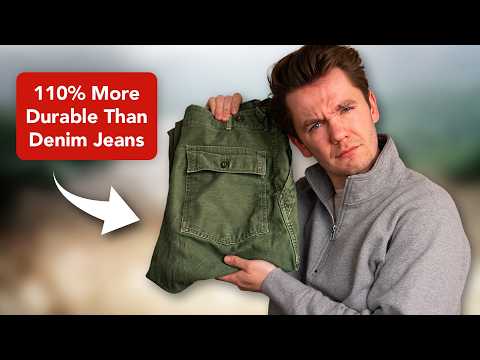
“The reverse sateen that the military used had one major trick up its sleeve that made it the most comfortable fabric the military ever used, but also the most durable fabric the military ever used, and the most wind-resistant fabric the military ever used, and the most water-resistant fabric the military ever used at that time.” — Michael Kristy, 0:12
Clip command
yt-dlp --download-sections "*0:12-0:50" "https://www.youtube.com/watch?v=QcWlSGBiyiY" --force-keyframes-at-cuts --merge-output-format mp4 -o "reverse-sateen-super-fabric.mp4"”Nerds, the nerdiest nerds in the United States”
“For one of the first times ever, the US military enlisted the help of one of the greatest tactical resources they’d never tapped into before: nerds. The nerdiest nerds in the United States.” — Michael Kristy, 1:17
Clip command
yt-dlp --download-sections "*1:17-1:50" "https://www.youtube.com/watch?v=QcWlSGBiyiY" --force-keyframes-at-cuts --merge-output-format mp4 -o "military-nerds.mp4"”They were called fatigues because you were doing fatiguing work”
“Fatigues, the type of work you’re doing when you’re wearing these pants. They were called fatigues because you were doing fatiguing work in them. The fact that they were fatigues and used for work like that directly, obviously influences their design.” — Michael Kristy, 3:00
Clip command
yt-dlp --download-sections "*3:00-3:42" "https://www.youtube.com/watch?v=QcWlSGBiyiY" --force-keyframes-at-cuts --merge-output-format mp4 -o "fatigues-fatiguing-work.mp4"”Use the weft yarns as a shield to the really important warp yarns”
“Backer was saying, if we take this fabric with the warp on the outside and we flip it so the weft is on the outside, we can use those weft yarns as a shield to the really important warp yarns underneath. And since a sateen is so dense, it’s particularly suitable for this.” — Michael Kristy, 14:22
Clip command
yt-dlp --download-sections "*14:11-14:55" "https://www.youtube.com/watch?v=QcWlSGBiyiY" --force-keyframes-at-cuts --merge-output-format mp4 -o "weft-as-shield.mp4"”80% more durable than herringbone twill, 110% more durable than denim”
“It was found to be 80% more durable than herringbone twill using the same yarns and fibers and 110% more durable than denim using the same yarns and fibers. But only under one condition: the sateen was only this powerful if it was actively being worn.” — Michael Kristy, 14:45
Clip command
yt-dlp --download-sections "*14:45-15:37" "https://www.youtube.com/watch?v=QcWlSGBiyiY" --force-keyframes-at-cuts --merge-output-format mp4 -o "sateen-durability-numbers.mp4"Key Points
- OG-107 decoded (2:53) - “OG” is olive green, “107” is the specific shade of olive green, and “fatigues” refers to the fatiguing work the wearer did in them.
- Pre-1950 military fabric R&D was based on guesswork (1:17) - The OG-107 era was the first time the US military rigorously tested fabrics with engineers and a combat course.
- MIT’s Stanley Backer and Ernest Kaswell (1:48) - Backer ran lab tests and theory; Kaswell ran the field test at Camp/Fort Lee, Virginia.
- Wide leg, hip-friendly cut, exterior patch pockets (3:00) - Functional design choices driven by movement and field repairability, not tailoring.
- Why military design dominates civilian fashion (3:41) - “Simple, very effective, durable, useful” — the reason most fashion designers spin off military patterns.
- Three weaves: plain, twill, sateen (4:21) - The army tried each in sequence; each shifts the trade-off between durability and comfort.
- Plain weave (6:26) - Maximum interlacement points, maximum stiffness/abrasion resistance, minimum comfort.
- Twill / denim (6:58) - 3-over-1 floats add comfort, but diagonal channels propagate tears and the fabric skews on the body.
- Herringbone twill (HBT) (8:18) - “Broken twill” reverses offset every few rows; ~15% stronger than denim and the dominant WWII fabric.
- Sateen weave (9:59) - Longest floats and fewest interlacements; the drapiest, most flexible weave with offset interlacement points so tears don’t channel.
- Density (10:40) - Because sateen lacks the up-and-down structure of plain weave, more yarns fit per square inch, yielding wind, water, and chemical-treatment friendliness.
- Warp-faced vs. weft-faced (13:59) - Standard fabric exposes the strong warp yarns; reverse sateen flips the weft to the outside.
- Why the flip works (14:22) - Weft yarns become a sacrificial shield for the structural warp yarns underneath; sateen’s density makes the cheaper weft good enough.
- Forward-direction durability is what matters (15:00) - Lab tests in all directions tied; on a person moving forward, sateen blew the others out of the water.
- Not all OG-107s are equal (9:31) - The military spec allowed manufacturer leeway, so different vintage pairs vary slightly.
- OrSlow re-edition (9:46) - The most famous modern reproduction; Michael says “I can see why they’re so famous.”
- Articles of Interest “Gear” (15:53) - Avery Trufelman’s seven-part series tracing this military research forward into modern outdoor gear.
- Tease for next video (16:11) - Closes by previewing the upcoming Limmer boots video.
Mentions
Companies & Brands
- OrSlow (9:46) - Japanese brand making the most famous modern OG-107 reproduction.
- Engineered Garments (description) - Listed in the video description as one of the modern fatigue makers worn on screen.
- Carhartt (description) - Detroit Jacket worn on screen.
- The Iron Snail (0:00) - Michael’s own brand; Prologue (FoxFibre and Snail Selvedge) and Chapter 1 Jeans (1947 Recreation Fabric) appear in the video.
- eBay (9:31) - Where Michael bought a bunch of vintage OG-107s for “pretty good prices.”
- Trader Joe’s (9:18) - Reference to “Mango Tango” as a flavor analogue for the peach-tangerine snack.
- Surfshark (4:34) - Sponsor of the video.
People
- Stanley Backer (1:48) - MIT mechanical engineer; later professor; produced the textile-geometry theory paper that argued for flipping fabrics.
- Ernest Ralph Kaswell (1:48) - Co-researcher; ran the Quartermaster Combat Course wear-testing study.
- Avery Trufelman (16:03) - Host of Articles of Interest, recommended for further reading on this lineage.
Products & Technologies
- OG-107 fatigue pants (0:00) - The video’s subject; reverse-sateen Vietnam-era US military fatigues.
- Reverse sateen weave (14:11) - Sateen flipped weft-faced for durability; the breakthrough fabric.
- Herringbone twill (HBT) (8:18) - WWII-era broken twill; 15% stronger than regular denim.
- Plain weave (6:26) - Standard up/down weave; max stiffness.
- 3x1 twill (denim) (6:58) - Three warps per weft; flexible but skews and channels tears.
- M-43 HBT Jacket (description) - Worn on screen.
- WWII HBT Fatigue Pants (description) - Comparison garment used in the video.
- Gore-Tex / synthetics (0:30) - Mentioned as the modern descendants of mid-century military fabric research.
Places
- MIT (Cambridge, Massachusetts) (1:31) - Backer and Kaswell’s institution.
- Camp Lee / Fort Lee, Virginia (1:48) - Site of the Quartermaster Combat Course wear test.
- Brown University (1:31) - Michael jokes about the Brown Book Award being insufficient for admission.
- Japan (5:04) - Mentioned in the Surfshark ad-read about geo-unblocking Netflix.
Surprising Quotes
“These bad boys are simple, it’s very effective, meant to be durable and meant to be useful. That is why basically every single fashion designer on the planet copies the military and puts a spin on it.” — Michael Kristy, 3:41
“Two nerds from MIT got the call from the US government: Stanley Backer and Ernest Ralph Kaswell, which are those the two most 1940s names that I’ve ever heard in my life?” — Michael Kristy, 1:48
“The army used every single type of weave they possibly could before they got to satin.” — Michael Kristy, 4:21
“One thing he kept saying in that paper was we’re using all of our fabrics backwards. We need to flip them, and we should get a lot better results.” — Michael Kristy, 11:38
“Sateen was only this powerful if it was actively being worn. By a human, or actively being worn by any animal or creature that travels forward.” — Michael Kristy, 14:45
“Those findings and that information changed clothing forever. Not just in the military, the entire planet. And that’s actually the foundation to basically every single outdoor brand.” — Michael Kristy, 15:37
Transcript
Michael Kristy: 0:00 These are the OG 107 reverse sateen fatigues on my legs. And these are the OG 107 fatigues a little bit closer. This is the fabric reverse sateen. The reverse sateen that the military used had one major trick up its sleeve that made it the most comfortable fabric the military ever used, but also the most durable fabric the military ever used, and the most wind-resistant fabric the military ever used, and the most water-resistant fabric the military ever used at that time. Obviously, we have synthetics and Gore-Tex and sprays and stuff now, but at the time, insane fabric that we don’t talk about enough, IMO.
Michael Kristy: 0:36 In order for sateen to be that good and to have that trick up its sleeve, though, you have to do one thing to it that changes all of its characteristics. You had to take the original fabric in 1952 when it was made on the loom and go like this. It’s harder to do than I thought. Now, it’s a magical fabric. I just flipped it inside out. And you might be thinking, well, it’s not actually a super fabric, Michael. There’s no way to quantify that data and show that it destroyed every other fabric that it was being compared to at that time. And guess what, buddy? Normally, you’d be wrong, but not in the 1950s. That’s when everything changed, and this really is the butt-kicker in charge of all of the other fabrics.
Michael Kristy: 1:17 And I know it’s so much better because for one of the first times ever, the US military enlisted the help of one of the greatest tactical resources they’d never tapped into before: nerds. The nerdiest nerds in the United States. Two nerds from the Massachusetts Institute of Technology, MIT, other words, the number one university in the world for 14 years in a row. I’m from Massachusetts, so I take great pride in MIT, but I didn’t go there. Surprise! I didn’t go to Brown either, but I did get the Brown Book Award, which I did think meant I would automatically get into Brown if I applied. Turns out that’s not the case.
Michael Kristy: 1:48 Two nerds from MIT got the call from the US government: Stanley Backer and Ernest Ralph Kaswell, which are those the two most 1940s names that I’ve ever heard in my life? They did a bunch of fancy lab tests, but also there was a huge simulated combat zone in Fort Lee, Virginia, where they tested all of these clothings in the real world. There’s a bunch of soldiers running around the combat course in smocks of different fabrics being like, “Oh yeah, this one’s pretty good.” And from that point on, garments, fabrics, and everything were truly never the same, and it started here.
Michael Kristy: 2:22 But the real question is, why? Why is it so much better than all the other fabrics? Is it actually better than all the other fabrics? Because this is herringbone twill, the fabric that came before it, and a lot of people today say, “No, this is better, this is more durable.” So what the heck is going on? What’s cracking, everybody? It’s your boy Mikey. Hope everybody’s doing well today. Bow low, just like they say in Lord of the Rings, till your beard touches the floor to show how grateful you are that people are watching your YouTube video about reverse sateen.
Michael Kristy: 2:53 Anyways, okay, OG, olive green. 107, the shade of that olive green. Reverse sateen, the type of fabric. Fatigues, the type of work you’re doing when you’re wearing these pants. They were called fatigues because you were doing fatiguing work in them. The fact that they were fatigues and used for work like that directly, obviously influences their design. So very wide leg or straight leg, but pretty darn wide, has a lot of movement in the crotch and the hip area so you can move around. They’re not tailored really at all. You had dress wear for that.
Michael Kristy: 3:22 My favorite detail on fatigues is always these exterior patch pockets. You can get a ton of durability by putting this thick fabric that you used for the rest of the pants as a pocket, but you put it on the outside so it’s more comfortable, easier to repair and doesn’t mess with the integrity of the pants if something like a hole were to happen. And that simplicity that is a necessity of military design is why the OG-107s and military clothing in general usually explodes when it hits the civilian market, because it’s simple, it’s very effective, meant to be durable and meant to be useful. That is why basically every single fashion designer on the planet copies the military and puts a spin on it. That being said, even though the design of the pants may be simple, the fabric is anything but, and the considerations that go into why you’re using a certain fabric are not simple. Either way, that was supposed to be the transition into sateen.
Michael Kristy: 4:21 We’re now in the weaves section. There are three main types of weaves: plain, twill, and satin. The army used every single type of weave they possibly could before they got to satin. Starting with a plain weave.
Michael Kristy: 4:34 This video is sponsored by SurfShark. This is Michael. Michael does not know that when he’s browsing the internet in a coffee shop, it’s not secure and can easily be seen. Hey Michael, what are you searching? Um, I was just checking to see if a book was available at the local library. If only Michael knew, SurfShark would make his browsing secure, encrypts your data and keeps you safer on those random public Wi-Fi spots like Michael keeps stumbling into. Banking information, passwords, chat messages, searches, all safer with SurfShark. And get this, Michael is going to Japan shortly. With SurfShark, Michael can watch his favorite shows on Netflix without having to worry about a thing. With over 3200 servers in 100 plus countries, Michael’s able to change his internet location to almost anywhere on the planet with one easy tap. And boom, Netflix libraries change, prices change, and websites are unblocked. Check out the link in Michael’s description or you could, come on, use this code to get three extra months of SurfShark VPN. Seriously Michael, I just wanted to see something.
Michael Kristy: 5:35 The main thing we’re going to focus on that differentiates all of these weaves are interlacings. So with any weave, you have warp yarns, like these guys right here. These are preset, they’re under tension when it’s being woven. If you look at this video, they’re already out and they’re stretched out. These are the big daddy, strong, important yarns. Then we also have the weft. The weft, when you’re weaving, shoots across the warp yarns like this again and again and again and it can be done a bunch of different ways but that is how a weave works is just repeatedly adding the warps in.
Michael Kristy: 6:08 The important thing that we’re going to break down is an interlacement point. So if these are two warp yarns this weft yarn is not interlacing them right now but this is it’s locked in between the two the amount of those directly correlates to the toughness and comfort of a fabric.
Michael Kristy: 6:26 And speaking of interlacing points, these guys want as many as possible. They’re huge fans of the plain weave. A plain weave has the maximum amount of interlacement points possible. The weft goes up down, up down, up down, up down, up down, up down, up down, and locks everything firm. Because of all those points a plain weave is super stiff, super durable, really abrasion and tear resistant and snag resistant, everything is just totally locked into place. That’s really useful, but if you’re on the battlefield you probably want something that you can move with and is not uncomfortable all the time. So the military was like, “What else you got?” And we had twill.
Michael Kristy: 6:58 The most popular usage of twill is on denim. All of the blue yarns that you see on denim are warp yarns, and the reason that you don’t see the weft yarns is because we’re not going up and down, up and down, up and down. It’s not even. We’re going under, under, under, over. So for every three warp yarns exposed, there’s one weft. Twills also introduce an offset. Every row you shift the pattern by one and that causes those diagonal lines. So if you look at the diagonal, you have all the warps, and if you go in that little crevice between the two, that’s your weft. Since all of the yarns aren’t super locked down and we have those floats, we have a lot more flexibility and ease of movement. So denim is a lot more comfortable than plain weave, but it’s still pretty darn tough. That’s great. Although this denim 3x1 weave has a problem.
Michael Kristy: 7:46 Those diagonal channels really are not good for tear propagation because a tear can just run down those channels and rip a lot easier. Also denim skews because of the direction of the yarns spun and the way the weave works the fabric actually twists on your legs and your arms however you’re wearing it. Two things that we can fix by modifying our twill.
Michael Kristy: 8:05 This is herringbone twill, I think I mentioned that before. The reason… Oh, I got… Oh, I have my magnifying glass in these giant pockets. Oh, jeez, what is this, a comedy routine? Goodness. If you modify the basic twill weave by changing the way you do the offsets, you get a more durable, more stable twill called a broken twill. And this one is a herringbone twill. A herringbone twill is changing the offset every few rows. So we’re going shift, shift, shift, shift, shift. That’s a diagonal we typically see with denim. And then we go shift, shift, shift, shift, shift. That fixed some problems. The first thing it did was really stabilize the fabric because it’s not pulling in one direction as strong. The second thing that it did is if something is tearing it’s harder for that tear to keep going when things switch over. There’s not a channel we can pursue the entire time. Which leads to the military really liking it and it being approximately 15 percent stronger than regular denim. So this fabric was the golden boy of World War Two. Everything is HBT, herringbone twill. A lot of people really love herringbone twill.
Michael Kristy: 9:03 Okay, HB twill. Now, the big daddy. Before that, though, I am going to have a quick snack break and I’m going to put on some overpants. Today’s snack is a peach-terrine, which I would assume is a mix of a peach and a tangerine. That is literally unbelievable. It tastes like Trader Joe’s mango tango. Okie-dokie, we’re back. The peach-terrine is making my throat a little itchy, but sometimes that happens with fruit. Never has escalated to be that bad.
Michael Kristy: 9:28 But these, since we’re talking about sateen, are my favorite sateen pants that I got. I picked up a bunch of OG 107s from eBay for pretty good prices. And something to note is that the military had a lot of specifications of how the pants should be made, but there was some parts where they said as long as it fits these qualifications, do what you want. So not all OG 107s are the same, and not all sateens are the same, but they’re all pretty darn good quality. I also picked up the most famous modern re-editions, the Orslow versions. I can see why they’re so famous.
Michael Kristy: 9:59 When we’re looking at a sateen, that has the longest floats and least interlacing points of all of those other weaves. It is the flowiest, most flexible, drapey, fun, beautiful fabric from the list. It also does have an offset like twill, but the reason it doesn’t have strong diagonal lines or anything like that is because the offset is offset in such a way that none of those interlacing points are lining up. So it gives you a really, really flat fabric with no real channel to sink your nail in or for anything to snag on. Oops, I did that thing where you say the exact opposite of what you mean. So it does snag easier than the other weaves, but with those offset interlacement points, it’s harder for a tear to just run down one of those channels like you see on twill. That’s what I meant to say.
Michael Kristy: 10:40 But what’s really interesting is those lack of interlacing points also means there’s a lot more room in the weave that’s not taken up by the up-and-down, up-and-down, up-and-down. So with that, you can pack in way more yarns into the weave itself and make it way, way denser. When you take that density and apply it to a military sense instead of a tuxedo, you get a lot more wind resistance, a lot more water resistance. It’s easy to put chemicals and waxes and things on the surface because it’s so smooth. And that density really, really boosts up durability, so it’s not way behind the other weaves.
Michael Kristy: 11:11 But there’s also one more thing from Backer. Well, I don’t know if it was from Backer, but Backer was the guy testing it and saying like you should do this. Stanley Backer, you know him, the mechanical engineer that would later become a professor at MIT in the ’60s. Remember Stanley Backer? In his paper, he’s kind of… I could hardly understand what he was talking about in the paper. It’s so dense. But he’s like, okay, the fibers are this thick, the yarns are spun like this, this is the optimal way you should do a yarn and the weave should look like this, and this should be the overall crimp, and if we have this, it’s more breathable or less breathable. Losing his marbles in the sauce of all these fabrics, but one thing he kept saying in that paper was we’re using all of our fabrics backwards. We need to flip them, and we should get a lot better results.
Michael Kristy: 12:00 And everybody else was like, “Okay, go on,” and Backer was like, “No, I’m actually gonna pass it over to my boy, Caswell, and we’ll do some real-world testing to prove me wrong.” So we went over to Caswell. Caswell is the guy that wrote the paper on the findings of the combat course constructed at Camp Lee in Virginia. Now I think it’s Fort Lee or something else. Essentially, a bunch of soldiers were there. They were testing denim, herringbone twill, and sateen-modified uniforms that looked like giant smocks. I talked about it over there.
Michael Kristy: 12:29 They got all the soldiers, put them on this course that had like rubble and everything on it, and they were like, “Okay guys, just, uh, this is war, so just show me what you typically do when you’re fighting.” And the soldiers were like— “Okay, well, if we’re testing the uniforms, sometimes I’ll have to like, go down like this, I guess, and, you know, pull myself forward.” And then one soldier was like, “Uh, Mr. Caswell, one time I think someone was shooting at me and I went like this and I like, dodged the bullet, and I’m just wondering if that’s important for your research?” And all the soldiers were like, “There’s no way you did that, Dave!” And then another soldier was like, “Uh, Mr. Caswell, one time I went like this during war and I kicked three bad guys in the head and they all passed out and I saved them. Um, do you think that’s important for your data?” “Mr. Caswell, one time I had the bad guy like this and I was like, [grunts]. Do you think that’s important to your data?” “Mr. Caswell, one time when I was running downhill, I spun like this, I dodged the bad guy. Do you think that’s pertinent to your data?” “Um, Dr. Casimir, sir, do you mind if we go look at Michael because he had that peach tree in and it’s really hurting his stomach?”
Michael Kristy: 13:28 But the testing was complete. All the uniforms were collected. They originally were going to test them before they washed them, but they were so caked in dirt and mud they couldn’t. So they got them all, they documented, they circled the holes, measured the holes, said, “This one’s more damaged than that one, this one’s not that, this one,” and sateen kicked everybody’s butt because of that thing Backer kept yammering about. And that thing is making a warp-faced fabric into a weft-faced fabric.
Michael Kristy: 13:59 Denim, as we typically know it, is a warp-faced fabric. The warp yarns are on the outside. A plain weave with a messed-up collar is a balanced-faced fabric since it’s up and down and everything like that. You have equal parts warp and weft on the outside. And in standard weaving, warp yarns are the money yarns—the yarn under tension, usually a nicer yarn, sometimes it’s plied. That is the structure of the garment and really the infrastructure of the entire thing—the big tough yarn. Backer was saying, if we take this fabric with the warp on the outside and we flip it so the weft is on the outside, we can use those weft yarns as a shield to the really important warp yarns underneath. And since a sateen is so dense, it’s particularly suitable for this because typically the weft isn’t as good, but with this, it’s great.
Michael Kristy: 14:45 And that flip, combined with the density of sateen, is why it kicked every other fabric’s butt. It was found to be 80% more durable than herringbone twill using the same yarns and fibers and 110% more durable than denim using the same yarns and fibers. But only under one condition: the sateen was only this powerful if it was actively being worn. By a human, or actively being worn by any animal or creature that travels forward. Because you can test fabrics in a lab a bunch of different ways. Sideways, up and down, do they tear like this? Do they tear like that? And that data is useful, but you need to weight it correctly. And when it’s on a person, they can really only go in this direction. Longitudinal, forward, backwards. They’re not doing a lot of this. A lot of abrasion is not happening because of this. So this way durability is mega important. If all of those fabrics were tested in all directions, it would be a wash. They all basically equaled one another. Sateen, which is particularly good like this.
Michael Kristy: 15:37 And those findings and that information changed clothing forever. Not just in the military, the entire planet. And that’s actually the foundation to basically every single outdoor brand. And if you know why I’m saying that, you should continue watching the video. One of the greatest podcasts of all time in the world of clothing, Articles of Interest, did a seven-part series basically tracking what happened here all the way to modern times. How did these tests affect everything around us? Articles of Interest, the series called Gear. Seven episodes by Avery Trufelman, freaking fantastic. All right. Anyways, that’s about it. I will see you all very, very soon with a video on Limmer. Bye!