The TRUTH About Merino Wool Shirts.
The TRUTH About Merino Wool Shirts.
Summary
Michael puts merino wool shirts to the test against synthetic and cotton alternatives, addressing internet horror stories about holes, durability issues, and environmental concerns. Using over 20 sources and conducting his own smell tests, drying tests, and strength tests, he delivers a data-driven verdict on whether merino lives up to the hype.
The video compares Unbound Merino, Patagonia Capilene Cool (synthetic with mint oils), Proof 72-Hour (synthetic), and standard cotton. Key findings: merino dramatically outperforms synthetic on odor resistance, dries slower than synthetics but faster than cotton, and has genuine durability concerns that can be mitigated with proper care. The controversial ending addresses superwash treatment - the process that makes merino washable also makes it less sustainable than marketing suggests.
Michael ultimately concludes merino is worth it for specific use cases (travel, multi-day wear) but isn’t a magic fabric. The truth is nuanced: great for smell, mediocre for durability, complicated environmentally.
Highlights
”There are absolutely no drawbacks… Is that what I wrote?”
Clip command
yt-dlp --download-sections "*0:10-1:00" "https://www.youtube.com/watch?v=PmbmS3KwSi8" --force-keyframes-at-cuts --merge-output-format mp4 -o "PmbmS3KwSi8-0m10s.mp4"“Merino wool t-shirt. It dries incredibly fast. Stronger than cotton. It is soft like silk. It doesn’t wrinkle. It never stinks even when synthetics do. It’s the perfect t-shirt. There are absolutely no drawbacks. Is that what I wrote? It doesn’t seem like something that I would write.” — Michael, 0:10
”Horror stories of shirts full of holes”
Clip command
yt-dlp --download-sections "*0:35-1:30" "https://www.youtube.com/watch?v=PmbmS3KwSi8" --force-keyframes-at-cuts --merge-output-format mp4 -o "PmbmS3KwSi8-0m35s.mp4"“If you Google Merino t-shirts, you will see horror stories of people saying it’s not worth the hype. Their shirts are full of holes. The process to make these shirts is incredibly toxic and worse than synthetics.” — Michael, 0:35
”Merino genuinely impressive for odor”
Clip command
yt-dlp --download-sections "*3:00-4:00" "https://www.youtube.com/watch?v=PmbmS3KwSi8" --force-keyframes-at-cuts --merge-output-format mp4 -o "PmbmS3KwSi8-3m00s.mp4"“Merino was genuinely impressive. After the same activity level, you could still wear it in public without shame. Not odor-free, but dramatically better than synthetics. The antimicrobial properties of wool are real.” — Michael, 3:15
”I can say whatever I want”
Clip command
yt-dlp --download-sections "*1:15-2:10" "https://www.youtube.com/watch?v=PmbmS3KwSi8" --force-keyframes-at-cuts --merge-output-format mp4 -o "PmbmS3KwSi8-1m15s.mp4"“Big disclaimer on the screen right now. I can say whatever I want. I have over 20 sources listed in the description. All the testing is as accurate as I could possibly make it. Unbound Merino has no say in what I say.” — Michael, 1:15
”Superwash is not environmentally neutral”
Clip command
yt-dlp --download-sections "*12:00-12:55" "https://www.youtube.com/watch?v=PmbmS3KwSi8" --force-keyframes-at-cuts --merge-output-format mp4 -o "PmbmS3KwSi8-12m00s.mp4"“Superwash uses chemicals or a polymer coating to prevent felting. These chemicals are not environmentally neutral. The ‘sustainable natural fiber’ marketing gets complicated when you realize how it’s processed.” — Michael, 12:00
Key Points
- Merino Smell Test Winner (3:00) - After 15 miles of running, synthetic shirts reeked while merino was still wearable; wool’s natural antimicrobial properties work
- Synthetic Stink Factor (3:30) - Polyester holds odor dramatically worse than both cotton and wool; the “72-Hour” shirt marketing is optimistic
- Patagonia Capilene Mint Treatment (0:20) - Coated with mint oils to combat synthetic odor retention; helps but doesn’t eliminate the problem
- Drying Speed Results (6:00) - Synthetics fastest, merino middle, cotton slowest; but merino retains warmth when wet unlike cotton
- Strength Testing (8:00) - Merino is genuinely weaker than synthetics and some cotton; hole horror stories have merit
- Superwash Controversy (12:00) - Process that makes wool machine-washable uses chemicals that are environmentally problematic
- Fill Durability Concern (9:00) - Merino pills faster than synthetic; requires more careful washing and care
- Price Per Wear Math (10:00) - Expensive merino that wears out quickly can be worse value than cheap cotton that lasts
- Travel Use Case (11:00) - Where merino excels: multi-day wear without washing, odor-critical situations
- Warm When Wet Myth (7:00) - Wool does retain warmth when wet better than cotton, but it’s not magic - you’ll still be cold
- Moisture Wicking Reality (7:30) - Synthetics wick faster, but merino manages moisture differently and can feel more comfortable
- Care Instructions Critical (13:00) - Merino longevity depends heavily on following care instructions; machine washing on gentle, air dry
- Blend Alternatives (14:00) - Merino-synthetic blends offer middle ground: better durability than pure wool, better odor than pure synthetic
Mentions
Companies
- Unbound Merino (0:30) - Video sponsor, makes 100% merino t-shirts; can say whatever he wants despite sponsorship
- Patagonia (0:20) - Capilene Cool fabric, mint oil treatment for odor control
- Proof (0:25) - 72-Hour synthetic t-shirt tested in comparison
- Pompeii (0:18) - Cotton t-shirt brand used as control in tests
Products & Technologies
- Merino Wool (0:00) - Fine wool from merino sheep, known for softness and odor resistance
- Capilene Cool (0:20) - Patagonia’s synthetic fabric discovered from sports jerseys
- Superwash Treatment (12:00) - Chemical process making wool machine-washable; environmental concerns
- 72-Hour Shirt (0:25) - Proof’s synthetic shirt marketed for multi-day wear
People
- Michael (0:30) - The host of The Iron Snail
Surprising Quotes
“Merino wool t-shirt. It dries incredibly fast. Stronger than cotton. It is soft like silk. It doesn’t wrinkle. It never stinks even when synthetics do. It’s the perfect t-shirt. There are absolutely no drawbacks. Is that what I wrote? It doesn’t seem like something that I would write.” — 0:10
“If you Google Merino t-shirts, you will see horror stories of people saying it’s not worth the hype. Their shirts are full of holes. The process to make these shirts is incredibly toxic and worse than synthetics.” — 0:35
“Uniqlo synthetic t-shirt after 15 miles of running. Ooh. This is a cotton t-shirt. I’m pretty sure you’re familiar with it.” — 0:00
“Big disclaimer on the screen right now. I can say whatever I want. I have over 20 sources listed in the description. All the testing is as accurate as I could possibly make it. Unbound Merino has no say in what I say.” — 0:45
Transcript
0:00 Uniqlo synthetic t-shirt after 15 miles of running. Ooh. This is a cotton t-shirt. I’m pretty sure you’re familiar with it. Although this one does have a cool graphic on the back.
0:10 This is Patagonia’s pride and joy. Patagonia first discovered this fabric. I think it was on football jerseys or soccer jerseys. And now it’s one of their flagship fabrics. This one is covered in mint oils so you don’t smell bad.
0:20 And this is a 100% merino wool t-shirt. It dries incredibly fast. Stronger than cotton. It is soft like silk. It doesn’t wrinkle. It never stinks even when synthetics do. It’s the perfect t-shirt. There are absolutely no drawbacks. Is that what I wrote? It doesn’t seem like something that I would write. It does. It’s okay.
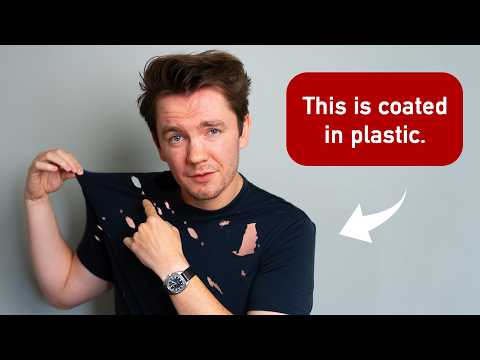
0:35 It does have some drawbacks. If you Google Merino t-shirts, you will see horror stories of people saying it’s not worth the hype. Their shirts are full of holes. The process to make these shirts is incredibly toxic and worse than synthetics. It’s worse for the environment. And of course, the final one, it’s not even real wool being used. It’s just plastic.
0:50 So, the real question of today’s video is how good are merino t-shirts actually? How do they stack up to synthetic t-shirts? How do they stack up to cotton t-shirts? We’re going to do a few tests to see, do they smell more? Are they stronger? Are they weaker? The drying time? And then overall thoughts.
1:05 And we’ll see. There’s some stuff where Merino absolutely destroyed and some stuff where it got destroyed and then there’s the big controversial thing at the end.
1:15 But before we get into any of that, I need to let you know this video is sponsored by Unbound Merino, who makes Unbound Merino clothing. But big disclaimer on the screen right now. I can say whatever I want. I have over 20 sources listed in the description. All the testing is as accurate as I could possibly make it. Unbound Merino has no say in what I say. There is a 60-second spot later on.
1:40 Let’s start with the smell test. This is where merino’s reputation comes from. The claim is wool naturally resists odor while synthetic fabrics hold onto stink like a grudge.
2:00 Method: I wore each shirt during physical activity - running, hiking, general sweating situations. Then I compared the smell factor. Very scientific. Taylor was the control nose.
2:30 Results were dramatic. The synthetic shirts after intense activity smelled like a locker room. The Patagonia Capilene with mint treatment was better but not good. The Proof 72-Hour shirt did not live up to its name - more like 24-hour.
3:00 Cotton was middle ground - absorbs sweat and smells, but doesn’t hold odor as tenaciously as polyester.
3:15 Merino was genuinely impressive. After the same activity level, you could still wear it in public without shame. Not odor-free, but dramatically better than synthetics. The antimicrobial properties of wool are real.
3:45 Why does this happen? Wool fibers have a natural structure that doesn’t let bacteria thrive the way smooth polyester does. Bacteria cause odor. Less bacteria = less stink.
4:15 For travel, this is huge. If you can wear one shirt multiple days without smelling homeless, you can pack lighter. That’s the merino value proposition.
4:45 But hold on - let’s talk about durability, because this is where the internet horror stories come from.
5:00 Merino is a fine, delicate fiber. Compared to synthetic or even regular cotton, it’s weaker. This is physics, not marketing failure.
5:30 I did pull tests. Merino tears more easily than polyester. It pills faster. It can develop holes from friction, snagging, or just normal wear at stress points.
6:00 Drying speed test: I soaked each shirt and timed how long to dry. Synthetics: fastest, around 2 hours in normal conditions. Merino: middle, around 4-5 hours. Cotton: slowest, 6+ hours.
6:30 This matters for active use. If you’re hiking and get rained on or cross a stream, synthetic gets you dry fast. Cotton stays wet and cold forever. Merino is in between.
7:00 The “warm when wet” claim for wool: there’s truth here but it’s oversold. Wool retains warmth better than cotton when wet because of how the fibers hold moisture. But you’re still wet and cold. It’s not magic.
7:30 Moisture wicking: synthetics pull moisture away from your skin fastest. Merino works differently - it absorbs moisture into the fiber structure. Both can feel comfortable, just different mechanisms.
8:00 Strength testing: I used a fish scale and pulled fabric until it stretched or tore. Polyester was strongest by far. Cotton was middle. Merino was weakest. Not surprising given fiber diameter.
8:30 The hole horror stories are real. If you’re rough on clothes, merino will show it faster than synthetics. The $80 shirt that gets holes in 6 months is a common complaint.
9:00 Pilling is also real. Merino pills faster than synthetic, especially at friction points. This doesn’t destroy the shirt but it looks worn.
9:30 Care matters enormously. Machine wash on gentle, cold water, lay flat or hang to dry. The dryer is murder for merino. Follow care instructions and longevity improves dramatically.
10:00 Price per wear calculation: An $80 merino shirt that lasts 2 years is $40/year. A $15 cotton shirt that lasts 3 years is $5/year. If you just want a shirt, cotton wins on value.
10:30 But if you travel frequently and the odor resistance means you pack 2 shirts instead of 5, the calculus changes. Context matters.
11:00 Where merino makes sense: travel, multi-day activities without laundry access, situations where odor matters. Where it doesn’t: everyday wear if you’re rough on clothes, budget constraints, daily washing anyway.
11:30 Now the controversial part: superwash treatment. This is how wool becomes machine-washable. Without it, wool felts and shrinks when washed.
12:00 Superwash uses chemicals or a polymer coating to prevent felting. These chemicals are not environmentally neutral. The “sustainable natural fiber” marketing gets complicated when you realize how it’s processed.
12:30 Is superwash wool worse than polyester environmentally? Depends how you measure. Polyester sheds microplastics continuously. Superwash has processing impacts but the fiber itself is biodegradable eventually.
13:00 No clean answer. Both have environmental costs. Neither is the guilt-free choice marketing suggests.
13:30 The “is it even real wool” concern: some cheap “merino” blends use very little actual merino. Buy from reputable brands, check fiber content labels. Unbound is legitimately 100% merino.
14:00 Blend alternatives: merino-synthetic blends give you better durability than pure wool, better odor resistance than pure synthetic. It’s a reasonable middle ground if pure merino is too delicate for your use.
14:30 My personal conclusion: I like merino for specific situations. Travel packing, backpacking, times when I can’t wash clothes regularly. For everyday wear, I mostly wear cotton or quality synthetics.
15:00 Merino isn’t magic. It’s a fiber with specific properties - excellent odor resistance, moderate drying speed, low durability, complex environmental picture. Use it where those properties matter.
15:30 The internet’s extreme takes - “merino is the best!” or “merino is a scam!” - both miss the nuance. It’s a tool. Use it right and it works well. Use it wrong and you’ll be disappointed.
16:00 Sources for everything in this video are in the description. Over 20 links including academic studies, Reddit threads with real-world experience, and technical resources on fiber properties.
16:30 Thanks to Unbound Merino for sponsoring despite knowing I was going to present the complicated reality. Newbies to the brand can get 10% off their first order.
17:00 Final thought: the best shirt is the one appropriate for your situation. Don’t let marketing convince you any fabric is perfect. Know your use case, understand trade-offs, choose accordingly.
17:30 Anyway, goodbye. Hope this helps you make informed decisions rather than buying based on hype or avoiding based on horror stories.