Why Jamaica Is Obsessed With A WWII Boot.
Why Jamaica Is Obsessed With A WWII Boot.
Summary
This video explores the fascinating cultural connection between Jamaica and Clarks Desert Boots, revealing how a simple British shoe became an iconic symbol of rebellion and status in Jamaican culture. Michael traces the boot’s origins from the African Felkun hunting boot, which was adopted by British soldiers in WWII for its comfort in hot climates, to Nathan Clark’s simplified version that became the Desert Boot.
The video dives deep into the technical construction of the boot - covering rough-out leather, stitch-down construction, and crepe rubber soles - while also comparing modern Clarks quality to vintage 1980s models using measurements like durometer hardness. Michael also introduces Astorflex as a brand that more closely resembles original Clarks construction. The cultural section explains how the Desert Boot became the footwear of Jamaica’s Rude Boys in the 1960s, symbolizing rebellion after independence, and how hundreds of songs have been written about Clarks in Jamaica, including Vybz Kartel’s famous track.
Highlights
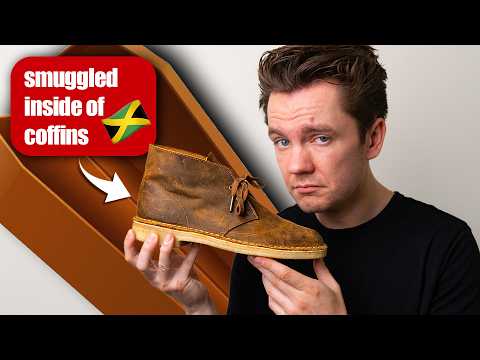
”Boots That Men Smuggled Into Jamaica Via Coffins”
Clip command
yt-dlp --download-sections "*0:00-0:55" "https://www.youtube.com/watch?v=JzAgs47Idzw" --force-keyframes-at-cuts --merge-output-format mp4 -o "JzAgs47Idzw-0m00s.mp4"“These are Clark’s desert boots. Boots that men smuggled into Jamaica via coffins.” — Michael, 0:00
”There Are Hundreds of Songs About Clarks in Jamaica”
Clip command
yt-dlp --download-sections "*1:17-2:10" "https://www.youtube.com/watch?v=JzAgs47Idzw" --force-keyframes-at-cuts --merge-output-format mp4 -o "JzAgs47Idzw-1m17s.mp4"“There is not one song about Clarks in Jamaica. There are hundreds of songs.” — Michael, 1:19
”Nothing Is Like This Relationship”
Clip command
yt-dlp --download-sections "*1:42-2:35" "https://www.youtube.com/watch?v=JzAgs47Idzw" --force-keyframes-at-cuts --merge-output-format mp4 -o "JzAgs47Idzw-1m42s.mp4"“There is nothing like the relationship between Jamaica and Clarks. I thought maybe blue jeans in the USA kind of but not like this. Nothing is like this.” — Michael, 1:51
”You Will Fall on Your Butt in Crepe”
Clip command
yt-dlp --download-sections "*4:55-5:50" "https://www.youtube.com/watch?v=JzAgs47Idzw" --force-keyframes-at-cuts --merge-output-format mp4 -o "JzAgs47Idzw-4m55s.mp4"“You will fall on your butt eventually if you are wearing crepe. So, be careful out there.” — Michael, 5:20
”The Birth of the Rude Boy”
Clip command
yt-dlp --download-sections "*11:47-12:45" "https://www.youtube.com/watch?v=JzAgs47Idzw" --force-keyframes-at-cuts --merge-output-format mp4 -o "JzAgs47Idzw-11m47s.mp4"“And those people, young men, those young men kind of rude to the system, the general system at be. They were rude boys. Nowadays, the term rude boy is pretty iconic.” — Michael, 12:05
Key Points
- African Felkun Origins (0:10) - The Desert Boot is based on the African Felkun (Veldskoen), a hunting boot that British soldiers adopted for hot climates
- Quaker Roots (0:23) - Clarks has deep Quaker heritage emphasizing simplicity, honesty, and quality
- Vybz Kartel’s “Clarks” (0:35) - There are hundreds of songs about Clarks in Jamaica, with Vybz Kartel’s being the most famous
- Rude Boy Culture (1:42) - Clarks were worn by the original Rude Boys of Jamaica starting in the 1960s
- Rough-Out Leather (3:23) - The leather is “rough out” (grain side inside), making it incredibly tough and scratch resistant
- Stitch-Down Construction (4:09) - Simple construction where the upper flanges out and is stitched to the midsole, resistant to elements
- Crepe Rubber Sole (4:36) - Natural rubber made from latex coagulated with acid; soft but not great on slick surfaces
- Modern vs Vintage Quality (8:43) - Comparison of 1980s Clarks to modern: leather half millimeter thicker, crepe harder (50 vs 30 Shore A), thicker midsole
- Astorflex Alternative (10:37) - Astorflex midsole is about 2x thicker than modern Clarks, closer to original construction
- 1962 Jamaica Independence (11:51) - The cultural explosion of Clarks in Jamaica coincided with independence and the rise of Rude Boy culture
- Symbol of Rebellion (13:05) - Police targeting well-dressed young men in Clarks actually increased their status as a rebel symbol
Mentions
Companies
- Clarks (0:00) - British footwear company with Quaker roots, maker of the Desert Boot
- Astorflex (10:37) - Italian brand making chukkas closer to original Clarks construction
- Jim Green (description) - South African boot maker, Vellie model mentioned
- Huckberry (6:07) - Sponsor, one-stop men’s shop
- Quaker Oats (7:01) - Not actually a Quaker company, but named for Quaker reputation
Products & Technologies
- Desert Boot (0:00) - Clarks iconic two-eyelet chukka boot
- Felkun/Veldskoen (0:10) - South African field shoe that inspired the Desert Boot
- Crepe Rubber (4:36) - Natural rubber sole material made from rubber tree latex
- Goodyear Welt (8:57) - Construction method on vintage Clarks sample
- Proof 72-Hour Merino T-Shirt (6:07) - Huckberry product, wool travel shirt
People
- Nathan Clark (2:09) - Creator of the Desert Boot, saw African hunting boot and adapted it
- Vybz Kartel (0:35) - Jamaican artist who made the famous song “Clarks”
- Henry Seymour (7:31) - Named Quaker Oats after Quaker reputation for integrity
Surprising Quotes
“These are Clark’s desert boots. Boots that men smuggled into Jamaica via coffins.” — 0:00
“There is not one song about Clarks in Jamaica. There are hundreds of songs.” — 1:19
“There is nothing like the relationship between Jamaica and Clarks. I thought maybe blue jeans in the USA kind of but not like this. Nothing is like this.” — 1:51
“You will fall on your butt eventually if you are wearing crepe. So, be careful out there.” — 5:20
“Astroflex Chukkas are closer to original Clark’s desert boots.” — 10:57
Transcript
0:00 These are Clark’s desert boots. Boots that men smuggled into Jamaica via coffins. But they are also pretty blatant copies of the boot of Africa. This is the Felkun or the Felly. I hope I’m saying that correct. Yes, it does look like the Felchkun or the Felly, but it has its own design language. You can see that when you’re looking at this boot. And if you like that design language and you find the boot striking, you know who you should thank? The Quaker religion. Because Clarks has a very deep history with the Quaker religion. And this is a Quaker boot if I ever did see one.
0:31 And now Jamaica. Look at this concert. Absolutely packed. See that man performing right there? That is Vibes Cartel and he is performing his hit song Clarks. Obviously, I couldn’t afford the licensing fee. So, I was going to put the song in the video. Then, I scrapped it. I told Holly, which was a mistake, and now she’s insisting that the video would be better if there was a little tiny bit of the song in. So, we have this much to play with. Holly will use it at her will.
0:53 So, that song is completely about Clarks. Clark’s in the summer, Clarks in the winter, the leather hard, the suede is soft, toothbrush helps get the dust off. It’s a great song. And you’re probably thinking what I originally thought. That’s not a big deal. We have songs about footwear in the US, too. Air Force Ones with Nelly, Apple Bottom Jeans, Boots with the Fur with the 36 Mafia, Flow Rider. Wow. 36 Mafia is probably looking to kill me.
1:17 Now, you’re probably thinking, “Yeah, no big deal.” You’re totally wrong because there is not one song about Clarks in Jamaica. There are hundreds of songs. Vibes Cartels now is the most famous cuz it’s an absolute banger, but it’s one of hundreds. Clarks makes videos about the relationship with Jamaica. They invest in Jamaican infrastructure. They make custom Jamaican marketed dance hall Clarks. In fact, there is an entire book on Clarks in Jamaica. I think it’s called Clarks in Jamaica.
1:42 This is also the footwear worn by the original Rude Boys of Jamaica. The rude boy culture started walking in these boots. What I’m trying to say is there is nothing like the relationship between Jamaica and Clarks. I thought maybe blue jeans in the USA kind of but not like this. Nothing is like this. You’re probably named something that I never thought of, but still from what I can tell there’s nothing like this.
2:04 To really understand the craze, we need to understand the footwear. And we can’t understand the footwear if we don’t talk about Africa. Nathan Clark basically took an African hunting boot and then Jamaica made it time. This is a felkun or a fell. I’m going to say fell cuz I’m probably not saying felkun correctly, but that translates directly to or it’s slang for field shoe.
2:27 Now, the felly was a massive, massive relief for British soldiers. I think specifically it was for British officers. Humongous relief when they tossed these bad boys on their feet. Why? They were in places like Africa and Myanmar. And it was insanely hot. It was like 97,000 degrees outside. And they’re wearing these giant British ammo boots. Boom. Here’s some footwear designed specifically for the desert for very very hot places. Eureka all of a sudden way more comfortable. Nathan Clark sees that and is like, “Oh, okie dokie.”
2:55 So, we know that the Felly is a near-perfect boot, but what makes it near perfect? What is so special about this that no other boot was doing at the time? The hint, simplicity. Also, this bug. Also, since we have this really nice mushroom stand, we’re talking about an upgraded Clark’s later just to show I think this is what Clarks used to be like. I think this is why people get upset with modern Clarks.
3:18 First thing we’ll do is go over an authentic felly and then we’ll see what Nathan Clark did to his version of the felly and how it changed things forever. Suede? Are you crazy using nice suede on a South African bush? Not suede. Well, suede duh. Suede has a little bit of a bad reputation because there’s, you know, some people say suede is when the shiny side of the leather is on the inside and the rough part is on the outside.
3:40 Other people when they say suede, they mean they split the leather in half and only the rough side on this side is left and the rough side on that side is left. Very confusing and it’s hard to actually nail down what a brand is talking about unless they specifically say what it is. But now brands say rough out to indicate that it’s basically the full piece of leather flipped and rough out or reverse leather, whatever you want to call it. Incredibly tough, incredibly scratch resistant.
4:05 If you’re going through the African bush, you want something that can handle briars or really, really tough stuff and look new and hold up to it. And then we have stitch down construction. Very, very simple construction. This upper leather flanges out over the outsole right here as you can see. And then it’s just stitched down. It’s stitched to this little black line. The midsole, the outsole is here. Bing, bang, boom. Very simple.
4:21 Simplicity is great. We all know that. People always say to me, “Michael, you’re a very simple simple man.” Stitch down construction is also very resistant to the elements, which is a huge plus. And it’s cheap to do because you’re not adding a whole bunch of other parts on the inside. Flange it out, sew it down, done.
4:36 Then we have my favorite part of Clark’s desert boots and it’s homages crepe. But you’ll notice it’s strikingly not there on the gym green fellies. And if you’ve ever worn crepe, you know why. It’s not on the actual working felly that’s made for the bush and stuff like that. I really, really love crepe rubber. I just find it so beautiful and natural because that’s exactly what it is. It’s about as natural of a rubber as you can possibly get.
4:55 You essentially get the rubber from the rubber tree or I guess the latex from a rubber tree. You coagulate it with acid into these big gross looking ball things and then you roll it really skinny. That’s it. That’s crepe. If you look closely, see how this isn’t one piece of rubber? There’s a little split right here. It’s two sheets of crepe stacked on top of each other.
5:11 Crepe is really soft and beautiful, but it’s not good near chemicals. It’s not good in really, really harsh temperature variations. It’s not as tough in general, and you will fall on your butt eventually if you are wearing crepe. So, be careful out there. Enjoy your beautiful crepe, but just know that it was not originally meant for asphalt and slick concrete surfaces and floors and stuff like that. It was meant for the great outdoors.
5:33 And then we get to the midsole, this little light line right here, and the insole, the inside of the boot, which this is where it gets a little controversial with Clarks. Before we get into the comment section where all of you are going to say, “Sucks that the quality is not like it used to be.”
5:46 Quaky. What a beautiful day. Oh, are we recording? Hi. Hi, John Davis. I play Michael Christie from the Iron Snail series. Great to actually meet you. We’re in New Hampshire this time around talking about Limmer Boots, a video that I’m sure Michael is going to have a lot of fun making. It’s only possible for us to travel to places like New Hampshire due to our sponsors like Huckberry, the one-stop men’s shop.
6:12 Do you Are you a men? This is the proof 72-hour Marino t-shirt. The ultimate travel t-shirt. Why? I’m glad you asked. First off, it’s wool, so John Davis isn’t going to get all stinky winky when he’s outside all day. I haven’t washed this shirt yet. I’ve been in New Hampshire for 3 days, so that has been fantastic. I should have actually brought the proof 72-hour t-shirts that I have at home cuz I’ve had those for like 3 or 4 years since we first started getting sponsored by Huckberry.
6:32 I wear them as my base layer in the winter. I wear them when I’m exercising most of the time when I’m exercising cuz they don’t get all smelly, especially at the end of a run or something like that. T-shirt material reserved for cotton because it was impossible to make a next-to-skin soft lightweight incredibly strong fabric out of wool before.
6:49 So if you’ve ever sweat, you’ve ever run, you’ve ever been outside, you’ve ever rode your bike, you’ve ever hiked, I highly suggest you check out the link in the description. Thank you Huckberry for sponsoring this video. One-stop men shop, Pedro Pascal.
7:00 Admittedly, I knew absolutely zilch about the Quaker religion when I started this video. So I was like, “Oh, I know where I can start. Quaker Oats, because that’s obviously a Quaker company.” Nope. Turns out that’s not true. That’s a lie. Blew my mind. Is that legal? I’m surprised the Quakers haven’t been litigious about this.
7:15 That being said, the man who named his company Quaker Oats named it Quaker Oats because the Quakers had such a good reputation. So, by looking up Quaker Oats, it actually does tell us about Clark’s Quaker roots. And I quote, “According to some accounts, Quaker mill partner Henry Seymour came up with a brand name after discovering an encyclopedia article about Quakers. He stated that the qualities describing Quakers, such as integrity, honesty, and purity, were traits that he wanted customers to associate with a company’s product. Quakers are often seen as embodying a blend of seriousness and generosity, simplicity, and social engagement.”
7:48 Boom. Clarks. Clarks has really strong Quaker roots. It’s still on their website. They still do a lot of Quaker principal things, like they really support the communities. They also are a community founded company. None of that’s really important besides the simplicity factor of Clarks.
8:01 And that is how we get to the design. The Felly caught Nathan’s eye because it’s so simple and so effective. It’s about as simple of a shoe as you could possibly make, but you could still make it simpler. Bring in the desert boot. All we’re doing here is saying, how can we keep the functionality of the felly but take away what we don’t need? So, instead of three eyelets, how about we do two? Instead of folding things or adding reinforcements or anything like that, let’s make it one piece of leather right here and another piece of leather right here. Keep everything very, very simple, as simple as you possibly can and use high quality materials. That is it.
8:33 And what that does is make a really high quality but simple boot. And it’s so simple that it becomes striking. You see that it’s simple. There’s something special about that.
8:43 All right. So, a lot of you suspect foul play when it comes to modern-day Clark’s quality. I can see why you would think that. Look at this. It was very hard to do, but I found a pretty authenticated 1980s Clark desert boot. The only problem with our comparison is that this is a Goodyear welted boot. So, it’s constructed differently, but I think they would use very similar components, so it should be okay.
9:05 Leather quality, a modern day Clark, still pretty good. Feels good, nice and thick. I like it a lot, but old Clark’s half a millimeter thicker. And then we have crepe. One of the most fascinating findings on this boot using a durometer, we found that it was 40 to 45 shore a in hardness. But on these fancy boots that are $10 more that come with this little tab thing, this crepe is 30 shore a. It is like goo. It is so very soft.
9:27 Then, and we have to account that maybe this got harder over time, but this crepe is 50 Shore A, which is much, much harder. It’s still soft. It still feels gummy, but significantly harder, so it should be more durable over time on the old boot.
9:38 And this little lighter line right here, that is the midsole of the boot. Not that thick. And this is fiberboard, so it’s not just straight leather. It’s like all crumbled up, glued together leather. Look at this. Kind of hard to see cuz it’s Goodyear welted. So, we have the welt leather here that kind of distracts from it. But, I’ll put my finger. Look what’s under my finger. It’s kind of tough to see, but it looks like two layers of fully stacked leather midsole. So, it’s much thicker, much stiffer.
10:01 The insole here appears to be thick natural leather. The insole here does not. It’s a little thinner, and I think it has a little cushioning on the bottom, but definitely thinner. This is not the best sample size. We have one boot that doesn’t use the exact same construction, so there could be variables, but looking at this pair on eBay that the guy’s trying to sell for like $8,000, the leather looks thicker and the midsole also looks thicker. Vintage ads looks thicker.
10:20 Anyways, all of that contributes theoretically to why people say modern-day Clarks feel different. They don’t necessarily say they break down faster, but they feel different. And that would be because the insole is not as thick, the midsole is not as thick, the leather is not as thick, and the crepe is softer.
10:35 But remember the midsole I was talking about? This Clark’s old one about two times thicker. Guess what? The Astrolex midsole is about two times thicker than modern Clark’s. The leather thickness is about the same. The crepe hardness is about the same. The insole thickness, I couldn’t measure, but I’m assuming it’s about the same. It also has a little bit of foam, so it accurately, if you want to get as accurate as I suppose you could probably get, Astrolex Chukkas are closer to original Clark’s desert boots.
11:00 After all that being said though, I still really do love Clark’s desert boots. They’re just iconic. I like mine a lot. I’m going to wear them to the ground. So, if you want them, I suggest cool.
11:11 Okay, now the grand finale where we put absolutely everything together and find out why they are popping off in Jamaica and why they have been since the 60s. Keyword rude boy. When the desert boot touched down in the US, it was basically an instant success because we’re just off the back of World War II. The young folks are like, “Hey, t-shirts and jeans and stuff like that. Way cooler than dress pants. We’re rebelling.”
11:32 So, Clark’s Desert Boots, they were this perfect. That’s not a dress shoe. It’s way more comfortable. It’s casual. It looks cool beat up. I can wear it when I’m on my motorcycle. It’s really just awesome. It fits into this thing perfectly. It’s kind of like a precursor to the sneaker. All of a sudden, dress shoes, no comfy. I don’t want them anymore.
11:47 Clarks, Jamaica, obviously that was there, but that’s not the big thing. The big thing that happened was in 1962 when Jamaica became independent from the UK, became their own thing. At the time in 1962, people pretty pumped about this. They were like, “Ah, if the equality gap’s going to go down, everything is going to get more fruitful and perfect. It’s just going to you we’re going to all blossom.”
12:05 And that didn’t necessarily happened. There was overcrowding, high unemployment, a lot of restlessness in general. And a lot of people were like, you know what? Screw this system. And those people, young men, those young men kind of rude to the system, the general system at be. They were rude boys. Nowadays, the term rude boy is pretty iconic. It’s in a Rihanna song. It’s probably in Drake song. This was the birth of the rude boy. This civil unrest.
12:29 And the rude boy of the 60s and 70s had a very particular way of dressing. It was showing pride, respect to themselves, and like, “Yes, I can dress amazingly, even though I was not dealt the best hand.” So, picture this. It’s 1965. You’re a rude boy. You’re going to look for a pair of footwear. You want to be different. You don’t want a classic dress shoe or something like that. You want it to stand out right away. You see this strikingly simple design. Definitely not a dress shoe. Has something different going on. And it’s expensive and made in England. Check, check, check, check, check.
13:05 At a practical level, though, you could probably say rough out, but this is full grain suede. It’s very, very tough. It’s resistant to abrasion and scratches, aka it looks new for a very, very long time. And at the same time, you’re a young man rebelling against the system running around Jamaica all day. Aka, you’re on your feet all the time. So, when you squish this bottom, wow, certainly doesn’t feel like leather. I bet that’s going to be mega comfortable.
13:27 The music scene also exists. And obviously, these young men are the people that are also making music. So, what do they say in their songs? Hey, put your clarks in the air while you’re dancing and wave them like you just don’t care. There’s a bunch of young men running around going to dances trying to meet women. And women are like, “What are those? Those are cool.” And then the guy next to him is like, “She likes those shoes. If I get them, she’ll like me.” Bing, bang, boom. They start to grow a lot in the culture.
13:50 But there is one thing that strikes the match and explodes the culture into society. The police. The police are the answer. There’s all these young dudes running around in beautiful suits and very fancy footwear, and the police are like, “Okay, how on earth did you get all that nice stuff? You must be bad.” Boom. Standing out society. That’s a bad boy. Look at that guy. That’s a rebel. Key word, rebel. Clark’s originally was a proper dress shoe, fancy, nice company. All of a sudden, they come out with a war boot and they advertise it as, “Hey, some dude fought in war, found this boot, and took it home.” Yeah, that’s Rebellion. I’m a fighter. These also look sick. I love them. I’m going to wear them all the time.
14:27 You’re looking at the symbol of rebellion in Jamaica via footwear. Kind of similar to what the US was doing with blue jeans. They got banned from schools and stuff, only made them more popular. Bing, bang, boom. And then as those rude boys are getting older, they’re starting families. They’re having kids. I want my kids to wear Clarks to school. I want to show that I can afford the Clarks. They’re comfortable. They’re long-lasting. They’re durable. I love them.