Ralph Lauren Tricked You Into Wearing Costumes.
Ralph Lauren Tricked You Into Wearing Costumes.
Summary
Michael Kristy opens the video as a self-admitted Ralph Lauren skeptic and ends it as a convert. His investigation traces the designer back to Ralph Lifshitz of the Bronx, a former Brooks Brothers employee who quietly walked out the door with the button-down collar, slapped a polo player on it, and built a $22 billion empire on a single insight: the story behind a garment is worth more than the garment itself. Polo isn’t a sport Ralph Lauren played — it’s a word that means “rich, aspirational, elegant,” and that’s why he picked it.
The center of the video is the philosophy Lauren borrowed from Cary Grant: “I pretended to be somebody I wanted to be until finally I became that person.” Lauren did the Cary Grant trick fifteen times over — cowboy, banker, mechanic, skier, car collector — and sold each persona back to customers as a wearable American Dream, perfectly timed to the optimistic post-Berlin-Wall 1990s when Americans were free to dream up new identities for themselves.
Kristy then runs the philosophy as a personal experiment. After getting mocked as a “rich kid” at a Portland, Maine dry cleaner for wearing an Oxford cloth button-down, he stops apologizing for his clothes and starts inhabiting them — pretending to be an architect, a Wall Street banker, Ryan Gosling. The lesson he lands on, via a course-correction from his wife Taylor, is gentler than the Cary Grant version: it doesn’t have to be a costume. It’s just what you felt like wearing. That, he concludes, is “very Ralph of you.”
Highlights
”I pretended to be a somebody I wanted to be until finally I became that person.”
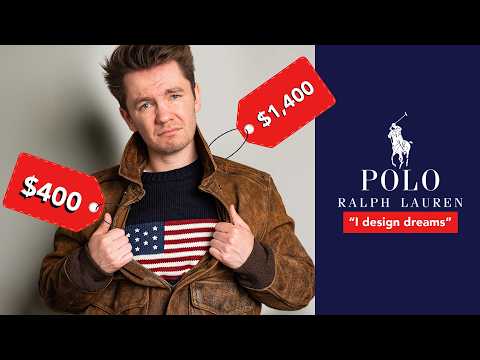
“Somebody asked Cary Grant, ‘How did you become Cary Grant from Archibald Alec Leach?’ And he said, ‘I pretended to be a somebody I wanted to be until finally I became that person, or he became me.’” — Michael Kristy, 12:12
Clip command
yt-dlp --download-sections "*12:12-13:06" "https://www.youtube.com/watch?v=0QXZKkaMdwQ" --force-keyframes-at-cuts --merge-output-format mp4 -o "cary-grant-pretend.mp4"”Polo represented a style and a life and an elegance.”
“Why Polo? Did he play the sport? No, he didn’t play the sport. Polo is for rich people. You need an entire fleet of horses, you need a field… But to Ralph Lauren, that was the entire point. In an interview he said, we talked about baseball, football, what would be great? Rugby, polo. What did it represent? Represented a style and a life and an elegance.” — Michael Kristy, 5:22
Clip command
yt-dlp --download-sections "*5:22-6:08" "https://www.youtube.com/watch?v=0QXZKkaMdwQ" --force-keyframes-at-cuts --merge-output-format mp4 -o "why-polo.mp4"”Could have kind of sort of taken the main flagship thing from the brand you used to work at.”
“If you work at Brooks Brothers and you think, man, I really suck at my job. They must hate me. Look on the bright side. You could have kind of sort of taken the main flagship thing from the brand that you used to work at and started your own 22 billion dollar empire and had a 600 million dollar car collection. But you didn’t. That’s pretty cool.” — Michael Kristy, 8:09
Clip command
yt-dlp --download-sections "*8:09-8:50" "https://www.youtube.com/watch?v=0QXZKkaMdwQ" --force-keyframes-at-cuts --merge-output-format mp4 -o "brooks-brothers-heist.mp4"”Rich kid, rich kid, rich kid.”
“The second I walked in, which, by the way, if you live in Portland, Maine, you definitely know the dry cleaner that I’m talking about. Second I walked in, he went, ‘Oh, rich kid, rich kid, rich kid.’ … is this really just because five minutes ago I took off a hoodie and put on an Oxford cloth button-down and this guy completely judged me off of one thing?” — Michael Kristy, 17:49
Clip command
yt-dlp --download-sections "*17:49-18:47" "https://www.youtube.com/watch?v=0QXZKkaMdwQ" --force-keyframes-at-cuts --merge-output-format mp4 -o "rich-kid-dry-cleaner.mp4"”Ralph Lauren left the Bronx through sheer force of imagination.”
“A lot of people that know Ralph Lauren describe him as a guy who left the Bronx through sheer force of imagination. He did the Cary Grant thing 15 times over and became not just Ralph Lauren, but Ralph Lauren the mechanic, the Wall Street… anchor, the skier, the car collector, the billionaire, anything you could imagine, Ralph Lauren made himself into that. He was every man and he was every type of cool that could possibly exist.” — Michael Kristy, 14:51
Clip command
yt-dlp --download-sections "*14:51-15:23" "https://www.youtube.com/watch?v=0QXZKkaMdwQ" --force-keyframes-at-cuts --merge-output-format mp4 -o "sheer-force-imagination.mp4"”Look like you didn’t even think about putting it on.”
“Ralph Lauren… is the first-ever American male fashion influencer, and every male fashion influencer ever has tried to copy the same thing, and that is to look like you’re not trying, no matter what you do. Because the most important thing of any outfit, of any cool outfit, is to look like you didn’t even think about putting it on. But anybody that’s taking a picture of their outfit thought about their outfit for a very, very long time.” — Michael Kristy, 21:19
Clip command
yt-dlp --download-sections "*21:19-22:01" "https://www.youtube.com/watch?v=0QXZKkaMdwQ" --force-keyframes-at-cuts --merge-output-format mp4 -o "look-like-not-trying.mp4"Key Points
- Ralph Lauren’s fake biography setup (0:59) - Kristy tells a fabricated life story (born in France, raised on a Colorado ranch, Wall Street banker, Hamptons retiree) and then admits he made it up
- The real Ralph Lifshitz (1:47) - Born in the Bronx, name changed from Lifshitz because he was made fun of, started at Brooks Brothers as their worst-ever employee
- The 600 million dollar car collection (2:24) - Real, alongside the Presidential Medal of Freedom and son David’s marriage to Lauren Bush (“Lauren Bush Lauren wearing Lauren by Ralph Lauren”)
- Why “Polo” (5:22) - Lauren never played the sport; he picked it because it represented “a style and a life and an elegance” — the most aspirational sport he could attach his name to
- The Lacoste rebrand (6:25) - The mesh tennis shirt was invented by René Lacoste; Lauren rebranded it as “the polo shirt” and convinced even Lacoste to use that name on their own website
- The real polo shirt is the OCBD (7:46) - Brooks Brothers added buttons to collars after seeing English polo players use them; Lauren learned this at Brooks Brothers and made it his own
- Story beats product (8:30) - Lauren proved that a good shirt without a story loses to a marketed shirt with one, “doesn’t matter if you’re a 150, 200 year old brand”
- Cary Grant as model (11:22) - Grant changed his name from Archibald Alec Leach, joined acrobatic dancers, and reinvented himself; Lauren explicitly quoted him
- “I pretended to be a somebody I wanted to be until finally I became that person” (12:12) - Cary Grant’s line that’s the spine of the whole Ralph Lauren philosophy
- The iconic flag sweater (1989) (13:06) - Released the same year the Berlin Wall fell, and Lauren donated $10M to restore the Star-Spangled Banner
- The End of History moment (13:31) - America’s optimistic 1990s pressure-release-valve era let people freely choose new identities, exactly what Lauren was selling
- Martha Stewart as parallel (14:24) - Same era, same trick: turn a chore into an aspirational lifestyle (“you can be this gardener woman that does this stuff for fun”)
- Ralph Lauren = every other brand, with a Ralph spin (16:47) - “Ralph Lauren is Barbour, Levi’s, L.L. Bean, Brooks Brothers, any other brand you could think of”
- Pre-broken-in clothing (20:49) - Lauren’s trick: “If you get a new one, you’re going to look like you’re trying too hard, so let us break it in for you”
- First non-actor fashion influencer (22:34) - Paul Newman, McQueen, Brando looked effortless because they were actors; Lauren was the first non-actor to make “effortless” his entire brand
- Phase 3 personal experiment (22:58) - Kristy poses as Ryan Gosling, a Wall Street banker, an architect rushing to a meeting — and finally wears a tie he’d owned since college
- Taylor’s correction (24:46) - “You don’t have to say it’s a costume or pretending or you’re playing a character. It’s just clothing, that’s just your vibe for the day.”
- Self-recognition as the dry cleaner (24:59) - Kristy realizes he’s been the same gatekeeper, “putting everything in a box and saying I can’t wear this or you can’t wear that”
Mentions
Companies & Brands
- Ralph Lauren (0:09) - The subject; $22B empire, $600M car collection, Presidential Medal of Freedom
- Brooks Brothers (4:56) - 150-year reign as America’s clothing brand; outfitted the Rough Riders, Union Army, US presidents; Lauren’s first employer
- Lacoste (6:25) - Inventor of the mesh tennis shirt that Lauren rebranded as the polo shirt; now even Lacoste calls it a polo shirt on their own website
- Huckberry (3:15) - Video sponsor; their director of design Nick Kemp sourced Cone Mills 1968 selvedge for the American Reserve Collection
- Cone Mills (4:10) - Deadstock 1968 selvedge denim from El Paso, “basically gone from the planet”
- K-Mart (1:40) - Where the joke shirt was bought
Products & Concepts
- The polo shirt (Ralph Lauren) (6:14) - High-twist cotton mesh, sold in a rainbow of colors, tagline “wears or gets better with age”
- The Oxford cloth button-down (7:46) - The actual polo shirt; buttons originally added by English polo players so collars wouldn’t flap
- Iconic flag sweater (13:06) - Released 1989, the year the Berlin Wall fell
- Pre-broken-in leather jackets and jeans (20:41) - Lauren’s signature: clothes that look worn-in straight from the store
People
- Ralph Lauren (Ralph Lifshitz) (1:47) - Born in the Bronx, name changed because of bullying
- Cary Grant (Archibald Alec Leach) (11:22) - Lauren’s quoted role model; reinvented his name, walk, and voice after growing up in England
- Charlie Rose (9:00) - The interview that converted Kristy
- Audrey Hepburn (10:57) - Lauren namedrops her in interview (“I was having dinner with Audrey Hepburn”)
- René Lacoste (6:25) - Invented the modern tennis shirt
- Martha Stewart (14:24) - Same lifestyle-rebrand era as Lauren
- Lauren Bush Lauren (2:24) - David Lauren’s wife; the recursive name joke
- Paul Newman, James Dean, Steve McQueen, Marlon Brando (22:13) - Pinnacle-of-cool actors who looked effortless
- Ryan Gosling (22:58) - Kristy’s pose-reference for Phase 3
- Taylor (24:46) - Michael’s wife; delivers the video’s gentlest insight
- Nick Kemp (3:27) - Huckberry’s director of design; “10 sewing machines in his garage”
Historical Touchpoints
- The Berlin Wall falling (1989) (13:23) - Same year as the iconic flag sweater
- “The End of History” (13:31) - Cited as the post-Cold-War optimism backdrop
- The Star-Spangled Banner / Great Garrison Flag (12:57) - Lauren donated $10M to its restoration
Surprising Quotes
“He really is one of the coolest guys on the planet, and that really affects his clothing and how he taught other people to dress. Before researching this video, I don’t feel like I dressed as well as I do now. It unlocked a lot of secrets.” — Michael Kristy, 0:43
“People don’t think it’s Ralph Lauren because that sounds too American and too basic. It has to be Lorén.” — Michael Kristy, 6:00
“Every single answer that Ralph Lauren gave was luxurious, nostalgic, aspirational, it was a polo shirt. And I was like, ‘There it is, this is all the same thing. I want to buy the polo shirt, I want to hang out with you.’” — Michael Kristy, 11:04
“That’s Ralph Lauren. I wish I were him.” — Michael Kristy (quoting Ralph Lauren on Charlie Rose), 12:41
“If you just put on a shirt and all of a sudden this guy thinks you’re rich, put on a big nice suit and people are going to think you’re a Wall Street banker. Use that psychology thing and be whoever you want to be. It’s actually very easy.” — Michael Kristy, 19:15
“I don’t know. I have no idea where it began, where it ended, where the thought stopped and the instincts took over, but that’s what Ralph Lauren has been saying for 70 years. It doesn’t matter.” — Michael Kristy, 25:23
Transcript
Michael Kristy: 0:00 No, I also did not see anything special about Raphael Lauren.
Michael Kristy: 0:09 He has a 600 million dollar car collection because everybody bought into this. He was awarded the presidential medal of freedom. All the fancy fashion guys that are super stylish all say I owe everything to Ralph Lauren. Why? I don’t buy it. I don’t see it at all.
Michael Kristy: 0:27 It really didn’t make any sense to me whatsoever. This guy that made this is the quintessential American designer, the guy that changed fashion in America forever. I think everybody just got on the bandwagon, or that’s what I previously thought, and that is not true.
Michael Kristy: 0:43 He really is one of the coolest guys on the planet, and that really affects his clothing and how he taught other people to dress. Before researching this video, I don’t feel like I dressed as well as I do now. It unlocked a lot of secrets. But we have to start with his bio, because it’s insane.
Michael Kristy: 0:59 Raphael Lauren was born in 1947 in France. Ralph Lauren came to America when he was five years old where he worked on a ranch in Colorado for 20 years. With his savings, he purchased that ranch, bought a Schott Perfecto jacket and a motorcycle, rode to New York where he had a short but steady powerful career as one of Wall Street’s top bankers before retiring completely to the Hamptons, raising a family, becoming a semi-professional skier, a part-time mechanic to his fleet of cars that he bought while on Wall Street. And it was only then that he started a clothing brand which was simply all of the clothes he picked up on that crazy journey of his life and he made them into different sizes.
Michael Kristy: 1:40 Well, this shirt I bought at K-Mart. This is living proof of what I believe in. I love the aging of it, I love the rips, I love it all.
Michael Kristy: 1:47 But at the same time, I had a second question. Who is Ralph Lauren? Because I made all of that up. None of that is true. It’s Lauren. Ralph Lauren was born in the Bronx, and his real name, or his first name, was Ralph Lifshitz, and then he changed it to Lauren because he was made fun of a lot, and he worked at Brooks Brothers starting off, and then became the worst Brooks Brothers employee of all time and started his fashion career.
Michael Kristy: 2:24 A lot of that stuff about Ralph Lauren really is true though. He does have a 600 million dollar car collection. He was awarded the presidential medal of freedom. And his son did marry Lauren Bush, and her last name is now Lauren. So she’s Lauren Bush Lauren. And Ralph Lauren has a women’s clothing line called Lauren by Ralph Lauren, and if she wears that, that would be Lauren Bush Lauren wearing Lauren by Ralph Lauren.
Michael Kristy: 2:40 So his life does seem pretty fantastical because it certainly is. But the true question is, who the heck is Ralph? Because of all these pictures, he does none of that, but it really looks like he does. And that is the crux of this video. That is what I found out. The magic behind Mr. Ralph Lauren.
Michael Kristy: 2:59 And yeah, at the beginning of the video, not a lie, I really did not buy into any of this and now my eyes are completely opened. So I’m doing an experiment on you right now. If you notice it, please don’t say anything, but just think it in your head, I noticed what he’s doing because it’s an experiment. So let’s see if it works.
Michael Kristy: 3:15 This video is sponsored by Huckberry. Look at that, their ultimate off-duty short. Huckberry said I could talk about anything on their site, and I said I’d like to talk about Nick. And everybody on the call was like, Nick Kemp? The guy on the call right now, you want to talk about him? And I was like, yep. Nick Kemp is on the site. Personally, I think it would be nice to talk about how Nick did three tiers of denim as the director of design at Huckberry.
Michael Kristy: 3:46 Starting at the entry point with the stretch selvedge denim offering. I think the fit is good for people getting into denim, and those people probably like stretch and they’re getting selvedge for the first time. That’s smart. I also really appreciate that Nick knows not everybody’s into very stretchy pants and they like 100% cotton offerings, and Nick took care of us. And since Nick himself is a massive denim nerd with 10 sewing machines in his garage, he has some hookups and he sourced deadstock first quality Cone Mills 1968 selvedge denim in the form of the American Reserve Collection. There’s also the Japanese Reserve Collection. Both of these pieces don’t fit me, they’re just lended to me from Huckberry, but still they’re very cool.
Michael Kristy: 4:23 At Cone Mills denim is why Nick is so important. You have to have connections, you have to know people, and you have to have 10 sewing machines in your garage in order to find first quality Cone Mills 1968 selvedge denim in El Paso when it’s basically gone from the planet. So thank you very much, Nick. You are the best. There he goes.
Michael Kristy: 4:47 This is probably my favorite story from the entire video, and it just shows you how much of a monster Ralph Lauren is at marketing and getting people to wear his clothes.
Michael Kristy: 4:56 There’s this big American clothing brand that everybody knows, Brooks Brothers. They had a 150-year kind of dominant reign as America’s clothing brand. They outfitted the Rough Riders, the Union Army, almost all US presidents and Gatsby, even though Gatsby’s not real.
Michael Kristy: 5:11 But what’s crazy is a little kid from the Bronx works at Brooks Brothers for a little bit, sees their schtick and is like, oh, I have a better idea. And he introduces this, a polo player, both the logo and the name.
Michael Kristy: 5:22 And that was my first big question: why Polo? Did he play the sport? No, he didn’t play the sport. Polo is for rich people. You need an entire fleet of horses, you need a field, you need time to learn how to be on a horse. But to Ralph Lauren, that was the entire point. In an interview he said, we talked about baseball, football, what would be great? Rugby, polo. What did it represent? Represented a style and a life and an elegance.
Michael Kristy: 5:46 Polo is rich. It’s aspirational. It’s a whole different world that when you see it, you think this must be a very, very fancy brand. It’s still so effective today that people don’t think it’s Ralph Lauren because that sounds too American and too basic. It has to be Lorén.
Michael Kristy: 6:08 But anyways, Ralph Lauren started off making ties that sold very well, but this is probably what you think of when you think of Ralph Lauren. And for good reason, because he redefined what this is called. This is not a polo shirt. Obviously, it is now a polo shirt and yes, polo players do wear polo shirts and they did before Ralph Lauren, but the polo shirt that we recognize today is popularly thought to be invented by René Lacoste, aka the brand Lacoste.
Michael Kristy: 6:32 René Lacoste was essentially like, well, these button-ups and everybody’s wearing are not that good to play tennis in, so I want a high twist cotton mesh knit that I can move around in and have an advantage on the court. But everybody was looking at the tennis shirt as an athletic piece of gear. So when synthetic fabrics came out, they switched it over to synthetic and were like, boom, it’s even better.
Michael Kristy: 6:54 But not Ralph Lauren. Ralph Lauren was like, wait, you guys are major miss here, guys. This high twist cotton ages beautifully over time and it feels nice and it’s natural. This is really what you’ve got to keep selling. So he sold it and he also said, guys, stop selling it in just like country club white. Do it in a whole list of rainbows and make it romantic. And give it the tagline, wears or gets better with age. People will eat it up. And they freaking did.
Michael Kristy: 7:15 Look at that nice blurry shot for you. What do you think of that? And Ralph Lauren was so correct that people wanted to buy the story and feel high class and luxury and whatever that now Lacoste calls their own shirt, the tennis shirt, which they did name it like L 1 2 3 10 15, which is not the best name ever. They call it on their website a polo shirt.
Michael Kristy: 7:36 But what’s even more insane is that neither of those are a polo shirt. This is technically the polo shirt.
Michael Kristy: 7:46 Part of the reason Brooks Brothers became so successful is because the founder was in England and he saw that polo players added buttons to their collars so they didn’t flap and hit them in the face. And he said, that’s a great idea. We’ll just do that standard on our shirts in America. That is by definition the polo shirt. And guess who worked at Brooks Brothers before he started Ralph Lauren? Ralph Lauren.
Michael Kristy: 8:09 And so if you work at Brooks Brothers and you think, man, I really suck at my job. They must hate me. Look on the bright side. You could have kind of sort of taken the main flagship thing from the brand that you used to work at and started your own 22 billion dollar empire and had a 600 million dollar car collection. But you didn’t. That’s pretty cool. And that’s kind of the modern shopping style.
Michael Kristy: 8:30 Ralph Lauren proved that like, yeah, you can make a good shirt, but if you don’t market it well and say, it’s luxurious, it has this story behind it, here’s why it’s not just a shirt, here’s why you need it, that’s going to dominate. Doesn’t matter if you’re a 150, 200 year old brand, not as cool as a story Ralph Lauren was going to tell. Very sorry, it’s much hotter than I thought today. Bit warm outside, isn’t it?
Michael Kristy: 8:50 Ralph Lauren took that philosophy and said, okay, I myself need to become the polo shirt. That’ll work. And it did. And the reason I’m saying that is because of this interview with Charlie Rose where Ralph Lauren says a very telling quote, not about himself, but about someone else, Cary Grant.
Michael Kristy: 9:12 I really did have a very up and down thought on Ralph Lauren in general because while researching this video, I watched a lot of his documentaries and I thought, is this, what is this?
Michael Kristy: 9:23 And I never thought about money, I didn’t have any, I didn’t think about it.
Michael Kristy: 9:25 I kept having these moments while I was watching the documentary and looking at pictures of Ralph Lauren and I was like, ‘Ah, that guy is so cool.’ But then I was like, ‘But wait, that’s not him.’ I know that guy just flew on his private jet from his multimillion-dollar penthouse, probably polished up his $600 million car collection, then landed at his 17,000-acre ranch, and just, did he walk around? What do the cowboys that he hired that do what it looks like he does say? And I was just like, it’s just this weird costume.
Michael Kristy: 9:57 And I thought that until I saw Ralph Lauren’s interview with Charlie Rose and I said, ‘Oh, no, never mind. This really is the coolest guy on the face of the planet.’ I totally fell into his magic spell. He’s just so cool. He’s like, ‘Charlie, you’d be cool. Your lapels are fine, not a big deal.’
Michael Kristy: 10:15 I look at the suit, one man to another and I see a wide lapel.
Michael Kristy: 10:19 Well, you know, this is second time around really. This was, it got narrow and then it got wider again.
Michael Kristy: 10:21 Yeah, but your lapels are okay.
Michael Kristy: 10:24 I was like, ‘Wow, you are Ralph Lauren.’ But then after a while I was like, ‘Wait a minute, this is, how on earth is this guy that cool? It’s basically impossible.’ Charlie Rose would be like, ‘Ralph Lauren, how did you start a fashion empire and have time for your family?’
Michael Kristy: 10:43 I always somehow in my family, I always spend time with my kids. I think, I think I was able to step away from myself and see life.
Michael Kristy: 10:53 Ralph Lauren, how did you think of all these crazy things? Like what was going on inside your head? And Ralph Lauren would be like… I never thought about style. I didn’t know what that word meant. I just, I just acted on my first natural instinct and that’s, you know, I was having dinner with Audrey Hepburn…
Michael Kristy: 11:04 And I was like, ‘What are you talking about?’ Every single answer that Ralph Lauren gave was luxurious, nostalgic, aspirational, it was a polo shirt. And I was like, ‘There it is, this is all the same thing. I want to buy the polo shirt, I want to hang out with you.’
Michael Kristy: 11:16 I’ve gotten to know Audrey Hepburn and Cary Grant and they became my friends. Cary Grant came to my house for lunch.
Michael Kristy: 11:22 But there was one moment where Ralph Lauren quoted something, and if you want to learn about someone, figure out what they’re quoting. And Ralph Lauren quoted Cary Grant. Cary Grant, the man, was asked how he managed to live up to his larger-than-life image. He replied, and this is the part that Ralph quoted, ‘We all wish we were Cary Grant. Sometimes I wish I was Cary Grant.’
Michael Kristy: 11:42 I’d like to be Cary Grant. He said, ‘I wish I was Cary Grant.’
Michael Kristy: 11:46 Mhm. Cary Grant changed his name from Archibald Alec Leach and he grew up in England and apparently just had an absolutely terrible childhood. But he got out of everything because he joined a group of acrobatic dancers… and learned how to walk on stilts. When he came to America, he became Cary Grant. He changed everything about himself: how he walked, how he talked.
Michael Kristy: 12:09 Cary Grant was not Archibald Alec Leach.
Michael Kristy: 12:12 Somebody asked Cary Grant, “How did you become Cary Grant from Archibald Alec Leach?” And he said, “I pretended to be a somebody I wanted to be until finally I became that person, or he became me.”
Michael Kristy: 12:26 They didn’t talk about that in the Ralph Lauren interview; they just talked about the “I wish I were Cary Grant even though I am Cary Grant” part. But shortly after that, Charlie Rose says, “Here’s a montage of Ralph Lauren’s life,” and they show it. And when they cut back to Ralph Lauren, he laughs and says,
Michael Kristy: 12:41 “That’s Ralph Lauren. I wish I were him.”
Michael Kristy: 12:43 Dave, you probably said that. Ah, I figured it out. And what clicked was this: this little bad boy right here, the Ralph Lauren iconic flag sweater.
Michael Kristy: 12:57 Ralph Lauren donated ten million dollars to help restore the Great Garrison Flag, aka the Star-Spangled Banner, the flag that inspired the National Anthem.
Michael Kristy: 13:06 Ralph Lauren loves America a lot, and it’s not just putting stars and stripes all over his clothes; it goes way, way deeper than that. And if I had the sweater in my hand, I would say, “And it starts here,” with the iconic flag sweater, which was released in 1989.
Michael Kristy: 13:23 And if you’re a history nerd, you probably just turned to someone and said, “1989? What happened in 1989?” The Berlin Wall fell.
Michael Kristy: 13:31 The Berlin Wall falls, the Soviet Union collapses, and that is literally, by some people, because of a book called “The End of History,” because people were like, “Alright, well, America won, so I guess we’re done. Everybody’s going to do it that way. Most powerful nation in the world.”
Michael Kristy: 13:46 And that moment was like a giant pressure release valve. America was super—generally, not everybody—super optimistic, triumphant, happy, and finally just relieved. The ’90s to really 2001 are considered to be some of the most optimistic times in American history. A lot of people felt very prosperous; they felt like they had a lot of upward momentum, and they could finally just say like, “Oh my gosh, okay, so now that I’m not worried about that,”
Michael Kristy: 14:12 what the heck am I gonna be? Maybe I want to dress like a cowboy, or maybe I saw this great movie where this guy wore this beautiful velvet dinner jacket. I’m going to wear that. Or I’m going to be a Wall Street banker.
Michael Kristy: 14:24 So you’re hanging in the ’90s and you’re like, “Well, this is kind of awesome. I just bought a house, I’m feeling really good.” And, like, I don’t know, what should I do to the house? Who comes along? Martha Stewart. She’s like, “Don’t just do like an old Betty Crocker thing. Set the table, make it beautiful, make it brilliant, and you can be this gardener woman that does this stuff for fun. It’s not a chore anymore. The whole world is different.” And people eat that up.
Michael Kristy: 14:46 “We’re having a picnic this afternoon and my friends have asked me to bring the sandwiches.”
Michael Kristy: 14:51 A lot of people that know Ralph Lauren describe him as a guy who left the Bronx through sheer force of imagination. He did the Cary Grant thing 15 times over and became not just Ralph Lauren, but Ralph Lauren the mechanic, the Wall Street… anchor, the skier, the car collector, the billionaire, anything you could imagine, Ralph Lauren made himself into that. He was every man and he was every type of cool that could possibly exist.
Michael Kristy: 15:11 But his specific talent was being able to make you believe he was actually everything he was saying he was. But when the camera stops, is that actually going to go on or is that just part of the Polo shirt?
Michael Kristy: 15:23 If you’re on your farm now and you’re getting dressed, you sort of feel like a farmer? You bet. You want to wear your farm clothes? Right. You wear your farm, what you think of the farm clothes that your dad wore, what you thought the farmer was. Make you feel good? Make you feel like a real farmer? You bet. That’s the answer to what I, to what I do.
Michael Kristy: 15:43 From what I read and from what everything interviews say and stuff, Ralph Lauren, huge movie fan. And he based his kind of Ralph Lauren world off of old lavish movies from the 50s, 40s, 30s, where everything was perfect. There was a beautiful party, everybody was so beautiful, their clothes didn’t wrinkle, no one drank too much, there was no issues, everybody had the perfect line.
Michael Kristy: 16:05 I’ve been having such a good time. Everybody should have a good time.
Michael Kristy: 16:07 That was Ralph Lauren’s version or I guess that is the version of the American dream. If you dream it, you will become it.
Michael Kristy: 16:14 And Ralph Lauren was doing that in one of the most optimistic times in America where a lot of people were like, ‘Yeah, you’re right. I can do that.’
Michael Kristy: 16:23 America’s about dreams. It’s about an accumulation of the world, seeing the world.
Michael Kristy: 16:30 You might not agree with it, but he’s essentially saying the identity of every American is anybody in the world because this is where you come to reinvent yourself. So whatever you want to be, you be.
Michael Kristy: 16:40 And that’s why it’s so hard to talk about Ralph Lauren quality specifically because what is Ralph Lauren besides everything?
Michael Kristy: 16:47 Ralph Lauren is Barbour, Levi’s, L.L. Bean, Brooks Brothers, any other brand you could think of, Ralph Lauren has their version of it. And sometimes it’s better, sometimes it’s not, but he’s putting his little spin on it and reinventing it.
Michael Kristy: 16:58 And this is actually where I tried one of my two experiments.
Michael Kristy: 17:00 The whole costume thing happens to be basically every time I put on clothes. Like, I really want to wear Oxford cloth button-downs. Very simple. But every time I put them on, I’m like, I don’t know, I feel like a character. I don’t feel real. Like, this isn’t me. I don’t wear this. So I don’t. And you can see it on the first half of the B-roll, I’m very uncomfortable in all the shots. I’m like, maybe this outfit’s stupid, people are going to make fun of me, I don’t know, I don’t know how to put this on, let me just stand here.
Michael Kristy: 17:29 And then I changed something. But first, I was called a rich kid about a billion times in a dry cleaner. My friend Chris is getting married and he invited me to his wedding. So I had to get my suit dry cleaned and I was wearing a hoodie and jeans. And I thought, you know what? I’m doing the Ralph Lauren video, let me put on Oxford cloth button-down and go out. And I did.
Michael Kristy: 17:49 And the second I walked in, which, by the way, if you live in Portland, Maine, you definitely know the dry cleaner that I’m talking about. Second I walked in, he went, ‘Oh, rich kid, rich kid, rich kid.’ And I was like, is he talking about me? Rich kid doesn’t even… I don’t want to unzip the bag. Rich kid doesn’t even want to show me his fancy suit. He doesn’t want to mess up his perfect fingernails.
Michael Kristy: 18:06 And at that moment I was like, is this really just because five minutes ago I took off a hoodie and put on an Oxford cloth button-down and this guy completely judged me off of one thing? And yes, that’s exactly what’s happening and that’s exactly what everybody does on the entire planet. Even the nicest person in the world gives you an up-and-down and decides what they think about you and who they are.
Michael Kristy: 18:27 And you yourself, even though you’re judging people or you are that person, you’re thinking, nobody actually knows who I am. This is just the shirt I put on. And Ralph Lauren knew how to weaponize that.
Michael Kristy: 18:37 When the dry cleaning guy said that, it got right, you know when someone can poke right to the center of you and push your buttons? He did that to me and I was like, ooh, that’s not even close. You don’t know anything about me. But I also want to crawl out of this Oxford cloth button-down and burn it.
Michael Kristy: 18:53 Ralph Lauren on the other hand, would say one, Michael, who cares? Where does that end? If that guy is going to dictate your life and that’s how you’re going to think, maybe you shouldn’t wear jeans because those are for gold miners. And that guy was wearing gym shorts, but he’s not a gym teacher, so why is he wearing that? He’s also not a personal trainer, also he has a fish on his shirt, he’s not a fish, he can’t wear that either. But also, and this is where the B-roll is going to start to shift, if I did a good job, Ralph Lauren was like, you can use that.
Michael Kristy: 19:15 If you just put on a shirt and all of a sudden this guy thinks you’re rich, put on a big nice suit and people are going to think you’re a Wall Street banker. Use that psychology thing and be whoever you want to be. It’s actually very easy. So, I was like, you know what, let me just fully buy into Ralph Lauren and not be awkward.
Michael Kristy: 19:30 Just pretend that I belong in the clothing that I’m wearing. That was the second phase of what I did and immediately, I started to like my outfits a lot better and I felt more comfortable in them.
Michael Kristy: 19:39 There should be a really big difference in standing like this for B-roll and feeling awkward and doing little dances versus trying to actually pose and feeling like you belong in the clothes and just like there’s no big deal. You should see two different things.
Michael Kristy: 19:51 But there’s also a step further. Oh jeez, we’re running very, very low on light. But I wanted a sport coat forever, but I always felt super uncomfortable wearing it.
Michael Kristy: 19:58 And that is where Ralph Lauren comes in because there’s a big stretch to do what Ralph Lauren himself is doing, which is referencing movies and saying like, yeah, I’m going to be a cowboy that I saw from a movie, or I’m going to be Cary Grant.
Michael Kristy: 20:12 Instead, Ralph Lauren is saying, I’ll do that, you can just copy me. You don’t have to pretend. I’m not a movie character, I’m a real dude. I have a really cool life and like, you saw me on the catalog. Just buy what I’m selling and wear it how I’m wearing it.
Michael Kristy: 20:27 And if you’re a guy in the US, what you’re probably most comfortable wearing is a pair of jeans, a chambray shirt, maybe at the most. So Ralph Lauren combines English tailoring with jeans and all of a sudden, doesn’t feel like that much of a stretch to put it on.
Michael Kristy: 20:41 And you feel pretty cool because you’re doing what the coolest guy in the world did. Have you always wanted to wear a cool leather jacket that you saw in a picture of a World War II fighter pilot or something? No problem, we have that too. But if you get a new one, you’re going to look like you’re trying too hard, so let us break it in for you.
Michael Kristy: 21:00 And have it look really worn in and then I’ll show you how to wear it. But since it’s worn in and since our jeans are worn in and everything else we sell you, it looks fine, it looks natural, and it works really, really well.
Michael Kristy: 21:11 And to sum all of that up, what it really looks like is that you’re not trying. And that was my experiment for this entire video.
Michael Kristy: 21:19 Ralph Lauren, who he truly is—well, who I truly think he is—is the first-ever American male fashion influencer, and every male fashion influencer ever has tried to copy the same thing, and that is to look like you’re not trying, no matter what you do.
Michael Kristy: 21:31 Because the most important thing of any outfit, of any cool outfit, is to look like you didn’t even think about putting it on. But anybody that’s taking a picture of their outfit thought about their outfit for a very, very long time.
Michael Kristy: 21:46 And so the experiment that I tried to do throughout the video at varying points of success was to look like I’m really not trying. My shirt’s unbuttoned, I’m relaxing. All the—well, most of the poses I tried to set up specifically to look cool, but look like I’m not specifically trying to sit that way.
Michael Kristy: 22:01 And I’m going to pretend it’s too warm so I have to take off my jacket. It’s very—sorry, it’s much harder than I thought today. Bit warm outside, isn’t it?
Michael Kristy: 22:13 I have no idea how successful it was, but still, 60, 70 years later, people still hold Paul Newman, James Dean, Steve McQueen, Marlon Brando to be like the pinnacle of cool. They didn’t try at all.
Michael Kristy: 22:22 Is there any part of the world you can now go where you’re not recognized or known? Um, it’s difficult. It’s one of the things that I don’t really care very much about.
Michael Kristy: 22:34 Except they’re actors. Every single shot that you’re seeing of them, even the ones where it looks like you didn’t see it of them or they didn’t know the camera was there, they are posing for that. And Ralph Lauren was really the first-ever non-actor to take that concept and make it their entire brand, and it sells a lot of things because he looks very, very cool and he just looks natural and everybody wants that. And they think it’s the shirt, not everything that goes into posing that shirt.
Michael Kristy: 22:58 So for the final stage in the B-roll, Phase 3, I did a full Ralph Lauren and I pretended. I said, ‘Okay, this guy is Ryan Gosling seconds before he’s told he has to save the world. This guy is a guy that just found out the stock market exploded while he was on his lunch break. This guy is coming to pick up the girl that he loves, but he doesn’t know he loves her yet.’
Michael Kristy: 23:18 I was going full into character and thinking what would they wear? What would they do? How would they act? How would they walk? And that, my friends, is the first time I ever, literally ever, wore this tie that I thrifted in college at Savers many, many, many years ago, and I always wanted to wear it.
Michael Kristy: 23:35 And I never felt right and I was like, ‘I don’t—when would I put this on?’ I was pretending to be an architect that woke up late for a meeting, and he was really cool, he was a natural, he just looked at something and knew how to architect it. And I was like, ‘You know what, why am I not wearing a tie? Because he would be wearing a tie and it would be rushed.’
Michael Kristy: 23:51 And as I ran to get the tie, I was like, ‘I just can’t believe I thought that.’ And even one step further, as I grabbed the tie, I was like, ‘Man, I really wish I had a red version of this wool tie because the character would wear that.’ That’s what… be a little bit more poppy. And that is the first time I have ever thought about fashion like that in my life. I knew exactly what I should wear and why because it’s what that guy would wear and I just pretended.
Michael Kristy: 24:10 And that is what I thought Ralph Lauren did and then Taylor said wait, why why pretend, why imagine, what is that? It doesn’t always have to be a character.
Michael Kristy: 24:18 I wish I was Cary Grant. And so did you. Yes, in your head. Yeah. And part of your life has been about becoming Cary Grant.
Michael Kristy: 24:27 No, no. I never wanted to be anyone but myself. Everything I do is because it’s made for me. I want to wear it. I want to be that. That’s not trying to be somebody else, it’s me.
Michael Kristy: 24:39 People sort of sense ‘why are you living, you know, you’re driving that thing or you’re wearing that suit, who do you think you are, you know? You grew up in the Bronx. What is this?’
Michael Kristy: 24:46 Taylor’s one of the most fashionable people I know and she was like, I mean, you don’t have to say it’s a costume or pretending or you’re playing a character. It’s just clothing, that’s just your vibe for the day. You just felt like putting that on.
Michael Kristy: 24:56 And I was like, Taylor, that’s actually very Ralph of you. It’s very profound, that’s the point of this video.
Michael Kristy: 24:59 And in a very cruel twist of fate, I also am a dry cleaner man in my own way. Albeit, I think a little bit nicer, but still, I was putting everything in a box and saying I can’t wear this or you can’t wear that or we can’t do this. Ralph Lauren’s in a costume.
Michael Kristy: 25:13 When in reality, I don’t know. Did he pretend anything when he was a kid? Was he imagining that he was going to be a billionaire and dominate the world of clothing or did he just do it?
Michael Kristy: 25:23 I don’t know. I have no idea where it began, where it ended, where the thought stopped and the instincts took over, but that’s what Ralph Lauren has been saying for 70 years. It doesn’t matter.