How Shinkei Is Reshoring America's Seafood Supply Chain | Saif Khawaja
How Shinkei Is Reshoring America’s Seafood Supply Chain | Saif Khawaja
Summary
Saif Khawaja, co-founder and CEO of Shinkei Systems, discusses how his company is revolutionizing fish harvesting with robots that use the traditional Japanese ike-jime method to humanely kill fish. The Poseidon robot, a 2.5 by 3 foot device that goes on boat decks, spikes fish in the brain and cuts the gills, resulting in fish that last up to three times as long, taste significantly better, and retain more weight - all while being handled humanely.
The company operates as a vertically integrated business - they’re a robotics company, an industrial business, and a consumer brand all at once. They provide Poseidon robots to fishermen for free via zero-cost leases in exchange for exclusivity on the product, then sell the fish under their “Ceremony Grade” label. This model allows fishermen to increase their net income by 25-100% while Shinkei captures value throughout the supply chain.
Saif shares his journey from being born in Canada and raised in the Middle East to founding the company after reading an essay called “If Fish Could Scream.” He discusses the challenges of the down market, finding his co-founder Reed, and his philosophy of democratizing artisanal food. The company now serves almost every Michelin restaurant in the US that serves fish and exports to six countries.
Highlights
”Fish don’t have vocal cords so we give them less empathy than terrestrial animals”
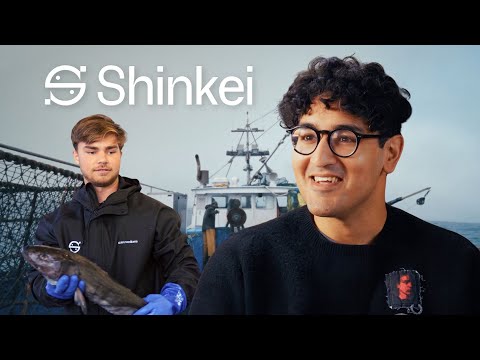
Clip command
yt-dlp --download-sections "*0:00-1:00" "https://www.youtube.com/watch?v=sAn5qwkaF8g" --force-keyframes-at-cuts --merge-output-format mp4 -o "sAn5qwkaF8g-0m00s.mp4"“There was this essay: ‘If fish could scream.’ Because fish don’t have vocal cords, we give them less empathy than terrestrial animals. Most fish are suffocated today, flopping around releasing stress hormones. It’s kind of like putting a cow’s head under water.” — Saif Khawaja, 0:00
”61% of all fish landed don’t make it to a plate”
Clip command
yt-dlp --download-sections "*4:15-5:20" "https://www.youtube.com/watch?v=sAn5qwkaF8g" --force-keyframes-at-cuts --merge-output-format mp4 -o "sAn5qwkaF8g-4m15s.mp4"“North America including Canada, The Guardian said 61% of all fish that are landed don’t make it to a plate. A lot of that waste happens at the latter portion of the supply chain. Our premise is the fish are more unit economically efficient to trade.” — Saif Khawaja, 4:15
”Over 90% of American fish are imported - half shipped overseas for processing then back”
Clip command
yt-dlp --download-sections "*17:11-18:15" "https://www.youtube.com/watch?v=sAn5qwkaF8g" --force-keyframes-at-cuts --merge-output-format mp4 -o "sAn5qwkaF8g-17m11s.mp4"“Over 90% of American fish are actually imported. Half are domestic origin - landed by American fishermen, shipped to Ecuador or Peru or Guatemala or China to be broken down, then brought back. It makes no sense.” — Saif Khawaja, 17:11
”The first version was a 3D printer with a nail stuck on the end”
Clip command
yt-dlp --download-sections "*12:47-13:50" "https://www.youtube.com/watch?v=sAn5qwkaF8g" --force-keyframes-at-cuts --merge-output-format mp4 -o "sAn5qwkaF8g-12m47s.mp4"“The very first version was a 3D printer with a nail stuck on the end of it and a plastic fish. We used OpenCV for computer vision. I had bought a bunch of dead fish from Whole Foods and was just going at it with the prototype.” — Saif Khawaja, 12:47
”Serving almost every Michelin restaurant in the US that serves fish”
Clip command
yt-dlp --download-sections "*6:45-7:50" "https://www.youtube.com/watch?v=sAn5qwkaF8g" --force-keyframes-at-cuts --merge-output-format mp4 -o "sAn5qwkaF8g-6m45s.mp4"“We’re serving almost every single Michelin restaurant in the country that serves fish. Through our distribution network we have access to over 50 stars. Our fish is being auctioned off in Tokyo. Best restaurants in Europe are reaching out by name.” — Saif Khawaja, 6:45
”Co-founder at first sight - I knew from the first meeting”
Clip command
yt-dlp --download-sections "*33:09-34:15" "https://www.youtube.com/watch?v=sAn5qwkaF8g" --force-keyframes-at-cuts --merge-output-format mp4 -o "sAn5qwkaF8g-33m09s.mp4"“When we met for the first time in person, it was one of those things like the way people talk about meeting your wife for the first time and ‘I knew I was going to marry this person.’ It was co-founder at first sight. I met 40-50 potential co-founders before Reed.” — Saif Khawaja, 33:09
Key Points
- Fish Suffocation Problem (0:00) - Most fish today are suffocated on boat decks, flopping around for 5-60+ minutes releasing stress hormones
- Poseidon Robot (1:59) - 2.5 by 3 foot robot that spikes fish in the brain and cuts gills, extending shelf life 3x
- Fish Processing vs Harvesting (0:42) - Harvesting is on the boat, processing is on land; Poseidon is technically harvesting equipment
- 1.5 Billion Pounds Daily (2:58) - Global fish harvest is approximately 1.5 billion pounds per day of whole fish
- 61% Waste Rate (4:29) - 61% of fish landed in North America don’t make it to a plate according to The Guardian
- No Fish Quality Standards (3:57) - Unlike beef (USDA prime) or chicken (pasture-raised), fish has no process-based quality grading
- Ceremony Grade Brand (6:27) - Shinkei’s consumer label for their premium fish, creating a new industry vertical
- Michelin Restaurant Reach (6:57) - Serving almost every Michelin restaurant in the US that serves fish; access to over 50 stars
- Six Country Exports (8:26) - Fish being exported to six countries, auctioned off in Tokyo
- Origin Story (9:19) - Founded after reading “If Fish Could Scream” essay about fish lacking vocal cords
- First Prototype (12:47) - Started as a 3D printer with a nail stuck on the end and a plastic fish
- Vertical Integration (21:59) - Give robots free to fishermen, get exclusivity, pay premium above commodity price
- 25-100% Income Increase (22:12) - Fishermen working with Shinkei see 25-100% improvement in net income
- 4-Week Robot Payback (23:47) - Robots pay for themselves in just four weeks
- 90%+ Fish Imported (17:11) - Over 90% of American fish are imported; half shipped overseas for processing then back
- Tropical Storm Experience (23:59) - Saif worked on a fishing boat in New England and got caught in a tropical storm
- Co-founder Story (32:01) - Met 40-50 potential co-founders before finding Reed; knew immediately he was the right one
- Copy-Paste Robots (16:49) - Can now make a new Poseidon every two weeks with one person; six robots per month with three technicians
Mentions
Companies
- Shinkei Systems (0:32) - Saif’s company building fish harvesting robots
- Nike (16:51) - Referenced for Steve Jobs’ philosophy about celebrating what matters
- The Guardian (4:29) - Source for 61% fish waste statistic
- Michelin (6:45) - Restaurant rating guide; Shinkei serves almost every Michelin restaurant serving fish
- USDA (6:07) - Referenced for prime beef grading standards fish lacks
- WeWork (15:35) - Where Shinkei was located in El Segundo with other Gundo founders
Products & Technologies
- Poseidon (1:11) - Shinkei’s fish harvesting robot that goes on boat decks
- Ceremony Grade (6:27) - Shinkei’s consumer brand label for premium fish
- Ike-jime (0:20) - Traditional Japanese humane fish killing method
- OpenCV (13:00) - Open source computer vision used in early prototypes
People
- Saif Khawaja (0:32) - Co-founder and CEO of Shinkei Systems
- Reed (32:01) - Saif’s co-founder; was at Starship when they met; phenomenal leader
- Steve Jobs (16:51) - Referenced for Nike philosophy about celebrating athletes
Surprising Quotes
“There was this essay in this newspaper: if fish could scream, because fish don’t have vocal cords, we give them less empathy than we do to terrestrial animals.” — 0:00
“61% of all fish that are landed don’t make it to a plate.” — 4:29
“Over 90% of American fish are actually imported and half are actually domestic origin where they’re basically landed here by American fishermen, shipped to other countries to be broken down in Ecuador or Peru or Guatemala or China and then brought back.” — 17:11
“The very first version was a 3D printer with a nail stuck on the end of it and a plastic fish.” — 12:47
“When we met for the first time in person, it was one of those things like the same way people talk about meeting your wife for the first time and I knew I was going to marry this person. Like I knew from the first… it was like co-founder at first sight.” — 33:09
Transcript
0:00 There was this essay in this newspaper: if fish could scream, because fish don’t have vocal cords, we give them less empathy than we do to terrestrial animals. Most fish basically are suffocated today. They’re flopping around releasing stress hormones, lactic acid, all this stuff. And I thought I was like, “Oh, this is kind of like putting a cow’s head under water. It’s not very humane.” Rather than letting the fish flop around, we have this small robot that goes on the deck, spikes the fish in the brain, stops the experience of stress, and then we cut the gills. The fish lasts up to three times as long, tastes significantly better. I realized like if we don’t step in to do this, no one else will.
0:32 This is Saif Khawaja and he is the co-founder and CEO of Shinkei Systems and they’re basically radically improving how fish processing works. And I’m from Alaska and so that’s meaningful. Do you want to just explain how fish processing has been traditionally done?
0:48 Yeah. You know, so there’s harvesting and processing. So harvesting is what we talk about going on the boat. Processing, you know, is on land. The way that I’d kind of describe it is if you take the analogy of mining, it’s the extracting versus refining process. So generating raw material out from the land and then breaking that down into something ready for human consumption.
1:11 So our key product Poseidon goes on the deck of a boat. So even though it’s a processing step in a way, it’s technically under harvesting. So when you walk into most mass market, nationwide retailers, or any restaurant, the fish that you buy, they’re basically brought onto a deck of a boat and they’re left to suffocate, you know, so they’re flopping around releasing stress hormones, lactic acid, all this stuff.
1:35 That takes like 25 minutes typically? It could be five, it could be over an hour. It’ll just depend on the species, the handling, you know, like some of them are crushed. It’s, you know, it can vary. It’s gruesome. It is.
1:49 And so that process basically decays meat quality and shelf life. So what we do is rather than letting the fish flop around, we have this small robot, two and a half by 3 feet, that goes on the deck and basically fishermen put the fish in head first one by one and we spike the fish in the brain. So we euthanize it, stops experience of stress, stops the production of stress hormones. And then we cut the gills. And so kind of like kosher slaughter for cows, we basically open up the major artery. The heart, which is still active after brain death, will pump the blood out. And so you have a less acidic carcass because there’s less stress hormone production. And then there’s less nutrition suspended in the blood. And so the bacteria basically get somewhat starved out.
2:36 And so when you do this process, the fish last up to three times as long. They taste significantly better. They actually retain more of their weight as well. So generating more yield per pound of fish. And obviously nice fish that are handled humanely.
2:50 Yeah. Do you know why no one has kind of done this before? Because I don’t know how many billions of pounds of fish we harvest every year, but it’s a lot. I think it’s something around one and a half billion a day. Yeah. One and a half billion a day. Yeah, billion pounds. Yeah, it’s obviously the whole fish. So it’s broken down to filet. So it’s not one and a half billion pounds of filet meat generated every day but probably still like a few hundred million.
3:14 Anyway, so the value of what we do kind of accrues further down the supply chain you go, right? So we have longer shelf life, better flavor, more weight retention, right? Retailers will care more about weight retention and shelf life than a fisherman will, right? Chefs will care more about flavor than a fisherman will. And so the premise of this technique is that really the value doesn’t accrue to the producer, to the resource extractor. It accrues down to the actual, basically right before the consumer. And so in that way there’s kind of been this asymmetric information.
3:48 There’s not really been a feasible way to do this process at scale. And also just the way that Americans consider fish. We actually only grade on size and not on quality or shelf life. When you go to any nationwide retailer, generally when you buy fish, it’s very rare you’ll actually get a landing date or projected shelf life, the same way you would with milk with an expiry date. Instead, you just have a pack-out date, which doesn’t really tell you much.
4:15 So this kind of stacking of opacity basically leads to a lack of incentive for people to want to handle the fish appropriately. And then there’s all the waste. North America including Canada also has, I think something like The Guardian said, 61% of all fish that are landed don’t make it to a plate. A lot of that waste happens at the latter portion of the supply chain. And so our premise is, yes obviously the fish are handled humanely, but fundamentally the fish are more unit economically efficient to trade.
4:51 It’s kind of interesting to touch on - you guys are trying to make it so you can basically know exactly where the fish that you’re eating was harvested, at what time, all this stuff, changing the way that it’s basically sold in stores. You want to go into that a little bit?
5:05 Yeah, happy to. So right now, if you were trying to differentiate the fish, all you have is the species, just kind of generic, and you have the location it was caught and not even the location, but just like is it wild or is it farmed. Maybe Alaska caught? Maybe. Yeah. If it’s a nice retailer.
5:23 And so that’s great, but that’s kind of the only resolution of data stream that we have in the industry. And so if you compare that to cattle or poultry, and just the sophistication that happens in those industries, there’s a lot of infrastructure around shelf life projected, which farm it was coming from. Exactly. Like all those things, sometimes you even have little photos of the people who harvested your eggs on the little egg carton. Very cute. That doesn’t really exist in fish.
5:56 So there’s consumers who are educated about the levels of quality in those meats, right? So you have USDA prime grass-fed beef, you have pasture-raised chicken. There’s not really an analog in terms of the process rather than the geography for fish.
6:18 And so we sell our fish under a label that we have called Ceremony Grade. And the premise of Ceremony Grade is it’s this kind of new standard and philosophy for the very best fish where we’re basically taking these artisanal techniques across the supply chain, not just the flagship product, but how the fish are caught, how they’re handled, how they’re packaged, temperature monitoring, traceability, and then basically turning it into this separate industry vertical that we have a monopoly of today based on the technology.
6:45 Did you take anything from the Michelin guide and how it all happened? A little bit. Yeah. I mean, we joke, “Michelin grade for all” is one of the phrases we use for talking about the product.
7:01 At this point we’re serving almost every single Michelin restaurant in the country that serves fish, or have at some point. Through the distribution network we have access to over 50 stars. A lot of them don’t necessarily know that it’s our product but they’re just like, “Oh, all of a sudden this fish is a lot better.” And we’re at the point now where not just the best restaurants in the country, but in the world are actually reaching out to us by name. So best restaurants in Europe, our fish is being auctioned off in Tokyo.
7:33 And it’s really been magical to take this traditional commodity fish, like black cod, which is our main SKU, and actually turn it into something that’s prized by the best in the entire industry, best chefs.
7:45 Yeah. And so the way that I kind of think about it in this commodities trading analogy is we’re basically taking these low differentiation commodities and applying our unique refining or processing stack to them to be able to generate a new type of commodity that we have a monopoly of that is significantly more economically efficient to trade.
8:08 Yeah. Did you ever go to Japan and tour any fish markets and stuff like that? More so now. I went to Japan as a kid. My dad did a lot of business in Japan and so it’s fun to be able to go and check it out, but that was kind of all peripheral background. And then since starting the company, I go to Japan probably twice a year. We’re exporting to six countries now, so slowly doing the tours for them and meeting the chefs as well.
8:30 I wonder if there’s a network of people. So once one person starts using your fish, they basically just tell their friends. Does that kind of thing happen?
8:42 That does actually. So it’s kind of fun that we’re both a robotics company and an industrial business and a consumer brand. And so you can go on our Instagram @ceremonyfish, and you can see we cross post with a lot of chefs. And that’s actually a really great way for us to be able to get distribution very quickly because chefs don’t follow distributors or wholesalers, they follow other chefs. And so slowly there’s been this network effect that’s kind of helped push the name brand because there’s some floor of quality that basically no other company is able to achieve that is associated with our brand and our name.
9:12 So, how did the company start in the first place? What were kind of the first few months like?
9:19 Yeah. So, the origin story really starts with my origin story. So, I was born in Canada, raised in the Middle East. First in kind of arguably rural Saudi Arabia, and then moved to Dubai and I was there until I was 18 and I came to the US by myself then finally, at the time for college. Went to college, went to grad school, intended to get my PhD.
9:46 And one of my early mornings there, there was this essay in this newspaper that was by this ironically vegan activist called “If Fish Could Scream” and it was all about how because fish don’t have vocal cords, we give them less empathy than we do to terrestrial animals. So cows, chickens, things like that. So the premise was talking about how most fish basically are suffocated today. They’re brought onto land, flopping around, whatever have you.
10:19 And I thought, “Oh, this is kind of like putting a cow’s head under water. It’s not very humane.” And so I just started thinking about the problem and I actually first wanted to work on a project on how might fish express pain. So could you put sensors on the skin, generate electrical signals, and then actually use that to convert that if you generate the electrical signals, convert that to PWM or something or even like a human scream, kind of giving fish a voice.
10:49 And then in doing that I basically found the techniques that we’re now working on today and so I thought why not just solve the problem directly. So that’s kind of the genesis for everything. I took the company full-time when I was 22 in mid-2022 and then have been working on it. We’re heads down.
11:12 It was very tough up front. I’m sure you can imagine. First of all, hardware wasn’t hot at the time. We were basically in a down market. So, it was very tough to raise money.
11:22 I imagine that for this sort of thing, not many venture investors are thinking about how fish harvesting or processing works. It’s funny. Yeah, this is one of those markets that’s not really traditional, but ends up being exceptionally large. 3 billion people rely on fish as a primary source of protein.
11:43 In the US, if you look at the most recent executive order, over 90% of American fish are actually imported and half are actually domestic origin where they’re basically landed here by American fishermen, taken on by American distributors. They’re shipped to other countries to be broken down. So Ecuador or Peru or Guatemala or China and then they’re broken down, gutted, scaled, filleted, packaged. So frozen, thawed, and then frozen again and then brought back.
12:17 That just destroys meat quality. Yeah. Exactly. And I mean the reason that we can do this is because if you don’t have to pay labor costs because these people are generally indentured servants, it’s 20 cents on the dollar to process the fish. Here in the US foreign workers basically make up the majority of meat processing workforce particularly in seafood. And I think it’s something like 65% of them are foreign workers so they’ll come in on a J1 visa, be handling our food supply and then leave and they’re paid basically significantly below minimum wage.
12:47 What were the first few iterations for Poseidon?
12:51 So the very first version was a 3D printer with a nail stuck on the end of it and a plastic fish. Did it just stab? It was literally just like, I had off-the-shelf computer vision from OpenCV with a little camera over the 3D printer in my dorm room and I would basically generate G-code for the 3D printer to move to a certain spot and then I would just have the nail pluck the top and that’s basically what it was.
13:19 And then we first thought okay, I always knew that I wanted to work on wild fisheries although we did go to farm briefly in the interim for testing. And the very first commercially deployed systems were basically this giant version of that but instead of having a nail, it was a high pressure water jet.
13:40 And lo and behold, me as a 22-year-old, I was like, “There’s a lot of water in the ocean, why don’t we use that to cut fish.” Turns out it’s very hard to find water jets that can handle the salt water corrosion. So, if you’re listening, this is a great startup idea somewhere. We found a few, but they weren’t getting the PSI we wanted.
14:03 So your ideal situation was just shooting a very high straight high pressure stream of water really fast. Yeah, because it would cut straight through. If you can modulate the pressure too, then you can use it for different types of cuts, potentially clean the fish out.
14:20 So that was kind of the first pass. We fundamentally thought that that was throughput limited. So there’s a certain floor of cycle time in the system architecture that we couldn’t generate the industrial speeds that we wanted, right? Fundamentally we have to hit a 2mm point. My co-founder says it’s like half your pinky fingernail - surgical accuracy at industrial speeds. And so when you’re moving that fast, if you can only hit the fastest time of like 30 seconds per fish, there’s just no way you’re going to be able to put on a factory crawler.
14:55 So around the time, middle of fall 2023, moved here to El Segundo. Kind of had a rebounding of the company. We raised our seed round. My co-founder and a bunch of our early team joined around that same time. And then we just kind of been heads down.
15:17 We were in the WeWork a few blocks away from here. A lot of the best ones were. Yeah. Yeah. I remember there’s like four of the key Gundo founders and we were just in the same room there.
15:30 And then we’re very much a culture of keeping heads down, staying quiet. So this is probably my second or third podcast I’m doing just so we can get the core fundamentals of business right.
15:42 I think we’re at the point now where we’re copy-pasting robots. We can make a new version of the Poseidon every two weeks with just one person. With three technicians, you can pound out six robots every month. We’re active in basically every major region in the US now. So Alaska, Washington, California, Texas, Louisiana, New England, much more to come. And multiple species.
16:10 So over the next few months, we’re gearing up for launching in a few nationwide retailers. And the hope would be, now you can walk into some high class retailer, but even one that’s buying really large volumes and you’re basically, you could pay to start maybe 10% more, eventually price par for your fish. And it’s going to last longer and taste better. And the same way you’d have a grass-fed beef filet, you’d have a pasture-raised chicken, you also have a Ceremony Grade fish.
16:42 There’s this Steve Jobs talk or speech where he’s basically saying, what is Nike? What does it celebrate? And it’s not technically a shoe company, but really what it does is celebrate great athletes and great athletics. And I kind of like the way that you guys are trying to celebrate the people that you’re working with, the fishermen. How did you kind of come to that philosophy?
17:07 Yeah, our premise here is, first of all I worked after starting the company for a few weeks, about a month and a half or so, on a small boat in New England and the experience of getting caught in a tropical storm I think really kind of woke me up to just how tough the job is. I think fishing is if not number one, it’s in the top three most dangerous jobs in the US in terms of fatalities.
17:32 Especially commercial fishing is incredibly dangerous. Yeah. I mean, if your comms go out, if your engine blows out, you’re done. There’s no way you’re getting back. I just went fishing on Saturday on one of our commercial vessels just to check it out and we were like four or five hours out west of the shore - if the engine blew out and the comms blew out, I’m not swimming back. I can barely swim a few hundred meters let alone that.
17:58 So I think having that empathy for just how hard they’re working and how different a job this is - people in their mind conceptualize fishing as agriculture. It’s not. It’s actually much more like natural resource extraction. So when you think of hunting, it’s like hunting or like mining where you don’t necessarily know where your resource is, how effective it would be to catch it, and there’s no fixed real estate and constant production of the resource.
18:26 It is nice that fishing does have some certain cycle time - mother nature will replenish some ores over maybe millennia, but fish is like a couple of months. So that is a nice benefit for us. But at the same time, the jobs are much more dangerous than traditional agriculture like farming fruit or farming cows.
18:46 Yeah. No one’s dying picking apples. Exactly.
18:50 So I’d say we have that as a core philosophy - celebrating the fishermen, the people who are actually putting our products to work because they’re generally not celebrated. It’s generally very opaque. You don’t even know who’s catching fish.
19:06 The other side of the philosophy, the way that I describe our mission is we basically harness technology to democratize artisanal food. And the premise is here in the US, like I grew up in the Middle East. For us to even have beef there, it has to be halal before it’s imported. And so you end up having depending on who you ask, much higher quality meat. The farmers are generally more artisanal. Your dairy, your fruit, all that stuff is much more vetted because the population is much smaller.
19:40 If you compare that to the food system here when I moved here, I couldn’t quite figure it out, but everything just kind of tasted like straw. And I think one of the things that I noticed was just this kind of chronic brain fog and being tired all the time and stuff like that. And it got to the point where in my sophomore/junior year of college I was ordering unpasteurized milk from my local farmer. All my friends thought I was crazy but I started feeling great and then I kind of realized if we don’t step in to do this, no one else will.
20:14 Yeah. It’s almost the opposite of traditional livestock production where you almost don’t want to know where your chicken comes from in your chicken sandwich from McDonald’s because it kind of loses your appetite. Whereas the exact opposite where you’re like, if you do it right you actually are like, “Wow, this is really cool. I know exactly where it was caught, how it was processed, all this stuff.” It requires a lot of integrity to be able to do that.
20:40 And you also take a lot on the line, right? You have to have pride in what you’re doing versus just hiding it. Yeah. Exactly. I think that’s why I’ve been able to build such a strong team is I think there’s a lot of pride of craft. And eating is such an emotional experience. You sit down with your family, you share a meal. It’s one of the only things that’s been passed down for millennia as a form of generating culture.
21:05 And generally when engineers are working on very complex hardware, it’s stuff that their family is never going to see or never experience. And so to take it from this four-wall facility where no one basically gets to see what you’re doing to, “Hey, let’s just go out for a meal and try our stuff today.” It creates this almost intimacy with the product - an emotional bond. And I think you spend two years working on some new component in a rocket before you really get to test it out. Over here you can upload new software to one of the robots and you can see the quality of fish improve in your local grocery store the next week.
21:45 Can you just talk about one of the first deployments that you had?
21:50 Yeah, happy to. So the argument that we give to fishermen is very simple which is basically that if they work with us they get paid more. And it’s not a small component. It can be anywhere from 25 to 100% improvement in net income.
22:05 How does that work? Can you break down the math? So we basically give machines which are fairly low cost but very complex to build to fishermen for free structured as a zero cost lease and then we basically get exclusivity on any product that goes through it. We generally pre-order and then we basically pay them a small floating premium above the commodity price to do that and then we take ownership of the fish. We take the risk and then we sell the product. So we’re kind of acting as their first layer buyer.
22:38 And in doing that basically, if you think of the way fishermen make money, it’s kind of very stochastic. They have this natural resource. They kind of just have to go and hunt and hope that they can close. And we take it from that stochastic system into a cash flow predictive system.
22:57 And then the robots themselves, the economics are great. They pay themselves back in four weeks. Very strong margins because of all the differentiation and the product quality and the shelf life. And so it’s why we’ve taken the approach of being so vertically integrated.
23:12 How are you planning to scale this up so that you’re on kind of almost every boat that’s out there? I think we want to be on every boat that we believe will respect the handling protocols that we want.
23:26 Is that an issue? We’ve never had a fisherman say no because the argument is really simple. We have passed on fishermen just because we have a feeling that they’re just not someone who’s going to stay true to their word or they’ll try and sell some product or whatever have you. And that’s a small risk. We know that’s a risk. We have a really long backlog and we’ve only had to reject one or two people. But it’s always a risk because these fundamentally are partnerships. The fishermen are not our customers, they’re partners. And we together are basically a transformation function on their balance sheet that makes their economics much better.
23:57 Do you have any really good stories of going out on the water?
24:00 Yeah, so I mentioned the tropical storm - that was really tough. It was like 25 knot winds. The boat pitching yaw was like 67 degrees. It was kind of crazy. Like 8-10 foot swells. And I did not think I was going to lose my life. I was worried about it.
24:25 And then I think there’s a lot of tough stories about the company and building, especially the early days. There’s a time when I took a friend out for Pinkberry and I ran out of money and so when I swiped my card to treat him, it was rejected.
24:42 I’ve definitely felt that. I’ve definitely had that happen. Yeah. I mean, it was because I had to pay interns. It was a long time ago. Running out of money to eat was very tough. On principle, I feel like I wanted to grit through it. And I think a lot of people were saying that this was an idea that didn’t make sense or whatever at the time. And now it’s one of those obvious things like, “Oh, this is an interesting idea. I didn’t really think about it.”
25:11 How long was that period where there was a lot of uncertainty? Basically right up until our seed round was wired in January of 2024. So like two years? So like a year, nine months. That definitely put a lot of gray hair on the side of my head. But I think it was worth it because in going through the down market, we have a lot more resiliency and are trying to focus on the business fundamentals for what they are and build the business the right way.
25:47 And why did this in particular matter so much to you?
25:51 I’ve always thought about myself as being a food guy. I grew up very close and kind of eating in harmony with nature with things being seasonal. For example, in the Middle East, we’d have the premise of honoring the story of Abraham, you would sacrifice a goat and we would share it over a meal. And so as a kid, I’d go and feed the goat myself and I’d have that close of a relationship with the meat that I was eating.
26:18 And so I think in this modern day and age, we’ve kind of been so disassociated with how the food that we eat… we trust some general large system that magically shows up and you swipe a card. Yeah, exactly. And it’s almost like, I very much believe that in the most simple format, you are what you eat. And so I think when we have this intimate relationship with the food that we’re actually putting atoms into our bodies for the things that we’re becoming, then it generates a level of self-respect that you then fully deploy into many other aspects of your life as well. The food you eat, the water you drink, the air you breathe - all these things are basically dynamically kind of shaping who you are becoming in some epigenetic expression.
27:09 Can you just talk about one of the first deployments that you had?
27:13 Yeah, happy to. So I mentioned I always thought that we wanted to work with wild fisheries but all the venture investors that we initially spoke to, a large proportion of them were like, “Wild fisheries are too specific a crazy model to work with.” And then, the environments are so crazy, maritime environment building surgical equivalent robotics, and it was just extremely unreasonable.
27:41 So for some very short period of time, I was convinced to instead of selling the fish, we should sell the technology - robotics as a service. And instead of selling it to fishermen, we would sell it to fish farms. Which was the incorrect decision. You should always follow your intuition.
28:02 And so we had this farm in upstate New York, Simon Farm, very small. At the time they were buying our technology in the robotics as a service model. And so we deployed our technology sometime in January 2023. Basically the entire week and a half leading up to it, I was averaging with the team like two and a half hours of sleep a night on average. It was very stressful.
28:30 You’ve never done that before? No. And I really want to go through a hard thing again so the rest of the team can experience it. I’m a physicist by background, business and physics, and so I was only so helpful when it got really down to design and computer vision. I was a software engineer. I did initial prototyping with the team. There’s a certain threshold after which I was focused more on the business side.
28:58 And so the only thing that I could do as a leader and kind of stepping up was just be there. I basically every few hours would go and bring Chick-fil-A and cigarettes and the whole 9 yards just to keep them going.
29:13 And I think going through that of just being told that the idea was not going to work for a very long time and then going through the period of pushing that hard to the point where I was getting almost heart palpitations for basically nine days in - I mean there’s multiple nights where I just wouldn’t sleep and then other nights I’d get five hours.
29:38 And then deploying the technology and actually seeing and opening up our first fish and seeing the side by side. It was just one of these really surreal moments where everything just finally clicked for me where I was like, “Independent of what anyone else says, I’m just going to brute force through willpower the entire company into actualization.”
29:56 Where do you think that comes from? Like I know most great founders definitely listen to people and they hear opinions and thoughts and ideas and advice. But then they do kind of follow their natural drift or intuition. And if some advice that they get doesn’t match that intuition, then they kind of say, “The hell with it. I’m going to go do my thing.” Where does that come from for you?
30:21 I had a pretty tough childhood. I am actually very close to my parents, but we were immigrants into the Middle East, specifically into the Gulf. And maybe you can take me for beer and we can talk about that offline, but it was very tough.
30:40 And then myself being an immigrant here to the US, the culture shock of that. And then not really having family support here I think generated this independent lifestyle for me. And then throughout college I’ve been working on a lot of crazy art projects and human computer interaction. And that was what I was planning to spend 5 years of my life working on.
31:03 And there was this basically perspective on Saif as a person where he had all these cool projects and this and that but he didn’t really have a straight career path. And I found a lot of friends were saying that about me. And I think that was kind of the straw that broke the camel’s back where it just generated so much anger and frustration. I’m a very calm level-headed guy. For me to get angry, it’s pretty rare. It takes a lot.
31:31 And so I think that kind of experience of basically multi-decade long rejections and seeing myself just rise through it and slowly being positively reinforced - getting a little bit of a callus built up - exactly, it’s led into this really high pain threshold where no matter what it takes, I can just grit my teeth and do it even if it’s something I haven’t done before.
31:59 What has been the biggest moment where you did follow your intuition when other people were telling you to do something else?
32:06 Everyone told me from the start of the company that I should just find someone who’s technical and call him a co-founder. And I met probably 40-50 people in my search, maybe more, all from top companies what have you. And there just wasn’t that click of just knowing that they were going to be the person that I wanted to spend the rest of my life working with.
32:30 And then I got introduced to my co-founder Reed where even from our first call, he was at Starship, calling me from his trailer and I could see his bathroom and we’re on FaceTime. And it was one of those things, we just got along so well the first chat. And then I think he was a little skeptical of the vision. I painted a pretty crazy vision for what we wanted to do at the time. And then I met him in person.
33:00 And when we met for the first time in person, it was one of those things like the same way people talk about meeting your wife for the first time and I knew I was going to marry this person. Like I knew from the first… it was like co-founder at first sight. And I knew that I could just feel the rush in my blood of like this is the person that I want to build enduring companies with for the rest of my life.
33:25 And generally when you hear stories like that, it’s normally one way on the romance side and it was very much the same way here. It took me a while to hammer and chisel him away. But I told him I was like, “I’m meeting all these people, but you’re the person I want to work with, and I don’t want to ask your advice. I want you to just come and work here.”
33:46 And we basically refounded the company together. And we went through this whole process of basically thinking through all these decisions. Reed and I, we went back to the Ceremony Grade as a model of selling the fish together. Reed scrapped a lot of the technology we’d worked on before and around the time, other engineers I’d hired, he basically really corralled into this beautiful culture.
34:12 Reed is such a phenomenal leader and we balanced each other in this way of being able to be right brain/left brain while also speaking the other language. And if I listened to everybody else I would have picked someone who just hit the bar but Reed so exceeds the bar and is such an amazing person that there’s no one else I want to work with. So I’m happy I waited out because if I followed everyone else, I don’t know if we would be here today.
34:43 What do you think are the things that are your superpowers versus his?
34:48 I think of myself as very much an abstract thinker. So I’m very good at distilling very ambiguous complex information into very concrete things. I am very strong in sales, whether it’s selling people on joining the company or selling equity or selling fish - kind of being a missionary on that side.
35:12 I think it comes from this raw authenticity of having the core foundation of really believing in what I do and believing that we’re working on some of the most important problems anyone could. What’s the point in defending the country if no one is healthy or happy, no one has good food or food security at the end of the day?
35:35 And I think Reed is very much analytical in the way that he is very able to take big ideas and distill them down into very concrete plans. Very good at accountability and leadership. And I think we both realize we have our swim lanes and we’re very good. And there’s a lot of trust that I don’t think would have happened with other people.