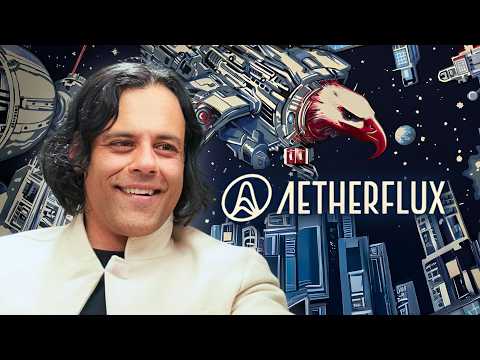
Why the Co-Founder of Robinhood is working on Space Datacenters | Baiju Bhatt, Aetherflux
Why the Co-Founder of Robinhood is working on Space Datacenters | Baiju Bhatt, Aetherflux
Summary
Baiju Bhatt, co-founder of Robinhood and founder of Aetherflux, sits down with Ti Morse to discuss his transition from building one of the most iconic fintech companies to launching a space energy startup. Baiju shares stories from rock climbing with Jared Leto, building a Shelby Daytona race car during COVID, and the creative processes that helped him think about merging form and function — from digital products to satellites.
The conversation dives deep into Aetherflux’s core mission: building a power grid in orbit. Baiju explains how the company evolved from space-based solar power beaming to the concept of orbital data centers, where GPUs could be placed directly next to solar panels in space, eliminating multiple conversion steps. He seeded the company with $10 million of his own money, booked a satellite ride share, and assembled a 30-35 person team. The hardware is scheduled to launch in summer 2026.
Throughout the interview, Baiju reflects on the parallels between his first and second company-building experiences, arguing that the second time is just as hard as the first. He discusses the importance of getting failures out of the way quickly, the story of building the pre-Robinhood app “Analyst” that failed before leading to the breakthrough simplicity of the stock trading app, and his philosophy of walking three steps down a path before deciding whether to continue or turn back.
Highlights
”Get Your Failures Out of the Way Quickly”
Clip command
yt-dlp --download-sections "*38:42-40:00" "https://www.youtube.com/watch?v=a7B2rgAOUkc" --force-keyframes-at-cuts --merge-output-format mp4 -o "a7B2rgAOUkc-38m42s.mp4"“Get your failures out of the way quickly. Don’t be too precious with the idea. Just try it. Even if the idea is not perfect, you’re going to learn way more by completing the loop.” — Baiju Bhatt, 38:42
”What If You Just Deleted All of It?”
Clip command
yt-dlp --download-sections "*28:16-29:20" "https://www.youtube.com/watch?v=a7B2rgAOUkc" --force-keyframes-at-cuts --merge-output-format mp4 -o "a7B2rgAOUkc-28m16s.mp4"“What if you just took the chips and moved them right next to the receiver? What if you put the solar panels and the GPUs on the backs of the solar panels? Why not just delete the laser entirely?” — Baiju Bhatt, 28:16
”The Pursuit Is the Joy”
Clip command
yt-dlp --download-sections "*63:06-64:10" "https://www.youtube.com/watch?v=a7B2rgAOUkc" --force-keyframes-at-cuts --merge-output-format mp4 -o "a7B2rgAOUkc-63m06s.mp4"“The real high about all of this was when I went from not knowing and being unsure of my ideas to knowing that my ideas were right. It’s not the IPO day. It’s the day seven years earlier when we made a breakthrough in the product.” — Baiju Bhatt, 63:06
”It’s Not Over Until I Win”
Clip command
yt-dlp --download-sections "*65:00-66:00" "https://www.youtube.com/watch?v=a7B2rgAOUkc" --force-keyframes-at-cuts --merge-output-format mp4 -o "a7B2rgAOUkc-65m00s.mp4"“When are we going to be eight years in on the brink of bankruptcy? When you get to that point and you get to the other side of it, it’s very difficult to stop you. I just declare to myself: it’s not over until I win.” — Baiju Bhatt, 65:00
”I Bought a Satellite with My Gold Card”
Clip command
yt-dlp --download-sections "*51:59-53:00" "https://www.youtube.com/watch?v=a7B2rgAOUkc" --force-keyframes-at-cuts --merge-output-format mp4 -o "a7B2rgAOUkc-51m59s.mp4"“I seeded the company with $10 million of my own. I used that money to hire a small team, book a ride share, buy a satellite. I put my deposit down with my Robinhood gold card.” — Baiju Bhatt, 51:59
Key Points
- Rock climbing with Jared Leto (0:05) - Baiju went on a Mediterranean rock climbing trip with Jared Leto, who was an early Robinhood investor, which inspired him to start working out with co-founder Vlad Tenev
- Culture differences: software vs hardware (5:46) - At Aetherflux there are far more specialized disciplines (embedded software, opto-mechanical, thermal engineering, laser physics) compared to Robinhood’s software-focused teams
- Fun drives creativity (7:30) - When people enjoy what they do, they share more ideas, including the “halfway formed ideas” that often lead to breakthroughs
- Building a Shelby Daytona during COVID (15:57) - Baiju built a race car from scratch in 6-9 months to exercise his creative energy outside of work and understand physical engineering
- Steve Jobs design philosophy applied to satellites (12:00) - Form should natively represent function; for satellites, the solar panels and heat dissipation should be combined into one structure
- Orbital data centers concept (28:16) - Rather than converting solar to electrical to laser to electrical on the ground, just put GPUs right next to the solar panels in space
- The Analyst app that became Robinhood (38:22) - They built an everything-finance app called “Analyst” first that failed, which taught them to make Robinhood extremely simple — just a “stock market button”
- Walking three steps down the maze (45:57) - Baiju’s approach to exploring ideas: walk three steps down a path, evaluate, and if it doesn’t feel right, turn around and try another direction
- Seeding with $10M of his own money (51:39) - He used personal funds to hire a team, book a rideshare launch, and buy a satellite within months of leaving Robinhood
- Willingness to be scrappy again (58:08) - The hardest unlearning was returning to startup scrappiness after years of running a mature company with tens of millions of users
- Second company is just as hard (1:08:26) - People leave, teams don’t fit, recruiting breaks down — these problems don’t evaporate with experience, they just feel less existential
- Magic the Gathering and entrepreneurship (1:12:16) - Playing Magic teaches comfort with failure and separating emotion from critical decision-making, similar to building companies
- Goblin mode vs monk mode (1:17:32) - Baiju prioritizes family time with his four sons and exercises daily, refusing to compromise on being home for dinner despite startup demands
- Running as a creativity accelerant (1:22:00) - Running forces a flow state where ideas “line up in a line” versus being “mushed together” during caffeinated desk work
Mentions
Companies
- Robinhood (0:05) - Baiju’s first company, co-founded with Vlad Tenev, democratizing stock market access
- Aetherflux (0:05) - Baiju’s new company building space-based power beaming and orbital data centers
- SpaceX (28:16) - Discussed as launch provider and comparison for building space companies
- Apple (12:00) - Referenced for design philosophy of removing indicators and merging form with function
- Apex (51:59) - Satellite bus manufacturer that Aetherflux purchased from
- 30 Seconds to Mars (4:30) - Jared Leto’s band, mentioned in context of his Renaissance man qualities
- Telegram (3:00) - Pavel Durov’s company, whose workout regimen Ti is emulating
- Factory 5 Racing (15:57) - Kit car company whose Shelby Daytona Baiju built
Products & Technologies
- Orbital data centers (28:16) - Concept of placing compute chips directly in orbit next to solar power
- Laser power beaming (28:16) - Beaming energy from space via lasers to ground receivers
- Photovoltaics (28:16) - Solar panel technology that makes space power generation feasible
- Robinhood Gold Card (51:59) - Credit card product Baiju designed before leaving Robinhood
People
- Baiju Bhatt (0:05) - Co-founder of Robinhood, founder of Aetherflux
- Vlad Tenev (0:05) - Co-founder of Robinhood, worked out with Baiju during COVID
- Jared Leto (0:05) - Actor, musician, and early Robinhood investor
- Steve Jobs (12:00) - Referenced for “design is how it works” philosophy
- Brian Chesky (12:00) - Airbnb CEO, referenced for design adoption philosophy
- Elon Musk (28:16) - Discussed for SpaceX cost reduction, space datacenter idea going viral on X
- Pavel Durov (3:00) - Telegram founder whose 100 pushups/100 situps routine Ti is following
- Jensen Huang (55:00) - NVIDIA CEO, referenced for Elon’s ability to call him directly for chips
- Jeff Bezos (1:20:00) - Referenced for “work-life harmony” concept and 10am meeting philosophy
- Sam Altman (1:10:00) - Referenced for observation that existential crises feel less scary after surviving several
- Joe Yaffy (58:08) - Aetherflux’s new CLO and COO, bringing regulatory expertise
- Brian Armstrong (38:22) - Referenced for “action produces information” quote
Surprising Quotes
“I seeded the company with $10 million of my own and used that money to hire a small team, book a ride share, buy a satellite. I put my deposit down with my Robinhood gold card.” — 51:59
“It’s kind of like being on a pirate ship. It’s just a very small crew and everyone’s rowing in the same direction.” — 28:30
“I would like to have several meaningful chapters in my life… the first 22 years was math, physics, or I didn’t give a shit.” — 1:05:00
“The universe gives you creative ideas kind of at its own pace. The universe has its own clock where it will give you a creative idea when it so deems that you deserve said creative idea.” — 1:22:30
“If you’re not breaking the laws of man and you’re not breaking the laws of physics, there will be a path.” — 1:10:00
Transcript
0:00 Today I have the pleasure of sitting down with Baiju Bhatt who is the co-founder of Robinhood and the founder of Aetherflux. You just were mentioning you basically did a rock climbing trip with Jared Leto. I did. Let’s start with that.
0:12 I was in the Mediterranean on this boat with Jared Leto and a couple of his rock climbing friends. Jared’s a good friend of mine, was a very early investor in Robinhood, and I would say maybe my hair idol. Do you have one of those? He’s a handsome dude, man. So he invites me on this trip with a handful of people to go in the Mediterranean for a couple days and it’s with a bunch of rock climbing friends of his, like the dudes that pioneered deep sea free soloing.
0:44 So I go to this and I’m an entrepreneur, right? Like I work out, but it’s not the alpha and the omega of my life. And I go to this trip with these guys and I’m just like, you know what? I’m a fat piece of shit. I was on full display because I’m around all these beautiful rock climbers and not only am I not good at rock climbing, but I’m also not good to look at when I don’t have my shirt on. I was like, I got to do something about this.
1:22 So I come back and I’m like, I’m going to get a trainer. And I convinced Vlad also that we should start working out together. So we had this trainer together in 2019 working out together. This guy was hardcore and he was French and he would yell at us and be like, “You guys are pieces of shit! You work out harder.” So all the workouts were really hard.
1:55 So working out with this guy, then COVID happens, which was wild. But our workouts, we keep working out and we’re working out digitally. We’re doing a video chat with this guy over Zoom and the two of us are in our respective houses working out. Long story short, I was doing a workout, basically doing bench press with free weights, felt a little tickle in my nose, tried to go for one of these numbers and the weight starts falling backwards. I stabilize it but shoulder was messed up after that.
2:45 And mind you, this is in COVID and so what are you going to do? Go to the doctor? No. So I just put my arm in a sling for a while. All this to say, that was kind of a bummer because I stopped being able to do push-ups. Basically, Pavel Durov, who’s the founder of Telegram, has a training regimen where he does 100 push-ups and 100 sit-ups every single day. And so before I can interview him, I am going to do 100 and 100 every day for 30 days straight with no interruptions.
3:50 Do you have any other crazy stories like that? You said Jared Leto was one of the first investors in Robinhood. Yeah, he’s a really very intelligent human being and also in my experience like a modern Renaissance man. He has 30 Seconds to Mars. He’s an actor. He’s a very active tech investor. He’s a very cerebral dude. A little bit similar to the Chainsmokers where they started in music and want to now invest in a bunch of startups.
4:40 Anyway, all this to say, I ended up hurting my shoulder from that and I was out of the game for a while. After COVID, got my shoulder checked out, realized nothing was actually wrong with it. I just needed to work out more. And I’m back in the same boat right now actually. I started doing boxing like maybe a year and a half, two years ago and it has wrecked my shoulders, man. When you’re boxing, you’re compressing your shoulder the whole time.
5:46 Let’s jump to company culture. Most of the people I’ve interviewed have only been working on a hard tech company, but you’ve actually had this full transition from starting in software, building up that culture to many thousands of people and suddenly now you’re jumping to a hardware startup. What’s the difference?
6:10 Yeah, I think the biggest thing is there’s a lot more distinct disciplines here. In building a software company, Robinhood, the core kinds of people were front-end engineers, mobile engineers, backend software engineers, database engineers, DevOps, compliance and regulatory people, legal people. And for us, a big focus was on design and product design with people doing visual design, brand design, but also research — professional behavioral researchers.
7:00 On the engineering side, it’s different here because there’s more specialization. There’s embedded software engineering, opto-mechanical engineering, there’s a thermal engineer sitting right behind you. You have people from mechanical backgrounds, electrical backgrounds, computer science backgrounds, and then laser people, optics people which are sometimes also mechanical people. So there’s a lot more different kinds of engineering.
7:30 In terms of culture and the operating system for the company, one of the things I’ve found universally true is when people are having fun, when people are legitimately enjoying themselves, they will go above and beyond. Not only that, but people tend to be more creative. If you’re in a fear state, your creativity shrinks way down. If you’re calm and comfortable and happy, your mind flows in a whole bunch of different ways.
8:15 When people are having a good time and enjoying what they’re doing, you tend to get more ideas out of people. You get the quiet people to speak up a little bit more. You get people to actually vocalize the halfway formed ideas. Those are ideas where it’s like, “I don’t know if this is a good idea or not.” They’re taking risk by sharing it. And it’s basically lowering the barrier for them to feel like they can.
9:30 I don’t think this is something that people typically come into when they’re joining a new company. You kind of got to feel out how we operate in this new environment. It takes a while for people — every person that I’ve brought on, they have the ability to have great ideas for improving things, but you kind of got to draw it out at least a couple times prior to them naturally offering them up.
10:30 Steve Jobs had this line and I think Brian Chesky has really adopted this as well where the design is not only how something looks but also how it functions. You want something that’s great, super usable, but also beautiful and delightful. How do you kind of take that same philosophy to a satellite?
11:00 I read the Walter Isaacson book on Steve Jobs years ago, super inspirational. Steve Jobs undeniably through coming up was my idol. I absolutely idolized that guy and I tried to embody as much of his approach to design as I could. In the world of software and how it extends to hardware, it’s about form and function. Does the form of the thing natively represent the function? Is the function fundamentally simple and does the form communicate that simplicity?
12:00 The example that comes to my mind is like a laptop. Is it on or off? How do you communicate that? Apple thought about this a lot. There was a real allergy to indicators, a little light that always says it’s on. No, you should actually have the form represent the function which is that it’s natively on unless you actively turn it off. They’re doing that now, trying to have it always on. There isn’t an on/off button.
13:00 What does that mean for satellite hardware? You’ve got a job that the thing needs to do and you want the form to natively represent the function. We’ve been designing payloads that go on other people’s satellite buses. But as we get to designing entire satellites and constellations, the jobs that the thing has to do will very natively define the way it looks and feels.
14:00 In the context of laser power beaming, the biggest things in the satellite are going to be the power generation and the heat dissipation. So how can you natively combine those things? Ideas we’ve played around with: can you localize the power generation and the heat dissipation? Can the solar panel both dissipate heat while also collecting? Can you get the actual diodes that go from electrical to optical to reject the heat and leverage the surface area?
15:30 Do you have a specific feeling whenever you see something beautiful that just looks right? Yeah, there’s definitely the thing you strive for. When you look at something and you ask, “How could it possibly look any other way?” Like this just looks final. It looks like the last and final version of the thing.
15:57 Has your taste evolved over time? I have been drawn towards expressing that in other things. A lot of the first 10 years of the design language of Robinhood was something I was leading and at the forefront of. But my brain was like, can I apply this same lens to building hardware? My original version of this was actually I built a car in my spare time.
16:30 I built a Shelby Daytona, like a Factory 5 Racing. I built one of those from scratch. Had a lot of help along the way and had some pro mechanics look over and make sure everything worked correctly before I took it on the road. I did this over COVID. I was feeling the itch to express this creativity onto something that’s not software.
17:20 I’ve always found that in order to be creative at the main thing, I need to have a hobby or a creative outlet that’s not related to the thing I’m doing. Which stems from the idea of, what is creativity? Creativity is about taking unrelated ideas and seeing the commonality in them. Marrying them together.
18:00 That drew me towards wanting to build physical things. I know how to build digital things. What’s a physical thing I’ve always wanted to build? I’ve always loved cars. My little creator brain was like, I’ll build a car from scratch and then I’ll understand how all the different pieces work. So that then if I want to get into classic cars, I’ll really understand what’s going on. It took probably six to nine months to go from box of parts to something that drives.
19:30 Here’s how it started. Literally as a box in a truck. And that’s the full car but in box form. Got the first version, put all the pieces together on the frame. That didn’t take more than a couple weeks. Here’s the finished version. I didn’t paint the thing. I didn’t do any of the upholstery. You want to have somebody that’s done it a bunch of times for the artistry. There’s an old design word called fingerspitzengefuhl, the finger feel.
21:00 What held you back from starting this 5 or 10 years earlier? The 5 to 10 years leading up to it, I had been very busy. The impetus was I was cramped up in my house during COVID, working 12-hour days week after week. I need an outlet, something that’s not just work where I can still let that creative, almost frenetic energy from my monkey brain project somewhere else.
22:00 Also, let’s be real — 10 years before, I was dead broke. The idea of building a car for fun is like, I have this car that I drive that’s kind of broken and I can’t really afford to fix it.
22:30 I’m always interested in what made people fundamentally shift what they were doing. For a long time you’re building something up in your mind and then there’s some domino that knocks over. Like why did I not start a podcast six months earlier? Well, the answer was I actually did start a podcast six months earlier and no one said yes to an interview. So I just did it myself — I researched founders and did like a Founders Podcast episode on them.
23:44 The meme of founder hair patterns at different stages: Seed stage, you’ve got a full head of hair. Series A, starting to go a little bald. Series B, it’s a big old donut hole. Series C, there’s nothing there. And then pre-IPO, all of a sudden there’s a full head of hair. Post IPO, full head of hair again.
25:00 There’s been these different evolutions of SpaceX. First Elon wanted to do the first greenhouse on Mars, then he tried to buy rockets and couldn’t, so he decided to build them himself. I was watching this interview with Elon where someone brought up the space data center thing and they were like, “How did you come up with this?” And he’s like, “It went viral on Twitter.” I was like, seriously? Is this how you came up with the idea?
26:30 Is it a similar thing with you where you start out with collecting energy in orbit and beaming it down to Earth, and then suddenly because you have all this engineering know-how, you can expand into other areas? I think we’re in the early stages. We’re about 30-35 people just hustling. It’s kind of like being on a pirate ship. Everyone’s rowing in the same direction.
27:30 I haven’t been doing this for terribly long, a little less than two years full-time. My intuition for how these things work is developing, which is very fun because I’ve experienced what it feels like to go from searching and striving to demonstrating understanding to then being at the forefront.
28:16 We have recently announced that we’re pursuing orbital data centers as well. My idea when I started Aetherflux was there’s going to be an energy company that needs to be built in space. If you imagine low Earth orbit as a platform for commerce, what are the verticals? It’s Earth imaging, defense, telecommunications, and internet. But there will be other industries that natively exist.
30:00 The light bulb went off — we’re like, actually, what if you just took the chips rather than collecting the power in space, converting solar to electrical, electrical to laser, then pointing laser down and reconverting to electrical? What if you just deleted all of it? What if you put the solar panels and the GPUs on the backs of the solar panels?
31:00 As I started thinking about the thermodynamics, the radiation shielding, it became clear that it was going to be hard, but there weren’t any obvious showstoppers. By actually putting the thing consuming the power right next to the power generation, it’s actually kind of a magical architecture. The time it takes to bring a new data center online is 5 to 8 years. This has the potential to be a massive accelerant.
32:30 Imagine a factory where a truck full of chips comes in on one side. Takes a couple of months to integrate them with solar panels, build satellites out of them, build stacks of these things, rent a Falcon and ship them up. As soon as they’re in orbit, they’re effectively online. And then you network them together with lasers.
34:00 One of the biggest critiques was having a massive mega structure in space where slight variations could destroy the entire thing. If you just have small satellites all networked together with lasers, there’s not really any issue. I would love to live in a world where these massive mega structures exist in space. There’s probably a way of engineering them. It’s just not terribly economically feasible in 2026.
36:00 Space-based solar power, collecting power in space and beaming it down, this is a 1970s idea. People assumed this was the future and then nobody actually did it. The original idea didn’t work unless you had a really big satellite, the size of a kilometer or multiple kilometers, because of diffraction-limited optics. Nobody’s done that. That doesn’t exist.
37:30 I asked the question: what is the straight line, shortest time period path to realizing this idea? Could you do this with a small satellite? The number we came up with was about a kilowatt of power out of the satellite. That’s what we declare as power beaming — that’s an energy application, not just data beaming. Could you do it in two years? Yeah. So let’s just go and do that.
38:22 My philosophy is get your failures out of the way quickly. A lot of people don’t know that Robinhood as you see it today was not the first app we built. We built an app before that called Analyst which we then renamed to Robinhood. We released it on the App Store in 2013. We announced it and got some people to use it and I remember seeing the usage asymptote to a non-zero number and we’re like, that was wrong.
40:00 The learning was the way people think about apps on their phones is they think about them as functional buttons. This is the map button. This is the calculator button. This is the weather button. So the button was: this is the stock market button. This is the button I press when I want to buy stocks. If that’s what you’re trying to do, just do that.
41:30 The earliest versions of Robinhood was this incredibly reductive take. It was your account value at the top, a spark line, and a list of the stocks you owned or were following. Nothing else. We put all the other functionality behind the hamburger button that leads to the basement. But the 80% use case, the form should match that function.
43:00 If you’re doing something for the first time, don’t be too precious with the idea. Just see the idea through to completion. By doing so, you’re so much more likely to figure out what the actual thing that has a really important impact is that you would have never gotten to if you didn’t just knucklehead your way through the first thing.
44:00 As soon as you have an idea, you’re automatically saying this is probably wrong, but I’m going to run with it. The way I think about it is I try to walk three steps down the path and then see how I’m feeling. If I like the thing, great. If I don’t, I just turn around, come back, walk another three steps in another direction. It’s honestly a little bit like a maze.
45:57 How do you think about when you’re going down through this maze with hardware where iteration loops are way longer? If your thing is a contract with the government, that might take multiple years just to have the first thing you can tell them about. Then it might be two or three more years before you actually have something. That’s six years.
47:00 The hardware behind you is scheduled to go up sometime this summer and I left Robinhood full-time like February, March of 2024. It’ll be 2 years and 3 months. One thing I’ve talked with space founders about is you’re constrained by SpaceX’s ability to ship launches. The timeline is a year plus out. You have to commit to SpaceX, then make sure you hit that timeline because the rocket’s going up with or without your payload.
49:00 Which is exactly what we did when I started the company. I was like, I’m willing to spend a little bit of money to put this on an accelerated timeline. Elon in the early days of SpaceX had this mental model that every day in the future they’d be generating something like $10 million of revenue. Every day they delayed was a lost day of $10 million.
51:39 I seeded the company with $10 million of my own and used that money to hire a small team, book a ride share, buy a satellite. When we first put the purchase order for the satellite in was right after I left Robinhood. I put my deposit down with my gold card. It’s a really goofy picture of me holding this with the founders of Apex being like, “Yeah, I just bought a satellite, guys.”
53:00 With Elon and xAI, he’s able to just talk with Jensen, call him and say we need this. Have you been able to accelerate anything because of those relationships? I have not called up Jensen. If you’re watching Jensen, we should chat. I think our ability to do this benefits from the fact that this is not my first startup. There’s a level of people I’ve already met, the know-how of how to actually build a company.
55:00 No investors, right? Having intuition for how to spend money. Intuitively asking: is it okay if we run a little rich on this? Should we run cheap on these other things? There’s not a book you can read. I’ve done it before and I have the muscle memory.
58:08 Is there anything you had to unlearn? Yeah, the willingness to be scrappy again. The last 10 to 15 years, I go from Robinhood as this twinkle in our eyes to a thing that was very big, managing a hugely important amount of resources and money for the American people, tens of millions of users. The way you operate with tens of millions of people is decidedly more mature.
60:00 This is not mature. It’s an idea that’s sprouting out of the ground. What are the things you want to get really right? We announced that Joe Yaffy joined as both our chief legal officer and chief operating officer. We’re entering a space where we’re beaming power down from space. Doing this in a regulatory forward way from day one. One of our first hires was our laser safety officer.
62:00 If you look at Elon’s companies, SpaceX fires on all cylinders now, but at year eight it’s going bankrupt. Tesla at year eight, going bankrupt. If you look at Neuralink, they took 10 years to get to human trials. If you start a company and it’s successful, it’s like planting one seed, watering it, and eventually you have this big farm. Then you go start a new company in a different industry and you’re back to planting just one seed.
63:06 For a long time, you have this mission of democratizing finance. Have you gotten joy in recreating a new narrative? Yeah, it’s really fun. I would like to have several meaningful chapters in my life. The chapter before was growing up in Alabama and Virginia, pulling myself up out of poverty, willing myself to go to a really good school to pursue physics and math.
65:00 You get to some point of third party validated success and you’re like, man, I had so much fun getting here. The pursuit of it is the joy. The real high was when I went from not knowing and being unsure of my ideas to knowing that my ideas were right. It’s not the IPO day. It’s the day seven years earlier when we made a breakthrough in the product.
67:00 If you had to think forward 12 or 24 months and everything goes right, what would you like to see? I think that’s very dangerous thinking. I don’t think everything’s going to go right. I actually am much more of the opinion: when is it going to suck? When are we going to be eight years in on the brink of bankruptcy? When you get to that point and get to the other side, it’s very difficult to stop you.
1:08:26 You mentioned the second company is just as hard as the first. Starting a company at a small stage is full of stuff not working. You hire a person to do a function, that person is good and they up and leave. You’re back to square one. You hire a team and some people aren’t the right fit, you get rid of them, not enough people again. These problems are just like they were 10, 15 years ago. But the difference is the first time around, these would feel existential. This time I’m like, nah, I’ll figure it out.
1:10:00 Sam Altman talks about this — the first time you experience an existential event, the world’s falling apart. But by the sixth or seventh time, it’s like, well, we survived the first six. The mental model is: control the things you can control, put one foot in front of the other. If you’re not breaking the laws of man and you’re not breaking the laws of physics, there will be a path.
1:12:16 I love Magic the Gathering. It reminds me of my childhood. I love the artwork, especially the old cards. I grew up pretty poor so I didn’t have the collection I do now. I rediscovered it in 2015 or 2016 walking around Berkeley. Walked into a game store and was like, I remember these things. It gave me that feeling of awe and wonder as a kid.
1:14:00 It’s an hour of you and another person engaging in an intellectual way and your phones are nowhere to be found. The game was made by a combinatorial mathematician. The best people have win rates of like 65-70% against other really good people. A part of being successful is being comfortable failing. When you play Magic with decent people, you’ll lose games pretty often. How do you respond to losing? You just move on to the next one.
1:17:32 Some founders go into goblin mode for years, completely locked in to the detriment of family, relationships, or health. But eventually to stay in the game, you have to prioritize other things. It’s very different for me now. I have a family, three boys and another on the way, soon to be father of four. I love them more than I knew I had the capacity for love.
1:19:00 Tonight there’s a meeting at 5:30 but I want to go home because I want to exercise from 5:30 to 6:30, then dinner with my family, then hang out with my kids from 7 to 8 before they go to sleep. I’m not going to compromise on that. Rewind 10 years ago, I was in the office most days until 9:00.
1:20:30 Jeff Bezos’s idea of work-life harmony where the energy from work comes home with the same vibe. Executives are basically paid to have a few right decisions every year. Warren Buffett would say almost all of Berkshire’s growth has been related to maybe 15 decisions over the last 60 or 70 years.
1:21:30 Do you ever hold off on big decisions until the next morning? I do that all the time. You can just sleep on it. My brain knows how to operate in the pre-phone era. Just because you have the buttons you could press to do it right now doesn’t mean you have to do it right now. Slow form thinking is important.
1:23:00 I’ve never found it possible to sit down with a sheet of paper and be like, “Now I’m going to be creative.” You’re just out for a walk and something pops into your head. The universe gives you creative ideas at its own pace. You need to be open to receiving them but you can’t really force them. Running is a massive accelerant on creativity because it forces a flow state where ideas line up in a line.
1:24:30 Let’s end on the hardest thing you’ve overcome. Being overweight. I was very overweight as a kid. When I was in 10th grade, I got teased for my weight and took it super personally. I weighed about 210 as a kid and got all the way down to like 140, into the high 130s.