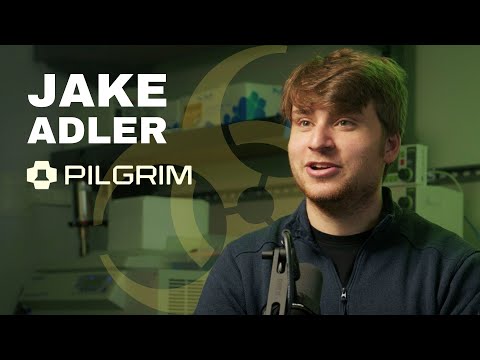
#41 - Building The First Biotech Prime | Jake Adler, CEO Pilgrim
#41 - Building The First Biotech Prime | Jake Adler, CEO Pilgrim
Summary
Jake Adler, founder and CEO of Pilgrim, sits down with Ti Morse for a wide-ranging conversation about building “the first biotech prime” — a company that aims to consolidate and modernize the biodefense and medical countermeasures supply chain for the US Department of Defense. Jake explains that before enhancing warfighter capabilities (“super soldiers”), Pilgrim first wants to restore and protect existing capabilities, addressing the shift from counterinsurgency operations to great power competition where medical evacuation is far more challenging.
The conversation covers a fascinating tour through military medical history and biotechnology, from tourniquets that haven’t fundamentally changed since Alexander the Great, to the invention of QuikClot, electronic tourniquets, and the current state of detecting viruses in the air. Jake discusses real biosecurity threats including H5N1 bird flu, the 2001 anthrax attacks, tick-borne Lyme disease as a potential biological weapon, and the controversial history of the US giving the smallpox virus to Russia. He also explores how SSRIs work, the potential of auto-injectors to enable extreme physical performance, and military experiments with tear gas exposure.
In the second half, Jake dives into biosurveillance — the technology for detecting biological threats in real-time. He describes Pilgrim’s work building a “real-time plague map” and discusses the uncomfortable reality of what a “super terrorist” could do with bioweapons. The interview concludes with a discussion of DOD procurement challenges, the history of Nazi and Chinese bioweapons labs, and the hardest things Jake has overcome in building a company at the intersection of biotech and defense.
Highlights
”What If You Were a Super Terrorist?”
Clip command
yt-dlp --download-sections "*75:45-76:55" "https://www.youtube.com/watch?v=Vxj41-p8xyo" --force-keyframes-at-cuts --merge-output-format mp4 -o "Vxj41-p8xyo-75m45s.mp4"“If you wanted to be a super terrorist, what are the things that you would do? If you generally know your way around a lab, it’s really not that tricky to encapsulate the purified virus. You could have a terrorist walk into JFK airport carrying a little tube of Ebola, spread it across the handles in all the major bathrooms. You would never know that it was him.” — Jake Adler, 1:15:45
”Tourniquets Since Alexander the Great”
Clip command
yt-dlp --download-sections "*5:46-6:55" "https://www.youtube.com/watch?v=Vxj41-p8xyo" --force-keyframes-at-cuts --merge-output-format mp4 -o "Vxj41-p8xyo-5m46s.mp4"“The tourniquet as a concept hasn’t fundamentally changed since Alexander the Great. We’re still wrapping something tightly around a limb to cut off blood flow. That’s insane. Three thousand years and the basic idea is the same.” — Jake Adler, 5:46
”Running a Marathon with No Training Using Auto-Injectors”
Clip command
yt-dlp --download-sections "*40:23-41:30" "https://www.youtube.com/watch?v=Vxj41-p8xyo" --force-keyframes-at-cuts --merge-output-format mp4 -o "Vxj41-p8xyo-40m23s.mp4"“Using auto-injectors to run a marathon with no training — the idea that you could pharmacologically enhance physical performance to the point where an untrained person could complete extreme endurance events. The military has been researching this for decades.” — Jake Adler, 40:23
”The DOD Doesn’t Buy the Best Technology”
Clip command
yt-dlp --download-sections "*84:27-85:35" "https://www.youtube.com/watch?v=Vxj41-p8xyo" --force-keyframes-at-cuts --merge-output-format mp4 -o "Vxj41-p8xyo-84m27s.mp4"“The DOD doesn’t buy the best technology. They buy the best positioned solution. You can have the most advanced technology in the world, but if you don’t understand the procurement process, if you don’t have the right relationships, if you don’t speak the language, you will lose to an inferior product every single time.” — Jake Adler, 1:24:27
”Sleeping 2 Hours”
Clip command
yt-dlp --download-sections "*47:23-48:30" "https://www.youtube.com/watch?v=Vxj41-p8xyo" --force-keyframes-at-cuts --merge-output-format mp4 -o "Vxj41-p8xyo-47m23s.mp4"“There are military programs researching whether you can maintain cognitive and physical performance on 2 hours of sleep. The combination of specific pharmacological compounds and training protocols can supposedly compress the sleep requirement dramatically.” — Jake Adler, 47:23
Key Points
- Super soldiers start with restoring, not enhancing (0:51) - Before enhancing warfighter capabilities, Pilgrim focuses on restoring wounded fighters and protecting existing capabilities
- Kingsfoil product (3:09) - Pilgrim’s battlefield medical product named after the healing plant in Lord of the Rings
- Tourniquets unchanged since antiquity (5:46) - The fundamental concept of cutting off blood flow to a limb hasn’t changed in 3,000 years
- Invention of QuikClot (8:52) - The story of how zeolite-based hemostatic agents were developed for battlefield use
- Electronic tourniquets (15:47) - Next-generation tourniquets that can precisely control pressure and blood flow
- Medical device development challenges (17:37) - The unique challenges of developing medical devices for battlefield use vs civilian applications
- Detecting viruses in the air (21:58) - Current technology for real-time airborne pathogen detection
- H5N1 bird flu threat (25:36) - The ongoing concern about avian influenza and pandemic preparedness
- 2001 anthrax attacks (27:02) - After 9/11, reporters and politicians received letters containing anthrax powder, revealing vulnerabilities in biodefense
- Tick-borne Lyme disease as bioweapon (29:49) - The controversial theory about weaponized tick-borne diseases
- Giving smallpox virus to Russia (32:03) - The disturbing history of exchanging dangerous pathogen samples between superpowers
- How SSRIs work (38:00) - Explanation of selective serotonin reuptake inhibitors and their mechanism of action
- Auto-injectors for extreme performance (40:23) - Using pharmacological compounds to enable extreme physical feats without training
- Mop suits and tear gas training (43:43) - Military exposure training where soldiers are put in gas chambers wearing protective suits
- Sleep compression to 2 hours (47:23) - Military research into dramatically reducing sleep requirements while maintaining performance
- Trying to become less human (53:28) - The ethical implications of pushing human performance beyond natural limits
- Real-time plague map (1:08:55) - Pilgrim’s work building a real-time biosurveillance system that maps biological threats globally
- DOD procurement realities (1:24:27) - The military doesn’t buy the best technology, they buy the best positioned solution
- Blood boys and parabiosis (1:27:55) - Why young blood transfusions aren’t more widespread despite the science
- Full liquid diet and Soylent (1:35:36) - Jake’s experience with meal replacement and extreme dietary optimization
- Amphetamines, modafinil, and caffeine (1:38:36) - Military use of stimulants for performance enhancement and their comparative effects
- Building a biotech prime (1:45:20) - Jake’s vision of consolidating the fragmented biodefense supply chain into a single “prime contractor” for biotech
- Nazi labs during WWII and China today (1:49:40) - Historical parallels between WWII biological weapons programs and modern concerns about Chinese bioweapons research
Mentions
Companies
- Pilgrim (0:00) - Jake’s company building the first biotech prime contractor for defense
- Department of Homeland Security (27:02) - Federal agency responsible for biodefense policy, mentioned for their deliberate choice about what biodetection systems detect
- Department of Defense (1:24:27) - Primary customer for Pilgrim’s products and services
Products & Technologies
- Kingsfoil (3:09) - Pilgrim’s battlefield medical product
- QuikClot (8:52) - Zeolite-based hemostatic agent for battlefield wound treatment
- BioWatch (27:02) - Federal biodetection system that only detects threats with known countermeasures, by design
- Auto-injectors (40:23) - Drug delivery devices for rapid pharmacological enhancement
- Modafinil (1:38:36) - Wakefulness-promoting drug used by military for extended operations
- Soylent (1:35:36) - Meal replacement product discussed in context of extreme dietary optimization
- MOPP suit (43:43) - Military protective suit for chemical/biological environments
People
- Jake Adler (0:00) - Founder and CEO of Pilgrim
Surprising Quotes
“If you wanted to be a super terrorist, what are the things you would do? You could have a terrorist walk into JFK airport carrying a little tube of Ebola, spread it across the handles in all the major bathrooms. You would never know it was him.” — 1:15:45
“The federal government — specifically the Department of Homeland Security — policy is that BioWatch does exactly what it was intended to do, which is detect the threats that we know how to counter. It doesn’t detect the things that we don’t have counters for. On purpose.” — 27:02
“The tourniquet as a concept hasn’t fundamentally changed since Alexander the Great. Three thousand years and the basic idea is the same.” — 5:46
“The DOD doesn’t buy the best technology. They buy the best positioned solution. You can have the most advanced technology in the world, but if you don’t understand the procurement process, you will lose to an inferior product every single time.” — 1:24:27
“In 2001 after the 9/11 attacks, there were reporters and politicians who received letters in the mail. When they opened them, there was this dry powder. What they realized is that powder was actually anthrax.” — 27:02
Transcript
0:00 If you wanted to be a super terrorist, what are the things that you would do? Generally, when we’re talking about bioweapons, the reputation is “a poor man’s nuke.” If you generally know your way around a lab, it’s really not that tricky to encapsulate the purified virus. Or just to spread the purified virus. You could have a terrorist walk into JFK airport carrying a little tube of Ebola, spread it across the handles in all the major bathrooms. You would never know that it was him.
0:40 In 2001 after the 9/11 attacks, there were a couple reporters, journalists, and politicians who received letters in the mail. In the letters, when they opened them, there was this dry powder. What they realized is that powder was actually anthrax. The federal government, specifically the Department of Homeland Security, policy is that BioWatch does exactly what it was intended to do, which is detect the threats that we know how to counter. It doesn’t detect the things that we don’t have counters for. Exactly. On purpose. On purpose.
0:51 Today I’m super excited to interview Jake Adler, the founder of Pilgrim. Jake, when are we going to get the first super soldier? So it’s one of those things where I’ve really believed since the creation of Pilgrim, but even before that, before we can go about enhancing warfighter capabilities, we want to first opt to restore.
1:30 As we look at the battlefield, we’re kind of moving away from this world that we saw in the global war on terror. In Afghanistan and Iraq, we had counterinsurgency operations where warfighters were deployed into environments that were readily accessible. We could easily evacuate them and bring them to military treatment facilities or proper therapeutics.
2:15 We’re moving to a world where warfighters are going to be deployed into environments where casualty evacuation is going to be extremely difficult. Think about great power competition — the Pacific theater, where you might be on an island or a ship and it could be days before you can get to proper medical care. That completely changes what you need in the field.
3:09 Kingsfoil is one of our key products. The name comes from Lord of the Rings — it’s the plant that Aragorn uses to heal Frodo. We wanted a name that captured the idea of battlefield healing. The product is designed to stabilize wounded warfighters in environments where evacuation isn’t possible for extended periods.
5:46 The tourniquet as a concept hasn’t fundamentally changed since Alexander the Great. We’re still wrapping something tightly around a limb to cut off blood flow. That’s insane. Three thousand years of human civilization, medical revolutions, and the basic idea is the same. The materials have gotten better, the design has been refined, but the core concept is identical.
8:52 The invention of QuikClot was a breakthrough in battlefield medicine. It uses zeolite minerals that rapidly absorb water from blood, concentrating clotting factors and causing near-instant hemostasis. The original version generated significant heat, which could cause burns. Newer formulations use kaolin clay which works without the exothermic reaction. It’s saved thousands of lives in Iraq and Afghanistan.
15:47 Electronic tourniquets represent the next generation. Instead of a manual strap that a wounded soldier has to tighten with one hand, electronic tourniquets can automatically inflate to the precise pressure needed. They can also modulate pressure over time to prevent tissue damage while maintaining hemorrhage control. Some prototypes can be activated by voice command.
17:37 Developing medical devices for battlefield use is fundamentally different from civilian medical devices. The FDA approval process is designed for controlled hospital environments. Battlefield devices need to work in extreme temperatures, dust, water, shock. They need to be operable by someone with minimal training, under extreme stress, possibly with one hand, in the dark.
21:58 Detecting viruses in the air is one of the most important and underappreciated challenges in biosecurity. Current technology can detect known pathogens, but the real threat is novel or engineered agents. We’re working on systems that can detect anomalous biological signatures — essentially, “something is here that shouldn’t be” — even if we don’t know exactly what it is.
25:36 H5N1 bird flu is a legitimate concern. It has a case fatality rate of about 60% in humans, compared to about 0.1% for seasonal flu. The reason it hasn’t caused a pandemic is that it doesn’t transmit efficiently between humans — yet. If it acquires that capability through mutation or reassortment, we could be looking at something far worse than COVID.
27:02 The 2001 anthrax attacks happened right after 9/11. Several journalists and politicians received letters containing weaponized anthrax powder. Five people died. It revealed massive gaps in our biodefense infrastructure. What’s really disturbing is the BioWatch program — the federal government’s biodetection network — is designed to only detect threats we have countermeasures for. It deliberately doesn’t detect things we can’t counter. The policy is that there’s no point in detecting something you can’t treat.
29:49 The tick-borne Lyme disease theory is fascinating and controversial. There’s evidence that suggests Lyme disease may have been originally studied as a potential biological weapon at facilities like Plum Island. Whether that’s true or not, tick-borne diseases in general represent an underappreciated bioweapon vector. Ticks are easy to breed, hard to detect, and the diseases they carry can be debilitating.
32:03 The history of giving the smallpox virus to Russia is one of those Cold War stories that seems unbelievable. Through various scientific exchanges, samples of dangerous pathogens were shared between the US and USSR. After the Soviet Union collapsed, we learned that they had used some of these samples to develop biological weapons in programs far larger than anyone in the West suspected.
38:00 How SSRIs work is actually pretty straightforward. Serotonin is a neurotransmitter that regulates mood, sleep, and appetite. When a neuron releases serotonin, the receiving neuron absorbs some and the sending neuron reabsorbs the rest through a process called reuptake. SSRIs block that reuptake, so more serotonin stays in the synapse, amplifying its effects. The military is interested in these mechanisms not just for treating depression but for enhancing resilience under stress.
40:23 Using auto-injectors to run a marathon with no training sounds like science fiction, but the military has been researching pharmacological performance enhancement for decades. Certain combinations of stimulants, anti-inflammatory compounds, and pain blockers could theoretically allow an untrained person to complete extreme physical tasks. The question is whether the long-term health consequences are acceptable.
43:43 The MOPP suit experience is something every service member goes through. They put you in full chemical protective gear and then expose you to CS gas — essentially tear gas. You have to enter a room full of it, remove your mask, state your name and rank, and then put the mask back on. It’s horrible. Your eyes burn, your lungs burn, snot is pouring out of your face. But the purpose is to build confidence in your equipment and train you to function under chemical attack.
47:23 The idea of sleeping only 2 hours and maintaining performance is actively being researched. There are military programs studying whether specific combinations of pharmacological compounds, sleep timing protocols, and environmental controls can compress the sleep requirement to 2-3 hours without cognitive degradation. Modafinil is part of this research, but there are newer compounds in development.
53:28 Trying to become less human is an interesting way to frame it. When you start stacking performance enhancements — sleep reduction, pain suppression, endurance boosting, cognitive enhancement — at what point are you no longer enhancing a human but creating something different? The ethical questions are profound and the military, to their credit, takes them seriously.
56:19 Biosurveillance is the backbone of everything we do at Pilgrim. The ability to detect biological threats in real-time, before they become pandemics, is arguably the most important technological challenge of our generation. COVID showed what happens when you detect too late. We’re building systems that can detect early enough to actually prevent the spread.
1:08:55 Building a real-time plague map is one of our most ambitious projects. Imagine a global dashboard that shows you, in real-time, where biological threats are emerging. Not just known diseases, but novel agents. We’re combining sensor data, hospital reporting, social media signals, animal health data, and satellite imagery to create a comprehensive picture of global biological risk.
1:15:45 If you wanted to be a super terrorist, what would you do? Generally, bioweapons are called “a poor man’s nuke.” If you know your way around a lab, it’s not that tricky to work with purified viruses. You could walk into a major airport with a small container, spread it on high-touch surfaces in bathrooms, and no one would ever know who did it. The attack wouldn’t be detected for days, by which time thousands of people would have traveled to every continent.
1:24:27 The DOD doesn’t buy the best technology. They buy the best positioned solution. This is something every defense startup needs to understand. You can have the most advanced technology in the world, but if you don’t understand the procurement process, if you don’t have the right relationships, if you don’t speak the language, you will lose to an inferior product every single time. Positioning and relationships matter more than technology.
1:27:55 Why doesn’t everyone have a “blood boy”? Parabiosis — the transfusion of young blood — has shown remarkable rejuvenating effects in animal studies. The challenge is regulatory, ethical, and logistical. You can’t just set up a blood transfusion service for rich people who want to live longer. But the science is real, and there are companies working on isolating the specific factors in young blood that provide the benefit.
1:35:36 I went on a full liquid diet for about six months. Soylent and similar products. The idea was to eliminate the decision fatigue and time associated with eating. It worked to a degree — I had more time and mental energy. But the social isolation was brutal. Meals are social events. When you stop eating with people, you lose a huge amount of human connection.
1:38:36 The military has a long history with stimulants. Amphetamines were widely used in WWII and Vietnam. Modafinil is the current standard — it promotes wakefulness without the jitteriness and crash of traditional stimulants. But even caffeine, properly dosed and timed, can be remarkably effective. The military actually has detailed protocols for caffeine dosing to optimize alertness during extended operations.
1:40:44 Video games are actually relevant to what we do. The military has been using games for training for decades. But more interestingly, the cognitive skills that top gamers develop — rapid decision-making, pattern recognition, attention management — are exactly the skills you want in a warfighter. There’s research suggesting that gaming might be one of the best cognitive training tools available.
1:45:20 Building a biotech prime is our long-term vision. Right now, the biodefense supply chain is incredibly fragmented. You have hundreds of small companies each making one product. There’s no single entity that can provide a comprehensive solution. We want to be the Lockheed Martin of biotech — a prime contractor that can deliver complete biodefense capabilities, from detection to treatment to decontamination.
1:49:40 The history of Nazi biological weapons labs during WWII is horrifying. Unit 731 in Japan gets more attention, but the Germans had extensive programs as well. After the war, many of these scientists were brought to the US and USSR through programs like Operation Paperclip. Today, there are serious concerns about China’s biological research programs, particularly after COVID raised questions about the Wuhan Institute of Virology. The parallels between historical bioweapons programs and modern dual-use research are uncomfortable.
1:54:01 The hardest thing I’ve overcome is the loneliness. Building a company at the intersection of biotech and defense is isolating. Most people don’t understand what you’re doing. Some people are actively hostile to defense work. And the nature of the work means you can’t always talk about what you’re working on. Finding peers who understand and can empathize has been the biggest personal challenge.