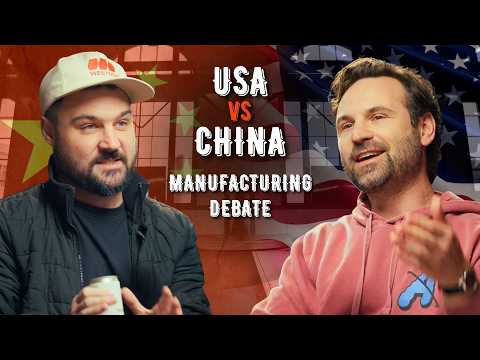
The US vs. China Manufacturing Debate
The US vs. China Manufacturing Debate
Summary
Ti Morse hosts a debate between Aaron Slodov, founder of Atomic Industries, and Sam D’Amico, founder of Impulse Labs, on the state of US versus China manufacturing. In the 1980s, the US produced roughly 30% of the world’s manufactured goods; today it is around 16%, while China has gone from almost nothing to nearly 30%. The conversation explores whether this decline is reversible, what it would take to rebuild American manufacturing capacity, and the systemic challenges — from environmental regulations to capital markets — that stand in the way.
Sam argues that the key is focusing on the “electric stack” (lithium-ion batteries, power electronics, embedded compute, electromagnetics, and computer vision hardware) and picking products that exercise all these muscles at sufficient volume to justify onshoring. Aaron counters that the US needs to preserve its remaining tribal manufacturing knowledge before it disappears entirely, comparing the manufacturing learning process to reinforcement learning where factory feedback at high volume is essential. Both agree that China’s vertically integrated manufacturing ecosystem is formidable, with companies like BYD co-locating engineers and factories on the same campus, while US companies send design files overseas and have disconnected their engineers from production.
The debate also covers how the data center boom represents an untapped opportunity to pull advanced manufacturing onshore, why Apple’s supply chain is almost entirely in China, how space companies like SpaceX had to vertically integrate out of necessity, and whether humanoid robots will shift the balance of power between the two countries. The speakers conclude that the US has the talent and capital markets but lacks cohesive industrial policy and the will to treat re-industrialization as a full-system problem.
Highlights
”In China, There Are 20 Elons”
“In China, there are 20 Elons is probably the way to think about it. In the US, there’s one and the NIMBYs have basically tried to make it so that there’s none. But if I’m an American entrepreneur that wants to build the most advanced device of its category, I can just go there and do it.” — Sam D’Amico, 9:00
Clip command
yt-dlp --download-sections "*9:00-10:00" "https://www.youtube.com/watch?v=TRcvUUMaBcA" --force-keyframes-at-cuts --merge-output-format mp4 -o "20-elons.mp4"”It’s Like an LLM That Can Build Hardware”
“It’s kind of like you have an LLM that can build hardware. And you communicate to it through Google Slides and in-person meetings and sometimes drinking some baijiu at dinner. But like that is how it actually works and it is a fascinating machine.” — Aaron Slodov, 8:24
Clip command
yt-dlp --download-sections "*8:24-9:00" "https://www.youtube.com/watch?v=TRcvUUMaBcA" --force-keyframes-at-cuts --merge-output-format mp4 -o "llm-hardware.mp4"”It’s Basically Illegal to Do Chemistry with Metal”
“We basically built up scaffolding of environmental laws from the 60s onward that have basically made it illegal to do stuff. California bit by bit has restricted what I basically call chemistry at a foundational level where it’s basically illegal to do chemistry with metal.” — Aaron Slodov, 21:01
Clip command
yt-dlp --download-sections "*21:01-22:00" "https://www.youtube.com/watch?v=TRcvUUMaBcA" --force-keyframes-at-cuts --merge-output-format mp4 -o "chemistry-illegal.mp4"”We Have Only So Much Tribal Knowledge Left”
“We have only so much tribal knowledge left in terms of how these systems work, how you can ultimately create a machine like that. But once it’s gone, it’s gone. And preserving tacit knowledge is very hard because it’s not like the Matrix where you just jump in and download.” — Aaron Slodov, 11:56
Clip command
yt-dlp --download-sections "*11:56-12:40" "https://www.youtube.com/watch?v=TRcvUUMaBcA" --force-keyframes-at-cuts --merge-output-format mp4 -o "tribal-knowledge.mp4"”The Data Center Boom Is the Missed Opportunity”
“There is massive demand for the most advanced computers in the world. And why aren’t there American supply chains spinning up to service this demand at scale? I just see this immense opportunity to use the data center boom to pull onshore a bunch of these advanced capabilities. And we’re just not doing it.” — Sam D’Amico, 33:00
Clip command
yt-dlp --download-sections "*33:00-34:00" "https://www.youtube.com/watch?v=TRcvUUMaBcA" --force-keyframes-at-cuts --merge-output-format mp4 -o "data-center-opportunity.mp4"”Apple Exports Engineers, Not Files”
“I would actually argue that what Apple exports is engineering expertise, often in person. The factory has been micromanaged by Apple to such a degree that it is effectively an Apple facility.” — Aaron Slodov, 1:00:00
Clip command
yt-dlp --download-sections "*1:00:00-1:01:00" "https://www.youtube.com/watch?v=TRcvUUMaBcA" --force-keyframes-at-cuts --merge-output-format mp4 -o "apple-exports-engineers.mp4"Key Points
- US Manufacturing Decline (0:39) - The US went from 30% of world manufacturing in the 1980s to ~16% today while China went from almost nothing to nearly 30%
- Aaron’s Background (1:04) - Rust Belt boy from Cleveland, physics/engineering background, worked on Waymo, now runs Atomic Industries combining Silicon Valley engineering with Detroit manufacturing talent
- Sam’s Background (4:42) - Electrical engineer, worked on Google Glass at Google X, joined Oculus/Meta, saw Chinese manufacturing evolution firsthand, now building Impulse Labs
- Chinese Manufacturers Are Full-Service (6:00) - You don’t just get a factory — you get a full engineering team that co-designs the product around their supply chain and tooling
- The Re-Industrialize Movement (11:56) - Aaron started a national movement to preserve tribal manufacturing knowledge before it disappears entirely
- Manufacturing as Reinforcement Learning (12:37) - Sam argues you effectively reinforcement learn how to manufacture stuff, and there’s a factory feedback step that requires high-volume production to achieve
- The Electric Stack (16:53) - Sam defines the core technologies: lithium-ion batteries, power electronics, embedded compute, electromagnetics, and computer vision hardware
- Where to Put a Factory (20:45) - Aaron argues Bay Area because that’s where the best engineers are, and an industrial YIMBY movement is needed
- California Made Chemistry Illegal (21:01) - Environmental regulations built over 50 years have effectively banned metalworking chemistry needed for the electric stack
- Tesla’s Shanghai Gigafactory (25:43) - The fastest factory ramp Elon ever built; Chinese workers were fundamentally more efficient
- Americans Don’t Do Anything Until They Have To (26:54) - Aaron observes that Americans are reactive, not proactive, but when forced to act they do it the best
- De-Industrialization of Capital Markets (30:21) - Aaron notes that before national bank branches, local banks could only invest in local entrepreneurs, making capital more accessible for manufacturing
- Data Center Boom Opportunity (33:00) - Hyperscalers ordering tens of thousands of $3-4M data center racks represent massive demand for advanced manufacturing that could be used to pull capabilities onshore
- Anduril and Defense Manufacturing (38:13) - The US government hasn’t been the customer that would incentivize companies to build base-level manufacturing capacity; defense procurement has been separate from consumer electronics for 30 years
- Space Companies Vertically Integrate (42:46) - SpaceX and others had to build their own supply chains because existing aerospace vendors are essentially consulting firms with outdated processes
- Why Impulse Went to China (45:18) - Even at $100M+ revenue, Sam couldn’t justify buying machines that would sit idle 75% of the time; contract manufacturing in China offered fractional access
- Apple’s China Dependency (48:54) - Apple can’t fill a conference room of tooling engineers in the US but can fill a football field in China; they spent hundreds of billions building supply chains over 20 years
- Apple Exports Engineering Expertise (1:00:00) - Apple’s factories are micromanaged to be effectively Apple facilities; they export engineers and process knowledge, not just files
- Consumer Electronics Factory = Amazon Warehouse (56:07) - Modern consumer electronics factories have the same industrial profile as Amazon warehouses, which communities already permit
- Humanoid Robots and Power Balance (1:08:10) - Whoever gets to 100,000 humanoid robots first where they can self-perpetuate and replicate, it’s game over; the supply chain doesn’t exist yet
- The US Is Squandering Opportunities (1:10:00) - Data center racks are excluded from tariffs, missing the chance to onshore the electric stack ahead of the humanoid robot era
Mentions
Companies
- Impulse Labs (4:42) - Sam D’Amico’s induction stove company, building advanced consumer electronics with Chinese supply chains
- Atomic Industries (1:04) - Aaron Slodov’s company working with large OEMs and manufacturers on metals and plastics, marrying Silicon Valley and Detroit talent
- Tesla (25:43) - Shanghai Gigafactory as example of Chinese manufacturing efficiency; Starlink as successful US onshoring example
- SpaceX (18:00) - Starlink onshored consumer electronics manufacturing starting manual in a parking lot in LA
- Apple (48:54) - Entire supply chain built in China over 20+ years, hundreds of billions invested; exports engineering expertise not just files
- BYD (18:59) - Chinese EV company with vertically integrated campus where factory and engineering office are in the same facility
- Anduril (38:13) - Defense startup building manufacturing campus in Ohio; has to learn volume production muscle
- Google (4:42) - Google Glass attempted to reshore consumer electronics manufacturing; assembled in California but components from China
- Oculus/Meta (6:00) - Sam’s VR headset experience showing transition from toy factory to advanced Chinese contract manufacturing
- Foxconn (46:05) - Apple’s primary contract manufacturer; taps different capital structures than Apple
- Astranis (42:46) - Satellite company that ended up needing to vertically integrate supply chain like SpaceX
- Goertek (36:00) - Chinese contract manufacturer referenced as type of company the US lacks
- California Forever (54:00) - Successfully got unions on board, showing how to align labor incentives with industrial goals
Products & Technologies
- Electric Stack (16:53) - The five core technologies: Li-ion batteries, power electronics, embedded compute, electromagnetics, computer vision hardware
- Starlink (18:00) - Successfully onshored consumer electronics manufacturing with lights-out production at millions of units
- Data Center Racks (33:00) - $3-4M units with hundreds of GPUs, energy storage, and advanced power supplies representing massive onshoring opportunity
- FPV Drones (40:32) - Military drones that use the electric stack; millions will be ordered for defense
- Humanoid Robots (1:08:10) - Potential game-changer for manufacturing; whoever builds 100K first with self-replication capability wins
- Google Glass (4:42) - Consumer device assembled in California but with components from China; the pioneering flex said “Assembled in California”
- Optimus (1:08:15) - Tesla’s humanoid robot; supply chain doesn’t exist yet and would need to be built from scratch
People
- Aaron Slodov (0:00) - Founder of Atomic Industries, physics/engineering background from Cleveland, started the Re-Industrialize movement
- Sam D’Amico (0:10) - Founder of Impulse Labs, electrical engineer, former Google Glass and Oculus hardware engineer
- Ti Morse (0:39) - Host of Relentless, moderating the debate
- Elon Musk (25:43) - Referenced throughout as the only US industrialist successfully vertically integrating at scale
- Tim Cook (48:54) - Famously said he can’t fill a conference room of tooling engineers in the US
- Palmer Luckey (30:21) - Founder of Anduril, referenced for defense manufacturing efforts
- Jony Ive (9:00) - Apple’s former design chief, example of US retaining high-value design work
- Drew Baglino (58:31) - Former Tesla executive who noted consumer goods industry talent is a good source for advanced manufacturing
Surprising Quotes
“It’s kind of like you have an LLM that can build hardware. And you communicate to it through Google Slides and in-person meetings and sometimes drinking some baijiu at dinner.” — Aaron Slodov, 8:24
“I got to go to some red state, tell them how much I love Donald Trump, you know, all this other stuff. And then I get my tax breaks and I get my free campus. Meanwhile, my engineers are over in Hipsterville in California.” — Sam D’Amico, 19:24
“Americans don’t really do anything until they have to. And then we do it the best.” — Aaron Slodov, 26:54
“The enemy of manufacturing is NIMBYs.” — Sam D’Amico, 32:49
“People stop calling robots robots when they work.” — Sam D’Amico, 1:10:54
“The guy who designed it has been dead for 20 years, and it’s manufactured by a company that bought another company that bought another company, and maybe their technician forgot how to do a certain process step.” — Aaron Slodov, 42:46
Transcript
Aaron Slodov: 0:00 I just got trolled. Why did I not learn Chinese? It’s not just that you get a factory, you get a full engineering team that co-designs the product for you. And they co-design the product around their supply chain, around the tooling they’ve got.
Sam D’Amico: 0:10 If somebody else can make all the stuff that you want, that’s not good. We have only so much tribal knowledge left. Once it’s gone, it’s, it’s gone.
Aaron Slodov: 0:18 In China there are 20 Elons. Maybe their Elons are not as good, you can debate that sort of thing, but like, if I’m an American entrepreneur that wants to build the most advanced device of its category, I can just go there and do it.
Sam D’Amico: 0:28 When you hear these analogies, you kind of want to just like hit your head against the wall like, yes, of course, they’re great at doing all these things. But like, what are we doing?
Ti Morse: 0:39 Welcome to this US versus China manufacturing debate. In the 1980s, the US produced roughly 30% of the world’s manufactured goods. Today it’s roughly around 16%. Over that same time frame, China has gone from almost nothing to nearly 30%. This has created one of the biggest transfers of power in human history. And so today, I’m talking with Aaron Slodov and Sam D’Amico, having a debate about what this means and more importantly, what comes next. So Aaron, in five minutes, can you please explain how this decline happened? And please give a little introduction to yourself.
Aaron Slodov: 1:04 Sure. So I’m a Rust Belt, Midwest boy. Grew up in Cleveland, clawed my way out, eventually moved out here to San Francisco. Lived in New York, LA, India, a couple other places strangely. But I have a background in like physics, engineering. Most of my pursuits have been chasing like moonshot ideas basically. And part of my early career was actually building Waymo before it was Waymo here. And I have a pretty decent breadth of hardware projects. The kind of like genesis of how I got to where I am is trying to make a consumer product by myself. And I had no exposure whatsoever to manufacturing and, you know, the thing that I wanted to make ultimately was a stupid like plastic widget and I found out the hard way what like tooling was and how to find suppliers and all of my buddies who worked, you know, like still at Google and other big tech companies on hardware teams were unanimously just like, yeah, go to China. Like, go find a supplier, get on Alibaba, get a WeChat, you know, like find somebody. I tried that for a little while and ultimately the overwhelming kind of consensus was that I’d have to like fly there and live in a factory basically for a little bit. And this is kind of like a rite of passage, you know? I wasn’t really that willing to do it at the time because this was just like a side project of mine. I was like, what is going on with this? Why do I have to go do this? And so ultimately I tried to go find American suppliers and that was an even, you know, worse shit show because they don’t care. I learned over time the reason they don’t care isn’t because they don’t care about me or my product, it’s just… They’ve been squeezed, you know, to the absolute margin on what they can do. And this is part of, right, like the global manufacturing world stage. And this is something to me that I thought was an insane problem, uh, because in my brain what didn’t compute was we became, you know, so wealthy and smart and powerful that we just kind of offloaded all this work. Um, and, you know, obviously over time China became very good at what they do. So in the beginning they weren’t, you know, this is like a whole train of people handing off skills and learning and undercutting and building capacity. So it’s a fascinating story ultimately, but one that really hit me hard being from like a Midwest rust belt town, because growing up you never think about why your city is like decimated, you know, and like what happened? This was the richest place in the country for like a hundred years. Um, so, yeah, and like you you do learn this stuff obviously like in high school, right, and college when you’re taking economics classes and poly sci. So it’s just it’s fascinating to really see it all kind of unwind in front of your face. And my answer to it was trying to build a response, right, with the company that I’m now building. And it’s kind of like a, you know, a marriage of Silicon Valley engineering talent with Detroit world-class manufacturing talent. And so to me, I think that, you know, we can do this. Um, it’s really gonna come down to a matter of will ultimately. So that’s, uh, it’s a quick background on how I’m sitting here now.
Ti Morse: 4:40 And now, Sam.
Sam D’Amico: 4:42 So hilariously we were, we I think we both started our careers in different buildings in the Google campus, very close by each other. Um, and it’s actually really funny because, so I, I went to college for electrical engineering. Um, I also, I do some, I moonlight as a software engineer occasionally, but um, I was on the Google Glass team. Um, which is a little different than Waymo because, you know, it’s a consumer electronics device versus a, like at that point it was, you know, in some sense a research project basically. And so the default assumptions were this is going to scale, all this other stuff. So I, I graduated, I graduate undergrad in electrical engineering and I’m about to start my master’s program and I’m like an intern at Google, I’m at Google X and I’m like I just got trolled, um, was the realization I had and I’m like why did I not learn Chinese? Because I didn’t understand like if you want to build like scaled consumer electronics, you’re going to need to go to China if you want to run as fast as possible. And I actually encourage, you know, people still in college or if you’ve got a chance to, you know, change your grad school curriculum or whatever to like you should take a year of Mandarin minimum, um, if you want to get into this world, which is kind of an aggressive statement, but I think it’s, it’s factually true. So I started going to China in 2013, um, after…
Aaron Slodov: 6:00 tried to become a full-time employee there and got like kind of the download of like where to go in Shanghai, like what to what to go do and sightsee and all this other stuff. And I basically realized that like, okay, I actually like doing this. It’s like pretty cool to go to world-class international cities and like and you get to then have engineering meetings and stuff like that um as well. Um, and so there was actually this like travel element to it. And also people like rag on San Francisco for like not having great nightlife and all this other stuff, you can just immediately inoculate that if you’re going to China like once every once every two months or something like that. So basically, basically I got picked up into this universe. Now, where this really accelerated was Google Glass obviously was a little too early for its time. Um, Oculus was not. And so I went and joined the Oculus team as they were getting bought by Facebook. And well, they had to they they was interesting is it’s kind of the same thing that you mentioned which is like the transition of China from like a low-end manufacturer to a high-end advanced manufacturer. I saw this at Oculus. So like Oculus was the Oculus dev kits were built by I believe the same contract manufacturer that made Guitar Hero and Rock Band. And it was a it’s a toy factory. And so in some sense it’s like yeah, they can do injection molding of like let’s call it cosmetically and you know sort of sort of I don’t want to rag on them because I think it’s like, you know, it’s a different era basically. Basically think like damp factory in Guangdong province, um, looked straight out of the like the 80s sort of thing like that. It’s probably a pretty similar site to what you would see if you were like going to China in the 90s or something like that. Um, and then the advanced electronics piece was kind of kept into a like, okay, they put a computer on the factory line that like does some of the advanced like software defined hardware stuff that like you need to do for a VR headset or whatever. Um, so that was where they started when they got acquired. Then as soon as as soon as the acquisition went through, I was involved with some of the initial contract manufacturer selection because I had worked on the Google Glass team on some of the like the inside, you know, factory stuff there. And so got to see kind of the next wave of Chinese manufacturers. And these folks are not mucking around. Like this is like it’s not just that you get a factory, a building with some operators that they go and recruit, it’s you get a full engineering team that co-designs the product for you. And they co-design the product around their supply chain, around their like tool like around the tooling they’ve got, etc. So it’s not just that you get a room with some cheap workers, it’s you get a machine that effectively can build it for you. I I think the analogy for kind of the audience that that you’ve got is like it’s kind of funny to use the Claude code for X sort of joke, but like it’s kind of like you have an LLM that can build hardware. And you communicate to it through Google Slides and in-person meetings and sometimes drinking some baijiu at dinner. But like that is how it actually works and it is a fascinating machine.
Sam D’Amico: 9:00 You were essentially able to be the high-level engineering input to that system. Now, there’s kind of this split brain because you do that, but then you’re also doing advanced R&D for, like, hey, how does my computer vision system work? How, like, a lot of that stuff ends up has stayed stateside and, like, you kind of see where, why this is, like, you know, this is the—this is the same transition that you’ve seen kind of from, like, the United States still does the high-value stuff. They still do the industrial design, they still do, like—like Jony Ive didn’t lose his job yet, you know, it’s kind of the point. Like, and that team at Apple, for instance, has, like, one of every potential machine that they want to use and they—they piloted different processes and they do it internally. But, like, who scales it? Not them, obviously. And so I got to see kind of this transition from, like, okay, China’s this, like, cheap labor toy factory, you know, there’s lead paint in the, you know, whatever, you know, like, all this stuff that people dismiss China with to, like, oh, this is fundamentally changed. And, like, in the past, you know, couple years as I’ve been building Impulse, I’ve seen a different thing which is, like, these guys are not just really good at building stuff and, like, you can—you can scale, like, an arbitrary VR headset or product through them, it’s, like, they are leaders on the R&D side as well and if you want the best battery cells, if you want the best process engineering for, like, how you build a battery pack, if you want, like, all this stuff, it’s, like, it’s an email away from you getting it. And not only that, they are super eager to go and work with you. Um, and they’re super eager to go and work with you for a bunch of reasons and a lot of them are, I would argue, fairly, like—fairly well-intentioned. It’s, like—it’s, like, well, they see, you know, United States as, like, the benchmark of, you know, especially Bay Area engineers and stuff like that as, like, this is—we can learn a ton of stuff from this. Um, and this will mean that we’re ahead of our crosstown rivals in a hyper-competitive, like—like, you could argue that it’s, like, all of these companies have been pumped up by state subsidies and it’s, like—it’s, like, in China, there are 20 Elons is probably the way to think about it. In the US, there’s one and the NIMBYs have basically tried to make it so that the—there’s none. And, uh, but in China, there—there—there—there’s, like, 20 to 50. Maybe they’re—maybe their Elons are not as good, you can debate that sort of thing, but, like, that—that’s how their hardware ecosystem and software ecosystem as well works. And the benefit of that is, if I’m a American entrepreneur that wants to build the most advanced device of its category, I can just go there and do it.
Ti Morse: 11:34 Yeah. So Aaron, I think Elon on a podcast recently basically explained that right now most of the US’s biggest companies effectively just export files that they send to China and then those files are converted into actual products. With this, like, massive decline over the last 45 years, how do you actually think the US can reverse this decline?
Aaron Slodov: 11:56 So part of, you know, this story and building my company seeing this stuff kind of first hand led me to also you know try to start a national movement around this which is reindustrialize, right? And the idea of that is we have only so much you know tribal knowledge left in terms of how these systems work, how you can ultimately you know create a machine like that but once it’s gone it’s gone. And preserving tacit knowledge is very hard because it’s not like the matrix where you just jump in and download…
Ti Morse: 12:35 I know kung fu.
Aaron Slodov: 12:36 Right, yeah. No.
Sam D’Amico: 12:37 I there’s a take on this that’s like machine… so I would also argue that like effectively you machine learn or you reinforcement learn how to manufacture stuff. And China’s incredibly good at this process. And so basically it’s like okay if we can break this down to like a simple example of like let’s build a lithium-ion battery cell, it’s not really simple but there’s all these process steps where you’re basically like laminating films on top of each other with different chemical processes and like the make-up of the powders you’re using and like the settings on the machines that do certain steps. All of that stuff you can imagine, again I’m assuming your audience is full of a bunch of aspiring AI engineers or whatever, all those things are like implicit weights into a neural… like a neural network basically. And you can pre-train, you know you can take all the knowledge in the world and design the best thing, the best single widget, but there is a reinforcement learning with factory feedback step that unless you build stuff at high volume you will never achieve. And this is actually the thing that like I’ve been talking to a number of folks doing kind of like new manufacturing things and it’s like that is the key thing that I think a lot of people who have not been close to the process they don’t get basically. Um, is this like implicit reinforcement learning aspect of it and the fact that like so much of the state of what makes advanced manufacturing work is not in the spec.
Aaron Slodov: 14:01 Yeah, it’s a, if you think about it like a stateful system it’s impossible to observe until you have high throughput which is mass production basically.
Sam D’Amico: 14:11 So who’s gonna fund you for that?
Aaron Slodov: 14:12 Exactly. Um, it’s very hard to understand all the parameters basically until you do it. So that’s why, you know, the Chinese machine is so efficient because they are just gathering more and more tribal knowledge and it’s gonna snowball out of control right, until basically like we’ll get to this later but the humanoid thing is an insane problem. Um, if it actually plays out.
Ti Morse: 14:37 What do you mean by that?
Aaron Slodov: 14:39 Oh we’ll get there, we’ll get there. Um, but my, like basically the whole purpose and MO of reindustrialize, right, is that like I would prefer if we could preserve as much of that knowledge as we can, encapsulate it, and then rebuild it here, right, and be able to… to have these kind of like reinforcement feedback loops because we’re building better brains and like compute and it’s in my opinion it’s not necessarily that like we need to live in a unipolar world with a single industrial superpower but like there has to be another option. And I also I don’t believe that like autarky is a necessity, right? Like you can trade is actually a good thing. Um however, when you do actually have an adversary on the world stage, you you cannot continually empower them. So part part of my, you know, ethos about this is that we have insanely deep capital markets like we have the talent, right? And it’s just this is where it comes down to a lot of people criticize this in terms of like, you know, communist like central planning basically where you need uh you’re going to need this kind of capacity one way or another for for medicine, for electronics, right? Chips, all of this kind of stuff. We we scrambled to to cover like EV supply chains and chips really fast because those were, you know, critical at that time and it really just turns out that it’s all it’s all critical. If you forget how to make anything it’s bad, right? So ultimately my my whole worldview is that like the toolbox is here. Uh we need we need the people to actually like do it um while we’re still kind of, you know, working with China and other industrialized nations to produce the things that we want to build.
Ti Morse: 16:40 And Sam same kind of question of with this massive decline do you think like A it’s reversible and how do we do that and then if you had a hundred million dollars to invest in a factory today where would you decide to put it and why?
Sam D’Amico: 16:53 That’s a great set of questions. Um so first thing is is this reversible? I think there’s a silver lining to like some of this stuff and I actually’ll disagree with your point of like it’s all important. It’s I think you can distill kind of all the next set of devices into what I would call like the electric stack and so this is an and if you want a 200 page reading on this Packy and I put together a really long article called the electric slide but basically it’s lithium ion batteries, power electronics, embedded compute, and then electromagnetics and I would also add a fifth column which is like computer vision hardware so like I’ve I’ve worked on camera modules and image sensors and stuff like that so like but basically anything from a Waymo to a robot to a stove of all things, you can use those those those technologies and actually make stuff stuff happen and so basically the idea is like pick devices that kind of give you let you exercise all of those key like those four to five key muscles. Make sure there’s a portfolio of them, some like portfolio of them that you can then selectively onshore and that and make sure that the volumes are high enough that you can get at least one of every process machine needed in that entire supply chain.
Aaron Slodov: 18:00 onshored and at 100% capacity. Because the problem is like if if I need like five different types of injection molding machines and I’m using each one of them for like, you know, 10,000 parts a year, well, I’m not going to be able to fund those. Like it’s not going to it’s not going to actually make sense. The flip side is like the only industrialist in the United States that has actually successfully done this recently, well, one, he doesn’t share, he does it in his own ecosystem. But two, but two, he actually can bring the volume to bear to actually go and do this. Like Starlink has enough enough customers that they can fully do a lights-out manufacturing line for that that that system and it makes financial sense to do so. That said, how did he actually do it onshored at the beginning? It was like pandemic era, probably pain in the butt to go to Vietnam or China or something like that to go and do this. They went and did it in the parking lot in in LA. And I think that goes back to where I what I put my factory and it’s like
Sam D’Amico: 18:59 It’s incredibly important and I said this earlier, it’s like it’s incredibly important to tie the factory and the engineers need to basically be in sync. And this is the superpower that companies like BYD bring to bear. Like literally the factory and the engineering office are like in the same facility in most cases. Like maybe it’s a couple buildings away, but it’s not it’s not across town.
Ti Morse: 19:23 It’s in the same campus.
Sam D’Amico: 19:24 It’s in the same campus. And there’s all of that tacit knowledge of like, yeah, you can’t really design it that way because this doesn’t fit kind of thing. Well, that’s like immediately short circuited and the context is already present. And in the US, we decided, oh, you got to like go do a bake off with a bunch of governors and like, I mean, you’re going to watch me, you know, be a hypocrite on this whenever I open a US factory at some point. But it’s like, okay, I got to go um I got to go I’m trying to think of a stereotypical Republican governor name, but basically like I got to base I got to basically like go to some red state, tell them how much I love Donald Trump, you know, all this other stuff. And then I get my tax breaks and I get my free campus and I get all this stuff. Meanwhile, my engineers are over in Hipsterville in California and they don’t want to move over there. They don’t want to move to, you know, real Midwestern small town that I am re- trademark re-industrializing. Um and so this is actually a I think this is actually a problem. So it’s like I think there’s like two solutions. One of which is like we should convince some smart engineers to go move to move to move to these actually kind of awesome Midwestern towns in Ohio and like if we can basically rebuild those, it’s like they’re going to be great places to live for smart people because those smart people lived there before.
Aaron Slodov: 20:39 Because these were walkable communities with like, you know, with great amenities and like in and again,
Sam D’Amico: 20:43 the engineers were next to the factory.
Aaron Slodov: 20:45 the engineers were next to the factory. Um the flip side is like where would I do it today? Well, where are the smartest engineers on the planet right now? The Bay Area. So you should put it in the Bay Area. How do you do that? Um well, there’s a guy who successfully expanded a factory in the Bay Area by putting a tent in the parking lot because that was the only way he could get around all the permit constraints and all this other stuff of like needing I need he needed to expand.
Sam D’Amico: 21:00 …one in Fremont.
Aaron Slodov: 21:01 So I think that basically the way I’m approaching it from my perspective is the YIMBY movement was a good start for like let’s unlock housing production to like make it so it’s actually affordable to live in places like the most popular places to live on the planet. But there’s going to need to be an industrial movement that is kind of its counterpart. Um, if we want to be able to like, you know, make this stuff work. And that that movement is going to need to be kind of like a yeah, it’s okay to build a factory now. And the contrarian take is that like, it’s actually currently illegal to do that. Okay, we basically built up scaffolding of like environmental laws from the 60s onward that have basically made it illegal to do stuff. Um, I’ll give you an example of like California bit by bit has restricted what I basically call chemistry at like a foundational level where it’s like basically illegal to do chemistry with metal. Um, and if it’s illegal to do chemistry with metals, you can’t build anything with the electric stack, because fundamentally electric stack, well, that’s batteries. Um, also if you want to coat any metal, like you want to anodize anything, yeah, good luck, you got to do that—you got to do that over in Reno.
Ti Morse: 22:06 Can you explain what you mean by California made chemistry with metals illegal?
Aaron Slodov: 22:12 Yeah, so basically California was an industrial superpower. We built like I don’t know what like half the world’s battleships at one point, we built like the Kaiser shipyards, like we had all this awesome stuff going on. Also this whole facility by the way like this was all—this is a center of like manufacturing of like the bridge superstructures for aircraft carriers were built like right around here and stuff like that. Awesome awesome industrial spot. But obviously if you do chemistry with metal it does cause pollution. And so um there are sites throughout the Bay Area and this is like within human memory um that have like trichloroethylene contamination. Um like the Google campus, there are um I think Teflon barriers below some of the buildings because essentially the—the pollution from both metal metal working and semiconductor production because we also used to have tons of fabs, all most of the fabs were here too, and effectively that pollution is still with us today. Um and you see controversies ranging from like Hunters Point hasn’t put new housing in where the old Naval shipyard because they keep finding like little radium painted markers that were like on um like if you worked on an aircraft carrier at night you’d basically put these little glowing green dots on you so that you don’t get hit by you know like a plane landing or whatever. Um they go find one of these and then like that shuts down housing production for like five years. And so but basically because of the past memory of like you know I would argue kind of reckless environmental stuff, we put in a bunch of scaffolding of new laws and these are all well intentioned and we built them over many years but now it’s effectively illegal to do chemistry with metal. And so and if you—and and so that seemed fine you know back you know back into the 90s and 2000s it’s like hey we’re…
Sam D’Amico: 24:00 There’s still what’s consumer electronics manufacturing in the Bay Area, like the Google Glass, for instance, was like a consumer device manufactured in California. And they had a flex that said, like—or they had a flex on the box, it was like, ‘Designed by Google, Assembled in California,’ to basically tell Apple, like, you know… a little bit of, ‘We know ball.’ And I’ve been to that factory. It was pretty cool to actually see an American factory building the most advanced consumer electronics device at the time, and they did a good job. But where were the plastics injection molded? I think it was China. Where were… where were the flex circuits made? I think that… yeah, like, it’s like you think of all the core components. Where was I going for camera module manufacturing? Yantai, China. So, like, you could already see the component—the most advanced pieces of that were getting pulled out. Where were the chips packaged? Pulau, Malaysia. And so we built these global supply chains over the years for, you know, again, well-intentioned reasons. But like, then when the EV revolution hit, when, like, basically it became very obvious that, like, everything will be built like a smartphone. Everything will be with the electric stack. It’ll be like… it doesn’t matter if it’s an iPhone or a BYD Han EV, or… or even like most of the, like, actuators and stuff in, like, Starship. You could argue Starship is, like, much more an electric vehicle than any rocket prior to it. And so all of these things use the electric stack. And California really prides itself on being in the forefront of—well, it was in the forefront of the EV revolution. It was in the forefront of the solar revolution. It’s like, all of these technologies were kind of, like, really scaled here. And we’ve, like, built scaffolding of environmental laws over the past 50 years that have effectively banned us being able to compete at a vertically integrated level, um, with these tech—like, on these technologies, despite, you know, a lot of the best engineers in these technologies being here.
Ti Morse: 25:43 Aaron, the first, like, two factories, I believe, with Tesla were here in the United States. And then when Elon went to China, the Shanghai factory was, like, the fastest ramp of any factory that he’d ever built. And I remember him saying that the Chinese were just significantly better at basically producing these cars in that factory. Like, that factory is just fundamentally more efficient. So what does that kind of say to you, and like, how do you think about that?
Aaron Slodov: 26:07 I mean, you can’t refute it, really. The… the way that I think about that is, you hear him kind of talking in most of his appearances about manufacturing, about, you know, just like the level of urgency and seriousness that they have about what they do. And, you know, that’s honestly kind of like a moral dilemma in some ways for Americans because we… we really like to, you know, what… like, in environmental laws like this, these are all reactionary snapshots of something that happened in time, and we don’t revisit those things. And we don’t do it in, like, a more proactive way. It’s everything is always reactive. And this is, like—
Sam D’Amico: 26:52 It’s also how our legal system works, too.
Aaron Slodov: 26:54 Exactly. Yeah. Like, Americans are… they don’t really do anything until they have to. And then we do it the best.
Sam D’Amico: 27:00 Exactly. So this, this is kind of like the way I think about this is like, yeah, Elon is very like enamored by how good they are at this because we, we aren’t doing the same, right? Like we don’t have, uh, we don’t have that same level of urgency, right? And financialization of everything has really, uh, driven us to chase, you know, the higher levels of this and…
Aaron Slodov: 27:30 I think that where I don’t necessarily disagree with the electric stack, but I think in a lot of my work, right? We work with a lot of the largest like OEMs and manufacturers on the planet. And it’s, it’s a constant like whack-a-mole game of where do you want to do your final assembly of the thing? And then it’s kind of like, now I need to assemble, you know, a bill of materials of what’s going into this. And then I have to go like build a supply chain and chase all those components around so that I can assemble it efficiently somewhere. And all of the, like, everything that’s, you know, kind of like ramping to a higher level of technology requires all these components that we have just, you know, totally shit the bed on hands down everywhere. And so my job now at Atomic is finding, right? Like all of these places where the lower level componentry like metals and plastics have to chase the electric stack components around to get assembled somewhere else.
Ti Morse: 28:35 I’ve seen delays on, on modules where it’s like we, we need the enclosure for a battery pack was a long lead tight item versus the welding of the cells, which is like crazy.
Aaron Slodov: 28:42 Yeah. And like in, in cars, the two longest lead time single components on a car are the bumper and, uh, like where your doors close into the car, the sheet metal piece. Um, those come out of molds. So one comes out of a sheet metal stamping die and the, you know, the bumper is injection molded. There were, there were stories, uh, back in the early days of Tesla of them getting their bumper molds cut in Japan and flying them to California on 747s just to cut two weeks off of like production time. Um, if that gives you any indication of just like the lower level components and how urgent they are, right? To like get something final assembled somewhere. So yeah, I mean, it’s like supply chains are a game of whack-a-mole because of the, the way we’ve constructed them like this. And we are to kind of blame for that because we built them intentionally that way.
Ti Morse: 29:37 I mean, and you go to BYD and then you have it a very integrated campus where it’s like, oh, like they have much of the dependencies of the electric stack all in-house in a lot of cases. Now they, they also go to sub-suppliers, they also do, do all sort of stuff, but like you have the optionality of being able to go full vertical. And then you see like the, like you see what Elon’s been doing lately, especially with like Starlink and, and, and stuff like that. And you’re like, okay, this guy is…
Sam D’Amico: 30:00 trying to go full vertical where he has his own industrial concern. Now, I would argue you need to start from demand and pull everything up because you can’t finance this with venture dollars. Like I don’t think you can—some of our friends have successfully financed large manufacturing concerns with venture dollars but, like, you’re—that’s not going to—that’s not the way that the capital markets work in the United States.
Aaron Slodov: 30:21 And there’s actually I think one of the other pieces of kind of deindustrialization that people forget is we didn’t have national bank branches in the—like in 1900 or whatever, like when you know this facility was built. But if you had a local bank in your town, it could only invest in, like, the crazy people in the town. And so it was a lot actually in some ways easier to get capital because the markets weren’t as mature. So like I guess we have to invest in, you know, stove guy and injection molding guy because they’re the only game in town doing stuff that actually can, you know, make me returns. Now we’ve replaced some of those systems with ever bigger venture funds that are kind of more like private equity firms especially at the top level, but like I think that you see like what Palmer Luckey’s doing with Anduril and all this other stuff—it’s like there’s definitely a reaction to, like, we forgot how to do the capital market side of this thing. But there’s another thing that I think is really important to just highlight is we’re in an AI boom right now. And I think it’s like there’s an enormous opportunity from the AI boom and people are missing what it is. So the missing piece is people think ‘oh, we can onshore stuff because we can get humanoid robots’ and like it’s going to magically solve these things and it’s like ‘oh you can just automate the factories’, whatever. Like, you know, honestly that’s stupid because if you look at what how Starlink onshored their consumer electronics line into the millions of units, it was a manual production line that they later automated. Like, Elon’s little algorithm or whatever, he says the last step is automate, and like, he learned that the hard way because he laid out an automated line at Tesla the wrong way—
Sam D’Amico: 31:49 And almost killed the company.
Aaron Slodov: 31:52 And almost killed the company. And so—but the point is, like, you can actually start manual with final assembly and be totally fine, and this stuff works. So going back to the AI boom what we’re clearly missing: currently we are building—like the hyperscalers are ordering tens of thousands of units of like, let’s call it $3 to $4 million datacenter racks. And these things have like, you know, I don’t know, hundreds of GPUs in them in some cases. Like 100 GPUs, something kind of crazy. They’ve got all of the various pieces. They’ve got energy storage built in. They’ve got, like, they’ve got advanced power supplies. They have the full electric stack at the most advanced node. They have all this photonics stuff. They have like all of these key technologies and the demand is there. And the demand is there installing it in the United States—
Sam D’Amico: 32:46 Until until all these states shut it down.
Ti Morse: 32:48 Yeah.
Sam D’Amico: 32:49 Well, then… the enemy of manufacturing is Nimbys, but…
Ti Morse: 32:51 Yeah.
Aaron Slodov: 32:52 And, you know, some of them could be—I’ll go into conspiracy theories later. But basically, basically the point is like…
Sam D’Amico: 33:00 There is massive demand for the most advanced computers in the world. And these are in some sense electromechanical systems, like they’ve got, you know, they’ve got all of the, they’ve got injection molding, they’ve got stamping, they’ve got all of this stuff. And why, why aren’t there not American supply chains spinning up to service this demand at scale? Like it seems very straightforward to be like, this is possible. Instead, what’s happening, and this is a very spicy take, is there’s no tariffs on this stuff. So meanwhile, like, you know, meanwhile, like I gotta pay the full, full tariffs on, you know, stoves or whatever, but the other Sam, you know, down the street, he doesn’t have to pay anything. And so, and I think this is actually like, I don’t think people have talked about this in like a, in a very clear way, but like I just see this immense opportunity to use the data center boom to pull onshore a bunch of these advanced capabilities, just like how the EV revolution and like, and the automotive companies going EV has been able to pull some of the battery technologies and other things onshore. And we’re just not doing it. And I think, I think that’s going to be a big regret that we’ll have five to 10 years from now, because it’s like, cool, there’s this immense CapEx boom that we could, we could muster to basically onshore advanced manufacturing.
Aaron Slodov: 34:17 How do you think about that? Because if right now we’re in the early stages of basically putting in all the weights and training, you know, this new supply chain, how do we basically reverse that so that we do actually end up with the, you know, most advanced manufacturing?
Sam D’Amico: 34:33 I mean, I mean if you had me run industrial policy, things would be a little different, but like, um, but basically, I don’t want to nominate myself, you know, in a future administration, but basically, I want to run businesses. But basically, basically I think that we need to be thinking about this from the systemic level of like, you need to have a baseline capability of being able to do this stuff. And military demand is not enough to sustain, like I got someone who was yelling at me about like how I don’t understand American PCB manufacturing and there’s like this one company that basically makes all the US military’s PCBs, and I’m like, I actually have never heard of this company because they don’t do anything for consumer electronics, except for Huawei apparently, which is a little interesting. And so we basically don’t work that muscle at all now for the reasons that like I think you’ve described, which is like, the American vendors are like have been squeezed so much that they don’t want to play ball with like crazy stove guy or whatever. And frankly, like, then you go, go to China and it’s like red carpet rolled out. Hey, do you want to work on some cool stuff? It’d be really cool to build that because it’s just cool.
Ti Morse: 35:35 There’s a South Park clip about that.
Sam D’Amico: 35:38 And, and it’s like, and it’s like, and it’s awesome. Also, also like such a flex when these companies go and like pick you up in a car or whatever, and it’s literally a car they make. Um, I mean the, there’s another company, the only other company that can do this is basically like, you know, the Elon universe, obviously that that exists, but it’s kind of like, oh, but in China there’s 20 of these. And…
Aaron Slodov: 36:00 And there’s 20 of these and you can hire them to do advanced manufacturing projects for you. So like, if I could go hire Tesla to go build the best induction stove in the world and they gave me their Bay Area engineers to do it, would it be worth it? Probably. I think it would actually—I think it would actually work great. Now, are they set up as a business to do that? Absolutely not. And um, that’s the other missing piece of the US ecosystem is like, I don’t think that’s a venture-scale business. Or maybe it is, but like, maybe I need to be more thoughtful about what the financial structure ends up looking like. But we don’t have the incentives in the capital markets for businesses like BYD or Goertek or like Longcheer or um—I’m thinking of a couple—or or for, yeah, to exist basically.
Sam D’Amico: 36:51 I—I can push back on this a little bit just because I’ve been trying to make a case that this level of—basically like, let’s just build Chinese-level capacity here, right?
Ti Morse: 37:02 Good take.
Sam D’Amico: 37:03 It’s so—it—like, the venture-backable piece is really interesting, right? Because this is where the rubber really meets the road. So it is—it’s really challenging if your narrative is ‘I just need a factory,’ right? In America you can’t—like we’re going back to the systemic level here. So you can’t walk into a bank and just say ‘Oh yeah, I want to go get like a machine shop, you know, like hook me up with 10 million dollars’.
Aaron Slodov: 37:21 Hundred years ago you could totally do that.
Sam D’Amico: 37:24 Exactly. Now, no.
Ti Morse: 37:25 In China you can do that.
Sam D’Amico: 37:26 Yeah. And it’s just like, the kind of time and place of the shop and the SMB, um, we might be looking at like the end of that, right? And so the idea that you could, if you actually did this in an intelligent way where you have, you know, you might start in a more manual capacity kind of setting, but the like—the dollars that you need for the R&D and for market capture is very well suited for venture, especially if you just bum-rush it, right? Like this—it’s probably the only hope that venture has at building these companies at any scale because otherwise it’s like you’re hopping on one leg with your arms tied behind your back, you know? And you have to kind of like build a little factory and show some good progress in unit economics when like the bigger prize is just like building, you know, multiple hundred million dollar factories
Aaron Slodov: 38:11 Mmm.
Sam D’Amico: 38:12 and like can founders actually, you know, do that?
Ti Morse: 38:13 So I have—I have—there is a spicy take that is like hiding in plain sight, um, which is like related to like Anduril, for instance. And so Anduril has announced a lot of like, ‘Hey, we’re gonna build this like advanced manufacturing campus in Ohio,’ we’re gonna do all this other stuff. I think like, you know, like by the way like they’ll IPO and be very successful. So like—they’re like—so I’m gonna lead with that piece—lead with that piece. Like I—I’m very bullish on Anduril the stock. But the—there’s a flip side of it that I think they even know. Like they—like I—they know
Aaron Slodov: 39:00 This, um, based on kind of… I’ve… this is not confidential information or anything like that. But the, the spicy thing is, if you build a business that is essentially like designed to service the US government as a customer, the US government until very recently has not been the customer that would incentivize Anduril to build base-level capacity of, like, the base capabilities. They’re much more of a, like, okay, SOCOM wants this type of drone helicopter, the Marines want this type of anti-drone interceptor.
Ti Morse: 39:31 There’s some high-volume but really low-end requests coming from Ukraine. There’s, like, you know, basically you end up being a product portfolio company.
Aaron Slodov: 39:42 And in some sense, like, and it matches venture in a way because it’s like, you’re not, you’re not building an advanced factory. You’re building a, like, you’re basically building a bunch of options that could turn into the next F-35 program or whatever. But what that means is you now have a company that’s almost ten years old that, like, hasn’t ramped volume production of any one item and then use that to teach itself to do the next thing. Um, and you can contrast this with, like, SpaceX for instance, which is, like, much more limited in terms of product scope. Now, SpaceX found a very deep market that they uniquely could dominate, which I don’t think the DOD has provided, um, yet. But I do think that, like, this is a really important thing of, like, this is where I’m also getting obsessive about the data center thing because I’m like, that’s a very high-volume deep market that you could just go and you could go and just do. And so…
Sam D’Amico: 40:32 I think I think that’s something that’s worth kind of describing where, like, Anduril now has to learn this muscle now because, okay, we’ve got the drone dominance program, we’ve got all these other things where it’s like, oh, will DOD order, or DOW, sorry, order, order a million of one, a million of anything? And yes, they order in millions of bullets, but they only, only until the Ukraine war were they ordering millions of artillery shells. Um, and now they’re going to be ordering millions of drones, which again use the electric stack. And so you then have to be good at that. And then if I go have an FPV drone and put it on the hypothetical table here, um, the lithium-ion battery, no one really makes in high volume yet, high discharge rate lithium-ion batteries, pouch cells, um, in the US at scale. Um, you could argue you could, you know, repurpose the Tesla Panasonic line for something like this, but again, not current. Like, Elon’s not going to share, um, necessarily. You then look at the, the PCB, probably doable in the US, but the chips there, are those packaged in the United States? No, probably packaged in Malaysia. Um, the, uh, the camera module on that thing, I believe there’s basically zero camera module manufacturing in the United States. Um, if you wanted a cheap thermal camera, the sensor’s probably made in China, not made by FLIR. Uh, you can go down the list and basically be like, okay, there’s a lot of tech that’s going to have to land stateside, um, to kind of, you know, do these things.
Ti Morse: 42:00 or friend-shored basically to do this. The US can totally do this with their allies, like US plus Japan plus Singapore gets you a good chunk of this, and plus South Korea gets you most of this. But I don’t think, my point is, I think the defense procurement world has been so separate from the consumer electronics world for 30 years, basically since the fall of the Soviet Union. These have been split-brained here, that I think it’s going to be a challenge.
Sam D’Amico: 42:35 I posted about this this morning, I think, where it’s just like, you know, less than 5% of everything in defense is produced at higher than 10,000 of anything per year.
Aaron Slodov: 42:46 And this is actually going to cause reinforcement learning into stupidity, is the problem. Because basically, like if you’re like, ‘Oh cool’, like I’ll give an example, like the sat… like if you’re building a satellite, so like Astranis across the street, right? If you’re building a satellite - I can pick on them because I’m an investor - so I’ll just pick on all these neoprimes. I think Astranis has like the supply chain for… they end up wanting to vertically integrate your supply chain just like SpaceX did, because you’re finding out that basically the suppliers that claim they can go and give you something, whether it’s like ion propulsion, solar panels… there’s a whole list of stuff… I’ll pick on star trackers because that’s a great one, because it’s just a camera! And so, but then if you go to Ball Aerospace, they’re going to charge you several hundred grand for a camera or something like that. Maybe they’ve gotten cheaper, but the idea is like, because there was like only one game in town, we were only launching tens of satellites a year, whatever we were doing back in the before times, these vendors basically were like the only game in town, and they essentially learned to… they’re not consumer electronics companies, they’re consulting firms. And so it’s like, I go and order a verified space-grade part and the thing is basically like, the guy who designed it has been dead for 20 years, and it’s manufactured by a company that bought another company that bought another company, and you’re like, and maybe their technician forgot how to do a certain process step or something like that. And you don’t know any of that because this is all black box to you. And it’s ITAR and all this other stuff, and they all claim, ‘Oh, this is the most advanced thing ever.’ And it’s like, meanwhile you ask me to go to the Shenzhen electronics market and I can be like, ‘Cool, that plus that plus that gets you a thing with like 10x the performance.’ And this example that I kind of just made up appears to exist across a huge swath of American capabilities. And so if you’re trying to rebuild American manufacturing, you’re building… getting your supply chains to actually be capable of volume, you end up falling into the same solution that Elon fell into, which is like, ‘Oh yeah, Starlink makes their own printed circuit boards.’ And then you run into the chemistry being a legal problem. And you give up. Most, most people give up.
Ti Morse: 45:06 And Sam, when you were setting up the supply chain for Impulse, why did you decide to go to China? And then what was the like main limiting factor stopping you from just building the same supply chain in the United States and vertically integrating?
Sam D’Amico: 45:18 Yeah, so let me start first from the demand side. So we’re now at the point where like, there are… it seems like we’re on track for tens of thousands of units a year of cooktops and other things. But even with that capacity, let’s start with like an… and that’s a, you know, like you… like you could be like a hundred million plus in revenue of your end product. And you would not need even one… like you would not be able to fully saturate the demand… the cap-… you’d not be able to fully saturate the capacity of like an injection molding machine in some cases. So then it’s like why are you buying this machine that is sitting idle 75% of the time or something like that? And like even if you can go finance all the CapEx, you can do all this other stuff, but it’s like, okay, you’re literally using something not at full capacity. So the incentive is to go and fractionally do that. Like just like for the same reason that like if I’m a mobile app company, I’ll use AWS.
Aaron Slodov: 46:04 Exactly.
Sam D’Amico: 46:05 Like the exact same reason you’ll want to fractionally use these resources. And so I think there’s like a logical incentive to kind of split the… split the universe between design and build where it’s like, okay… and hilariously the Soviets were really good at this model. They had… would have like a design agency, and then they’d pair it with one or more factories that were often in the same town. But that factory would be like building… and you see this in like basically you have the design agency that knows how to design tanks and they’re like the best tank designers in the world. And the output of those tank designs go to the factory across the street in Ukraine, and then the factory across the Urals in… in Russia. And that’s like how the Soviets built, you know, a lot of their military infrastructure or their space infrastructure, all this other stuff. It’s basically Foxconn and Apple is almost the same… almost the same analogy because like Foxconn taps different types of capital structures than what Apple can do. And when Apple’s ramping production of a new product, like they’re clearly not using all of this… all- all these machines. So like they can fractionally… like they’re not paying for like the next iPhone is not paying for all the complete equipment that is needed, you know, to produce for it two years ahead of time before they’re… while they’re still prototyping it, basically. And so you back this up and you’re like, okay, also like how much money can I raise as an entrepreneur? And it’s like, this is my first go at it, you know, I’m not… I’m not getting a billion dollar seed round or whatever like these AI lab people. Um, if I had a billion dollar seed round, maybe the trade-off is a little different, but- but basically, um, the basically it’s like what can you do with the money you can raise and the leverage you can get and it’s like, well you definitely want to use a contract manufacturer, um, and you definitely want one that ideally comes with a lot of engineering team. So that way like complicated design stuff, you know, you can- you can leverage them for that. And then the last piece is you also want one that comes with the supply chain… a lot of the supply chain. So like you give them a complicated thing, they can go figure out where to get the magnets. they figure out what how in their network to source it. And then the last thing is, you’re a startup, so who’s going to work with you? And- and once you kind of go and bake all this stuff off, you kind of end up with like a couple options. Um, you can- you can go to firms in Singapore, you can go to- they- they exist, just not as many of them. You can go to firms in Taiwan, if your thing is pretty much a standard consumer electronics device, you want to build a laptop, you want to build a phone, you can go to the Taiwanese ODMs and- and do it. Um, South Korea and Japan have all the capabilities to do this, but like LG is not a contract manufacturer in a lot of cases. Um, Japan’s got a lot of the sub-suppliers that are excellent quality, but they’re not- there’s not- there’s not really a final assembly house that will play ball with you. And so, yeah, you’re- you’re in China. And so that’s kind of- that’s kind of the- that’s kind of the play. And then why do the Chinese want to work with you? It’s like, they view- they really respect Silicon Valley and they think that, you know, next-generation products come out of there and they want to play ball and- and have- help in creating them in a lot of cases. And they’ve got their own, you know, they’ve got their own hyper-powered companies doing similar stuff as well. So, I think that’s- that’s frankly how you end up in these situations.
Ti Morse: 48:54 And Aaron, Apple is like a $3 trillion company and yet they manufacture virtually nothing in the United States. Um, and Tim Cook has famously said that the skills and all the supply chain required to build production at that scale is all in China and it doesn’t exist in the United States. How do we basically reverse that trend?
Aaron Slodov: 49:29 He has a really famous clip that I think is- it’s gotta be close to at least like 12 or 13 years old now at this point where he’s like, I can’t even fill a conference room full of tooling engineers, you know, in the United States and I can fill a football field full of them in China. Um, so this is- it’s very representative of kind of just the- the collective of like tacit knowledge, right? Um, the people that actually understand how to do the job, the process, all of it. And people have been sounding the kind of the re-industrialize alarm for 40 years, uh, since we started doing this, you know, and it’s not an easy trend to reverse, but it- it’s something that’s going to take decades to- to accomplish. Um, this is where I think this ultimately just comes down to how serious we- we really treat um the matter, you know, and it’s being able to absorb a lot of this kind of demand, right? Like manufacturing is very inflexible ultimately, um, when you come down to- I’m trying to- like from the very lowest level, from refining, you know, raw material and pumping it into a-
Sam D’Amico: 50:47 Illegal in California.
Aaron Slodov: 50:49 Yeah, uh, another factory that forms it into some, you know, other raw thing that can be, you know, pumped into a component stack or whatever it is. So, it’s- there’s- there’s really…
Sam D’Amico: 51:00 In my brain, in my estimation, these kind of like feedback loops of learning all the processes, right, and capturing that knowledge, it’s… there’s such an immense amount of opportunity there. It seems very insurmountable because there are just… there are literally thousands of industrial processes that you could do something like this with. We have to stack-rank them, right? And so the idea of, like, re-industrialization is, if you want to stack-rank, that’s fine, but there’s still an ocean of things just sitting here, right, that, like, we could go through the same set of motions with. And yeah, I mean, if we don’t do this now, what does the future look like? So in, kind of, I guess in a lot of ways I live very much in the future, right, because it’s obvious that we should be doing this stuff up and down, you know, the entire industrial base. And if we don’t do this, what does that mean? Are we going to be relegated to, you know, some kind of dependency model that allows China to basically, you know, take power because they have all this industrial might? And this is where it goes back to, like, how we ultimately stack-rank these things, what the timelines look like, where the capital’s going to come from. And so if you go back to the demand-side model, right, this is why it’s really hard to do this on a, like, shop-by-shop basis. And this is why you’re seeing, you know, like, a BYD city being built. I don’t know if that’s actually real or not, but…
Ti Morse: 52:56 It is.
Sam D’Amico: 52:57 Yeah. That, in my brain, is just, like, a level of seriousness that we need to step up to, right? And yeah, it’s a huge systemic problem across regulation, across capital formation, and labor, right? Because another piece of the systemic issue, too, is, you know, everything is a jobs program apparently. And, you know, unions are… they could be a force for good. And I think that, you know, we’ve seen blunder after blunder of attempting to, you know, stand up capacity, get things built here, and… we’re learning the hard way.
Aaron Slodov: 53:39 There’s actually a highlight on the union side in California. There’s actually two… there’s I think there’s a split… there’s a split brand in California on the union side because the carpenters unions have actually really embraced the YIMBY movement because realizing that this is additive versus, like, okay, we don’t really care about growing our membership, we’re just going to make sure that we can rent-seek as much as possible. Obviously, that’s bad, but the carpenters union’s like, “No, this is great. We… yeah, we can build more houses.”
Sam D’Amico: 54:00 pay more money and so the incentive alignment there with like you can see what California Forever they actually got the unions on board with it, which is crazy and an awesome achievement. Um, you can see that like the YIMBY, California YIMBY, managed to align with enough of the union interests um even though like DSA and some of the there’s kind of a left NIMBY movement basically.
Aaron Slodov: 54:24 Because I know why that’s the case and it’s interesting, but it’s basically because like the NIMBYs to win political power become whatever political party can win in their jurisdiction. So in San Francisco they’re leftists and in Florida they’re rightists. And so it’s kind of you’ll see the chameleon of the NIMBY thing because that’s a separate axis I would argue from the left-right political axis.
Sam D’Amico: 54:51 But you can see that like okay if let’s call it California Forever the anecdote of California Forever but also the YIMBY movement had figured out how to collaborate with the unions in a positive way then the flip side is like okay then there’s the like Berkeley academics using SEIU to push all the billionaires to Miami thing that’s going on. Um, and that’s where I think we’re going to run into again this split brain situation of like I think we have to make sure that like whatever movement here has to be kind of pro-labor but it doesn’t necessarily have to like it has to be pro-labor in the incentive aligned way basically.
Ti Morse: 55:35 Yeah, I mean to be honest if you go back and do a re-listen of like JD’s speech at the A16Z summit like last year, it was basically that. It was basically like we need to we need to uplift and dignify people’s work again. And there’s there’s a huge argument to be made that’s not zero-sum right that like we don’t have to be working in you know 50s or 80s factories anymore like it’s not this terrible awful thing where you get paid less than an Uber driver, you know like you don’t have to be-
Aaron Slodov: 56:07 No you work at an advanced engineering facility basically, right? And maybe you’re a service tech for robots like that’s the like it’s a cool job. Actually this is the other point is people misunderstand is like factories like this were like emitting pollution and all this other stuff because like that’s what you did. What does a consumer electronics factory emit? It’s like an Amazon warehouse and by the way we allow those in our community like we have figured out how to streamline permitting for stuff that like allows the consumer economy to work. Like all of that stuff just works as is today like there’s no issues.
Sam D’Amico: 56:41 And because like if we got rid of that there would be a consumer rebellion. And so you know where these former factories in literally in the Dogpatch in San Francisco well some of them are Amazon warehouses some of them are cloud kitchens. We’re all okay with that stuff and like literally a consumer electronics factory same industrial profile. And I think this is very misunderstood by kind of the regulatory like I think the people who know know but it’s this is misunderstood by-
Aaron Slodov: 57:00 The regulatory apparatus and we have to kind of update the priors there and in a in a key way. But look, you could have consumer electronics factories all over the place here.
Sam D’Amico: 57:06 Then the next bottleneck is, well, if you want to employ people making 30 bucks an hour in San Francisco, you need to figure out where the heck the housing is and you’d have to put some housing here. And if you go to a, so for instance, like if you walk outside of BYD’s headquarters and you you you see all of the vehicles they make like you know in the parking lot or whatever or like you shown up in the lineup, it’s pretty cool. But directly across, high rise housing for the workforce. And it looks super nice, pretty good amenities, all this other stuff. And like that is the case across every factory in China. They will basically go and say like, okay, there’s a housing development or a dorm or whatever depending different levels of, you know, luxury and stuff like that. Um and uh there’s only one case I know of of this happening in the US right now that’s like recent, it’s just Stardos.
Aaron Slodov: 57:54 Yeah, and I was there like probably 2 or 3 months ago.
Sam D’Amico: 57:56 They’re building a, they’re building mid-rise apartment buildings at Stardos.
Aaron Slodov: 58:00 And so I think the level of seriousness is you need to treat this as a full system solve. And the full system solve includes the built environment and making sure that we streamline that. And we should treat, and and there’s actually we’ve already have precedents for how to do this in a way that works. It’s called like how we’ve enabled a huge build-out of like Amazon warehouses and I mean arguably data centers as well. Um it’s like Amazon warehouses, data centers, and like cloud kitchen type stuff.
Sam D’Amico: 58:31 Those have no problem. There’s another thing that tells us look at that’s super important is there’s actually a part of the United States that has not deindustrialized. And it’s the consumer goods economy. It’s like your potato chip bag, like your bag of potato chips, your Pringles can, your Gillette razor, like the stuff that you see in CVS and also our food supply chain and stuff like that, you can’t really move it very easily. And it automated in the 60s before we had any of the outsourcing boom. And so like I was told by, uh, I think Drew Baglino said this on another panel we were on, but basically it was like there’s really good talent if you pull them out of the consumer goods industry in advanced manufacturing. And those that talent was a great source for Tesla making battery cells, for instance. And so I think there’s things that we we can look at as examples of like, well, clearly you can build facilities on the scale and operational complexity of a factory in cities like San Francisco today. It’s like look at Amazon, look at the cloud kitchens, look at all this other stuff. And the second thing is like, where is the talent to staff them? And it’s like, well, who’s bagging the potato chips and maybe you can cross train them to actually make chips. I don’t know.
Ti Morse: 59:42 Sam, uh, when we were talking off camera, you mentioned something very interesting that I want to touch on. Does Apple export files? Or if not, what do they export?
Sam D’Amico: 59:51 So there is there was a picture that was sent or was posted on Twitter, I think, um, couple years ago and it kind of made its rounds around the office when I was at when I was at Facebook.
Aaron Slodov: 1:00:00 Look, uh, the company formerly known as Facebook, and it showed United’s top customer… it was like at a conference or something like that, and it showed United’s top customer. And the number one customer for United was Apple and it was like to the tune of like a hundred million bucks or, like it was order of magnitude like $100 million in basically exclusively business class travel spend that they were, you know, spending on their engineers getting them to go all over the world. So I would actually argue that what Apple exports is engineering expertise, often in person, and they actually bring to bear a lot of the automation hardware that ends up powering their factories much more than you would expect. Like Foxconn in many cases kind of supplies a room that Apple fills and a workforce that works, than Apple actually, you know, exporting concepts to Foxconn where they then design it. Like it’s much more of a CM model than a — contract manufacturing model than a JDM or joint development model than you would think for a lot of, especially for their primary programs and stuff like that. So yes, while you’re exporting files, the factory has been micromanaged by Apple to such a degree that it is effectively an Apple facility. Um, the other thing is, um, where do they invent the process steps required to build these products that are so crazy?
Sam D’Amico: 1:01:18 Like I’ll give an example of like, I would be so jealous to be able to basically do this sort of like, this sort of like ceramic to metal like, like interface where there’s no gap. Like, you know, I’m jealous because I have a product that does something similar and we have silicone on the gap, like appliances would. Um, but like Apple likely pioneered processes for all of their various, especially cosmetic surfaces, at their ID offices in Cupertino. And what I’ve been told is at those facilities, at those offices, which are restricted to even like, you know, the inner core of the Apple brain trust, they’ve got copies of like every core process machine that they end up tuning to figure out how to make them work.
Aaron Slodov: 1:01:58 So it’s interesting about like, you could think of manufacturing as reinforcement learning, but like Apple ends up doing a lot of that core work and kind of building, getting those core weights themselves, and then pushing it through a scaling partner. Um, so it’s really like, yeah, they’re not exporting files, they’re exporting engineers.
Ti Morse: 1:02:22 Google intended to basically reshore consumer electronics with Google Glass and Motorola. What attempts outside of Elon and his companies have been made to basically reshore consumer electronics?
Aaron Slodov: 1:02:31 Yeah, so I mean I think we can also talk about Apple as well here where like Apple did the, the trash can Mac Pro was done in Texas. My understanding was like huge chunks of the dependencies to build that were all — like the tooling was essentially built in China and then it was designed in China, assembled in California, which is kind of a, kind of a joke statement, but like that’s actually what really happened with, with the Mac Pro and it was in some sense a political project.
Sam D’Amico: 1:03:00 To make sure that like consumer electronics tariffs didn’t get raised during the first Trump administration. Going back to Google—so like I was there across from Aaron working on Google Glass, and they did, I think it’s one of these cases of like, Sergey was right about this AI stuff and if you go back to consumer electronics, he was right about that too, it was just early. And the—the story here is like, they had realized that a bunch of the IP was going to be in like precision optical alignment of the—of the optical elements and like, it was hard and kind of a first—like, you had to do it for the first time anyway, so like if you were going to invent the process that made like the waveguide for the—for the optics yourself, like why not just do it yourself? Now, and they were willing—and at the time Google was flush with cash, willing to, you know, willing to spend the CapEx to do it. I think what you saw and then likewise they bought Motorola because they’re like, we need to get into the phone business with a vertically integrated phone partner, not just Android basically, Android and Google Play Services and all this other stuff. So they realized that these pieces needed to exist and I think we’re directionally correct, but the problem was they didn’t exist at the scale needed to kind of like, again, fully subsidize the supply chain that was—that—that like needed to also be brought along with it. So like you end up building Google Glass in San Jose, and where are the components coming from? Well like I was flying to China, I was flying to—I was flying to—I was flying to—I was flying to Asia for a lot of the component engineering work. And if you kind of do the gradient descent of like, well what’s the best way to build this thing, you end up back to manufacturing stuff in China basically. And, you know, organizations change over the years, different people come in, there’s not like focus of vision of like this is the directionally right thing to do and we have to just pay the tax until it works out. Like obviously Elon is really good at that, but you can see like Google like went through management changes, you know, different senior directors in organizations, you know, these things—these things are all natural evolutions of organizations over 10 years, but like keeping that coherency of like this initial assumption was correct and carrying it through 10 years later, you can actually objectively do this stuff. That didn’t happen in that organization. I do think that they’ll probably make another shot at it though, like I think—and I think it’s also worth saying like, I think there’s a similar story happening with AI, but like you can see right now, founders coming back into play, it’s getting, you know, they—they’ve been locked in pretty hard with Gemini and all this other stuff and like I think they’re doing a good job. So we’ll see what—we’ll see what happens. I’m also like a big—I’d be—I’d be excited to see if that—something like that, you know, they try to run it back again on that side. So…
Ti Morse: 1:05:39 There’s just so many—so many layers to this, right? I mean, philosophically if you go back to like Wealth of Nations basically, this—the idea of the invisible hand versus a more like Listian or Hamiltonian kind of worldview on your own sovereignty and just like if someone…
Aaron Slodov: 1:06:00 Somebody else can make all this stuff that you want, that’s not good. And ultimately there’s some kind of like push and pull, uh, that comes down to like market efficiency, right? And I think you can probably argue that like, you know, debasing the dollar uh, to have capability is an actual real argument. And this, this is kind of like just look at Chinese industrial policy. It’s cohesive and it doesn’t, it doesn’t break between a four-year administration, right? Like they have consistent five-year plans that they’ve been executing on for, you know, a very long time. And even since like, I don’t know, 2024, uh, the kind of like priority items in their five-year plan, they dumped a trillion dollars from the state into it. Like, we’re just we’re not at that level, you know? And so when you like hear these analogies, it’s, uh, you kind of want to just like hit your head against the wall like, yes, of course, they’re like, they’re obviously they’re great at doing all these things, but like, what are we doing? And this, this is ultimately just the the kind of question it’s like everybody knows this is gonna be a monumental undertaking. It’s not something that happens overnight. Uh, you have to you really do have to like stack rank these things. And it’s, um, yeah, I mean, ultimately the things I’ve learned dealing with OEMs at that scale now just through my company, uh, are are mind-boggling because, uh, there’s there’s like an economic decision to make and you can’t break that chain very easily, right? So it’s, um, yeah, that’s why I think this is just ultimately like a matter of will, uh, but more so a structural problem of like can we have some kind of cohesive industrial policy that’s durable and puts us in a position in the future that we want to be in.
Ti Morse: 1:07:58 Elon has mentioned that he basically believes that humanoids are going to be the biggest product ever created. How do you guys think the advent of humanoids is going to shift the balance of power and our ability to be the manufacturing powerhouse of the world?
Aaron Slodov: 1:08:10 So, I’m gonna just I’m gonna put myself in in Elon’s brain for a minute here, right?
Sam D’Amico: 1:08:14 I want to be there.
Aaron Slodov: 1:08:15 I mean, it’s… if you just go back to the economic decision, right? And kind of like the urgency level, um, it is the only place that you can do this right now, right? Uh, we don’t have the end-to-end supply chains to to do that here now. Uh, so the worry that I have is that if I’m in Elon’s brain and I think that getting like v1.0 of a massive like Optimus, right? Where it’s like 100,000 of these things. Um, does that actually set up this kind of training ground where they can start learning and then self-perpetuate and start replicating basically? Uh, whoever gets to that point first, it’s game over. So, yeah. Do we want to handle all that over to China because they can do it? Because if we do, it’s probably not a good decision.
Sam D’Amico: 1:09:09 Yeah, and I think Elon has specifically talked about basically a humanoid supply chain doesn’t exist. And so they’re rebuilding it from scratch.
Aaron Slodov: 1:09:15 Yeah. It’s… I mean, it’s a really challenging place to be in because if you… if you take all these language models and other foundational models that are being architected right now, they need… they need better scope. Atoms in… this is me talking now, out of Elon’s brain, but like, yeah, the world of atoms is the last frontier of AI. And yeah, I mean, like we’ve seen a lot of really cool robot companies with like folding laundry and stuff, but I do think that this is a really critical decision, if not even maybe more critical than drone production at mass scale too. So I don’t think it’s a good place to be right now.
Sam D’Amico: 1:10:00 And I would also argue that like we’re seeing with the data center build out, immense opportunity to like onshore the electric stack, onshore advanced chips, like all this other stuff. And we’ve excluded these products from the tariffs because there was a cross-pressure of if we tariffed it, we’d just build the data centers in Canada or Mexico and, like, you know, in space or whatever. And so we literally are sitting on an opportunity to like pull in a bunch of capability and… I think it’s kind of like the battle between the invisible hand and like the great man theory is like the way to kind of think about it where it’s like I’m maybe… I’m less of a believer in the great man theory and more in a belief that like you can just white-knuckle shit and you should just do it.
Aaron Slodov: 1:10:43 Well, yeah, I mean like if somebody came over here and gave each of us 10 billion dollars to do something, it would be…
Ti Morse: 1:10:50 Yeah, we’d just do it.
Aaron Slodov: 1:10:51 It would be amazing.
Ti Morse: 1:10:52 Yeah, we’d just do it. Be like, oh, there’s two more Elons now.
Sam D’Amico: 1:10:54 Exactly. But the invisible hand versus just white-knuckling it, you know, is I think the situation here. And so… Yeah, I would… and then the other piece is like where are the capital markets right now? And it’s like the incentives are to build a software company. The incentives are like, and so it’s weird because… I have a strong theory that, you know, as someone who’s written hundreds of thousands of lines of software over the past six months, thanks to these AI models (it’s not slop, I swear), basically like we’re now seeing the situation of like where’s the physical moats? It’s like the fact that I’ve got a better temperature sensor on my stove than everyone else means that like oh, I can… like I’ve got the first layer of autonomy for service cooking solved. And then you can start layering on this other stuff, and it’s like am I really an energy storage battery company? I’m like yeah, I guess that’s true, but like what are we actually doing here? And it’s like we’re building the robot… like people stop calling robots robots when they work. And I think that basically the US is actually squandering some interesting opportunities even ahead of the humanoid side of like well why aren’t we building the data center racks here?
Aaron Slodov: 1:12:00 Here, why aren’t we doing all this other stuff? We’ve essentially decided that that’s not interesting and it’s not critical and maybe the only thing that is interesting and critical is like low volume defense stuff. And thus we don’t have these capabilities. And then it’s like and then who’s getting the wealth of reinforcement learning knowledge from building stuff? And it’s, you know, it’s, it’s the folks actually building the humanoid actuators for people like Optimus and, and Figure and all these other guys. And they’re not here. So.
Sam D’Amico: 1:12:29 Let’s end it on Apple has spent hundreds of billions of dollars over the past, you know, 15, 20 years basically building out the entire supply chain in China. How do we as a nation become comparatively competitive against that backdrop?
Aaron Slodov: 1:12:43 So, I will, I will caveat that with it wasn’t really a, a forced error in some ways to, to do that. They actually did try to do some of it here.
Ti Morse: 1:12:56 They did it here in the 80s.
Aaron Slodov: 1:12:57 Yeah. And they, they kind of had to do what they did, um, which is very unfortunate. And it’s because of the systemic problems that we architected around making it easy for them to do what they wanted to do here. Um, so again, I think a huge amount of this will ultimately come down to, you know, good, good industrial policy. Um, and I think unfortunately, um, you can’t just like unwind what they did, right? Like they did it. They have, uh, all of the process and tacit knowledge behind that. Um, and the question is, you know, at this point, do, do we want to answer back somehow? And like what form is that going to take? Um, and how are we executing on it?
Sam D’Amico: 1:13:48 And I would say a big part of the story too is American, let’s call it American policy minds. Um, I think as you go west, you’re more mysterious and unknowable to DC. So if you go to California, they think we’re a bunch of whackos and hippies. But if you go to, but if you go to, if you go to China, it’s like unknowable. You think of like a totalitarian like, you know, monolith, even though it’s like each individual city is run totally differently by different, like different, different people and like it’s a very it’s much more diverse place than people think. And so I think the like not understanding how China works is a systemic problem both in DC and for Western technologists as well. Like you could argue that like one of Elon’s biggest assets is that he actually understands how China works. He understands how to manufacture stuff at scale in China. And like I would also argue that a lot of people, and I don’t want to call out, you know, some of our friends and stuff like that, but basically it’s like people being like, well I don’t need to learn that because they’re bad or something like that. And it’s like no, China is an amazing place with a lot of great people and you can learn how to make, make stuff at scale there. Um, and I would strongly encourage people to go visit and like, you know, learn, learn how this stuff works because it’s like I don’t think it, I think people it hasn’t dawned on enough people how America is not the center of the known universe for technology in the physical world anymore. Now, I think we still are in the digital world, but in the physical world, that’s not the case. And there is like core technologies and ways of doing things, and like the idea of like your engineers are next to your manufacturing line. Like, a lot of this stuff is like we kind of talk about it in the abstract, in kind of like the Gundo sort of context. And like obviously there’s well-intentioned people trying to do this in the United States, but the scale of the operation and the like understanding of how stuff works, it’s like in some sense it’s like I just strongly encourage people who like want to learn how to build advanced stuff to like go there and build advanced stuff there, absorb the tacit knowledge that is, you know, it’s very hard to gain that tacit knowledge in the United States. You need to probably spend a billion dollars of, you know, money that is under your control to do it. But you could do it much cheaper if you went to Shenzhen and like lived at a factory and got a consumer product out the door. So, I think that that’s something that like some people have shut off their brains to that reality of like of like okay, I’m going to basically say like, you know, I’m not going to play ball with the Chinese system, you know, all this other stuff and it’s like no, this is the way that advanced hardware is made today. Um, you can choose to participate in that world or you can or you can, you know, go Ted Kaczynski and live in a a cabin in the woods, but, you know, that’s the situation. And so and I think that people have kind of like plugged their ears, blindfolded themselves um to this reality where it’s like no, like some of the most advanced manufacturers manufacturers in the world are there. Um, and if you want to build stuff fast, cheap, and at scale, that’s that’s basically where you end up going. And if you wanted to fix that problem, it’s the way you have to fix that problem is to understand how it works.
Aaron Slodov: 1:16:53 How it works, yeah, exactly.