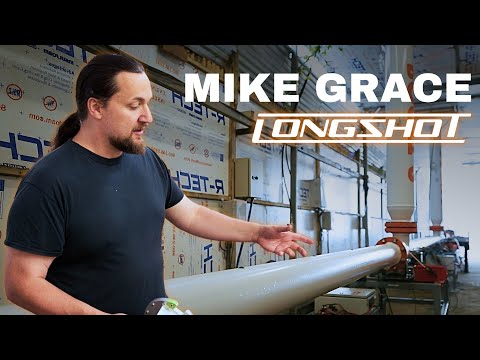
#47 - Building a MASSIVE Mach 25 Space Gun in the Desert | Mike Grace, CEO Longshot
#47 - Building a MASSIVE Mach 25 Space Gun in the Desert | Mike Grace, CEO Longshot
Summary
Mike Grace, co-founder and CEO of Longshot, discusses his ambitious plan to build massive space cannons that can launch payloads to orbit at a fraction of the cost of traditional rockets. The company is developing kinetic launch technology based on ideas dating back to Jules Verne and German engineering from World War II, using simple materials like sewer pipe and concrete rather than advanced aerospace composites.
Grace explains the physics behind their approach: by building very long guns (10-20km) and using distributed gas injection systems, they can achieve hypersonic speeds while keeping G-forces manageable for satellites and electronics. The company has achieved Mach 4.2 with their current prototype in Oakland and is scaling up for DoD hypersonic testing contracts as a stepping stone to full orbital launch capability.
The interview covers the colorful history of space guns from Gerald Bull’s HARP project to his assassination by Mossad, the economics of space launch ($150/kg target vs Starship’s projected $250/kg), and Grace’s vision of opening up the solar system to enable human diversity and expansion beyond Earth.
Highlights
”I want to crack the solar system open like an egg”
Clip command
yt-dlp --download-sections "*0:00-1:05" "https://www.youtube.com/watch?v=QgylXuow4Qo" --force-keyframes-at-cuts --merge-output-format mp4 -o "QgylXuow4Qo-0m00s.mp4"“If you want to do something in aerospace engineering, your task is to find something a German dude worked on in the 1930s and steal it. I’m trying to build a goddamn Panama Canal for putting stuff into space. I want to crack the solar system open like an egg.” — Mike Grace, 0:00
”The gun is made of sewer pipe and concrete - no carbon fiber, no inconel”
Clip command
yt-dlp --download-sections "*5:00-6:05" "https://www.youtube.com/watch?v=QgylXuow4Qo" --force-keyframes-at-cuts --merge-output-format mp4 -o "QgylXuow4Qo-5m00s.mp4"“The gun no longer has to be made of crazy engineered gun tube. It can be made out of sewer pipe, which is what this is. Sewer pipe and concrete. Mild steel and sex appeal, baby. No inconel, no carbon fiber. The maximum pressure is around 1,000 PSI - a third of a scuba tank.” — Mike Grace, 5:00
”The moral of Gerald Bull’s story is don’t build death stars for dictators”
Clip command
yt-dlp --download-sections "*10:30-11:35" "https://www.youtube.com/watch?v=QgylXuow4Qo" --force-keyframes-at-cuts --merge-output-format mp4 -o "QgylXuow4Qo-10m30s.mp4"“Gerald Bull built a gun that shot projectiles 200km into space. Then he got jailed by the CIA, worked for Saddam Hussein building a super gun, and was assassinated by Mossad in 1989. The moral of Gerald Bull’s story is don’t build death stars for dictators.” — Mike Grace, 10:30
”Rockets are expensive because they are flying bombs”
Clip command
yt-dlp --download-sections "*18:01-19:05" "https://www.youtube.com/watch?v=QgylXuow4Qo" --force-keyframes-at-cuts --merge-output-format mp4 -o "QgylXuow4Qo-18m01s.mp4"“Rockets are expensive because they are flying bombs. If one Starship out of 500 catastrophically explodes for no reason, that’ll be the best rocket ever built by man. That risk premium makes rockets inherently expensive.” — Mike Grace, 18:01
”Nothing about Falcon 9 was impossible in the 1970s”
Clip command
yt-dlp --download-sections "*15:41-16:50" "https://www.youtube.com/watch?v=QgylXuow4Qo" --force-keyframes-at-cuts --merge-output-format mp4 -o "QgylXuow4Qo-15m41s.mp4"“Nothing about the reusable Falcon 9 was impossible in the 1970s. We had the materials, we had the computing. The military-industrial complex just had no incentive to make launch cheap. They wanted cost-plus contracts.” — Mike Grace, 15:41
”We started with a 40-foot PVC potato gun in my garage”
Clip command
yt-dlp --download-sections "*37:59-39:05" "https://www.youtube.com/watch?v=QgylXuow4Qo" --force-keyframes-at-cuts --merge-output-format mp4 -o "QgylXuow4Qo-37m59s.mp4"“We started with a 40-foot PVC potato gun in my garage that achieved Mach 1.8. Extremely dangerous. PVC fragments like a grenade. I should not have done that. But that’s where it began.” — Mike Grace, 37:59
Key Points
- Kinetic Launch Basics (0:27) - Unlike rockets where only 1% of mass reaches orbit, kinetic launch keeps all energy on the ground and only the payload flies to space
- Jules Verne’s Concept (0:40) - The space gun idea originates from “From the Earth to the Moon” written almost 200 years ago
- Wedge Acceleration System (3:20) - Gas injected from the sides onto a wedge-shaped projectile allows speeds faster than gas velocity, similar to how sailboats exceed wind speed
- German V3 Inspiration (4:25) - The distributed injection gun concept comes from WWII German weapons technology
- Sewer Pipe Construction (5:11) - The gun is made from sewer pipe and concrete, operating at only 1,000 PSI (1/3 of scuba tank pressure)
- Paris Guns Failure (5:38) - WWI Paris guns destroyed themselves after 60 shots due to heat, teaching the importance of distributed systems
- Gerald Bull’s HARP Project (7:55) - Canadian engineer built a gun firing projectiles over 200km altitude using WWII battleship cannons
- Gerald Bull’s Fate (10:30) - After being jailed for CIA gun-running and building weapons for Saddam Hussein, Bull was assassinated by Mossad in 1989
- $4 Trillion Rocket Investment (11:15) - US and Soviet Union combined have invested roughly $4 trillion in rocket technology since WWII
- Why Not Elon (12:00) - SpaceX went back to Cold War technology; Longshot goes back to WWI to find the truly optimal solution for marginal cost
- Falcon 9 Was Possible in 70s (15:41) - Nothing about the reusable Falcon 9 was impossible in the 1970s; military-industrial complex incentives caused stagnation
- Cost Comparison (18:50) - MVP space gun targets $150/kg to orbit; ultimate goal is below $10/kg (mostly electricity cost)
- 150-250 G-Forces (13:33) - 10-20km gun produces 150-250 Gs, manageable for electronics (phones handle 900 Gs)
- Current Progress: Mach 4.2 (21:50) - Current prototype achieves Mach 4.2 with intact projectiles; could do Mach 6 with hydrogen
- DoD Hypersonic Testing (23:42) - Pivoting to sell DoD hypersonic test capability at $150K vs $15M for rocket-based testing
- Heat Shield Challenge (26:15) - Heating scales with cube of velocity; 50% of vehicle mass sacrificed to ablation at orbital velocities
- Ballistic Coefficient (27:30) - Large, heavy projectiles overcome atmospheric friction better; multi-ton vehicles required
- Real Estate Challenge (31:07) - Finding 20km of suitable land with minimal airspace conflicts is harder than the engineering
- Australia as Location (32:45) - Northern Territory has twice Texas’s land with <1% population; no indigenous space access makes it strategic
- Rapid Reusability (34:39) - Extending gun length reduces temperature and pressure, enabling reuse without barrel damage
- PVC Prototype Origins (37:59) - Started with a 40-foot PVC potato gun in garage achieving Mach 1.8; extremely dangerous
- Alameda Navy Facility (43:19) - Found old Navy gun testing facility perfect for their needs, previously used only for raves
- Tonopah Partnership (45:20) - Remote Nevada town actively recruited Longshot, providing essential local government support
- Opening the Solar System (55:41) - Vision of enabling human diversity through separation; want price of space launch to approach zero
- Human Homogenization (57:30) - Humanity rapidly homogenizing; need space settlement for new diversity and experimentation
- Near Bankruptcy 3x (1:04:46) - Company nearly went bankrupt three times; cut entire leadership to zero salary before last fundraise
Mentions
Companies
- Longshot (0:31) - Mike Grace’s company building space cannons
- SpaceX (12:52) - Inspiration for space industry; Grace wants Starship to succeed but sees rockets as fundamentally limited
- Spin Launch (53:18) - Competitor building centrifuge for space launch; spent $140M to reach Mach 1.6
- Stoke Space (53:45) - Another kinetic launch competitor using magnets
- Green Launch (53:55) - Competitor using light gas gun approach
- Rocket Lab (55:05) - Peter Beck’s company acknowledged as doing rockets well
Products & Technologies
- Falcon 9 (15:41) - Reusable rocket that could have been built in 1970s; currently $65M per ride
- Starship (12:41) - SpaceX’s large rocket; rumored $1,100/kg go-to-market price, Grace skeptical of $100/kg target
- V2 (6:56) - World’s first ICBM developed by Germans
- V3 (4:25) - German WWII distributed gun that inspired Longshot’s design
- HARP (8:15) - High Altitude Research Project; Gerald Bull’s super gun in Barbados
- Paris Guns (5:38) - WWI German guns firing 1-ton projectiles 130km
- Starlink (13:47) - SpaceX’s satellite constellation; competitors want alternatives to Falcon 9 rides
People
- Mike Grace (0:28) - CEO and co-founder of Longshot; economist and molecular biologist by training
- Jules Verne (0:40) - Science fiction author who coined the space gun concept in “From the Earth to the Moon”
- Isaac Newton (2:09) - Drew diagrams of kinetic launch mechanics
- Gerald Bull (7:55) - Canadian ballistics engineer who built HARP gun, later worked for Saddam Hussein
- Saddam Hussein (10:30) - Iraqi dictator who hired Gerald Bull to build a super gun
- Elon Musk (1:46) - SpaceX founder; Grace saw him speak at Mars Society when Elon was bald
- Gwen Shotwell (16:46) - SpaceX president who promised $9M Falcon 9 rides in 2015
- Richard Nixon (15:32) - Blamed for the Space Shuttle boondoggle
- Jeff Bezos (59:35) - Has vision of exporting heavy industry to space
- Brendan (38:28) - Longshot’s “9 foot tall” Chief Operations Officer
- John Hunter (54:00) - Green Launch founder whose talk in 2010 originally interested Grace in space guns
- Joanie Eastley (46:55) - Tonopah town council member who recruited Longshot
Surprising Quotes
“If you want to do something in aerospace engineering, your task is to find something a German dude worked on in the 1930s and steal it.” — 0:00
“I’m trying to build a goddamn Panama Canal for putting stuff into space. I want to crack the solar system open like an egg.” — 0:21
“The moral of Gerald Bull’s story is don’t build death stars for dictators.” — 10:55
“Rockets are expensive because they are flying bombs. If one Starship out of 500 catastrophically explodes for no reason, that’ll be the best rocket ever built by man.” — 18:01
“I would charge what I could… So I think that they need a competitive push to try and get that price actually down. And I long to be that competitive push to make help make SpaceX great again.” — 17:30
Transcript
0:00 If you want to do something in aerospace engineering, your task is to find something a German dude worked on in the 1930s and steal it. Build you a pipeline, maybe build you a 10 to 20 km long space gun. A rocket carries all of the energy necessary to propel it through flight and ends up in space. With kinetic launch, all the energy stays on the ground. I’m trying to build a goddamn Panama Canal for putting stuff into space. I want to crack the solar system open like an egg.
0:28 This is Mike Grace and he is the co-founder and CEO of Longshot. Longshot is basically building massive space cannons in the desert. Do you want to just talk about starting off with what is a space cannon? Well, I think that you should ask Jules Verne. He kind of coined it. From the Earth to the Moon book almost like freaking 200 years ago. Jules Verne was like, “How are we going to put stuff into space?” Well, clearly we’re just going to shoot it out of a gun. So I had a bunch of guys crawl into a bullet and like smack into the moon. And that’s one of like OG science fiction story right there.
1:01 And you know fundamentally the idea can kind of be categorized as kinetic launch. A rocket carries all of the energy necessary to propel it through flight and ends up in space. With kinetic launch, all the energy that you need stays on the ground. It never leaves the ground and only the thing that you’re throwing actually ends up in space. With a rocket, you know, like 1% of the total mass of a rocket ends up as payload, right? And that’s because it’s mostly a machine for lifting fuel. That’s what a rocket is. You’ve got to carry everything with you. So, you’ve got fuel, you have the infrastructure for combining the fuel into a burn, and then you have structure and the payload on top. Only the payload flies with a kinetic launch system.
1:46 And that means that like Elon Musk needs to solve his problems with advanced composites, aluminum, carbon fiber. I can solve my problems with sand and massive amounts of concrete. So kinetic launch, a space gun. The idea here is make something go so fast that you’re at orbital velocity and then you’re just in space. And this literally goes back to like diagrams that Isaac Newton drew of like fundamental mechanics and things like that. It is a tale as old as time. I don’t want to take credit for coming up with this idea.
2:20 All right. So, I’d actually like to talk about basically the design of the vehicle itself. So you were talking about before we turn on the cameras that you can basically make gas push an object faster than its actual total speed. So, how does that work? In a conventional gun where you’re pushing a projectile from behind, you know, gas moves forward one inch, the projectile gets pushed forward one inch. You are limited to the speed that the gas moves. And gas can move faster than the speed of its sound in it, particularly if you’re moving into a vacuum, but you fundamentally reach a limit.
2:55 And that limit for you know even like room temperature hydrogen unless you want to get super hot is well below orbital velocity. So, no gun, conventional gun is going to shoot stuff to orbital velocities. That’s not going to happen. The way that we overcome that is you have this long wedge sticking off the rear of the projectile. And initially, we get things up to like Mach 5 by just pushing behind like a normal gun, which is what this system is set up to do.
3:20 But then you enter a second chamber effectively where instead of pushing from behind, you’re actually injecting gas from the sides onto this wedge. So if you have a long wedge sticking off of the rear of the projectile and gas is impinging in from the sides, if the gas moves, if the wedge is like 5 inches long, right, the gas impinges in one inch, the thing has to travel forward 5 inches in order to be fully displaced. So the reason a sailing vessel can travel faster than the speed of the wind is because it moves at an angle to the wind. That angle is built into this wedge.
3:53 And you know, we thought we were super clever coming up with this idea, but there’s actually like a paper from a German dude we discovered like after a year of working on this idea from like the 1960s describing this idea. And there’s nothing new under the sun. Basically, if you want to do something in aerospace engineering, your task is to find something interesting a German dude worked on in the 1930s to 60s and steal it. That is the trick with success in aerospace engineering.
4:18 Yeah. Is there any other things where you just kind of like found some random paper or something that some guy wrote in Germany? Well, I mean there’s a weapon in World War II that looks a lot like this called the V3. And that’s basically this idea of a distributed gun. So we have multiple injections. This gun here goes bum bum bum bum bum down the length. And what this does is every time you double the number of injections, the maximum pressure and the maximum temperature cuts in half, and the maximum force of acceleration applied to the payload cuts in half. So you can basically stretch the gun out physically and make it much more gentle.
5:00 And you reach thresholds where all of a sudden the gun itself no longer has to be made out of crazy engineered gun tube. It can be made out of sewer pipe, which is what this is made of. Really. Yeah, sewer pipe and concrete. That’s it. Mild steel and sex appeal, baby. No inconel, no carbon fiber, forget all that stuff. The maximum pressures inside of this system is around 1,000 PSI. So like a third of what you’d see in a scuba tank. And that’s a feature. That’s a wonderful feature.
5:28 So what does a gun look like if you give up on mobility? The Germans asked this same question in World War II. They built a bunch of super crazy guns in World War I, the Paris guns, which could fire like a one-ton projectile over like 120, 130 km downrange. They were terrible weapons because these guns gutted themselves over 60 shots. Like the barrel, each shell had to be larger because the interior of the gun was turning into liquid and blowing out the end every single time they shot. So, and then after 60 shots, they’d have to send the barrel back to get reconditioned.
6:08 Was that because the like hot gas? The heat. It’s mostly the heat of combustion that does that. So yeah, forget that. In World War II, the Germans were like, “Well, that was bad. Let’s try something else.” They built this pipeline really on the side of a hill. And instead of boom, it was [multiple injection sounds]. And you can find pictures of it online. We can even throw that up. Yeah, go for it. Look, behold this beautiful picture of this thing online. Wikipedia black and white, baby. It’s lovely.
6:34 So yeah, and they bombarded Luxembourg with a prototype and the plan was to build a bunch of these in northern France around Calais and flatten London, but they got too busy losing the war and getting bombed out of them. But one of the reasons the Germans invested in this is because you need something that you can build while your industry is getting flattened. And this is made out of sewer pipe. So it was comparatively easy to build compared to sort of like the V2, which is like the world’s first ICBM.
7:01 But it also turns out it’s a bad weapon because you can’t move it. Once you sacrifice mobility and your enemy has control of the skies, it’s just a target for bombers, right? So the Americans and the Russians come in after the war and they basically kidnap every German rocket scientist immediately because while the marginal cost of the V2 of rockets is awful, who cares if you’re dropping an atomic bomb, right? If you’re dropping an atomic bomb, the marginal cost doesn’t matter. And also, if one out of 50 of your rockets just fails, who cares, right? You have 50 rockets, you have a hell of a deterrent. Like, you’re going to end all life on the planet.
7:50 So, marginal cost and repeatability and reliability stop mattering in the strategic deterrence situation that the Soviet Union, the United States found themselves post World War II. So, the space gun, the super gun, got put on the shelf. Although, there was a Canadian dude in the 1960s. Gerald Bull. Oh, yeah. Wild Wikipedia article, man. I cannot recommend enough. If you’re looking for a spicy, salacious wiki read, that’s a good one.
8:10 Gerald Bull was a Canadian ballistics engineer in the 1960s who built a super gun called HARP, high altitude research project for the Army for testing re-entry systems, hypersonic test actually. But like most people building a giant space gun, he really wanted to go to space. Gerald Bull built this gun in Barbados that was two World War II battleship cannons stuck end to end with bailing wire that fired projectiles I think over 200 km altitude. Right? So he was like well into what we call space but suborbital speeds. So it came right back down.
8:48 And he had plans for a multi-stage solid rocket to put inside of this gun to put like a kilogram into orbit in like 1964-65 when America was freaking out cuz like Sputnik’s beeping overhead. Everybody thinks that you know the sky is falling. So, but what happened is the army basically transferred this program for like six million bucks. This guy built this thing and it worked. Gerald Bull’s real genius was taking garbage off-the-shelf stuff in scrapyards and turning it into these incredible systems.
9:22 The army got control of it. They passed it off to the air force. There was kerfuffle. Vietnam was going on and everybody was just like… They kind of forgot about it. No, it was like this is going to be a big capital investment to get it to work and we already have missile silos which are these like fixed pieces of infrastructure that threaten Russia. Why invest in another giant fixed piece of infrastructure that threatens Russia? The market wasn’t right, right? Like, okay, you can put stuff into space for really cheap, but what does that matter to us? CubeSats don’t exist. Like 1 kilogram in space doesn’t matter, right?
9:58 Was anyone trying to optimize for kilogram to orbit at that time? No, not at all. Right. And how many vacuum tubes does that buy you? You know, like think about the era. So Gerald Bull was all salty about this. He started a munitions company. In the 1980s he ended up running guns to the South Africans at the behest of the CIA. Then there was a change of administrations and he ended up in jail for 3 years for doing that and the CIA disavowed him. He was really salty after that.
10:26 Still wanted to build a space gun. Looked for another patron who would help him for that. Found a gentleman named Saddam Hussein. Went to Iraq, started helping Saddam illegally build a really big gun. And then got a knock on his door in Belgium from some nice Mossad gentleman who blew his brains out. In I think 1989. And live by the sword, die by the sword, baby. Live by the gun, die by the gun. Right. Yeah. The moral of Gerald Bull’s story is don’t build death stars for dictators is actually the moral of the story there, I think. Okay. He broke bad. He went full Walter White.
11:04 You also mentioned and I think like Ashley Vance’s podcast or interview that you did with him you said basically the US has invested just hundreds of billions of dollars into rocket technology. Yeah. Yeah. The Soviet Union and the United States combined like it’s something like $4 trillion. It’s hard to measure the Soviet contribution, right? Like they were communist. It works different. But something like $4 trillion since sort of World War II in rockets. And that’s defense. That you can put satellites into space with rockets is a happy little accident, right?
11:38 If it was physically impossible to reach orbit with rockets from the surface of the earth because like gravity was too high or something, the world would be bristling with rockets and that’s because they’re great for suborbital applications which are like, you know, murder everybody on the planet. So as long as that remains true, we’re going to live in a world of rockets.
11:58 Yeah. My question is like why hasn’t Elon done something like this? Like I know that he was going after Hyperloop for a while. Well he’s like, he fancies himself a first principles thinker but is he really? I think this is first principles. This is going, he went back to like the Cold War and decided what is the technology that makes the most sense. I went back to World War I and decided what is the technology that makes the most sense. Put that $4 trillion fixed cost and sunk cost investment in rockets out of your mind for a second. Go back 150 years and ask yourself going forward from that point, what’s the right way if what you care about is marginal cost? And it’s not rockets. It’s not rockets at all.
12:36 And you know, I mean, I think Elon’s tens of billions in at this point. I don’t think he’s going to pivot. I think that and I also want to say that like, you know, I want Starship to succeed more than anyone. Like I’m in space to some degree because like SpaceX is an inspiring company that does amazing things. And I also like feel strongly that like I want to go to space and I’m not going to space in a space gun unless I want to get fractionated into my constituent proteins, right? Like I’m going to go in a rocket, but the food that I eat, the air that I breathe, the tools that I use, the habitat that I’m living in…
13:13 How many G-forces does something going through the space gun get? Every time you double the length, you cut the G-forces in half. So, build you a pipeline, maybe build you a 10 to 20 km long space gun flat on the ground, right? In the desert, flat on the ground, and then you’ve got enough of a ramp up that you’re looking at something like 150 to 250 Gs. Now, that’s too much for you and me, right? But your phone is actually designed to take about 900. Like surface mounted electronics are good at that.
13:47 Would a Starlink satellite be able to pull that G? I think so. I mean, if you look at sort of like the forces that satellites are subjected to on vibe tables, like they’re actually pretty rough. The instantaneous kind of like G forces that you’re experiencing from the shake are bad. So, most satellites are designed to be really robust. And like I think that if you get down to sort of like consumer electronics, G-forces, like stuff that human beings drop, right? We’re really bad about that. Butter fingers, the acceleration, the jerk that your phone can experience going from terminal velocity to stopped on the pavement is around 900, 800 Gs.
14:24 So yeah, you’d be surprised how robust stuff is. And like you can also think about like there are military systems, military electronics for like guided weapons and stuff like that that are designed to take 40,000, 60,000 Gs. That’s what you experience in a conventional gun where all of the acceleration is happening instantaneous in one go. Right? So build something that’s crazy long and you develop a system that like, my thought on this is forget about like fuel or aluminum or water. The market for bulk materials in space doesn’t exist. You have to launch satellites. That’s where the market is right now.
14:57 I want to launch telecommunication satellites, lots of them. And I can think of people who would love to be able to compete with Starlink not buying Falcon 9 rides. That’s a little bit, you’re not going to win. You’re going to lose doing that. Yeah. It’s interesting because I was looking earlier today. I think it was like $72,000 per kilogram during the like shuttle era. $72,000. Yeah. I’ve heard $20,000, but like I would believe it. It was nonsensical. It was insane. The space shuttle was a boondoggle. Richard Nixon, blame him. That son of a… We could have just kept going with rockets and probably would have ended up with something that looks…
15:41 Something I said about the Falcon 9 is there’s nothing about that reusable rocket that was impossible in the 70s. We could have built that rocket in the 70s. It’s actually a technically conservative play. It’s just that everybody who works in kind of like this defense aerospace, there are literally negative incentives towards price. Usability and… Well, towards any form of price performance. Like you develop a more efficient system and you lose money. So like the perversity of like the incentives in the military-industrial complex lead to total technical stagnation from the 1960s to you know the 2000s effectively.
16:22 That’s so sad. And so I know from the shuttle to I think Falcon 9 it was like a massive, even let’s say 20,000 I think it’s 3,000, like 500ish something. Okay. So, let’s say 3,000 per kilogram to orbit and then Starship once it’s actually… A little birdie tells me that $1,100 is their go to market price for that. Really? Okay. Okay. And then they’ll come down over time. Oh, they say they will. They never… I mean Gwen Shotwell in like 2015 or something said that they’d take the Falcon 9 down to like $9 million a ride. It’s still at like 65 or so. So, like they say stuff. They say stuff on Twitter. There’s things that are more aspirational than…
17:05 More aspirational and maybe that’s closer to their cost. I would believe SpaceX’s costs for a Falcon 9 are like 20 million or below something like that, but like they’re definitely… Why would they charge less? Yeah. Yeah. They’ve got investors to pay back, you know. So, it’s a company with like 10,000 people or something at this point and an average fully burdened cost of a quarter million bucks a pop. You can do the math on what the monthly burn rate is on that beast. I would charge what I could.
17:30 So I think that they need a competitive push to try and get that price actually down. And I long to be that competitive push to make help make SpaceX great again. You know, push them to be the very best they can be. Yeah. Okay. So, assume that Starship is like fully operational. I think their goal is like at least aspirationally $100 per kilogram orbit, something around that on the order. I’m skeptical. I think looking at it that like they bottom out at like 250 and that would be like they’re selling it for cost.
18:04 Okay? Like I fundamentally, here’s the thing. If one Starship out of 500 catastrophically explodes for no reason, that’ll be the best rocket ever built by man, best orbital rocket ever built by human beings. That is not a recipe for low marginal costs. Rockets are expensive because they are flying bombs. So, particularly when you’re putting human beings on things, there are just stuff that you have to do to make them safe that are exhausting, hard things to do. So, I think that from the physics up, this is not a technology that lends itself towards long-term low marginal costs.
18:50 They’ll have to get to an incredible scale, like they’ll have to be launching like megatons a month to get to a point of like really driving down cost to that level I think. Yeah. Okay. So, let’s just assume the 250 or even 350 price point somewhere around there. 250. Let’s say 250. Let’s say 250. For this once you actually have your, you know, 10 to 20 km long, you know, 2 meter wide tube. What’s your like general cost or expectation?
19:16 My MVP, my minimum viable space gun, right, is something on the order of $150 a kilogram is my go to market price, right? And then the thing that I build that’s my version of the Falcon 1, right? Yeah. My version of Starship is below $10 a kilogram and really like the majority of that is electricity. So to the degree that you think that the price of electricity could drop as like you know solar continues to just get better and better and better or like people put like small modular nuclear reactors online, this sort of thing, then I think it could go lower than that.
19:52 Okay. So in the limit like assume that you are launching huge amounts of mass orbit. How much in a single launch do you think you’re going to be doing? Again on the MVP. Yeah, I think it’s like payload is something on the order of half a ton, 500 kg. So that’s like two sort of like of these low earth orbit telecommunication satellites. Two or one, something along those lines. On the big mama jama, what we call papa bear. So we have baby bear, mama bear, papa bear. Papa bear is legitimately unhinged.
20:25 I actually think, let’s back up just talking about mama bear. That’s a 20 ton bullet. 20 ton payload inside the bullet. So that’s a Falcon 9 direct competitor right there. Crazy. Okay. Yeah. Do you want to talk about like kind of the iteration process of going from this to I believe it’s like four or five times the size?
20:49 Yeah, we have a, you can if you hear the grinding right now that is what is going on with a, it’s not quite a meter interior diameter gun. It’s some about 70 cm, I think 29 inches. So, steel, normal steel pipeline. We’re building, we’re basically scaling this prototype up in diameter, but it’s going to be a much much larger gun to a higher speed. So, the core technology risk to buy down with this thing is timing. Like if you’re going to do this kind of an operation we were describing earlier where you have to inject gas onto a vehicle that’s moving at high hypersonic speeds, you have to be able to have a large high pressure orifice go from closed to open.
21:30 That has to happen super quickly and it has to happen with great repeatability and precision like microsecond level precision, tens of microseconds. And that’s the problem that this solved. So we’ve addressed that at this point. This gun has shown the level of precision necessary to drive a space launch system that goes to much higher speeds.
21:50 Now, what Mach has this been able to achieve? 4.2 but 4.5 if you squint. Okay. And I could do like, things have come out of it at that speed. Not fully intact projectiles, but bits. In terms of like fully intact projectiles for flight, like yeah, 4.2. And we could do like Mach 6 with this, but we’d have to use hydrogen as the working fluid. And that is just a hair too spicy for downtown Oakland. Like I don’t want, I don’t need that kind of heat, man.
22:20 If that went wrong. Like, how big would the explosion be? Big. Big. Big fuel air hydrogen explosion. It’d be a big boy. Might be the end of Longshot. I mean, we’d probably live, but legally, yes. You know, we’re within a couple blocks of people’s houses. That’s basically a Chuck E. Cheese behind me right there, you know. So like I ain’t looking for that. We use helium when we’re trying to go to speed. When we’re out in the desert, hydrogen makes a ton of sense and it’s much cheaper.
22:55 And this whole thing like the bill of materials cost for this gun is like 40k. Like yeah, it’s cheap sewer pipe man. And yeah, talk to somebody. Ask them what the bill of materials is for like 1 kilogram to Mach 5. You’re able to get something to Mach 5 with $40,000? Yeah. Well, the gun, I think that like the per shot cost to count engineer time and stuff and like operating it because this wasn’t really ergonomic. It wasn’t designed for turnover. I think that’s like five grand, something like that.
23:30 Still think blue plate special prices, baby. So, yeah, if you’re doing magnets and stuff like you’ve got to have like cryogenic cooling, you’ve got to have like capacitors like you know your suitcase size gigantic capacitors and stuff. Stuff gets expensive really quick. This is sewer pipe and gas cylinders, man. So, yeah, use your great-granddad’s technology to solve what problems you can is the fundamental lesson.
23:55 Yeah. Okay. So, for scaling this up, what is that going to look like? So, basically, I tried pitching Longshot as a space launch company for like six months when I first came out of the gate with this thing. I just got kicked in the nuts. Nothing happening, right? Elon owns the whole thing. Don’t worry about it. You’re crazy. Peace out, homie. So basically I realized that, you know, the gap between what I could build in my garage and a space launch system is simply too large.
24:25 But there is an intermediate market. Like if you can make it to Mach 5 to Mach 15, boy oh boy does DoD want to be your friend. Right now if you’re the Air Force or the Navy or somebody and you’re trying to throw like hypersonic zooi boomies to high speeds either for like shooting purposes or for tracking or for testing your own things, heat shields, scramjet, ramjet, sensors, whatever. You buy rockets. Well, what is true above is also true below. If I’m two orders of magnitude cheaper than Elon, I’m two orders of magnitude cheaper than anybody who’s trying to sell sort of like a sounding rocket.
25:05 So, if you’re DoD and you’re spending 15 million bucks for a hypersonic flight test, hey man, I’ll sell it to you for $150,000. And that’s actually the pitch that I have in with the Air Force right now. Like, let’s go big potato gun on the ground hypersonic free-flight test for two orders of magnitude cheaper than you’re used to. Get in on the deal, baby. Yeah. So I think that’s a very compelling case for hypersonic technology development. And then like there are other spookier DoD applications. I will not discuss on a public podcast, but like if you’re in the Missile Defense Agency, give me a call, baby.
25:48 So yeah, I think that there’s stuff in that direction as well. Hypersonic test is kind of I think the thin end of the wedge for DoD work. And that basically gets you from like Mach 5 to Mach 15. And then you have like this kilometer long, like meter interior diameter system out in the desert doing this cool work throwing like, the vehicles are going to exit, hit the atmosphere and turn incandescently hot instantly. It’ll look like a meteor, right? The gap between that and a space launch system in my opinion is just a little crack of light. So the imagination that you’re demanding from people collapses at that point. And I think, you know, 250 million bucks doesn’t seem like a lot of money.
26:30 So if you actually are able to, you know, accelerate something, an object to Mach 25. 25. Yeah, Mach 25. It’s on the order of like 7 kilometers per second. Do you have to put like a heat shield or something on the top? Jesus Christ. It’s all heat shield. I mean, and so here’s the thing. Like the heating with the atmosphere as a function is a cube of velocity. So the faster you’re going, like the worse heating gets super super fast.
27:00 But the moral of the story here is if you had a feather and you threw that at Mach 5, you got the best arm in the world. You throw that at Mach 5, it’s going to stop and burst into flames immediately, right? It’s gone. It’s ash instantly. If you have a bowling ball and you throw that at Mach 5, it’s going to go through a few houses before it stops. The moral of the story here is ballistic coefficient.
27:25 Like, so heating and friction go up with the cube of velocity. That’s bad. But the way that you get rid of heat and the way that you overcome friction is respectively volume of ablative material and mass. Mass is a function of volume as well. So volume also goes up with the cube. So you got surface area is another part of that heating function that’s squared, right? And as you get chubbier and chubbier and chubbier, you got more mass to sacrifice for ablation and to just hold kinetic energy, momentum, so you can penetrate the atmosphere.
28:00 So go big or go home. You’re not throwing something small to space. Not in this atmosphere. Oh, so there’s like actually a requirement of you have to make the space gun big enough. Yes. The vehicle needs to be multi-ton. If you try to throw a 150 kg vehicle, I actually think there’s a guy at the University of Washington who’s done the math to show that there’s no material known to man where you can throw a 150 kg bullet at orbital velocities. If you throw it fast enough that it can overcome friction to still have orbital velocity in space, it’ll burn to ash. And if you throw it slow enough that it doesn’t burn to ash, friction slows it down and it falls back in.
28:40 But when you’re over that threshold, you have enough embodied momentum that like a little charred nugget can actually get out. And then as the vehicle gets larger and larger and larger, its guts get bigger so much faster than its surface area does that eventually you’ve got something where like on a two-ton vehicle almost half of that is going to be sacrificed to ablation. It’s going to turn into gas, right?
29:10 For perspective like the Apollo capsule is like the fastest object to ever carry a human being. Like 3% of the Apollo capsule was ablative material. So we’re talking about 50%. Because the Apollo capsule slowed down in the upper atmosphere. We’re in our highest speed in the lower atmosphere. So immediately half your vehicle, it’s going to the Lord. Goodbye. It’s off. As the vehicle gets larger, a 20 ton vehicle though has like two tons of ablative material on it. Right. So a lot more efficient.
29:50 Yeah. You can think about it like this. The nose of the vehicle isn’t getting that much larger, right? So yeah, have a large dense heavy body and throw it. So the trick then is what is the cheapest way to make something really really massive go fast? Steal Nazi technology clearly. Yeah, that’s the story.
30:15 So for the vehicle side, I do think though that like I’m totally prepared to admit that that vehicle flying through the atmosphere like nobody’s ever gone to orbital velocities free-flight in the lower levels of the atmosphere. That’ll be new. That’ll be new. So I think that in terms of technical risk that’s significant. I feel pretty confident about Mach 15 because that’s actually a lower speed than a lot of warheads. And warheads do travel in the lower atmosphere so they can get their atomic bombs nice into the ground safe and cool and sound. So, there are technical analogues to sort of like that work that go back to the 1950s and 60s. So, I’m confident about that. The transition to Mach 25 will have to do like legitimately new stuff.
31:07 What’s the like biggest technical hurdles that you’re kind of worried about or thinking about day to day? I think that it’s that heat shield and vehicle work and, I’m super confident we can build something that can survive the heat loads by just making it big enough, but like I also want to get price down. If like I can build it, but I’m like only 10% better in cost than Elon, I’ve failed, right? So, it both needs to be able to protect a payload exiting the atmosphere and it’s got to be made out of like wood chips and phenolic resin, right? It’s got to be made of very cheap basic materials and we have to overcome the technical challenges with scale size, brutal Soviet enormousness, right? Like that’s how you solve hard problems in my opinion.
31:52 Yeah. And so when you’re thinking about getting you know let’s say a 20 km stretch of land like that… My hunch is that it’s not easy to prepare 20 km. I think that because like engineers are the people who think about this problem. They don’t think about the real estate side. I actually think one of the reasons why nobody’s ever built a system like this is more to do with real estate than many people realize. String together 20 km of land.
32:20 You know it’s the noise. Like people talk about like oh there’s this mountain in Ecuador. People live near that mountain, right? It’s a national park. Convincing a nation state that this is like a valuable use of like your national park that’s like right next to a city and we’re going to create sonic booms there multiple times a day that are like the worst ever heard by human beings. If you think the Concord was loud, wait till you get a load of this. You want to put this gun somewhere where you could detonate an atomic bomb and nobody would notice. That’s the ideal type of location for this, right?
32:55 So like you’re very limited. And this is why Longshot is built flat on the ground, right? Like we’re not elevated because one, nobody’s going to give you the right mountain. Nobody. Like, good luck. You’re not going to find it. There’s no 10 kilometer long slab of mountainside doesn’t exist on this planet. Also, it’s orders of magnitude harder to build that if you can build the thing flat on the ground. Turns out there’s a lot of open desert on the planet Earth.
33:25 Australia, great. The outback, Northern Territory, Australia has twice the land area of Texas with less than 1% the population. If I was trying to hide an atomic explosion, that’s where I’d put it. Australia has no indigenous access to space. They want to launch a satellite, they got to send it to the United States or they got to send it to India, right? So, for them, it’s like a strategic game changer.
33:55 You know, I’m actually an economist by background. My bachelor’s degree is in economics. You need to find a nation state, a ministry of defense, somebody for whom this is a big deal on like a strategic level. And that’s how you get… You need like local government, jobs jobs jobs. You need local government, you need regional government, you need national government buy-in to try and do a project like this. And that’s true of like a lot of big industrial projects. I think startup people don’t typically think about those constraints.
34:30 Is this something where the US would want some other nation to have it put on their land versus ours? I mean, I think that you know what, the hard part about building the United States is not the land, it’s the airspace. So the United States lower 48 is one of the densest markets of air flight overhead in the world. And if you’re doing space launch, you’re talking about shutting down big corridors. And like even if you’re in like Tonopah, Nevada, we’re deploying a hypersonic test system there. It’ll be half a kilometer long. I would love to go to altitude.
35:05 But the trick is Tonopah’s between Chicago and LA, you know. And I think that for space launch, you need to go somewhere where the air is free, you know, because I want to launch multiple times a day. I want to crack the solar system open like an egg, man. And that means megatons. And that means many many launches. So I think that Australia is like a great place to do it. I think you could also like Alaska’s also got some land for Alaska, but it’s chilly. Don’t like it.
35:40 Okay. So for the system to basically be rapidly reusable, Nathan was talking about basically you can’t use hot gas or else it’ll just liquefy the inside of the… Yeah, you can use warm gas. And by warm I mean like a few hundred degrees C, but you know in an artillery system you’re looking at like a short period of being like the temperature of the mantle of the sun. And that’s what damages your steel. Is extending the cannon basically advantageous for both lower G plus you can use much cooler gas. Okay. Interesting.
36:12 Yeah. So lower pressure, lower temperature. Every time you double the length, the energy density of the system cuts lower and lower and lower because you’re basically investing that energy over greater length and greater time. So you don’t have to have this huge violent event. You have many many small, not a gigantic crack. Is there a reason that you wouldn’t go for like 40 km?
36:40 No. And I want to. And I think that if you start talking about Papa Bear, which I literally hesitate to mention because it sounds… Papa Bear is on the order of like 7 to 8 meter interior diameter and it’s throwing 100 tons. That is throwing a full Starship as a bullet. All right. And that gun might be on the order of 70 kilometers long. The curvature of the earth starts to matter. You have to cut the ground, right? You’re not going underground, but you’ve got to cut it. And you have to find like the right topology to make that make sense. And that’s a multi-billion dollar project, but I still think it’s cheaper than building Starship.
37:20 Let’s say that you have something that can launch… Oh, and for the record, it’s almost all concrete. Yeah. You’re basically building a concrete… Multi-billion dollar concrete structure. Yes, exactly. It’s a concrete hallway. The concrete is actually mostly there to function as a vacuum. It’s keeping the atmosphere out. So you got to pump that down when you want to fire because you can’t compress gas ahead of yourself as you’re trying to accelerate to these speeds. Won’t work.
37:55 Is there anything where you’re genuinely concerned about like the physics just not working? No, not really. Like I think that like it turns out two dimensional gas dynamics are pretty simple. And like the physics are extremely uncontroversial. I do think that the numbers are big, like the particularly the heating numbers on exit with the atmosphere. The gun I actually think is actually kind of trivial. The accelerator is trivial. Atmospheric transit is not.
38:25 So I think that to the degree that we have technical risk, it exists in that space between Mach 15 and Mach 25 in flight. But you know what happens when you build the world’s best hypersonic test system for the DoD? You have the world’s best hypersonic test system. So like we’ll be uniquely suited to solve those problems once we get this thing built that DoD is prepared to butter me up for. So, that’s a… I think we’ll be well positioned to answer the question.
38:55 And you know what? If I can’t go to space, okay, I’ll sell all the defense applications to Raytheon and like cry my little eyes out from like cocaine island that I’ve built out of just pure airdropping cocaine into a gigantic island where I’ll live the rest of my life, you know, crying with my $100 bills to wipe my tears. I’m lighting Faberge eggs on fire every morning. Like, I’ll be super loaded and it’ll be fine. But the good Lord put me on earth to go to space though. So that’s where my focus is on the long term.
39:35 Let’s talk about like the early days and what kind of was the early iterations of this and what went wrong. Did anything go horribly wrong? Oh. So the early iterations of this were in my garage. They were made entirely of PVC from Home Depot and it was a multi-injection potato gun and it was scary as [expletive]. Definitely the most dangerous thing we’ve ever done, right? Because like I’m not an engineer. I’m an economist and a molecular biologist who’s handy, right?
40:05 And PVC is dangerous. Like it fails in a catastrophic mode that steel actually doesn’t. And it gets soft when it gets warm in the sun and all kinds of scary stuff. So yeah, I built like a Mach 1.8, 40 foot long PVC potato gun with Brendan, my 9 foot tall Chief Operations Officer. So neither of us are engineers. We’re in my garage. We’re at friends’ places. We’re doing this stuff. I’ve got no money. I didn’t take a salary for like the first year and a half of Longshot. I have to make real sacrifices to do like a hardware startup. That’s crazy. This is obviously crazy.
40:45 So, it’s hard. And early on like those pressure vessels sometimes they’d fail. Like when we had stuff going up to pressure, we’d like want to be behind a steel plate. Like it was very sketchy. And we did have some explode and it was scary. Do you have videos of that? Not of the failures, but we do have video of that old gun, that old big potato gun. Mach 1.8 with PVC though, like let me tell you, that’s an accomplishment right there. Yeah. Like PVC does not want that to happen. The universe is fighting you, you know. But yeah, you draw vacuum ahead, a lot of pressure behind, use helium, and you can go to really high speeds.
41:25 Really high speeds with this gun. So once you build it and you’re testing it, like what are you testing for? That’s a lot of actually vehicle work at this point. So we like the burst discs are really important for this. And then like figuring out how to align the rails and like what are the actual tolerances that matter on the rails is a question. Now we’re instrumenting the projectile so we can get vibration and like we want to get telemetry off the vehicle which is challenging because there’s a safe behind me with two tons of concrete in it and that’s what stops the projectile.
42:00 So you’re going to get telemetry off of it. You better get it off of it quick, you know, before it absolutely obliterates. Before it obliterates. So yeah, but that’s actually like important problems to solve if we want to do the hypersonic test application as well because if we build this thing, you know, 100 times as large out in the desert, there’s going to be something also very large and concrete downrange of that that’s going to stop it. So, we need to get the customer’s telemetry off before the thing is halted.
42:35 So these are like there’s still good technical problems we can solve with this thing. Although I do think it’s just about run its course. I want to get bigger. This is Tinker Toy right here. Don’t lie. How long have you had this? It’s like two and a half years. Two and a half years. Two and a half years. But it’s grown in stages. Yeah. It’s been through many iterations. How many iterations has it got through? Oh jeez louise. I mean you get into like version 1.15 and stuff. It depends how big of a change you consider to be a big change. I’d say that we’ve built two barrels which were basically like we figured out a better way to align the thing. Let’s just go back to square one, weld it, and like reinstall the rails. We’ve done that twice. So, I suppose you could say that we’ve gone through three iterations of this diameter of gun.
43:25 Yeah. I would even imagine like if you have an object moving at Mach 25 or Mach 5 or Mach 10, the wheels, like if you had wheels to align along the pipe, it would just kind of explode because it’s moving so fast. No, you can’t. Yeah, that wouldn’t work. The way that this guy works is you’ll actually see there’s plastic bushings made into it. Those are press fit onto the rails and friction turns that plastic into a gas. So there’s actually a layer of plasma between… Yeah. Between the HDPE or teflon.
43:55 So the thing is people have known this like Gerald… This is Gerald Bull actually. This is like the 1950s, 1960s because they had like gas guns which actually go faster than this thing ever will. So just like superheated hydrogen can get you up to like orbital velocities pretty easily. And so what you do is you have your vehicle and it’s in a cup that’s made of like teflon or HDPE. You never want to have metal on metal. So you have plastic on metal and then the plastic gets super hot almost instantaneously and it doesn’t gall or anything because there’s this barrier of gas. It’s almost like you’re on an air hockey table between you and the walls.
44:35 So yeah, a dense hard plastic between you and the steel is the way to do it. And then as the plastic wears out over the shot, you basically have like a hard spring forcing more of it in. So you’re feeding this puck of plastic into the rail. How strong does that spring have to be? Strong. Yeah, you want a couple thousand pounds of pressure. Okay. But like no steel steel. You want like a heavy like a leaf spring basically made of steel that’s driving that in.
45:05 One thing that’s really special about this company that I’ve heard of a few other kinds of companies is there’s like specific space for certain types of businesses where no one wants the space except for a massive gun company or cannon company. And then suddenly it’s like the perfect space for you. So what’s it been like finding first this place and then also the new place that’s going to be like a few thousand a month?
45:30 It turns out there’s this old Navy gun testing facility at Alameda Point which is the old naval air station that Alameda the city now controls. And it’s just perfect. It’s like this 300 foot long, 20 foot by 20 foot by 20 foot hallway. I couldn’t imagine a better test facility in the San Francisco Bay area. By the way, the view, it’s on the water. You can see to San Jose to Alcatraz, right left to right on this thing. It’s amazing.
46:00 And then inside, like they used it for testing the Phalanx guns, which were the Navy’s point defense guns for their ships. You can actually see spray marks on some of the steel walls from where the bullets had pinged off and stuff like that. And yeah, it’s been closed up since the 1990s, I think. And I think like the city of Alameda has like given permits for people to use it for raves a couple of times and that’s basically been it. It’s got crazy acoustics on the inside.
46:30 There’s like nothing wrong with it, right? No, it’s great. It’s just… And it’s not old enough that it’s made out of like a block of asbestos. It’s modern enough that it doesn’t have those problems, right? So, it’s like this awesome facility that is perfect for us. And I’m furious at myself for not knowing about it earlier. Why didn’t you? I had a friend tell me about it and I think I was just too busy. I think I just like was just like too distracted with like day-to-day fire putting out to like put much attention into it. We had this facility and I was like this is good enough. I can make do with this. But like looking back on it that was a mistake. It would have been a stroke of luck to run into that like four years ago when the company was starting. I could have just built in there and that would have been awesome.
47:20 When you’re thinking about first starting to build that massive test site in the desert, how do you even… What’s like critical path to launching something? Well, I want to say that like my thought is that the technology and the physical infrastructure, the engineering side is the easy part. It is, you’ve got to interface with a local community. You have to get people…
47:50 There is a video of the Spin Launch guys at a town hall meeting in Hawaii. And if you want to see the most… It’s like somebody crossed over between Parks and Recreation and an episode of Silicon Valley. Like it is like “your rocket’s going to give my cat cancer.” And like you know, they dropped, that was a bad meeting, you know, an hour long of like a bunch of like kooky old people in Hawaii, you know, yelling at these young Turks to get the hell off their island before they hurt their property values.
48:25 You have to find a local community that wants you. Once you have a local community that wants you, then you talk to like a county, then you go to the state, then you’re talking to congressmen and everyone, right? But there’s like a whole process that you have to get to make sure that the people who are there want you. And if you don’t do that, if you come in like, “This is going to be great. It’s going to be great. It’s going to be awesome. Don’t worry, guys. Everything’s fine. We’re smart. Like, we’re smart dudes from California. We know what we’re doing. You idiots.” People are going to be very angry. You’re going to get nowhere.
49:00 So, I think that there’s almost kind of like a political economy and small town politics dimension to getting this stuff built that again, people in this town just don’t credit that that’s important and how hard that is. That’s real work and if you don’t do it, you’re going to be in trouble. So when I think about like building a big… And you know the thing is people who do gold mines and people who do oil and gas, they know this. They are totally hip to this game, right? But like people who are normally thinking about like I’m going to build like the technology problem is the most difficult problem to solve, suddenly it’s actually regulatory.
49:40 Right because these companies are started by technologists. I consider myself a technologist but in my heart of hearts, economist man. Economist. So I think it just gives me a different view on the situation. And I think that if you’re talking about large-scale infrastructure which is really what Longshot’s doing, I’m trying to build a goddamn Panama Canal for putting stuff into space. That’s an infrastructure project and it has the problems and the benefits of infrastructure projects. So yeah, that’s my thought on it.
50:15 Do you have any specific story of like some great serendipity or some people engaging with you because of this like this is an awesome company or an awesome idea? You know, I want to say the town of Tonopah. I was reaching out to like lots of local municipalities sort of like around Mojave and around Nevada and a bunch of things and just like calling people on like town councils and stuff like that trying to find something and just like radio silence for the most part.
50:45 But this woman Joanie Eastley who’s on the town council, basically the city council for Tonopah. It’s a town of like 1,500 people. Most geographically remote community in the continental United States. Really. It’s like a lithium and gold mining town that’s like equal distance between Reno and Vegas. It’s like a three-hour drive from Reno, three-hour drive from Vegas, middle of nowhere.
51:15 But like they reached out and they were like, “This looks super cool. You should come out and use the airport that we have here. We have an old World War II bomber training air base here that’s like basically gone that like we need people to use. You should come.” And they were super pro-business and they were super welcoming and they brought us out and they helped us lobby with the county and with the state and they were really supportive. And like that’s probably why we’re building out in Tonopah.
51:50 I’ll say that like that was amazing. And I’m super grateful to Joanie and everybody in the town and like because you know you’re never going to get like a congressman to cram you down the throat of a town. It doesn’t work that way. Like they want you to do the work. They have to want you to be there. Yeah. I don’t want to lose the votes of jamming you down these people. The lobbying doesn’t work that way. You’ve got to go from the ground up. And you know, the town of Tonopah being open to it. So yeah, they’re like super pro on national defense and like space stuff. Like yeah. Great. Awesome jobs.
52:25 Yeah. That was incredible. That was completely unexpected. Totally unexpected. Yeah. I was blasting. I’m not shy. I have a quantity approach towards sort of like outreach and so I was just like going after everybody. Gabs, Goldfield, whoever I could. And I got one reach back and that was like just the right person in this community. I got lucky and hit.
52:55 Has there been on the hiring side? I think this is probably one of the only companies in the entire world or the only company trying to launch things into space through using… No, I can think of three others. Three others. Spin Launch is still around. So that’s a, they’re building a centrifuge for lobbing stuff into space. I think they’ve blown through like 140 million bucks. And I want to say I got to Mach 1.4 after spending like three million bucks. And I think Spin Launch got to Mach like 1.6 or something after spending 140 million bucks.
53:30 Wait, but didn’t you get to Mach 1.2ish just on a PVC pipe? Yeah, on a PVC pipe. I literally spent like $13,000 I think or so on that. And like I think that if you… And they might say like, “Well, our thing was a lot bigger.” And that’s true, but if you have to build something that costs $140 million to like prove that you can do that, you got a problem on your hands.
53:55 So, there’s Spin Launch and they’re actually still around. But I thought they were about to go kaput, but I think the DoD puts some more money in them for like non-space launch purposes. There’s Stoke Space. They’re doing magnets. Magnets. How do they work? I think the insane clown posse fundamentally recapitulates my thesis on this matter. So they’re in LA and you should totally talk to them. They seem cool.
54:20 And then there’s Green Launch. They’re doing a gigantic light gas gun approach and they’re I think they’re just about done now. But John Hunter is a really smart guy. Seeing a talk by him back in like 2010 is actually what got me interested in this idea originally. Yeah.
54:45 I was thinking from more like a hiring side. I imagine that then there’s this is an interesting idea and problem to work on and so I imagine that you have quite a few people that are kind of like… I couldn’t imagine trying to do a startup like… There are hard things about doing a hard tech startup. It’s not hiring. My problems revolve around like telling a plausible story about like capital generation and like closing a business case and speed to investors. People want to work on this stuff.
55:15 Like I think that one of the reasons why SpaceX gets to treat people like the Morlocks did like with the surface dwellers that they cannibalized in that HG Wells book. That’s how they treat their engineers and they get away with that because they work on the coolest stuff on the planet Earth, right? They work on rockets and if you’re an aerospace engineer, you were born to work on rockets and there’s one company that’s doing it well on the planet Earth right now. Okay. Okay. I’m sorry, Peter Beck. I’m sorry. All right. Rocket Lab’s cool. Don’t get mad at me, Peter.
55:50 But SpaceX is king of this domain. And aerospace engineers, every single aerospace engineer on the planet Earth is a chemical engineer who decided to take like a 50% pay cut to do something awesome. Yeah. Right. These are people who care deeply about working on cool stuff. They just care about that. And so like give these people something cool to work on and they’ll break themselves for you.
56:20 And I feel like SpaceX has taken too much advantage of that, frankly. Like they’re not kind to their employees. But they show up, man. They show up. They’re wonderful. They’re inspiring people to work with and for and to hire like yeah. I can’t imagine doing like some B2B SaaS. I could not imagine that, man. That’s got to be absolutely soul-wrenching. Can you imagine standing up in front of a bunch of people like, “Yeah, we’re going to make the world a better place. We’re building a blockchain supported dating app for Latinx dog walkers. Kill me. Kill me.” Like, oh my god. I’d rather go work at a fan company, which is basically suicide for me. That’s like the worst thing imaginable.
57:00 You were telling me off camera, bigger fish to fry than Mars. Yeah, bigger fish to fry. Elon talks a lot about Mars and I actually saw Elon speak at a Mars Society symposium when I was like 15 years old and he had his original bald head before he got all the hair plugs. The 2000s. Yeah. Yeah. This was Falcon 1 times. So, they were early. They hadn’t actually been to orbit yet and everybody thought they were stupid. This was the everybody thinks SpaceX is dumb era.
57:35 And even the Mars Society, which is not like a super grounded group of individuals, were like, “Oh, yeah, this dude.” That was totally the vibe. But yeah, he came in, he was bald, OG Elon with no hair. And yeah, came over and gave a talk. That’s what I saw then. So, even, you know, very early on, he was like hanging out with Bob Zubrin and had the Mars idea in his head.
58:00 That’s what I refer to as a very planetary mindset. I think that like if you’re going to spend a bunch of juice getting out of the gravity well, why put yourself in another gravity well? The thing to do is sort of like get human beings to live in the broader solar system. Like the solar system as a whole has like the stuff necessary to support a human civilization of trillions of people at an American level of consumption. Like the stuff, the energy is there.
58:35 Yeah, a planet is cool, but like I don’t think that it’s going to be… Okay, so let’s talk about biology for a second. I’m a biologist, master’s degree in molecular. I’m a bacterial geneticist by training. Today like I would say that there’s some dude of my same demographics, my same age in let’s say Shenzhen, China, doesn’t speak English. I have more in common with that guy than my great-grandfather, who was an Irish peasant, had in common with a Welsh peasant.
59:05 Right? Like the guy in China and I have probably both seen Star Wars. We probably actually play some of the same video games. We both know about germ theory. Like we have all this stuff that is in common. We can buy plane tickets and go anywhere in the world. We have a whole bunch of stuff in common. My great-grandfather may or may not have been intelligible to the Welshman, right? They had different religions. They had different expectations about society and social and everything. And they had completely different educations about the world, very different life experiences, right?
59:40 Human, we’re going through a period of incredibly rapid homogenization as a species that we don’t really notice because it happens on a time scale that is sort of like outside of the scope of what most people encounter. But if you think about this in the biological analogy, the way that you get diversity is you have radiation, separation, and then natural selection takes place over time.
1:00:10 Two lizard populations get separated by some natural catastrophe or get put on a different island. They adapt and the population over here, the daughter population is subject to different conditions and as a result they go in a different direction biologically over time. And then those populations can recombine later and there’s this wealth of diversity and you can then kind of go through this sorting process of finding diversity within that option pool and it helps you solve more problems. And that’s why diversity is like a valuable thing for a population to have. It helps you solve problems and too much similarity is a potential vulnerability and a danger.
1:00:50 Because a disease could come along, something could come along. Humanity is going through a process right now of sort of harvesting an enormous reservoir of diversity that’s been built up over our entire history right now. The number of languages is collapsing. The number of ways of thinking about the world is collapsing. And this is a good thing in that we are adopting and expanding on the very very best ideas and the very best practices that we’ve got. Also, it is a potential vulnerability in that the failure modes start to coalesce and harden, right? And they don’t become local failure modes anymore. They become global failure modes of these various ways of thinking, ways of being.
1:01:30 If we actually want to build up new reservoirs of human diversity, you need separation and you need different conditions. I don’t think we can get that on the planet Earth anymore. I don’t think we can. I don’t think there’s enough space. There’s not enough elbow room here. You are never more than a 24-hour trip away from anywhere else on the planet Earth today. You could get to McMurdo station if you really wanted to spend the money, right?
1:02:00 So the planet Earth has kind of collapsed to a point and that’s accelerating even more. Like language barriers with like AI tools in 25 years not going to matter at all, right? Effectively there’s going to be one global language because we’re going to be able to talk to people… Global communication. Yeah. Yeah. You’re going to be able to walk up to somebody in Vietnam and just have a conversation with them completely naturally, natively. I think that’s going to just happen.
1:02:35 And so the world collapses to a point. Where does our future diversity come from? I think we need people going new places. I want the solar system to open up. I want like… The United States was settled by a bunch of convicts and religious weirdos. Those are the people who came. Like the Spanish had a different approach towards South America because there was like silver and gold to pillage. North America didn’t have those concentrations. And so you got a bunch of like religious weirdos and fanatics and you know the Mennonites and the Pilgrims and you know religious convicts sent over here to like do indentured labor and stuff like that.
1:03:15 I want the barrier to entry for going to new places in space to get low enough such that weirdos, just straight up weirdos can decide like this conservative Mormon enclave wants to go to Enceladus. Awesome. Knock yourself out guys. Some billionaire wants to try and start a Trotskyite commune on like an asteroid. Fantastic. You know, great. You’re almost guaranteed to fail. We need lots and lots of experiments.
1:03:50 And I think that like, you know, I think the room for experimentation in new political, economic, biological systems here on Earth is… It’s gone. It’s collapsed. The kind of goal is you basically want to make the cost to orbit and the cadence to orbit so cheap that you can basically just send insane amounts of mass to orbit and go build civilizations elsewhere. Yeah. Yeah. Yeah. A build brand.
1:04:20 I don’t, I think whether or not those are legitimately different civilizations or whether or not like we’re all part of some conceptual whole. I’ll leave that for future people to sort out. But I think that I want the price of putting stuff into space to go to zero, right? There are other ways to make money. I don’t want to make money putting stuff into space. That should be zero.
1:04:46 And if that goes to zero, there are a lot of businesses out there right now that are being developed that hinge on the price of orbit, right? Like people who are trying to deploy in-space solar power systems or want to mine asteroids. If the price of putting stuff into space goes to zero, those businesses go from batshit insane Silicon Valley venture capital plays to gold-plated overnight, right? If I can make those people billionaires, I can scrape up enough for myself to make a business case closed. I own the railroad for God’s sakes, right? I don’t need to charge people for access to space to make money and I want to give it away for free. That is what I think the right price for putting stuff into space is. Like it should be the same cost for sending air mail to Europe from the United States.
1:05:30 Just asymptote to zero. Yeah. Yeah. It should asymptote to zero. It should effectively be a rounding error on everything else, right? Maybe you buy fuel in space. Yeah, like sell ads and like use that to fund the space launch system. Just beam it on the moon. Yeah, that’s how you make your money. There are other business models that make sense. I want the price to go to zero for putting stuff into space.
1:06:00 Is this one of those things where you can actually launch like, I know right now I think it’s 15 Starships have to go up in order to refuel one Starship to go to Mars and this… Send fuel up into space. Totally for cheap. Absolutely. And I intend to. I do think that you’ve got to start with satellites because that’s where the market is until they are actually sending Mars missions. There isn’t a market for fuel in space right now. It’s like two tons a year, right? And that’s like ISS and everything. So that’s not a business.
1:06:35 I think that you’ve got to start where the business is, which is telecommunications, low Earth orbit, constellations. Super high value things. Yes, you got to start there and then you work your way down. I do think that like, think about how many cool businesses are starting on the sheer anticipation of Starship. Yeah. Right. So that’s people assuming that prices are going to go from $3,000 to $500, something like that. Right. That’s their anticipation, their hope.
1:07:05 If it goes from $500 to $10, right? Let’s chop a couple zeros off this nonsense, right? Orders of magnitude more stuff is going to get built in space. It’s going to happen faster and it’s going to happen bigger. And I think that like, you know, I think Jeff Bezos has actually pointed more towards this. Like there’s a certain price at which it just makes sense to export the world’s heavy industry to space and the earth sort of becomes a garden.
1:07:35 The only thing that’s unique about this planet is that we came from it. That’s it. So, you know, we should treat it kindly and we should work to try to preserve it. Man, that asteroid, life has never touched it. Rip it apart. Who cares? Rip it apart. Just gut it. But like these mountains in the Congo that we’re getting our cadmium out of, we’re giving a bunch of people brain damage from heavy metals in these poor countries. Like, that’s not cool. Definitely not cool. Ripping apart a dead asteroid that’s floating around in space. Knock yourself out, homie. Go nuts.
1:08:05 So, I think that’s a cooler future. I think it’s a more interesting future. I don’t like putting it in terms of existential threat. I think a lot of people do that where they’re like, we do this or we die. I understand why that’s a sales pitch. I also think that we do this or we just get more homogeneous and more boring. Yeah. I don’t want a boring future for my children. The Earth is getting claustrophobic. There’s not enough elbow room here. We’ve got to go somewhere else.
1:08:35 On that note, what’s the hardest thing you’ve overcome? Hardest thing for Longshot? Like I think that like I’ve done harder things in like my life life, but like Longshot, we’ve gone nearly bankrupt like three times. I think that’s a story that like almost every startup founder has. I think you’ve got to be really lucky for that not to be…
1:09:00 What pulled you out of those nose dives? The first one was the Air Force direct to phase 2 SBIR. So we were getting ready to wrap up. I had like $4,000 left in the bank and like my wife had basically been paying my rent for like, you know, I was like being a complete mooch. I literally had to sleep where I was building because I didn’t have enough money for gas to go back and forth to go home. Was living off my friends and my wife building this potato gun.
1:09:35 Everybody thinking I’m stupid and they’re right. This is not a rational thing. Normal psychologically normal human beings don’t do startups like this, right? This is a typical… Something’s weird here. You need that. That to some degree I think that’s the price of admission for doing certain types of things. That was hard. That was really hard, you know.
1:10:05 I think getting that close to failure is tough. And then you know you’re always confronted with this choice when you’re doing a startup like this of like I have to spend money as though we’re going to get more. And that’s this is a psychology that’s hard to get into. I have to put myself in a position of desperation and close to bankruptcy if I want to hit the milestones and do the things and look like the kind of company that can go fast and actually deploy the amounts of money and do the work that I’m telling these people I can do.
1:10:40 Yep. So, then you have like okay we can do that but that shortens the burn rate by half a year and all these wonderful people that I’ve hired like I’m in the position of like having to cut their salaries or fire them. I had to cut everybody’s salary before this last fundraise that I did. I took myself, Brendan, the entire business team went to zero. Went to zero salary.
1:11:10 And the entire engineering team took a 25% cut except for the CTO who took a 50% cut. The only people I didn’t cut were the people who were on paternity leave. Those are the only people I didn’t cut. And I just told folks like there is this opportunity that I’m going after right now. And if we don’t get it, the company’s done. And if we do get it, we’re awesome. Turns out we were awesome.
1:11:40 But like, if you are a startup founder, you’re going to run into that repeatedly. And you’re going to have people who you like, who you brought into this, right? Who moved interstate with their families to come work on your thing. And you’re going to have to say, “I’ve failed to raise money. And because of that, you’ve just been diverted for years of your life, right? And I’ve underpaid you and compensated you with equity because that’s the situation. That’s the nature of this work, right?
1:12:10 And you put this faith in me and I failed you.” That’s a position that you’re going to be in as a startup founder working on something that’s actually hard and you had better be psychologically prepared to do that. That said, like not the hardest thing I’ve ever done in my life. I’ve done harder things.