The Future of Metal Manufacturing | Machina Labs
The Future of Metal Manufacturing | Machina Labs
Summary
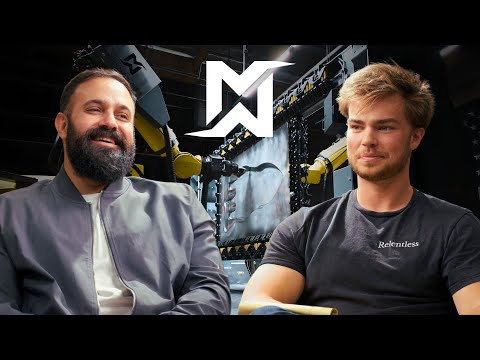
Ed Mehr, co-founder and CEO of Machina Labs, joins Ti Morse to explain how his company is reinventing metal manufacturing using robots that can form sheet metal without traditional dies. The interview takes place next to a metal sculpture of Franz von Holzhausen, Tesla’s chief designer, created using Machina’s robotic forming technology. Ed explains that a full set of dies for one of Tesla’s first cars cost $120 million, while Machina’s process eliminates the need for dies entirely — two robots come from two sides, start pinching the sheet, and form it into shape.
Ed shares his journey from making car panels by hand to working at SpaceX in 2012, where he witnessed the culture of rapid iteration and bold risk-taking that influenced his approach at Machina. He discusses building the first prototype on just $300,000, the importance of naivete and having fun in engineering, and how early mistakes taught him critical lessons about product design. The company recently announced a collaboration with Toyota to enable people to design custom car bodies, representing a vision where “any great idea can become real.”
The conversation also covers the strategic decisions around fitting the manufacturing system inside a shipping container for deployment flexibility, finding 10 champion customers before scaling, the complex capital structures required for hardware companies, and the broader theme of America’s need to reindustrialize. Ed argues that the limiting factor in creating more Elon Musks is giving talented people access to rapid manufacturing and iteration tools.
Highlights
”$120 Million for Dies vs Zero”
Clip command
yt-dlp --download-sections "*0:46-1:50" "https://www.youtube.com/watch?v=JQpwOkDUHvg" --force-keyframes-at-cuts --merge-output-format mp4 -o "JQpwOkDUHvg-0m46s.mp4"“I was talking with some of my friends at Tesla. A full set of dies for one of the first cars they made was $120 million. With our process, we realized we can get these robot sheet formers to form sheet metal without any need for dies. Two robots come from two sides, start pinching the sheet. As you expand, one of the robots starts giving it shape.” — Ed Mehr, 0:46
”Working at SpaceX in 2012”
Clip command
yt-dlp --download-sections "*24:17-25:25" "https://www.youtube.com/watch?v=JQpwOkDUHvg" --force-keyframes-at-cuts --merge-output-format mp4 -o "JQpwOkDUHvg-24m17s.mp4"“When I was at SpaceX in 2012, what struck me most was the culture of just trying things. There was no ‘let’s study this for six months.’ It was ‘build it, test it, if it breaks, figure out why, fix it, try again.’ That speed of iteration changed how I think about manufacturing.” — Ed Mehr, 24:17
”The Limiting Factor in Creating More Elons”
Clip command
yt-dlp --download-sections "*13:48-14:55" "https://www.youtube.com/watch?v=JQpwOkDUHvg" --force-keyframes-at-cuts --merge-output-format mp4 -o "JQpwOkDUHvg-13m48s.mp4"“The limiting factor in creating more Elons is not talent. There are brilliant people everywhere. The limiting factor is that they can’t turn their ideas into physical reality fast enough. If we make it so any great idea can become real through rapid manufacturing, that’s going to be a massive company.” — Ed Mehr, 13:48
”Building the First Prototype on $300K”
Clip command
yt-dlp --download-sections "*16:18-17:25" "https://www.youtube.com/watch?v=JQpwOkDUHvg" --force-keyframes-at-cuts --merge-output-format mp4 -o "JQpwOkDUHvg-16m18s.mp4"“We built our first prototype on $300,000. People said it couldn’t be done. They said you need at least $10 million to build a robotic forming system. But when you’re naive enough to not know what you can’t do, you just figure it out.” — Ed Mehr, 16:18
”Freedom of Expression in the Physical World”
Clip command
yt-dlp --download-sections "*1:00-2:00" "https://www.youtube.com/watch?v=JQpwOkDUHvg" --force-keyframes-at-cuts --merge-output-format mp4 -o "JQpwOkDUHvg-1m00s.mp4"“I would love to live in a world where any great idea can become real. We announced a collaborative work with Toyota enabling people to design a car that’s uniquely how they want it to look like. If we make a company that enables freedom of expression in the physical world, that’s going to be a massive company.” — Ed Mehr, 1:00
Key Points
- Creating the Franz von Holzhausen sculpture (0:46) - Machina created a metal sculpture of Tesla’s chief designer using their robotic forming process for a conference honoring his contribution to the auto industry
- Early prototype issues (3:28) - The first prototypes had significant issues that taught the team about the physics of metal deformation and robot control
- How robotic metal forming works (5:56) - Two robots approach from opposite sides, pinch the sheet metal, and incrementally form it into shape without any need for traditional dies
- Rapid design iteration (9:01) - Unlike traditional manufacturing requiring months for new tooling, Machina can iterate on designs in hours
- The limiting factor for innovation (13:48) - Not talent but the ability to turn ideas into physical reality quickly; Machina enables rapid prototyping and custom manufacturing
- $300K first prototype (16:18) - Built the initial robotic forming system on a shoestring budget when experts said it would cost $10M+
- Naivete and having fun (22:22) - Not knowing what’s “impossible” allowed the team to attempt things established players wouldn’t try
- SpaceX culture in 2012 (24:17) - Ed’s experience at SpaceX instilled a “build it, test it, fix it” mentality that he brought to Machina
- Celebrating customers (29:57) - Building deep relationships with customers and celebrating their success as a core company value
- Focusing on biggest risks (40:36) - Systematically identifying and attacking the highest-risk elements of the business first
- Shipping container form factor (45:35) - Designing the entire system to fit inside a standard shipping container for easy deployment anywhere in the world
- Early mistakes (47:25) - Key early errors in product design, customer selection, and engineering priorities that shaped the company’s evolution
- Finding 10 champions (52:22) - Strategy of finding 10 early champion customers who believe in the vision before attempting to scale broadly
- Systems vs parts vs assemblies (1:06:42) - Strategic decision about whether to sell the robotic systems, manufactured parts, or finished assemblies
- Complex capital structures for hardware (1:10:39) - Hardware companies require different financing approaches than software, including equipment financing, project finance, and strategic investment
Mentions
Companies
- Machina Labs (0:00) - Ed’s company building robotic metal forming systems
- Tesla (0:46) - Referenced for the $120M die cost for their first cars and chief designer Franz von Holzhausen
- SpaceX (24:17) - Where Ed worked in 2012, shaping his approach to rapid iteration
- Toyota (1:00) - Announced collaboration with Machina to enable custom car body design
Products & Technologies
- Robotic sheet forming (5:56) - Machina’s core technology using two robots to form sheet metal without dies
- CNC machining (5:56) - Traditional manufacturing method compared to Machina’s approach
- Additive manufacturing (5:56) - 3D printing technology that Machina’s approach complements
People
- Ed Mehr (0:00) - Co-founder and CEO of Machina Labs
- Franz von Holzhausen (0:46) - Chief designer of Tesla, subject of Machina’s metal sculpture
- Elon Musk (13:48) - Referenced in context of the limiting factor in creating more visionary founders
Surprising Quotes
“A full set of dies for one of the first Tesla cars was $120 million. With our process, we can form sheet metal without any need for dies.” — 0:46
“I would love to live in a world where any great idea can become real. If we make a company that enables freedom of expression in the physical world, that’s going to be a massive company.” — 1:00
“We built our first prototype on $300,000. People said it couldn’t be done. They said you need at least $10 million. But when you’re naive enough to not know what you can’t do, you just figure it out.” — 16:18
“The limiting factor in creating more Elons is not talent. There are brilliant people everywhere. The limiting factor is that they can’t turn their ideas into physical reality fast enough.” — 13:48
“I’m a car guy. I used to make car panels by hand. We announced collaborative work with Toyota enabling people to design a car that’s uniquely how they want it to look.” — 1:00
Transcript
0:00 I was talking with some of my friends at Tesla. A full set of dies for one of the first cars they made was $120 million. With our process, we realized, okay, we can get these robot sheet formers to form sheet metal without any need for dies. Two robots come from two sides, start pinching the sheet. As you expand, one of the robots starts giving it shape.
0:30 I would love to live in a world where any great idea can become real. I’m a car guy. So, I used to make car panels by hand. We announced a collaborative work that we’re doing with Toyota enabling people to design a car that’s uniquely how they want it to look like. If we make a company that enables freedom of expression in the physical world, that’s going to be a massive company.
0:46 Today I have the pleasure of sitting down with Ed Mehr and he is the co-founder and CEO of Machina Labs. And Machina is basically building these robots that allow you to form metal in a very unique way. We’re sitting next to the third or fourth iteration of the Franz von Holzhausen sculpture. How did that happen?
1:15 We were going to a conference and the organizers said, “Hey, in this conference we want to really honor Franz for all the contribution he has had to the auto industry.” He’s the chief designer of Tesla. And he’s a great guy, fantastic human being. They wanted to come up with something that captures him in something permanent that matches his contribution. He’s built all these amazing metal machines.
2:00 I was talking to the organizer and said, “Hey, we’ve been doing a lot of sculptures, so maybe we can do something around that.” And he was like, “Yeah, that’s a great idea.” So we created this metal sculpture of Franz using our robotic forming process. It went through several iterations to get the detail right.
3:28 The early prototypes had issues. The first version, the facial features weren’t sharp enough. The robots were applying too much force in some areas and not enough in others. We had to develop new control algorithms to handle the complex curves of a human face in metal. Each iteration taught us something new about how metal behaves under these forming conditions.
5:56 How the metal forming process works: you have two industrial robots facing each other with a sheet of metal between them. They start by gripping the edges and then incrementally pushing and forming the metal. One robot acts as the die and the other as the punch, but unlike traditional manufacturing, they can change their position and force at every single point. This means you can create any shape without ever needing to machine a physical die.
9:01 The rapid design iteration capability is what gets people excited. In traditional manufacturing, if you want to change a part design, you need new tooling. That can take months and cost hundreds of thousands of dollars. With our system, you change the digital file and the robots form the new design. You can iterate on a design multiple times in a single day. For engineers and designers, this is transformative.
13:48 The limiting factor in creating more Elons is not talent. There are brilliant people everywhere. The limiting factor is that they can’t turn their ideas into physical reality fast enough. Right now, if you have a great idea for a physical product, you’re looking at months of tooling, prototyping, and iteration. If we can compress that to days, we unlock an enormous amount of innovation. That’s what gets me up in the morning.
16:18 We built our first prototype on $300,000. People in the manufacturing industry told us it couldn’t be done. They said you need at least $10 million to build a robotic forming system. But when you’re naive enough to not know what you can’t do, you just figure it out. We bought used robots, built our own control software, and machined custom tooling in our garage. It wasn’t pretty, but it worked.
22:22 The importance of naivete and having fun in engineering cannot be overstated. The established players in metal manufacturing have decades of institutional knowledge about what’s “impossible.” That knowledge is actually a prison. They won’t try things because they “know” it won’t work. We tried everything because we didn’t know any better. And a surprising number of those “impossible” things actually worked.
24:17 What it was like working at SpaceX in 2012 was formative for everything I’ve done since. When I joined, the company had just successfully docked with the ISS for the first time. The energy was incredible. What struck me most was the culture of just trying things. There was no “let’s study this for six months.” It was “build it, test it, if it breaks, figure out why, fix it, try again.” That speed of iteration changed how I think about manufacturing.
29:57 Celebrating customers is something I feel deeply about. When a customer succeeds with our technology, when they create something they couldn’t have created any other way, that’s the whole point. We make it a big deal internally. We share the stories, we celebrate the wins. It keeps the team connected to why we’re doing this.
40:36 Focusing on the biggest risks first is something I learned at SpaceX. At any given time, there’s one thing that could kill the company. Your job is to figure out what that is and throw everything at it. Once that risk is mitigated, you move to the next biggest risk. It’s a simple framework but incredibly powerful. Most startups die because they work on comfortable problems instead of existential ones.
45:35 Designing the system to fit inside a shipping container was a deliberate strategic choice. A standard shipping container is 8 feet wide, 8.5 feet tall, and 40 feet long. If our entire system fits inside that, we can deploy it anywhere in the world. A customer in Germany, Japan, or Brazil can receive a complete manufacturing system that arrives on a truck and is operational within days.
47:25 Our early mistakes were painful but educational. One major mistake was trying to serve too many different applications at once. We were chasing automotive, aerospace, defense, and architecture customers simultaneously. Each had completely different requirements, quality standards, and sales cycles. We spread ourselves too thin and nearly ran out of money before learning to focus.
52:22 Finding 10 champions is my go-to strategy for early-stage hardware companies. Before you try to sell to the mass market, find 10 customers who are genuinely champions of your technology. These are people who believe in the vision, will tolerate imperfections, provide honest feedback, and advocate for you internally. Those 10 champions will teach you more than a thousand cold calls.
1:06:42 The question of selling systems versus parts versus finished assemblies is one of the most important strategic decisions we’ve had to make. If we sell systems, we’re a capital equipment company. If we sell parts, we’re a manufacturing services company. If we sell assemblies, we’re competing with our own potential customers. Each model has different economics, different scaling characteristics, and different relationships with customers.
1:10:39 Hardware companies require complex capital structures. You can’t fund a hardware company the same way you fund a SaaS company. We’ve used a combination of venture capital for R&D, equipment financing for our robots, government contracts for defense applications, and strategic partnerships with companies like Toyota. Each source of capital has different expectations and timelines, and managing them all is its own challenge.