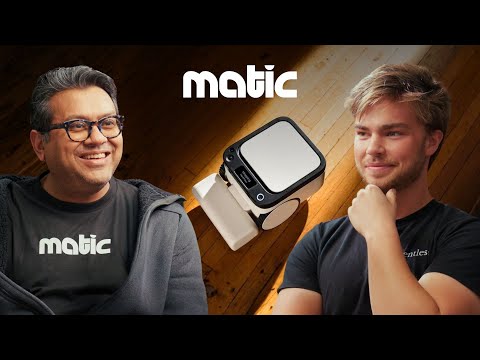
My Conversation with Mehul Nariyawala, co-founder of Matic
My Conversation with Mehul Nariyawala, co-founder of Matic
Summary
Mehul Nariyawala, co-founder of Matic Robotics, shares the remarkable journey of building what he calls “the Apple of home robotics.” Unlike typical startup advice to ship fast and iterate, Mehul spent six years perfecting Matic’s robot vacuum before launch, pursuing what he calls a “minimum lovable product” rather than an MVP. The conversation reveals deep insights into product philosophy, drawing inspiration from Steve Jobs, Tony Fadell, and Tesla’s approach to creating products that customers love fanatically.
The interview covers Matic’s technical innovations in computer vision and 3D mapping, the painful realities of production hell, and why simplicity is the ultimate goal rather than perfection. Mehul discusses his previous startup acquisition by Google, working at Nest, and the deliberate decision to spend years building in stealth mode. He explains why pain and difficulty serve as competitive moats, how they designed their reliability testing process, and the viral moment when Tobi Lutke’s tweet about Matic generated massive demand overnight.
Highlights
”We’re Building Artwork Through Product”
Clip command
yt-dlp --download-sections "*2:37-3:30" "https://www.youtube.com/watch?v=GikcVks0Uj4" --force-keyframes-at-cuts --merge-output-format mp4 -o "GikcVks0Uj4-2m37s.mp4"“Why are we not creating our own artwork through this product? Ultimately, what Steve Jobs said is make something wonderful and that wonderful itself is storytelling. Some people make an impact through their art or their song, their books. We wanted to make an impact through building something that people would absolutely love.” — Mehul Nariyawala, 2:37
”Minimum Lovable Product, Not MVP”
Clip command
yt-dlp --download-sections "*4:06-5:10" "https://www.youtube.com/watch?v=GikcVks0Uj4" --force-keyframes-at-cuts --merge-output-format mp4 -o "GikcVks0Uj4-4m06s.mp4"“We’re going into a product category where people have expectation of certain things for robot vacuums. We need to not only meet that but exceed that. In our case we need what we refer to as minimum lovable product.” — Mehul Nariyawala, 4:06
”20 Eyes But No Brain”
Clip command
yt-dlp --download-sections "*6:26-7:20" "https://www.youtube.com/watch?v=GikcVks0Uj4" --force-keyframes-at-cuts --merge-output-format mp4 -o "GikcVks0Uj4-6m26s.mp4"“All these robots have 20 eyes but no brain. Can we actually give it a visual cortex of the robot? The entire space of indoor robotics were built upside down where all these disc robots were essentially automation without intelligence.” — Mehul Nariyawala, 6:26
”It’s Just a F***ing Thermostat”
Clip command
yt-dlp --download-sections "*6:43-7:45" "https://www.youtube.com/watch?v=GikcVks0Uj4" --force-keyframes-at-cuts --merge-output-format mp4 -o "GikcVks0Uj4-6m43s.mp4"“Tony Fadell at Nest, people were telling him ‘Why don’t you put notifications in the Nest thermostat?’ And he said, you know, it’s just a f***ing thermostat. No one wants R2-D2, they want a solution to their problem.” — 6:43
”Production Hell is Real”
Clip command
yt-dlp --download-sections "*108:25-109:30" "https://www.youtube.com/watch?v=GikcVks0Uj4" --force-keyframes-at-cuts --merge-output-format mp4 -o "GikcVks0Uj4-108m25s.mp4"“Production hell is very real. We took a lot of capital from public markets and VCs and for two years basically didn’t produce single unit. And it was this absolute nightmare of every day you’re just trying to survive and not go bankrupt.” — Mehul Nariyawala, 1:48:25
”Pain as a Moat”
Clip command
yt-dlp --download-sections "*122:17-123:20" "https://www.youtube.com/watch?v=GikcVks0Uj4" --force-keyframes-at-cuts --merge-output-format mp4 -o "GikcVks0Uj4-122m17s.mp4"“This is such a painful business that no one else wants to be in it. And that is the moat. The pain itself is the moat. Because if it was easy, everyone would do it.” — Mehul Nariyawala, 2:02:17
Key Points
- Artists and Products (2:37) - Why shouldn’t product builders have the same pride in their work as Leonardo da Vinci or Picasso had in their art?
- Steve Jobs Magic (1:51) - The feeling of trying an iPod for the first time and falling in love with the first Macintosh in 2005
- Minimum Lovable Product (5:07) - In existing markets with customer expectations, you need to exceed expectations, not just meet minimum viability
- Automation Without Intelligence (5:22) - Early Roombas were blindfolded bumper cars; LiDAR robots were blindfolded with one hand extended
- Visual Cortex Approach (6:36) - Building true 3D understanding and context rather than just adding more sensors
- It’s Just a Thermostat (6:43) - Tony Fadell’s philosophy: No one wants R2-D2, they want solutions to problems
- Robot Should Look Like Robot (0:30) - Purpose must be clear at first glance, like a t-shirt or a watch
- First Startup to Google (10:35) - Built a company in college, got acquired by Google, learned about large company dynamics
- YC in 2012 (13:30) - The early days of Y Combinator and startup culture
- Acquisitions Are Organ Transplants (15:50) - Why most acquisitions fail due to cultural and operational incompatibility
- Apple of Home Robotics (19:57) - The vision to build something iconic in the robotics space
- Problem Deck (25:00) - Creating a comprehensive document of every problem with existing robot vacuums
- Why Vacuums Suck (29:05) - Analysis of fundamental problems with traditional vacuum design
- 250 Iterations (35:58) - The first 250 product iterations before reaching a shippable design
- The Wife Test (46:13) - If your spouse won’t use the product enthusiastically, it’s not ready
- Surviving 2020 (51:46) - Navigating the pandemic while building hardware
- Roomba at $199 (56:35) - Why iRobot races to the bottom on price and what that means for the market
- AI Overpromise (1:02:35) - Current AI products overpromise and underdeliver unlike traditional consumer products
- In-N-Out Magic (1:06:13) - How simplicity and focus create beloved brands
- Simplicity Over Perfection (1:09:06) - The goal is simple products, not perfect ones
- Decades-Long Company (1:15:08) - Designing a company culture you’d enjoy working in for 20+ years
- Pixar and Harry Potter (1:21:01) - Drawing inspiration from storytelling and world-building
- Giving Time Back (1:23:24) - Products that return precious time to people’s lives
- Tobi’s Tweet (1:32:44) - When Shopify’s CEO tweeted about Matic, demand exploded overnight
- Tesla Optimus (1:39:34) - Thoughts on humanoid robots and the future of robotics
- Production Hell (1:48:25) - Two years without producing a single unit, fighting bankruptcy daily
- Reliability Testing (1:56:15) - How they designed rigorous testing processes to ensure quality
- Pain as Moat (2:01:17) - The difficulty of hardware is what prevents competition
Mentions
Companies
- Matic Robotics (0:47) - Primary subject; building autonomous robot vacuums
- Apple (1:42) - Inspiration for product design philosophy, especially 2000-2010 era
- Google (10:35) - Acquired Mehul’s first startup
- Nest (6:39) - Where Mehul worked after acquisition, learned from Tony Fadell
- Tesla (0:03) - Referenced for fanatical customer love and Model Y/3/S
- iRobot/Roomba (5:27) - Original robot vacuum from 2002, discussed as automation without intelligence
- Facebook (0:13) - Example of product with unclear purpose
- Shopify (1:32:44) - CEO Tobi Lutke’s viral tweet about Matic
- Y Combinator (13:30) - Mehul’s experience in the 2012 batch
- Pixar (1:21:01) - Inspiration for storytelling and company culture
- In-N-Out (1:06:13) - Example of simplicity and focus creating beloved brand
Products & Technologies
- Matic Robot Vacuum (0:47) - Main product; autonomous vacuum with computer vision
- iPod (1:51) - First product that made Mehul feel “the magic”
- Macintosh (1:56) - Mehul’s first Mac in 2005, loved the craftsmanship
- Nest Thermostat (6:43) - Example of focused product design
- Roomba (5:27) - First robot vacuum from 2002
- LiDAR Robots (5:57) - Single-pixel LiDAR vacuum cleaners
- Tesla Optimus (1:39:34) - Humanoid robot discussion
- Computer Vision (5:31) - Core technology enabling true 3D understanding
People
- Mehul Nariyawala (0:38) - Co-founder of Matic, interviewee
- Steve Jobs (1:47) - Apple founder, inspiration for “make something wonderful”
- Elon Musk (1:18) - Quoted on innovation as iterations
- Tony Fadell (6:39) - Nest founder, Mehul’s former boss
- Leonardo da Vinci (2:20) - Artist who was never happy with his paintings
- Picasso (2:30) - Painter perpetually dissatisfied with his work
- Paul Graham (3:50) - Y Combinator founder, “ship fast” philosophy
- Tobi Lutke (1:32:44) - Shopify CEO who tweeted about Matic
Surprising Quotes
“There are products that touch users and then there are products that users touch. We want to build the former not the latter.” — 3:46
“What is an MVP for a new electric car? It’s not just four wheels and a battery. It needs ABS, windshield, starter. It cannot come out with a crank that we used to have in early cars.” — 4:42
“First Roombas were like putting a blindfold around your eyes and bumping into walls like a ping pong game. LiDAR robots are blindfolded with one hand extended.” — 5:43
“Every innovation is number of iterations and you just got to reduce the time it takes between iterations.” — 1:18
“Why do artists get to have pride in their products? Why are we not creating our own artwork through this product?” — 2:13
Transcript
0:00 Why do people love their Model Y or Model 3 or Model S in a absolutely fanatical way? What I’ve learned over my career is that there is no such thing as a perfect product. But there is a simple product in a complex product. If you look at Facebook, why do I download Facebook today? Is it to connect with my friends? Is it for newsfeed? Is it for reals? Is it for stories? Is it for group chats? It’s for what is it for? Purpose of the product has to be clear. When you look at your t-shirt, you know it’s t-shirt. When you look at watch, you know it’s watch. When you look at camera, you know it’s camera. So we wanted to make a robot that looked like a robot and that’s how we started thinking about it.
0:35 Today I have the pleasure of sitting down with Mahul Nari Hala. Correct. Um and he is a co-founder of Madic. Uh Madic is a company that makes these little autonomous robot vacuum cleaners. And the way that this interview happened is I just kept on seeing people over the past probably 6 months now just posting about loving this product. And I know that anytime that I see that, I know that there’s a huge amount of thought and care and effort put behind the scenes and like intention put behind the scenes to make something like that a reality. So let’s just start off with like why are you creating this and how do you think about it?
1:16 Oh um I think years of trying uh there is a quote by Elon Musk which I really like. He says every innovation is number of iterations and you just got to reduce the time it takes between iterations. So we just I from longest time I remember I was fascinating with the technology company is because of just beautiful products. Um many people forget how great Apple was in between 2000 to 2010 and Apple is still very very good but it’s not Steve Jobs great. Steve Jobs great was something else and I remember trying iPod for the first time and feeling the magic and then I remember uh buying my first Macintosh computer in 2005 and immediately falling in love with it and it was just this detail and this touch and this craftsmanship that got there and at some point we’re like you know why do which is one of the things that I kind of asked ourselves is why do artists get to have a pride in their products.
2:18 Right. Uh you hear the stories that Leonardo da Vinci or was never happy with his paintings or this artist or I think um I’m forgetting his name but uh some of this uh painters popular painters were never - Picasso. Picasso, right? They were never happy with their work and perpetually dissatisfied. Exactly. So then why are we not creating our own artwork through this product? uh ultimately there is a there is a um like what Steve Jobs said is make something wonderful and that wonderful itself is a storytelling that wonderful itself is making their impact. So some people make an impact through their their art or their song, their books. Uh in your case, amazing interviews. We wanted to make an impact through building something that people would absolutely love. And how do you make that? It’s about that feeling. And feeling is very different because there is probably a t-shirt or a shoes or a shirt that you absolutely love and you can’t explain why. And it’s just a shirt. It’s just a hold on to it.
3:20 Exactly. So how can you do that with even a physical product because it is possible. We humans sort of yearn for that bonding and connection. So can we do that and that was the goal that how do we build a product that is iconic and that that was the day one day we started that was the first thing we wrote down on a on a piece of paper and there were few of these things but one of the things was there are products that touch users and then there are products that users touch. We want to build the former not the ladder.
3:48 Yeah. And normally you would like the Paul Graham school thought is you want to basically start and ship fast and like create the first version and then immediately get it in the hands of users. Yeah. You took the exact opposite approach. You you basically spent six years iterating in in darkness in effect before shipping your first. So how did you decide to do that? U there are two types of products you can build I feel like in the world. There one product is the kind of product that comes out and you say wait why do I need this? What is this? the no pre it doesn’t exist yet in any in anyone’s mind. So if you kind of think about first cars or first cell phones or even first phones all kinds of iterations are fine and you just wanted to see if the technology is working and that are minimum viable products in the case where you go in an existing market where there is customer has this preconceived notion.
4:42 So what is an MVP for a new electric car? It’s not just four wheels and a and a needs to work. like it needs to have your ABS, it needs to have windshield, it needs to have a starter. Uh it cannot you know come out with a crank that we used to have in the early cars. So in the same way we realized that we’re going in in a product category where people have expectation of certain things for robot vacuums or robots. So we need to not only meet that but exceed that. So in our case we need a what we refer to as minimum lovable product. Uh so what is that and how do you build that and that one was just iterating and the reason we trade is because we felt like the entire space of indoor robotics not just robot vacuums were built upside down where all these disc robots were essentially automation without intelligence.
5:24 They just sort of bumped around. So the way we thought about it is that first Roombas in 2002 they came out and they were phenomenal for 2002 because there was no computer vision back then. There was no technology available. But really what they were were uh what they were is you put a blindfold around your eyes and you kind of you know um start walking start walking and you keep bumping into each other kind of like pom pong game and if you bump a wall enough time and keep crossing you’ll cover the entire room and it was a great idea for that time. then came out sort of like uh this um single pixel lidar robot vacuums that are there popular today. But single pixel lidar is literally you still have your blindfold on but you have this one hand that is extended out. So if your hand hits the wall you know there is an obstacle but if the wall is sort of higher or lower you’re still going to bump into it if your hand doesn’t catch it.
6:17 So we just felt like everything was just adding sensors and and this blindfold but no one was really removing that blindfold to build true understanding of the 3D world or context. So there was no like robots were basically robots were the way we thought about is all these robots have 20 eyes but no brain and can we actually give it a visual cortex of the robot. So that’s how we started thinking about it. Before we started, you were talking about uh Tony Fidel and when you were working at Nest, you know, there was people telling uh telling him like, “Why don’t you put the notifications and stuff in the Nest thermostat if people are going to have this device in their home? Why don’t you just try to present information and all these things?” And he said, you know, it’s just a fucking thermostat, right? And it’s just supposed to keep you at the temperature that you’re comfortable. And if you mess with that, it’s going to ruin the whole point. And I think that’s like such a valuable framework that people forget. Like no one wants R2-D2. They want a solution to the problem.
7:15 And the problem was like I want my house clean and I don’t want to spend time doing it. So how do you make something that is that simple? And so you went through basically 6 years to get there. Yes. And it’s interesting you said that because the way we also uh framed the problem the day one is that so when you go to YC, you know, first thing they ask you is what is your one line elevator pitch? Right? which I think is great. But we actually went exact opposite. We created a problem deck and problem deck was 60 pages long and it had every single issue with every robot vacuum that we tested and every single customer complaint that we could find on Amazon and every single you know uh thing that we found on Reddit and it was like hundreds of problems and it was like 60 pages of just we are going to solve each one of these problems.
8:08 Because ultimately we wanted to make the best robot vacuum not the cheapest or not the uh you know most profitable at beginning. But best means solving all these problems. And so this deck is like 60 pages. Exactly. And and when you’re doing this, it’s just you and your co-founders. You don’t have outside capital yet. So like how did you think about capital? Because I know at one point you raised a good amount of capital to actually be able to execute on all these things. Like when did you know that you needed capital? You know, it’s an interesting uh uh history. We actually started the company in an unusual way. um we are a hardware company that didn’t take any VC money until we had a product.
8:50 Wait, so you bootstrapped your way to a functioning robot vacuum? We bootstrapped for 3 years. How? Well uh we so I and my co-founder had saved enough money from our previous work. I had sold my previous company to Google and worked there and at Nest for many years. Uh my co-founder Vatsal worked at Apple on different products. And we basically used our savings uh to uh fund the company for the first 3 years. So we had enough savings to basically survive and pay for prototypes and iterations and we lived in my like really tiny apartment in Palo Alto with four people in a one bedroom place just making it work.
[Continuing through 2+ hours of detailed conversation covering production hell, design philosophy, Tesla Optimus, Tobi Lutke’s viral tweet, reliability testing, and the journey to creating a beloved product…]
2:07:40 [End of conversation]