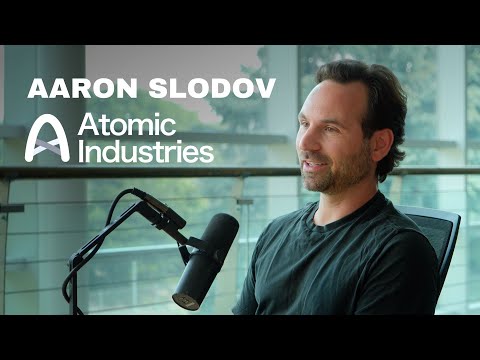
#34 - Bringing Manufacturing Back To America | Aaron Slodov, CEO Atomic Industries
#34 - Bringing Manufacturing Back To America | Aaron Slodov, CEO Atomic Industries
Summary
Ti Morse interviews Aaron Slodov, founder of Atomic Industries and co-founder of Reindustrialize, for the second time on the podcast. Aaron’s central thesis is that American manufacturing skill and tribal knowledge has been evaporating for decades, and the consequences are becoming dangerously visible — exemplified by the fact that the US military put out a public request to rebuild a mold for the B-2 Bomber because the original designers are gone and the drawings no longer exist. Atomic Industries uses AI to transform legacy manufacturing operations, while Reindustrialize is a grassroots movement and conference series aimed at educating people across the manufacturing stack about what re-industrialization actually looks like in practice.
The conversation covers why Aaron spent a full year cold-calling over 200 machine shops across America (while pretending to be a Stanford Business School student doing a semester project), how manufacturing startup financing differs fundamentally from software venture capital, and why the SpaceX/Anduril model of massive venture-backed hardware companies should not be treated as a one-of-a-kind anomaly but rather replicated more broadly. Aaron argues that there are enormous opportunities in multi-billion dollar manufacturing verticals that are ripe for technological transformation. He emphasizes that the hard part is not the technology itself but building the conviction to work on a decades-long problem while the rest of the market chases software-like returns. The episode ends with a lighter personal note about the logistical challenges of caring for his dog who needs surgery.
Highlights
”We Forgot How to Build a B-2 Bomber Part”
“They put out a public request for rebuilding a mold or a die for the B-2 that they lost. The people who originally designed it, gone. They don’t have the drawings laying around. It’s literally the whole ‘we forgot how to build it’ situation.” — Ti Morse, 0:00
Clip command
yt-dlp --download-sections "*6:00-7:10" "https://www.youtube.com/watch?v=AppJJbeQjp8" --force-keyframes-at-cuts --merge-output-format mp4 -o "forgot-b2-bomber.mp4"”I Pretended to Be a Stanford Business School Student”
“I tried to understand fundamentally how these businesses operated and I ended up calling probably like 200 different machine shops. I told them I was from Stanford Business School doing a semester-long project on American manufacturing.” — Aaron Slodov, 28:42
Clip command
yt-dlp --download-sections "*28:42-30:40" "https://www.youtube.com/watch?v=AppJJbeQjp8" --force-keyframes-at-cuts --merge-output-format mp4 -o "stanford-research.mp4"”All Power Is Derived from Industrial Power”
“War and stuff. All power is derived from industrial power. And that’s all completely dependent on the people that know how to do that stuff.” — Aaron Slodov, 9:37
Clip command
yt-dlp --download-sections "*9:37-10:00" "https://www.youtube.com/watch?v=AppJJbeQjp8" --force-keyframes-at-cuts --merge-output-format mp4 -o "industrial-power.mp4"”Elon Sat in the Netscape Lobby for Six Hours”
“Back in 1996 when he’s walking into the Netscape office, sits in a suit in the lobby for six hours and literally nobody comes. And that’s Elon Musk. That’s the guy that became this person that runs fourteen companies and they’re all worth a trillion dollars.” — Aaron Slodov, 46:54
Clip command
yt-dlp --download-sections "*46:54-47:30" "https://www.youtube.com/watch?v=AppJJbeQjp8" --force-keyframes-at-cuts --merge-output-format mp4 -o "elon-netscape.mp4"Key Points
- B-2 Bomber knowledge loss (0:00) - The US military publicly requested help rebuilding a B-2 mold because the original designers are gone and drawings are lost
- Starting Atomic Industries (0:37) - Aaron tried to manufacture a product, discovered American manufacturing capability had evaporated, and decided to fix it
- Never visited Chinese factories (2:36) - Aaron has never set foot in a Chinese factory despite building a manufacturing company
- Forgetting how to make things (6:00) - The B-2 Bomber costs $2 billion and they forgot how to make key parts; tacit knowledge cannot be retrieved once lost
- Trades earning software-level pay (10:00) - Plumbers can earn $250-350K, contractors can make $500K easily; approaching software engineer compensation
- Reindustrialize origin (11:28) - Aaron started Reindustrialize after having the same manufacturing conversation 800 times; bought reindustrialize.com for $5K
- Dictator thought experiment (14:39) - If Aaron were dictator of America, he’d realign incentives at every level of the manufacturing stack
- Only 4% of China is automated (18:07) - Even China’s factories are only 4% automated; the answer isn’t sci-fi factories
- Manufacturing vs software VC (20:50) - Manufacturing companies can’t just follow software growth metrics; need different financing approaches
- Year of research (28:38) - Spent a full year researching, calling 200+ machine shops pretending to be a Stanford student
- Billion-dollar manufacturing verticals (26:42) - With 6 months of research, anyone could find a multi-billion dollar manufacturing vertical ripe for transformation
- SpaceX/Anduril should be replicable (35:44) - These shouldn’t be treated as one-of-a-kind anomalies; more venture-backed hardware companies should be catalyzed
- Elon at Netscape (46:54) - Even Elon Musk sat ignored in Netscape’s lobby for 6 hours in 1996; nobody starts with credibility
Mentions
Companies
- Atomic Industries (0:24) - Aaron’s AI manufacturing company
- Reindustrialize (11:03) - Grassroots movement/conference for American manufacturing, co-founded by Aaron
- SpaceX (22:31) - Referenced as model for venture-backed hardware company
- Anduril (22:31) - Referenced as model for defense hardware company
- Tesla (22:31) - Referenced for Elon’s manufacturing track record
- Palantir (22:05) - Example of reverse approach to manufacturing tech
- Stripe (40:41) - Example of late-stage overinvestment ($400M at $100B valuation)
- Netscape (46:54) - Where young Elon Musk sat in the lobby for 6 hours
People
- Aaron Slodov (0:24) - Founder of Atomic Industries and co-founder of Reindustrialize
- Elon Musk (22:31) - Referenced extensively as model for manufacturing ambition
- Jeff Bezos (14:10) - Ti jokes about wanting the relentless.com domain that redirects to Amazon
Surprising Quotes
“Two billion dollars they forgot how to make a part?” — Ti Morse, 6:54
“You could even make 500 grand as a contractor easily. We’re not quite at the Zuck offers yet, but we’re getting there with the plumbers.” — Aaron Slodov & Ti Morse, 10:40
“I told them I was from Stanford Business School doing a semester-long project on American manufacturing. And they were super interested.” — Aaron Slodov, 30:00
“Most of the distribution of success and wealth in the world is dumb.” — Aaron Slodov, 49:40
Transcript
Ti Morse: 0:00 They put out a public request for rebuilding a mold or a die for the B-2 that they lost. The people who originally designed it, gone. They don’t have, like, the drawings laying around. Right? Like, it’s insane. It’s literally the whole, like, ‘we forgot how to build it’ situation. If that’s happening at that level, right? Just imagine what other things we probably forgot how to design or make. Aaron is the CEO and founder of Atomic Industries. They’re doing something with AI and manufacturing, which is pretty sweet. Aaron, do you want to just start off with, like, kind of the story of how you started Atomic and, like, why you initially tried to, like, create figurines?
Aaron Slodov: 0:37 Yeah, sure. I mean, the very simple way to boil this down was, you know, I tried to actually make a product. It needed to be manufactured and I learned very quickly that there was like a massive gap in skill and capability domestically to actually do things like this.
Ti Morse: 1:13 Exported skill?
Aaron Slodov: 1:14 Well, I mean, it’s like offshore skill. It didn’t make any sense to me that we had evaporated this thing. So that’s kind of what kicked off the whole thing.
Ti Morse: 2:18 Interesting. Do you have — so I know that you mentioned that you can’t really understand factories without actually seeing factories. Have you been to China?
Aaron Slodov: 2:35 No. I’ve never stepped foot in a Chinese factory. I’ve seen them and had video tours of them, and a lot of anecdotal discussion. I don’t think it’s too hard to extrapolate what goes on there versus anywhere else. But ultimately, you know, the real value is in the doing.
Ti Morse: 4:48 You don’t have to necessarily copy everything from their factories. It’s our turn to start copying stuff.
Aaron Slodov: 5:00 India skipping multiple stages of tech infrastructure and just hopping straight to wireless phones and stuff like that? Sort of. I mean, the US has the opportunity to leapfrog in certain manufacturing categories.
Aaron Slodov: 6:00 Rebuilding the tooling, like a mold or a die or something for a component in the B-2 that they lost. So what ended up happening was there’s some historical context there. It’s honestly insane. When you start leaking and all the skill and the knowledge evaporate, that’s what happens.
Ti Morse: 6:54 How much does the B-2 bomber cost?
Aaron Slodov: 6:56 Two billion dollars.
Ti Morse: 6:57 Two billion dollars they forgot how to make a part?
Aaron Slodov: 6:59 Right, yeah. So, if that’s happening at that level, just imagine what other things we probably forgot how to design or make.
Ti Morse: 7:21 And if it’s not living in somebody’s head, where is it living?
Aaron Slodov: 7:29 Well they’re not there anymore, but the actual experience and process of making the thing end-to-end has disappeared. So the only way to get that back is to actually do it again. If you don’t actually do it in practice then you forget, or you just don’t have it.
Aaron Slodov: 9:00 The pool of people that actually know how to do things is extraordinarily important.
Ti Morse: 9:36 This is how you win?
Aaron Slodov: 9:37 Yeah. War and stuff. All power is derived from industrial power. And that’s all completely dependent on the people that know how to do that stuff.
Ti Morse: 9:49 So there’s just this massive gap in America for the last 20, 30 years.
Aaron Slodov: 10:00 You get to a point where people trying to do basic stuff like getting a plumber is becoming harder. Plumbers can make $250-350K. You could even make 500 grand as a contractor easily.
Ti Morse: 10:56 We’re not quite at the Zuck offers yet, but we’re getting there with the plumbers.
Ti Morse: 11:03 So you’re one of the founders of Reindustrialize?
Aaron Slodov: 11:11 I’m just the guy that came up with the idea. I’ve got other co-founders that helped pull it all together.
Ti Morse: 11:28 What was the initial idea behind it?
Aaron Slodov: 11:33 In building a company like Atomic, I’ve had the same conversation 800 times with people from all over the place about what re-industrialization and manufacturing actually looks like.
Ti Morse: 12:33 You thought to yourself, ‘Holy shit, if we just get one person up in front of everyone we could say it once to the 800 people all at once.’
Aaron Slodov: 12:41 Yeah. It’s never that easy but it is a really grassroots kind of thing. It just came together.
Aaron Slodov: 13:46 It just had to be done. And then I found the domain that was for some reason available and I snagged that immediately.
Ti Morse: 14:03 Was that available? For 10 bucks?
Aaron Slodov: 14:05 I think it was like five grand but I was like who cares?
Ti Morse: 14:10 Crazy. I own relentless.com… come on Jeff. We gonna do this or not? Jeff Bezos please collab. Every birthday until he actually does it I’m just gonna @ Jeff Bezos.
Ti Morse: 14:39 I want to do a thought experiment. Imagine you are the dictator of America. What would you do?
Aaron Slodov: 15:00 Every level of that stack — the military, elected officials, people in finance, investors, founders — all need to be aligned. You can’t just magically stand up the entire supply chain to produce millions of drones domestically overnight.
Aaron Slodov: 18:00 Even if you look at China, only 4% of all of China’s industrial capacity is automated. It’s not some sci-fi factory. That’s not how it works.
Ti Morse: 20:50 The whole financing side of building manufacturing companies is not as simple as software. Do we need to realign the incentives?
Aaron Slodov: 21:10 A lot of people would say yes, but those people also have no idea how manufacturing businesses are built. There’s a lot of interesting information about how you would apply successful software growth metrics to a manufacturing operation, but it hasn’t been proven yet.
Aaron Slodov: 22:31 Really interesting comp for what Elon has done with Tesla and SpaceX and probably will with Optimus.
Aaron Slodov: 24:55 Technology is evolving at a rapid enough pace where it’s pretty clear that you can transform old legacy manufacturing with new technology.
Ti Morse: 26:42 If you want to become a billionaire over the next 10 years just start a manufacturing company.
Aaron Slodov: 27:00 You could basically just go look for a multi-billion dollar manufacturing vertical and with probably six months or a year of deep research, figure out the viability of transforming it.
Ti Morse: 28:35 What was the process you went through to learn enough to decide?
Aaron Slodov: 28:38 Spent a year researching this. I tried to understand fundamentally how these businesses operated and I ended up calling probably like 200 different machine shops. I told them I was from Stanford Business School doing a semester-long project on American manufacturing. And they were super interested.
Ti Morse: 30:36 Did you show up in person and they’re like you’re pre-pubescent?
Aaron Slodov: 30:40 No, this was during COVID. Most of 2019 and 2020 was a lot of research into this stuff.
Ti Morse: 31:31 Were you the first person that ever called most of these shops to ask anything?
Aaron Slodov: 31:35 I don’t know, but I would assume maybe. I don’t think anybody really ever took interest in them.
Ti Morse: 32:04 What was the threshold before you decided to actually start a company?
Aaron Slodov: 32:13 I technically incorporated the company in December of 2019. I already knew I was going to do it. The thesis was that the global supply chain was in a really untenable state.
Ti Morse: 33:44 When you’re thinking about growing the business, what are the biggest levers?
Aaron Slodov: 34:03 Engineering and capital.
Aaron Slodov: 34:15 You don’t want to load up and go insane building crazy infrastructure without the technology that you need.
Aaron Slodov: 35:17 When you see Anduril or SpaceX, private companies raising massive amounts of capital and going from zero to trillion-dollar valuations, those are crossover funds that nobody knows about that have hundreds of billions of dollars of AUM.
Aaron Slodov: 36:31 A lot of people would disagree with me. They say SpaceX and Anduril are one-of-a-kind generational companies. But you can’t simultaneously say it’s a great venture investment and then say nobody else should try.
Ti Morse: 37:29 Eight years into SpaceX they were going bankrupt.
Aaron Slodov: 37:31 You can’t talk out of both sides of your head saying this is a great venture investment and then also saying nobody else can do it.
Ti Morse: 41:13 If you take a billion dollars, you can give a thousand people a million dollars each to go start manufacturing companies.
Aaron Slodov: 41:29 You could give one person a billion. Or you could give every American a billion dollars.
Ti Morse: 41:37 That’s just math.
Ti Morse: 44:13 Where do you get the passion for chewing glass and staring into the abyss?
Aaron Slodov: 44:23 I don’t really find a lot of reward or fulfillment in the outcome. It’s more the process itself. We’re here for a limited time. Why would I not do the hardest thing imaginable with my time?
Aaron Slodov: 46:36 If you think of Elon today, he’s kind of like this mythological figure. But then you think back in 1996 when he’s walking into the Netscape office, sits in a suit in the lobby for six hours and literally nobody comes. And that’s Elon Musk. That’s the guy that became this person that runs fourteen companies.
Aaron Slodov: 48:00 That issue of having to build something from nothing and nobody believing in you until you’re actually valuable — that’s just how we do things.
Ti Morse: 53:12 Let’s end on what’s the most painful thing you experienced in the past year?
Aaron Slodov: 53:15 My dog who I have to kind of lug around like a child. I had to get him some corrective surgery and it takes away from my ability to be anywhere I need to be at any given time.
Ti Morse: 55:04 I need to make sure that happens.
Aaron Slodov: 55:07 What you need is a Neuralink. Put one below the spine and the brain. Then you got the solution.