The Hidden Tech Behind an NBA Broadcast!
The Hidden Tech Behind an NBA Broadcast!
Summary
Marques Brownlee gets a behind-the-scenes tour of the gear powering an NBC NBA playoff broadcast in 2026 — and walks away with a deep appreciation for how impossibly hard a “good” live game broadcast actually is. The video opens with a viral clip he posted on Twitter of a camera operator perfectly tracking the ball, and his counter to the people who replied “looks easy” is the entire premise: it isn’t, the lens costs $200,000, the fluid head costs $25,000, and even with all that gear he still can’t do what the pros do.
The arena tour covers 40-50 cameras and dozens of microphones. The workhorses are Sony P50 broadcast boxes ($50,000 each, 1080p60, global shutter, sub-1-inch sensor) paired with Canon glass — including the Canon 122, an 8-1000mm 122x zoom that he calls the lens of the show. He climbs through a dedicated bank of six P50s on swiveling chairs (wide, tight, two player ISOs, coach ISO, and one for vertical mobile), shows the cable cam (a P50 on a Ronin 2 hanging by four carabiners), and explores the stanchion cameras — a Red, a Sony A9, a Canon R6, and a Nikon D4 stills camera with black tape around the lens to kill reflections off the backboard glass. There’s also a Sennheiser MKH 416 shotgun on the rim (“I have a soft spot for them, I’m literally recording with one right now”), a floor mic catching sneaker squeaks and trash talk, and the legendary Steadicam that runs onto the floor every timeout.
The second half moves to the parking lot, where six broadcast trucks 200 yards from the arena do “where the magic happens.” A director watches every feed, engineers white-balance and audio-mix in real time, and replay operators use EVS controllers — a wheel to scrub, a lever for variable playback up to 180fps source — to deliver crisp slow-mo seconds after the play. Brownlee frames the whole production as “48 minutes of live, unscripted, multicam footage being delivered as a finished product as it’s happening” — a Hollywood-grade pipeline compressed to zero post. He closes by recommending Dallas Taylor’s deep dive on the arena’s microphones.
Highlights
”This is a $200,000 lens”
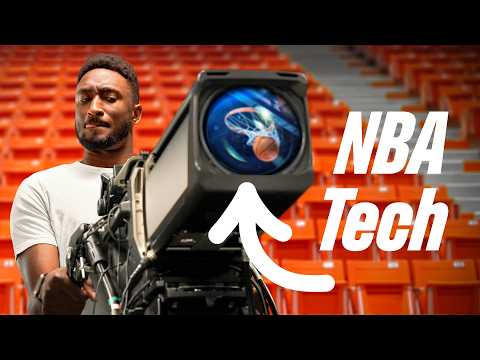
“So the NBA players are not the only talented ones in the arena, as evidenced by this clip that I posted on Twitter a couple days ago that went kind of viral. And what’s funny is another one of my replies to someone about how this is a $200,000 lens also kind of went viral. But then there’s a bunch of comments from people about how, ‘Oh, you know, what’s the big deal? Like, it’s not that hard. It’s just following the ball. Looks pretty easy.’ Uh, no, it this is not easy.” — Marques Brownlee, 0:00
Clip command
yt-dlp --download-sections "*0:00-0:54" "https://www.youtube.com/watch?v=mk_wdHePbtQ" --force-keyframes-at-cuts --merge-output-format mp4 -o "nba-200k-lens.mp4"”The Canon 122 — 122x optical zoom”
“This is an 8 to 1,000 millimeter lens with insane stabilization and all the powerful servo motors to be able to move the glass quickly and accurately. It’s called the Canon 122 because it’s literally 122x optical zoom, which is ridiculous.” — Marques Brownlee, 1:14
Clip command
yt-dlp --download-sections "*0:54-1:42" "https://www.youtube.com/watch?v=mk_wdHePbtQ" --force-keyframes-at-cuts --merge-output-format mp4 -o "nba-canon-122.mp4"”The cheat sheet of player faces”
“Also fun fact: that little cheat sheet of player faces is given to every broadcast camera operator because they also have a headset on and at any time could get a command from the director telling them to get an ISO shot of a certain player and they have about two seconds to ID them, find them, zoom in, focus, get the shot.” — Marques Brownlee, 2:01
Clip command
yt-dlp --download-sections "*2:01-2:27" "https://www.youtube.com/watch?v=mk_wdHePbtQ" --force-keyframes-at-cuts --merge-output-format mp4 -o "nba-cheat-sheet.mp4"”Hanging by four carabiners”
“And then the fact that it’s all connected essentially by four carabiners to these cables that go all the way up to the roof is hilarious to me. So shout-out to those carabiners.” — Marques Brownlee, 4:00
Clip command
yt-dlp --download-sections "*3:43-4:14" "https://www.youtube.com/watch?v=mk_wdHePbtQ" --force-keyframes-at-cuts --merge-output-format mp4 -o "nba-carabiners.mp4"”Hollywood spends months — this is 48 minutes live”
“And I don’t know if you realize how hard that is. Like, Hollywood might spend a couple months of production getting a few minutes of good footage per day, and then a couple more months of post-production just getting it all looking, sounding, feeling just right. But this is 48 minutes of live, unscripted, multicam footage being delivered as a finished product as it’s happening.” — Marques Brownlee, 8:24
Clip command
yt-dlp --download-sections "*8:07-8:51" "https://www.youtube.com/watch?v=mk_wdHePbtQ" --force-keyframes-at-cuts --merge-output-format mp4 -o "nba-48-minutes-live.mp4"”A symphony of live storytelling”
“It really is a symphony of live storytelling on the biggest stage for an audience of millions. And if it’s done right, if it’s done really, really well, you don’t even really think about it once.” — Marques Brownlee, 10:34
Clip command
yt-dlp --download-sections "*10:25-10:43" "https://www.youtube.com/watch?v=mk_wdHePbtQ" --force-keyframes-at-cuts --merge-output-format mp4 -o "nba-symphony.mp4"Key Points
- Following the ball isn’t easy (0:00) - The viral Twitter clip and Brownlee’s defense of camera operators
- Sony P50 is the workhorse (0:54) - $50,000 broadcast box, sub-1-inch sensor, 1080p60, global shutter
- The Canon 122 (1:14) - 8-1000mm, 122x optical zoom; the “where they got the name Canon from” lens
- $25,000 fluid head (1:42) - Brownlee admits he can’t track like the pros even with the gear
- Two-second player ID (2:01) - Cheat sheet of player faces because operators have ~2 seconds to grab an ISO shot
- Six-camera main bank (2:27) - Wide game, tight, two player ISOs, coach ISO, mobile vertical
- The iconic tip-off shot (3:00) - The sweeping intro from the rafters; “it’s so iconic it’s even in 2K”
- Cable cam = two-person team (3:13) - Sony P50 + Canon 14x on a Ronin 2; one moves it in 3D space, the other controls camera
- Hanging by carabiners (4:00) - The entire cable cam rig is held up by four carabiners
- The stanchion is loaded (4:14) - Cameras and mics top to bottom; closest you can get to the court
- Red, Sony A9, Canon R6, Nikon D4 (4:43) - The mix of broadcast and press cameras on the stanchion
- Sennheiser MKH 416 (4:43) - The shotgun mic Brownlee uses for his own videos
- Black tape kills reflections (5:04) - Common trick on the backboard Nikon D4 to minimize glare from the glass
- Above-the-rim camera (5:26) - Above even the shot clock, pointed down for dunk top-downs
- 40-50 cameras in the arena (5:51) - Sonic Dome, referee-to-scorers-table, Steadicam, and more
- Steadicam is always working (6:00) - Runs onto the floor every timeout; another P50 + Canon 14x; weight-distributing rig
- Microphones everywhere (6:34) - Net, rim, sneakers, players yelling, crowd, all individually captured
- Six broadcast trucks (7:30) - 200 yards from the arena; more gear than the stadium
- 48 minutes of live unscripted multicam (8:24) - Hollywood-grade production with no post; the central thesis
- EVS replay controller (9:21) - Wheel scrubs in either direction; lever modulates playback speed
- Source up to 180fps (9:52) - Replay cameras capture at 180 FPS for variable slow-mo
- Symphony of live storytelling (10:34) - When done right, the viewer doesn’t think about any of it
- NBC and the Spurs (10:43) - Acknowledged for opening the curtain
Mentions
Companies
- NBC (0:00) - Broadcaster of the NBA playoff game shown
- NBA (0:00) - The league whose broadcast is being deconstructed
- San Antonio Spurs (10:43) - Hosted the visit; thanked for opening the curtain
- Sony (0:54) - Maker of the P50 broadcast camera; A9 mirrorless on the stanchion
- Canon (0:54) - Lens manufacturer for the broadcast cameras; R6 on the stanchion
- Nikon (5:04) - D4 stills camera behind the backboard
- RED (4:43) - Camera spotted halfway up the stanchion
- Sennheiser (4:43) - Maker of the MKH 416 shotgun microphones
- EVS (9:21) - Maker of the wheel-and-lever replay controllers used in the trucks
- DJI (implied via Ronin 2) (3:13) - Ronin 2 gimbal mounts the cable cam
- 2K (3:00) - Video game; referenced as proof the tip-off shot is iconic
Products & Technologies
- Sony P50 (0:54) - $50,000 broadcast camera box; the most common camera in the arena
- Canon 122 (1:14) - 8-1000mm, 122x zoom broadcast lens with servo motors
- Canon 14x lens (3:13) - Cable cam and Steadicam zoom lens
- $25,000 fluid head (1:42) - Tripod head Brownlee tried; intuitive zoom dial + focus handle
- Ronin 2 (3:13) - Gimbal stabilizing the cable cam
- Carabiners (4:00) - Four of them hold the cable cam rig
- Sony A9 (4:43) - Mirrorless camera on the stanchion
- Canon R6 (4:43) - Mirrorless camera on the stanchion
- Nikon D4 (5:04) - Stills camera behind the backboard
- Sennheiser MKH 416 (4:43) - Shotgun microphone; what Brownlee uses for his own videos
- EVS replay controller (9:21) - Wheel + lever variable-speed replay interface
- 180 FPS slow-mo source (9:52) - High-frame-rate source for variable replay speed
- Above-the-rim camera (5:26) - Remote-controlled top-down dunk view
- Sonic Dome camera (6:00) - One of the 40-50 specialty cameras
- Steadicam rig (6:22) - Waist-loaded operator rig running another P50 + Canon 14x
People & Channels
- Dallas Taylor (6:58) - YouTuber whose video tours every microphone in the arena with Ben the audio engineer
- Ben (audio engineer) (6:58) - The engineer who walks Dallas Taylor through every microphone
Surprising Quotes
“Fun fact: most of the cameras in the arena are Sony boxes. They’re called Sony P50s. They have a less than one inch type sensor and they only shoot 1080p 60, but they have global shutter and they’re $50,000 a pop.” — Marques Brownlee, 0:54
“I looked it up by the way, just out of curiosity: $25,000.” — Marques Brownlee, 1:42
“A lot of these shotgun microphones are Sennheiser MKH 416s, which I happen to already know is a great microphone. I have a soft spot for them. I’m literally recording with one right now.” — Marques Brownlee, 4:43
“So that sort of black tape around the lens is a common trick for minimizing reflections with the backboard glass.” — Marques Brownlee, 5:04
“Overall there’s easily 40 to 50 cameras sprinkled all around the arena in all these different places for various things.” — Marques Brownlee, 5:51
Transcript
Marques Brownlee: 0:00 So the NBA players are not the only talented ones in the arena, as evidenced by this clip that I posted on Twitter a couple days ago that went kind of viral. And what’s funny is another one of my replies to someone about how this is a $200,000 lens also kind of went viral. But then there’s a bunch of comments from people about how, ‘Oh, you know, what’s the big deal? Like, it’s not that hard. It’s just following the ball. Looks pretty easy.’ Uh, no, it this is not easy.
Marques Brownlee: 0:28 I shouldn’t have to say this, but it is a lot of reps and practice and skill to be able to perfectly track the ball and keep it center frame and rack focus and zoom in and out at the same time. I would know because I got to try it. And I also got an up-close look at a ton of the other gear and tech that goes into NBA game broadcast feeds that you watch from your couch and some of it really surprised me.
Marques Brownlee: 0:54 Fun fact: most of the cameras in the arena are Sony boxes. They’re called Sony P50s. They have a less than one inch type sensor and they only shoot 1080p 60, but they have global shutter and they’re $50,000 a pop. But the Canon lenses on these cameras are what’s really crazy. This feels like where they got the name Canon from because this lens is insane.
Marques Brownlee: 1:14 This is an 8 to 1,000 millimeter lens with insane stabilization and all the powerful servo motors to be able to move the glass quickly and accurately. It’s called the Canon 122 because it’s literally 122x optical zoom, which is ridiculous.
Marques Brownlee: 1:32 And then the controls here next to the fluid head are actually super intuitive. The dial on the right side is zoom and then the handle on the left side is twist to focus.
Marques Brownlee: 1:42 So here you can see I can actually fly in and out with this insane motorized optical zoom really quickly. And the fluid head is also really good. I looked it up by the way, just out of curiosity: $25,000. But even with all this gear, I can’t do the crazy level of tracking that these professionals can. But it sure is fun to try. Intuitive to learn, difficult to master.
Marques Brownlee: 2:01 Also fun fact: that little cheat sheet of player faces is given to every broadcast camera operator because they also have a headset on and at any time could get a command from the director telling them to get an ISO shot of a certain player and they have about two seconds to ID them, find them, zoom in, focus, get the shot. And they’re doing this all over the country for all of the teams, so you could be forgiven for needing a bit of a cheat sheet once in a while.
Marques Brownlee: 2:27 So these cameras are sprinkled around the arena, these Sony P50s with Canon lenses on them. And there’s actually a dedicated bank of six of them on these swiveling chairs that are the main cameras that follow the action the whole game. Looks like a pretty cozy setup up here, honestly. In case you’re wondering, it’s one wide game camera, one tight, two dedicated player ISOs, one coach ISO, and one for mobile vertical broadcast. And this is where those incredibly skilled tracking shots I was talking about earlier are coming from. Zooming in and out, manual focus, and with the headphones on taking directions from the broadcast team.
Marques Brownlee: 3:00 So impressive. One of my favorite shots though is the- the tip-off shot. Like the huge wide sweeping intro shot at the beginning of every game when it comes down from the top of the arena to the players. It’s so iconic it’s even in 2K.
Marques Brownlee: 3:13 And that is done with this. A cable cam. This is another Sony P50, this time with a Canon 14x lens, but then all rigged up onto a Ronin 2 that then wirelessly transmits all of the video and controls to just two people that sit up in the corner of the arena in charge of everything.
Marques Brownlee: 3:29 And this is a serious tag team effort. So one person is moving the camera around in 3D space through the arena, and the other is controlling the camera itself. Zoom, focus, and the direction that it points.
Marques Brownlee: 3:43 So together they can make some pretty sick sweeping shots and I actually got to try a few myself and- it- it really is a team effort. I was listening carefully to what the location person was saying and then combining that with what I thought was a nice camera move, and I thought it looked pretty great. Kind of similar to flying a drone. Super fun honestly.
Marques Brownlee: 4:00 And then the fact that it’s all connected essentially by four carabiners to these cables that go all the way up to the roof is hilarious to me. So shout-out to those carabiners.
Marques Brownlee: 4:14 Then the stanchion. The stanchion that holds the basketball hoop at each end of the court is also loaded with cameras and microphones from top to bottom. Basically because these here are the closest that you can get cameras and microphones to actually being on the court while they’re playing.
Marques Brownlee: 4:25 So this is a combination of some broadcast cameras and some press cameras and the variety of angles and purposes for all this stuff is massive.
Marques Brownlee: 4:34 There’s a cutout at the bottom here for an ultrawide camera and a floor microphone to pick up the sneaker squeaking and the players trash talking and complaining to the refs.
Marques Brownlee: 4:43 Then halfway up the stanchion, I spy a Red camera and a Sony A9 and a Canon R6 it looks like. And you know what? A lot of these shotgun microphones are Sennheiser MKH 416s, which I happen to already know is a great microphone. I have a soft spot for them. I’m literally recording with one right now.
Marques Brownlee: 5:04 So then if you look even higher, there’s actually two more cameras behind the backboard. One video and one stills camera. The video camera, of course, is another Sony P50 and Canon lens again for the broadcast, but then on the other side that’s actually a Nikon D4 for photos. And so that sort of black tape around the lens is a common trick for minimizing reflections with the backboard glass.
Marques Brownlee: 5:26 But I think my favorite here is the above the rim camera, which is literally all the way up above the backboard, above even the shot clock, and that’s pointed down. It’s great for following shots and getting incredible top down views of dunks and everything else happening right below the basket.
Marques Brownlee: 5:44 If you ever get to go to a game, just watch that for a few minutes and you’ll see it moving quite a bit from a remote-controlled operator as well.
Marques Brownlee: 5:51 Overall there’s easily 40 to 50 cameras sprinkled all around the arena in all these different places for various things, including some other favorites like the referee talking to the scores table camera. That’s a classic. It’s a remote-controlled pivoting panning camera…
Marques Brownlee: 6:00 Sonic Dome camera. And the legendary Steadicam that runs out onto the floor the second a timeout is called or anytime there’s an opportunity to get onto the floor and get close-ups of players walking away between plays.
Marques Brownlee: 6:13 That dude is always working and constantly in the mix. I think it’s easily the most dynamic camera because of how much it moves and how much it gets close to the players.
Marques Brownlee: 6:22 Crazy enough, that’s another Sony P50 box and a Canon 14x lens with this huge rig that distributes most of the load to the operator’s waist instead of straight to their back like some other rigs.
Marques Brownlee: 6:34 And if you didn’t know, there’s also a ton of other microphones hidden around the court as well. Obviously there’s a lot of camera angles to be able to cut between and pick up everything, but there’s also a lot of sounds to capture too.
Marques Brownlee: 6:46 Stuff like the sound of the ball going through the net or bouncing off the rim. That’s very important. Stuff like the sneakers squeaking on the floor at various points on the court. The players yelling, talking to each other. You gotta get a microphone down there.
Marques Brownlee: 6:58 Of course, the crowd noise is another big one too. You can never get too much of that. There’s a great video by YouTuber Dallas Taylor where he walks around with Ben the audio engineer and they show where like every single one of these mics is and what they’re for. After this, you should totally go watch that video. I’ll link it below the like button. I think it’s really fun.
Marques Brownlee: 7:16 So, it was probably pretty obvious before watching this just intuitively that there are a lot of cameras and microphones and gear all around the arena. But what you probably don’t think about as much is how they bring all of that together.
Marques Brownlee: 7:30 But, 200 yards away from the arena is a pod of broadcast trucks. Six trucks specifically in this case because it’s a playoff game. And trust me when I say there is way more gear in these here trucks than any of the stadiums by a mile.
Marques Brownlee: 7:46 This is where the magic happens. It’s where they’re taking all of the footage and all of the audio from all these cameras and microphones. The broadcast cameras, the above-the-rim cameras, the backboard cameras, the Steadicam, the slow-mo cameras, the flying cable camera, and everything gets cut together in real time because you forget this also has to happen live.
Marques Brownlee: 8:07 So from the chaos of the arena with everything going on, there is a team in those trucks that’s in charge of taking it all from all those feeds, obviously what’s happening on the court, but also the interviews and the commentators and the crowd and the antics off the court, everything, and basically cutting it into a real-time live unscripted movie as it’s happening.
Marques Brownlee: 8:24 And I don’t know if you realize how hard that is. Like, Hollywood might spend a couple months of production getting a few minutes of good footage per day, and then a couple more months of post-production just getting it all looking, sounding, feeling just right. But this is 48 minutes of live, unscripted, multicam footage being delivered as a finished product as it’s happening.
Marques Brownlee: 8:51 So there’s engineers white-balancing every camera, making sure they all match with the same color. Dozens of microphones? Okay, that means a live audio mix has to happen to make sure everything sounds right and you can still hear the commentators but also appreciate how loud it is.
Marques Brownlee: 9:00 is in the arena. And there’s also live framing and cropping and adjusting and key framing of zooming in for spotting certain things that are smaller inside of a big frame.
Marques Brownlee: 9:08 And there’s a director basically watching all of these feeds, talking to those camera people and deciding which feeds to use and when, basically calling out cuts in real time. It was really cool to watch.
Marques Brownlee: 9:21 And there’s also some sick gadgets on these trucks too I got to check out. One thing I see that they have a lot of throughout these setups is this controller here made by EVS.
Marques Brownlee: 9:30 There’s a wheel on one side and a smooth lever on the other side and it is very versatile.
Marques Brownlee: 9:38 So let’s say the director wants to cut to a slow-mo replay of something that just happened. Okay, perfect. One of those trucks is a replay truck.
Marques Brownlee: 9:46 And they’re getting camera feeds of everything all the time and they can queue up whatever they want. That wheel on the right lets them scrub through the footage in either direction.
Marques Brownlee: 9:52 And the lever on the left lets them control the playback speed up to full speed or down to way slower. The source is often up to 180 FPS.
Marques Brownlee: 10:00 So it actually becomes very intuitive to scrub to the beginning of the clip. Then when they’re getting called to from the director, they can modulate the playback speed super smoothly with this lever and even slow down to zero all the way at the bottom if you need to.
Marques Brownlee: 10:12 That’s how you see those crisp replays coming in getting played exactly at the right moment just seconds after they actually happened.
Marques Brownlee: 10:21 Again, intuitive to learn, difficult to master.
Marques Brownlee: 10:25 It was really, really cool seeing all of this happen behind the scenes and it gave me more of an appreciation for like how different this is than what I do.
Marques Brownlee: 10:34 It really is a symphony of live storytelling on the biggest stage for an audience of millions. And if it’s done right, if it’s done really, really well, you don’t even really think about it once.
Marques Brownlee: 10:43 So shout out to NBC and the Spurs for pulling back the curtain on this and letting us see all the gear and thank you for watching. Catch you in the next one. Peace.