So This is Peak Foldable
So This is Peak Foldable
Summary
Marques Brownlee declares “peak foldable” with the Oppo Find N6, the seven-years-into-the-Galaxy-Fold-1-era device that he says has finally engineered away every meaningful compromise of the form factor. At 230 grams and just under 9mm thick, the N6 is dimensionally identical to the iPhone 17 Pro Max — meaning the cover screen is now a perfectly normal slab phone you actually want to use one-handed instead of immediately opening up.
He walks through how each prior compromise has been solved: a 6,000mAh silicon-carbon battery with 80W wired and 50W wireless charging fits despite the hinge; the 200MP ISOCELL HP5 sensor (also in the S25 Edge) plus 50MP ultrawide and 50MP 3x telephoto deliver flagship cameras in a thin Z-axis; a slightly-binned Snapdragon 8 Elite Gen 5 plus a dedicated S1 networking chip handles performance; IP59 rating handles durability. And the centerpiece — the “no-feel crease” — uses laser-scanned titanium hinges with 3D-printed liquid polymer fill (UV-cured) to drop surface variation from 0.2mm to 0.05mm, “less than half a human hair thickness,” rated for 600,000 folds.
There’s also pen support via a magnetic case that wirelessly charges the stylus from the phone’s battery. Brownlee closes by pivoting to the inevitable: now that foldables are mature, Apple is the obvious next entrant — and rumors point to a “passport style” iPhone fold with a short squat 5.5” cover screen that opens into a near-8” widescreen “portable iPad Mini,” due possibly later this year.
Highlights
”Peak foldable means a phone that just happens to fold in half”
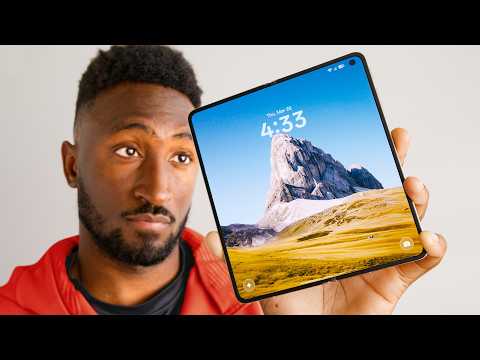
“I’ve been saying for years that foldables are for early adopters only and they don’t make sense for regular people until the only difference between a foldable and a regular phone is the fact that one of them happens to fold in half and there’s no other compromises.” — Marques Brownlee, 0:00
Clip command
yt-dlp --download-sections "*0:00-0:54" "https://www.youtube.com/watch?v=eFUB_jL_XcM" --force-keyframes-at-cuts --merge-output-format mp4 -o "peak-foldable-thesis.mp4"”Same dimensions as an iPhone 17 Pro Max”
“This phone is just under 9 millimeters thick and weighs around 230 grams. For context, the iPhone 17 Pro Max is also just under 9 millimeters thick and around 230 grams. So this is effectively a no compromises normal phone, at least dimensions-wise, before you even open the thing.” — Marques Brownlee, 1:45
Clip command
yt-dlp --download-sections "*1:45-2:32" "https://www.youtube.com/watch?v=eFUB_jL_XcM" --force-keyframes-at-cuts --merge-output-format mp4 -o "peak-foldable-iphone-dimensions.mp4"”The no-feel crease, explained”
“They literally laser scan each individual titanium hinge to map the slightest variations across the surface, then 3D print a liquid polymer to fill in the exact micro gap to perfectly smooth out the hinge and then harden it with ultraviolet light. It is incredibly complicated, but the end result is they minimize the surface level variations across the hinge from 0.2 millimeters down to 0.05 millimeters, which is apparently less than half a human hair thickness.” — Marques Brownlee, 5:59
Clip command
yt-dlp --download-sections "*5:40-6:48" "https://www.youtube.com/watch?v=eFUB_jL_XcM" --force-keyframes-at-cuts --merge-output-format mp4 -o "peak-foldable-no-feel-crease.mp4"”Now Apple jumps in”
“We are saying all of this before Apple jumps in the ring with what we expect to be a folding iPhone. The rumors are saying it’s probably going to be this year, end of this year. And actually that makes perfect sense because that’s what Apple does with emerging technologies. That’s kind of their thing. They’ll sit on the sidelines for the first few cycles while the most aggressive daring companies innovate and work out all the bugs and the kinks and the compromises.” — Marques Brownlee, 7:55
Clip command
yt-dlp --download-sections "*7:55-8:30" "https://www.youtube.com/watch?v=eFUB_jL_XcM" --force-keyframes-at-cuts --merge-output-format mp4 -o "peak-foldable-apple-jumps-in.mp4"”Passport-style iPhone Fold”
“This iPhone fold is supposed to be more of a small passport style, so a short squat like 5.5-inch display while it’s closed and then that opens up to an almost 8-inch widescreen, kind of like a portable iPad Mini.” — Marques Brownlee, 9:57
Clip command
yt-dlp --download-sections "*9:57-10:34" "https://www.youtube.com/watch?v=eFUB_jL_XcM" --force-keyframes-at-cuts --merge-output-format mp4 -o "peak-foldable-passport-style.mp4"Key Points
- Galaxy Fold 1 (2019) compromises (0:16) - Huge cover-screen bezels, subpar cameras and battery, durability, the crease
- Year-by-year compromise removal (0:40) - Thinner builds, bigger batteries, better hinges, smaller creases
- N6 looks like a regular slab from the front (1:13) - Asymmetrical metal corners are the only tell
- Same dimensions as iPhone 17 Pro Max (1:45) - Sub-9mm thick, ~230g
- 6.6” cover screen (1:38) - 3,600 nits peak / 1,800 nits full screen, 1-120Hz LTPO, high-frequency PWM
- Silicon carbon = 6,000mAh in a foldable (3:00) - Plus 80W wired and 50W wireless charging
- 200MP ISOCELL HP5 main (3:08) - 1/1.56” sensor with shallow Z-axis to fit; same one used in S25 Edge
- 50MP ultrawide + 50MP 3x telephoto (3:29) - Flagship-grade extras
- Snapdragon 8 Elite Gen 5 (binned) (3:41) - One core fewer than the full version
- Dedicated S1 networking chip (3:59) - Improves connectivity performance
- IP59 rated (3:59) - “Used to be nuts for foldables”
- 8.1” inner display (5:11) - Same 1-120Hz LTPO panel as outer
- No-feel crease tech (5:40) - Teardrop fold + laser-scanned titanium + 3D-printed UV polymer
- Crease drops from 0.2mm to 0.05mm (6:00) - Less than half a human hair
- Rated for 600,000 folds (6:00) - Without crease deepening
- Stylus support with magnetic charging case (7:03) - 4,000 pressure levels, works on both screens, doubles as Bluetooth shutter
- Apple’s “wait then refine” pattern (8:30) - Vision Pro into VR, HomePod into smart speakers, original iPhone into mobile
- Passport-style aspect ratio rumored (9:41) - Short and squat closed → near-8” widescreen open
Mentions
Companies
- Oppo (0:54) - Maker of the Find N6
- Samsung (0:16) - Galaxy Fold lineage; S25 Edge as sensor reference
- Apple (7:55) - Expected entrant with the iPhone Fold
- Qualcomm (3:41) - Snapdragon 8 Elite Gen 5 supplier
Products & Technologies
- Oppo Find N6 (0:54) - The phone in hand; current “peak foldable”
- Galaxy Fold 1 (0:16) - 2019 launch reference
- iPhone 17 Pro Max (1:51) - Dimensional benchmark
- Samsung Galaxy S25 Edge (3:08) - Same ISOCELL HP5 200MP sensor
- ISOCELL HP5 (3:08) - Thin Z-axis 200MP sensor for foldables
- Snapdragon 8 Elite Gen 5 (3:41) - Binned version inside
- Silicon carbon battery (3:00) - The technology enabling 6,000mAh in a thin folding chassis
- No-feel crease (Oppo) (4:54) - Laser-scanned titanium hinge + 3D-printed UV polymer
- Apple Vision Pro (8:30) - Cited as a “wait then refine” precedent
- HomePod (8:30) - Same precedent
- iPad Mini (10:00) - Comparison for the rumored iPhone Fold open-state size
Surprising Quotes
“It’s also IP59 water and dust resistance rated, which used to be nuts for foldables, but now you can just spill water on this thing and it’ll be fine.” — Marques Brownlee, 3:59
“They literally laser scan each individual titanium hinge to map the slightest variations across the surface, then 3D print a liquid polymer to fill in the exact micro gap to perfectly smooth out the hinge and then harden it with ultraviolet light.” — Marques Brownlee, 5:59
“This process they’re saying is good for 600,000 folds and still not showing any significant crease.” — Marques Brownlee, 6:00
“So aside from the price tag, of course, this is effectively a regular phone that just happens to fold in half. And so yeah, peak foldable. We’ve arrived, I guess.” — Marques Brownlee, 7:36
Transcript
Marques Brownlee: 0:00 So I’ve been saying for years that foldables are for early adopters only and they don’t make sense for regular people until the only difference between a foldable and a regular phone is the fact that one of them happens to fold in half and there’s no other compromises.
Marques Brownlee: 0:16 So when this all got started seven years ago with the Galaxy Fold 1, it was really exciting that it folded in half, but there were obviously a ton of compromises back then to make that happen for the first time, from the huge bezels on that cover screen to the smaller subpar cameras and battery and other specs, the extremely compromised durability, and of course the crease, the massive crease through the middle.
Marques Brownlee: 0:40 So every year foldables have gotten better and better and better and better from a bunch of different companies as they slowly tackled each one of those compromises. So foldables have gotten thinner, and they’ve gotten bigger batteries, and they’ve gotten better hinges and smaller creases.
Marques Brownlee: 0:54 And that’s all led to this, the Oppo Find N6. Does seem kind of random that this is now peak foldable but I actually think by the end of this video you’ll agree with me.
Marques Brownlee: 1:02 So the obvious problem number one with old foldables was that they sucked to use one-handed since they’re thicker, they have worse bezels, and just they’re generally compromised versus a normal slab phone. But we’ve seen this string of thinner foldable phones, especially in the past few years, and now you look at the Oppo Find N6, from the front, you’d hardly know it’s just a normal slab phone.
Marques Brownlee: 1:23 Now you do have the telltale asymmetrical metal, so rounded corners on one side, square corners on the hinge side, that’s how you’d be able to know, but other than that, it just looks like a normal 6.6-inch phone. Oppo’s been absolutely cooking with the materials and the build. So when you pick it up and use it, it genuinely feels like a regular slab phone because it’s the same size as one now.
Marques Brownlee: 1:45 This phone is just under 9 millimeters thick and weighs around 230 grams. For context, the iPhone 17 Pro Max is also just under 9 millimeters thick and around 230 grams. So this is effectively a no compromises normal phone, at least dimensions-wise, before you even open the thing.
Marques Brownlee: 2:04 So many of the previous foldables I remember using them and it’s like you can use the outside screen, but you didn’t really want to, you’d rather just open it up and get to the better screen. But this you could just use like normal. It’s perfectly fine to take pictures with, to watch videos on, to text on, because the keyboard isn’t too small. It’s a normal aspect ratio, it’s great.
Marques Brownlee: 2:22 And it also has all the flagship specs by the way. 3600 nits peak brightness, 1800 nits full screen, so it’s very viewable everywhere outdoors. Super responsive 1 to 120Hz LTPO, high frequency PWM dimming, the whole thing.
Marques Brownlee: 2:40 Now, folding in half also always has presented a bunch of challenges with just the physics of fitting stuff in a smaller, thinner form factor that has to split. So for years these folding phones never really had flagship cameras because there wasn’t enough room. And also the batteries would always be smaller because they’d have to split it in half around a hinge. Which is tough because you’re trying to power a bigger display.
Marques Brownlee: 3:00 But it’s 2026, so now of course the tech has evolved to the point where we have silicon carbon batteries. 6,000 milliamp hour battery, which is more than a lot of slab phones already, plus 80W charging and 50W wireless charging.
Marques Brownlee: 3:08 And then as far as cameras, so the physical sensor size can never quite be the same as a slab phone because again, it’s split in half. So there’s just not as much room in the Z-axis dimension. But there has been development of some big sensors with shallow Z-axis thickness specifically to fit in thinner phones. So this phone has the same ISOCELL HP5 sensor that’s in the S25 Edge.
Marques Brownlee: 3:29 200 megapixels, 1/1.56 inches, optically stabilized, so there is that. Plus the 50 megapixel ultrawide and a 50 megapixel 3x telephoto.
Marques Brownlee: 3:41 And then, I don’t know if you remember, but folding phones used to have significantly lesser chips, too. Less room inside, less room for cooling. This phone has a Snapdragon 8 Elite Gen 5 inside, but a binned version with one less core. So for all intents and purposes, I think we can say it’s a flagship chip and maximizing what you can do in that thin of a space.
Marques Brownlee: 3:59 Plus, there’s a new dedicated S1 chip for better network performance. So now, despite being ultra thin and chopped in half, this thing has flagship displays, flagship chip, flagship specs, high-end cameras. It’s also IP59 water and dust resistance rated, which used to be nuts for foldables, but now you can just spill water on this thing and it’ll be fine.
Marques Brownlee: 4:13 But the pièce de résistance for this N6 is without question this center display. For years, for folding phones, we’ve gotten used to them, you know, having an amazing folding screen but also having a small crease in the middle. And the crease, you know, it’s just one of those things where on most phones, most of the time, it doesn’t bother you.
Marques Brownlee: 4:34 Trust me, as someone who’s used these phones, I’ve said it before, it’s like bezels. Most of the time you’re just looking at the content or reading or typing, so you’re not really seeing it. But every once in a while it catches the light the right way or you run your finger over it and it just hits, you’re reminded of it, and so you can still notice it sometimes.
Marques Brownlee: 4:54 But not with this phone. So the N6 has this new thing they developed called the no-feel crease, and I’d seen the marketing, I’d heard, I’d watched some videos about it but they’re mostly sponsored, so I was a bit skeptical, okay, but I got it in my hands. And this thing is actually super impressive.
Marques Brownlee: 5:11 You open it up, it’s the classic big square, 8.1 inches corner to corner, same full screen brightness, same 1 to 120 hertz LTPO, same PWM dimming. But you might notice there’s basically no perceptible crease here. I mean, there’s a little bit of crease if you’re really looking for it, but compared to other foldables we’ve seen and that I’ve used, this is basically no crease.
Marques Brownlee: 5:40 And the extra bit of engineering that goes into solving this last problem is actually very intricate. And they’re already doing a bunch of the stuff that everyone else has already thought of, like softening the crease radius by doing a teardrop shape when it’s folded. But the main innovation here is with this hinge.
Marques Brownlee: 5:59 They literally laser scan each individual titanium hinge to map the slightest variations across the surface, then 3D print a liquid polymer to fill in the exact micro gap to perfectly smooth out the hinge and then harden it with ultraviolet light. It is incredibly complicated, but the end result is they minimize the surface level variations across the hinge from 0.2 millimeters down to 0.05 millimeters, which is apparently less than half a human hair thickness. So that, combined with a slightly thicker layer of top glass that they’re using, really makes a big visual difference and feel different. A lot of these foldables also, they look great out the box, but the more you use it as you know, the more you fold and unfold it, the deeper that crease becomes, the more you notice it. This process they’re saying is good for 600,000 folds and still not showing any significant crease. Which you know, obviously, I’ve been folding and unfolding this a lot, uh, but not that many times. So I’m just gonna have to take their word for it. But yeah, now that really that’s the last few percent of like quality of life when you’re using a foldable, never really noticing or perceiving the crease at all.
Marques Brownlee: 7:03 And the cherry on top is unlike Samsung’s fold, it actually has pen support. So there’s this little half case you can snap on the back of this phone that holds the pen near the coil, so it wirelessly charges from the phone’s battery. And then yeah, it works on both the front cover screen and the interior display with more than 4,000 levels of pressure sensitivity and minimal lag. So if you’re the artist type or the handwritten note type, this display has digitizer layer to keep that dream alive. And yes, it charges because it does have Bluetooth, so it can still be used as a remote camera shutter.
Marques Brownlee: 7:36 So now in 2026, this Oppo Find N6 is complete as far as I’m concerned. We’ve gone through one by one each of the potential compromises of a folding phone and engineered them away. So aside from the price tag, of course, this is effectively a regular phone that just happens to fold in half. And so yeah, peak foldable. We’ve arrived, I guess. Which of course got me thinking about the obvious elephant in the room. We are saying all of this before Apple jumps in the ring with what we expect to be a folding iPhone. The rumors are saying it’s probably going to be this year, end of this year. And actually that makes perfect sense because that’s what Apple does with emerging technologies. That’s kind of their thing. They’ll sit on the sidelines for the first few cycles while the most aggressive daring companies innovate and work out all the bugs and the kinks and the compromises.
Marques Brownlee: 8:30 And then once that technology is mature enough, that’s when they jump in with all the learnings from everyone else and like an Apple-ified version of it. So that’s Vision Pro jumping into the world that already existed of VR headsets. That’s HomePod jumping into the world that already existed of smart speakers. Heck, that’s what the original iPhone did jumping into the already existing world of mobile phones. So now that we’re at peak foldable and we’ve sort of engineered away the compromises and we’ve got to this point where the tech is mature, it’s ready for Apple to jump in if they wanted to.
Marques Brownlee: 9:00 Do their own Apple-ified version. The question is what is the - what is the Apple-ified thing for a foldable? Cause you know typically when they jump in a new category, their cheat code is just by making theirs the version that works well with the iPhone and that automatically gets you a bunch of users from iPhone land.
Marques Brownlee: 9:15 But this is an iPhone fold, so what’s the trick? Will it like run a special iPadOS when it’s open or maybe, you know, every foldable has multi-window support and extra multitasking features, so maybe that will make its way to the iPhone fold too? Maybe. Don’t really know software-wise but the one big weird thing that the rumors are actually pointing to is playing with aspect ratio again.
Marques Brownlee: 9:41 Cause so many of these modern full-sized folds has trended towards the like regular slab phone aspect ratio when it’s closed and we’ve talked about this, that leaves you with the square when you open it up, which is bigger, but it is a little bit compromised, it’s not as good for widescreen media, things like that.
Marques Brownlee: 9:57 But this iPhone fold is supposed to be more of a small passport style, so a short squat like 5.5-inch display while it’s closed and then that opens up to an almost 8-inch widescreen, kind of like a portable iPad Mini. It’s a little bit of a throwback. We used to see more interesting shapes in folds a couple years ago even from earlier Oppo Find Ns. So this won’t be the first to try it and it certainly won’t be the last.
Marques Brownlee: 10:21 We’ll see how much of the other stuff like the no-feel crease and the super thin build, silicon carbon battery, flagship cameras, we’ll see how much of that other stuff makes it to the iPhone fold as well later this year - but we’ll see.
Marques Brownlee: 10:34 Looking forward to it. Also subscribe to be among the first to see that when it does come out because we’ll cover it here on the channel. Thanks for watching, catch you guys in the next one. Peace.