Jensen Huang: NVIDIA - The $4 Trillion Company & the AI Revolution | Lex Fridman Podcast #494
Jensen Huang: NVIDIA - The $4 Trillion Company & the AI Revolution | Lex Fridman Podcast #494
Summary
Jensen Huang, co-founder and CEO of NVIDIA, joins Lex Fridman for a wide-ranging conversation about how NVIDIA evolved from a GPU specialist into the world’s most valuable company by architecting the infrastructure of the AI revolution. Huang explains his philosophy of “extreme co-design,” where NVIDIA optimizes the entire computing stack — from chips and memory to networking, power, and cooling — at rack and data center scale. He traces the company’s pivotal decisions, including the near-existential gamble of putting CUDA on every GeForce GPU despite it consuming all of the company’s gross profit, a bet that ultimately created the massive developer install base that remains NVIDIA’s greatest competitive moat.
The conversation explores four distinct AI scaling laws (pre-training, post-training, test-time reasoning, and agentic scaling) and how NVIDIA anticipates future hardware requirements years in advance through first-principles reasoning and close relationships across the semiconductor supply chain. Huang discusses the transition from retrieval-based computing to generative AI “token factories,” his vision for NVIDIA reaching $3 trillion in revenues, and the practical engineering challenges of power delivery, memory bandwidth, and global supply chain coordination with partners like TSMC, SK Hynix, and ASML.
On the human side, Huang shares his leadership philosophy of “speed of light” thinking over continuous improvement, his approach to dealing with pressure by decomposing problems and sharing the burden, and his view that intelligence is a commodity while humanity — compassion, resilience, character — is what truly matters. He declares that AGI has essentially arrived, predicts the number of programmers will grow from 30 million to one billion as natural language becomes the primary interface for specification, and reflects on mortality with the aspiration to “die on the job” while continuously passing knowledge to his team.
Highlights
”I think we’ve achieved AGI”
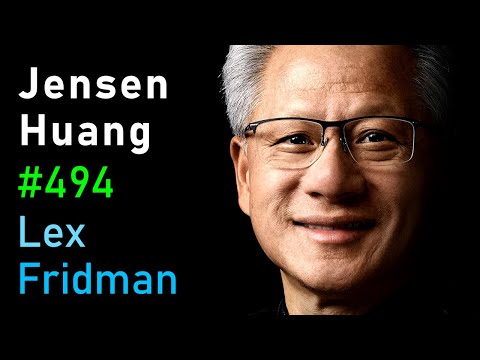
“I think it’s now. I think we’ve achieved AGI.” — Jensen Huang, 1:56:33
Clip command
yt-dlp --download-sections "*56:33-57:29" "https://www.youtube.com/watch?v=vif8NQcjVf0" --force-keyframes-at-cuts --merge-output-format mp4 -o "jensen-agi-achieved.mp4"”What is it about a dishwasher that allows that dishwasher to sit in the middle of superhumans?”
“I’m sitting in the middle, orchestrating all 60 of them. And so you got to ask yourself, what is it about a dishwasher that allows that dishwasher to sit in the middle of superhumans?” — Jensen Huang, 2:15:00
Clip command
yt-dlp --download-sections "*2:14:42-2:15:50" "https://www.youtube.com/watch?v=vif8NQcjVf0" --force-keyframes-at-cuts --merge-output-format mp4 -o "jensen-dishwasher-superhumans.mp4"”CUDA on GeForce was as close to an existential threat as it gets”
“We increased our cost by 50% and that consumed and we were a 35% gross margin company. And so it was a it was quite a difficult decision to make.” — Jensen Huang, 10:58
Clip command
yt-dlp --download-sections "*10:58-15:30" "https://www.youtube.com/watch?v=vif8NQcjVf0" --force-keyframes-at-cuts --merge-output-format mp4 -o "jensen-cuda-geforce-existential.mp4"”Agents are the iPhone of tokens”
“The iPhone of tokens arrived. It is the fastest growing application in history. It went straight up.” — Jensen Huang, 1:33:17
Clip command
yt-dlp --download-sections "*1:33:07-1:33:31" "https://www.youtube.com/watch?v=vif8NQcjVf0" --force-keyframes-at-cuts --merge-output-format mp4 -o "jensen-iphone-of-tokens.mp4"”I really don’t want to die”
“I really don’t want to die. I’ve a great life. I’ve a great family. I’ve really important work. This is not a once in a lifetime experience… This is a once-in-a-humanity experience, what I’m going through.” — Jensen Huang, 2:17:22
Clip command
yt-dlp --download-sections "*2:17:22-2:18:36" "https://www.youtube.com/watch?v=vif8NQcjVf0" --force-keyframes-at-cuts --merge-output-format mp4 -o "jensen-mortality-once-in-humanity.mp4"”We just went from 30 million to probably one billion programmers”
“What is the definition of coding? I believe that is the definition of coding as of today is simply specifying specification… So the question is, how many people can do that? I think we just went from 30 million to probably one billion.” — Jensen Huang, 2:01:46
Clip command
yt-dlp --download-sections "*2:01:46-2:03:04" "https://www.youtube.com/watch?v=vif8NQcjVf0" --force-keyframes-at-cuts --merge-output-format mp4 -o "jensen-billion-programmers.mp4"Key Points
- Extreme co-design necessity (1:12) - The problem no longer fits inside one computer; NVIDIA must optimize across GPU, CPU, memory, networking, power, and cooling simultaneously to beat Amdahl’s Law at scale
- Flat organization with 60+ direct reports (5:01) - Jensen has over 60 direct reports and does no one-on-ones; every meeting is collaborative so the entire team attacks problems together
- CUDA on GeForce was a near-existential bet (10:58) - Putting CUDA on consumer GPUs increased costs by 50%, crushed gross margins, and dropped NVIDIA’s market cap from ~$8B to $1.5B, but built the install base that defines the company
- Shaping belief systems before announcing decisions (18:44) - Jensen shapes his employees’, partners’, and industry’s belief systems step-by-step so that by the time he announces a major direction, everyone’s response is “what took you so long?”
- Four AI scaling laws (22:59) - Pre-training, post-training, test-time scaling, and agentic scaling form a continuous loop where intelligence scales fundamentally with compute
- Inference is thinking, not retrieval (25:54) - Contrary to early predictions that inference would be easy and commoditized, Jensen argues thinking is fundamentally harder than reading, making test-time scaling intensely compute-intensive
- Vera Rubin rack designed for agents (30:02) - Grace Blackwell was designed for LLM inference; the next-gen Vera Rubin rack was redesigned from scratch for agentic workloads that use tools, storage, and spawn sub-agents
- Power grid waste as untapped resource (46:46) - 99% of the time, power grids run at ~60% capacity; Jensen proposes data centers that gracefully degrade during peak demand rather than requiring 100% uptime guarantees
- Elon’s systems engineering approach (53:11) - Jensen praises Elon Musk’s ability to question everything down to its minimal necessity and be present at the point of action, creating urgency across the entire supply chain
- “Speed of light” thinking over continuous improvement (56:11) - Rather than improving from 74 days to 72, Jensen strips problems to zero and asks what physics allows, often finding that 6 days is the real limit
- China as the fastest innovating country (1:02:07) - 50% of world’s AI researchers are Chinese; internal provincial competition, open-source culture driven by schoolmate loyalty, and arriving at the mobile/cloud era created explosive innovation
- TSMC’s three unmatched qualities (1:10:21) - Technology excellence, miraculous manufacturing orchestration across hundreds of dynamic customers, and an intangible culture of trust built over three decades without a formal contract
- CUDA install base is NVIDIA’s biggest moat (1:15:20) - The combination of install base reaching hundreds of millions of computers, rapid execution velocity, and developer trust that NVIDIA will maintain CUDA forever creates an insurmountable advantage
- From retrieval computing to token factories (1:24:44) - Computing shifted from pre-recorded file retrieval to contextually aware token generation; data centers are no longer warehouses but revenue-generating factories
- $1000 per million tokens is coming (1:28:00) - Token pricing is segmenting like iPhones, with free tokens, premium tokens, and specialized high-intelligence tokens that people will pay $1000 per million for
- Radiologists grew despite superhuman AI (1:59:33) - Computer vision became superhuman by ~2020 but the number of radiologists increased because the purpose of the job (diagnosing disease) differs from the task (reading scans)
- Resilience through systematic forgetting (1:39:36) - Jensen manages anxiety by decomposing problems, sharing the burden with the right people immediately, and then deliberately forgetting and moving to the next challenge
- Intelligence is a commodity; humanity is not (2:14:13) - Jensen argues intelligence should not be conflated with humanity; character, compassion, and resilience are the truly superhuman powers that AI cannot replicate
- Die on the job; no succession planning (2:18:36) - Instead of formal succession planning, Jensen continuously passes knowledge to his team through reasoning meetings, aiming to make the company resilient by elevating everyone around him
Mentions
Companies
- NVIDIA (0:33) - Central subject; world’s most valuable company, AI computing platform
- TSMC (1:09:51) - NVIDIA’s foundry partner for 30 years, no formal contract, trust-based relationship
- ASML (39:23) - EUV lithography supplier; key supply chain bottleneck
- SK Hynix (39:23) - High-bandwidth memory supplier
- xAI (52:44) - Elon Musk’s AI company; built Colossus supercomputer in Memphis in record time
- CoreWeave (1:18:31) - Cloud GPU company ramping NVIDIA infrastructure
- Lambda (1:18:31) - Cloud GPU company mentioned alongside CoreWeave
- Eli Lilly (1:18:31) - Using NVIDIA supercomputers for drug discovery
- Amazon AWS (1:18:31) - “Ramping up AWS like crazy right now”
- Google Cloud (1:18:16) - Part of NVIDIA’s horizontal ecosystem
- Microsoft Azure (1:18:16) - Part of NVIDIA’s horizontal ecosystem
- DeepSeek (1:06:00) - Chinese open-source AI company pushing the movement forward
- MiniMax (1:06:00) - Chinese AI company contributing to open source
- Perplexity (1:05:43) - AI search engine; Jensen is a fan
- Dassault (1:48:46) - Software company whose products run on NVIDIA
- Autodesk (1:48:46) - Software company in the NVIDIA ecosystem
- GEV / Caterpillar (42:53) - Downstream infrastructure companies
Products & Technologies
- CUDA (10:58) - NVIDIA’s computing platform; now at version 13.2, the foundation of their developer ecosystem
- GeForce (15:00) - “NVIDIA is the house that GeForce built”; still the company’s #1 marketing strategy
- NVLink 72 (30:02) - Rack-scale interconnect enabling 10 trillion parameter models in one computing domain
- Grace Blackwell (30:02) - Previous-gen rack designed for LLM inference
- Vera Rubin (30:02) - Next-gen rack with storage accelerators, new CPU, and support for agentic workloads
- Nemotron-3 Super (1:06:00) - 120B parameter open-weight MOE model; combines transformers and SSMs
- GR00T (21:00) - Robotics platform that Jensen laid the foundation for over two and a half years
- Open-COA / Open Cloud (33:00) - Agentic system framework; Jensen says it did for agentic systems what ChatGPT did for generative AI
- NeMo Guardrails (36:44) - NVIDIA’s security framework for agentic AI; offers 2-out-of-3 rights model
- OpenShield (36:44) - Security framework integrated into Open Cloud
- HBM / HBM4 (42:00) - High-bandwidth memory; Jensen convinced DRAM CEOs to invest years before it went mainstream
- LPDDR5 (42:00) - Cell phone memory adapted for data center supercomputers
- CoWoS (45:59) - TSMC’s advanced packaging technology
- DLSS 5 (1:49:58) - AI upscaling for games; 3D-conditioned, artist-guided generative enhancement
- RTX Mod (1:54:48) - Modding tool that injects latest ray-tracing technology into old games
- Colossus (52:44) - xAI’s Memphis supercomputer; 200,000 GPUs, built in 4 months
People
- Elon Musk (52:44) - Praised for systems engineering approach, presence at the point of action, and building Colossus in record time
- Ilya Sutskever (23:13) - Referenced for saying “we’re out of data” which Jensen argues was obviously not the final answer
- Morris Chang (1:13:14) - TSMC founder who offered Jensen the CEO position in 2013; described as a personal friend and highly regarded executive
- Jim Cramer (1:36:00) - Referenced in context of mainstream investors who bought NVIDIA stock on his recommendation and became millionaires
- John Carmack (implied via 1:53:27) - Creator of Doom, which Jensen calls the most influential game ever made
Surprising Quotes
“No company in history has ever grown at a scale that we’re growing while accelerating that growth. It’s incredible.” — Jensen Huang, 39:39
“I don’t know if the chip would ever get nervous. And that’s the, of course, the conditions by which that causes anxiety or nervousness or whatever emotion, I believe that AI will be able to recognize those and understand those. I don’t think my chips will feel those.” — Jensen Huang, 2:11:16
“I don’t know how many tens, hundreds of billions of dollars of business we’ve done through them, and we don’t have a contract.” — Jensen Huang, 1:13:05
“Incredible superpower of being… have the mind of a child. My first thought is: how hard can it be?” — Jensen Huang, 1:42:00
“You can’t walk up to Excel and say I don’t know how to use Excel, you’re done.” — Jensen Huang, 2:10:01
Transcript
Lex Fridman: 0:00 The following is a conversation with Jensen Huang, CEO of NVIDIA, one of the most important and influential companies in the history of human civilization. NVIDIA is the engine powering the AI revolution, and a lot of its success can be directly attributed to Jensen’s sheer force of will and his many brilliant bets and decisions as a leader, engineer, and innovator. This is the Lex Fridman Podcast. And now, dear friends, here’s Jensen Huang.
Lex Fridman: 0:33 You’ve propelled NVIDIA into a new era in AI, moving beyond its focus on chip-scale design to now rack-scale design. And I think it’s fair to say that winning for NVIDIA for a long time used to be about building the best GPU possible. And you still do, but now you’ve expanded that to extreme co-design of GPU, CPU, memory, networking, storage, power, cooling, software, the rack itself, the pod, and even the data center. So let’s talk about extreme co-design. What is the hardest part of co-designing a system with that many complex components and design variables?
Jensen Huang: 1:12 Yeah, thanks for that question. So first of all, the reason why extreme co-design is necessary is because the problem no longer fits inside one computer to be accelerated by one GPU. The problem that you’re trying to solve is you would like to go faster than the number of computers that you add. So you added, you know, 10,000 computers, but you would like to go a million times faster. Then all of a sudden, you have to take the algorithm, you have to break up the algorithm, you have to refactor it, you have to shard the pipeline, you have to shard the data, you have to shard the model. Now all of a sudden, when you distribute the problem this way, not just scaling up the problem, but you’re distributing the problem, then everything gets in the way. This is the Amdahl’s Law problem, where the amount of speedup you have for something depends on how much of the total workload it is. And so if computation represents 50% of the problem and I sped up computation infinitely, like a million times, you know, I’d only speed up the total workload by a factor of two. Now all of a sudden, not only do you have to distribute the computation, you have to, you know, shard the pipeline somehow, you also have to solve the networking problem because you’ve got all of these computers are all connected together. And so distributed computing at the scale that we do, the CPU’s a problem, the GPU’s a problem, the networking’s a problem, the switching is a problem, and distributing the workload across all these computers are a problem. It’s just a massively complex computer science problem. And so we just gotta bring every technology to bear. Otherwise, we scale up linearly or we scale up based on the capabilities of Moore’s Law, which has largely slowed because Dennard scaling has slowed.
Lex Fridman: 3:16 I’m sure there’s trade-offs there. Plus you have complete disparate disciplines here. I’m sure you have specialists in each one of these. High bandwidth memory, the network and the NVLink, the NICs, the optics and copper that you’re doing, the power delivery, the cooling, all of the… I mean, there’s like world experts in each of those. How do you get them in a room together to figure that out?
Jensen Huang: 3:34 That’s why my staff is so large.
Lex Fridman: 3:36 What’s the process? Can you take me through the process of the specialists and the generalists? Like, how do you put together the rack when you know the set of things you have to shove into a rack to get together? Like, what does that process look like of designing it all together?
Jensen Huang: 3:52 Yeah, there’s the first question, which is: what is extreme co-design? You’re optimizing across the entire stack of software from architectures to chips, to systems, to system software, to the algorithms, to the applications. That’s one layer. The second thing that you and I just talked about goes beyond CPUs and GPUs and networking chips and scale-up switches and scale-out switches. And then, of course, you gotta include power and cooling and all of that because, you know, all these computers are extremely, extremely power-hungry. They do a lot of work and they’re very energy efficient, but they in aggregate still consume a lot of power. And so that’s the first question is what is it. The second question is why is it and we just spoke about the reason why, you know, you want to distribute the workload so that you can exceed the benefit of just increasing the number of computers. And then the third question is: how is it? How do you do it? And that’s the kind of the miracle of this company.
Jensen Huang: 5:01 When you’re designing a company, you should first think about what is it that you want the company to produce. You know, I see a lot of company organization charts and they all look the same. Hamburger organization charts, software organization charts, and car company organization charts. They all look the same. And it doesn’t make any sense to me. You know, the goal of a company is to be the machinery, the mechanism, the system that produces the output, and that output is the product that we like to create. It is also designed, the architecture of the company should reflect the environment by which it exists. It almost directly says what you should do with your organization. My direct staff is 60 people. You know, I don’t have one-on-ones with them because it’s impossible. You can’t have 60 people on your staff if you’re, you know, going to get work done and…
Lex Fridman: 5:51 So you still have 60 reports. You still have a flat…
Jensen Huang: 5:55 More.
Lex Fridman: 5:56 And most are at least have a foot in engineering.
Jensen Huang: 5:59 Almost. All of them. There’s experts in memory, there’s experts in CPUs, there’s experts in optical, all yeah GPUs and architecture, algorithms, design.
Lex Fridman: 6:11 So you constantly have an eye on the entire stack? And you’re having these like intense discussions about the design of the entire stack?
Jensen Huang: 6:18 And no conversation is ever one person. That’s why I don’t do one-on-ones. We present a problem and all of us attack it. You know, because we’re doing extreme co-design. And literally the company is doing extreme co-design all the time.
Lex Fridman: 6:33 So even if you’re talking about a particular component, like cooling, networking, everybody’s listening in and they can contribute: ‘Well, this doesn’t work for the for the power distribution, this doesn’t work for the for the memory, this doesn’t work for this’…
Jensen Huang: 6:49 Exactly. And whoever wants to tune out, tune out. You know what I’m saying? And the reason for that is because the people who are on the staff, they know when to pay attention. They’re supposed, you know, if something they could have contributed to they didn’t contribute to, I’m going to call them out, you know? And so hey, come on, let’s get in here.
Lex Fridman: 7:07 So as you mentioned, Nvidia’s this company that’s adapting to the environment. So at which point can you say did the environment change and you became adapting sort of secretly in the early days from GPU for gaming, maybe the early deep learning revolution to: we’re now going to start think of it as an AI factory. What does Nvidia do? It produces AI. Let’s build the factory that makes AI.
Jensen Huang: 7:31 I could reason through it just systematically. We started out as an accelerator company. But the problem with accelerators is that the application domain’s too narrow. It has the benefit of being incredibly optimized for the job. The problem with intense specialization is that of course your market reach is narrower. But the problem is the market size also dictates your R&D capacity. And your R&D capacity ultimately dictates the influence and impact that you can possibly have in computing. And so when we first started out as an accelerator, we always knew that that was going to be our first step. We had to find a way to become accelerated computing. But the problem is when you become a computing company, it’s too general-purpose and it takes away from your specialization. I connected two words that actually have fundamental tension. The better computing company we become, the worse we became as a specialist. The more of a specialist, the less capacity we have to do overall computing. And the company has to find that really narrow path step by step by step.
Jensen Huang: 9:00 To expand our aperture of computing but not give up on the most important specialization that we had. So the first step that we took beyond acceleration was we invented the programmable pixel shader. That was the first step towards programmability. The second thing that we did was we put FP32 into our shaders. That FP32 step, IEEE compatible FP32 was a huge step in the direction of computing. It was the reason why all of the people who were working on stream processors and other types of data flow processors discovered us. Which led us to create, put C on top of FP32 which we call CG. That CG path took us to eventually CUDA. Putting CUDA on GeForce, that was a strategic decision that was very, very hard to do because it cost the company enormous amounts of our profits and we couldn’t afford it at the time, but we did it anyways because we wanted to be a computing company. A computing company has a computing architecture. A computing architecture has to be compatible across all of the chips that we build.
Lex Fridman: 10:42 Can you take me to that decision so putting CUDA on GeForce, could not afford to do. Can you explain that decision why, why boldly choose to do that anyway?
Jensen Huang: 10:58 Yeah, absolutely. That was the first, I would say that that was the first strategic decision that is as close to an existential threat.
Lex Fridman: 11:05 For people who don’t know, it turned out to be, spoiler alert, one of the most incredibly brilliant decisions ever made by a company. So CUDA turned out to be an incredible foundation for computation and in this AI infrastructure world. So just setting the context, it turned out to be a good decision.
Jensen Huang: 11:28 Yeah, it turned out to be a good decision. So here’s the way it went. We invented this thing called CUDA and it expanded the aperture of applications that we can accelerate with our accelerator. The question is how do we attract developers to CUDA? Because a computing platform is all about developers. And developers don’t come to a computing platform just because it could perform something interesting. They come to a computing platform because the install base is large. Because a developer like anybody else wants to develop software that reaches a lot of people. So the install base is in fact the single most important part of an architecture. The architecture could attract enormous amounts of criticism. For example, no architecture has ever attracted more criticism than the x86. As a less than elegant architecture, but yet it is the defining architecture of today. It gives you an example that in fact so many RISC architectures, which were beautifully architected, incredibly well designed by some of the brightest computer scientists in the world, largely failed.
Jensen Huang: 13:00 Install base defines an architecture. And so there were other architectures at the time. CUDA came out, OpenCL was here, there were several other competing architectures. But the decision that we made that was good was we said, hey, look, ultimately it’s about install base and what is the best way we could get a new computing architecture into the world? By that time frame, GeForce had become successful. We were already selling millions and millions of GeForce GPUs a year. And we said, we ought to put CUDA on GeForce and put it into every single PC whether customers use it or not. And use it as a starting point of cultivating our install base. Meanwhile, we’ll go and attract developers and went to universities and wrote books and taught classes and put CUDA everywhere. The problem was CUDA increased our cost of that GPU, which is a consumer product, so tremendously, it completely consumed all of the company’s gross profit dollars. And so at the time the company was probably worth six, seven billion dollars or something like that. After we launched CUDA, I recognized that it was going to add so much cost, but it was something we believed in, our market cap went down to like one and a half billion dollars. And so we were down there for a while and we clawed our way back.
Jensen Huang: 15:00 Slowly, but we carried CUDA on GeForce. I always say that NVIDIA is the house that GeForce built because it was GeForce that took CUDA out to everybody. Researchers, scientists, they discovered CUDA on GeForce. Because they were all, many of them were gamers. Many of them built their own PCs anyways. In a university lab, many of them built clusters themselves using PC components and so that’s kind of how we got going.
Lex Fridman: 15:38 That existential moment, do you remember like what were those meetings like? What were those discussions like? Deciding as a company risking everything?
Jensen Huang: 15:48 Well, I had to make it clear to the board what we were trying to do and the management team knew our gross margins were going to get crushed. So you could imagine a world where GeForce would carry the burden of CUDA and none of the gamers would appreciate it and none of the gamers would pay for it. They only pay a certain price and it doesn’t matter what your cost is. And so we increased our cost by 50% and that consumed and we were a 35% gross margin company. And so it was quite a difficult decision to make. But you could imagine that someday this could grow into workstations and it would go into supercomputers and in those segments maybe we can capture more margin. So you could reason your way into being able to afford this, but it still took a decade.
Lex Fridman: 16:46 But that’s more of like conversation with the board, convincing them, but you psychologically. Because NVIDIA’s continued to make bold bets that predict the future and in part, especially now, define the future. So I’m almost looking for wisdom about how you were able to make those decisions, to make leaps like that as a company.
Jensen Huang: 17:11 Well, first of all, I’m informed by a lot of curiosity. At some point there’s a reasoning system that convinces me, so clearly this outcome will happen. That this will happen. And so I believe it in my mind and when I believe it in my mind, you know how it is, you manifest a future and that future is so convincing there’s no way it won’t happen. There’s a lot of suffering in between, but you’ve got to believe what you believe.
Jensen Huang: 18:00 And you reason about how to get there, you reason about why it must exist. And you know I reasoned, the management team will reason about it, all the people, we spend a lot of time reasoning about it. The thing, the next part of it is probably a skill thing which is often times in leadership the leadership stays quiet or they learn about something and then they do some manifesto and it’s a brand new year and somehow at the end of the year next year we’re going to have a brand new plan, big huge layoff this way, big huge organization change this way, new mission statement, brand new logos.
Jensen Huang: 18:44 We’ve just never, I never do things that way. When I learn about something and it’s starting to influence how I think I’ll make it very clear to everybody near me that this is interesting, this is going to make a difference, this is going to impact that, and I reason about things step-by-step-by-step. Often times I’ve already made up my mind but I’ll take every possible opportunity, external information, new insights, new discoveries, new engineering revelations, new milestones, I’ll take those opportunities and I’ll use it to shape everybody else’s belief system and I’m doing that literally every single day. I’m doing that with my board, I’m doing that with my management team, I’m doing that with my employees, I’m trying to shape their belief system such that when I come the day I say hey let’s buy Mellanox it’s completely obvious to everybody that we absolutely should. On the day that I said hey guys let’s go all in on deep learning and let me tell you why. I’ve already been laying down the bricks to different organizations inside the company. And on the day that I announce it everybody’s kind of saying you know Jensen what took you so long?
Jensen Huang: 20:41 And in fact I’ve been shaping their belief system for some time and therefore leadership sometimes it looks like you’re leading from behind but you’ve been shaping to the point where on the day that I declared it 100% buy-in but that’s what you want, you want to bring everybody along. Otherwise we announce something about deep learning and everybody goes what are you talking about.
Jensen Huang: 21:00 GTC in fact, if you go back in time, look at the keynotes. I’m also shaping the belief system of my partners and the industry. And so by the time that I announce something, like for example, we just announced GR00T. I’ve been talking about the stepping stones for two and a half years. And so I’ve been laying the foundation step by step by step. So when the time comes you announce it, everybody’s in, you know, what took you so long?
Jensen Huang: 21:53 We don’t build computers. We actually don’t build clouds. As it turns out, we’re a computing platform company. And so nobody can buy anything from us. That’s the weird thing. We vertically design, vertically integrate to design and optimize, but then we open up the entire platform at every single layer to be integrated into other companies’ products and services and clouds and supercomputers and OEM computers. And so the amazing thing is, I can’t do what I do without having convinced them first. And so most of GTC is about manifesting a future that by the time that my product is ready, they’re going, “what took you so long?”
Lex Fridman: 22:45 So one of the things you’ve been a believer for a long time is scaling laws broadly defined. So are you still a believer in the scaling laws?
Jensen Huang: 22:59 Yeah. We have more scaling laws now.
Lex Fridman: 23:02 So I think you’ve outlined four of them with pre-training, post-training, test-time and agentic scaling. What do you think when you think about the future, what are the blockers that you’re most concerned about that keep you up at night that you have to overcome in order to keep scaling?
Jensen Huang: 23:13 Well, we can go back and reflect on what people thought were blockers. So in the beginning, the pre-training scaling law, people thought that the amount of data that we have, high quality data that we have, will limit the intelligence that we achieve. And that scaling law was an important, very important scaling law. The larger the model, the correspondingly more data, results in a smarter AI. And so that was pre-training and Ilya Sutskever, Ilya said, “we’re out of data” or something, that pre-training is over. The industry panicked, that this is the end of AI. And of course that’s obviously not true. We’re going to keep on scaling the amount of data that we have to train with. A lot of that data’s probably going to be synthetic. And what people don’t realize is that most of the data that we are training, that we teach each other with, inform each other with is synthetic. It’s synthetic because it didn’t come out of nature. You created it, I’m consuming it, I modify it, augment it, I regenerate it, somebody else consumes it.
Jensen Huang: 24:31 And so we’ve now reached a level where AI is able to take ground truth, augment it, enhance it, synthetically generate an enormous amount of data, and that part of post-training continues to scale. The amount of data that we could use that is human-generated will be smaller and smaller, the amount of data that we use to train models is going to continue to scale to the point where we’re no longer limited — training is no longer limited by data, it’s now limited by compute. And the reason for that is most of the data is synthetic.
Jensen Huang: 25:14 Then the next phase is test time. And I still remember people telling me that inference, ‘oh yeah, that’s easy. Pre-training, that’s hard.’ And so inference chips are going to be little tiny chips and in the future inference is going to be the biggest market and it’s going to be easy and we’re going to commoditize it and everybody can build their own chips. And that was always illogical to me because inference is thinking.
Jensen Huang: 25:54 And I think thinking is hard. Thinking is way harder than reading. Pre-training is just memorization and generalization, looking for patterns and relationships. You’re reading and reading, versus thinking, reasoning, solving problems, taking unexplored experiences, new experiences and breaking it down into decomposing it into solvable pieces that we then go off either through first principle reasoning or through previous examples, prior experiences, or just exploration and search and trying different things. And that whole process of test-time scaling, inference is really about thinking. And it’s about reasoning, it’s about planning, it’s about search. And so how could that possibly be compute-light? And we were absolutely right about that, test-time scaling is intensely compute-intensive.
Jensen Huang: 27:00 Then the question is okay, now we’re at inference and we’re at test time scaling, what’s beyond that? Well obviously, we have now created one agentic person and that one agentic person has a large language model. But during test time, that agentic system goes off and does research and bangs on databases and it goes on and uses tools, and one of the most important things it does is spins off and spawns off a whole bunch of sub-agents, which means we’re now creating large teams. It’s so much easier to scale NVIDIA by hiring more employees than it is to scale myself. And so the next scaling law is the agentic scaling law. It’s kind of like multiply AI. We could spin off agents as fast as you want to spin off agents. And so you now have four scaling laws.
Jensen Huang: 27:44 And as we use the agentic systems, they’re going to create a lot more data, they’re going to create a lot of experiences. Some of it we’re going to say, ‘wow, this is really good, we ought to memorize this.’ That data set then comes all the way back to pre-training, we memorize and generalize it, we then refine it and fine-tune it back into post-training, then we enhance it even more with test time, and the agentic systems put it out to the industry. And so this loop, the cycle is going to go on and on. It kind of comes down to basically intelligence is going to scale by one thing, and it’s compute.
Lex Fridman: 28:41 But there’s a tricky thing there that you have to anticipate and predict, which is some of these components, it requires different kind of hardware to really do it optimally. So you have to anticipate where the AI innovation is going to lead. For example, Mixture of Experts with sparsity. With hardware, you can’t just pivot on a week’s notice.
Jensen Huang: 29:17 For example, these AI model architectures are being invented about once every six months. And system architectures and hardware architectures, kind of every three years. And so you need to anticipate what likely is going to happen two, three years from now. And there’s a couple of ways that you could do that. First of all, we could do research internally ourselves. We’re also the only AI company in the world that works with literally every AI company in the world, and to the extent that we can, we try to get a sense of what are the challenges that people are experiencing. For example, when mixtures of experts came out, that’s the reason why we had NVLink 72 instead of NVLink 8. We could now take an entire 4 trillion, 10 trillion parameter model and put it in one computing domain as if it’s running on one GPU.
Jensen Huang: 32:22 You just reason about it. A first principle… you just reason. No matter what happens, at some point, in order for that large language model to be a digital worker, what does it have to do? It has to access ground truth, that’s our file system. It has to be able to do research. It’s obviously if it wants to help me it’s got to use my tools. And so I think the — I just described in fact almost all of the properties of Open-COA. That it’s going to use tools, that it’s going to access files, it’s going to be able to do research, it has IO subsystem. And when you’re done reasoning through it in that way, then you say, oh my gosh the impact to the future computing is deeply profound and the reason for that is I think we’ve just reinvented the computer.
Jensen Huang: 34:58 And then now you say, okay, when did we reason about that? If you take the Open-COA schematic that I used at GTC, you will find it two years ago. Literally two years ago at GTC I was talking about agentic systems that exactly reflect Open-COA today. And I think Open-COA did for agentic systems what ChatGPT did for generative systems.
Lex Fridman: 37:41 So you eloquently explained how we have a long history of blockers that we thought were going to be blockers and we overcame them. But now looking into the future, what do you think might be the blockers?
Jensen Huang: 37:59 Power is a concern, but it’s not the only concern. But that’s the reason why we’re pushing so hard on extreme co-design so that we can improve the tokens per second per watt orders of magnitude every single year. And so in the last 10 years, Moore’s Law would have progressed computing about 100 times. We progressed and scaled up computing by a million times in the last 10 years. And so we’re going to keep on doing that through extreme co-design. Our computer price is going up, but our token generation effectiveness is going up so much faster that token cost is coming down. It’s coming down an order of magnitude every year.
Lex Fridman: 39:23 How much does it keep you up at night, the bottlenecks in the supply chain of AI? Like ASML with EUV lithography machines, TSMC with advanced packaging like CoWoS, and SK Hynix with high-bandwidth memory?
Jensen Huang: 39:39 All the time. And we’re working on it all the time. No company in history has ever grown at a scale that we’re growing while accelerating that growth. It’s incredible. And it’s hard for people to even understand this. In the overall world of AI computing, we’re increasing share. And so supply chain upstream and downstream are really important to us. I spend a lot of time informing all the CEOs that I work with what are the dynamics that’s going to cause the growth to continue or even accelerate.
Jensen Huang: 40:31 About three years ago, I was able to convince several of the CEOs that even though at the time HBM memory was used quite scarcely, that this was going to be a mainstream memory for data centers in the future. And at first it sounded ridiculous, but several of the CEOs believed me and decided to invest in building HBM memories. The low-power memories that we use for cell phones and we wanted them to adapt them for supercomputers. All three of them had record years in history and these are 45-year companies. And so that’s part of my job is to inform and shape, inspire.
Lex Fridman: 46:34 Maybe if we can just linger on the power for a little bit, what are your hopes for how to solve the energy problem?
Jensen Huang: 46:46 One of the areas that I would love us to talk about and just get the message out. Our power grid is designed for the worst case condition with some margin. Well, 99% of the time, we’re nowhere near the worst case condition and we’re probably running around 60% of peak. And so 99% of the time, our power grid has excess power and they’re just sitting idle. But they have to be there sitting idle because just in case hospitals have to be powered, infrastructure has to be powered, airports have to run. And so the question that I have is whether we could go and create contractual agreements and design computer architecture systems, data centers, such that when they need the maximum power for infrastructure and society, that the data centers would get less. I just want to use their excess.
Lex Fridman: 52:44 You’ve highly lauded Elon and xAI’s accomplishment in Memphis in building Colossus supercomputer probably in record time in just four months. It’s now at 200,000 GPUs and growing very quickly. Is there something about his approach that’s instructive to broadly to all the data center creators?
Jensen Huang: 53:11 First of all Elon is deep in so many different topics yet he’s also a really good systems thinker. And so he’s able to think through multiple disciplines. He obviously pushes things, questions everything, whether number one is it necessary, number two does it have to be done this way, and does it have to take this long? And so he has the ability to question everything to the point where everything is down to its minimal amount that’s necessary. Now you can’t take anything else out.
Jensen Huang: 56:11 Is there parallels in the Nvidia extreme systems code design approach? Well, first of all, code design is an ultimate systems engineering problem. The other thing that we do, and this is a philosophy that I started 30 years ago, it’s called the speed of light. Speed of light is not just about the speed, speed of light is my shorthand for what’s the limit of what physics can do. And so every single thing that we do is compared against the speed of light: memory speed, math speed, power, cost, time, effort, number of people, manufacturing cycle time. And I force everybody to think about what the first principles are, what the physical limits are, for everything before we do anything.
Jensen Huang: 58:23 I don’t love the other methods, which is continuous improvement. The problem with continuous improvement — somebody says, hey, it takes 74 days to do this today, and we can do it for you in 72 days. I’d rather strip it all back to zero and first of all explain to me why it’s 74 days in the first place, and let’s think about what’s possible today. And if I were to build it completely from scratch, how long would it take? Oftentimes you’d be surprised and it might come to six days. Now the rest of the six days to 74 could be very well-reasoned, but at least you know what they are. And then now that you know that six days is possible, then the conversation from 74 to six surprisingly much more effective.
Jensen Huang: 1:00:37 The phrase that I use most often is we need things to be as complex as necessary, but as simple as possible. And the question is, is all that complexity there necessary? And we ought to test for that, and we ought to challenge that. And then after that, everything else above it is gratuitous.
Jensen Huang: 1:01:12 It is the most complex computer the world has ever made.
Lex Fridman: 1:01:37 You recently traveled to China. China’s been incredibly successful in building up its technology sector. What do you understand about how China is able to build so many incredible world-class companies?
Jensen Huang: 1:02:07 A whole bunch of reasons. 50% of the world’s AI researchers are Chinese, plus or minus. Their tech industry showed up at precisely the right time at the time of the mobile cloud era. Their way of contributing was software. China is not one giant economic country. It’s got many provinces and cities with mayors all competing with each other, that’s the reason why there’s so many EV companies, AI companies. As a result, they have insane competition internally, and what remains is an incredible company.
Jensen Huang: 1:03:24 They also have a social culture where it’s family first, friends second, and company third. And so the amount of conversation that goes back and forth, they’re essentially open source all the time. The open source community then amplifies, accelerates the innovation process. So you get this rapid, incredibly great talent, rapid innovation because of open source and just the nature of friends, and insane competition among the companies, what emerges is incredible stuff. This is the fastest innovating country in the world today.
Jensen Huang: 1:05:18 It’s a builder nation. Our country’s leaders, incredible, but they’re mostly lawyers. Their country’s leaders, because they’re trying to build out of poverty, most of their leaders are incredible engineers, some of the brightest minds.
Jensen Huang: 1:06:28 One of the things that I love about Nemotron-3 is it’s not just a pure transformer model, it’s transformer and SSMs. The fact that we’re doing basic research in model architecture and in different domains gives us visibility into what kind of computing systems would do a good job for future models. And so it is part of our extreme co-design strategy. I think we rightfully recognize that on the one hand, we want world-class models as products and they should be proprietary. On the other hand, we also want AI to diffuse into every industry and every country, every researcher, every student. And if everything’s proprietary, it’s hard to do research and innovate. And so open source is fundamentally necessary for many industries to join the AI revolution.
Lex Fridman: 1:09:51 You’re originally from Taiwan and have a close relationship with TSMC. What do you understand about TSMC culture that explains how they’re able to achieve this singular unmatched success?
Jensen Huang: 1:10:21 The deepest misunderstanding about TSMC is that their technology is all they have. Their ability to orchestrate the dynamic demands of hundreds of companies in the world, somehow they’re running a factory with high throughput, high yield, really great costs, excellent customer service. Their system, their manufacturing system is completely miraculous. The second thing is their culture, simultaneously technology focused on one hand, advancing technology, simultaneously customer service oriented on the other hand. And then probably the third thing is the technology that I most value in them that they created is this intangible called trust. I trust them to put my company on top of them.
Jensen Huang: 1:13:05 Three decades. I don’t know how many tens, hundreds of billions of dollars of business we’ve done through them, and we don’t have a contract.
Lex Fridman: 1:13:14 There’s this story that in 2013, the founder of TSMC, Morris Chang, offered you the chance to become TSMC’s chief executive and you said you already had a job. Is this story true?
Jensen Huang: 1:13:29 Story is true. I was deeply honored. Of course I knew then as I know now TSMC is one of the most consequential companies in history. And Morris is one of the highly regarded executive and business and personal friend that I’ve had in my life. But the work that I’m doing here is really important. And it’s my responsibility, my soul responsibility to make this happen. And so I declined it, not because it wasn’t an incredible offer, it’s an unbelievable offer, but I simply couldn’t take it.
Lex Fridman: 1:15:03 Nvidia’s now the most valuable company in the world. What is Nvidia’s biggest moat?
Jensen Huang: 1:15:20 Our single most important property as a company is the install base of our computing platform. Our single most important thing is the install base of CUDA. If somebody came up with a Guda or a Tuda, it wouldn’t make any difference at all. Because it’s never been just about the technology. It’s the fact that the company was dedicated to it, stuck with it, expanded its reach. It wasn’t three people that made CUDA successful, it was 43,000 people that made CUDA successful and the several million developers that believed in us. That install base, when you amplify it with the velocity of our execution at the scale that we’re talking about — no company in history had ever built systems of this complexity, period. And then to build it once a year is impossible. And that velocity combined with the install base, in the developer’s mind, if I support CUDA, tomorrow it’ll be 10 times better. I just have to wait six months on average. Not only that, if I develop it on CUDA, I reach a few hundred million computers. I’m in every cloud, I’m in every computer company, I’m in every single industry, I’m in every single country.
Jensen Huang: 1:17:30 And not only that, I trust 100% that Nvidia is going to keep CUDA around and maintain it and improve it and keep optimizing the libraries for as long as they shall live. You could take that to the bank. And that last part, trust, is perhaps the biggest moat.
Lex Fridman: 1:20:42 What do you think about compute in space? Elon has talked about it for solving some of the energy issues.
Jensen Huang: 1:21:08 We’re already there. NVIDIA GPUs are the first GPUs in space. We’ve been in space. It’s the right place to do a lot of imaging. Those satellites have real high resolution imaging systems and they’re sweeping the Earth continuously now. You don’t want to beam that back down to Earth. You’ve got to just do AI right there at the edge. Obviously we have 24/7 solar if we put it at the poles. But there’s no conduction, no convection and so you’re pretty much just radiation. But space is big, I guess we’ll just put big giant radiators out there.
Lex Fridman: 1:24:29 Do you think Nvidia may be worth 10 trillion at some point?
Jensen Huang: 1:24:44 I think that Nvidia’s growth is extremely likely and in my mind inevitable. Two foundational technical reasons. The first reason is that computing went from being a retrieval based file retrieval system to now AI computers are contextually aware, processing and generating tokens in real time. We went from a retrieval based computing system to a generative based computing system. We’re gonna need a lot more processing in this new world. The second idea is computers, because it was a storage system, it was largely a warehouse. We’re now building factories. Warehouses don’t make much money. Factories directly correlate with a company’s revenues.
Jensen Huang: 1:28:00 You have free tokens, you have premium tokens, and you have several tokens in the middle. And so intelligence, as it turns out, is a scalable product. There’s extremely high intelligence products, tokens that are used for specialized things, people will be willing to pay, the idea that somebody’s willing to pay a thousand dollars per million tokens is just around the corner. It’s not if, it’s only when.
Lex Fridman: 1:30:00 Is it possible for Nvidia to be a three trillion dollar revenues company in the near future?
Jensen Huang: 1:30:09 The answer is of course yes. And the reason for that is because it’s not limited by any physical limits. I still remember the first time we crossed a billion dollars, I was reminded of a CEO who told me it’s theoretically impossible for a fabless semiconductor company to exceed a billion dollars. Somebody told me you’ll never be more than 25 billion dollars. Those aren’t principled first-principle-reason thinking. The simple way to think about that is, what is it that we make and how large is the opportunity that we can create?
Jensen Huang: 1:31:55 Nvidia is not in the market share business. Almost everything that I just talked about don’t exist. That’s the part that’s hard. If Nvidia was a 10 billion dollar company trying to take Nvidia share, then it’s easy. But it’s hard for people to imagine how large we could be because there’s nobody I could take share from.
Jensen Huang: 1:33:07 The reason why I was so excited about it, the iPhone of tokens arrived.
Jensen Huang: 1:33:17 Agents in general. The iPhone of tokens arrived. It is the fastest growing application in history. It went straight up.
Lex Fridman: 1:34:41 I read that you attribute a lot of your success to your ability to work harder than anyone and withstand more suffering than anyone. How do you deal with this much pressure? What gives you strength given how many nations and people depend on you?
Jensen Huang: 1:35:37 I’m conscious about the fact that NVIDIA success is very important to the United States. We generate enormous amounts of tax revenues. We establish technology leadership for our nation. Technology leadership is important for national security. We’re creating mountains of jobs. We’re helping shift how we build things back to the United States.
Jensen Huang: 1:36:48 I am completely aware of that circumstance. The way I deal with that is exactly what I just did. I reason about: what is it that we’re doing? What is it causing? What’s the impact that has on other people? And the question is, therefore, what are you going to do about it? I break it down, decompose the problem, and the decomposition of these circumstances turns into manageable things that I can do. And the only thing after that is: did you do it? Did you either do it or did you get somebody else to do it? And if you didn’t do it, you reasoned that you need to do it and you didn’t do it and you didn’t get anybody else to do it, then stop crying about it.
Jensen Huang: 1:38:28 I’m fairly tough on myself, but I also break things down so that I don’t panic. I can go to sleep because I’ve made the list of things that needed to be done, and I’ve made sure that everything that could put our company in harm’s way, could put my partners in harm’s way, I’ve told somebody. Everything that I feel could put anybody in harm’s way, I’ve told someone. And I told that someone who could do something about it.
Jensen Huang: 1:39:21 Oh yeah. All the time. All the time. All the time.
Jensen Huang: 1:39:36 And part of it is forgetting. One of the most important attributes of AI learning as you know is systematic forgetting. You need to know when to forget some things. You can’t memorize everything. One of the things that I do very quickly is I decompose the problem, I reason about a problem, and I shared the load with it. When I say I tell everybody, I’m essentially sharing that burden as quickly as possible. Whatever worries me, tell somebody else. Decompose the problem into smaller parts and get people to go do something about it. But part of it’s just forgetting. A lot of it is you gotta be tough on yourself. You say come on, stop crying about it. Let’s get going. And then you get out of bed.
Jensen Huang: 1:40:29 And then the other part is you’re attracted to the next shiny light, the next future, the next opportunity. I think you watch this with great athletes, they just worry about the next point. The last point is behind them.
Lex Fridman: 1:41:33 You did say there’s this kind of famous thing, if you knew how hard it would be to build NVIDIA, it turned out to be a million times more hard than you anticipated, that you wouldn’t do it.
Jensen Huang: 1:42:00 Incredible superpower of being… have the mind of a child. And I say to myself oftentimes when I look at something: how hard can it be? And so you get yourself into that mode, how hard could it be? And nobody’s ever done it, it looks gigantic, it’s gonna cost hundreds of millions of dollars, and you just go, ‘Yeah, but how hard can it be?’
Jensen Huang: 1:43:00 While you’re there, you need to have endurance, you need to have grit so that when the setbacks actually happen, those setbacks are going to surprise you, the disappointments are going to surprise you, the embarrassments are going to surprise you. You just can’t let — now you’ve just got to turn on the other bit, which is: just forget about it, move on, keep moving. And to the extent that my assumptions about the future and why the future’s gonna manifest, so long as those assumptions and that input doesn’t change materially, then I should expect that the output won’t change.
Jensen Huang: 1:44:23 This combination of three, four, five things I think is really important for resilience. I’m always curious, always learning, I’m always learning from everybody, I’m always asking. And because I’m humble about everything, I’m always thinking, ‘Gosh, they did that so nicely, they did that so wonderfully, I wonder what they’re thinking through.’ So I’m simulating everybody in a lot of ways, emulating almost everybody I watch.
Jensen Huang: 1:45:42 Surprisingly no. And I would actually go the other way. Because I do so much of my work publicly, when I’m wrong, pretty much everybody sees it.
Jensen Huang: 1:45:56 The way that I manage and lead, I’m constantly reasoning in front of people. I want to make sure that you understand what I’m saying, not because I told you, because I’m so humble about what I’m about to tell you, I kind of show you the steps that I got there, and then you could decide whether you believe what I said in the end. It gives everybody the opportunity to intercept and say, I disagree with that part. They can disagree with your reasoning steps and they could pull me in different directions, and then we can reason forward. And so we’re kind of collective path searching method, and it’s really fantastic.
Jensen Huang: 1:47:58 Tolerance for embarrassment, I think is…
Jensen Huang: 1:48:18 Yeah, well, you know, they knew I was recently, my first job was cleaning toilets, so-
Lex Fridman: 1:48:24 I’m glad you maintained that same spirit of Denny’s, the work. Your whole journey from starting from Denny’s is a beautiful one. Let me ask you about video games. I’m a big gaming fan, so I have to say thank you to NVIDIA for many years of incredible graphics.
Jensen Huang: 1:48:46 By the way, GeForce is still to this day our number one marketing strategy. People learn about NVIDIA while they’re in their teenage years and then they go to college and they know who NVIDIA is, and in the beginning it’s just playing Call of Duty, Fortnite, and then later they’re using CUDA and then later they’re using NVIDIA and Blender, Dassault, Autodesk.
Lex Fridman: 1:49:58 There was some controversy around this with DLSS 5. Gamers online were concerned that it makes games look like AI slop. What do you think of this drama?
Jensen Huang: 1:49:58 Yeah, I think their perspective makes sense and I can see where they’re coming from because I don’t love AI slop myself. That’s just not what DLSS 5 is trying to do. DLSS 5 is 3D conditioned, 3D guided. It’s ground truth structured data guided. The artist determined the geometry. We are completely truthful to the geometry maintained in every single frame. It’s conditioned by the textures, the artistry of the artist. The system is open, you could train your own models and in the future even prompt it. I think that they got the impression that the games are going to come out the way they do, and then we’re going to post-process it. That’s not what DLSS is intended to do. DLSS is integrated with the artist. It’s about giving the artist the tool of AI.
Lex Fridman: 1:53:18 Ridiculous question. What do you think is the greatest or most influential game ever made?
Jensen Huang: 1:53:27 Doom. Unquestionably, that was the start of the 3D. From the intersection of the cultural implication as well as the industry. Turning a PC into a gaming device. That was a very important moment. From an actual game technology perspective I would say Virtual Fighter.
Lex Fridman: 1:55:15 What’s your AGI timeline? An AI system that’s able to essentially do your job. Start, grow and run a successful technology company that’s worth more than a billion dollars. How far are we away from that?
Jensen Huang: 1:56:33 I think it’s now. I think we’ve achieved AGI.
Lex Fridman: 1:56:36 You think you can have a company run by an AI system like this?
Jensen Huang: 1:56:40 Possible. And the reason for that is this: you said billion and you didn’t say forever. And so for example, it is not out of the question that a Claude was able to create a web service, some interesting little app that all of a sudden a few billion people used for 50 cents and then it went out of business again shortly after. Now we saw a whole bunch of those type of companies during the internet era and most of those websites were not anything more sophisticated than what Open Cloud could generate today.
Jensen Huang: 1:57:39 When you go to China, you’re going to see a whole bunch of people getting their claws to try to go out look for jobs and do work, make money. I wouldn’t be surprised if some social thing happened or somebody created a digital influencer, super cute. Or some social application that feeds your little Tamagotchi or something like that and out of the blue, an instant success. Now, the odds of 100,000 of those agents building Nvidia is 0%.
Jensen Huang: 1:58:31 I want to make sure we all recognize that people are really worried about their jobs. I just want to remind them that the purpose of your job and the tasks and the tools that you use to do your job are related, not the same. I’ve been doing my job for 34 years. The tools that I’ve used to do my job has changed continuously. And the first job that AI researchers said was going to go away was radiology. Because computer vision was going to achieve superhuman levels. And it did.
Jensen Huang: 1:59:33 Computer vision was superhuman in 2019, maybe 2020. Every radiology platform and package today is driven by AI. And yet, the number of radiologists grew. And we now have a shortage of radiologists in the world. The purpose of a radiologist is to diagnose disease and help patients and doctors. Because we’re able to study scans so much faster now, you can study more scans, diagnose better, inpatient faster, see people more. The hospitals are making more money, you need more radiologists. The number of software engineers at Nvidia is going to grow, not decrease. The purpose of a software engineer and the task of a software engineer, coding, are related not the same. I want my software engineers to solve problems. I didn’t care how many lines of code they wrote.
Jensen Huang: 2:01:46 What is the definition of coding? I believe that the definition of coding as of today is simply specifying specification and maybe if you want to be rather directive, you could even give it an architecture of the software that you wanted to write. So the question is, how many people can do that? Describe a specification for a computer to go tell the computer what to go build. How many people? I think we just went from 30 million to probably one billion. And so every carpenter in the future will be a coder. Except a carpenter with AI is also an architect. They just increase the value that they could deliver to the customer. I believe that every accountant is also your financial analyst, also your financial advisor. So all of these professions have just been elevated.
Jensen Huang: 2:03:43 The goal of specification, the artistry of specification, is going to depend on what problem you’re trying to solve. When I’m thinking about giving the company strategies and formulating corporate directions, I describe it at a level that is sufficiently specific that people generally understand the direction and it’s actionable. But I underspecify it on purpose, so that I enable 43,000 amazing people to make it even better than I imagined.
Jensen Huang: 2:04:38 And so everybody’s gonna have to learn how, where in the spectrum of coding they want to be. Writing a specification is coding. You might decide to be quite prescriptive because there’s a very specific outcome you’re looking for. You might decide that this is an area you want to be much more exploratory, and so you might underspecify and enable you to go back and forth with the AI to even push your own boundaries of creativity. This artistry of where you are in the spectrum, this is the future of coding.
Jensen Huang: 2:06:00 We all need to have compassion and the responsibility to feel the burden of what the actual suffering feels like for individual people and families that lose their job. I think whenever you have transformative technology, there’s going to be a lot of pain. And I don’t know what to do about that pain. Hopefully it creates much more opportunities for those same people. I’ve been having so much fun programming, I have to say, like I’ve never had this much fun. So hopefully it makes their job, automates the boring parts and makes the creative parts the ones that the human beings are responsible for.
Jensen Huang: 2:07:16 If we were to hire a new college graduate today and I have a choice between two, one that is no clue what AI is and one that is expert in using AI, I would hire the one who’s expert in using AI. Every college student should graduate and be an expert in AI. If your job is the task, then you’re very highly going to be disrupted. If your job’s purpose includes certain tasks, then it is vital that you go learn how to use AI to automate those tasks.
Jensen Huang: 2:10:01 You can’t walk up to Excel and say I don’t know how to use Excel, you’re done.
Jensen Huang: 2:10:38 When you go to Taiwan just ask AI what are Jensen’s favorite restaurants in Taiwan?
Lex Fridman: 2:11:02 Do you think there’s some things about human nature about human consciousness that is fundamentally non-computational? Maybe something a chip, no matter how powerful, can never replicate?
Jensen Huang: 2:11:16 I don’t know if the chip would ever get nervous. The conditions by which that causes anxiety or nervousness or whatever emotion, I believe that AI will be able to recognize those and understand those. I don’t think my chips will feel those. And therefore how that anxiety, how that feeling, how that excitement, how all of those feelings manifest in human performance — that entire spectrum of human performance that comes out of exactly the same circumstances for different people manifesting in different outcome. I don’t think there’s anything about anything that we’re building that would suggest that two different computers being presented with exactly the same context would — of course, it would produce statistically different outcomes, but it’s not because it felt different.
Jensen Huang: 2:13:40 It’s really important to understand, to break down what is intelligence. Intelligence has a meaning. It’s something that we do that includes perception and understanding and reasoning and the ability to plan. Intelligence is not one word that is exactly equal to humanity. I actually think intelligence is a commodity. I’m so surrounded by intelligent people more intelligent than I am in each one of the spaces that they’re in. And yet, I have a role in that circle.
Jensen Huang: 2:14:42 They’re more educated than I am. They went to better schools than I did. They’re deeper in any of the fields that they’re in. All of them. I have 60 of them. They’re all superhuman to me.
Jensen Huang: 2:15:00 I’m sitting in the middle, orchestrating all 60 of them. And so you got to ask yourself, what is it about a dishwasher that allows that dishwasher to sit in the middle of superhumans? My point is intelligence is a functional thing. Humanity is not specified functionally. It’s a much, much bigger word. Our life experience, our tolerance for pain, our determination, those are different words than intelligence.
Jensen Huang: 2:15:50 Intelligence is a word that we’ve elevated to very high form over time. Character, humanity, all of those things. Compassion, generosity. I believe those are superhuman powers. And now intelligence is going to be commoditized. Unfortunately, our society has put everything into one single word. And life is more than one word. And I’m just telling you, my life would suggest that being lower on the intelligence curve than everybody around me doesn’t change the fact I’m the most successful.
Jensen Huang: 2:16:21 Don’t let this democratization of intelligence, this commoditization of intelligence, cause you anxiety. You should be inspired by that.
Lex Fridman: 2:17:03 So much of the success of NVIDIA and the lives of millions of people depend on you. But you’re just one human. Mortal like all of us. Do you think about your mortality? Are you afraid of death?
Jensen Huang: 2:17:22 I really don’t want to die. I’ve a great life. I’ve a great family. I’ve really important work. This is not a once in a lifetime experience. This is a once-in-a-humanity experience, what I’m going through. Nvidia is one of the most consequential technology companies in history. We’re doing very important work. I take it very seriously.
Jensen Huang: 2:18:19 Some of the practical things, like how do we think about succession planning? I’m famous in saying that I don’t believe in succession planning. The reason for that isn’t because I’m immortal. If you’re worried about succession planning, what should you do about it? Then you break it all the way back down. The most important thing you should do today, if you care about the future of your company post-you, is to pass on knowledge, information, insight, skills, experience as often and continuously as you can.
Jensen Huang: 2:19:13 Every single meeting is about a reasoning meeting. Every moment I spend inside the company, outside the company, is about passing on knowledge to people as fast as I can. Nothing I learn ever sits on my desk longer than a fraction of a second. I’m passing that information before I even finish learning all of it myself, I’ve already pointed it to somebody else: ‘Get on this. This is so cool. You’re gonna want to learn this.’
Jensen Huang: 2:19:46 And so I’m constantly passing knowledge, empowering people, elevating the capability of everybody around me, so that the outcome that I seek, that I hope for, is that I die on the job. And hopefully I die on the job instantaneously, and there’s no long periods of suffering.
Jensen Huang: 2:20:56 I’ve always had great confidence in the kindness, the generosity, the compassion, the human capacity. I’ve always been extremely confident of that. And vastly I am proven right. Constantly proven right. And often exceeds my expectations. And so I have complete confidence in the human capacity.
Jensen Huang: 2:22:03 The things that give me incredible hope is what I see as I extrapolate, what will very likely happen. There’s so many things that we want to solve. There’s so many things that we want to build. There’s so many good things that we want to do that are now within our reach and within the reach of my lifetime. You just can’t possibly not be romantic about that.
Jensen Huang: 2:22:51 How can you not be romantic about that? The fact that it’s a reasonable thing to expect the end of disease. It’s a reasonable thing to expect that pollution will be drastically reduced. It’s a reasonable thing to expect that traveling at the speed of light is actually in our future. Very soon I’m going to put a humanoid on a spaceship, my humanoid. And all of my consciousness has already been uploaded in the internet. When the time comes, we’ll just send that out at the speed of light, catch up with my robot.
Jensen Huang: 2:24:14 Understanding the biological machine is right around the corner. It’s not ten years, it’s five years probably.
Jensen Huang: 2:24:26 Explaining consciousness, that one would be awesome.
Lex Fridman: 2:24:30 Jensen, thank you so much for everything you’ve done over the years. Thank you for everything you’re doing for the world. Thank you for being who you are. I can tell you’re a great human being, and I wish you incredible success this year.
Jensen Huang: 2:24:54 Thank you, Lex. I had a great time. And also if I could just say one more thing. Thank you for all the interviews that you do. The depth, the respect that you go through and the research that you do to reveal for all of us the amazing people that you’ve interviewed over the years. I’ve enjoyed them immensely and as an innovator, to have created this long form, unbelievable and yet captivating. So anyways, thank you for everything you do.
Lex Fridman: 2:25:28 It means the world. Thank you, Jensen.
Lex Fridman: 2:25:32 Thank you for listening to this conversation with Jensen Huang. To support this podcast, please check out our sponsors in the description. And now, let me leave you with some words from Alan Kay. ‘The best way to predict the future is to invent it.’ Thank you for listening, and hope to see you next time.