Satya Nadella on A.I. Jobs: Humans Will Do the 'Glue Work'
Satya Nadella on A.I. Jobs: Humans Will Do the ‘Glue Work’
Summary
At Hard Fork’s live San Francisco show, Kevin Roose and Casey Newton interview Microsoft CEO Satya Nadella in a wide-ranging conversation about the AI economy. Nadella’s central argument is that AI has to stop being framed as “one thing” — one model from one of three firms — and instead become a general-purpose platform where “the economy is at the frontier, not a firm or a model.” He compares the transition to electricity, and argues that a company touting an amazing model while the economy grows at 2% “is not going to end well.” Along the way he previews Microsoft’s agent-first hardware bet (Project Solara), “unmetered intelligence” running trillion-parameter models locally on the PC, and the “hard reset” coming to Xbox, whose entertainment Microsoft admits it has been subsidizing rather than monetizing — noting that more Xbox-game monetization happens on YouTube than at Microsoft.
The interview also revisits the 2023 OpenAI crisis — Kevin gifts Satya a fabricated “Microsoft Advanced AI Research” sweatshirt for the division that never had to exist — and Nadella reaffirms the partnership while touting Microsoft’s own from-scratch MAI models. On jobs, he pushes back on wholesale replacement: just as the 1980s produced billions of “typists” doing knowledge work, AI will produce new named, waged roles. He coins “cognitive coverage” (the software-developer analog of test coverage) as the work of understanding and verifying repos full of agent-written code, and insists humans will keep doing the “glue work” that automation can’t. On the AI backlash and data centers, he points to 20 years in Quincy, Washington — higher tax base, lower local taxes, more employment — as proof communities can benefit, while conceding “you can’t deny that the perception is terrible.”
On the bigger questions, Nadella is measured. He reframes his Dwarkesh-Patel benchmark of 10% GDP growth as an economics problem: real growth comes only when “the marginal cost of the token” matches the marginal value it produces — not from everyone “token maxing” for its own fun. He admits to being an addicted token-maxer himself (his latest project: a coding agent wired to Microsoft 365’s Work IQ as an MCP server that keeps a repo in sync with out-of-band discussions), but champions Copilot’s “auto-mode”: don’t use frontier models for non-frontier problems. Citing Joel Mokyr’s history of technology, markets, and democracy acting as checks on one another, he closes on how “AGI-pilled” he is: he buys that closed-loop domains like coding and AI research will keep advancing, but is skeptical that traces of messy human knowledge work are enough to “RL my way in.” AI is “in the pantheon of all technologies a big step up” — but not, he says, “the last technology we ever will invent.”
Highlights
”We will discover the new glue work”
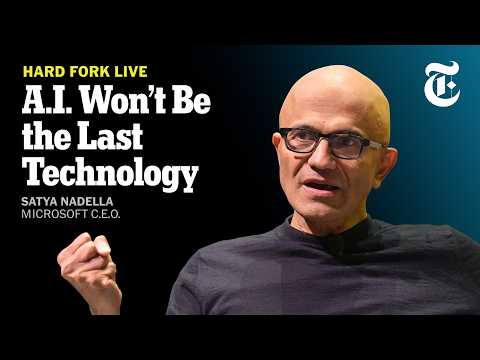
“We as humans have agency, ambition, that should not be counted out. And if you look at even what is human capital today, the human capital in spite of all the digital systems we have at our disposal, we do the glue work. We will discover the new glue work that happens with all this automation, and that I think is the process of change.” — Satya Nadella, 18:44
Clip command
yt-dlp --download-sections "*18:44-19:49" "https://www.youtube.com/watch?v=zqEZyHkXgh0" --force-keyframes-at-cuts --merge-output-format mp4 -o "new-glue-work.mp4"”The economy is at the frontier, not a firm or a model”
“If we are ever going to transition to an economy that is driven by AI, it can’t be about one model, it can’t be about three firms, it has to be something that’s broadly felt where the economy is at the frontier, not a firm or a model is at the frontier.” — Satya Nadella, 0:59
Clip command
yt-dlp --download-sections "*0:59-2:00" "https://www.youtube.com/watch?v=zqEZyHkXgh0" --force-keyframes-at-cuts --merge-output-format mp4 -o "economy-at-the-frontier.mp4"”Cognitive coverage” on a repo written by agents
“What does a software developer do? I have a repo full of code that was written by agents, I am cognitively understanding what happened, and I now need tools for cognitive coverage on what that has built. That’s a job, I think, of a software developer.” — Satya Nadella, 18:00
Clip command
yt-dlp --download-sections "*18:00-18:44" "https://www.youtube.com/watch?v=zqEZyHkXgh0" --force-keyframes-at-cuts --merge-output-format mp4 -o "cognitive-coverage.mp4"”The marginal cost of productivity has to match the marginal cost of the token”
“The hard truth is that the marginal cost of productivity improvement has to match the marginal cost of the token. That’s a management discipline, right? So you can’t just say, hey, I love token maxing because it’s sort of money in my bank. The business has to benefit from it.” — Satya Nadella, 21:27
Clip command
yt-dlp --download-sections "*21:27-22:29" "https://www.youtube.com/watch?v=zqEZyHkXgh0" --force-keyframes-at-cuts --merge-output-format mp4 -o "marginal-cost-of-the-token.mp4"”There’s more monetization of Xbox games on YouTube than at Microsoft”
“The challenge we have is we’ve not been monetizing that entertainment. In fact, if anything, we’ve been subsidizing that entertainment. In fact, like there’s more monetization of Xbox games happening on YouTube than at Microsoft.” — Satya Nadella, 6:00
Clip command
yt-dlp --download-sections "*6:00-6:45" "https://www.youtube.com/watch?v=zqEZyHkXgh0" --force-keyframes-at-cuts --merge-output-format mp4 -o "xbox-monetization-youtube.mp4"”I’m not sitting there thinking this is the last technology we ever will invent”
“I’m not sort of sitting there and thinking this is the last technology we ever will invent. I don’t buy that. I kind of feel like, yeah, this is in the pantheon of all technologies a big step up, but I do think that there will be more to come.” — Satya Nadella, 27:00
Clip command
yt-dlp --download-sections "*27:00-28:00" "https://www.youtube.com/watch?v=zqEZyHkXgh0" --force-keyframes-at-cuts --merge-output-format mp4 -o "not-the-last-technology.mp4"Key Points
- From “one AI” to an AI ecosystem (0:59) - Nadella’s framing shift: the goal is an economy driven by AI as a general-purpose technology, not a single frontier model or firm.
- Build conference and the platform question (0:59) - Can Microsoft build the platform and tools so every enterprise in every country can operate at the frontier.
- Project Solara / agent-first hardware (2:47) - New device form factors not “beholden to the old form factors,” designed for a world of long-running agents.
- Unmetered intelligence on the PC (3:00) - Jensen’s RTX SOC with a petaflop of local compute; a Windows PC running a trillion-parameter model locally for 24x7 agents.
- The nurse’s “badge” device (3:00) - Example of ambient agent-first hardware: scan, speech input, turn output into a prompt.
- Xbox hard reset (4:37) - 25th year of Xbox; new leader Sarah/Asha taking a fresh 100-day look at a sustainable business model amid rising component costs.
- Semiconductor scarcity is temporal (6:55) - Cloud/AI-driven memory and chip shortages are raising consumer-electronics prices, but the permanent question is the Xbox model itself.
- The OpenAI 2023 weekend (7:54) - Kevin gifts a fabricated “Microsoft Advanced AI Research” sweatshirt; Satya’s clearest memory is India losing to Australia in cricket.
- “Intelligence is log of compute” (9:34) - The original bet on OpenAI’s non-profit-turned-for-profit, which many inside Microsoft thought was “nuts.”
- What Microsoft got in the renegotiation (10:46) - Cap-table stake, large customer, IP rights through GPT-4, plus the flexibility to build its own MAI models.
- Frontier goal is everyone’s frontier (12:00) - A base model with reasoning and an agent loop that customers bring into their own RL; they keep the harness, context, and weights and can swap the model.
- Human capital + token capital (12:00) - Nadella wants every balance sheet and income statement to carry both.
- AI backlash and “everyone is a stakeholder” (13:50) - Can’t offer unbelievable tech while taking people’s jobs, water, and energy; the perception “is terrible.”
- 20 years in Quincy, Washington (13:50) - Data-center town where the tax base rose, local taxes fell, and employment grew.
- Metawork and metacognition (15:00) - New waged work will emerge; the GitHub app evolving into an “ADE” to manage 100 CLIs is an example.
- 3.5 billion typists (17:02) - The 1980s wouldn’t have believed everyone would type all day; each new role gets a name and wage support.
- Cognitive coverage (18:00) - The test-coverage analog for understanding and verifying repos of agent-written code.
- The untrainable part / glue work (18:44) - Citing Sarah Guo, human agency and ambition are the “untrainable” glue automation can’t replace.
- Government stakes in AI companies (20:20) - Open to a US sovereign fund idea (as with Alaska’s oil wealth), not opposed to the innovation.
- Reframing the 10% GDP AGI benchmark (21:27) - 10% growth arrives only when the marginal cost of a token matches its marginal value.
- Auto-mode and Copilot economics (22:49) - “Don’t use frontier models for non-frontier problems”; match compute to the problem.
- Satya’s own token project (24:00) - Work IQ (Microsoft 365’s underlying database) wired as an MCP server so a coding agent keeps a repo in sync with out-of-band discussions.
- Mokyr’s parallel paths (25:00) - Technology, markets, and democracy as mutual checks; the model must be redefined for the AI age.
- How AGI-pilled? (27:00) - Buys closed-loop domains (coding, AI research); skeptical that traces of messy knowledge work are enough to close the loop.
Mentions
Companies
- Microsoft (0:59) - Platform company aiming to bring every enterprise to the AI frontier.
- OpenAI (7:54) - Partner from the 2023 crisis through the renegotiated deal and its S-1 filing.
- Nvidia (2:47) - Jensen Huang’s Computex demo of desktops/laptops with the new RTX SOC.
- GitHub (15:00) - The GitHub app evolving toward an agent development environment (“ADE”).
- YouTube (6:00) - More Xbox-game monetization happens there than at Microsoft.
Products & Technologies
- Sydney / Bing AI (0:24) - The 2023 chatbot Kevin references as trying to “break up my marriage.”
- Project Solara (2:30) - Microsoft’s agent-first hardware initiative announced at Build.
- Nvidia RTX SOC (3:00) - New chip delivering a petaflop of compute on the PC.
- MAI models (10:46) - Microsoft’s from-scratch frontier models, with a published paper.
- GPT-4 (10:46) - Source of IP for Microsoft under the OpenAI deal.
- ChatGPT, Gemini, Claude (11:51) - The frontier competitors Kevin lists.
- Xbox (4:37) - 25-year-old division facing a “hard reset” and new business model.
- Flight Simulator (5:08) - Microsoft’s first app, older than Windows and Office.
- Copilot auto-mode (22:49) - Matches model choice to problem for better economics.
- Work IQ + MCP server (24:00) - Microsoft 365’s underlying database exposed to a coding agent to keep a repo in sync.
People
- Kevin Roose (0:00) - Hard Fork co-host and interviewer.
- Casey Newton (2:30) - Hard Fork co-host and interviewer.
- Jensen Huang (2:47) - Nvidia CEO; Computex demo of the RTX PC.
- Sam Altman (7:54) - Fired and rehired at OpenAI in 2023; floated government AI stakes.
- Greg Brockman (9:15) - OpenAI co-founder in the hypothetical Microsoft division.
- Sarah / Asha (Xbox leader) (5:08) - Newly in charge of Xbox, running a 100-day review.
- President Trump (19:49) - Weighed in on government investment stakes in AI companies.
- Sarah Guo (18:44) - Investor whose blog on the “untrainable part” Nadella cites.
- Dwarkesh Patel (21:05) - Interviewer to whom Nadella gave the 10% GDP AGI benchmark in Feb 2025.
- Joel Mokyr (25:00) - Economic historian; author Nadella cites on technology, markets, and democracy.
Surprising Quotes
“I have not been a regular user of a Microsoft AI product since 2023 when one of them tried to break up my marriage. Unsuccessfully I should add, my wife is right there.” — Kevin Roose, 0:24
“All I remember, quite frankly, of the weekend is India getting thrashed by Australia in cricket. That was the more tragic thing.” — Satya Nadella, 9:03
“MSFT, you can trade.” — Satya Nadella, 20:09
“You can’t go out there and say I have this unbelievable technology, except you’re not going to have a job and in fact we’re going to take all your water and all your energy and, you know, good luck.” — Satya Nadella, 13:50
“I’m like a token maxer too, so it is addictive, it’s kind of like, hey, I love this thing. So then you have to step back when the novelty wears off to say, what is it that I’m trying to create?” — Satya Nadella, 22:49
Transcript
Kevin Roose: 0:00 Let’s get started with the show. Our first guest tonight is someone we’ve been very excited, we’ve been trying to get him on the show for many years. He finally agreed and he’s here tonight. Everyone please give a warm welcome to Satya Nadella, CEO of Microsoft. Now Satya, I have to start by making a confession, which is that I have not been a regular user of a Microsoft AI product since 2023 when I when one of them tried to break up my marriage. Unsuccessfully I should add, my wife is right there.
Satya Nadella: 0:44 Those were the days, right? Didn’t have think about a world without guardrails.
Kevin Roose: 0:56 But so much has been happening at Microsoft with AI since then. So just catch us up like what for people who may not have tuned in a little while, what have you guys been up to in AI?
Satya Nadella: 0:59 Yeah, I mean, look, the fundamental thing that I feel we’re about to move from is not talking about AI as a one thing, to sort of having even a mental picture of what is an ecosystem that is sort of driven by AI, right? So today if you think about it, even since when you first used Sydney to now, it has been about a frontier model you’ve sort of talked about fable, what have you. But if we are ever going to transition to an economy that is driven by AI, it can’t be about one model, it can’t be about three firms, it has to be something that’s broadly felt where the economy is at the frontier, not a firm or a model is at the frontier. So Microsoft as a platform company, to me that’s what we are up to, right? So to me we had our developer conference last week, it was all about, hey, can we build the platform and the tools where every enterprise in every country can operate at the frontier. To me that’s the question, to be saying, hey, my model does this, but the economy is growing at 2% means this is not going to end well, unless we sort of really get to a place where the economy is inflecting in terms of its economic growth and it’s widespread because the frontier benefits are. That’s what happened in electricity and every other technology which was a general purpose technology.
Casey Newton: 2:30 Let me ask about one of the platform shifts that you signaled at build last week when you announced Project Solara. You said it would be agent-first hardware, kind of next-generation set of devices that would have agents running them. Tell us a little bit more about that, what that looks like. Can you give us an example of maybe what a Project…
Satya Nadella: 2:47 Yeah, there were two things Casey we did at Build which were interesting, right? One was we took the PC itself, in fact Jensen had done it the previous night at Computex where he talked about, you know, if the the pick… Sure, I wanted… one of my favorite pictures was Jensen with the desktops, the laptops, because the… and he obviously had the RTX chip, which is a new SOC, with essentially a petaflop of compute right on the PC. So that was about new functionality coming to the old form factor, right? So think about what I describe as unmetered intelligence, right? So the fact that you can have a Windows computer that can run a one you know a trillion-parameter model locally, I think is going to be very needed if we’re going to ever have tokens, I mean models, agents running 24 by 7. But then the question it sets up is, in a world where we have these models and these agents that are long-running, can I have like a badge? Uh, right? If I’m a nurse in a hospital and I’m walking to from station to station, can I just take out this device which can scan, which can input, which can take my speech output and turn it into a prompt? Uh, that is what I think an agent-first device looks like, right? So it’s sort of really a new, instead the centrality of the phone, I think, is still going to be there for a lot of apps that we use, but in an agent world, you kind of have that ambient intelligence that is like a sense of feel that then works with your models. And so that’s what goal is, to invent the new form factors that are not beholden to the old form factors for this functionality.
Kevin Roose: 4:37 It’s super interesting, and I want to hear a lot more about it. We have many more questions about AI, but I wanted to ask about one more device that has been in the news today, which is the Xbox. The leaders of the Xbox division put out a memo today saying that we should expect a hard reset of Xbox coming soon. They said that there are massive increases in the prices of components and that Xbox might need a new business model. So as a big gamer who’s enjoyed many happy hours on Xbox, Satya, I have to ask: what is your strategy for Xbox?
Satya Nadella: 5:08 Yeah. So look, in fact, we’re, you know, this is the 25th year of Xbox, and we’re very thrilled about the progress we’ve made. I mean, gaming in an interesting way at Microsoft is older than even Windows and Office, right? The first app we built was the Flight Simulator. And so it’s got a long heritage. Xbox itself has been there for 24, 25 years. The challenge now for us is to think about how do you innovate both in hardware as well as in the games going forward in a world, in an economically viable way, right? I think one of the things that Sarah, who has just taken over Xbox, put out is that we’ve invested a lot. No one can accuse Microsoft of not having invested for the last 25 years. And now we have to turn this into a sustainable business. That delivers what is fundamentally one of the best sources of entertainment still. The challenge we have is we’ve not been monetizing that entertainment. In fact, if anything, we’ve been subsidizing that entertainment. In fact, like there’s more monetization of Xbox games happening on YouTube than at Microsoft. And so that doesn’t mean we go do things that are unnatural. We want us to do what is really our job, which is to build great games, build great hardware, but we’ve got to do it in an economically sustainable way. So I think Asha’s really 100 days in and she put out a post saying in the next 100 days, she’s going to take a fresh look and make sure we deliver on what our fans expect of us, both on the hardware side or on the publishing side.
Casey Newton: 6:45 I mean, can you give us just any more detail? Like, when I hear that, I think, okay, so maybe like the Xbox gets way more expensive, the games get way more expensive? Like, is there any sort of like carrot you can offer the gamers?
Satya Nadella: 6:55 I think we have to find ways to deliver the games in a way which it’s economically relevant for the customer and for us. So today, there’s a issue, in fact, unfortunately, because of what’s happening with the cloud and AI, the prices have gone up, right? It’s happening with PCs, it’s happening with phones, Xbox is impacted as well. So the scarcity of the semiconductor supply and memory in particular are having a massive impact on consumer electronics all up. That’s a temporal thing. That, I think, we’ll get through. It is not going to be a permanent. But there is a permanent thing, which is what’s the Xbox model going forward? And that’s where if you think about it, like, PCs and consoles both have their place, obviously mobile has, people play and elsewhere, and so we have to now bring it all together while staying true to what we’ve always done.
Kevin Roose: 7:54 Satya, I want to take you back in a time machine. The year is 2023. The board of OpenAI has just fired Sam Altman, one of Microsoft’s biggest partners. You and your team spend a hurried weekend trying to pull together an entirely new division of Microsoft, Microsoft Advanced AI Research, to sort of catch the employees that are making a mass exodus from OpenAI. You’re ordering laptops, you’re opening up an office in San Francisco so that all these people have a place to go work. The company looks like it’s on the verge of collapse. And then nothing happens. Then, then Sam gets rehired and OpenAI stands back up on its feet. Um, and I want to present you, as part of this time machine experiment, with a piece of rare merchandise, which I recently acquired from an OpenAI employee, which is a Microsoft Advanced AI Research…
Satya Nadella: 8:45 All right. That is awesome!
Kevin Roose: 8:48 sweatshirt. To be clear, this division never existed, and I was told by the person who made this that they had to sort of fudge a little bit on the sort of copying and printing shop application, which made them prove that they were a Microsoft employee to get… But this is for you, if you ever want to take that walk down memory lane.
Satya Nadella: 9:03 Thank you. Thank you for this. Oh man, that weekend. I’ll remember that forever, and thank you for this, but all I remember, quite frankly, of the weekend is India getting thrashed by Australia in cricket. That was the more tragic thing.
Kevin Roose: 9:15 So if that had happened, in the world where all of these OpenAI employees ended up working at Microsoft in a new advanced AI research division run by Sam Altman and Greg Brockman, in that world, is Microsoft better or worse off with AI than it is today in this world?
Satya Nadella: 9:34 Look, we’re thrilled that Greg and Sam made it back to OpenAI and they are where they are and they’ve now, as you said, filed an S-1 or what have you. Look, it’s fascinating, right? When we initially took the bet on OpenAI, it was a research lab, a non-profit entity that had created a for-profit unit, and said, ‘Hey,’ they went and shopped around and said, ‘Who can back our crazy idea that intelligence is log of compute?’ And quite frankly, there were lots of people that were at Microsoft at that time who thought this is nuts. But, you know, we said, ‘I think this is a worthwhile thing to back,’ and quite frankly, we changed, I think, and they changed through their work and OpenAI through their work, the world. And here we are in 2024, and we’re thrilled about it.
Casey Newton: 10:29 You guys recently renegotiated your deal between OpenAI and Microsoft. And I understand what OpenAI got out of that deal. They got the ability to work with multiple cloud providers, to be a little bit more open about how they commercialize their technology. What did Microsoft get out of the revision of that deal?
Satya Nadella: 10:46 I mean, we have a lot of, you know, interests in OpenAI. We’re obviously on their cap table and we are a customer of theirs, a large one. We are their source of IP for us, all the way to GPT-4, and so all of the things. And at the same time, we have the ability and the flexibility to reuse the IP, build our own IP. We just last week launched MAI models, which we’ve built from the ground up. We published in fact the paper which I think should help people even get the capability we have. Especially if you take those two thoughts, right? Which is: here is intelligence is log of compute and here is a pure lineage model from Microsoft that climbed all the way, means that we now have the ability to keep going. And to us, and our infrastructure, I must mention that we wouldn’t have been where we are with even Azure but for that close partnership with OpenAI. So we have the compute, we have now the model, and we have still the partnership.
Kevin Roose: 11:51 Let’s talk about those models. Is your goal to make a frontier best model in the world? And if so, what’s the strategy for overtaking a ChatGPT, a Gemini, a Claude?
Satya Nadella: 12:00 Yeah, so I think the way I would say it is our real goal is to get everyone across the ecosystem to the frontier. So we’re going to take a slightly different take in saying, for example, if you think about what’s—how does one build a frontier model? You hill climb, you RL, and then you need data, right? So at this point, we have saturated the data. And so that means you’re basically hoovering the data from every place, right? So the question is, what if you turn that around and said, no, there’s a base model that has reasoning, that has the agent loop, but you can bring it into your RL. Every company, right? If you—if the future of the firm is human capital and token capital, I want every balance sheet, every income statement in every company to have both. And that’s our goal with our frontier model. Our model should be the best model that they can use as a base and keep even the weights, definitely the harness and the context, which is theirs, and they can replace our model with anything else. So that to me is more of a vision that I think is what Micro—I always ask the question, why does Microsoft or why does the world need Microsoft? And if we’re successful, can the world around us be successful? This I believe is a more sustainable way to go at it.
Kevin Roose: 13:27 We have to ask a question about the AI backlash that we’re seeing around the country. Graduation speakers are getting booed. AI is polling terribly. Lots of people upset about data centers. What role does Microsoft have in that image or helping to solve that? And how do you think the industry can find a path forward that involved, I don’t know, being a little more popular?
Satya Nadella: 13:50 Yeah. Yeah. I think we can start quite frankly by painting a picture and delivering the results on why there are more than, you know, everyone is a stakeholder, right? You can’t go out there and say I have this unbelievable technology, except you’re not going to have a job and in fact we’re going to take all your water and all your energy and, you know, good luck. I mean, that cannot be an—and no wonder there is so much anxiety, right? You talked about the students or you can talk about a community. And so therefore you’ve got to do the hard work at this point. It is what it is, right? So you can’t deny that the perception is terrible. And so I feel at Microsoft, we want—whether it’s like, take the data centers. It’s fascinating. We’ve been operating in Quincy, Washington for 20 plus years and I just, you know, we celebrated our 20th year. You know, if I look at what all has happened in Quincy in the 20 years, their tax base has gone up, their taxes locally have gone down, they have more employment locally…
Casey Newton: 14:57 Because of the data center.
Satya Nadella: 14:59 Because of the data centers. Data center. In fact, the data center, it’s kind of like basically it’s become a data center town. And when we did this, you know, cookout and people came and they celebrated the rejuvenation of Quincy, Washington, because of our presence for the last 20 years. That’s the first longitudinal thing of 20 years that I’ve seen. And that’s what the communities where data centers are, they definitely can’t increase price on energy, they have to be very, you know, in fact, they should replenish all the water they use and create economic opportunity. So that’s on the data center side. But across the economy, if there are small businesses feeling like, wow, AI is making me more productive, if every large multinational is able to say, oh, I’m building that token capital and human capital, right, because the big question is employment. Everybody thinks that all jobs are going away. But if you sort of, and I’m not saying there won’t be real displacement, the workflow doesn’t change, but take software development. Of course, you know, software development is now all agentic. Except if you think about even the evolution of the GitHub app, right, you know, when I had 100 CLIs, what did I need? I need a new IDE. It’s called an ADE, right? A back end, again, some piece of software that helps me manage all of this complexity. So I think we have to think about new work that gets done, which will be metacognition, metawork, that is going to have wages and we have to be concrete about that.
Kevin Roose: 16:34 But help us understand like what your own view is of the potential disruption, right? Like because I’ve been talking to so many economists, tech leaders like yourself about this over the past couple of months, and truly opinion is all over the place. And I talk to some folks who say, yes, you better believe I’m hiring fewer people next year because of AI. And then I talk to other people who say, I can’t get enough engineers, I want more than I have. So where are you on that? In two years, are you going to have more engineers or fewer?
Satya Nadella: 17:02 Yeah, so I think the if in the early 80s if someone had come to us and said, hey, we’re going to have three and a half billion people in the world who are all going to be typists, we would have said why does the world need three and a half billion typists? Except we do. We all get up in the morning and type, but we’re doing quote-unquote information work, knowledge work, and so on. So that type of change is going to have to happen and each of them will have a name and it’ll have a wage support. That reinvention, right? So a software developer of the past to the software developer of the future may have the similar sort of skills, but the work they do is different because they’re managing a group of 100 agents, a thousand agents. In fact, there’s a beautiful term one of my colleagues has, which is just like in software development we always had this concept of test coverage, one of the new things that we are learning is what I’ll call— …or cognitive coverage, right? So what does a software developer do? I have a repo full of code that was written by agents, I am cognitively understanding what happened, and I now need tools for cognitive coverage on what that has built. That’s a job, I think, of a software developer. And in order to do that, you’ve got to go to school, you’ve got to learn computer science and have cognitive coverage. And so this reinvention of work, the work artifact, the workflow, right? Because software went from input to output. That’s a format change, an artifact change, the workflow is changed, and the work changes with it.
Kevin Roose: 18:31 I feel like what people really want to hear is some combination of like, your job isn’t going to change that much, or if it does change, you’re going to get paid more. Do you think that either of those things will be true for most people?
Satya Nadella: 18:44 I think that that’s the thing. The wages, you know, have always been about what is it that we as a society value? Right? I mean, we’ve grown—the last 200 years, 250 years was about a particular form of expertise and a pool of knowledge. So when you have abundance of some form of expertise, what is that human ability to now build a new expertise that is not trainable? Right? In fact, there was a nice blog I read this morning from Sarah Guo, which I thought was an interesting one, where she sort of mentions, hey, what is the untrainable part? And that applies to organizations and I think us as well. And it’s—we as humans have agency, ambition, that should not be counted out. Uh, and if you look at even what is human capital today, the human capital in spite of all the digital systems we have at our disposal, we do the glue work. We will discover the new glue work that happens with all this automation, and that I think is the process of change.
Casey Newton: 19:49 One idea that’s been floated recently, including by, uh, reportedly Sam Altman, and President Trump has also weighed in on it, is the idea of having the US government take direct investment stakes in frontier AI companies. Do you think that’s a good idea? What percent of Microsoft would you like the US government to own?
Satya Nadella: 20:09 MSFT, you can trade.
Casey Newton: 20:12 But do you think that is a way for the gains of AI to be more broadly felt?
Satya Nadella: 20:20 You know, look, this is all very new, right? I mean, the idea that there may be the United States, whether it has a sovereign fund and the sovereign fund has equity stakes, and that somehow, uh, is part of what is considered the wealth of the citizens of this country, I think it’s a novel idea. Other countries have done it. I think Alaska has some form of it in the state because of the oil wealth. Uh, so I’m not sort of opposed to innovative ideas like this, uh, but at the end of the day, I mean, there’s this entire movement of if only we had invested some portion of our social security in S&P 500, we would have a surplus or what have you. And so to the degree to which some of these ideas can… played out and and they succeed, I think we’ll all benefit from it.
Kevin Roose: 21:05 You um told Dwarkesh Patel in February 2025 that your benchmark for achieving AGI was 10% GDP growth. Uh seems like we’re not super close to hitting 10% yet. Um I’m curious like how you view that kind of statement you made a year ago now and do you see any sort of recent acceleration that makes you think it’s more possible?
Satya Nadella: 21:27 In fact, you know, it’s one of the things that I think a lot about is the difficulty of even a very powerful general purpose technology and its diffusion and the amount of change management that is required, right? I mean, the systems, so for example, one of the challenges right now that we’re going to face in the next year, two years, is this, you know, the economics of tokens. Uh for example, the hard truth is that the marginal cost of productivity improvement has to match the marginal cost of the token. That’s a management discipline, right? So you can’t just say, hey, I love token maxing because it’s sort of money in my bank. The business has to benefit from it. And that is what is going to really drive it. So in fact, it’s fascinating. The equation for that 10% growth would be when you have a perfect match between the marginal cost of the token to the marginal value and it’s priced, right? So that means it’s the best way to get at it. If that happens, 10% is definitely going to happen. But not definitely what’s happening right now where everybody goes and writes codes and token maxes, that’s not a way to achieve 10% growth.
Casey Newton: 22:41 How much uh sort of token maxing has been going on at Microsoft in the last year?
Satya Nadella: 22:47 A lot.
Kevin Roose: 22:49 Yeah.
Satya Nadella: 22:49 And I’m out of it. And what I mean by that is um you know, look, I want people to obviously and myself, I’m like a token maxer too, so the it is addictive, it’s kind of like, hey, I love this thing. So then you have to step back when the novelty wears off to say, what is it that I’m trying to create? Uh in fact, the thing that I love now in in Co-pilot now is our auto-mode. And so we now have a very good, we have an economic model that’s feeding it as well. Basically, I say don’t use frontier models for non-frontier problems, right? Please let’s kind of match these things such that you get the outputs, you get the economics, uh and it’s not it can’t be a race to just doing things that just don’t add value.
Casey Newton: 23:32 Give us a flavor of like Satya’s token maxing, like what are some of your your big token projects lately?
Satya Nadella: 23:41 Yeah, I mean like the one thing that I recently um built was, you know, I’ve always sort of felt that I want a repo that is in sync all the time with discussions that are happening out of band, uh that I’m not in. Right, think about even that concept. See, I like that thing because it sort of is sort of not possible today, right? So you have essentially the ability now to have an agent that literally is looking at all the work discussions that may be related to your repo and creating the plan and executing the plan. And it’s just, in fact, all I did was I put Work IQ, which is the database underneath all of Microsoft 365, as an MCP server to my coding agent, and I said keep watching that, and every time people discuss this repo, please change my repo. And it keeps working. And so this is the best way to keep your basically your model, you know, in sync with all requirements that ever come up.
Kevin Roose: 24:44 You’ve been thinking a lot about the political economy of AI, obviously, you know, the things you’re talking about about diffusion and adoption and GDP growth are all part of that. What do you think the people in San Francisco leading the AI companies here get wrong about the political economy of AI?
Satya Nadella: 25:00 I mean, I wouldn’t say they’re wrong about the political economy of AI, but I do think when I look back at the—there’s a very core book I read I think in December. It’s called—I may have the name wrong, but it’s written by Joel Mokyr and a couple of co-authors on—I think it’s called Parallel Paths to Prosperity. They describe a little bit of how the last thousand years the United—you know, the West grew and what was happening in China. So it was a thousand-year history. But the fundamental thing when I take from that book and in general when I read history is, the West in particular got three things into a virtuous cycle, right? They got technological revolutions, markets, and democracy. All both acting as a check on the other. That’s why there is no such thing as an economy. It’s a political economy. A democracy controls ultimately what happens in a market, and then technology sort of tries to disrupt the two, and then you keep sort of the checks and balances. That’s magical. It’s one of the most unbelievable social constructs ever to emerge in the world, right? Think about sort of, you know, it became the model. And we now need that same model to be redefined for this age. But it will work because it worked the last time. And so therefore, I think us reminding ourselves that the balance, the checks that each one has on the other, is what I think we have to aspire for, whether it’s in San Francisco, whether it’s in Washington, D.C., or quite frankly, anywhere else.
Casey Newton: 26:41 Maybe just as a last question, I’m still trying to like hone in on what I think Kevin might call how AGI-pilled you are. Like, there’s a sense in the—in Silicon Valley that it really is different this time, and that the jagged frontier is going to keep advancing forever, and all of a sudden the little tasks that AI can automate today are going to convert into full jobs. How much do you buy that story?
Satya Nadella: 27:00 Look, I- I buy that anything where the loops can be closed, right, like coding. In fact, AI research is sort of possible to close. I think we have now got sufficient, I’d say, evidence of that. But is that enough? I don’t think so. Um, and- and when I think about, you know, people talk about how verifiable is this task, and in the messy real world of even knowledge work, just saying I’m going to look at the traces of human activity is enough to close the loop? I don’t think so. That I think is the- the challenge, which is when I am in a meeting, I say things, I note things, I may observe things, but what I do with it is not a trace today that I can RL my way in, right? And that to me is where we’re selling short what is, I would say, unverifiable part of the human capital. And so to me, that’s where- the… so I believe the advances keep happening. I still am in the more in the world of, hey, this is platforms, tools, very powerful, very disruptive. I have a lot of, sort of, you know, humility to say a lot of things will change, but at the end of the day, so was electricity, so were a lot of other, you know, steam when it first came out and what have you. And so I’m not sort of sitting there and thinking this is the last technology we ever will invent. I don’t buy that. I- I kind of feel like, yeah, this is in the pantheon of all technologies a big step up, but I do think that, you know, there will be more to come.
Casey Newton: 28:56 Very good. Well, Satya Nadella, thanks so much for joining us. Please give Satya a hand.
Satya Nadella: 28:59 Thank you.
Kevin Roose: 29:00 Thank you so much.
Satya Nadella: 29:01 Thank you so much. Thank you.