She's Fought Online Spying for 30 Years. Here's What's Next.
She’s Fought Online Spying for 30 Years. Here’s What’s Next.
Summary
At Hard Fork’s live San Francisco show, Kevin Roose and Casey Newton sit down with Cindy Cohn, the civil liberties lawyer who spent 11 years as executive director of the Electronic Frontier Foundation and is the author of “Privacy’s Defender: My 30-Year Fight Against Digital Surveillance.” Cohn — wearing her “Let’s Sue the Government” shirt — traces the arc from her first big fight in the ’90s defending cryptologist Daniel Bernstein against government restrictions on encrypted source code to today’s still-unfinished encryption wars. Her side won the first round (“we have Signal, and we have HTTPS”), but the fight never ends: EARN IT in the US, messes in the UK and Australia, and a Canadian bill that Signal says would force it out of the country. Her sad conclusion: encryption, like freedom and speech, is something “you just have to fight for it all the time.”
The conversation’s sharpest theme is how the EFF’s adversary changed. In the ’90s, Cohn says, “we didn’t anticipate that spying on everybody would become the number one business model of the internet.” As surveillance became the business model, the once-united front between digital rights groups and Silicon Valley broke: companies that used to stand up for their users — on copyright balance, on Section 230 — now roll over on exceptions like FOSTA-SESTA and are increasingly adversarial to their own users. Her rule for tech companies is simple: stand with your users and EFF stands with you; stand against them and EFF is first in line to sue. On AI, she notes that the two hard lines Anthropic drew that got it in trouble with the Defense Department — mass domestic spying and autonomous weapons — are exactly right: mass surveillance supercharged by AI shifts power away from citizens, and the political economy “will turn on whether we can stop mass surveillance that’s AI supercharged.” She points to Dobbs prosecutions built on Facebook messages, social media vetting of visa applicants (which EFF is suing over), and a strange-bedfellows FISA Section 702 coalition from Ron Wyden to Rand Paul as proof the surveillance circles “are getting closer and closer to all of us.”
Cohn also delivers one of the best rebuttals to privacy nihilism you’ll hear: intelligence people will tell you old data has a short shelf life, so it’s never game over — “if it were game over, they’d stop spying on us.” On Sam Altman’s proposal for chatbot privilege, she’s lukewarm: better to build anonymity into AI tools so companies never hold the data than to expect them to protect us, because “if their promises are up against their business model, I think you know which one is gonna win.” And on EFF’s decision to leave X — shrinking reach, abuse aimed at her staff and the people EFF defended — she reframes it as a free speech act: “freedom of speech has to mean the right to leave,” including the right not to hang out in the Nazi bar.
Highlights
”Spying on everybody became the number one business model of the internet”
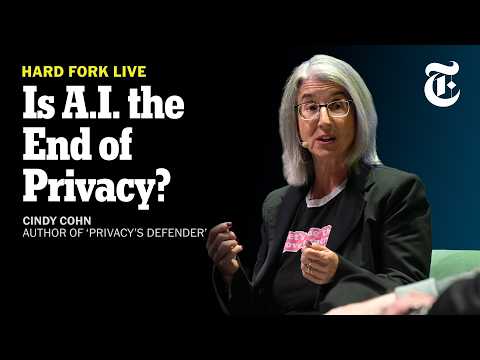
“I would say in the 90s, we didn’t anticipate that spying on everybody would become the number one business model of the internet.” — Cindy Cohn, 3:23
Clip command
yt-dlp --download-sections "*3:23-4:28" "https://www.youtube.com/watch?v=gVIAq9IP-mc" --force-keyframes-at-cuts --merge-output-format mp4 -o "spying-business-model.mp4"”Like freedom, you just have to fight for it all the time”
“I think, you know, law enforcement’s interest in making sure nobody can ever have a private conversation just never goes away. But our need to have a private conversation online doesn’t go away either… And I’ve kind of come to the sad conclusion that it’s just something like freedom. You just have to fight for it all the time.” — Cindy Cohn, 1:42
Clip command
yt-dlp --download-sections "*1:42-3:04" "https://www.youtube.com/watch?v=gVIAq9IP-mc" --force-keyframes-at-cuts --merge-output-format mp4 -o "fight-for-it-all-the-time.mp4"”Mass surveillance supercharged by AI”
“It’s not a surprise to us that the two hard lines that Anthropic drew that got them in trouble with the Defense Department is mass domestic spying and autonomous weapons… people with less power need privacy to have protection against people with more power. And mass surveillance supercharged by AI tends to make us a lot less powerful compared to the people who are going to know a lot about us.” — Cindy Cohn, 9:54
Clip command
yt-dlp --download-sections "*9:54-11:09" "https://www.youtube.com/watch?v=gVIAq9IP-mc" --force-keyframes-at-cuts --merge-output-format mp4 -o "ai-supercharged-surveillance.mp4"”They’re either cowed or they’re in cahoots”
“It used to be the only thing that Silicon Valley lobbied about was visas… I agree with you, they would have been standing up for for this and they’re not and, you know, I, I would argue it’s because they’re either cowed or they’re in cahoots. Those are the two reasonable options.” — Cindy Cohn, 15:00
Clip command
yt-dlp --download-sections "*15:00-15:33" "https://www.youtube.com/watch?v=gVIAq9IP-mc" --force-keyframes-at-cuts --merge-output-format mp4 -o "cowed-or-in-cahoots.mp4"”If it were game over, they’d stop spying on us”
“It’s never, I mean, if it were game over, they’d stop spying on us, right? Like they’re not like, oh, we’re going to unplug the spying machine because we’ve got everything we need folks… as long as you’re living, your data is valuable to the government and to the companies and the minute we stop this business model the better.” — Cindy Cohn, 16:15
Clip command
yt-dlp --download-sections "*16:15-18:00" "https://www.youtube.com/watch?v=gVIAq9IP-mc" --force-keyframes-at-cuts --merge-output-format mp4 -o "never-game-over.mp4"”Freedom of speech has to mean the right to leave”
“I’m a free speech activist. Like, freedom of speech has to mean the right to leave. Like, the idea that we should be forced to speak in a place is fundamentally inconsistent with the value of freedom of speech, which includes your ability to decide where you speak in the first place.” — Cindy Cohn, 21:00
Clip command
yt-dlp --download-sections "*21:00-22:49" "https://www.youtube.com/watch?v=gVIAq9IP-mc" --force-keyframes-at-cuts --merge-output-format mp4 -o "right-to-leave.mp4"Key Points
- Robot dogs as creepy mass surveillance (0:46) - Cohn’s problem with robot dogs at the live show: “they’re taking photos all the time, and they’re going to last forever” — mass surveillance in the form of a creepy dog
- The Bernstein case and round one of the crypto wars (1:10) - Kevin recaps Cohn’s ’90s defense of cryptologist Daniel Bernstein against government restrictions on encrypted source code
- What winning round one bought us (1:42) - “We have Signal, and we have HTTPS, and when you lose your phone, you don’t lose all the data on it because it’s encrypted”
- The encryption fight is global and ongoing (1:42) - EARN IT in the US, “the UK is a mess, Australia is a mess,” and Canada is debating a law that Signal says would force it to withdraw from the country
- Encryption used against Meta in court (1:42) - In the Meta social media case, offering encryption was argued as evidence of a product defect
- EFF’s rule for tech companies (3:34) - “If you stand with your users, we will stand with you. And if you stand against your users, we’re going to be the first in line”
- How the tech alliance eroded (4:46) - EFF once worked with companies on balanced copyright (“rip, mix, and burn”) and Section 230; companies then rolled over on FOSTA-SESTA and stopped standing up even for their own rights
- Ideology or money behind the rightward shift? (6:28) - Cohn can’t tell: “I never count out money… as the driver for people who have devoted their lives to making money,” and the billionaires are now in their own echo chamber
- The real split is the top of tech vs. the rest of tech (7:55) - Many EFF members work inside these companies; the divide isn’t tech vs. non-tech but billionaire leadership disconnected from workers who “still want to be in the business of making cool stuff”
- Will AI founders walk their talk? (9:00) - On Anthropic and pledges like giving 80% away: “if they walk their talk, we’re there with them, and if they’re not, we’re the ones who are probably going to be on the other side of the v in the lawsuit”
- Why AI supercharges surveillance (9:54) - People with less power need privacy as protection against people with more power; AI-scaled surveillance can impact “our ability to vote out the people who we don’t think are leaders”
- The Dobbs effect on surveillance targets (11:42) - After Roe was overturned, people involved in reproductive health suddenly became surveillance targets; a Nebraska mother went to jail based on Facebook messages
- The circles are closing in (12:00) - Visa holders, the undocumented, protesters, even people filming police (two were killed in Minnesota): “these circles are getting closer and closer to all of us”
- The strange-bedfellows FISA 702 coalition (12:00) - Ron Wyden and Jamie Raskin on the left plus Freedom Caucus members Andy Biggs, Rand Paul, and Mike Lee all want the FBI to need a warrant before searching mass spying databases
- EFF is suing over social media visa vetting (14:41) - The government now requires visa applicants to submit social media to be judged on protected First Amendment speech; EFF has an active lawsuit
- The answer to privacy nihilism (16:15) - Old data has a short shelf life; the best time for a comprehensive privacy law was 10 years ago, “the second best time is today”
- Nihilism as entitlement (16:15) - Believing nothing will happen to you or anyone you love “is a bit of a denial or entitled position” when grandmas are being swept up in immigration raids
- Chatbot privilege vs. anonymity by design (18:32) - On Sam Altman’s chatbot-privilege idea: conceptually fine, but Cohn prefers AI tools that never hold identifiable data “so that they don’t have anything that they can reveal about you”
- Facebook’s shrinking privacy promises (19:12) - Facebook launched as “the privacy protective social network,” then its terms of service promises shrank over time as the business model won
- Why EFF left X (20:14) - Shrinking reach for digital rights voices plus waves of abuse directed at EFF staff and the LGBTQ people its posts defended made staying “not worth the candle anymore”
Mentions
Companies
- Electronic Frontier Foundation (EFF) (0:00) - Cohn led the digital rights organization for 11 years; 30,000 members
- Signal (1:42) - A fruit of the first crypto war win; has said it will pull out of Canada if a pending anti-encryption law passes
- Meta / Facebook (1:42) - Encryption used against it as a “product defect” argument; Facebook messages used to jail a Nebraska mother (12:00); its privacy promises shrank over time (19:12)
- Google (4:28) - Casey recalls when EFF, Google, Facebook, and Amazon marched in lockstep on statements
- Amazon (4:28) - Part of the former united front Casey describes
- Anthropic (9:54) - Drew hard lines against mass domestic spying and autonomous weapons, which got it in trouble with the Defense Department; also cited on AI founders’ giving pledges (9:00)
- OpenAI / ChatGPT (11:42) - Casey’s hypothetical about the FBI reading your ChatGPT; Sam Altman’s chatbot privilege proposal (18:16)
- X (formerly Twitter) (19:52) - EFF left the platform over shrinking reach and abuse directed at staff
- The New York Times (14:57) - Cohn jokes Kevin should ask silent Silicon Valley leaders for her, since he’s at the Times
Products & Technologies
- End-to-end encryption (1:10) - The 30-year fight from Bernstein to today’s EARN IT, UK, Australia, and Canada battles
- HTTPS (1:42) - Cited as a win from the first crypto war
- EARN IT Act (1:42) - The most recent US bill attempting to restrict encryption
- Section 230 (4:46) - EFF defends the intermediary liability shield users need in order to speak online
- FOSTA-SESTA (4:46) - Section 230 carve-outs that tech companies rolled over and supported
- FISA Section 702 (12:00) - The mass spying law up for renewal, with a cross-partisan coalition demanding warrant requirements
- Robot dogs (0:40) - The live show’s earlier demo becomes a punchline about always-on photographic surveillance
People
- Cindy Cohn (0:00) - Guest; former EFF executive director and author of “Privacy’s Defender”
- Daniel Bernstein (1:10) - The cryptologist Cohn defended in the ’90s against export restrictions on encrypted source code
- President Trump (6:10) - Kevin ties the tech industry’s rightward shift to his re-election
- Ron Wyden (12:00) - Part of the left flank of the FISA 702 warrant coalition
- Jamie Raskin (12:00) - Also pushing warrant requirements for FBI database searches
- Andy Biggs, Rand Paul, Mike Lee (12:00) - Freedom Caucus and libertarian right members of the same coalition
- Sam Altman (18:16) - Has advocated for a form of legal privilege for chatbot conversations
Surprising Quotes
“In the Meta social media case, they use the fact that they offered encryption as an argument of a product defect, right?” — Cindy Cohn, 1:42
“So suddenly the capabilities of surveillance of people’s online activities where they might have seemed completely innocuous and nothing that could ever be used against you is throwing your mom in jail, right? That happened in Nebraska.” — Cindy Cohn, 12:00
“It’s better for all of us if we have due process and and separation of powers kinds of things for mass surveillance.” — Cindy Cohn, 14:12
“If their promises are up against their business model, I think you know which one is gonna win.” — Cindy Cohn, 19:12
“I have a hard time with people who are like, ‘You’re a free speech organization, so you must post on this private platform.’ And I’m like, ‘I don’t think you know what free speech means.’ It means I get to decide who my audience is. And I’m sorry if you’re hanging out in the Nazi bar and I decide that that’s not where I want to speak.” — Cindy Cohn, 21:00
Transcript
Kevin Roose: 0:00 Our next guest has spent the last 30 years fighting for online privacy, speech rights, and just is fascinated by many of the same issues that we are at Hard Fork. She’s the author of the memoir, Privacy’s Defender: My 30-Year Fight Against Digital Surveillance. And for the last 11 years, she was executive director of the Electronic Frontier Foundation, one of the oldest digital rights organizations in the world. We’re so excited to have a conversation with her. Please welcome to the stage, Cindy Cohn.
Cindy Cohn: 0:27 Thank you. Oh my gosh.
Kevin Roose: 0:30 Hi, Cindy.
Cindy Cohn: 0:31 Thank you.
Kevin Roose: 0:34 I’m admiring your ‘Let’s Sue the Government’ shirt.
Cindy Cohn: 0:38 Yeah. We have the best merch at EFF, and I know they made this especially for me. So.
Casey Newton: 0:40 Cindy, how do we get those robot dogs banned?
Cindy Cohn: 0:42 They’re creepy, aren’t they? Oh my god.
Casey Newton: 0:44 Do you have a call you could make in D.C.?
Cindy Cohn: 0:46 You know, the thing that’s creepy about them is what he said at the end, which is they’re taking photos all the time, and they’re going to last forever, right? This kind of creepy mass surveillance in the form of a creepy dog.
Casey Newton: 1:07 What could go wrong?
Kevin Roose: 1:08 Nothing.
Casey Newton: 1:09 Nothing will go wrong.
Kevin Roose: 1:10 It could be a reason to sue the government, which is something that you did throughout your illustrious career at EFF. One of your first big fights back in the ’90s was defending the cryptologist Daniel Bernstein against government restrictions on encrypted source code. 30 years later, we are still seeing fights between the government and private individuals over end-to-end encryption. How surprised are you that this battle is still going on? And how would you characterize the state of that fight today?
Cindy Cohn: 1:42 Yeah. I mean, look, we won the first round, which means that we have Signal, and we have HTTPS, and when you lose your phone, you don’t lose all the data on it because it’s encrypted. So I mean, that was great. But yeah, we continue to have to fight. And we, you know, in the Meta social media case, they use the fact that they offered encryption as an argument of a product defect, right? Um, so the fight continues. I think, you know, law enforcement’s interest in making sure nobody can ever have a private conversation just never goes away. But our need to have a private conversation online doesn’t go away either. So, um, you know, I think in the United States, we’ve managed to fend off, you know, there’s periodically a… the last bill was called EARN IT, but different bills to try to, you know, restrict encryption. But, you know, the UK is a mess, Australia is a mess, we’re going to have to… Canada now is debating something that Signal has said, we’re not going to be able to offer our product in… our tool in Canada if they pass this law. So the fight just goes on. And I’ve kind of come to the sad conclusion that it’s just something like freedom. You just have to fight for it all the time. 3:00 speech like privacy that we’re just always going to have to stand up for.
Casey Newton: 3:04 Hmm. I remember when I started covering tech more than a decade ago, the EFF was known for taking on the government, primarily fighting government overreach. Um, now you also fight big tech overreach. So I’m curious, like, did that shift come as a surprise, and where does that leave you today in terms of allies? Like, who are the good guys?
Cindy Cohn: 3:23 Yeah, it’s— um, I would say in the 90s, we didn’t anticipate that spying on everybody would become the number one business model of the internet.
Kevin Roose: 3:32 It’s very profitable.
Cindy Cohn: 3:34 Um, turns out, and it also, you know, has created this problem with the five big tech giants that control every— you know, the vast majority of people’s experience online. And these two things together have really forced us to— you know, we don’t make common cause with the tech giants anymore at the level that we used to because they used to stand up for their users and increasingly, they’re adversarial to their users. So what I tell all the tech companies is, look, if you stand with your users, we will stand with you. And if you stand against your users, we’re going to be the first in line. And sadly, that second part has become bigger than— than I think it should, um, but it’s— it’s dragged us into these places where we’re adversarial against the tech giants because they’re not standing with users.
Casey Newton: 4:28 So I want to hear— I mean, I remember, you know, Kevin and I started covering tech around the same time, and I remember, you know, whenever you guys would put out a statement, you know, like Google, Facebook, like Amazon were putting out statements, like you guys were marching in lockstep. You just said that that united front is— is now broken. When did you first notice those cracks start to appear?
Cindy Cohn: 4:46 I mean, it depends on the topic, right? You know, the early fights EFF was involved a lot in trying to make copyright balanced in the digital age, and we— we worked a lot with the companies on this because they wanted to give you the ability to make your own media and to rip, mix, and burn— those kinds of things. And we would stand with them. Um, but I think again, as surveillance became the business model, as they became, you know, less interested in empowering their users and more interested in their— surveilling their users, we’ve— we’ve— we’ve separated. And now, you know, we stand up for things like, you know, Section 230, the idea that, you know, the— nobody would host anybody else’s speech if they were responsible for it. So users need intermediaries to be able to speak. We’ve seen the tech companies roll over and support all of these exceptions, FOSTA-SESTA and other things. Um, and they’re not even standing up for their own rights anymore. So it’s really topic by topic and issue by issue. But I would say… 6:00 say that in the last 10 years it’s less and less of the time that we end up standing with them because they don’t stand with the users.
Kevin Roose: 6:10 It obviously seems like that has accelerated quite a bit since President Trump was re-elected. There’s been a major rightward shift in some of these companies. You’ve talked to these people for many, many years. How much do you think that is driven by something truly ideological and how much of it is just they think they can make more money this way?
Cindy Cohn: 6:28 It’s hard to tell, honestly. I don’t think they’re being honest with themselves, much less the rest of us, about it, and certainly not me, right? I mean, I’m the civil liberties lawyer who shows up to beat up on them. So, you know, I don’t really have the ear of the billionaires. I never count out money and maximizing the amount of money that you can make as the driver for people who have devoted their lives to making money. But I really can’t tell, and I do feel like they’re in their own echo chamber now in a way that wasn’t true before, and so they end up not understanding how they come off at a level that’s pretty, pretty high and different than when I started out in this.
Casey Newton: 7:19 I’m curious how you feel about it. You know, I remember in the early 2010s, I found myself, you know, maybe somewhat embarrassingly carried away by some of the more grandiose pronouncements of these companies. You know, they were going to organize the world’s information and make it universally useful and make the world more open and connected. And while, you know, that was always obviously self-serving in some ways, I did talk to many employees who seemed sincerely moved by that mission, and they did talk about it all the time. And so I took them to be at least somewhat sincere. I no longer take them to be sincere about that, and I wonder, like, did you take them at their word back then, and as the sort of truth emerged, how’d you feel about it?
Cindy Cohn: 7:55 I mean, I think it depends on who in Silicon Valley. Honestly, I think when you’re at the top of the companies, it’s a whole different feeling than when you’re in the middle. You know, EFF has 30,000 members. I would say the vast—I don’t know, we are a privacy organization, I don’t know who those people are, but I think it’s fair to say that a lot of them are people who work in these companies who still want to be in the business of making cool stuff for the rest of us, connecting all the world’s people. I mean, we did that. The internet connects all the world’s people in a way that is still magnificent. So I think that the split isn’t between—I mean, you’re in Silicon Valley as well, but to me it’s not between tech and non-tech. It’s between the top of tech, which is much more like the billionaires in any other industry and disconnected from the rest of tech. And we’ll see, right? I mean, the AI founders have committed to a lot of things. 9:00 …anthropic and, you know, the 80% they’re going to give away and things like that. So, I mean, time will tell, right? Are they going to walk their talk or is it just talk? And we’ll just see. I mean, from EFF’s perspective, again, if they walk their talk, we’re there with them, and if they’re not, we’re the ones who are probably going to be on the other side of the v in the lawsuit. Um, so.
Kevin Roose: 9:23 Speaking of AI, there are many things to be concerned about from a privacy perspective when it comes to frontier AI systems. There is the risk of these things just becoming very charming and people entrusting them with private information and maybe the companies not being responsible safeguards of that information. There are concerns about mass domestic surveillance that could become more salient with models that are very capable. Of all of the risks to privacy and user sovereignty posed by AI, which worries you the most?
Cindy Cohn: 9:54 Oh God, it’s a race to the bottom, isn’t it? But I would say it’s, it’s not a surprise to us that the two hard lines that Anthropic drew that got them in trouble with the Defense Department is mass domestic spying and autonomous weapons. Now, I don’t know as much about autonomous weapons, but I’ve spent my career fighting mass domestic spying, and they’re right. That will change the dynamic. It will change how democracy works. We need—I mean, this is part of the stuff I wrote about in my book—is that people with less power need privacy to have protection against people with more power. And mass surveillance supercharged by AI tends to make us a lot less powerful compared to the people who are going to know a lot about us. And that can really impact our ability to vote out the people who we don’t think are leaders, control what policy and law affects all of us. The political economy questions will turn, I think, on whether we can stop mass surveillance that’s AI supercharged.
Casey Newton: 11:09 Sketch out a bit how AI— 11:16 For folks who may have spent less time contemplating worst-case scenarios.
Cindy Cohn: 11:20 I know, I live there, yeah.
Casey Newton: 11:21 Can you sketch out for us a bit why AI makes surveillance particularly scary? Some folks might say, ‘Hey, I don’t know, I’m already pretty scared of the FBI, you know. What do I care if they can read my ChatGPT?’
Cindy Cohn: 11:42 Well, I mean, I think that, I think that we’re living in a time where we’re seeing that if you thought you weren’t ever going to be a target of surveillance, that isn’t a very safe bet anymore, right? And, you know, I think the Dobbs decision, right, overturning Roe versus Wade suddenly made a lot of people who were engaged in reproductive assistance or needing reproductive health suddenly found— 12:00 themselves targeted by surveillance. We’ve got people who’ve gone to jail based upon their Facebook messages. Um, so suddenly the capabilities of surveillance of people’s online activities where they might have seemed completely innocuous and nothing that could ever be used against you is throwing your mom in jail, right? That happened in Nebraska. Um, and we are seeing the same things that, you know, you may not, you may be one of the few people who knows nobody with a green card, nobody with visa status, nobody’s here on a student visa, nobody’s here undocumented and there’s nobody who you love or care about who is impacted by the fact that the government has decided that those people are in the crosshairs or you don’t want to stand with them or protest with them, which is, you know, people who were exercising their First Amendment right to monitor the police were the two people killed in Minnesota. So like, even if you’re none of them, I mean, you’ve got to start looking these circles are getting closer and closer to all of us. And if you think that the people in power who have control of this massive surveillance stuff will just never happen upon you or anyone you love, I think you’re kind of living in a dream world. Like, and and that matters what your no matter what your politics is, because if that’s not, if this administration isn’t the one that bothers you, when the administration change it may. I mean, that’s why right now Congress is debating renewing the big mass spying law FISA Section 702. And there is this combination of Ron Wyden and Jamie Raskin, people on the left, and the Freedom Caucus, Andy Biggs and Rand Paul and Mike Lee, you know, people who do not agree with each other very much are all saying look, we think the FBI needs a warrant before it starts searching the mass spying databases for its targets. 14:12 Um, it’s it’s because I think those people on the far right realize that even if they’re in power today, they may not be in power tomorrow. And it’s better for all of us if we have due process and and separation of powers kinds of things for mass surveillance.
Kevin Roose: 14:21 Yeah. You um, you brought up how uh immigrants to this country who are here on various different kinds of visas might find themselves subject to mass surveillance. And in fact, we just tell people who are applying for visas, like we are going to scan your social media, you must submit it, we are going to review the contents of your social media and judge it based on your protected First Amendment speech?
Cindy Cohn: 14:41 Correct. That’s one of our lawsuits we’re suing over that right now.
Kevin Roose: 14:43 So I want to talk about this because 10 or 15 years ago, this is something where I can imagine all of Silicon Valley standing up and saying how dare you, this is outrageous, this is a clear violation of the First Amendment. They’ve been absolutely silent on this. Why?
Cindy Cohn: 14:57 I don’t know. I think… you’re at the New… 15:00 times which you ask them for me? I, I really, I don’t, I mean, I think they’re afraid. I think that the administration because they depend on H1B visas like it used to be the only thing that Silicon Valley lobbied about was visas, right? that, you know, the workforce is heavily, you know, immigration dependent and I agree with you, they would have been standing up for for this and they’re not and, you know, I, I would argue it’s because they’re either cowed or they’re in cahoots. Those are the two reasonable options.
Kevin Roose: 15:31 Cowed and cahoots, two of the worst places you can find yourself.
Casey Newton: 15:33 I think a lot of it too is that I don’t think that there is a sense among just users of these platforms that privacy is a winnable fight anymore. I hear so much nihilism and fatalism about this when I talk to people and they, you know, I’m asking them about their privacy practices and they’re kind of like, well that ship has sailed, like the government has all my data anyway. What is the point of trying to fight? I’m sure you get this too.
Cindy Cohn: 16:13 Yes.
Casey Newton: 16:14 What is your response to the privacy nihilist?
Cindy Cohn: 16:15 I think there’s a couple of things. One is that this idea that because your information is already out there, it’s all over. Like if you talk to people in intelligence or in cops, they will tell you that old information has a very short shelf life, right? So your information isn’t all out there because you’re continuing to live your life. And so yes, it would have been great if 10 years ago we had passed a comprehensive privacy law that included law enforcement as well as the commercial entities. That’s the first best time. The second best time is today, because if we can begin to cut the knees out from under this massive data collection, the information will get less and less important and their ability to spy on us will get smaller and smaller. So it’s never, I mean, if it were game over, they’d stop spying on us, right? Like they’re not like, oh, we’re going to unplug the spying machine because we’ve got everything we need folks. Like that would be a different world than the one we’re living in. So one of the things is like, it’s never game over. It’s not game over, I mean, it’s ultimately game over when you’re not alive anymore maybe, but as long as you’re living, your data is valuable to the government and to the companies and the minute we stop this business model the better. The second thing I would argue is, it’s easy to say it’s all over and there’s nothing I can do if they’re not sweeping up your grandma in an immigration raid, but I think it’s a bit of a denial or entitled position to think that you could not care and nothing… because what’s going on there in the nihilism is I don’t have to care 18:00 I don’t care about this, it feels like too big a fight, and nothing will really happen to me or anyone I love if I don’t care about this. And I think we’re living in a time where that’s not a safe assumption anymore. We have to fight for our privacy.
Kevin Roose: 18:16 Folks like Sam Altman have advocated for a form of privilege when you talk to a chatbot. So if you were to ask ChatGPT about a medical question, for example, Sam Altman says that information should not be sort of within the the reach of law enforcement. Do you agree with that and how much help would it do, do you think if that were true?
Cindy Cohn: 18:32 I mean, I think conceptually there ought to be privileged places in conversations with chatbot. I’m actually a little more interested in trying to not have the companies have all that information and trackable back to you. So I’m more interested in people who are developing ways that you can have a, you know, anonymity in your use of these things so that they don’t have anything that they can reveal about you. And I think that’s a better way to go than expecting them to stand up and protect us.
Casey Newton: 19:07 Did something happen that damaged your trust in these companies?
Cindy Cohn: 19:12 I mean, you know, the there’s a - it’s an old video of the Facebook privacy promises, right? I mean, and I’m an old lady, right? I remember when Facebook came out, they were the privacy protective social network because they, and then you can see their terms of service shrink over time to what they’re promising you about their privacy and, you know, if their promises are up against their business model, I think you know which one is gonna win. And so they’re now all committed to mass surveillance as a business model, and I think that means that we need to take some policy and legal actions to try to cut that off at the knees.
Casey Newton: 19:52 I’d like to end by asking about one of the longest ongoing fights in the relationship that Kevin and I have, which is whether or not you should tweet. Uh, Kevin still tweets. I do not tweet. Uh-huh. Recently, uh, you know, before you left EFF, you guys made the decision, you were leaving X. Um, tell us about that decision and has it cost you anything?
Cindy Cohn: 20:14 It was a long time coming, um, because there are, you know, there’s plenty of people who are still on the platform who care about their rights. And it’s always a hard decision because we always want to be able to talk to people who who, you know, care about rights and there are plenty of people on that platform who do. I mean, there’s a couple of things that happened. We saw our reach just shrinking and shrinking and shrinking, right? I mean, there was just recently the the picture of who has reach on on the platform and it’s nobody who’s talking about digital rights in the, you know, on your side.
Kevin Roose: 20:51 Well that’s on you guys. Have you thought about posting more beheading videos or crypto scams?
Casey Newton: 20:55 Yeah, exactly. You know, these things can really increase your reach.
Cindy Cohn: 20:58 We also were seeing a lot of… 21:00 You know, I, I’m also an employer. We were seeing a lot of really, um, abusive things going to my staff and, um, and people who we talked about in our posts who, you know, were standing up for LGBTQ and we would post something about that. Those people would get abused and at some point, we just decided it wasn’t worth the candle anymore, you know? And, um, it- to me, it makes me sad, um, because again, I know there are plenty of people on that platform who are not hateful, but they are stuck in a place where the fundamental dynamic is really awful. And, you know, at some point, I mean, I, it kind of, I’m a free speech activist. Like, freedom of speech has to mean the right to leave. Like, the idea that we should be forced to speak in a place is fundamentally inconsistent with the value of freedom of speech, which includes your ability to decide where you speak in the first place. And it’s, it kind of, I have a hard time with people who are like, ‘You’re a free speech organization, so you must post on this private platform.’ And I’m like, ‘I don’t think you know what free speech means.’ It means I get to decide who my audience is. And I’m sorry if you’re hanging out in the Nazi bar and I decide that that’s not where I want to speak. And, um, but I, again, I’m sad about it because it- there are a lot of people there, especially a lot of politicians and other people who were trying to stop 702. There’s a, there’s a lot of audiences that, um, it would be better if they weren’t all on that platform.
Kevin Roose: 22:49 Well, fascinating conversation, Cindy. Thank you so much.
Cindy Cohn: 22:53 Thank you.
Casey Newton: 22:54 Thank you.
Cindy Cohn: 22:54 Thank you so much.
Casey Newton: 22:55 Thank you so much.
Kevin Roose: 22:57 That was awesome, thank you.