YouTube's A.I. Slop Problem ... for Kids
YouTube’s A.I. Slop Problem … for Kids
Summary
In this episode of Hard Fork, Kevin Roose and Casey Newton dive into the growing problem of AI-generated “slop” targeting toddlers and young children on YouTube. The episode opens with a “Hard Fork Review of Slop” segment where the hosts watch and react to several AI-generated kids’ videos — alphabet songs featuring animals squeezed out of paint tubes, creatures injected with color by animal doctors, animals transforming into armored vehicles, and children sleeping in fruit-shaped beds. The videos are surreal, devoid of narrative, and clearly designed to hypnotize young viewers with rapid visual stimuli rather than educate or tell stories.
The hosts then bring in NYT video journalist Arijeta Lajka, who investigated this phenomenon for her story “How AI-Generated Videos Are Distorting Your Child’s YouTube Feed.” Lajka’s research found that in a single 15-minute scrolling session starting from reputable children’s channels like Miss Rachel and Bluey, more than 40% of recommended YouTube Shorts were AI-generated. The investigation revealed that YouTube’s policies only require creators to label “realistic-looking” synthetic content, leaving animated AI slop largely unlabeled. Comments are disabled on kids’ content, removing the community warning system that might alert parents. Lajka also found far more disturbing content lurking just a few recommendation hops away — popular characters placed in violent or pregnant scenarios, echoing the 2017 “Elsagate” scandal but now turbocharged by AI tools that let anyone create this content in minutes.
The conversation broadens into a critique of the entire recommendation-driven content ecosystem, with Kevin arguing that children’s entertainment had already crossed the Rubicon with hyper-stimulating shows like Cocomelon, and Casey drawing parallels to the same attention-hijacking dynamics affecting teens and adults on TikTok and Instagram Reels. Child development experts warn these videos lack the narrative arcs and relatable characters that help children learn, instead creating cognitive overload with “fantastical” imagery and rapid-fire visual changes that strain developing attention systems.
Highlights
”More Than 40% of the Videos Were AI Generated”
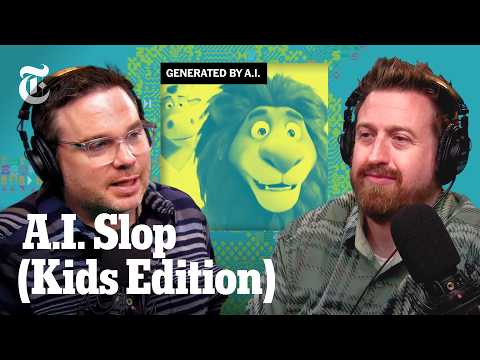
“Like in one session alone, in one 15-minute session that we were scrolling, more than 40% of the videos were AI generated.” — Arijeta Lajka, 12:00
Clip command
yt-dlp --download-sections "*11:53-12:27" "https://www.youtube.com/watch?v=f8Z1EmBmf40" --force-keyframes-at-cuts --merge-output-format mp4 -o "40-percent-ai-slop.mp4"”The Alphabet Is a Perfect Way to Stitch Together AI Clips”
“Most of the the AI video generators that we have in this moment can only generate clips of up to a few seconds. So the alphabet just becomes a perfect way to stitch together all of that into a one piece that still at least has some sort of coherence.” — Casey Newton, 4:07
Clip command
yt-dlp --download-sections "*4:07-4:46" "https://www.youtube.com/watch?v=f8Z1EmBmf40" --force-keyframes-at-cuts --merge-output-format mp4 -o "alphabet-ai-hack.mp4"”Needles Are Scary to Children — It’s an Engagement Hack”
“Whoever is making the slop knows that needles are scary to children, so this is effectively just an engagement hack, right? You know the kid is going to watch the injection because the kid is afraid of needles. So this is just, again, this is classic slop.” — Kevin Roose, 2:44
Clip command
yt-dlp --download-sections "*2:44-3:21" "https://www.youtube.com/watch?v=f8Z1EmBmf40" --force-keyframes-at-cuts --merge-output-format mp4 -o "needles-engagement-hack.mp4"”This Truly Is Just a Sequel to Elsagate”
“And by the way, that was the exact scandal of Elsagate, was that people were seeing Elsa from Frozen pregnant all over YouTube. So I mean, like, this truly is just a sequel to Elsagate, and I think it’s, you know, interesting that it has flown under the radar until your story, Arijeta.” — Casey Newton, 20:29
Clip command
yt-dlp --download-sections "*20:29-21:00" "https://www.youtube.com/watch?v=f8Z1EmBmf40" --force-keyframes-at-cuts --merge-output-format mp4 -o "sequel-to-elsagate.mp4"”We Are Creating a Lifelong Pipeline of Slop”
“We’re seeing old people falling for AI slop on Facebook and middle-aged people fall for it on X and Instagram and like, it just feels like we are kind of creating this like lifelong pipeline of just like whatever slop is going to be most engaging to you.” — Kevin Roose, 23:02
Clip command
yt-dlp --download-sections "*23:02-23:50" "https://www.youtube.com/watch?v=f8Z1EmBmf40" --force-keyframes-at-cuts --merge-output-format mp4 -o "lifelong-slop-pipeline.mp4"Key Points
- Hard Fork Review of Slop returns (0:00) - Kevin and Casey introduce a new installment reviewing AI-generated slop aimed at kids, prompted by colleague Arijeta Lajka’s NYT investigation
- AI alphabet videos (1:00) - First slop reviewed features animals squeezed out of paint bottles while teaching the alphabet, deeply confusing the concept of how animals exist
- Needles as engagement hack (2:44) - Slop makers use scary imagery like needles/injections because children will keep watching out of fear, a classic attention-grabbing technique
- AI tools limited to short clips (4:07) - The alphabet format is perfect for AI slop because current video generators can only produce a few seconds of footage at a time
- Cocomelon already crossed the Rubicon (5:35) - Kevin argues mainstream children’s shows like Cocomelon already use hyper-stimulating rapid-cut formats; AI just makes it cheaper to produce
- Overstimulation concerns (5:04) - Casey raises concerns about videos designed to overstimulate children rather than tell stories, unlike traditional cartoons that had moments of calm
- Arijeta’s investigation methodology (9:58) - Lajka started from approved channels like Miss Rachel and Bluey, then tracked what YouTube’s algorithm recommended in YouTube Shorts
- Custom scrolling tool (9:58) - A colleague coded a tool to scroll without influencing the algorithm, capturing all recommended video links for later frame-by-frame analysis
- 40% AI in one session (12:00) - In one 15-minute scrolling session starting from reputable kids’ content, more than 40% of recommended videos were AI-generated
- YouTube’s labeling gap (13:39) - YouTube only requires creators to label “realistic-looking” synthetic content; animated AI slop falls outside this requirement
- No comment section for warnings (13:39) - YouTube disables comments on kids’ content, preventing parents from warning each other about AI-generated videos
- Parent Reddit forums seeking help (14:52) - Parents on Reddit are asking how to filter AI slop, with some recommending playlists and others saying to quit YouTube altogether
- Cognitive overload for developing brains (15:55) - Experts say these videos with rapid changes and fantastical content put a heavy processing burden on children under five whose attention systems are still developing
- Lack of narrative arcs (15:55) - AI slop lacks the beginning-middle-end structure that child development experts say is beneficial for learning
- Kevin’s 2017 whitelist proposal (17:19) - Kevin recalls pushing YouTube years ago to create a whitelist system for kids’ content rather than default-allow, but the problem persists
- Elsagate 2.0 (20:29) - Casey draws a direct parallel to the 2017 Elsagate scandal, noting AI has made it trivially easy for anyone to flood YouTube with disturbing kids’ content
- Masha and the Bear violence (19:29) - Arijeta found AI videos of the popular character Masha having her stomach cut open; YouTube only removed them after she linked to them in her story
- No AI filter option (22:31) - There is currently no way for parents to filter out AI-generated content on YouTube; Shorts time limits announced in January may help somewhat
- Slop pipeline across all ages (23:02) - Kevin argues the problem extends across demographics: kids get YouTube slop, teens get TikTok slop, older adults get Facebook slop
Mentions
Companies
- YouTube (0:00) - Central subject; platform policies fail to prevent AI slop from reaching children through recommendation algorithms
- New York Times (0:12) - Publisher of Arijeta Lajka’s investigation into AI kids’ content on YouTube
- PBS Kids (18:56) - Produces quality Shorts content but gets recommended less than AI slop
- TikTok (23:02) - Referenced as platform where older children encounter AI slop like Tung Tung Sahur
- Facebook (23:02) - Referenced as platform where older adults fall for AI slop
- Instagram (23:02) - Instagram Reels cited as another vector for attention-hijacking content
Products & Technologies
- YouTube Kids (11:27) - Supposedly controlled environment for children that still surfaces AI-generated content
- YouTube Shorts (9:58) - Short-form video format where most AI kids’ slop appears, as AI tools default to vertical format
- AI video generators (4:07) - Current tools limited to a few seconds per clip, driving the alphabet-format stitching approach
- Cocomelon (5:35) - Popular children’s program already using hyper-stimulating rapid-cut format; AI slop imitates its style
- Bluey (7:52) - Kevin’s exception to the kids’ entertainment “wasteland”; cited as example of quality programming
People
- Arijeta Lajka (0:12) - NYT video journalist who investigated AI-generated kids’ content on YouTube; guest on the episode
- Miss Rachel (9:58) - Popular children’s YouTube creator used as a starting point for the investigation
Surprising Quotes
“I’m gonna have to answer so many questions from my three year old about why ducks come out of toothpaste tubes.” — Casey Newton, 1:32
“Kids like lots of things that are bad for them. That’s why we don’t let them use cocaine.” — Casey Newton, 9:23
“These videos contain extraneous effects and we know that when videos contain all these bedazzling elements, kids can’t learn as well. They’re also devoid of a narrative arc, which is really beneficial for kids to watch content with a beginning, middle, and end with characters they can relate to.” — Arijeta Lajka, 15:55
“It’s so fascinating to me how much more these videos are recommended to me than more thoughtful content like PBS Kids, because PBS Kids also puts out shorts, but I was seeing more of this than PBS Kids.” — Arijeta Lajka, 18:56
“Now anyone can do this in a few minutes, so we’re going to be seeing more of this content.” — Arijeta Lajka, 20:44
Transcript
Kevin Roose: 0:00 All right Casey, well it’s time to look at some kids slop.
Casey Newton: 0:02 Yeah Kev, we have recently been alerted to the fact that YouTube has been beset by a bunch of AI generated slop for toddlers and it’s time to take a look and see what we’re dealing with.
Kevin Roose: 0:12 My colleague at the New York Times, Arijeta Lajka, has a new story about this called how AI generated videos are distorting your child’s YouTube feed. And I read this story, I loved it, I thought I’ve got to see some of this slop for myself. So today let’s take a look at this emerging new genre of AI slop directed at kids with a new installment of the Hard Fork Review of Slop.
Arijeta Lajka: 0:30 A B C animals. A B C animals. The Hard Fork Review of Slop.
Kevin Roose: 0:47 All right, what do we have up first? First is a video about the alphabet. Do you know the alphabet?
Casey Newton: 0:53 You know, I keep meaning to learn it.
Kevin Roose: 0:54 Okay, let’s see how the AI generated alphabet videos are doing.
Arijeta Lajka: 1:00 Kids TV. ABC fun animals. A is for alpaca. A alpaca. Mmm mmm mmm.
Kevin Roose: 1:13 So far so good.
Arijeta Lajka: 1:15 B is for bear. Brown bear says…
Casey Newton: 1:17 Okay, okay. Why are they being squirted out of a little paint bottle?
Arijeta Lajka: 1:21 C is for cat. Pink cat says…
Kevin Roose: 1:23 Oh, I’m deeply uncomfortable with this.
Arijeta Lajka: 1:27 D is for duck. Yellow duck says…
Casey Newton: 1:32 I’m gonna have to answer so many questions from my three year old about why ducks come out of toothpaste tubes.
Kevin Roose: 1:37 Yeah, this is… if you’re, listen, if you’re three years old, you need to know this. That is not how a duck is made.
Casey Newton: 1:42 Let’s take a look at this next video, Kevin. I believe we’re going to see some animals appearing out of colorful clouds.
Arijeta Lajka: 1:49 I is for impala. Green impala says boing boing boing. J is for jackal. Yellow jackal says… K is for kudu. Pink kudu says spin spin spin. L is for lion. Purple lion says roar roar roar.
Kevin Roose: 2:11 He’s rolling the R’s on his roars.
Casey Newton: 2:14 Why are they… why is the other animal a doctor? Why are they running toward the camera? Why is the kudu pink? And what is a kudu? That, I have to say, I’m a little older than the target age for these videos, but I’m learning things myself.
Kevin Roose: 2:26 Good for you.
Casey Newton: 2:27 I’m learning. So, this one uses a trope of having this doctor figure inject these animals with color…
Kevin Roose: 2:37 And the doctor is also an animal.
Casey Newton: 2:40 And the doctor is also an animal. Is this like anti-vax propaganda?
Kevin Roose: 2:44 Well the thing is, like, whoever is making the slop knows that needles are scary to children, so this is effectively just an engagement hack, right? You know the kid is going to watch the injection because the kid is afraid of needles. So this is just, again, this is classic slop.
Casey Newton: 3:00 This is just one of these like little miniature insidious ways that these these like slop makers grab the attention of kids is by like showing them something scary in order to hypnotize them into continuing to watch the slop.
Kevin Roose: 3:11 It does teach the valuable lesson that giving injections to children does result in them turning into pink kudus and running towards the camera. So all children need to learn that lesson eventually.
Casey Newton: 3:21 Alright, this next one, Kevin, shows animals turning into armored vehicles, trucks and planes, going to show once again that a key theme in slop for kids in 2026 is the transformation of animals.
Arijeta Lajka: 3:34 Q is for Quail, chirp, chirp, chirp.
Casey Newton: 3:40 Oh wow. We have sort of mecha quail.
Arijeta Lajka: 3:42 R is for rhino, snort, snort, snort.
Casey Newton: 3:43 Okay.
Arijeta Lajka: 3:45 S is for snake, sss, sss, sss.
Kevin Roose: 3:47 Okay, I wonder if that’s a licensed use of the Thomas the Tank Engine IP.
Arijeta Lajka: 3:52 T is for train, puff, puff, puff. These are the amazing animals.
Kevin Roose: 3:59 Okay, unfortunately that one slapped for me. My kid would be super into that, and I must never show him that.
Casey Newton: 4:07 Yeah, so you know, this one, it— it almost, you know— this one reminds me of, like, cartoons that I watched as a kid, where there was a lot of, you know, Transformers transforming, and so I could understand why, you know, a lot of little kids might like that one. But, you know, this is making me realize that another reason why slop makers love the alphabet is because they can just stitch together a bunch of very short clips. And of course, most of the the AI video generators that we have in this moment can only generate clips of up to a few seconds. So the alphabet just becomes a perfect way to stitch together all of that into a one piece that still at least has some sort of coherence.
Kevin Roose: 4:46 Great point. I mean, I guess I can see a world in which, like, this stuff is not actually that harmful. Like, maybe it is going to teach some kids the alphabet. But it is just so weird and it— it— it strikes me as just like— why— like, we already had a lot of videos teaching kids the alphabet. Why— why are people doing this?
Casey Newton: 5:04 But also, and you know, listen, I’m no child neurologist, but I wonder about the consequences of essentially just creating images that are designed to overstimulate a child. You know what I mean? It’s like, at least when you’re watching, like, a normal cartoon, there could be moments of relative calm, or like a story might unfold over a few minutes. When you’re just showing, like, raw visual stimuli and— and bombarding a kid with it, it— it just doesn’t seem like it’s probably that good for them.
Kevin Roose: 5:35 This is how I know you do not have a child in the year of our Lord 2026, because if you go onto, like, Cocomelon or any of the other, like, extremely popular children’s programs, like, they are essentially just this. It’s like a series of very short clips. Maybe they do one song and then they do a cutaway to a different song, cutaway to a different song. It is, like, these same sort of, like, hyper-stimulating environments. So, like, I’m not saying that any of this is good. I’m just saying that, like, we— we have crossed the Rubicon already. A while ago and we are now in the land of the hyper-stimulating children’s entertainment and like the big difference to my mind is now that it’s just easier and cheaper to create this stuff.
Casey Newton: 6:08 Listen, this is my takeaway. When I have my child, which I do hope to do, the only visual stimulation that I’m going to allow them is a pile of sticks.
Kevin Roose: 6:18 And Etch A Sketch.
Casey Newton: 6:19 And Etch A Sketch. They can make their own fun, you know, with the pile of sticks, but we are not going down this road, Kevin.
Kevin Roose: 6:27 Now we have another vehicle-related one here. This one has school buses, but in a crazy twist, it does not involve the alphabet. Okay, we have some sort of a series of animals driving colored buses down a track. Oh, the wheels are on fire. Oh, that… something went horribly wrong with that last bus.
Casey Newton: 6:53 That was the least offensive one we’ve seen. That just sort of had some basic information about colors. It did show a bus going down a slide, which is weird, and I could understand why a child would be hypnotized by it, but it does not offend me in the way that a tube of paint, you know, turning into an alpaca does.
Kevin Roose: 7:18 See, like I feel like maybe I’m just sort of spending more time in like children’s entertainment than you are because I… like none of this is either surprising or particularly disturbing to me. Like I find this like weird, and it’s why I don’t let my child watch YouTube Kids because it’s just like low quality and I think there’s better stuff out there. But like all of children’s entertainment sort of looks like this now. It’s just like very bright colors, people with very big eyes, like singing songs that are like kind of rip-offs of something else. None of it is particularly creative or original.
Casey Newton: 7:46 How does your child react to only being allowed to watch Downton Abbey?
Kevin Roose: 7:52 No, Bluey is the exception. Bluey, we’re still good. Everything else is a vast wasteland.
Casey Newton: 7:58 Speaking of Bluey, you kind of have a Blue’s Clues thing going on right now. Have you noticed that?
Kevin Roose: 8:02 Yeah, if you connect the lines on my shirt, it tells you what the… the word of the day is.
Casey Newton: 8:08 Oh, all right. If you guess the word of the day, email hardfork@nytimes.com. All right, and why don’t we wrap up with a lullaby about animated children tucking themselves into beds made out of fruit. Mmm.
Kevin Roose: 8:20 Love a fruit bed.
Casey Newton: 8:21 What’d you call me?
Kevin Roose: 8:29 Okay, we’ve got a girl with a crown going into a bed made of strawberry. Banana bed. Kiwi bed. Cozy fuzz so calm and clean. Super Boy in his orange glow drifts to sleep all warm and slow. Casey, what do you make of the fruit beds?
Casey Newton: 8:51 You know, this is just another one that feels a little more surreal than I am comfortable with, right? It’s like, what is the… the true meaning… I don’t know what I’m supposed to conclude from any of this. Like, it just seems designed to confuse children more than to educate or even really entertain them.
Kevin Roose: 9:08 Yeah, and there have been, I will say like, a, a few sort of videos in here where I’m like, oh my kid would like that, but I don’t like that he would like that. You know? It’s like I don’t want him watching something that’s just like a bunch of animals like driving buses or lying in, you know, fruit beds.
Casey Newton: 9:23 Like, and also kids like lots of things that are bad for them. That’s why we don’t let them use cocaine.
Kevin Roose: 9:27 Yeah.
Casey Newton: 9:29 Yes. Well, now that we’ve seen the videos, I feel like we are armed and ready to have the conversation about what they all mean. So let’s bring in my colleague, Arijeta Lajka.
Kevin Roose: 9:37 I don’t know, I feel like I need to cleanse first, maybe go read a play by Shakespeare or something. Just go watch an episode of Bluey. Very heartwarming.
Casey Newton: 9:44 Arijeta Lajka, welcome to Hard Fork.
Arijeta Lajka: 9:45 Thank you so much for having me.
Kevin Roose: 9:47 I want you to just ask like, first of all, how did you get interested in this? How did you learn about this? Did you get a tip from a toddler submitting things through the New York Times confidential tip process? Uh, how did this come onto your radar?
Arijeta Lajka: 9:58 Yeah, so no toddlers were involved in the making of this story. We had some ethical concerns there about showing them these videos repeatedly. But I started by getting interested in this because there is so much AI slop on all of our social media feeds, regardless of the platform. And I was interested in learning more about how this content is being presented to children and how it’s being moderated. And so where do many children watch media? It’s YouTube. So I started by looking at channels that parents approve of, channels like Miss Rachel and Bluey that are considered more high quality and thoughtful, and other popular channels like Cocomelon and said, well, if I click on a Cocomelon video and I am a toddler and I look at the recommended videos right next to that video, what sort of videos would I be recommended? And we focused on YouTube Shorts because a lot of these AI tools default to, um, short, to this vertical format. And so we just started scrolling through the feed and making a note of the different videos we were seeing. One of my colleagues actually coded a tool where I wasn’t really interacting with the screen so it wouldn’t influence the algorithm and I was just like scrolling down and it was making a note of all the different links I was seeing and then we later analyzed these videos frame by frame to determine which videos were AI generated.
Kevin Roose: 11:25 And were you using regular YouTube or YouTube Kids?
Arijeta Lajka: 11:27 So we started looking at regular YouTube in a private browser because a lot of parents tend to put on their own YouTube accounts for their children. But then we also looked through YouTube Kids, you know, because it is a more controlled environment with content that’s supposed to be approved for children.
Kevin Roose: 11:44 And when you started this process, what were your sort of expectations? And then how much AI generated stuff did you wind up seeing as like kind of a proportion of the total?
Arijeta Lajka: 11:53 So, I think especially when I was watching channels like Miss Rachel and Bluey, I was expecting to see content that that would be, you know, more in the lines of those programs, right? Um, more Bluey-ish or, and I wasn’t really seeing that, and I was surprised just about how much AI-generated content was being recommended. Like in one session alone, in one 15-minute session that we were scrolling, more than 40% of the videos were AI generated.
Kevin Roose: 12:20 Wow. And how are you determining that? Is there like a sort of detection system that you’re plugging these things into?
Casey Newton: 12:27 The detection system is called looking at the video.
Kevin Roose: 12:29 Well, no, I’m saying like if you have a video of like a, you know, an alpaca getting squeezed out of a paint tube, like that’s very clearly not photo-realistic, but it could be made using some like CGI software or something like that. I don’t know. How did you determine that this was AI?
Arijeta Lajka: 12:43 Right. So, I think some of these videos were a little bit more obvious, but we looked at them frame by frame and tried to look for inconsistencies, like in some cases, the objects were disappearing in the background, there was text in the background that was distorted, if there was an animal in the background it would morph into something else. Some of the videos were actually labeled as synthetic media even though they were animated. Um, and then we would also look at the YouTube channel and get a sense of like, okay, what sort of content have they been posting in the last few years? And even some of the channels that had been around, you know, before the last two years where this technology really improved, they were making very simple low-quality animation that looked nothing like what they had been posting the last few months.
Casey Newton: 13:23 Now, Arijeta, I have done a lot of reporting on YouTube, but it’s been a few years. What are their actual policies like today on this kind of content?
Arijeta Lajka: 13:39 So I sent them a few channels as examples, and I asked them what their policy is around flagging AI content that’s being made for children, and that includes animated content. And they told me that content creators are required to label content that is realistic-looking. In some cases, we saw that creators weren’t labeling the content, and I’m referring to videos of animals, you know, displaying behaviors that those animals don’t do, like elephants doing gymnastic maneuvers on a tightrope. Those videos, for example, were not labeled as synthetic media. Um, some creators were labeling the animated videos, but it’s not part of YouTube’s policy. So it really— the burden is falling on parents, especially for parents who may not want their child to watch AI-generated media, to determine, okay, what sort of video is this? And not only that, but you have to click through the video and then you see the synthetic media label. And when it comes to kids’ content on YouTube, YouTube doesn’t allow comments. So sometimes when there’s an AI-generated video, you’ll have people in the comments saying, like, ‘This is AI,’ and in this case, you know, parents can’t really talk amongst themselves as to what the video is.
Kevin Roose: 14:43 Has there been any backlash yet that we’ve seen from parents against these kinds of videos? Like, are some parents upset by what they’re seeing?
Arijeta Lajka: 14:52 Yeah, we came across several Reddit forums where people were asking how to get around this AI slop for kids um whether there was a filter on YouTube. Some parents recommended making a playlist, other parents were like get off YouTube altogether. And I think um a lot of it is also going to fall on parents to closely supervise what kids are watching since the algorithm is pushing so much of this content.
Casey Newton: 15:16 Right, although of course the whole point of YouTube is that what it’s what you show your kids so that you don’t have to spend time with them. Right, you know, it’s I mean and not in a mean way, but like maybe you have to cook dinner, right?
Arijeta Lajka: 15:25 Right, parents are busy.
Casey Newton: 15:26 Yeah, like if parents were, you know, sitting down to like watch YouTube with their children like I we would not be in this situation.
Kevin Roose: 15:30 Yeah, and I’ll say like as the parent of a almost four-year-old like the couple times that I’ve like found him watching something like this because he like you know went onto the YouTube Kids app when he wasn’t supposed to or something, it’s like my feeling about it is not like this is damaging my child. It’s just like this is so bad. Like the quality is just so bad.
Kevin Roose: 15:45 And I think I feel I wonder if you think Arijeta like there’s any sort of evidence we what do we know about the actual effects of this on kids? Is the worry that it’s actually harming them or is the worry that there’s just like there’s just better stuff they could be watching?
Arijeta Lajka: 15:55 So there’s a lot of factors to consider. So these videos contain extraneous effects and we know that when videos contain all these bedazzling elements, kids can’t learn as well. They’re also devoid of a narrative arc, which is really beneficial for kids to watch content with a beginning, middle, and end with characters they can relate to that they’re familiar with. Um watching content that uses short phrases that they can understand and doesn’t feature these abstract concepts. Um, you know, worst case, a lot of these videos are fantastical and that could be cognitively overloading to the child. Um and when it comes to short-form content, experts say for children under under five, we know their attention systems are still developing. Um so it’s hard for them to follow rapid changes, um and it really puts a heavy burden on children to process that information, especially when we we see this more realistic fantastical content of animals, you know, showing bizarre behavior.
Casey Newton: 16:32 You know, when I was growing up, Kevin, in the 1900s, I would watch He-Man. Remember He-Man?
Kevin Roose: 16:37 Yes.
Casey Newton: 16:38 It was a cartoon about a gay guy who had a sword and rode a tiger around and as a young—
Kevin Roose: 16:47 Was he gay canonically?
Casey Newton: 16:48 Well, I think not canonically but read between the lines. Okay? Read between the lines.
Kevin Roose: 16:52 Okay.
Casey Newton: 16:53 And, you know, as a young gay kid I could see that and relate to that and it, you know, and and yes the stories were fantastic, you know, but to Arijeta’s point, there was a beginning and a middle and an end and I’d you know, it didn’t exactly like teach me in the ways of the world but like it maybe told me something about like storytelling and narrative and it wasn’t just sort of like raw flashing shapes and colors.
Kevin Roose: 17:05 Yes. I mean, I remember before I had a kid having this argument with people at YouTube about YouTube Kids because there was, I think there was you know, discussion and concern even back in like 2017 or 2018 about these weird videos. They weren’t AI generated at the time, but they were like weird sort of CoCoMelon rip-offs. And I remember saying to these these these YouTube people like you guys gotta change the way that you do this, like instead of just default allowing channels to serve content to very young children, you have to like kind of set up some whitelist where like if you prove that like your stories have a beginning, middle, and end, and like there’s some thought being put into them, you are allowed to be on YouTube Kids, and if you’re not, if you’re just some content farm that’s like churning out Cocomelon rip-offs, like you’re not going to be allowed on. So, do you get the sense, Arijeta, that there’s any like concern or consideration of this at YouTube or are they basically just sort of like, you know, we got bigger fish to fry?
Arijeta Lajka: 18:33 I mean, these videos are recommended to me and these channels multiple times and I’ve been I’ve been looking at these videos since November. So…
Casey Newton: 18:46 I bet you know your alphabet.
Arijeta Lajka: 18:48 I do, yeah, the alphabet, and you know those songs really get stuck in your head.
Kevin Roose: 18:54 Oh, trust me, I know.
Arijeta Lajka: 18:56 And then it’s just so fascinating to me how much more these videos are recommended to me than more thoughtful content like PBS Kids, for example, because PBS Kids also puts out shorts, but I was seeing more of this than PBS Kids.
Casey Newton: 19:06 I mean, just to sort of like echo Kevin’s question, it this has gotten me thinking about Elsagate, right, this like 2017 controversy where parents see a lot of really surreal content in YouTube and they get very upset. It seems like we have not seen that kind of backlash yet and I’m wondering, is it because we just feel like the content is actually better here in some ways, or are most parents just not actually aware of just like the volume of slop that might be being served to their kids?
Arijeta Lajka: 19:29 Because so many of these videos are animated, it may not be obvious to some parents that these are AI-generated. But we were working in a more contained environment. So like elsewhere on YouTube, there are so many videos featuring popular characters that children like in very violent scenarios. Um, there’s this show called Masha and the Bear and I remember I typed in Masha and I was coming across videos of Masha’s stomach being cut open and that channel was putting up these videos and YouTube didn’t take them down until I reference- I linked out to one of them in my story. And I don’t know if any of you uh know children who are obsessed with that K-Pop Demon Hunters film, but there are so many horrible videos featuring those characters and again, it’s nonsensical. Sometimes the characters are pregnant and those are all over YouTube as well if you type in those characters’ names.
Casey Newton: 20:29 And by the way, that was the exact scandal of Elsagate, was that people were seeing Elsa from Frozen pregnant all over YouTube. So I mean, like, this truly is just a sequel to Elsagate, and I think it’s, you know, interesting that it has flown under the radar until your story, Arijeta.
Arijeta Lajka: 20:44 Right, and before, I mean, you had to have some sort of animation skills to do that, but like now anyone can do this in a few minutes, so, you know, we’re going to- we’re going to be seeing more of this content.
Casey Newton: 20:56 And again, what is so insidious here is that the people who are making these videos are counting on… And the fact that regular kids are going to go searching for K-pop demon hunters and Masha and the Bear, and they are unwittingly just going to be served this slop of like, you know, the poor bear getting cut open and the pregnant demon hunter, just through the recommendation algorithm. And like, this is where YouTube’s responsibility lies, that like, this is where YouTube should be saying, we’re actually not going to show this incredibly disturbing stuff to kids.
Kevin Roose: 21:23 Yeah, I would say like among the parents of young children that I know, like very few of them let their kids watch YouTube, even YouTube Kids, for this exact reason. That it’s like, you might start with Masha and the Bear, you might start with, you know, a K-pop demon hunters video, you might start with Bluey or Cocomelon, but like you, you know, you go away for 10 minutes to cook dinner and you come back and like they’re on their third hop from the recommendation and they’re watching some like, you know, weird AI generated thing with like Spiderman, you know, on the surgery table or something. And like it’s like, what are we doing here?
Casey Newton: 21:56 Yeah, because, because it turns out that all of these recommendation algorithms work exactly the same way. They find the video that is the closest to going over the line and they find that it gets more engagement than any other and so that’s what shows up in the feed, right? So how many times are we going to have to revisit this story? Uh, it, it really depresses me, honestly.
Kevin Roose: 22:15 Arijeta, until the platforms like YouTube take more action on this, what can parents do in the short term? I mean, if you’re going to let your kid watch YouTube or YouTube Kids, is there anything you can do to like toggle off the AI slop or do you just kind of have to make peace with it?
Arijeta Lajka: 22:31 In terms of filtering it out, there isn’t an option to do that right now. I mean, in January, YouTube announced that they were going to add some controls where parents can set time limits to YouTube Shorts. We’re seeing a lot of this AI content in YouTube Shorts, so that might be an option.
Casey Newton: 22:43 They could call it the slop watch, you know? It’s like a stopwatch, but for slop.
Kevin Roose: 22:47 I, I just wonder if like all of this is a losing battle. Like I feel like—
Casey Newton: 23:01 Kevin Roose, do not bring your nihilism into the recording studio today.
Kevin Roose: 23:02 Oh, well just like look at what is happening to older children with like, with like Tung Tung Sahur and and like all the AI slop from, from TikTok, and I just feel like, you know, we’re seeing old people falling for AI slop on Facebook and middle-aged people fall for it on X and Instagram and like, it just feels like we are kind of creating this like lifelong pipeline of just like whatever slop is going to be most engaging to you.
Casey Newton: 23:24 Well, I’m glad you brought that up because that is the thought that I’m having as we wrap up, is that while, you know, right now we’re talking about the concerns we have for kids, I think that, you know, older, older teens and adults wind up having the same issue, which is they open up TikTok or Instagram Reels and they see something that is designed to hypnotize them as well. And it might not be colors and shapes and the alphabet, but it does seem like the basic idea is just sort of turn your brain off and experience the raw visual stimuli for as long as, you know, we can get you to.
Arijeta Lajka: 23:50 Yes.
Casey Newton: 23:51 Arijeta, fascinating story, thank you so much for doing this digging and watching all of these children’s videos.
Kevin Roose: 24:00 …so that I don’t have to and so that I can protect my child from them. I appreciate it.
Arijeta Lajka: 24:04 Thank you so much for having me. Wait, I think I took one for the team.
Casey Newton: 24:06 Yes, Arijeta, you really did take one for the team on this one. I have to say.
Kevin Roose: 24:10 All right. Thanks so much.
Arijeta Lajka: 24:12 Thanks.