Sundar Pichai on A.I. Backlash, the Future of Work and Google's Next Era
Sundar Pichai on A.I. Backlash, the Future of Work and Google’s Next Era
Summary
Recorded the day after Google I/O 2026, Kevin Roose and Casey Newton sit down with Google CEO Sundar Pichai for a wide-ranging interview about Google’s position in the AI race. Pichai concedes that while Google is “the only large company actually at that frontier,” it’s behind in specific areas — particularly agentic coding, tool use, and long-horizon developer tasks where Anthropic and OpenAI have pulled ahead. He emphasizes the rapid iteration enabled by Gemini 3.5 Flash and the surprising internal usage numbers, noting that Google’s own token consumption is “doubling every week.” On the bumpy launch-day reception of 3.5 Flash, with complaints about pricing and quality, he acknowledges regressions and says rate limits were tightened to avoid outages but will loosen soon.
The conversation turns to the broader AI backlash — including a recent NYT/Siena poll finding 35% of Americans think AI is “mostly bad” — and the trend of commencement speakers being booed for mentioning AI. Pichai is sympathetic to public anxiety, framing it as a natural response to “the most profound technology humanity will ever work on” arriving faster than humans evolved to handle change. He pushes back on overly deterministic dire scenarios about jobs, comparing AI to the spreadsheet revolution and arguing that radiologists, doctors, and graduates will be more productive and freer for human work rather than displaced. He’s heading to Stanford to give a commencement speech and brushes off the boo risk with optimism about the next generation.
On the policy and safety side, Pichai signals support for the rumored Trump executive order requiring government pre-release review of AI models, calling cross-industry coordination on cybersecurity “prudent” while warning against slowing the U.S. down at the frontier. On recursive self-improvement (RSI), he says Google sees agents building things like simple operating systems in 12 hours (work that would take humans thousands), but the field is “not quite there yet” on true RSI — and if a lab approaches that moment, “we all have to avoid race conditions.” He defends Google’s decision to sell TPUs to rivals like Anthropic as the economics of running a platform business — Anthropic researchers using TPUs help Google improve its next-generation chips. Asked if he’s “AGI-pilled,” Pichai says the rate of progress over the last 1–2 years has made him feel AGI is “on the closer side” of the 3–10 year range, and he endorses Demis Hassabis’s “foothills of the singularity” framing as essentially “the advent of AGI” by around 2030.
Highlights
”We are the only large company which is actually at that frontier”
“I think our models are at the frontier in some areas, and there are areas where we are behind the frontier… When it comes to agentic coding with tool use, and instruction following, long horizon tasks, I think we are a bit behind at this moment… I think we are the only large company which is actually at that frontier.” — Sundar Pichai, 0:20
Clip command
yt-dlp --download-sections "*0:20-1:30" "https://www.youtube.com/watch?v=RgV57kDzcng" --force-keyframes-at-cuts --merge-output-format mp4 -o "only-large-company-at-frontier.mp4"”30 to 60 days look like five years”
“We are a large company and we have scale, so we will be able to focus on a few multiple things at the same time. I don’t see it as any fundamental issues as much as we are making progress. We’re going to make progress. I think we are in a moment in time in this field where 30 to 60 days look like five years.” — Sundar Pichai, 6:00
Clip command
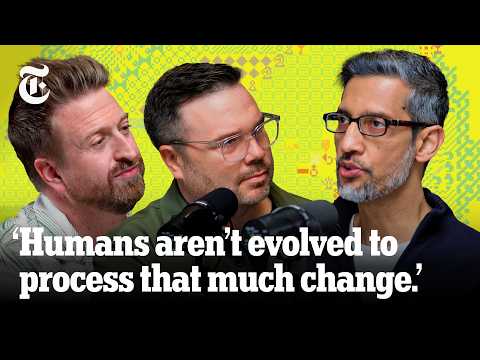
yt-dlp --download-sections "*6:00-6:33" "https://www.youtube.com/watch?v=RgV57kDzcng" --force-keyframes-at-cuts --merge-output-format mp4 -o "30-60-days-five-years.mp4"”Humans aren’t evolved to process that much change”
“AI is, you know, I’ve always viewed it as the most profound technology humanity will ever work on. It’s progressing at an extraordinary pace. I, you know, humans aren’t evolved to process that much change. And there are, I think people rightfully so are anxious about, you know, what is the future that this technology will bring.” — Sundar Pichai, 9:38
Clip command
yt-dlp --download-sections "*9:38-10:30" "https://www.youtube.com/watch?v=RgV57kDzcng" --force-keyframes-at-cuts --merge-output-format mp4 -o "humans-not-evolved-for-change.mp4"”You just pretend they’re saying Google”
“You just pretend they’re saying Google. It’s like close enough, you know?” — Kevin Roose, 13:05
Clip command
yt-dlp --download-sections "*12:00-13:15" "https://www.youtube.com/watch?v=RgV57kDzcng" --force-keyframes-at-cuts --merge-output-format mp4 -o "boo-strategy-google.mp4"”AI is like spreadsheets — I had no idea how to do financial analysis”
“I do think we are, you know, there is a new level of capability all of us are going to have to be able to do things. I wasn’t there like when spreadsheets rolled out to people. Like you know I wouldn’t know how you did financial analysis before that.” — Sundar Pichai, 13:25
Clip command
yt-dlp --download-sections "*13:25-14:30" "https://www.youtube.com/watch?v=RgV57kDzcng" --force-keyframes-at-cuts --merge-output-format mp4 -o "ai-like-spreadsheets.mp4"”We have to avoid race conditions” at AGI moments
“I think all responsible labs, I think if you’re approaching moments like that, you would be, you know, consulting with, you know, it shouldn’t be an internal conversation at that point. I think it has to be a much broader conversation than that. And I think we all have to avoid race conditions at those stages of AGI.” — Sundar Pichai, 22:46
Clip command
yt-dlp --download-sections "*22:36-23:10" "https://www.youtube.com/watch?v=RgV57kDzcng" --force-keyframes-at-cuts --merge-output-format mp4 -o "avoid-race-conditions-agi.mp4"”The rate of progress has made me feel AGI is on the closer side”
“I absolutely, you know, I’m sure that the technology is making foundational progress towards AGI. I’m less able to predict with certainty whether it’s in the 3 to 5 year time frame or 5 to 10 year time frame. The rate of progress over the last 1 to 2 years has made me feel it’s on the closer side than not.” — Sundar Pichai, 26:23
Clip command
yt-dlp --download-sections "*26:19-27:10" "https://www.youtube.com/watch?v=RgV57kDzcng" --force-keyframes-at-cuts --merge-output-format mp4 -o "agi-on-the-closer-side.mp4"Key Points
- Where Google leads, where it lags (0:20) - Pichai says Google is at frontier on multimodality, voice, reasoning, but behind on agentic coding, tool use, and long-horizon developer tasks
- Coding gap is closing fast (3:00) - Internal Google token usage is doubling every week as 3.5 Pro hill-climbs
- Google missed the Claude Code surface (0:20) - Pichai concedes they didn’t have a developer-facing surface like Claude Code or Cursor, which made it harder to get the data flows to improve
- 3.5 Flash launch teething problems (4:26) - Pichai acknowledges regressions, tight rate limits to prevent outages, says it will be addressed soon
- Coding focus across all labs (5:56) - “We all saw an inflection point in coding” — every major lab is responding to it
- “30 to 60 days look like five years” (6:00) - Pichai’s signature line on the pace of AI progress
- 10 blue links aren’t going away (7:12) - On the biggest Search change in 25 years, Pichai says sources and links will always be there as part of it
- Casey: I haven’t done a traditional Google search in a year (8:14) - Asked if this scares Pichai given the search ads business
- AI revenue model: subscription + ads (8:33) - “Adam Smith’s rules don’t change in this new world”
- AI backlash is “natural” and “healthy” (9:38) - Pichai is sympathetic, says industry needs to do more to show benefits and citizens should be engaged in democracy
- Spreadsheets analogy for jobs (13:25) - AI will change the starting point for many people, like spreadsheets did for financial analysis
- Radiologists 10x more scans, 10x more data (15:00) - You’ll actually need AI to keep up with demand
- Pushes back on “overly deterministic dire scenarios” (15:56) - Acknowledges disruption but resists the bleakest predictions
- Personal Spark agent use case (17:47) - Pichai had Gemini Spark color-code his calendar by meeting type
- Self-driving back-seat analogy for agents (18:31) - Trust must be earned in steps; agents that can be hacked must not get ahead of the frontier “in a wrong way”
- Heading to White House for AI executive order signing (19:13) - Endorses pre-release government review, especially for cyber, calling it prudent if not overly slow
- AlphaDev can build a simple OS in 12 hours (21:30) - Concrete data point on agentic progress (Pichai’s RSI example)
- Not at RSI yet (22:36) - True recursive self-improvement is “a next level of acceleration” Google hasn’t reached
- “Avoid race conditions” at AGI moments (22:46) - When labs approach RSI, decisions must be broader than internal
- TPUs to Anthropic make Google’s chips better (24:00) - Platform economics: researchers using TPUs help Google improve next-gen hardware
- AGI is “inevitable” (25:51) - Pichai says he pivoted Google 10 years ago around this technology
- “AGI-pilled” toward the closer side (26:23) - 3-5 year or 5-10 year range; recent progress makes him lean closer
- CEO language is different than other people (26:23) - Pichai acknowledges he chooses careful language because of his role
- Singularity = advent of AGI by 2030 (27:30) - Pichai’s interpretation of what Hassabis means by “foothills of the singularity”
Mentions
Companies
- Google (0:20) - The subject of the entire interview
- Google DeepMind (2:24) - “GDM” — Pichai distinguishes GDM/first-party from Google Cloud business
- Google Cloud (23:34) - Platform business that justifies selling TPUs to rivals
- Anthropic (0:20) - Cited as a leader on coding via Claude Code; uses Google TPUs
- OpenAI (5:24) - Cited as focused on coding; criticized last year for spreading bets too thin
- Cursor (0:20) - Coding tool surface Google didn’t quite have
- NVIDIA (24:00) - Google uses NVIDIA chips too; next-gen chips are “incredible”
- New York Times (9:16) - Cited (with CNN) for the AI perception poll
- CNN (9:16) - Co-cited with NYT for the perception poll
- Stanford (11:55) - Where Pichai is giving the commencement speech next month
- White House (19:13) - Where Pichai is headed for an AI executive order signing
Products & Technologies
- Gemini 3.5 Flash (0:20) - The new fast/cheap model launched at I/O; had bumpy launch with complaints
- Gemini 3.5 Pro (0:20) - Used internally at Google with token usage doubling weekly
- Bard (0:05) - “RIP” — Google’s earlier AI chatbot referenced as past
- Gemini Spark (16:21) - Personal AI agent coming this summer; Pichai used it to color-code his calendar
- AI Mode in Google Search (6:33) - Biggest Search change in 25 years; still has the 10 blue links option
- AlphaDev (21:30) - Google agent that can build a simple OS from scratch in 12 hours
- SynthID (19:44) - Google’s open-sourced AI provenance tool with consortium
- Claude Code (0:20) - Cited as a developer surface Google didn’t have an equivalent of
- TPUs (23:11) - Google’s chips, sold to rivals; first announced at I/O 10 years ago
People
- Demis Hassabis (25:14) - Google DeepMind CEO; said AGI in the keynote and coined “foothills of singularity”
- Sundar Pichai (0:00) - Google CEO, interview subject
- Adam Smith (9:00) - Pichai invokes him to defend the AI economic model
Surprising Quotes
“Three months ago people were like ‘we’re ahead and no one could catch up with us,’ and then now the conversation flips.” — Sundar Pichai, 0:20
“I’ve never seen anything like it internally. We are doubling every week and people are really putting the models to work.” — Sundar Pichai, 3:00
“30 to 60 days look like five years.” — Sundar Pichai, 6:00
“We have to avoid race conditions at those stages of AGI.” — Sundar Pichai, 22:46
“The rate of progress over the last 1 to 2 years has made me feel it’s on the closer side than not.” — Sundar Pichai, 26:23
“You just pretend they’re saying Google. It’s like close enough, you know?” — Kevin Roose, 13:05
Transcript
Kevin Roose: 0:00 Sundar Pichai, welcome back to Hard Fork.
Sundar Pichai: 0:03 Thanks for having me, great to be here.
Casey Newton: 0:05 So the last time we had you on the show was in 2023, Bard, RIP, had just come out. And I think at the time, the perception was that Google was catching up in AI. How are you feeling about your position in the race these days?
Sundar Pichai: 0:20 Well that brings back memories, so it feels like eons ago, you know, those three years feel like a long time ago now. But I think it’s staggering to see how much both the technology is making progress, we’ve made progress as a company, and I think it’s a very dynamic moment in the industry. I think our models are at the frontier in some areas, and there are areas where we are behind the frontier, and so it’s a combination. I think if you look at overall capabilities including text, multimodality, voice, or audio, reasoning in general, overall intelligence, I think we are very capable. When it comes to agentic coding with tool use, and instruction following, long horizon tasks, I think we are a bit behind at this moment. But we are hard at work, and the space is so dynamic. All of the leading labs have their own pre-training cycles, so you have these cadences and they may not exactly match up. I think the moment is intense enough that if you’re slightly off, three months ago people were like ‘we’re ahead and no one could catch up with us,’ and then now the conversation flips. But that’s part of the territory of being at the frontier. I think we are the only large company which is actually at that frontier, right? So one way to think about it is there are, in this moment, a couple of startups which have made extraordinary progress, and we’ve been deeply working on this for a long time. I think we took a big step forward with 3.5 Flash. It does address some of the areas we’ve been behind, and I think obviously getting it out in the real world and iterating with that data coming back is going to really help us. I think coding was the area where getting access to the data flows was important. I think we maybe quite didn’t have the surface, like Claude Code as an example, or what Anthropic maybe had with Cursor too. And so getting activity with 3.5 Pro, we’ve been using it internally at Google for a while. I shared the token usage at Google I/O.
Sundar Pichai: 3:00 Yeah, I’ve never seen anything like it internally. We are doubling every week and people are really putting the models to work. And so that is helping us hill climb quite a bit. But, you know, the frontier is very dynamic, but I’m very, very optimistic and confident we’ll push through there.
Casey Newton: 3:20 It sounds like if there’s like any place where you feel maybe not quite at the very lead where you actually want to be, it is coding. Is that right? Like is that where you’re sort of putting the pressure?
Sundar Pichai: 3:29 Look, I think coding ends up being very foundational in everything we do. So I think it’s an important frontier to be on. There are areas in coding where we’ve been very good — we’ve been very, very good at creating single-shot web frontends, everything. But in terms of these long-running tasks where serious developers are working on complicated codebases, I think we are making progress. It is just that there is a gap to the frontier where others are, but we are working, we’re well aware of it and making progress.
Kevin Roose: 4:03 3.5 Flash has been out for a day. I do think it typically takes a few days to really put these models through their paces. We have seen some complaints though about pricing, model quality. Curious like what you’ve made of the reception so far.
Sundar Pichai: 4:19 Oh, you know, it’s… I’m looking forward to being done with my interviews and so on so that I can spend more time with the teams.
Casey Newton: 4:25 Wrap it up, guys.
Sundar Pichai: 4:26 No. Look, I’m going to meet the teams right after this. I think we are definitely, it’ll take a day or two to settle in. I think it’s a new model, in a new area where we’ve made some progress. There could be some regressions, but we will be able to quickly address them through our post-training, pretty quickly I think. There are some artifacts and behaviors we are seeing, which I think are easy to address, so we will. I do think given it was a day after us putting out a lot of things, I think we had tightened usage limits to avoid outages, but you will see us make progress on usage limits very soon. That is rightfully a source of frustration when you encounter. I feel the same, but those are areas we will address pretty soon and make progress.
Kevin Roose: 5:24 It seems like one thing that some of the AI companies are succeeding at is focus. Just, you know, Anthropic and OpenAI have this sort of relentless focus on coding. OpenAI was criticized last year for sort of spreading their bets too thin, doing, trying to do too many things all at once. They’ve now sort of tightened that. Do you feel like Google is appropriately focused on coding? Or are all the other bets you’re making taking away resources and time and focus from the main push?
Sundar Pichai: 5:56 I think all of us saw sometime around… you know, there was an inflection point in coding, and I think we’re all responding to it.
Sundar Pichai: 6:00 I think we all have pretty serious strides around this area. And so I don’t see it as an issue for focus. We are a large company and we have scale, so we will be able to focus on a few multiple things at the same time. I don’t see it as any fundamental issues as much as we are making progress. We’re going to make progress. I think we are in a moment in time in this field where 30 to 60 days look like five years. That’s all it is.
Kevin Roose: 6:33 Yeah. Another thing that got a lot of attention this week was the changes that you all made to the search bar on the sort of front door of Google, the biggest change in 25 years. I think a lot of people expect that at some point the kind of normal Google sort of classic search interface goes away, the ten blue links maybe go away, and you just kind of have this AI mode as the default. But you haven’t sort of done that yet. There’s a lot of integration, but it’s still — you still can get the ten blue links if you want them. Do you think that goes away at any point? That you sort of rip the Band-Aid off and just go full AI mode?
Sundar Pichai: 7:12 You know, I think it’s important to bring users along the journey as well as making sure the product is working for their expectations. So, I try not to get ahead of that. I think it is very clear as we have evolved through these changes, people are responding positively. We can see it in the long-term metrics of the product in such a clear way. And so I think we understand that. But people want search to be fast. They — I do think through search people are looking to connect with what’s out there on the web. So that’s important to us. It’s all of that. So I think you’re seeing us evolve the product, and I think you will continue to see it be methodical. But we didn’t have AI mode a year ago, but now a lot of people are experiencing it. I think we’ve made it more seamless to go there than before. And so it’s a continuum. But I do see — sources and links will always be there as part of it.
Casey Newton: 8:14 He was telling me on the ride down that he feels like he basically has not done a traditional Google search in the past year, that he’s sort of fully doing these AI searches. When you hear that, are you like, ‘Cool, like this is the kind of user that I want right now,’ or does it send you a little chill because, you know, the sort of traditional search ads business is a pretty good one for you?
Sundar Pichai: 8:33 Well, you know, I think we will, if anything in the AI mode, in an agentic — these things are going to do a lot more for you than what we were able to do for users ten years ago. I think the economic value is always a function of the total value you’re giving users. I think all of us would say over time the value…
Sundar Pichai: 9:00 we’re providing as this increases, there’s more competition, there are more choices. So I feel comfortable between a combination of subscription and ads, that the right models will continue to be there. Adam Smith’s rules don’t change in this new world.
Casey Newton: 9:16 Right. Let’s talk about public perception. The New York Times, CNN did a poll this week found that only about 16% of people say that AI is mostly good, about 35% say it’s mostly bad. What do you make of the AI backlash that we’re seeing right now? And how much leverage do you think Google has to change that perception?
Sundar Pichai: 9:38 I mean, AI is, you know, I’ve always viewed it as the most profound technology humanity will ever work on. It’s progressing at an extraordinary pace. I, you know, humans aren’t evolved to process that much change. And there are, I think people rightfully so are anxious about, you know, what is the future that this technology will bring. So to me, you know, I understand it. I think it feels to me natural with like such a profound technology shift. We’ve had far simpler technology shifts where there has been anxiety around those shifts. This is of a scale unlike anything we’ve seen before. I think the, we as an industry have to do a lot more to continue driving and showing the benefits that’s possible with the technology. So that is something in our control. We have more work to do to make sure when we are scaling up the infrastructure investments etc, what are the things we can do to make some of that work better. But I think people’s concerns are a bit more fundamental around the shift than all of that. I think a natural part of this is people are anxious about their economic future in this world, and you have a lot of conversation where people saying, jobs are going to radically change, some of it will go away etc. I happen to think, you know, the outlook is better than some of those dire predictions. But you know, as a society if you’re hearing it, it’s natural, I would be surprised if people weren’t more anxious about it. I do think it’s important because the change is happening so fast you need people in democracy, you need citizens to be engaged, be aware that this is happening and make their preferences known, that’s what causes action in society. So I think there’s something healthy about this dialogue too, which is happening, and given the pace at which the technology’s moving forward, it seems right to me both the concerns and the fact that we need to take it seriously.
Kevin Roose: 11:55 You’re giving the commencement speech at Stanford next month. I’m sure you’ve noticed or heard that the…
Kevin Roose: 12:00 A bunch of commencement speakers have been booed recently by college students who are worried about AI. What are you planning to tell the graduates about AI and do you have your like boo strategy in place?
Sundar Pichai: 12:15 Anytime we have driven technology progress, I think it helps drive progress in the world and in some ways these graduates are actually both going to be a big part of that driving that progress and also dealing with the impact of that technology. So I think we have to be very mindful of that and you know I’ve always been an extraordinarily optimistic about the next generation. I think we all always have this view in the world, you know we’re anxious and we worry about the next generation but I think the next generation rises to the challenge and you know builds a better world and so I view it as no different from those moments and you know my goal would be to share my experiences and share that with them and that’s what I’m looking to do.
Kevin Roose: 13:05 You just pretend they’re saying Google. It’s like close enough, you know?
Casey Newton: 13:11 I’d be curious to hear a little bit more about your case that like you think that sure jobs may change a lot but you know you entry-level graduate the economic future is still bright for you. Like what is that case in your mind?
Sundar Pichai: 13:25 You know at a basic level I do think we are, you know, there is a new level of capability all of us are going to have to be able to do things and you know I wasn’t there like when spreadsheets rolled out to people. Like you know I wouldn’t know how you did financial analysis before that. Right? Like…
Kevin Roose: 13:48 I’ll say it, I didn’t do it. I had no idea how to do it.
Sundar Pichai: 13:52 Okay. But you know spreadsheets changed that and so there’s an aspect of this I think it just is going to change the starting point for many many people. Just even coding, I think if you fast forward the progress we are seeing there, so many more people are going to be able to code in the world. Right? And I’ve heard you two might be examples of that and in that journey but I think you’re just at the leading edge of what is going to happen more and more. So I think those are the new serendipitous ways this will all work out that we underestimate. I think people are going to be more productive, they will have more time for leisure, all of that will simultaneously be true. There are so many areas where today people’s work involves a lot — doctors have high burnout rates and it’s because they train and their…
Sundar Pichai: 15:00 Willingness to spend time with patients, taking care of patients, but most doctors would tell you if you actually watch their time, the percentage of time they spend with patients is less. So I think AI will actually help them do more of that. And I think those are examples of it. The radiologist analogy has been fascinating. It’s been now a decade running. I look at myself and I say, well, I’ve gotten a lot more scans in my life than my dad ever did. And each of the scans have like 10x the amount of information than his scans had because they were constrained by printing film versus us being digital. And I think that number is going to be 10x in 10 years. So where is that projection going into? You are actually going to need AI to keep up with that demand coming.
Sundar Pichai: 15:56 So I think it’s non-linear how the impact of all this will be. This is not — I don’t want in any way to minimize every technology shift brings disruption with it. And I think there will be disruption and we as a society need to be super serious about it and engage. And so some of the conversations I think are rightful in thinking through that. But I do think there are many positive dimensions to it, which are maybe not being talked about as much. And also there is an overly deterministic dire scenarios which I quite don’t agree with as part of it.
Casey Newton: 16:21 Let’s talk about agents. Because I feel like agents actually tie sort of into this question of, well, what is going to make us more productive in the future and how will it change our job? Later this summer, you’re releasing Spark, which seems sort of intended to be an agent for the regular person. And I’m so curious to know, could you walk us through something this agent is doing for you personally?
Sundar Pichai: 17:04 I’ve used it a lot more in my professional context, more to the context because it was mainly available in my corp account. In that context, I’ve definitely used it as it’s super easy to use it to prepare for any meeting. I wish I had brought the prompt slash the output for, I just as a test case used it for Hard Fork.
Kevin Roose: 17:31 I’ll say, if you email us, we would flash it on the screen.
Casey Newton: 17:34 Yeah, well, yeah, we want that.
Kevin Roose: 17:36 We want that.
Casey Newton: 17:37 We want to know how Gemini trashed us.
Sundar Pichai: 17:40 I’m not sure I’ll allow that to — no, I’m just kidding. Partially kidding.
Kevin Roose: 17:44 You used to see Casey’s browser history.
Sundar Pichai: 17:47 Partially kidding. But I have had it in my personal account more recently. So again, here’s a simple task I did. I just asked it to just look ahead…
Sundar Pichai: 18:00 My meetings and color-code it in categories so that I can keep sense of how I’m spending my time. I think it’s extraordinary to watch it. It came back with like suggestions of two color-coding schemes and I just had to choose one. And it’s actually like sci-fi, it’s just like, you know, changes the color in the calendar. Personal meetings, health-related meetings, time I’m spending at work, etc. That’s an example of a personal query I just did, just to see what’s happening.
Sundar Pichai: 18:31 But with agents, I think you have to give people a sense of — I think about this as what allowed us to get someone to sit in the back seat of a self-driving car. We did it in steps. And I think there’s an element of that where with agents, if something unexpected happens, people will back off from this, and so part of it is earning their trust, and so giving them a sense of control, transparency, but more importantly from a security standpoint, these systems can be hacked and so we want to make sure we are not ahead of the frontier in a wrong way.
Kevin Roose: 19:13 Speaking of meetings and your calendar, we hear that you’re headed to the White House for some kind of AI executive order signing. What should the government be doing right now to regulate AI? Do you like this idea of a kind of pre-release strategy where the government gets to sort of see models before they’re released and sign off on them? Is that a good idea? Is that potentially dangerous if it gives them the ability to censor or jawbone companies into releasing different kinds of models? What’s your take on that?
Sundar Pichai: 19:44 Look, we’ll have to wait and see the details of the full executive order, but they’ve been very — they’ve engaged with the industry in a very robust way, and I think the approach really balances innovation and oversight. We’ll have to wait for the details to come out. But there are a few areas which are coming up, we will need more cross-industry, cross-industry government coordination. So it makes sense to me. Cyber is a great example of that. I think we all have to work together. It makes full sense to me if you’ve found an exploit which could impact a governmental agency, the government needs to be prepared for it. So there is validity, but of course doing it in a moment with this important technology where it’s important as a country to be at the frontier too, not doing it in a way where you’re overly slowing things down, and maybe that balance has to shift as we reach more advanced levels of technology. But I think to me this seems like a prudent approach. In general, I’ve, you know, part of what we are doing with building SynthID, open-sourcing it, and then sharing it with others, and more importantly, building a consortium together…
Sundar Pichai: 21:00 I think it’s an example of, in a different area, these things only work together if we can come together as an industry. So, I’m glad they’re approaching it in that way.
Casey Newton: 21:12 Yeah.
Kevin Roose: 21:13 Another sort of safety-related question. All of the big labs are racing toward what you call recursive self-improvement, so building AI systems that improve themselves rapidly. Do you think that can be done safely? And do you feel like you have a line of sight to it right now?
Sundar Pichai: 21:30 You know, these models are getting better at coding and agentic workflows. And so at some point, you can see in AlphaDev today, in over 12 hours it can build a simple OS from scratch. And that is genuinely those are multiple thousands of hours for somebody to do. So you are seeing some of that in work today. We’re all in our products in some version or the other have agents and subagents and the orchestration of those agents building things together. It’s a continuum. And I think we are all definitely making some progress. But in the way people describe RSI, I don’t think we are there yet. And that would represent a next level of acceleration. And I think would have a lot of implications. But we aren’t quite there yet.
Kevin Roose: 22:36 Is there like a plan for uh-oh? Like I mean, great news, Sundar, like we just hit RSI, like is there a sort of, do we break glass or what happens then?
Sundar Pichai: 22:46 It’s a great example of like, look, I think all responsible labs, I think if you’re approaching moments like that, you would be consulting with — it shouldn’t be an internal conversation at that point. I think it has to be a much broader conversation than that. And I think we all have to avoid race conditions at those stages of AGI.
Casey Newton: 23:11 Right now all the labs are racing to get more compute. There seems to be bottomless demand for compute. They’re hoarding it wherever they can, striking deals, you know, building their own data centers. Google is still selling access to TPUs to rivals and other companies in the race. Why? Why aren’t you just keeping that for yourselves and your own models?
Sundar Pichai: 23:34 I think each is not a constraint on the other, right? So as long as we can make enough chips, it’s not a constraint. So the right way to think about it is we have GDM and our first-party services, if you can think about that as a company, business, cash flows, you’re planning for that. And then you’ve Google Cloud, which is a business.
Sundar Pichai: 24:00 Which has revenue cash flows and you’re doing long term plan and you’re planning for that, right? So if we didn’t have cloud and we weren’t providing, we wouldn’t be planning those chips anyway. Right? And so that’s at the simplest level. You obviously, you know, it’s a bit more complex than that. But there’re a lot of advantages of providing TPUs to others, the fact that researchers at Anthropic are using TPUs is what will allow us to make, in addition to us, allows us to make the best hardware in terms of next generation. And by the way, we use Nvidia’s chips too and their next generation chips are incredible and so we use that and we work too. When you’re running platforms, when you have a platform side of the business and you know, I’ve always worked on many platforms in my life and be it Chrome or Android or Google Cloud, you know, why would you ever open source something or why do you provide this technology? I mean, all that makes sense on its own merits. I do think there are advantages like I mentioned. It allows us to stay at the frontier, economies of scale helps in various ways. And so it makes a lot of sense that way.
Casey Newton: 25:14 Yeah. The last time we had you on, we asked you about AGI and your feelings about the term and at the time you responded that it didn’t really matter whether we’ve reached AGI or not because the systems are going to be very, very capable and Google’s strategy should be the same. I noticed that you did not say AGI in your keynote. Demis did, but you did not. What’s your relationship with the term AGI today and sort of the idea that all of this progress is building towards something singular and world-changing?
Sundar Pichai: 25:51 Oh, we are, there is inevitable progress towards AGI that’s happening, I’ve long understood it and otherwise I wouldn’t have pivoted the company 10 years ago to like put that technology at the heart and center of the company. All I meant by that statement was even in the scenario AGI is going to take 10 years, the technology which three years out will be so much more powerful than what we have today that I don’t want people to think because AGI is 10 years out, you don’t need to act or prepare. That is all my statement means in those contexts.
Kevin Roose: 26:19 Are you AGI-pilled?
Sundar Pichai: 26:23 Well I, I absolutely, you know, I’m sure that the technology is making foundational progress towards AGI. I’m less able to predict with certainty whether it’s in the 3 to 5 year time frame or 5 to 10 year time frame. The rate of progress over the last 1 to 2 years has made me feel it’s on the closer side than not. And in your role running one of the largest companies in the world which has a responsibility to society, the language I choose to use around it might be different than other people. But I think we are on that path.
Sundar Pichai: 27:00 As a company in terms of, you know, 10 years ago at the IO stage, I announced TPUs and AI-first data centers, yes, clearly understood where this technology is headed.
Kevin Roose: 27:12 Maybe as a last question, one of the more memorable phrases I think from the keynote this year did come from Demis when he said that we’re in the foothills of the singularity. Can you tell us like concretely what that means from Google’s perspective and should people be excited about that or afraid or both?
Sundar Pichai: 27:30 Look, I’ve had many conversations with Demis obviously on this topic and I think in this context he’s, I think he’s defining singularity as the advent of AGI. I think he’s talking in that context and you know, I think if you think, regardless of, if I remember I think he had kind of articulated by 2030 or so, I think if you believe that, it makes sense to you that that’s what you’re articulating and, you know, it’s as simple as that. I think for him that’s how he defines singularity and I think Demis, myself, many others, we all feel it’s important to, if that’s what you believe, it’s important to articulate that because we’re all at the frontier building this technology and hopefully people are listening and I think it’s important to as a society we’re internalizing that and getting ready for it.
Kevin Roose: 28:41 Sundar Pichai, thanks so much for coming.
Sundar Pichai: 28:43 Thank you, sir.
Casey Newton: 28:44 Thanks.
Kevin Roose: 28:45 Good to talk to you.
Sundar Pichai: 28:46 Appreciate it. Take care.