Hard Fork Live: Watch the Full Show!
Hard Fork Live: Watch the Full Show!
Summary
Kevin Roose and Casey Newton bring the full ~2.5-hour Hard Fork Live show to a San Francisco stage, opening with a Baha Men sing-along, disclosure hats, and a pack of Beeple’s face-swapped robot dogs before settling into three marquee interviews. Microsoft CEO Satya Nadella leads off with an argument that the AI era won’t be won by “one model” or “three firms” but by getting the whole economy to the frontier — pitching agent-first hardware (Project Solara), unmetered local intelligence, and a “human capital and token capital” balance sheet for every company. He walks through the economics of tokens (“the marginal cost of productivity improvement has to match the marginal cost of the token”), the Xbox “hard reset,” the 2023 OpenAI firing weekend (Kevin gifts him a bogus “Microsoft Advanced AI Research” sweatshirt), and where he lands on AGI: powerful and disruptive, but not the last technology we’ll invent, with the “unverifiable part of human capital” as the thing today’s models still can’t RL their way into.
Civil-liberties lawyer Cindy Cohn, former EFF executive director, delivers the show’s sharpest warnings. She traces encryption from her 1990s Bernstein fight to today’s EARN IT / UK / Canada battles (“something like free speech… we’re just always going to have to stand up for”), explains how “spying on everybody” became the internet’s number-one business model and split EFF from the tech giants, and argues that mass surveillance “supercharged by AI” is the risk that will decide the political economy. She points to Dobbs prosecutions built on Facebook messages, visa applicants screened on their First Amendment speech (an EFF lawsuit), and a strange-bedfellows FISA Section 702 coalition, then dismantles privacy nihilism (“if it were game over, they’d stop spying on us”) and reframes EFF leaving X as a free-speech act: “freedom of speech has to mean the right to leave.” In between, Node’s Phil Mohun explains the “regular animals” robot-dog art project (including “poop mode”), and a Teenage Engineering robot choir performs.
Figma CEO Dylan Field makes the creative-optimist case: in a world drowning in AI “slop,” taste, voice, and the willingness to push past the first draft become the differentiators — “if you have a creative voice, writing or design… this is a good time” to take a risk. The back half turns forecast-heavy: an AI 2027-vs-”AI as Normal Technology” panel (Daniel Kokotajlo and Sayash Kapoor) finds surprising near-term agreement while flagging Anthropic’s degraded-for-AI-R&D model as a “dangerous precedent” and warning about off-the-shelf “killer robots”; Toberlife’s George Ekas demos Toby the humanoid (who face-plants mid-dance) and fields the Unitree-backdoor question; and podcaster Dwarkesh Patel argues the scary part is how far models still are from human intelligence even as they earn ~$100B combined — continuous learning, not raw capability, is the real bottleneck to superintelligence. An audience Q&A closes on jobs, education, data brokers, and Kevin and Casey’s cases for optimism: accelerating science and medicine, and the sheer fun of learning and building.
Highlights
”The economy is at the frontier, not a firm or a model”
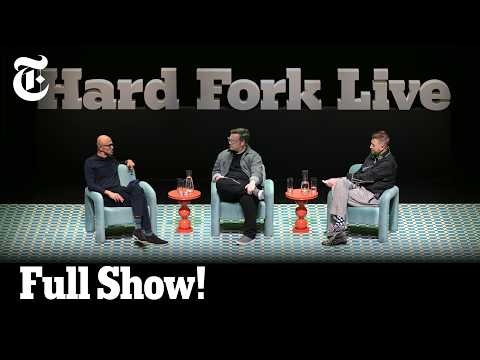
“If we are ever going to transition to an economy that is driven by AI, it can’t be about one model, it can’t be about three firms, it has to be something that’s broadly felt where the economy is at the frontier, not a firm or a model is at the frontier.” — Satya Nadella, 5:09
Clip command
yt-dlp --download-sections "*5:09-6:00" "https://www.youtube.com/watch?v=MCJn08wBeV8" --force-keyframes-at-cuts --merge-output-format mp4 -o "economy-at-the-frontier.mp4"”Can I just take out this device” — the agent-first badge
“If I’m a nurse in the hospital and I’m walking from station to station, can I just take out this device which can scan, which can input, which can take my speech output and turn it into a prompt? That is what I think an agent-first device looks like.” — Satya Nadella, 6:54
Clip command
yt-dlp --download-sections "*6:54-7:50" "https://www.youtube.com/watch?v=MCJn08wBeV8" --force-keyframes-at-cuts --merge-output-format mp4 -o "agent-first-badge.mp4"”Cognitive coverage” — the software developer’s new job
“I have a repo full of code that was written by agents. I am cognitively understanding what happened and I now need tools for cognitive coverage on what that was built. That’s a job I think of a software developer.” — Satya Nadella, 21:00
Clip command
yt-dlp --download-sections "*21:00-22:00" "https://www.youtube.com/watch?v=MCJn08wBeV8" --force-keyframes-at-cuts --merge-output-format mp4 -o "cognitive-coverage.mp4"”I don’t buy that this is the last technology we ever will invent”
“I still am more in the world of, hey, this is platforms, tools, very powerful, very disruptive… I’m not sitting there and thinking this is the last technology we ever will invent. I don’t buy that.” — Satya Nadella, 31:04
Clip command
yt-dlp --download-sections "*31:04-32:10" "https://www.youtube.com/watch?v=MCJn08wBeV8" --force-keyframes-at-cuts --merge-output-format mp4 -o "not-the-last-technology.mp4"”Spying on everybody became the number one business model of the internet”
“I would say in the 90s, we didn’t anticipate that spying on everybody would become the number one business model of the internet. It’s very profitable, it turns out.” — Cindy Cohn, 44:26
Clip command
yt-dlp --download-sections "*44:26-45:20" "https://www.youtube.com/watch?v=MCJn08wBeV8" --force-keyframes-at-cuts --merge-output-format mp4 -o "surveillance-business-model.mp4"”If it were game over, they’d stop spying on us”
“It’s never — I mean if it were game over, they’d stop spying on us, right? Like they’re not like, oh, we’re going to unplug the spying machine because we’ve got everything we need folks… as long as you’re living, your data is valuable.” — Cindy Cohn, 57:15
Clip command
yt-dlp --download-sections "*57:15-58:20" "https://www.youtube.com/watch?v=MCJn08wBeV8" --force-keyframes-at-cuts --merge-output-format mp4 -o "never-game-over.mp4"”Freedom of speech has to mean the right to leave”
“I’m a free speech activist. Like, freedom of speech has to mean the right to leave… I’m sorry if you’re hanging out in the Nazi bar and I decide that that’s not where I want to speak.” — Cindy Cohn, 1:01:56
Clip command
yt-dlp --download-sections "*1:01:56-1:03:00" "https://www.youtube.com/watch?v=MCJn08wBeV8" --force-keyframes-at-cuts --merge-output-format mp4 -o "right-to-leave.mp4"”If you have a creative voice… this is a good time”
“If you have a creative voice, writing or design, you put yourself out there and you take a risk, this is a good time to do that. It’s something that’s going to be rewarded.” — Dylan Field, 1:15:42
Clip command
yt-dlp --download-sections "*1:15:42-1:16:40" "https://www.youtube.com/watch?v=MCJn08wBeV8" --force-keyframes-at-cuts --merge-output-format mp4 -o "creative-voice-good-time.mp4"Key Points
- Disclosures (2:48) - Kevin notes the NYT is suing OpenAI, Microsoft and Perplexity; Casey’s fiancé works at Anthropic (delivered in listener-made “disclosure hats”).
- Satya Nadella takes the stage (4:30) - Kevin opens by joking a 2023 Microsoft AI product “tried to break up my marriage.”
- AI as a broad ecosystem, not one model (5:09) - Nadella’s core thesis: the economy, not a single firm or model, must be at the frontier.
- Project Solara / agent-first hardware (6:28) - “Unmetered intelligence,” trillion-parameter models running locally on a Windows PC, and a nurse’s “badge” device.
- Xbox “hard reset” (8:40) - 25 years in, Xbox has been subsidizing entertainment; more monetization happens on YouTube than at Microsoft; semiconductor scarcity is pushing consumer prices up.
- The 2023 OpenAI firing weekend (11:54) - Kevin gifts Nadella a bogus “Microsoft Advanced AI Research” sweatshirt from the division that never existed; Nadella mostly remembers India losing to Australia in cricket.
- What Microsoft got in the renegotiated OpenAI deal (14:30) - Cap-table stake, customer relationship, IP source, plus flexibility to build its own MAI models.
- Frontier-model strategy (15:54) - Goal is a swappable base model companies bring their own RL, harness, weights and context to — “get everyone across the ecosystem to the frontier.”
- AI backlash and data centers (17:29) - Quincy, Washington as a 20-year case study; data centers should replenish water and not raise local energy prices.
- Reinventing software work (20:37) - The “3.5 billion typists” analogy; new metacognitive “glue work” with wages.
- Cognitive coverage (21:00) - Understanding agent-written repos becomes the developer’s new discipline.
- Government equity stakes in AI firms (24:00) - Nadella isn’t opposed to a sovereign-fund idea floated by Altman and Trump (“MSFT, you can trade”).
- AGI = 10% GDP growth (25:07) - Token economics: the marginal cost of productivity gains must match the marginal cost of the token; “token maxing” alone won’t get you there.
- Political economy of AI (28:47) - Citing Mokyr, the West’s virtuous cycle of technology, markets and democracy must be redefined for this age.
- How AGI-pilled is Satya (30:47) - Closed-loop domains (coding, AI research) will advance; the “unverifiable part of human capital” is where he’s skeptical.
- Phil Mohun & the “regular animals” (34:13) - Node’s robot-dog art project by Beeple: six dogs wearing the faces of Musk, Zuckerberg, Bezos, Picasso, Warhol and Beeple himself.
- “Poop mode” (37:53) - The dogs “poop out” AI-processed images of their surroundings; each robot is designed to “die” after three years with its memories preserved.
- Cindy Cohn on the encryption fight (42:13) - From the 1990s Bernstein case to EARN IT, the UK, Australia and Canada; the first round won us Signal and HTTPS.
- The surveillance business model (44:26) - Why EFF no longer marches in lockstep with the tech giants; Section 230 and FOSTA-SESTA.
- Mass surveillance “supercharged by AI” (51:00) - The two hard lines Anthropic drew — mass domestic spying and autonomous weapons — are the right ones.
- Dobbs, Facebook messages, and FISA 702 (52:54) - Surveillance circles “getting closer and closer to all of us”; a left-right coalition wants a warrant requirement for 702 database searches.
- Visa social-media vetting lawsuit (55:31) - EFF is suing over First Amendment-based screening of visa applicants; Silicon Valley is “either cowed or in cahoots.”
- Answering the privacy nihilists (57:00) - Old data has a short shelf life; the second-best time to pass a privacy law is today.
- Chatbot privilege vs. anonymity (59:22) - Cohn prefers building anonymity in over expecting companies to protect the data they hold.
- Why EFF left X (1:00:57) - Shrinking reach and abuse toward staff; “the right to leave” as a free-speech principle.
- Dan Powell’s robot choir (1:08:19) - Teenage Engineering robots take MIDI/Bluetooth input and sing.
- Dylan Field on “vibe mapping” (1:11:24) - Doing math with AI; contrasting verifiable domains with the unverifiable nature of design.
- “Design is dead”? (1:14:04) - Figma’s ad campaign and Field’s case that a creative voice matters more in the age of AI slop.
- The taste debate (1:17:32) - “In-distribution” output is a race to the average; pushing the frontier is what gets rewarded.
- AI slop and the writing profession (1:22:25) - Casey’s discomfort at spotting Claude-generated posts on Techmeme.
- AI 2027 vs. AI as Normal Technology panel (1:48:00) - Kokotajlo and Kapoor on transformer “herding,” near-term agreement, and forecasting track records.
- Anthropic’s degraded model as “dangerous precedent” (1:54:40) - Fine-tuning a model to underperform on AI R&D tasks shouldn’t be allowed; both panelists value transparency.
- Off-the-shelf “killer robots” (1:57:08) - No technical bottleneck remains; computer-vision libraries could build lethal autonomous systems today.
- George Ekas & Toby the humanoid (2:00:00) - Toberlife AI demos a Unitree humanoid that face-plants mid-dance (“just a misclick on the controller”).
- Humanoid use cases and cost (2:04:02) - Today’s market is research data collection; robots with dexterous hands run “50 to 70” thousand.
- Unitree backdoor / China data (2:05:14) - Logging data goes to China “like every other Chinese thing”; Congress has floated an import ban.
- Dwarkesh Patel on the human-intelligence gap (2:09:11) - The scary part: how far models still are from human intelligence, and what happens when they gain our advantages too.
- Continuous learning as the AGI bottleneck (2:14:49) - Whether weights must update between sessions (the “Henry Kissinger at politics” problem).
- Conflicts of interest in AI media (2:18:00) - Patel defends interviewing leaders of companies he invests in; “I hope the product speaks for itself.”
- Audience Q&A (2:20:01) - The Fediverse/“Forkeverse,” entry-level jobs, education, and “outlaw data brokers.”
- The case for optimism (2:27:20) - Kevin on accelerating science and medicine (pancreatic-cancer breakthrough); Casey on learning and building.
Mentions
Companies
- Microsoft (4:30) - Nadella’s full interview on platform strategy, Azure, MAI models and Xbox.
- OpenAI (11:54) - The 2023 firing weekend, the renegotiated deal, and the S1 filing.
- Anthropic (50:00) - Cohn on its hard lines against mass spying and autonomous weapons; the “80% giveaway” pledge; later flagged for a degraded-for-AI-R&D model.
- Electronic Frontier Foundation (EFF) (41:35) - 30,000 members; lawsuits over visa social-media vetting; the decision to leave X.
- Figma (1:09:21) - Dylan Field’s web-based, AI-infused design platform, founded 2012.
- Node (34:13) - Phil Mohun’s digital-art center in Palo Alto hosting the “regular animals” show.
- Unitree (2:05:14) - Chinese maker of the Go2 robot dogs and the humanoid robots Toberlife distributes.
- Toberlife AI (1:59:53) - George Ekas’s robotics company distributing humanoid robots.
- Teenage Engineering (1:08:19) - Maker of the robots in the Hard Fork choir.
- The New York Times (2:48) - Kevin’s employer, suing OpenAI, Microsoft and Perplexity.
- 1X / Figure / BMW (2:04:19) - Referenced humanoid deployments (1X in homes, Figure in the BMW factory).
- SemiAnalysis (2:17:15) - Dylan Patel’s semiconductor newsletter, reportedly ~$100M/year in revenue.
Products & Technologies
- Claude Fable / Claude 3.5 (3:24) - Anthropic models joked about in the intro; a degraded Claude model later cited as a “dangerous precedent.”
- Copilot auto mode (27:00) - “Don’t use frontier models for non-frontier problems.”
- MAI models / Phi (15:00) - Microsoft’s own model lineage (“intelligence is log of compute”).
- Project Solara (6:28) - Agent-first hardware announced at Build.
- Work IQ + MCP (27:40) - Nadella’s personal project: an MCP server keeping a repo in sync with out-of-band discussions.
- Signal / HTTPS (42:46) - The fruits of winning the first encryption round.
- FISA Section 702 / EARN IT / FOSTA-SESTA (54:00) - Surveillance and intermediary-liability laws Cohn discusses.
- Unitree Go2 robo-dogs (34:40) - The “regular animals” with celebrity faces.
- NFTs / WebGL (1:12:40) - Dylan Field on early tech bets that paid off in unexpected ways.
- AI 2027 / “AI as Normal Technology” (1:48:00) - The two competing AI forecasts debated on the panel.
People
- Satya Nadella (4:30) - Chairman and CEO of Microsoft.
- Cindy Cohn (41:35) - Former EFF executive director, author of “Privacy’s Defender.”
- Dylan Field (1:09:21) - CEO and co-founder of Figma.
- Phil Mohun (34:13) - Executive director of Node.
- Dwarkesh Patel (2:08:07) - Tech podcaster and YouTuber.
- Daniel Kokotajlo & Sayash Kapoor (1:48:00) - Co-authors of AI 2027 and “AI as Normal Technology,” respectively.
- George Ekas (2:00:00) - Director of engineering at Toberlife AI, with Toby the humanoid.
- Dan Powell (1:08:19) - NYT composer of the Hard Fork theme; led the robot choir.
- Mike Winkelmann (Beeple) (35:00) - Digital artist behind the “regular animals.”
- Sam Altman (59:22) - Cited on chatbot privilege and the government-stake idea.
- Jensen Huang (6:54) - Referenced for his Computex “unmetered intelligence” pitch.
- Sholto Douglas & Dylan Patel (2:17:15) - Patel’s roommates (Anthropic researcher and SemiAnalysis founder).
- Robert Caro (2:19:12) - Patel’s “white whale” interview guest.
Surprising Quotes
“Those were the days! We didn’t have… think about a world without guardrails.” — Satya Nadella, 4:53
“The hard truth is that the marginal cost of productivity improvement has to match the marginal cost of the token. That’s a management discipline… you can’t just say hey, I love token maxing.” — Satya Nadella, 25:20
“What’s creepy about them is what he said at the end, which is they’re taking photos all the time and they’re going to last forever. This kind of creepy mass surveillance in the form of a creepy dog.” — Cindy Cohn, 42:00
“If their promises to you are up against their business model, I think you know which one is going to win.” — Cindy Cohn, 1:00:14
“When new models drop, everyone’s looking for something that they can say is dead… on social media now it’s like either you’re so back or it’s over. And I prefer to be back.” — Dylan Field, 1:14:25
Transcript
Casey Newton: 0:00 Well Kevin, we are here for Hardfork Live 2!
Kevin Roose: 0:03 It is a blockbuster sequel Casey, bigger, better, more fun. We have so much cool stuff in store for this show. I am very excited. We’ve got, let me just review the list backstage here, Satya Nadella, Dylan Field, Cindy Cohn, and in like purple crayon you wrote below that Elon Musk and Mark Zuckerberg. What’s going on?
Casey Newton: 0:26 Well, I had a little surprise I wanted to introduce, Kevin. A little something unexpected to kick things off and kind of get us started on the right note.
Kevin Roose: 0:34 Oh boy.
Casey Newton: 0:35 And to ask a question that too few people are asking these days.
Kevin Roose: 0:39 What’s the question?
Casey Newton: 0:40 Well, I think to ask the question I’m going to ask a few of my friends. Do you know the Baha Men?
Kevin Roose: 0:44 Oh boy. I think I know where this is going.
Casey Newton: 0:46 Hit it boys!
Kevin Roose: 1:17 I’m Kevin Roose, tech columnist from the New York Times.
Casey Newton: 1:21 I’m Casey Newton from Platformer!
Kevin Roose: 1:23 And this is
Casey Newton: 1:25 Hardfork Live! Ah, Kevin. What a fine-looking bunch of humans this is.
Kevin Roose: 1:31 Truly. We are so happy to be here. This is one of the highlights of our year. We love meeting our friends and our family and our listeners and viewers all here. It is so much fun.
Casey Newton: 1:43 These are the few and the proud who got tickets within hours of them going on sale and who crucially made it through the security line. So thanks for that.
Kevin Roose: 1:54 We haven’t seen a security response like that since the time I tried to use Claude to make a bioweapon. Now, if you are used to listening to us or watching us on YouTube, you’ll notice there are a few differences you’re going to experience tonight.
Casey Newton: 2:08 For starters, there’s no button you can press to speed us up to 1.5x. Sorry.
Kevin Roose: 2:14 You also can’t skip the ads.
Casey Newton: 2:16 And you’re about to find out just how heavily each week’s show is edited.
Kevin Roose: 2:22 Now, before we start tonight, because I imagine we will be doing some talking about AI, should we make our disclosures?
Casey Newton: 2:29 Let’s do that. And in fact, we thought we would do something really special this time because we actually had a listener make us disclosure hats, which I thought we could show off. I think this is yours.
Kevin Roose: 2:41 Oh, thank you.
Casey Newton: 2:42 Yeah. So these are our disclosure hats. We’ll put them on. So official here.
Kevin Roose: 2:48 I work for the New York Times which is suing OpenAI, Microsoft and Perplexity.
Casey Newton: 2:53 And my fiancee works at Anthropic.
Kevin Roose: 3:02 Now, Casey, it has been such a big week in tech. So much has been going on. We were down in Cupertino on Monday for Apple’s big developer conference where they showed off the new Siri AI.
Casey Newton: 3:14 Yeah, it’s really interesting. You can use Siri AI to set an alarm that will trigger every time Apple falls further behind in AI. So that’s kind of interesting.
Kevin Roose: 3:24 We also saw the release of Claude Fable, the new powerful model from Anthropic.
Casey Newton: 3:32 Yeah, this one is really big. They’re already starting to use it in the government. In fact, Pete Hegseth just said it makes the best martini recipe he’s ever seen.
Kevin Roose: 3:42 And then we have also been gearing up for hot IPO summer and the IPO of Anthropic and SpaceX and OpenAI.
Casey Newton: 3:50 Yeah, and you know, unfortunately, the OpenAI S1 filing isn’t yet available, but if you want, you can just use ChatGPT to make one up for you. So something to think about.
Kevin Roose: 4:03 Well, with that, let’s get started with the show. Our first guest tonight is someone we’ve been very excited, we’ve been trying to get him on the show for many years. He finally agreed and he’s here tonight. Everyone please give a warm welcome to Satya Nadella, CEO of Microsoft. Hello! Now Satya, I have to start by making a confession, which is that I have not been a regular user of a Microsoft AI product since 2023 when one of them tried to break up my marriage. Unsuccessfully, I should add, my wife is right there.
Satya Nadella: 4:53 Those were the days! We didn’t have… think about a world without guardrails.
Kevin Roose: 5:01 But so much has been happening at Microsoft with AI since then. So just catch us up like, what for people who may not have tuned in a little while, what have you guys been up to in AI?
Satya Nadella: 5:09 Yeah, I mean, look, the fundamental thing that I feel we’re about to move from is not talking about AI as a one thing, to sort of having even a mental picture of what is an ecosystem that is sort of driven by AI, right? So today, if you think about it, even since when you first used Sidney to now, it has been about frontier models, you sort of talked about Fable, what have you. But if we are ever going to transition to an economy that is driven by AI, it can’t be about one model, it can’t be about three firms, it has to be something that’s broadly felt where the economy is at the frontier, not a firm or a model is at the frontier. So Microsoft as a platform company, to me, that’s what we are up to. Right, so to me, we had our developer conference last week, it was all about… Hey, can we build the platform and the tools where every enterprise in every country can operate at the frontier? To me, that’s the question. To be saying, hey, my model does this, but the economy is growing at 2% means this is not going to end well. Unless we sort of really get to a place where the economy is inflecting in terms of its economic growth and its broad spread because the frontier benefits are… That’s what happened with electricity and every other technology which was a general purpose technology.
Casey Newton: 6:28 Let me ask about one of the platform shifts that you signaled at Build last week when you announced Project Solara. You said it would be agent-first hardware, kind of next-generation set of devices that would have agents running them. Tell us a little bit more about that, what that looks like. Can you give us an example of maybe what Project Solara…
Satya Nadella: 6:54 Yeah, there were two things Casey we did at Build which were interesting. Right, one was we took the PC itself, in fact, Jensen had done it the previous night at Computex where he talked about the picture, I mean one of my favorite pictures was Jensen with the desktops, the laptops, because the… and he obviously had the RTX chip which is a new SOC with essentially a petaflop of compute right on the PC. So that was about new functionality coming to the old form factor, right? So think about what I describe as unmetered intelligence, right? So the fact that you can have a Windows computer that can run a one billion, you know, trillion parameter model locally, I think is going to be very needed if you’re going to ever have agents running 24/7. But then the question it sets up is, in a world where we have these models and these agents that are long-running, can I have like a badge, right? If I’m a nurse in the hospital and I’m walking from station to station, can I just take out this device which can scan, which can input, which can take my speech output and turn it into a prompt? That is what I think an agent-first device looks like. Right, so it’s sort of really a new… the centrality of the phone I think is still going to be there for a lot of apps that we use. But in an agent world, you kind of have that ambient intelligence that is like a sense of field that then works with your models. And so that’s what our goal is, to invent the new form factors that are not beholden to the old form factors for this functionality.
Kevin Roose: 8:40 It’s super interesting and I want to hear a lot more about it. We have many more questions about AI, but I wanted to ask about one more device that has been in the news today, which is the Xbox. The leaders of the Xbox division put out a memo today saying that we should expect a hard reset of Xbox coming soon. They said that there are massive increases in the prices of components and that Xbox might need a new business model.
Casey Newton: 9:00 So as a big gamer who’s enjoyed many happy hours on Xbox, Satya, I have to ask, what is your strategy for Xbox?
Satya Nadella: 9:05 Yeah, so look, in fact, we’re, you know, this is the 25th year of Xbox and we’re very thrilled about the progress we have made. I mean, gaming in an interesting way at Microsoft is older than even Windows and Office, right? The first app we built was the Flight Simulator. And so it’s got a long heritage. Xbox itself has been there for 25 years. The challenge now for us is to think about how do you innovate both in hardware as well as in the games going forward in a world, in an economically viable way? Right, I think one of the things that Sarah, who has just taken over Xbox, put out is that we’ve invested a lot. No one can accuse Microsoft of not having invested for the last 25 years. And now we have to turn this into a sustainable business that delivers what is fundamentally one of the best sources of entertainment still. The challenge we have is we’re not been monetizing that entertainment. In fact, if anything, we’ve been subsidizing that entertainment. In fact, like there’s more monetization of Xbox games happening on YouTube than at Microsoft. And so that doesn’t mean we go do things that are unnatural. We want to do what is really our job, which is to build great games, build great hardware, but we’ve got to do it in an economically sustainable way. So I think Sarah’s really 100 days in and she put out a post saying in the next 100 days she’s going to take a fresh look and make sure we deliver on what our fans expect of us both on the hardware side or on the publishing side.
Casey Newton: 10:46 If, Satya, you could give us just any more detail, like when I hear that, I think, okay, so maybe like the Xbox gets way more expensive, the games get way more expensive. Like, is there any sort of like carrot you can offer the gamers?
Satya Nadella: 10:56 No, I think we have to find ways to deliver the games in which it’s economically relevant for the customer and for us. So today, there’s a issue, in fact, unfortunately, because of what’s happening with the cloud and AI, the prices have gone up, right? It’s happening with PCs, it’s happening with phones, Xbox is impacted as well. So the scarcity of the semiconductor supply and memory in particular are having a massive impact on consumer electronics all over. That’s a temporal thing, that I think will get through. It is not going to be a permanent. But there is a permanent thing, which is what’s the Xbox model going forward? And that’s where, if you think about it, like PCs and consoles both have their place, obviously mobile has, people play in elsewhere. And so we have to now bring it all together while staying true to what we’ve always done.
Kevin Roose: 11:54 Satya, I want to take you back in a time machine. The year is 2023. The board of OpenAI has just— fired Sam Altman, one of Microsoft’s biggest partners. You and your team spent a harried weekend trying to pull together an entirely new division of Microsoft, Microsoft Advanced AI Research, to sort of catch the employees that are making a massive exodus from OpenAI. You’re ordering laptops, you’re opening up an office in San Francisco so that all these people have a place to go work. The company looks like it’s on the verge of collapse. And then nothing happens. Then Sam gets rehired and OpenAI stands back up on its feet. And I want to present you as part of this time machine experiment with a piece of rare merchandise which I recently acquired from an OpenAI employee, which is a Microsoft Advanced AI Research sweatshirt. To be clear, this division never existed and I was told by the person who made this that they had to sort of fudge a little bit on the sort of copying and printing shop application, which made them prove that they were a Microsoft employee to get this. But this is for you if you ever want to take that walk down memory lane.
Satya Nadella: 13:03 All right. That is awesome. Oh man, that weekend, I’ll remember that forever and thank you for this. But all I remember quite frankly of the weekend is India getting trashed by Australia in cricket. That was the more tragic thing.
Kevin Roose: 13:18 So, if that had happened, in the world where all of these OpenAI employees end up working at Microsoft in her new Advanced AI Research division run by Sam Altman and Greg Brockman, in that world is Microsoft better or worse off with AI than it is today in this world?
Satya Nadella: 13:31 Look, we’re thrilled that Greg and Sam made it back to OpenAI and they are where they are and they’re now as you said are filed their S1 or what have you and look, it’s fascinating right? when we initially took the bet on OpenAI it was a research lab, a nonprofit entity that had created a for-profit unit and said, hey, who they went and shopped around and said, who can back our crazy idea that intelligence is log of compute? And quite frankly, there were lots of people that were at Microsoft at that time who thought this is nuts. But you know, we said I think this is a worthwhile thing to back and quite frankly, we changed, I think, and they changed through their work and the OpenAI through their work the world and here we are in 2026 and we’re thrilled about it.
Kevin Roose: 14:30 You guys recently renegotiated your deal between OpenAI and Microsoft. And I understand what OpenAI got out of that deal. They got the ability to work with multiple cloud providers, to be a little bit more open about how they commercialize their technology. What did Microsoft get out of the revision of that deal?
Satya Nadella: 14:49 I mean we have a lot of you know interests in OpenAI. We are obviously on their cap table and we are a they’re a customer of ours a large one. We are their source of IP. phi for us, all the way till 32, and so all of the things and, and at the same time we have the ability and the flexibility to reuse the IP, build our own IP. We just last week launched MAI models, which have helped climb from the ground up. We published in fact the paper which I think should help people even get the capability we have, especially if you take those two thoughts, right? Which is, here is, you know, intelligence is log of compute and here is a pure lineage model from Microsoft that climbed all the way, means that we now have the ability to keep going and to us and we would and our infrastructure, I must mention that that we wouldn’t have been where we are with even Azure but for that close partnership with OpenAI. So we have the compute, we have now the model and we have still the partnership.
Kevin Roose: 15:54 But let’s talk about those models. Is your goal to make a frontier best model in the world? And if so, what’s the strategy for overtaking a ChatGPT, a Gemini, a Claude?
Satya Nadella: 16:06 Yeah, so I think the way I would say is our real goal is to get everyone across the ecosystem to the frontier. So we’re going to take a slightly different take in saying, for example, if you think about what’s… how does one build a frontier model? Uh, you hill climb, you RL, and then you need data, right? So at this point we have saturated the data, and so that means you’re basically hoovering the data from every place, right? So the question is what if you turned that around and said, no, there’s a base model that has reasoning, that has the agent loop, but you can bring it into your RLE. Every company, right? If the… if the future of the firm is human capital and token capital, I want every balance sheet, every income statement in every company to have both. And that’s our goal with our frontier model. Our model should be the best model that they can use as a base and keep even the weights, definitely the harness and the context which is theirs, and they can replace our model with anything else. So that to me is more of a vision that I think is what Microsoft… I always ask the question: why does Microsoft… or why does the world need Microsoft? And if we’re successful, can the world around us be successful? This I believe is a more sustainable way to go at it.
Casey Newton: 17:29 We have to ask the question about the AI backlash that we’re seeing around the country. Graduation speakers are getting booed. AI is polling terribly. Uh, lots of people upset about data centers. What role does Microsoft have in that image or helping to solve that? And how do you think the industry can find a path forward that involves, I don’t know, maybe being a little more popular?
Satya Nadella: 17:48 Yeah. I think we can start quite frankly by painting a picture and delivering the results on why there are more than… you know, everyone is a stakeholder, right? You can’t go out there and say I have this unbelievable technology, except you’re not going to have a job and, in fact, we’re going to take all your water and all your energy and, you know, good luck. I mean, that cannot be… And no wonder there is so much anxiety, right? You talked about the students or you can talk about a community. And so therefore you’ve got to do the hard work at this point. It is what it is, right? So you can’t deny that the perception is terrible. And so I feel at Microsoft, we want, whether it’s like take the data centers, it’s fascinating. We’ve been operating in Quincy, Washington for 20-plus years, and I just, you know, we celebrated our 20th year. You know, if I look at what all has happened in Quincy in the 20 years, their tax base has gone up, their taxes locally have gone down, they have more employment locally.
Kevin Roose: 19:00 Because of the data center.
Satya Nadella: 19:01 Because of the data center. In fact, the data center is—it’s kind of like basically it’s become a data center town. Uh, and we when we we did this, you know, cookout and people came and they they celebrate the rejuvenation of Quincy, Washington because of our presence for the last 20 years. That long—that’s the first longitudinal thing of 20 years that I’ve seen. And that’s what the communities where data centers are. They—they definitely can’t increase price on energy, they have to be go—you know, in fact, they should replenish all the water they use, uh, and create economic opportunity. So that’s on the data center side. But across the economy, if there are small businesses feeling like wow, AI is making me more productive, if every large multinational is able to say, ‘Oh, I’m building that token capital and the human capital,’ right? Because the—the big question is employment. Everybody thinks that all jobs are going away. But if you sort of—and I’m not saying there won’t be real displacement, the workflow doesn’t change, but take software development. Of course, you know, software development is now all agentic. Except if you think about even the evolution of the GitHub app, right? You know, when I had 100 CLIs, what did I need? I needed a new IDE. It’s called an ADE, right? I’m back at again some piece of software that helps me manage all of this complexity. So I think we have to think about new work that gets done which will be metacognition, metawork, that is going to have wages and we have to be concrete about that.
Kevin Roose: 20:37 But help us understand like what your own view is of the potential disruption, right? Like because I’ve—I’ve been talking to so many economists, tech leaders like yourself about this over the past couple of months and truly opinion is all over the place. And I talk to some folks who say, ‘Yes, you better believe I’m hiring fewer people next year because of AI.’ And then I talk to other people who say, ‘I—I can’t get enough engineers. I want more than I have.’ So where are you on that? In two years, you’re going to have more engineers or fewer?
Satya Nadella: 21:00 Yeah, so I think the if in the early 80s if someone had come to us and said, hey, we’re going to have three and a half billion people in the world who are all going to be typists. We would have said why does the world need three and a half billion typists? Except we do. We all get up in the morning and type but we’re doing quote-unquote information work, knowledge work, and so on. So that type of change is going to have to happen and each of them will have a name and it’ll have a wage support. That reinvention, right? So a software developer of the past to the software developer of the future may have the similar sort of skills but the work they do is different because they’re managing a group of 100 agents, 1000 agents. In fact, there’s a beautiful term one of my colleagues has which is just like in software development we already had this concept of test coverage, one of the new things that we are learning is what I’ll call cognitive coverage. Right? So what does the software developer do? I have a repo full of code that was written by agents. I am cognitively understanding what happened and I now need tools for cognitive coverage on what that was built. That’s a job I think of a software developer. In order to do that you’ve got to go to school, you’ve got to learn computer science and have cognitive coverage. And so this reinvention of work, the work artifact, the workflow. Right? Because software went from input to output. That’s a format change, an artifact change, the workflow has changed and the work changes with it.
Kevin Roose: 23:31 I feel like what people really want to hear is some combination of like your job isn’t going to change that much or if it does change you’re going to get paid more. Do you think that either of those things will be true for most people?
Satya Nadella: 23:50 I think that that’s the thing. The wages, you know, have always been about what is it that we as a society value? Right? I mean we have grown in the last 200 years, 250 years, was about a particular form of expertise and accrual of knowledge. So when you have abundance of some form of expertise, what is that human ability to now build a new expertise that is not trainable? Right? In fact, there was a nice blog I read this morning from Sarah Gao which was I thought was an interesting one where she sort of mentions, hey, what is the untrainable part? And that applies to organizations and I think us as well. And it’s just we as humans have agency, ambition, that should not be countered out. And if you look at even what is human capital today? The human capital in spite of all the digital systems we have at our disposal, we do the glue work. We will discover the new glue work that happens with all this automation and that I think is the process of change.
Kevin Roose: 24:00 in frontier AI companies. Do you think that’s a good idea? What percent of Microsoft would you like the US government to own?
Satya Nadella: 24:08 MSFT, you can trade.
Kevin Roose: 24:11 But do you think that is a way for the gains of AI to be more broadly felt?
Satya Nadella: 24:17 Look, this is all very new, right? I mean the idea that there may be the United States, whether it has a sovereign fund and the sovereign fund has equity stakes and that somehow is part of what is considered the wealth of the citizens of this country. I think it’s a novel idea. Other countries have done it. I think Alaska has some form of it in the state because of their oil wealth. So I’m not sort of opposed to innovative ideas like this. But at the end of the day, I mean there’s this entire movement of if only we had invested some portion of our social security in S&P 500, we would have a surplus or what have you. And so to the degree to which some of these ideas can be played out and they succeed, I think we’ll all benefit from it.
Casey Newton: 25:07 You told Dwarkesh Patel in February 2024 that your benchmark for achieving AGI was 10% GDP growth. It seems like we’re not super close to hitting 10% yet. I’m curious like how you view that statement you made a year ago now and do you see any sort of recent acceleration that makes you think it’s more possible?
Satya Nadella: 25:20 In fact, it’s one of the things that I think a lot about is the difficulty of even a very powerful general purpose technology and its diffusion and the amount of change management that is required, right? I mean the systems, like for example, one of the challenges right now that we’re going to face in the next year, two years, is this, you know, the economics of tokens. For example, the hard truth is that the marginal cost of productivity improvement has to match the marginal cost of the token. That’s a management discipline, right? So you can’t just say hey, I love token maxing because it’s sort of money in my back. The business has to benefit from it. And that is what is going to really drive it. So in fact, it’s fascinating. The equation for the 10% growth would be when you have a perfect match between the marginal cost of the token to the marginal value and its priced, right? So that means it’s the best way to get at it. If that happens, 10% is definitely going to happen. But definitely what’s happening right now where everybody goes and why code and token maxes, that’s not a way to achieve 10% growth.
Casey Newton: 25:23 One idea that’s been floated recently, including by reportedly Sam Altman and President Trump has also weighed in on it, is the idea of having the US government take direct investment stake
Kevin Roose: 26:41 How much sort of token maxing has been going on at Microsoft in the last year?
Satya Nadella: 26:49 A lot. And I’m out of it. And what I mean by that is, you look, I want people to obviously and myself, I’m like a token maxer too. So it is addictive. It’s kind of like, hey I love the… thing. So then you have to step back when the novelty wears off to say what is it that I’m trying to create? In fact, the thing that I love now in in copilot now is our auto mode. And so we now have a very good, we have an economic model that’s feeding it as well. Basically, I say don’t use frontier models for non-frontier problems, right? Please let’s kind of match these things such that you get the outputs, you get the economics, and it’s not, it can’t be a race to just doing things that just don’t add value.
Kevin Roose: 27:33 Give us a flavor of like Satya’s token-maxing. Like what are some of your- your big token projects lately?
Satya Nadella: 27:40 Yeah, I mean like the one thing that I recently built was, you know, I’ve always sort of felt that I want a repo that is in sync all the time with discussions that are happening out of band that I am not in. Right? Think about even that concept. See, I like that thing because it sort of is sort of not possible today, right? So you have essentially the ability now to have an agent that literally is looking at all the work discussions that may be related to your repo and creating the plan and executing the plan. And it’s just in fact all I did was I put Work IQ, which is the database underneath all of Microsoft 365, as an MCP server to my coding agent and I said keep watching that. And every time people discuss this repo, please change my repo. And it keeps working. And so this is like the best way to keep your basically your model, you know, in sync with all requirements that ever come up.
Kevin Roose: 28:47 You’ve been thinking a lot about the political economy of AI. Obviously, you know, the things you’re talking about about diffusion and adoption and GDP growth are all part of that. What do you think the people in San Francisco leading the AI companies here get wrong about the political economy of AI?
Satya Nadella: 29:01 I mean, I wouldn’t say they’re wrong about the political economy of AI, but I do think when I look back at the, you know there’s a very cool book I read I think in December. It’s called, I may have the name wrong, but it’s written by Joel Mokyr and a couple of co-authors on, I think it’s called ‘Parallel Paths to Prosperity’. They describe a little bit of how the last thousand years in the United, you know the West grew and what was what was happening in China. So it was a thousand year history. But the fundamental thing when I take from that book and in general when I read history is the West in particular got three things into a virtuous cycle, right? They got technological revolutions and markets and democracy. All both acting as a check on the other. That’s why there is no such thing as an economy. It’s a political economy. A democracy controls ultimately what happens in a market and then technology sort of… tries to disrupt the two and then you keep sort of the checks and balances. That’s magical. It’s one of the most unbelievable social constructs ever to emerge in the world, right? Think about sort of, you know, it became the model. And we now need that same model to be redefined for this age. But it’ll work because it worked the last time. And so therefore, I think us reminding ourselves that the balance, the checks and balances that each one has on the other is what I think we have to aspire for, whether it’s in San Francisco, whether it’s in Washington, D.C., or quite frankly, anywhere else.
Casey Newton: 30:47 Maybe just as a last question, I’m still trying to like hone in on what I think Kevin might call how AGI-pilled you are. Like, there’s a sense in Silicon Valley that it really is different this time and that the jagged frontier is going to keep advancing forever and all of a sudden the little tasks that AI can automate today are going to convert into full jobs. How much do you buy that story?
Satya Nadella: 31:04 Look, I buy that anything where the loops can be closed, right? Like coding, in fact, AI research is sort of possible to close. I think we have now got sufficient evidence of that. But is that enough? I don’t think so. And when I think about, you know, people talk about how verifiable is this task? And in the messy real world of even knowledge work, just saying I’m going to look at the traces of human activity is enough to close the loop? I don’t think so. That I think is the challenge, which is when I am in a meeting, I say things, I note things, I may observe things, but what I do with it is not a trace today that I can RL my way in, right? And that to me is where we’re selling short what is, I would say, unverifiable part of the human capital. And so to me, that’s where… so I believe the advances keep happening. I still am in the more in the world of, hey, this is platforms, tools, very powerful, very disruptive. I have a lot of sort of, I’d say, humility to say a lot of things will change, but at the end of the day, so was electricity, so were a lot of other, you know, steam when it first came out and what have you. And so I’m not sort of sitting there and thinking this is the last technology we ever will invent. I don’t buy that. I kind of feel like, yeah, this is in the pantheon of all technologies a big step up, but I do think that, you know, there will be more to come.
Casey Newton: 32:57 Very good. Well, Satya Nadella, thanks so much for joining us. Please give Satya a hand.
Kevin Roose: 33:09 All right. There was like sort of our big question for the show was like, you know, how AGI pilled is Satya?
Casey Newton: 33:15 I thought it was what is the unverifiable part of our human capital? What do you think yours is?
Kevin Roose: 33:19 I’m still working on that. We’ve had a lot of show to prepare for so…
Casey Newton: 33:23 We’ll get to the bottom of it. Uh, but we have so much more to cover tonight
Kevin Roose: 33:27 and we’re very excited about our next guest because I’m sure everyone in here is still thinking about those robot dogs like I am.
Casey Newton: 33:34 I had, yeah. I was having trouble focusing on the interview because I had so many questions about the dogs.
Kevin Roose: 33:40 Yes and I will be jolted awake tonight by the vision of the Elon Musk and Mark Zuckerberg dog. And we wanted to actually bring on someone who has been responsible for training and walking and taking care of these dogs to tell us why the hell they built such a terrifying thing.
Casey Newton: 33:54 So our next guest is Phil Mohun, he’s the Executive Director of Node, a digital art center in Palo Alto that is showing off these robot dogs as part of an art exhibit that runs through the end of the month. Please welcome to the stage our dog handler, Phil Mohun.
Kevin Roose: 34:13 Hey, Phil.
Casey Newton: 34:14 Thank you. Hey, Phil.
Kevin Roose: 34:15 Oh god, they’re coming back. Oh boy, hey, that’s that might be far enough. Heel!
Dylan Field: 34:27 You know they’re very lifelike in that they don’t seem to respond well to instructions.
Kevin Roose: 34:31 Kind of like the original. Okay, please go, please leave.
Casey Newton: 34:34 See you guys.
Kevin Roose: 34:35 Well shall we have a seat? Yeah, let’s have a seat. Now, I want to just describe these dogs a little bit for people who are going to be listening to this later. These are two Unitree Go2 robo-dogs with the faces of Mark Zuckerberg and Elon Musk. And as I understand it, they are part of a whole pack. So, Phil, tell us about these dogs, how many are there and how can we protect our families from them?
Dylan Field: 35:00 Yeah. By the way, when you said there was a whole pack, a chill fell through the crowd. Yeah. Uh, a little different from the last conversation. I think, um, so these are called the regular animals and these were created by an amazing digital artist, uh, named Mike Winkelmann or Beeple. How many people know Beeple in the crowd? Okay, so for those of you who don’t, um, I’m excited to share. Um, Mike is an amazing artist. He has been creating a new piece of digital art every day for 20 years. And these dogs are his latest creation. They’re called regular animals and they’re part of a show we’re doing at Node in Palo Alto.
Kevin Roose: 35:35 And what made him or both of you together think of this project? What is the idea that you are trying to convey with these terrifying robot dogs?
Casey Newton: 35:41 Yeah, what’s wrong with you?
Dylan Field: 35:42 So, so I asked this question, uh, to Mike actually, exactly that, why did you do this? Um, a couple weeks ago at Stanford, we did a talk and Mike’s entire practice is about taking technology to show you something you’ve never seen before. I think mission accomplished, uh, with these. Uh, there’s actually six dogs in total, so there’s part of… of Picasso, there’s Andy Warhol, there’s Mike, he put his own face on a dog, which is… really interesting when you see him next to it, it’s kind of this strange double take, and Jeff Bezos as well. And I think with the regular animals in particular, so much of what we think about and our imagination of things comes from creatives, it comes from movies that we’ve seen or literature that we’ve read. But increasingly, the way that we see the world is coming through media and specifically digital media. And so the fact that half of the regular animals are media CEOs and technology executives and the other half are artists is not a coincidence.
Casey Newton: 36:31 So, you took these dogs out onto the streets of San Francisco recently. What happened once they were set loose?
Dylan Field: 36:41 Yeah, it was like the best - the best social experiment of all time. I think there’s a couple common reactions. Um, you know, it has a phone factor that’s very high, so about 100% of people take out their phones and take a picture. Um, kids, honestly, really like it. I think they’re like ‘Of course there’s robot dogs, it’s 2026, why wouldn’t there be?’. And I think most people, they’re - it feels like the future. It feels like maybe not the exact future that we’re thinking about, but it feels like something you’ve never seen.
Kevin Roose: 37:08 When you say this feels like the future, what do you imagine sort of, like, the role of robot dogs with human faces will be?
Dylan Field: 37:15 Yeah. So, so part of - part of what we do at Node is, um, there’s an amazing group of digital artists who are using software to create art. Now, I love enterprise SaaS, I know you guys too…
Casey Newton: 37:26 Shout out to enterprise SaaS! There has got… a huge applause from the crowd here in San Francisco for enterprise SaaS.
Dylan Field: 37:31 Um, there’s - there’s gotta be more. There’s gotta be more. And if software is the defining medium of our age, we think that there deserves to be a home for these artists who are defining digital culture. And I think that Mike is an excellent example of the type of artist who’s working with this medium, but he’s not the only one. And so we hope to give a home to these artists in Palo Alto.
Kevin Roose: 37:53 Phil, I have to ask you about… look at my card here and make sure I’ve got this right. Poop mode. What is poop mode?
Dylan Field: 37:58 Yeah, poop mode. So the dogs, um, they’re constantly taking photos of their environment, and they will poop out these images, um, and we have a person at Node, um, who’s hired to pick up the poop and who certifies it and gives it out to guests. If anyone’s looking for a job by the way, we pay very well by the hour. Um, also robot dog walker.
Casey Newton: 38:22 These are the only two jobs in the future: the pooper and the…
Dylan Field: 38:24 That’s right, yeah. Yeah. So if you - if you want to escape the permanent underclass, you know where to go. Um, and so each dog based on the head that it’s wearing, the photos come out completely different. So the Picasso dog is sort of this cubist, and the Mark Zuckerberg dog looks like it’s in the metaverse, and it’s just a reminder that, you know, the - the reality that you see is not always exactly the way that it is, so…
Casey Newton: 38:44 Have you heard from the real Mark Zuckerberg or Elon Musk?
Dylan Field: 38:51 You know, uh, we’ve been trying to get them to come by, so if anyone’s got a line, uh, please send them before June 28th when… Memories from its life preserved forever, unchanged.
Kevin Roose: 39:01 Let me read you the sentence on the Node website that gave me a seizure. It says, ‘After three years, or 21 dog years, each robot will die with all…’ What?
Casey Newton: 39:04 Yeah, none of those words are in the Bible.
Dylan Field: 39:08 You know, one of the challenges with creating digital art or using technology in general to create art, and there’s a long tradition of this, you know, technology sort of begets new artistic movements. And the beginning of these movements sort of have to grapple with there not being good categories or there not being institutions that are purpose-built for them. And in many of the conversations that we had with digital artists, they were trying to go to existing institutions and explain their work or explain, ‘Hey, I can use software or computers or computation to create these amazing works of art that make people feel things or make people see a future that only I can see.’ And the response that they got from institutions consistently was either we don’t understand it, or we have an opening in five years and maybe we’ll talk to you then, or even if they were interested in it, it wasn’t, you know, pure apathy, our IT department can, and it’s like this total, you know, out of scope of what they’re built for. And so this focus on preservation and around keeping the art available is a big part of what we do at Node. And I think that, you know, so much of what we build, and if you look at the history of software, it’s all of these projects that get built and they’re amazing at the time and then they’re discarded. And art can’t be like that. It has to exist through generations. And so that’s part of what we’re trying to do.
Kevin Roose: 40:21 All right, that’s all the time we have. Thank you Phil, and please do not attach weapons to those robot dogs. They’re scary enough as it is.
Dylan Field: 40:23 No problem, not yet, I promise. Thanks for showing up.
Kevin Roose: 40:26 Thank you Phil.
Casey Newton: 40:27 Thank you.
Kevin Roose: 40:28 Thank you.
Dylan Field: 40:29 Thank you guys.
Kevin Roose: 40:36 Is it like, is there any sort of person out there whose face you would like to have on a robot dog in your home?
Casey Newton: 40:41 Uh, I don’t know. I I I could do I like just the regular robot dogs. I think they’re kind of cute. But I do have two real dogs, so I think I’m good on dogs. What about you?
Kevin Roose: 40:45 Uh, there are any number of drag queens I think it would be fun to have roaming around the backyard. Some drag dogs. Phil, are you listening?
Dylan Field: 40:46 Yeah.
Casey Newton: 40:47 Well, that was terrifying.
Kevin Roose: 40:49 It was. And our next conversation may have some chills as well, although maybe in a different way. Our next guest has spent the last 30 years fighting for online privacy, speech rights, and just, you know, is fascinated by many of the same issues that we are at Hard Fork.
Casey Newton: 40:59 She’s the author of the memoir Privacy’s Defender: My 30-Year Fight Against Digital Surveillance. And for the last 11 years, she was executive director of the Electronic Frontier Foundation, one of the oldest digital rights organizations in the world. We’re so excited to have a conversation with her. Please welcome to the stage Cindy Cohn.
Cindy Cohn: 41:35 Thank you. Oh my god. Thank you.
Kevin Roose: 41:41 I’m admiring your ‘Let’s sue the government’ shirt.
Cindy Cohn: 41:42 Yeah. Yeah, we have the best merch at EFF and I know they made this especially for me, so…
Kevin Roose: 41:52 Cindy, how do we get those robot dogs banned?
Cindy Cohn: 41:56 They’re creepy, aren’t they? Oh my god. You know, the thing that… What’s creepy about them is what he said at the end, which is they’re taking photos all the time and they’re going to last forever, right? This kind of creepy mass surveillance in the form of a creepy dog.
Kevin Roose: 42:13 What could go wrong? Nothing. Nothing will go wrong. It could be a reason to sue the government, which is something that you did throughout your illustrious career at EFF. One of your first big fights back in the 90s was defending the cryptologist Daniel Bernstein against government restrictions on encrypted source code. 30 years later, we are still seeing fights between the government and private individuals over end-to-end encryption. How surprised are you that this battle is still going on and how would you characterize the state of that fight today?
Cindy Cohn: 42:46 Yeah, I mean, look, we won the first round, which means that we have Signal and we have HTTPS and when you lose your phone, you don’t lose all the data on it because it’s encrypted. So I mean, that was great. But yeah, we continue to have to fight and we, you know, in the Meta social media case, they use the fact that they offered encryption as an argument of a product defect, right? So the fight continues. I think, you know, law enforcement’s interest in making sure nobody can ever have a private conversation just never goes away. But our need to have a private conversation online doesn’t go away either. So, um, you know, I think in the United States, we’ve managed to fend off, you know, there’s, there’s periodically a… and the last bill was called Earn It, but different bills to try to, you know, restrict encryption. But you know, the UK is a mess, Australia’s a mess. We’re going to have to… Canada now is debating something that Signal has said we’re not going to be able to offer our product in our tool in Canada if they pass this law. So the fight just goes on and I’ve kind of come to the sad conclusion that it’s just something like free speech, like privacy, that we’re just always going to have to stand up for.
Casey Newton: 44:09 Hmm. I remember when I started covering tech more than a decade ago, the EFF was known for taking on the government, primarily fighting government overreach. Um, now you also fight big tech overreach. So I’m curious, like, did that shift come as a surprise and where does that leave you today in terms of allies? Like, who are the good guys?
Cindy Cohn: 44:26 Yeah, it’s, um, I would say in the 90s, we didn’t anticipate that spying on everybody would become the number one business model of the internet. It’s very profitable. It turns out and it also, you know, has created this problem with the five big tech giants that control every, you know, the vast majority of people’s experience online and these two things together have really forced us to, you know, we don’t make common cause with the tech giants anymore at the level that we used to because they used to… stand up for their users and increasingly they’re adversarial to the users. So what I tell all the tech companies is look, if you stand with your users, we will stand with you. And if you stand against your users, we’re going to be the first in line. And sadly that second part has become bigger than I think it should, but it’s dragged us into these places where we’re adversarial against the tech giants because they’re not standing with users.
Casey Newton: 45:32 I mean, I remember, you know, Kevin and I started covering tech around the same time, and I remember, you know, whenever you guys would put out a statement that, you know, like Google, Facebook, like Amazon were putting out statements, you guys were marching in lockstep. You just said that that united front is now broken. When did you first notice those cracks start to appear?
Cindy Cohn: 45:54 I mean, it depends on the topic, right? You know, the early fights EFF was involved a lot in trying to make copyright balanced in the digital age and we worked a lot with the companies on this because they wanted to give you the ability to make your own media and to rip, mix, and burn those kinds of things. And we would stand with them. But I think again, as surveillance became the business model, as they became, you know, less interested in empowering their users and more interested in their surveilling their users, we’ve separated and now, you know, we stand up for things like, you know, Section 230, the idea that, you know, the nobody would host anybody else’s speech if they were responsible for it. So users need intermediaries to be able to speak. We’ve seen the tech companies roll over and support all of these exceptions, FOSTA-SESTA and other things. And they’re not even standing up for their own rights anymore. So it’s really topic by topic and issue by issue. But I would say that in the last 10 years, it’s less and less of the time that we end up standing with them because they don’t stand with the user.
Casey Newton: 47:16 It obviously seems like that has accelerated quite a bit since President Trump was elected. There’s been a major rightward shift in some of these companies. You’ve talked to these people for many, many years. How much do you think that is driven by something truly ideological and how much of it is just they think they can make more money this way?
Cindy Cohn: 47:32 It’s hard to tell, honestly. I don’t think they’re being honest with themselves, much less the rest of us, about it. And certainly not me, right? I mean, I’m the civil liberties lawyer who shows up to beat up on them. So, you know, I don’t really have the ear of the billionaires. I never count out money and maximizing the amount of money that you can make as the driver for people who have devoted their lives to making money, but… I really can’t tell and I do feel like they’re in their own echo chamber now in a level at a way that wasn’t true before and so they end up not understanding how they come off and in at a level that’s pretty pretty high and different than when I started out in this.
Kevin Roose: 48:21 I’m curious how you feel about it, you know, I remember in the early 2010s, I found myself, you know, maybe somewhat embarrassingly carried away by some of the more grandiose pronouncements of these companies. You know, they were going to organize the world’s information and make it universally useful, and make the world more open and connected. And while, you know, that was always obviously self-serving in some ways, I did talk to many employees who seemed sincerely moved by that mission and they did talk about it all the time. And so I took them to be at least somewhat sincere. I no longer take them to be sincere about that. And I wonder, like, did you take them at their word back then? And as the sort of truth emerged, how’d you feel about it?
Cindy Cohn: 48:58 I mean, I think it depends on who in Silicon Valley, honestly. I think when you’re at the top of the companies, it’s a whole different feeling than when you’re in the middle of. You know, EFF has 30,000 members. I would say the vast that I don’t know the vast. We are privacy organization. I don’t know who those people are, but I think it’s fair to say that a lot of them are people who work in these companies who still want to be in the business of making cool stuff for the rest of us, connecting all the world’s people. I mean, we did that. The internet connects all the world’s people in a way that is still magnificent. So I think that the split isn’t between, I mean, you’re in Silicon Valley as well, but to me, it’s not between tech and non-tech. It’s between the top of tech, which is much more like the billionaires in any other industry and disconnected from the rest of tech. And we’ll see, right? I mean, the AI founders have committed to a lot of things, Anthropic and, you know, the 80% they’re going to give away and things like that. So I mean, time will tell, right? Are they going to walk their talk or is it just talk? And we’ll just see. I mean, from EFF’s perspective, again, if they walk their talk, we’re there with them, and if they’re not, we’re the ones who are probably going to be on the other side of the V in the lawsuit. So.
Casey Newton: 50:26 Speaking of AI, there are many things to be concerned about from a privacy perspective when it comes to frontier AI systems. There is the risk of these things just becoming very charming and people entrusting them with private information and maybe the companies not being responsible safeguards of that information. There are concerns about mass domestic surveillance that could become more salient with models that are very capable. Of all of the risks to privacy and user sovereignty posed by AI, which worries you the most?
Cindy Cohn: 51:00 It’s a race to the bottom, isn’t it? But I- I would say it’s- it’s not a surprise to us that the two hardlines that Anthropic drew that got them in trouble with the Defense Department is mass domestic spying and autonomous weapons. Now, I don’t know as much about autonomous weapons, but I’ve spent my career fighting mass domestic spying and they’re right. That will change the dynamic, it will change how democracy works, we need- I mean this is part of the stuff I wrote about in my book is that people with less power need privacy to have protection against people with more power. And mass surveillance supercharged by AI tends to make us a lot less powerful compared to the people who are going to know a lot about us and that can really impact our ability to vote out the people who we don’t think are leaders, control what policy and law affects all of us, the political economy questions will turn, I think, on whether we can stop mass surveillance that’s AI supercharged.
Kevin Roose: 52:25 Sketch out a bit how AI, yeah. For- for folks who may have spent less time contemplating worst-case scenarios.
Cindy Cohn: 52:40 You know, I live there, yeah.
Kevin Roose: 52:41 Can you sketch out for us a bit why AI makes surveillance particularly scary? Some folks might say, eh, I don’t know, I’m already pretty scared of the FBI, you know, what do I care if they can read my ChatGPT?
Cindy Cohn: 52:54 Well, I mean, I think that- I think that we’re living in a time where we’re seeing that if you thought you weren’t ever going to be a target of surveillance, that isn’t a very safe bet anymore, right? And, you know, I- I think the Dobbs decision, right, overturning Roe versus Wade suddenly made a lot of people who were engaged in reproductive assistance or needing reproductive helps suddenly found themselves targeted by surveillance. We’ve got people who’ve gone to jail based upon their Facebook messages. Um, so suddenly the capabilities of surveillance of people’s online activities where they might have seemed completely innocuous and nothing that could ever be used against you is throwing your mom in jail, right? That happened in Nebraska. Um, and we’re seeing the same things about, you know, you may not- you may be one of the few people who knows nobody with a green card, nobody with visa status, nobody’s here on a student visa, nobody here’s here undocumented and there’s nobody who you love or care about who is impacted by the fact that the government has decided that those people are in the crosshairs or you don’t want to stand with them or protest with them, which is, you know, people who were exercising their first amendment right to to monitor the police were the two people killed in Minnesota, so like even if you’re none of them, I mean you’ve got to start looking. These circles are getting closer and closer to all of us. And if you think that the people in power who have control of this massive surveillance stuff will just never happen upon you or anyone you love, I think you’re kind of living in a dream world. Like and and that matters no matter what your politics is, because if that’s not, if this administration isn’t the one that bothers you, when the administration changed it may. I mean that’s why right now Congress is debating renewing the big mass spying law FISA Section 702 and there is this combination of Ron Wyden and Jamie Raskin, people on the left, and the Freedom Caucus, Andy Biggs and Rand Paul and Mike Lee, you know, people who do not agree with each other very much are all saying, look, we think the FBI needs a warrant before it starts searching the mass spying databases for its targets. Um, it’s because I think those people on the far right realize that even if they’re in power today they may not be in power tomorrow and it’s better for all of us if we have due process and and separation of powers kinds of things for mass surveillance.
Kevin Roose: 55:31 You, you brought up how, uh, immigrants to this country who are here on various different kinds of visas might find themselves subject to mass surveillance. And in fact, we just tell people who are applying for visas, like we are going to scan your social media, you must submit it, we are going to review the contents of your social media and judge it based on your protected first amendment speech.
Cindy Cohn: 55:54 Correct. That’s one of our lawsuits. We’re suing over that right now.
Kevin Roose: 56:00 So I want to talk about this because 10 or 15 years ago this is something where I can imagine all of Silicon Valley standing up and saying how dare you? This is outrageous, this is a clear violation of the first amendment. They’ve been absolutely silent on this. Why?
Cindy Cohn: 56:14 I don’t know. I think you’re at the New York Times, would you go ask them for me? I I really I don’t I mean, I think they’re afraid. I think that the administration because they depend on H1B visas like it used to be the only thing that Silicon Valley lobbied about was visas, right? That you know, the workforce is heavily you know, immigration dependent and um I agree with you, they would have been standing up for for this and they’re not and you know, I I would argue it’s because they’re either cowed or they’re in cahoots. Those are the two reasonable options.
Kevin Roose: 56:44 Cowed and Cahoots. Two of the worst places you can find yourself. Yeah.
Casey Newton: 56:48 I think a lot of it too is that I don’t think that there is a sense among just users of these platforms that privacy is a winnable fight anymore. I hear so much nihilism and fatalism and…
Kevin Roose: 57:00 about this when I talk to people and they you know I’m I’m you know asking them about their privacy practices and they’re kind of like well that ship has sailed like the government has all my data anyway what is what is the point of trying to fight I’m sure you get this too
Cindy Cohn: 57:12 Yes.
Kevin Roose: 57:13 What is your response to the privacy nihilists?
Cindy Cohn: 57:15 I think there’s a couple of things. One is that this idea that because your information’s already out there it’s all over, like if you talk to people in intelligence or or cops, they will tell you that old information has a it’s a very short shelf life, right? So your information isn’t all out there because you’re continuing to live your life. And so yes, it would have been great if 10 years ago we had passed a comprehensive privacy law that included law enforcement as well as the commercial entities. That’s the first best time. The second best time is today. Because if we can begin to cut the knees out from under this massive data collection, the information will get less and less important and their ability to spy on us will get smaller and smaller. So it’s never I mean if it were game over, they’d stop spying on us, right? Like they’re not like oh we’re going to unplug the spying machine because we’ve got everything we need folks. Like that would be a different world than the one we’re living in. So one of the things is like it’s it’s never game over. It’s not game over I mean it’s ultimately game over when you’re not alive anymore maybe but as long as you’re living your data is valuable to the to the government and to the companies and the minute we stop this business model, the better. The second thing I would argue is it’s it’s easy to say it’s all over and there’s nothing I can do if they’re not sweeping up your grandma in an immigration raid but I think it’s a bit of a denial or entitled position to think that you could not care and nothing because what’s what’s going on there in the nihilism is I don’t have to I don’t care about this it feels like too big a fight and nothing will really happen to me or anyone I love if I don’t care about this. And I think we’re living in a time where that’s not a safe assumption anymore. We have to fight for our privacy.
Kevin Roose: 59:22 Folks like Sam Altman have advocated for a form of privilege when you talk to a chatbot, so if you were to ask ChatGPT about a medical question for example Sam Altman says that information should not be sort of within the the reach of law enforcement. Do you do you agree with that and how much help would it do do you think if that were true?
Cindy Cohn: 59:37 I mean I think conceptually there ought to be privileged places in conversations with chatbots. I’m I’m actually a little more interested in trying to not have the companies have all that information and trackable back to you. So I’m more interested in people who are developing ways that you can have a you know anonymity in your use of these things so that they don’t have any thing that they can reveal about you. And I think that’s a better way to go than expecting them to stand up and protect us.
Casey Newton: 1:00:11 Did something happen that damaged your trust in these companies?
Cindy Cohn: 1:00:14 I mean, you know, there’s a — it’s an old video of the Facebook privacy promises, right? I mean, and I’m an old lady, right? I remember when Facebook came out, they were the privacy-protective social network because they… and then you can see their terms of service shrink over time to what they’re promising you about their privacy. And you know, if their promises to you are up against their business model, I think you know which one is going to win. And so they’re now all committed to mass surveillance as a business model, and I think that means that we need to take some policy and legal actions to try to cut that off at the knees.
Casey Newton: 1:00:57 I’d like to end by asking about one of the longest ongoing fights in the relationship that Kevin and I have, which is whether or not you should tweet. Kevin still tweets. I do not tweet. Recently, you know, before you left EFF, you guys made the decision, you were leaving X. Tell us about that decision and has it cost you anything?
Cindy Cohn: 1:01:25 It was a long time coming because there are — you know, there’s plenty of people who are still on the platform who care about their rights. And it’s always a hard decision because we always want to be able to talk to people who care about rights, and there are plenty of people on that platform who do. I mean, there’s a couple of things that happened. We saw our reach just shrinking and shrinking and shrinking, right? I mean, there was just recently the picture of who has reach on the platform, and it’s nobody who’s talking about digital rights on your side.
Kevin Roose: 1:01:56 Well, that’s on you guys. Have you thought about posting more beheading videos or crypto scams? These things can really increase your reach.
Cindy Cohn: 1:02:02 Yeah, exactly. You know, we also were seeing a lot of, you know, I’m also an employer, we were seeing a lot of really abusive things going to my staff and people who we talked about in our posts, who, you know, were standing up for LGBTQ, and we would post something about that, those people would get abused. And at some point, we just decided it wasn’t worth the candle anymore. You know, and it makes me sad because again, I know there are plenty of people on that platform who are not hateful, but they are stuck in a place where the fundamental dynamic is really awful. And you know, at some point, you know, I’m a free speech activist. Like, freedom of speech has to mean the right to leave. Like, the idea that we should be forced to speak in a… place is fundamentally inconsistent with the value of freedom of speech, which includes your ability to decide where you speak in the first place. And it’s, it kind of, I have a hard time with people who are like, ‘You’re a free speech organization, so you must post on this private platform.’ And I’m like, ‘I don’t think you know what free speech means.’ It means I get to decide who my audience is. And I’m sorry if you’re hanging out in the Nazi bar and I, I decide that that’s not where I want to speak. And, but I again I’m sad about it, because there are a lot of people there, especially a lot of politicians and other people who like were trying to stop 702. There’s a lot of audiences that, um, it would be better if they weren’t all on that platform.
Casey Newton: 1:03:53 Well, fascinating conversation, Cindy. Thank you so much. You’re a legend. Thank you.
Cindy Cohn: 1:03:58 Thank you. Thank you so much.
Kevin Roose: 1:04:01 How awesome. Thank you.
Casey Newton: 1:04:03 Guys, you’re not going to believe this, but we have so much more good show.
Kevin Roose: 1:04:08 We have so much more, and Casey and I will be back.
Casey Newton: 1:04:15 But first, a very special performance from the Hard Fork robot choir. See you soon.
Cindy Cohn: 1:04:21 Please welcome to the stage, New York Times composer Dan Powell and his robot choir.
Kevin Roose: 1:08:19 Dan Powell. Dan Powell and the incredible Hard Fork choir, you know, Dan, in addition to being our DJ tonight also composed the Hard Fork theme song and so much of the other amazing music on the show. Thank you Dan for coming out tonight. Rarely has a human losing a job to automation sounded so beautiful.
Casey Newton: 1:08:40 Yeah. So those robots are made by Teenage Engineering and uh they are part of a choir that takes in input via MIDI and Bluetooth and outputs beautiful songs and only occasionally do they need to be like rapped on the head to behave.
Kevin Roose: 1:08:57 But I’m told that feels good for them. Yeah.
Casey Newton: 1:08:59 Yeah, they like it. Yeah.
Kevin Roose: 1:09:00 Much more to come tonight, I know it’s hard to believe, um, but we are so excited for our next guest. Our next guest is the CEO of Figma, an AI and web-based design application founded in 2012. It’s Dylan Field. Dylan, welcome! Um, well we have so many… Hey Dylan!
Casey Newton: 1:09:20 Hi Dylan.
Dylan Field: 1:09:20 Hey.
Kevin Roose: 1:09:21 So Dylan, I want to start by reading you a Facebook message I got on August 5th, 2009. “Hey Kevin, I recently picked up your book at the library, just wanted to let you know how much I enjoyed it. Anyway, best of luck with your future endeavors. I’m going to Brown this fall. Who knows? Maybe I’ll meet you in Providence someday.” That message was sent by a teenage boy named Dylan Field, and I want to just first of all apologize, I never responded to that. So, I’m sorry.
Dylan Field: 1:09:58 It was a good book. You should all read it.
Casey Newton: 1:09:59 Can you imagine you write a book and a college student emails you out of the blue and you’re like, “Yeah, whatever.”
Kevin Roose: 1:10:01 It was, you know, a lot going on in 2009.
Casey Newton: 1:10:03 You’re like, “Get along now.”
Kevin Roose: 1:10:04 Anyway, I’m sorry for ghosting you. And second of all, how did your freshman year of college go?
Dylan Field: 1:10:12 It was awesome. Yeah, and I got to meet you, because I don’t know if you remember, but for the a cappella group that you were in, you came back as a super senior to hang out with everyone I guess, including the new freshmen.
Kevin Roose: 1:10:21 Yeah. Well, it went so well that you dropped out and moved to Silicon Valley to seek your fortune here, and it’s been quite a run for you. Um, Figma went through it last year, has had a wild ride, and I want to talk to you first about AI, because I have heard that you are quite AI-pilled, and I have seen on your social media accounts that you are constantly experimenting with AI, doing all these AI side projects. Um, what are you doing and do you have AI psychosis?
Dylan Field: 1:10:58 I think it’s best to front-run the psychosis rather than like have it sneak up on you. You just gotta dive right in and you get it over with. But yeah, I ask myself sometimes and I don’t think so right now. I think I’ve got a pretty reasonable take on what the models are good at, where they’re not so great, but it’s really interesting to see the new capabilities. Right now I’m vibe mapping.
Kevin Roose: 1:11:24 What’s vibe mapping?
Dylan Field: 1:11:26 Well, it’s basically where you do math but with AI and…
Casey Newton: 1:11:32 Are you proving Fermat’s Last Theorem? What are you doing?
Dylan Field: 1:11:34 No, no, I’m not. But basically, like, I think it’s just interesting to see how AI attacks these problems. It’s kind of the opposite of Figma. In Figma we’re a design platform. We often are evaluating the models, trying to see how good they are at design, what we should use, what we should put in our product, expose to users. And it’s like the opposite of verifiable. You know, you and I could look at something and disagree or agree. on the merits of it and the design merits of it, but, you know, there’s some domains, like math, some aspects of computer science where things are correct or they’re not. And so I think it’s really cool to see that range and the verifiable domains models are very good at now.
Kevin Roose: 1:12:14 Casey vibed math his way through high school. They flunked him, but I’m glad it’s going better for you.
Casey Newton: 1:12:21 I don’t have any results, so just be very clear.
Kevin Roose: 1:12:24 I want to hear a little bit more about like what direction you are taking in all of your AI use as you sort of, you know, pursue these projects. This sounds like a lot of sort of like personal stuff that you’re doing for fun. Is that just sort of like the curiosity of a lifelong learner or is there something specific that you’re trying to find?
Dylan Field: 1:12:40 Um, I find that just in general the more that you like explore new technology, you don’t know how it’s going to pay off or what benefit it will have, but it ends up having some benefit in weird ways you can’t expect. And, I don’t know, you had Node up here earlier. I was very excited about NFTs early on, then they became what they are now. They weren’t called NFTs then, they were called crypto-collectibles because that was a cool phrase. Um, but you know, it was like whether it’s that or, um, you know, WebGL which led to Figma, uh, I just always try to explore stuff and like go deep on it, figure out the new capabilities because you can find ways to use them.
Kevin Roose: 1:13:14 I have a theory that I want to run past you, which is that, you know, now you can’t—every startup founder, CEO in Silicon Valley is obsessed with vibe coding. They’re all doing it on the weekends. They come in on Mondays and, you know, they say why—why are we building this thing? 50 people used to build this thing. I just built it in a weekend. It’s driving their employees crazy. But I have—my theory about this is that, uh, this is—is reminding CEOs of what it was like when their jobs were fun. Uh, do you agree with that statement?
Dylan Field: 1:13:40 Um, you said you were fearful of that.
Kevin Roose: 1:13:42 No, that’s my theory.
Dylan Field: 1:13:43 Oh, theory. Okay, sorry, I misheard you. Um, I think that people like to make things, and they like to design stuff, and they like to actually put their ideas out in the world in a more tangible way. And I think we’re just going to see more of it from everyone, uh, not just CEOs trying to have fun on the weekend.
Kevin Roose: 1:14:04 Speaking of making stuff, uh, Figma recently launched an ad campaign organized around the, uh, idea, sort of making fun of the idea that design is dead, which is sort of a more common sentiment maybe in the era of AI. Make that case for us, that design is not dead in a world where I can just sort of, you know, type what kind of app I want into a box.
Dylan Field: 1:14:25 This is a real rollercoaster from, you know, my 2009 Facebook message now to design. We’ve covered it all. It’s taking a turn. Uh, no, I mean, the—look, I think that there’s so many hot takes online, I’m sure you get a few of them an hour. Uh, and, you know, I think when new models drop, everyone’s looking for something that they can say is dead. Uh, because, you know, on social media now it’s like either you’re so back or it’s over. And, uh, I prefer to be back. But no, I mean in terms of the case, uh, I—I mean look, like, it’s interesting to see folks catch up with the capabilities… It’s like, yeah, you do art. But the average sort of response from AI, whether it’s a domain like writing, you know, my take—my hot take right now would be I actually think that people that know how to write and actually engage in thinking, critical thinking around writing, it’s like it’s a good time for them. It’s a good time for them.
Casey Newton: 1:15:19 Yeah. Oh, well you told me, but I think so.
Dylan Field: 1:15:22 Yeah.
Kevin Roose: 1:15:24 Yeah. It’s like half the audience is applauding. They’re like, ‘I don’t know, should we? Should we not? Is it too, like… Are we sucking up?’
Casey Newton: 1:15:29 I mean, I think that, like, you know, to the extent that writing is a showcase for your critical thinking abilities, like, yes, like having great critical thinking skills are always, like, a boon. Like, is the… but is the style…
Dylan Field: 1:15:41 What’s that? It’s a style of writing.
Casey Newton: 1:15:42 Sure.
Dylan Field: 1:15:43 Like if you’re funny, if you’ve got an actual, like, way you phrase things, if you have voice. And I think it’s especially true right now in a way that wasn’t a few years ago. Like, three, five years ago, I would have said, ‘Oh man, there’s a lot of people on social media that are writing really interesting things.’ And we’re in this world where like, there’s, you know, Substack and like people are putting content there and it’s really good. And now I look at that and I’m like, ‘Man, it’s a lot of Claude.’ Maybe I’m over-rotated even on identifying people that are basically using AI to write. Yeah. Same same thing’s true for design. Folks are basically looking at these websites or applications and seeing the average. Maybe they’re even over-identifying it. But I think if you have a creative voice, writing or design, you put yourself out there and you like take a risk, this is a good time to do that. It’s something that’s going to be rewarded.
Kevin Roose: 1:16:45 And I can imagine, maybe in your view, there’s a world where the fact that I can use an AI tool to quickly whip up a design might make me more interested in actually getting good, right? And sort of, like, not settling for the first generation.
Dylan Field: 1:16:52 Yeah. Exactly. It’s like how do you not settle for the first draft, the first thing out there, the first output, and actually mold it and craft it and push it further. And I think that the more you can do that, the more you’ll stand out and also the more you’ll be differentiated. And I think that there’s going to be… I mean we saw the data recently on the number of apps in the App Store. It was… it went up a ton. But the number of apps actually being used and getting frequent traffic is still the same. And so you’re basically in this hyper-competitive environment now where you have to differentiate. You really have to, like, lean in and figure out how to have a unique voice and a unique take and a unique viewpoint. Just like writing.
Kevin Roose: 1:17:32 The big buzzword in San Francisco right now is taste. Everyone’s talking about taste as the sort of bulwark against being replaced by AI. If you have taste, you’ll be fine.
Dylan Field: 1:17:44 It’s the first time taste has ever been a big subject in San Francisco, I think.
Kevin Roose: 1:17:49 Yes. This is the city that made Allbirds a thing. Proudly tasteless since 1821. …to the stuff that the models aren’t very good at yet. You know, researchers in AI used to say, ‘Oh, but they don’t have taste.’ And then the models got better and it was like, ‘Oh, wait a minute, maybe they can do all of the taste parts of the job too.’ So is… defend the concept of taste as being either important or cope from people who just haven’t used the good models yet.
Dylan Field: 1:18:21 I mean, the cycle seems to be the model comes out, you think it can do everything, you discover the limits, and then you realize that like life goes on. And uh, it… you know, will at some point that be different and affect the world in a different way? Perhaps, we’ll see. But so far it seems like everyone’s adapting, and part of that adaptation is uh realizing the sort of new average that’s being put out by the models. And I think it’s not even… you don’t even have to defend taste and people having taste because nobody’d argue about do they? Um, to just recognize that people can detect the average. They can detect that output and they can dare to do more. Um, but I also do believe that this is a great time to be creative. And I think that the more the models put out that’s in-distribution, uh because that’s how the models are trained, they’re trained on the distribution of data. And if you’re in-distribution, uh and you’re not actually pushing the bounds, like I think that uh you’re in a worse shape than if you’re actually going and exploring the frontier of human knowledge, creativity, and what you can put out in the world, and making something that’s fundamentally new as an expression of yourself. Uh so I get excited about that, I get excited about our opportunity to be the place where people uh can really unlock their creativity at Figma, and um or one of the places, there may be many, uh and just like creating tools that can empower people.
Kevin Roose: 1:19:44 I’m curious if you’re seeing a reaction in the world of art and design to AI and what that looks like, right? You think back and the invention of the camera gets us Impressionism. Do we have an analog for that yet in the design world now that AI makes design easier to access?
Dylan Field: 1:20:05 I think it’s interesting how we’re seeing some of that reaction maybe in the world of marketing and advertising. I don’t know if maybe it’s happening in the art world. Like I would have expected by now that people would be really into sculpture in a way that they’re not, or just things with textures. Uh and I mean, like my art thesis, you know, so probably don’t hire me as an art advisor. Uh but like, you know, I think that that’s probably uh a natural reaction is like lean into the things that are not digital. Um whereas I think in advertising now we’re seeing ways to prove authenticity, to prove that you are actually making uh something that is not generated by AI, and some companies are really going for that. Uh in the world of design I think that what we’re going to see and what we are starting to see is a lot more interactivity, a lot more creativity, uh people really making software more of a creative medium. You know I think back to… early days of the internet. And it was so fun. And I feel like the last 15 years or so, like basically the time we’ve been working on Figma, we kind of have been in a bit of a rut, honestly. Um, you know, a lot of very monoculture takes when it comes to design and the way it expresses. And I, you know, the people that are trying to do hot takes in the audience will be like, and Figma’s to blame. Um, hopefully not.
Casey Newton: 1:21:27 Shame on you.
Dylan Field: 1:21:28 Yeah, exactly. Casey said it. But um, no, I think that the more we can do to make it so that people can push further and like actually create really dynamic interfaces as well as marketing and media in general, the better.
Kevin Roose: 1:21:43 Have you seen anything that’s been AI-generated in the realm of design or art that you think is really good? Like Casey turned me on to Fruit Love Island, which is now my favorite TV show/TikTok series. Um, but is there anything that you’ve seen that is clearly AI-generated where you’re like, oh, that’s actually kind of fun and interesting?
Dylan Field: 1:22:04 You know, yes and also it wears off fast. Uh, I think it’s just like any style…
Kevin Roose: 1:22:12 I’m on season three of Fruit Love Island, so it hasn’t worn off yet. That pineapple had an affair. The papaya and the banana are about to hook up. It’s great.
Dylan Field: 1:22:21 Oh wow. Sounds tantalizing. Uh, I’ll have to watch it tonight.
Casey Newton: 1:22:25 I, I want to come back to something that you were saying about writing earlier. It’s just sort of been on my mind ever since you brought it up because you were bringing about the fact that, you know, we have Substack now and a lot more people are writing, which I agree with you is super cool. When Satya was here earlier, he brought up this post that he had read, um, that was on Substack today. I happened to read the same post because it was on Techmeme. And I read it and I’m just going to say it, it was Claude-generated, okay? And it irritated me as somebody who’s always trying to get my stories on Techmeme because I’m like, I’m just reading like the output of a prompt. And so when I read that, my, my honest feeling is like, this is not good for my profession. Like my profession is starting to look more and more like slop. And so I just wonder like if there are designers in the audience, if they are having a similar feeling when the, you know, they’re looking at the designs that they’re seeing everywhere and they’re just knowing that it was outputted with the touch of a button.
Kevin Roose: 1:23:20 Well, I mean…
Dylan Field: 1:23:22 Well, I mean, one quality that writers and designers also share is imposter syndrome. Um, and it’s good to label it so that you know it’s there and you don’t have to deal with it every day, um, or as much. But I, I think it’s, uh, designers are arguably in one of the best roles, uh, in technology. And I, I mean I’m talking to companies all the time, customers, they’re telling me that they’re hiring designers, sometimes they’re not hiring others, but design is one of the most prioritized places in the company where they’re hiring. Um, overall folks are still hiring a lot. This also perplexes me. I mean, we’re in a world where folks are saying that all the jobs are going to get replaced and they’re then turning around and they’re like, oh let me call the really good engineer so I can get them to join my team. Um… community in AI and, you know, it took a matter of like a few years until the community pivoted and now everyone is all in on transformers. But perhaps that’s not the right architectural choice either. Perhaps we’re sort of yet to discover these new architectures that would allow us to make these data-efficient AI systems. And perhaps those will still not be enough to get us to the point where we have the sample efficiency of humans in the cloud. So that’s sort of the broad stroke of things. I think the AI community in general has been really accurate about near-term predictions, about things that are within the event horizon, so to say, and has been really bad at predicting transformative shifts that sort of change the entire research paradigm. And maybe like, credit where credit is due, I think Daniel was one of the few people who got some things right in his report from 2021, was it, about what 2025 looks like? But in general I would say the community has a very poor track record at this.
Casey Newton: 1:48:48 Well say more, but like, what’s a prediction that the AI industry made that just wasn’t true at all?
Dylan Field: 1:48:53 Come again?
Casey Newton: 1:48:55 Like, like what is a prediction that the AI industry made that just was not true at all?
Dylan Field: 1:49:00 Hmm. Um, I guess like the entire skepticism about neural networks. So from the 1990s to the 2010s, the entire AI community has dismissed neural networks as a joke. Basically, you could count the number of researchers who took you seriously if you worked on neural networks on, on like two hands. And it was only through the persistence of a few people like Fei-Fei Li, who released this big data set that led to the deep learning revolution, and Yoshua and Yann and Geoffrey Hinton, who later went on to win the Turing Award for their work on deep learning, that this sort of subfield persisted and eventually was able to disprove claims of skeptics. And, you know, in the same way, I think the AI community might be herding too much around, like, transformer-based models right now, and perhaps at the expense of other transformative improvements that are breakthrough improvements that are sort of being sidelined because of this community’s single-minded focus on it.
Kevin Roose: 1:49:49 I think an experience that you both have in common and that Casey and I also share is writing things that we think are very measured and careful and precise, and then just having people interpret them in the wildest possible ways. Um, you both published your sort of breakout, uh, essays, scenarios last summer. And it was immediately, both of them were sort of seized on by these polarized camps. Um, you know, David Sacks, the former White House advisor, was, was, you know, posting things about AI being a normal technology and sort of agreeing with you and taking issue with you for changing your forecasts. And oh my God, the doomers are, are, you know, backed into a corner now. Gary Marcus and J.D. Vance and all—Bernie Sanders and all kinds of people have used your arguments in support of kind of whatever they already believed. Um, how has that been to watch your work ripple out in maybe these ways that aren’t what you expected?
Dylan Field: 1:50:44 Well, uh, I’ll, I guess I’ll go first. It’s been a sort of, um, a leap of faith, faith in humanity. Uh, you know, at OpenAI, I was doing scenario forecasts like this too, much smaller, you know, low-effort versions, but they were just for internal use only. Like, I wouldn’t be allowed to publish them.
Casey Newton: 1:51:00 And it seemed to me that the world really needs to wake up to AI and what’s coming and start thinking more seriously about it. And you know, the discourse is not necessarily so great and there’s lots of terrible people and lots of terrible takes and you know, it’s very chaotic and confusing, but we at AI Futures Project are sort of making a bet that like, well, we should say what we think is coming, we should be clear, we should be articulate, we should explain our reasoning, the discourse will get rolling, lots of people will say lots of things, hopefully in the end it will converge towards the truth, hopefully in the end it will converge towards better decision making on average. And we’ll see what happens. I have faith.
Kevin Roose: 1:51:44 Dylan?
Dylan Field: 1:51:45 I guess the biggest surprise for me was how few people read things in depth. I mean, yeah. Like it was honestly shocking. Like in the first line of the essay we compare AI to the internet or perhaps the electricity, like electrical revolution. We talk about AI’s impact as sort of being at par with perhaps the first industrial revolution, and people put us in the same camp as Gary Marcus sometimes, which is just honestly shocking. Um, but you know, like one level deeper, I think it has been really nice to see sort of these intellectual communities use these essays to advance their intellectual thinking. I think, uh, perhaps the biggest surprise to me was the fact that like our essay and perhaps both of our essays were sort of taken so seriously by people who are thinking deeply about the future of AI and that was really heartwarming.
Kevin Roose: 1:52:36 Looking back, do you ever like have second thoughts about using the adjective normal to describe AI? Because I read your writing and I think it’s beautifully argued and I share it widely with folks to sort of help them explore, you know, reasons why AI may diffuse more slowly than other folks think, and yet I have never really thought that AI was all that normal. You know what I mean?
Dylan Field: 1:52:52 I do understand that. I mean, I guess part of it is the fact that we have been in these cycles of discourse where at least the people who are thinking seriously about AI take it for granted that AI is transformative. And we do too. Now, within that discourse as well, there’s this huge spectrum of opinions, right? Like even just between the two of us, I think AI will be as impactful as the internet, Daniel perhaps thinks this is the most important invention in the history of humanity. And you know, how do you, how do you put yourselves on that spectrum? So this was the debate that we felt was really worth having. Like we’re not interested in the takes of people who think there’s nothing to see here, like we actively sort of distance ourselves from that, let’s say in the first paragraph of the essay in a lot of our writing. And I think this is the debate that’s worth having. So within the context of this debate, I don’t know, like I feel like it’s a fair description of where we lie on the spectrum. And I don’t know if you agree, Daniel, but I think it’s also been helpful between us to clarify where we stand on this technology and to just say that, you know, today’s AI…
Satya Nadella: 1:54:00 AI as normal technology I think is like a really powerful statement. Um, and of course this doesn’t discount the importance of the technology, it does not discount the importance of taking its societal impact seriously. Um, but it does sort of put things into perspective compared to the the view that Daniel perhaps has about the future of AI.
Casey Newton: 1:54:18 So, AI 2027, because it warns us that these sort of very disruptive changes are coming very soon, has a sort of like natural set of policy responses that we might want to see in response to that. What is the right policy response to AI’s normal technology and it’s going to take longer than Daniel says?
Satya Nadella: 1:54:40 I mean, one thing that I don’t know if you’ll find surprising but maybe many people here will find surprising is that Daniel and I share a lot of common ground when it comes to policy responses. I think both of us value transparency immensely. Uh, both of us value the ability of external third parties to be able to see what’s going on inside companies. Um, in fact, I mean we were just talking backstage about Anthropic’s release of Claude 3.5 and the fact that the model purposefully is degraded for tasks involving AI R&D. And I think I speak for both of us when I say that this is a very dangerous precedent. We shouldn’t be fine-tuning our models in such a way that they lie to their customers, companies shouldn’t be sort of allowed to do this, they should act in good faith. And so that’s the sort of thing where we have a lot of policy agreement. I do think there are areas where we diverge, for example, um, there might be sort of the more in these more aggressive scenarios, you might want a conditional slowdown, you might want companies to pause, uh, whereas when you consider AI as normal technology, the benefits of diffusion of AI and the development of more capable AI systems perhaps outweigh the risks a little bit more. But at least in the near term, and it was funny when we sort of I spoke to Thomas who’s another one of the co-authors of AI 2027, we spent hours trying to figure out where it is on the timelines that we actually disagree. And it was funny because we couldn’t find any near-term disagreements. Um, I mean we wrote this blog post together where we say that you know I agree completely with the events of AI 2027 or at least find them plausible until the end of 2026, which is a long time, we wrote this last year. And so in some sense I think there is much more common ground in terms of policy than you might think.
Casey Newton: 1:56:26 You guys are being much too agreeable. Um, Daniel, what is something you are worried about more than Sayash is, and then I’ll ask the same question of Sayash. What is an AI risk that concerns you more than you think it concerns Sayash?
Dylan Field: 1:56:39 Well in general, you know, strong AGI or you know superintelligence, that sort of thing. Main one would be loss of control, number two would be concentration of power. There’s a whole bunch of other ones besides that, but I’ll stop there. I can elaborate if you like.
Casey Newton: 1:56:50 Those seem pretty bad. Um, Sayash, what about you?
Satya Nadella: 1:56:52 Actually, this is another thing we were just talking about backstage. I mean, I was surprised to hear that we disagree far more or like I’m far more concerned about—
Casey Newton: 1:57:00 Military uses of AI? Then Daniel is—
Satya Nadella: 1:57:01 I mean, it’s on the list, it’s just, you know—
Casey Newton: 1:57:02 Yeah.
Satya Nadella: 1:57:03 Perhaps, yeah, it’s true.
Dylan Field: 1:57:05 It’s true.
Casey Newton: 1:57:06 A couple notches down.
Dylan Field: 1:57:08 But I mean, like as you both know, in the essay we explicitly carved out military AI because we felt like we weren’t the right people to comment on it and, you know, people who are experts on this like Michael Horowitz have used our frame to argue that military AI at least today is a normal technology in his view as well. But frankly, the actions that are being taken by like countries worldwide, by nation states, are pretty, pretty, pretty damningly alarming. I mean, I think we shouldn’t take it for granted that companies or countries can use killer bots. And that is not something that requires further technological investment either. It’s not something where we have any technical bottlenecks. We can use, like, off-the-shelf computer vision libraries to basically build killer robots today. It is actually something where we need to exercise a lot of agency and I’m not really positive about where things are going right now on that front.
Casey Newton: 1:57:58 Well, I truly believe that whatever is about to happen to us lies somewhere in between the views of these two people, so we will continue to pay very close attention to your work. Thank you so much, Daniel and Sayash.
Dylan Field: 1:58:08 Thank you.
Satya Nadella: 1:58:10 Thank you for joining us.
Casey Newton: 1:58:11 Thank you guys, that was fun. Thank you.
Kevin Roose: 1:58:12 Thank you.
Casey Newton: 1:58:13 Hey, thank you. Thanks guys. Well Kevin, where are you sort of on that spectrum?
Kevin Roose: 1:58:23 So I find myself oscillating based on like the last person I talked to, so I’m really confused right now because I have no most recent person in my ear. But I think in general, I mean, I have just seen over and over again that so many people’s thoughts about the future of AI are just motivated by like what they want to happen or a feeling that they want to avoid. I find sitting with Sayash’s vision of AI as a normal technology very comforting because it’s like ‘oh, I don’t have to change anything about my life.’ I find sitting with the AI 2027 vision much harder, which doesn’t mean that it’s wrong, it’s just uncomfortable to think that we are headed toward a situation where two years from now we may have recursively self-improving superintelligence. What about you?
Casey Newton: 1:59:07 I mean, I feel very much the same as you actually. But, you know, as always on our show, we try to keep our eyes focused on what we think is most likely to happen however it makes us feel.
Kevin Roose: 1:59:18 Yep. One thing we know for sure is that no matter what happens with the future of AI, it will be extremely fun to talk about robots.
Casey Newton: 1:59:22 Yes. So we have already shown you, I think, more than 10 robots tonight, including members of our robot choir. But we have one more very special robot guest tonight. We are about to bring on George Eikas. He is the Director of Engineering at Toperlife AI, a robotics company in Silicon Valley that is one of the leading distributors of humanoid robots, specifically these Unitree robots from China. And we are going to be joined by George and Toby the Robot. George and Toby, come on out!
Kevin Roose: 2:00:00 George, you’re a very convincing humanoid. Oh no wait, that’s Toby. Should we shake hands? Okay. Try it. Hi, I’m short king.
Casey Newton: 2:00:23 It’s great. I appreciate the weak grip strength. It gives me comfort.
Kevin Roose: 2:00:27 Yeah, it’s sort of like a dead fish handshake.
Casey Newton: 2:00:29 Yeah.
Kevin Roose: 2:00:30 Now he is advancing on me. All right. Oh, okay. Wow.
Casey Newton: 2:00:35 Um, now we’re gonna talk about all of the things that Toby and his brethren can do, but we heard that Toby can actually dance. Is that true?
Dylan Field: 2:00:44 That is the case.
Casey Newton: 2:00:46 Okay. Can we see that? Toby, can you dance for us? Ben, will you help us out? Hit it, DJ! Oh!
Kevin Roose: 2:01:21 Listen, we’ve all been there. Sometimes you just dance till you drop. This robot left it all on the dance floor, ladies and gentlemen.
Casey Newton: 2:01:31 Could have been an operator error.
Kevin Roose: 2:01:33 Thank you. Thank you, Toby, for your sacrifice. You will not be forgotten. We’ll add you to the in memoriam next year.
Casey Newton: 2:01:45 Now, is Toby capable of standing up? Is he okay?
Dylan Field: 2:01:48 Yeah, probably just a misclick on the controller. He’s not autonomous right now. He’s absolutely fine. They’re quite durable.
Casey Newton: 2:02:00 Oh my god. That was not in the script.
Dylan Field: 2:02:03 No.
Kevin Roose: 2:02:04 Yeah.
Casey Newton: 2:02:04 I’m sorry, we’ve traumatized our audience here tonight. I’m so sorry. Um…
Kevin Roose: 2:02:11 Now George, were you the choreographer on that or…?
Dylan Field: 2:02:14 Nope.
Kevin Roose: 2:02:15 Okay. Well, it was great choreography.
Casey Newton: 2:02:17 So George, what is the use case for these other than doing dance demos and sometimes falling over? Who is buying and renting these humanoid robots from your company and what are they doing with them?
Dylan Field: 2:02:30 Well, right now the early market for the humanoids is the research market. People want to collect a lot of data. You guys had the Neo folks on, specifically Brent, right? And they’re deploying the humanoids into households to try to collect a lot of data. People with the Unitree robots are also targeting different use cases. Different companies are pursuing different verticals with them and trying to get big data sets and train models on these humanoids. There are also a set of robots that we also sell, which are more reliable, more industrial right now, called… Quadrupeds and probably easier just to remember them as the dog robots. You can put lidar on them. You can put…
Kevin Roose: 2:03:07 You can put a mask of Mark Zuckerberg or Elon Musk on them. We saw that earlier tonight, yes.
Dylan Field: 2:03:11 I forgot about that.
Kevin Roose: 2:03:13 Somehow.
Dylan Field: 2:03:15 Somehow, somehow I forgot about that. But they are practical for like inspection use cases or security patrols. So that, those are kind of being pushed out into industry and applications more, and these are on the, the edge of research and acquiring data to build policies.
Kevin Roose: 2:03:29 How much do one of these cost?
Dylan Field: 2:03:31 Uh, they range in cost if you want one to just dance around, uh, I don’t remember the exact figure on the low-level dancing ones, but uh, they’re less than the ones that you could put dextrous hands on and then go and collect manipulation data uh, with on tasks so you collect data from doing tasks with them and…
Kevin Roose: 2:03:54 So like more or less than $10,000?
Dylan Field: 2:03:57 More.
Kevin Roose: 2:03:58 More.
Casey Newton: 2:03:59 Okay. That’s a great question.
Kevin Roose: 2:04:01 Okay.
Dylan Field: 2:04:02 The ones I was getting to are like in the 50 to 70 range. The ones with the hands.
Kevin Roose: 2:04:06 So like a like a mid-range sports car.
Dylan Field: 2:04:08 Yes.
Kevin Roose: 2:04:09 All right.
Casey Newton: 2:04:10 I have to say, it did not inspire a lot of confidence in me to learn that the primary use case for these robots is data collection.
Dylan Field: 2:04:19 I mean, I think the vision is that these things, as we saw when we talked with Bernt from 1X about their robot, as we’re hearing about these Unitree robots, the dream is that these things will just be in your house and will be doing chores for you: folding laundry, doing the dishes, cleaning the house.
Casey Newton: 2:04:34 What is the timeline for that do you think? Is that realistic? Should people be pre-ordering now in hopes of automating their chores forever? Where are we on the chore spectrum?
Dylan Field: 2:04:43 I think Bernt’s very optimistic. I’d put it a few more years out than he would on terms of being in your house, but in terms of maybe operating in an industrial setting where they can maybe load up a fabricator or something with a material or a part, I think that’s in the next couple years. And there’s actually early implementations of that and by like Figure and Unitree, and Unitree in their factory, Figure in the BMW factory. So people are doing that with these and, and but at the widespread adoption I believe in the next couple years will happen in those settings.
Casey Newton: 2:05:14 Let me ask one question about the data collection. Some security researchers have claimed that Unitree robots might have a backdoor that could allow remote users to control or monitor what they’re seeing. Is, can Toby send the data to China?
Dylan Field: 2:05:35 So they do send logging data to China just like every other Chinese thing that you can own, like a computer or, um, any other computer chip-based thing that connects to the internet that sends logging data, they send that, but they don’t actually like, there hasn’t been an established thing that sends camera data or telemetry data of the joints to China. So there are things that people will be like, oh, it sends… data to China, it’s like, yeah, and your computer sends data to Microsoft, and it’s because your computer crashed and it needs to send data to Microsoft.
Casey Newton: 2:06:07 Right, I think the difference is in this case the Unitree is a Chinese company, and some members of Congress have become very worried about the fact that these are now being sold in the United States. Some have even proposed banning the importation of these specific Unitree robots. How likely do you think that is, and would that be a big hit to your business? What’s your plan if they ban these?
Dylan Field: 2:06:25 That would certainly be problematic. Um… (laughs). They’re not a lot of American alternatives. Yeah. No, um… but… yeah, if they’re going to ban all Chinese humanoid robots, like, I wouldn’t be too stoked on that. So, I don’t have much more to say. (laughs)
Casey Newton: 2:06:46 Well, much to consider. Uh, before we let you go, does Toby maybe have, you know, one more cool routine he could show us?
Dylan Field: 2:06:57 Yes, he does. Take it easy.
Casey Newton: 2:06:59 Alright. DJ Dan, will you help us out again?
Kevin Roose: 2:07:21 It’s great.
Casey Newton: 2:07:24 It’s so good. I believe it.
Kevin Roose: 2:07:25 This is like what happened the last time Casey had a Long Island iced tea at the club.
Casey Newton: 2:07:31 Alright. Okay. Fascinating.
Kevin Roose: 2:07:34 Dylan and Toby, thank you so much for joining us.
Dylan Field: 2:07:39 Thank you.
Kevin Roose: 2:07:40 Ah. Alright gang, we are in the home stretch, but we had one more friend of the pod who we just wanted to bring on and have a little bit of fun with before the end of the show.
Casey Newton: 2:07:46 Yes, our next guest is friend of the pod and YouTuber and podcast sensation, Dwarkesh Patel. Dwarkesh, come on out!
Dylan Field: 2:08:07 What’s up guys? Good to see you. Hello. All right, so how am I supposed to follow a robot dancing?
Casey Newton: 2:08:11 You can fall over.
Kevin Roose: 2:08:13 You can just faceplant. That would be great.
Casey Newton: 2:08:15 Um, Dwarkesh, it’s been a hell of a year for you. You are, you know, firing on all cylinders, doing interviews with Jensen Huang and other tech luminaries. You’ve got a new Blackboard series that teaches people, you know, extremely dense and esoteric concepts in AI. You also got published… profiled in the New York Times in April, and they made a big deal of you and your media empire that you are building here. I don’t really have a question about that. I’m just… I’m just kind of like in awe of what you have managed to build. And I’m curious like what you hear when you hear the conversation about AI 2027 versus AI and normal technology.
Kevin Roose: 2:09:00 Where are you on the spectrum of like everything is changing, the scaling laws are holding, to maybe things are slowing down and we don’t quite have the breakthrough ideas yet to get to AGI?
Dylan Field: 2:09:11 I think fundamentally the scary thing is we realize just how far we are from human intelligence, yet these models are so powerful. And so that raises the obvious question is when they not only have the current advantages that they do, that they can think, you know, thousands of times faster, they, uh, have greater ability to absorb knowledge across a wide variety of domains. If anybody’s used these models at like coding work or any sort of like computer use work, you must have experienced this. And then you think, well, there’s this huge overhang where humans are able to learn about new things literally a million times faster. If you think about how much information you see from birth to, uh, adulthood versus what these models see. We’re capable of retaining information across sessions, we’re learning on the job, we’re not just like first day on the job the way these models are experiencing things. And despite this, the model companies, you know, are earning close to and now a hundred billion dollars combined between them. And so I think that the really scary thing really is that like we know that there’s a big difference between where these models are currently and where human intelligence lies. We’re making really fast progress towards human intelligence. Already these things are so capable. What happens when they not only have their inherent advantages because they’re digital minds, but also, uh, have all our advantages?
Kevin Roose: 2:10:25 You’ve written and spoken before about how you’ve tried and failed to automate parts of your own production process with your podcast and your YouTube show, and how hard it’s been to sort of get rid of some of the sort of sticky human processes there. Are you having better luck with newer models? Like is your operation more AI than it was six months ago?
Dylan Field: 2:10:46 Um, so most of the tokens I see in a given day are produced by AI. And so I can’t really come here and say like, no, AI is not making me more productive or I’m not using it in a significant way. I do, I think people underrate how hard it is to automate jobs. Like the, people underrate how much it takes to do every single thing a human, even white-collar worker might be doing. Um, at the same time, I, you must, you guys must be finding this, uh, as well. Just the ability to triage huge amounts of information, which is a large part of my job, has just gotten way better. Yeah, how are you guys been finding these models?
Casey Newton: 2:11:18 Yeah.
Kevin Roose: 2:11:19 I mean, sort of the same. I do feel like with each of the big leaps in model capability, it becomes better at tasks that are quite useful in, for example, like the preparing for a podcast, right? If we’re sitting down with a guest that I’m not that familiar with, saying, hey, go out and, you know, prepare a briefing document for me about this person and give me some interesting directions to maybe take the conversation based on things they’ve said in public in the last three months. I mean, that’s absolutely a job that I could have hired for and now, you know, I can get in about like four minutes on my computer. So that’s really useful. Does it make me more productive? Yes. But do I like work less or use the computer less? No.
Casey Newton: 2:11:56 I’m finding something similar. I, I like, I want to use these models to automate…
Dylan Field: 2:12:00 A lot of my life and I’ve been very successful at doing some pieces of it, but there are just things that—now the primary feeling I had, like I got access to Claude 3 yesterday and—and the primary feeling I had was like I am too dumb to use this thing. Like I actually don’t know what I would prompt it to do that a previous model would not have been able to do. But I’m not building RL environments, I’m not overseeing training runs. So like, what is the use for you as a media figure and podcaster, like what is the thing that you wish the models could do that they can’t currently?
Casey Newton: 2:12:34 I think because we’re so—first of all, every time I’m embarrassed about the models, I—I put it in the context that we’re living in like an absurd timeline, and I am reacting to my, you know, close friends who are just like, well you just had some of them on and talking about like the singularity in two years. Um, but I feel like we’re so used to what these models are capable of currently that we have questions like, well what is it that they can’t do, aren’t they clearly already AGI? It’s like, no, we all have jobs that wouldn’t happen in a world with AGI, right? Like, just get them to do something pretty—okay, so for example, I’m negotiating with a sponsor for next season or something and like, they ask for—you do like the back and forth there with the relevant context about how we think about our business and stuff, it’s like probably a one hour horizon task for me or my general manager. The models couldn’t do it at all. Um, or like, let’s say book a show in another city, like book an event like this, right? There’s a lot of people who are involved in this. What part of it could the models do reliably? It’s like—anyways, all this is to say, I think people really underrate what the range of human even white collar work is.
Kevin Roose: 2:13:43 I mean it seems to me like it might be very helpful in a negotiation though, like particularly—I mean, you’re not in this position, but maybe you’re just, you know, starting a new podcast and you have some interest from a sponsor and you say, go tell me something about this market and what’s sort of the best place to get started? Like I could see it compressing that into a much smaller problem, but to your point, somebody still has to do the rest of the job.
Dylan Field: 2:14:04 Yeah, that’s right. I mean, they can’t like do something on a computer you might want them to do, right? And it’s actually quite interesting why are they so bad at computer use given that it’s like an extremely verifiable domain. Um, and I think that actually goes to show you that it’s not just about verifiability, it’s about like the ability to—the environment has to be one which allows you to deterministically run many parallel, um, rollouts at the same time and like if you try to do that on Amazon, Andy Jassy will just shut your ass down. Um, and so, you know, they have to build clones every single website and because it’s—it takes a ton of data in the relevant domain in order for these models to become competent at like learning how Amazon works or Slack works, so you gotta build clones of those things. That’s very labor intensive. Um, yeah so I think we’ll make progress on that as well, um, but yeah.
Kevin Roose: 2:14:49 One of the issues that you really brought to the forefront of the industry’s conversation, I would say over the past year, has been the failure of these models when it comes to continuous learning, right? So, you know, it’s—
Casey Newton: 2:15:00 Someone observed that like a good LLM might be better on day one than an intern, but the intern is almost always better like after two weeks because they’ve been able to like learn. Um, are you still as convinced that like this is gonna be a major hiccup to getting us all the way to AGI? Or has uh, have recent developments maybe any new models changed the way you think about that?
Dylan Field: 2:15:20 So there’s a big crux in how people think about how these models would evolve. And one side of the discussion says you need some way in which between sessions for a given user, the weights themselves are updating. Because if you think about the way humans learn, there’s not like—you know, your way better at your job than you were the first day you were on your job. Like people often say an employee’s not net productive until six months on the job. What is happening during that time? It’s not like you’re building up this intensely accurate episodic recall of every single thing that has happened to you over the six months, which is what in-context learning is like, that just grows linearly in size as you spend more time on the job. It’s like, no, there’s some distillation back in like a higher level abstraction that’s happening over time. And so, does there need to be an updating that happens back in the weights is the real question? Because some people say, well no, you’ll just basically you’ll get to a point where these models are spending six months on the job and they—that six months is happening in context and we’re gonna train them in such a big variety of RL environments that they’ll learn how to adapt to any given situation you put them in. My question with something like this is I think that might be enough to get these labs to like a trillion dollars in revenue or something—like truly ludicrous outcomes. Um, I’m concerned about or also interested in, what—well, do we get to superintelligence or something like that? And, you know, one question you’d ask is how—how would you build something that is as good as Henry Kissinger at politics? Um, the relevant—there’s no relevant training environment for that that you can run in a data center. And so you do need something that can learn that on the fly and maybe just by doing enough RL, you learn—build something that can just pick up whatever Kissinger picked up through his life, through interacting with the world. Maybe not.
Kevin Roose: 2:17:04 You know the headline coming out of this talk is going to be Dwarkesh says Henry Kissinger is good at politics. So I’m just preparing you for that.
Dylan Field: 2:17:12 LBJ or whatever, the example doesn’t matter. You know what I’m saying.
Kevin Roose: 2:17:14 Interesting. You have a very old soul. All your references are to mid-20th century. Uh, you lived in San Francisco with uh Sholto Douglas, a researcher at Anthropic, and Dylan Patel of SemiAnalysis, a very influential semiconductor newsletter. You guys are—
Dylan Field: 2:17:26 Have you seen the rent man? I gotta split it.
Casey Newton: 2:17:28 Well that’s my question. SemiAnalysis is reportedly making something like a hundred million dollars a year in revenue, Anthropic is obviously very valuable. At what point are you guys rich enough to not need roommates?
Dylan Field: 2:17:49 The problem is everybody else in SF is also getting so rich and so the housing is increasing at the same rate that our net worth is increasing. We’re never escaping this.
Kevin Roose: 2:18:00 One knock that I sometimes hear on the sort of San Francisco AI scene is that it’s all very clubby and insular, um, that there aren’t a lot of people who are sort of doing the work of holding people to account or being appropriately skeptical. Um, you, you know, one detail in the New York Times profile of you was that you sometimes invest in companies whose CEOs or leaders you interview. Do you think that journalists and other sort of more conventional media people have the wrong sort of framework for thinking about conflicts of interest, or do you just think you’re doing something different?
Casey Newton: 2:18:33 I totally see the rationale for, um, journalistic policies that say you’re not allowed to have, um, any sort of financial, um, entanglement with the company that you’re covering or whatever. Um, I think at the end of the day, I hope the product speaks for itself. Um, and that if you watch an interview I do with a CEO or an executive, um, you hopefully feel like I ask the relevant questions, and at least I’m not, look, I also don’t try to steel man some objection that I don’t have. Um, but when I do think that they’re not making sense, I try to say so and, um, I hope that that in and of itself speaks for.
Kevin Roose: 2:19:12 Who’s your white whale? Who’s the guest that you wish you could book that has not agreed to come on?
Casey Newton: 2:19:14 Robert Caro. Can you make this happen?
Kevin Roose: 2:19:18 Robert Caro? Okay, Robert, if you’re out there, go on Hard Fork. I will say that Robert Caro was also famously Conan O’Brien’s white whale and Conan O’Brien never got him on the show.
Casey Newton: 2:19:21 No, he got him on.
Kevin Roose: 2:19:22 Did he?
Casey Newton: 2:19:23 Yeah, on Conan O’Brien Needs a Friend.
Kevin Roose: 2:19:24 All right, he just fact-checked my ass.
Casey Newton: 2:19:25 Yeah.
Kevin Roose: 2:19:26 Well, Hard Fork, the podcast and the show is amazing. Uh, I learn so much from it. I listen to every episode and I understand about 80% of it now, which is up from a, you know, 20, 25, about 20%. So I’m learning along with your audience and we thank you for all the work you do. It’s a great show.
Casey Newton: 2:19:30 Thank you, Kevin. Great to see you guys. Great to see you. Thank you.
Kevin Roose: 2:20:01 All right. Okay, well friends, we are almost there at the finish line, but before we go, we wanted to take some questions. If any of you have questions for us, we will spend a few minutes answering them. We have mic runners upstairs and downstairs. So raise your hand, someone will approach you with a mic, anything we’re an open book, you can ask us about it all.
Casey Newton: 2:20:26 It’s like a YouTube comment section, but in real life.
Kevin Roose: 2:20:31 This one right here.
Dylan Field: 2:20:32 Hi, can you hear me? Okay. Hi, my name is Dylan. We’re a group with my brother from Utah. Um, what happened to the Fediverse?
Casey Newton: 2:20:41 Great question.
Dylan Field: 2:20:42 The Forkeverse I should say. What’s…
Casey Newton: 2:20:44 The Forkeverse was of course our, uh, effort to build a social network in a federated way, sort of show people what it would be like to be part of a social network that wasn’t owned by a giant corporation. And I think it just ran into the challenge that any social product does, which is that if you’re not constantly-
Dylan Field: 2:21:00 Bringing in new users, it’s like default state is to just kind of shrink. And so, um, you know, we’ve been in discussions recently about like what is the future of it. I think it was a fun experiment, but, you know, we didn’t really have that strong of an idea of what was going to happen after we started it. And so we’re now sort of living with the consequences of that.
Casey Newton: 2:21:20 Thanks.
Kevin Roose: 2:21:21 Yeah. Balcony, do we have anyone in the balcony? Yes.
Satya Nadella: 2:21:28 Hello. Hi, good evening Casey. I was wondering why we’re not hearing more from executives like Satya and other, like, you know, tech leaders who are restructuring their companies around the premise of AI. They just don’t seem to want to engage with that premise when you ask them. What do you think that’s about?
Kevin Roose: 2:21:48 I mean, I think there’s a lot of conflicting incentives here, right? There are some companies that really want you to know how much they are using AI and how much more productive they are getting and how many workers they are laying off. And sometimes that’s real and sometimes it might just be covering for some overhiring they did a couple years ago. Um, I think that’s going to flip at some point where companies will not want to advertise, uh, the fact that they are restructuring around AI. Right now there is still sort of this weird market premium for that. And so, um, I think that will continue for as long as the market premium lasts. And then it’ll be like, we’re just going to sort of sweep it under the rug and hide it and if we’re going to lay people off to replace them with AI, we’re going to call it something else, uh, because we don’t want to deal with the backlash. But I think that really hasn’t happened yet, which has been a surprise to me. What about you?
Casey Newton: 2:22:34 No, I agree with that.
Kevin Roose: 2:22:35 And in the interest of answering as many questions as possible, I think we should move on to the next one.
Casey Newton: 2:22:40 Right here.
Kevin Roose: 2:22:41 And right somewhere back there. Let’s… oh, we’re…
Casey Newton: 2:22:45 We have to follow the mics so that we can hear you and so the audience can hear you.
Kevin Roose: 2:22:51 Yeah.
Cindy Cohn: 2:22:53 Hi, my name is Ina. I work at Quizlet. If you’ve gone to school in the last 20 years, you’ve heard of Quizlet. If you haven’t, what? Anyways… um, education is being obviously, like, radically changed, but like, what people need to learn and kind of the fact that you need to learn doesn’t really change. So I’m curious, if Quizlet were to just like start everything from the ground up tomorrow, what do you think we should build?
Casey Newton: 2:23:15 I mean, that’s… that is really challenging. I mean, you know, Kevin and I get a chance to go speak in schools, um, from time to time. And I think what we find are people who are like doing their absolute best to introduce like fairly incremental change and kind of see what happens. There’s this tremendous uncertainty right now. You know, school is typically trying to educate you for like a fixed target, you know? Like when I went to journalism school, it was like, well if I get these skills, then, you know, I can have this kind of job. I think, you know, like we’re not able to ask any guests on this stage, um, about anything longer than a two-year timeline because none of them have credibly anything to say about that. So, you know, how do you like educate a five-year-old so they’ll be prepared for the world when they’re 18? Like, you know, good luck.
Kevin Roose: 2:24:00 What an inspired message. Thank you.
Casey Newton: 2:24:05 All right, let’s take a couple more. Yes, we’ll follow the mics so wherever the mics are we will respond. Yes.
Kevin Roose: 2:24:13 Up there in the balcony.
Cindy Cohn: 2:24:14 Hey. Can you hear me? Okay, great.
Casey Newton: 2:24:16 Please introduce yourselves.
Cindy Cohn: 2:24:18 Oh, hi, I’m Liz.
Casey Newton: 2:24:20 Hi Liz.
Kevin Roose: 2:24:21 Hey.
Cindy Cohn: 2:24:24 Um, okay. So, two—two real legitimate questions. Number one, what are we wearing now that Allbirds is over? Okay. And two, so I work as a regulator. I work for the State of California. I do privacy regulation. And so, my question is on, um, so if you were to take a stab at what would be in the AI, in the new world for privacy, like how you going to protect your digital selves, either your sons’ or your friends’? Like what are we going to do when it’s all owned in one walled universe?
Kevin Roose: 2:24:53 Yeah, I mean my hope is just that that is not the case. You know, we sort of asked Cindy about that tonight. Like I think there is a lot of logic in having, um, some kind of privileged-like system that protects certain kinds of conversations that you would have with a chatbot the same way, you know, that a conversation with a lawyer, um, might be protected. But I also think there’s a lot of wisdom about what she said is, you know, what systems can we build that would ensure that that sort of data never makes it into the hands of a big corporation.
Casey Newton: 2:25:21 And I think we should outlaw data brokers. Next question.
Kevin Roose: 2:25:23 Oh yeah. Outlaw data brokers. That’s a good one.
Casey Newton: 2:25:27 What’s that? Oh, yes. And where do you get your shoes, Kev?
Kevin Roose: 2:25:31 Uh, these are from Quince. That was not sponsored content. They just are. Yeah.
Dylan Field: 2:25:37 Yours are better though. I got these from like online unspecified. I honestly don’t remember. But I can look into it. I’ll figure it out by the reception. How’s that?
Casey Newton: 2:25:48 All right. Just a couple more.
Satya Nadella: 2:25:49 So, I’m a software engineer, so take this for what it’s worth. Um, there’s been some talk about, you know, like lots of people are afraid of jobs going away and then you hear other people saying, ‘Oh, there’s tons of hiring going on.’ That’s what I see. I see a lot of hiring going on. But, it’s all for senior engineers or people who know how to fact check the models or how to, like, architect and combine the things that they can do really fast. What’s happening with the entry-level folks? It seems like that is a real problem.
Kevin Roose: 2:26:13 Yeah. So I’ve talked to a couple labor economists about this within the past couple weeks, and they have sort of said like, believe it or not, things were actually just like much worse during the Great Financial Crisis and that like the circumstances that we’re seeing today like don’t approach that at all. Now, maybe they will eventually. But one labor economist I talked to, Catherine Anne Edwards, was telling me like some people sometimes forget that like your first job just sucks and has nothing to do with the thing you actually want to do. And so she’s sort of like encouraging younger folks to manage their expectations, which is also not a very inspiring message.
Casey Newton: 2:26:56 I think we could do one more question. So let’s have the last question.
Dylan Field: 2:27:00 Yes. Hey there. Um, my name is Kevin.
Kevin Roose: 2:27:03 Oh. Great name.
Dylan Field: 2:27:04 All right. Good. Um, yes, my name is Kevin and what is your optimistic view over here in the middle if you’re looking out? What is your optimistic view on AI for about three years out, two to three years out, just curious to get y’all’s take.
Kevin Roose: 2:27:20 Yeah. My optimism is around the acceleration of science and medicine. This is really a place I care a lot about. I don’t know if any of you saw the cheering at the conference the other week where they announced that they had created a new breakthrough therapy for pancreatic cancer. I want there to be like many, many more of those very soon. And I want the— yeah, thank you. So that is my case for optimism is that we sort of muddle through the transition from the old jobs to the new jobs, we deal with the safety risks that are really extreme, and then we just accelerate the hell out of the things that make people’s lives healthier and longer and allow us to flourish.
Casey Newton: 2:28:12 Yeah, I mean that’s my number one, but two more I would throw in there is like AI is amazing for learning and AI is amazing for building, and it’s fun to learn and it is fun to build. Like if I were in school right now, like I froth at the mouth thinking of what it would have been like to take my AP exams in a world where I could have, you know, ChatGPT generate infinite quizzes for me to do. And you know, like Kevin and I have talked a lot on the show about vibe coding in the past year, I’ve been making new projects this week and annoying my fiance and making him come see them even though they’re just pure slop, but it is fun to make things and AI lets you do that.
Kevin Roose: 2:28:42 It is fun to annoy your partner with random AI stuff you build.
Casey Newton: 2:28:45 All right, we’re going to stop it there so that we can get to the reception. Yes, but we first we have a few thank yous. We want to thank the New York Times live event team: Hillary Coen, Beth Weinstein, Caitlin Roper, Chantal Reynier, Melissa Tripoli, Natalie Green, Kirsten Birmingham, Marissa Farinha, Jennifer Feeney, Morgan Singer, Dana Proskowski, Haley Daffee, En-Way Liu, Matt Kaiser, Sarah Chieber, Johnny Merola, Victoria Kim and SP Productions.
Kevin Roose: 2:29:07 Yes, please. The Times event team is amazing. Thank you guys. Thanks also to our photographers, Mike Kai Chen and Min Connors. And thanks everybody at the Yerba Buena Center for the Arts and the Blue Shield of California Theater.
Casey Newton: 2:29:23 And Kevin, we have some credits.
Kevin Roose: 2:29:25 We do. Our production team, most of them are here tonight. So sitting here with us are Whitney Jones and Rachel Jones, our producers. Our editor, Vjeran Pavic. Our fact-checker, Caitlin Love. Thank you also to our DJ, Dan Powell tonight with assistance from Alicia Baetou. You heard original music by the two of them and Mary Lozano, Diane Wong, Rowan Niemisto, Corey Schreppel, and Alyssa Moxley. Video production by Sawyer Roque, Jake Nicol, and Chris Schott. And a special thanks to Paula Shuman, Pui-Wing Tam, Brooke Minters, and Dahlia Haddad. We’ll see you all at the reception. Thank you so much for coming. Thank you. We love you.
Casey Newton: 2:29:54 We love you.
Kevin Roose: 2:30:02 T-minus 10, 9, 8
Casey Newton: 2:30:04 7, 6, 5, 4
Kevin Roose: 2:30:06 3, 2, 1
Casey Newton: 2:30:08 Blast off!