Is Google Doing Enough to Win the A.I. Race?
Is Google Doing Enough to Win the A.I. Race?
Summary
In this short bonus episode, Kevin Roose and Casey Newton record live from Google I/O 2026 — the company’s annual developer conference — to share their immediate impressions of the keynote. Google announced what it calls the biggest change to Search in 25 years, a wave of new agentic AI products, and Gemini 3.5 Flash, a faster and cheaper model aimed at serving billions of users. Demis Hassabis closed the keynote by declaring that we are standing in the “foothills of the singularity,” prompting Kevin to joke that by I/O 2027 we’ll be at “base camp.”
The hosts return to the studio after spending hands-on time with Gemini 3.5 Flash and Google’s new anti-gravity coding assistant. Kevin reports that the model is fast and offers generous token limits, but doesn’t feel like a meaningful improvement over existing frontier models — and the rollout is being further dampened by complaints about the cost, which is significantly higher than the previous Gemini Flash version. Casey notes that this efficiency-focused class of models has never really been for him: he’d rather wait a little longer for the best answer than get an instant cheap one.
Their overall verdict on I/O is “a base hit” — a solid set of announcements that proves Google has regained its footing in the AI race, but no killer feature that would force a power user to switch. The real test, they say, comes next month when Google ships Gemini 3.5 Pro, which is expected to compete at the actual frontier. Notably absent: any boos for AI mentions, which has been the dominant reaction at recent gatherings — the I/O crowd seemed actively excited about new AI capabilities, in stark contrast to college commencements and other public events.
Highlights
”The Coachella of capitalism, the warped tour of the web, the Lollapalooza of links”
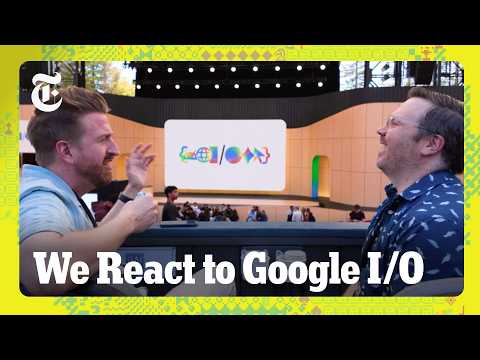
“Yes, this is like the Coachella of capitalism, the warped tour of the web, the Lollapalooza of links… I could keep going.” — Kevin Roose, 0:36
Clip command
yt-dlp --download-sections "*0:36-1:08" "https://www.youtube.com/watch?v=3OuXRxh3JNw" --force-keyframes-at-cuts --merge-output-format mp4 -o "coachella-of-capitalism.mp4"”We’re in the foothills of the singularity”
“I love that Google’s version of the Steve Jobs like ‘one more thing’ is like ‘one more thing, the singularity!’” — Kevin Roose, 1:17
Clip command
yt-dlp --download-sections "*1:17-1:50" "https://www.youtube.com/watch?v=3OuXRxh3JNw" --force-keyframes-at-cuts --merge-output-format mp4 -o "foothills-of-singularity.mp4"”I’m building a bioweapon, but I don’t want to say that in this crowd”
“I’m building a bioweapon, but I don’t want to say that in this crowd.” — Kevin Roose, 4:48
Clip command
yt-dlp --download-sections "*4:25-5:00" "https://www.youtube.com/watch?v=3OuXRxh3JNw" --force-keyframes-at-cuts --merge-output-format mp4 -o "bioweapon-in-this-crowd.mp4"”Fast and cheap is what you talk about when it isn’t the best”
“I mean, I think they care about it. I think that they just haven’t built it yet, you know. Fast and cheap is what you talk about when it isn’t the best. And so that’s what we’re getting this year.” — Kevin Roose, 3:14
Clip command
yt-dlp --download-sections "*3:14-3:40" "https://www.youtube.com/watch?v=3OuXRxh3JNw" --force-keyframes-at-cuts --merge-output-format mp4 -o "fast-and-cheap.mp4"”The only recent gathering where mentions of AI do not produce a chorus of boos”
“This is the only recent gathering of a large number of people where mentions of AI do not produce a large chorus of boos. This was a crowd where people actually seemed like they wanted to hear about new AI developments.” — Casey Newton, 5:53
Clip command
yt-dlp --download-sections "*5:53-6:25" "https://www.youtube.com/watch?v=3OuXRxh3JNw" --force-keyframes-at-cuts --merge-output-format mp4 -o "io-crowd-no-boos.mp4"”It felt like a base hit”
“It felt like a base hit to me. You know, I think that if they ship everything that they showed off and it works basically as advertised, like, I think that there is some good stuff in there. I don’t think that there was a single product that made me think if I can’t use this, like today, I will be in extreme physical distress.” — Casey Newton, 10:46
Clip command
yt-dlp --download-sections "*10:46-11:11" "https://www.youtube.com/watch?v=3OuXRxh3JNw" --force-keyframes-at-cuts --merge-output-format mp4 -o "base-hit-verdict.mp4"Key Points
- Recording live from I/O 2026 (0:27) - Casey and Kevin walk and talk after the keynote at the conference
- Biggest change to Search in 25 years (1:37) - Google claims a massive Search overhaul, with custom AI-generated user interfaces coming this summer
- Foothills of the singularity (1:08) - Demis Hassabis ended the keynote with this kicker about where AI development stands
- Heavy emphasis on agentic AI (2:18) - Agentic coding, agentic search alerts (like a fancy Google Alerts), and other autonomous capabilities
- Gemini 3.5 Flash as Google’s bet on cost and speed (2:18) - Four times faster and much cheaper than other leading frontier models
- Casey: efficiency over frontier capability (3:00) - Google doesn’t seem to care about absolute cutting edge as long as they can serve cheaply and quickly to billions
- Gemini Spark agent (4:26) - Lets you run a Claude-style swarm in the cloud rather than on your open laptop
- Kevin’s anti-gravity coding eval (7:13) - Hands-on testing with Google’s coding assistant shows speed but no quality leap
- Cost backlash on Gemini Flash (7:13) - Significantly more expensive than the previous Flash, frustrating power users
- Better Gemini 3.5 Pro coming next month (10:17) - The model that will actually compete at the frontier
- No boos for AI (5:53) - I/O attendees actually wanted to hear about new AI developments, unlike at recent commencements
- Final verdict: a base hit (10:46) - Solid announcements, no must-have product, but Google has found its footing
Mentions
Companies
- Google (0:27) - Host of I/O 2026; subject of the entire episode
- Google DeepMind (1:08) - Demis Hassabis closed the keynote
- Anthropic (4:19) - Maker of Claude, which Kevin runs in a swarm on his open laptop
- OpenAI (3:37) - Implied competitor whose Open Interpreter Google is emulating with Gemini Spark
- Waymo (11:48) - How Kevin wanted to get to the Sundar Pichai interview
- Zillow (2:18) - Example of an agentic search use case: monitor new home listings
Products & Technologies
- Gemini 3.5 Flash (2:18) - Google’s new fast, cheap model, the headline of I/O 2026
- Google Search overhaul (1:37) - Custom AI-generated UIs based on user queries
- Gemini Spark (4:26) - Cloud-hosted agentic environment, similar to running a Claude swarm
- Anti-gravity (7:13) - Google’s coding assistant Kevin used to evaluate Gemini 3.5 Flash
- Omni model (5:22) - New multimodal model taking video, images, and text
- Google Alerts (2:18) - The product the agentic search mode is essentially a fancy upgrade of
- Bard (11:11) - Google’s earlier AI chatbot, referenced as the moment when things were going sideways
People
- Demis Hassabis (0:48) - Google DeepMind CEO; closed the keynote with the “foothills of the singularity” line
- Sundar Pichai (7:00) - Google CEO, whom they were headed to interview after recording
- Steve Jobs (1:17) - Referenced for his “one more thing” Apple keynote tradition
Surprising Quotes
“I love that Google’s version of the Steve Jobs like ‘one more thing’ is like ‘one more thing, the singularity!’” — Kevin Roose, 1:17
“Fast and cheap is what you talk about when it isn’t the best.” — Kevin Roose, 3:14
“I’m building a bioweapon, but I don’t want to say that in this crowd.” — Kevin Roose, 4:48
“I am somebody who is always willing to wait a little bit longer and to spend a little bit more to get the best answer.” — Casey Newton, 8:40
“You like to surround yourself with kind of awe-inspiring intelligence… Which is why we’re hosting this podcast together.” — Kevin Roose / Casey Newton, 8:57
Transcript
Casey Newton: 0:00 Ready to walk and talk?
Kevin Roose: 0:01 What are we talking about?
Casey Newton: 0:03 We’re just scenic, scene setting. Can you be less close?
Kevin Roose: 0:06 No, I’m asking, I was told to shut up because I ruined too much of the show earlier, so I’m like what what am I allowed to talk about?
Casey Newton: 0:13 Can you sack up and just give me some scenic B-roll here?
Kevin Roose: 0:15 I fully sacked.
Casey Newton: 0:17 I have to do everything around here, I swear to God. Okay.
Casey Newton: 0:27 Well Kevin, the keynote just wrapped up here at I/O 2026. What did you think?
Kevin Roose: 0:36 Yes, this is like the Coachella of capitalism, the warped tour of the web, the Lollapalooza of links… I could keep going.
Casey Newton: 0:46 Please don’t.
Kevin Roose: 0:48 And they are doing a lot. We heard about everything from like agentic search to these new like video editing models and products they have, all the way to Demis Hassabis at the end of the keynote declaring that we are in the foothills of the singularity.
Kevin Roose: 1:08 When we look back at this time, I think we’ll realize that we were standing in the foothills of the singularity.
Casey Newton: 1:15 Quite a kicker.
Kevin Roose: 1:17 Yeah and that puts us on pace by I/O 2027 to be at the base camp of the singularity. I love that Google’s version of the Steve Jobs like ‘one more thing’ is like ‘one more thing, the singularity!’
Casey Newton: 1:31 A great way to end. So yeah, what was your standout, what did they announce that caught your eye?
Kevin Roose: 1:37 I mean, they have said that they just made the biggest change to search in 25 years. I think time will tell if that is truly as significant a change as they’re suggesting because when we saw it in the demos, it just looked like the box grows if you type more into it. But you know, they’re also saying that by this summer, they’re going to be generating custom user interfaces based on your query and a bunch of other stuff.
Casey Newton: 2:00 I think like a through line through everything that they discussed here was coming this summer or coming to a group of trusted testers. And with these kind of productivity tools, until they’re in your hands, you don’t really know if anything has changed in your life or not.
Kevin Roose: 2:18 Yeah, there was a lot of focus on agentic stuff like agentic coding, they have this new agentic search mode which basically is sort of the fancy upgrade to Google Alerts. You can have it sort of tell you when there’s like a new home listed on Zillow or a new baseball score you might care about or something like that. I was really interested that they seem to be betting very big on cost and speed. So their new model that they talked about today was Gemini 3.5 Flash, which is the newest version, but it’s also they say four times faster and much cheaper than the other leading frontier models. And so I think Google’s strategy of kind of betting on scale and distribution…
Casey Newton: 3:00 Efficiency and like making their models as efficient to serve as possible is really the direction they’re going in. Like they don’t seem to care about having the absolute most cutting edge models as long as they can serve them cheaply and quickly to billions of people.
Kevin Roose: 3:14 I mean, I think they care about it. I think that they just haven’t built it yet, you know. Fast and cheap is what you talk about when it isn’t the best. And so that’s what we’re getting this year.
Casey Newton: 3:25 But you know, I am interested in trying these new agents. I’ll say, I tried to use the new agent, I said, ‘Let me know if Kevin Roose writes a good story,’ but it hasn’t sent me anything. And so I don’t know if it’s broken or if the AI isn’t working or what.
Kevin Roose: 3:33 Yeah, it must be — I’m writing good stories constantly, so something must be going on.
Casey Newton: 3:37 Yeah. I think my real curiosity is like which of these agents are going to find true product market fit. Like which is the agent that is going to get a billion users? Because we saw them show off what is effectively their version of OpenInterpreter, which definitely like had a big moment earlier this year, but it’s still not clear to me that that is an actual mainstream use case. Like I have to say, like of everything they showed off, like I’m not like dying to like have, you know, Gemini OpenInterpreter working overnight on my behalf because I don’t know what I would ask it to do.
Kevin Roose: 4:19 Yeah, I think that was actually one of my favorite parts because I am currently running a Claude swarm on my open laptop.
Casey Newton: 4:25 Doing what? What’s it doing?
Kevin Roose: 4:26 And what they have said is that you can now do that through Gemini Spark, this new agent thing, and it will run in like a virtual machine on the cloud so you don’t have to like keep your laptop cracked like an insane person.
Casey Newton: 4:39 But Kevin, please, what are you doing with your Claude swarm?
Kevin Roose: 4:42 I can’t tell you.
Casey Newton: 4:43 You can’t even tell me? Because you’re not doing anything.
Kevin Roose: 4:45 I’m ushering in the singularity.
Casey Newton: 4:47 You’re generating recipes.
Kevin Roose: 4:48 I’m building a bioweapon, but I don’t want to say that in this crowd.
Casey Newton: 4:51 They get sensitive about that sort of thing around here.
Casey Newton: 4:53 So what was the vibe of I/O this year?
Kevin Roose: 4:57 I mean, I honestly, the only people that I have talked to are like reporters and people that work at Google. So like I feel like we have not really had a chance yet to talk to developers and see what is on their minds. Clearly they have a lot of new toys to play with and I’m sure they’re excited about that. But you know, as I said, until you get your hands on them, you don’t really know if your life has changed.
Casey Newton: 5:22 Yeah, I feel like they have confidence in their sort of place in the front of the pack. I don’t think they believe that their models are the best in the world yet, but if they’re cheaper and faster and they can do more stuff… they have this new omni model that can take in video as well as images and text. So I feel like they’re sort of doing the spray and pray approach to AI development, which is you just do everything everywhere all at once and hope that something hits. And it’s worked for them.
Casey Newton: 5:53 Yeah, and I guess I will say one thing about the vibe here at I/O this morning, Kevin, which is this is the only recent gathering of a large number of people where mentions of AI do not produce a large chorus of boos. This was a crowd where people actually seemed like they wanted to hear about new AI developments and as we saw many many AI generated images and videos for almost two hours, there was nary a boo to be heard.
Kevin Roose: 6:18 I agree. Not a lot of mention of the AI backlash or any of the things. I think they’re just sort of hoping that these new products are so useful to people that they’ll sort of forget about all their objections, and then, you know, of course comes Demis Hassabis to talk about the singularity just to remind you that none of this is normal, that we are experiencing something very weird.
Casey Newton: 6:41 All right, well, I think those are some good early thoughts. We have a lot more to do at I/O, starting with probably hitting that lunch line in the press tent.
Kevin Roose: 6:46 I saw some ube croissants on my way in. I’m still trying to figure out what that means, but I’m gonna go try it out.
Casey Newton: 7:00 All right Kevin, well, we are back in the studio the day after I/O and we have a few hours before we head back down to interview Sundar Pichai. But before we do that, you have spent a little bit of time playing around with this new Gemini 3.5 Flash model. So what have you been doing with it?
Kevin Roose: 7:13 So I did try to use anti-gravity their kind of coding assistant to put the model through some of my own evaluations and it seems like two things are true. One is it’s very fast. It’s very fast and you don’t hit your sort of token limits at all like very quickly, which is a nice contrast to some of the other coding models that I’ve used. And the second thing is that it just doesn’t seem like that much of an improvement over what is out there now. I think you know there have been some people on my feeds talking about how they are feeling disappointed by the new Gemini model, there’s some indications that it’s maybe not as good as Gemini 3.5 Pro at some coding evaluations, but it is much faster and I think the other thing that people are reacting to is the cost. So the cost of Gemini 3.5 Flash while lower than other kind of frontier models is significantly more expensive than the last version of Gemini Flash. So people are upset about that. But I think in general my sense is like it’s a good model, it’s a pretty good model, it’s not like blowing me away, but it is quite fast and if you are a company that’s burning, you know, billions of tokens a day you might be interested in that, but for the average person I would say like nothing about it has made me want to switch to it as my daily driver yet.
Casey Newton: 8:40 Yeah, I have to say like this class of models has always just felt like it’s not for me, right? Like I am somebody who is always willing to wait a little bit longer and to spend a little bit more to get the best answer, right? Like I would sort of rather do that than just sort of have like instant answers from a very cheap model.
Kevin Roose: 8:57 You like to surround yourself with kind of awe-inspiring intelligence.
Kevin Roose: 9:00 Yes, that’s exactly right.
Casey Newton: 9:01 Which is why we’re hosting this podcast together.
Kevin Roose: 9:03 That’s exactly right. And so, I mean, look, I think for a very wide variety of use cases, a model like this is going to be perfectly fine. If you’re, you know, the average Gemini user and you’re just trying to pass sixth grade for free, I think this model is going to be a lot of help. But, you know, the sort of more vocal AI power user crowd, which are the people that you’re going to find on social media sort of putting these models through their paces on day one, does seem to be a little disappointed here. And I do think it’s notable that a model that was sold to us yesterday largely on the strength of its low price does not actually seem to be as cheap as maybe we were told.
Casey Newton: 9:44 Yeah. And I think part of this is just that the cycle of kind of I/O and developer conferences is maybe out of step with how these models are actually being built. I’ve been hearing some whispers from folks at Google that they are working on something that is more powerful, but that it just may not have been ready in time for I/O this year. So I think that’s one tricky thing about doing these conferences once a year is kind of every deadline has to line up at exactly the same time or else you end up looking like you’re behind.
Kevin Roose: 10:17 Yeah. I mean, I think the real test for Google, I mean, at least the next real test for Google will come next month when it puts out 3.5 Pro, which I think will sort of be at a similar class of the frontier models that we have today. And that’s when I’m going to sort of be putting the model through all of its paces and trying to figure out, okay, like what part of my daily workflows might this kind of thing slot into?
Kevin Roose: 10:40 Yeah. All right. Casey, what is your verdict on I/O? Did it meet your expectations?
Casey Newton: 10:46 It felt like a base hit to me. You know, I think that if they ship everything that they showed off and it works basically as advertised, like, I think that there is some good stuff in there. I don’t think that there was a single product that made me think if I can’t use this, like today, I will be in extreme physical distress. But yeah, overall I thought, you know, solid set of announcements. What’d you think?
Kevin Roose: 11:11 Yeah, I think that basically meets my expectations. I talked to one reporter who was walking around at I/O and who said it was like mid. Sort of like, you know, it’s like good. It’s good. It’s a better position than they were in a couple years ago at I/O when they were basically scrambling to get Bard out the door and, and everything looked like it was going sideways. So they found their footing, but it is still not clear whether they are producing a model that will truly be state of the art.
Kevin Roose: 11:40 All right. So that is some of our thoughts and early hands-on impressions of Gemini 3.5 Flash. Now let’s head down to Google to talk to Sundar.
Casey Newton: 11:47 Okay. Are you driving?
Kevin Roose: 11:48 I thought we were going to take a Waymo.
Casey Newton: 11:50 Okay.