Artificial meat is harder than artificial intelligence — Lewis Bollard
Artificial meat is harder than artificial intelligence — Lewis Bollard
Summary
Lewis Bollard, who leads Open Philanthropy’s farmed animal welfare strategy, joins Dwarkesh Patel for a deep dive into the economics, politics, and ethics of factory farming. The conversation’s central revelation is that factory farming is staggeringly efficient at what it does — chickens have a feed conversion ratio of 2x and have been optimized by evolution for billions of years — making it extraordinarily difficult for cultivated meat or alternative proteins to compete on price. Bollard argues that the end of factory farming is “far from inevitable” even with AGI.
The episode covers surprisingly effective interventions (corporate campaigns to move away from battery cages have already spared over 200 million hens), the astonishing neglect of the issue (less than $300 million globally is being spent wisely on animal welfare reform), and the outsized political influence of the meat industry. Bollard explains how the pork lobby is currently trying to strip states of their ability to set animal welfare standards through the farm bill, despite overwhelming public support for these laws. The conversation also includes a fundraiser — Dwarkesh has pledged $250,000 as a donation match through FarmKind, arguing that $1 donated can prevent more than 10 years of animal suffering.
Highlights
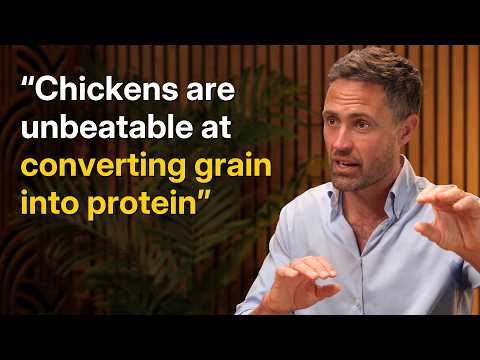
”The feed conversion ratio for chickens is 2x”
Clip command
yt-dlp --download-sections "*2:18-3:10" "https://www.youtube.com/watch?v=kWcPg8t1kJ4" --force-keyframes-at-cuts --merge-output-format mp4 -o "kWcPg8t1kJ4-2m18s.mp4"“The chicken has evolved over a very long time to be an incredibly efficient bioreactor. It takes a small amount of grain and converts it very efficiently into meat. The feed conversion ratio for chickens is 2x. That grain is incredibly cheap because they’ve removed everything about providing comfort. You’re trying to beat the price of this finely optimized biological machine. That is actually a really hard target to meet.” — Lewis Bollard, 2:18
”$1 can prevent 10 years of animal suffering”
Clip command
yt-dlp --download-sections "*28:13-29:10" "https://www.youtube.com/watch?v=kWcPg8t1kJ4" --force-keyframes-at-cuts --merge-output-format mp4 -o "kWcPg8t1kJ4-28m13s.mp4"“The work to get hens out of cages has already impacted well north of 500 million hens. The amount of money spent just on those campaigns was maybe $10-15 million a year over a couple of years. That’s far less than 1:10 of a dollar per animal year of suffering averted. So $1 can do more than 10 years of animal suffering prevention.” — Lewis Bollard, 28:13
”We made a mistake as a movement focusing on diet”
Clip command
yt-dlp --download-sections "*8:02-8:50" "https://www.youtube.com/watch?v=kWcPg8t1kJ4" --force-keyframes-at-cuts --merge-output-format mp4 -o "kWcPg8t1kJ4-8m02s.mp4"“I think we made a mistake as a movement making this about diet and personal behavior. This is not how large-scale social change occurs. We need people to be advocates for reform, regardless of their personal diet.” — Lewis Bollard, 8:02
”The meat lobby got a lock on Congress”
Clip command
yt-dlp --download-sections "*41:41-42:40" "https://www.youtube.com/watch?v=kWcPg8t1kJ4" --force-keyframes-at-cuts --merge-output-format mp4 -o "kWcPg8t1kJ4-41m41s.mp4"“The meat industry accounts for less than 1% of Americans and doesn’t even get that much money. Yet it has an incredible lock on the legislative process where it can stop any reform. They have effectively used the image of the American farmer to kill any animal welfare legislation.” — Lewis Bollard, 41:41
”8 billion chicks killed at birth every year”
Clip command
yt-dlp --download-sections "*9:54-10:50" "https://www.youtube.com/watch?v=kWcPg8t1kJ4" --force-keyframes-at-cuts --merge-output-format mp4 -o "kWcPg8t1kJ4-9m54s.mp4"“The standard practice is that about 8 billion male chicks every year are killed at birth — either through a giant meat grinder or suffocated in bags the day they’re born. In-ovo sexing technology can determine the sex of eggs very early in incubation, saving 200 million chicks from that fate.” — Lewis Bollard, 9:54
Key Points
- Factory farming’s astonishing efficiency (0:00) - Chickens convert feed at 2x ratio; evolution has been optimizing this for billions of years
- End of factory farming is not inevitable (0:37) - Even with AGI, there are cultural and political barriers that technology alone won’t solve
- Cultivated meat faces enormous hurdles (4:07) - We’re not on a path to reach cultivated meat at competitive prices without major breakthroughs
- Movement made a mistake focusing on diet (7:18) - Personal dietary choices don’t drive large-scale social change; advocacy and policy reform do
- In-ovo sexing technology (9:54) - New tech to determine chick sex before hatching, saving 200 million chicks annually from being killed at birth
- Higher welfare chicken breeds exist (16:16) - Breeds with broader legs, better cardio, less suffering — but they need advocacy to be adopted
- Technology historically made things worse (16:16) - For a century, tech innovation in farming has resulted in more animals suffering more
- $1 prevents 10+ years of animal suffering (28:21) - The most cost-effective philanthropy in existence due to systematic neglect
- Less than $300M spent wisely globally (28:21) - The entire smart funding for animal welfare is smaller than many single charities
- China leading on alternative protein patents (37:26) - Majority of global patents now coming from Chinese public universities
- Meat lobby controlling Congress (41:41) - Less than 1% of Americans but effectively blocking all animal welfare legislation
- Farm bill may strip state animal welfare laws (41:41) - Pork industry trying to add language banning states from setting welfare standards on imports
- Cal-Maine Foods profiteering (53:23) - Biggest egg producer’s share prices are at all-time highs due to price inelasticity
- Corporate campaigns are underrated (57:42) - Over 3,000 commitments secured from companies, affecting hundreds of millions of animals
- Switching from beef to chicken increases suffering (1:04:00) - 23 more animals per person per year, each enduring years of factory farm suffering
Mentions
Companies & Organizations
- Open Philanthropy (0:03) - Biggest charity in animal welfare space; Lewis Bollard leads their strategy
- FarmKind (28:21) - Re-grantor that directs donations to most effective animal welfare charities
- The Humane League (57:42) - Working on corporate campaigns and accountability
- Mercy for Animals (57:42) - Also working on corporate animal welfare campaigns
- Tyson Foods (53:23) - Major meat processor; uses carbon footprint arguments against welfare reforms
- Smithfield (53:23) - Major pork processor
- Perdue (53:23) - Chicken company that uses contract farming model
- Cal-Maine Foods (53:23) - Biggest egg producer, share prices at all-time highs
- McDonald’s (9:54) - Just implemented cage-free commitment, affecting 7 million hens yearly
- Niman Ranch (53:23) - Attempted higher-welfare supply chain, went out of business
- LDC Group (16:16) - Largest French chicken producer, moving to higher welfare genetics
- Unilever (37:26) - Multinational implementing global cage-free policies
People
- Dwarkesh Patel (0:00) - Host; pledged $250,000 donation match through FarmKind
Surprising Quotes
“23 billion animals are alive on factory farms at any point in the world. People think about dog fighting — it’s a real evil, it’s horrific, but we’re talking about a few thousand animals. Factory farming of chickens occurs on a far greater scale. We have rightly banned dog fighting. Yet when factory farmers do far worse to a far greater number of animals, it’s perfectly legal.” — Lewis Bollard, 28:21
“Artificial meat is harder than artificial intelligence. Converting calories into meat has been something evolution has been optimizing for billions of years. We’ve had to spend all this money on AI, and it’s only been a few decades. Evolution has had billions of years head start on meat.” — Lewis Bollard, 3:35
“It costs 19 cents more for a dozen eggs to produce cage-free. Yet retailers charge on the order of $1.70 more. They’re using animal welfare as a price differentiation tool to extract margins.” — Lewis Bollard, 57:42
“Almost all chicken in the US is sold with the label ‘all-natural.’ People assume that means the chickens were outside. It actually means nothing — it’s just that the chicken is chicken.” — Lewis Bollard, 53:23
Transcript
0:00 Today I’m chatting with Lewis Bollard, who directs animal welfare strategy at Open Philanthropy, the biggest charity in this animal welfare space. Thanks for having me on. How do you think about the end goal here? Are you trying to make conditions more humane, or do you think technology eventually solves this problem for us? I think that the interventions we’re funding, like in-ovo sexing or cage-free eggs, will matter even if we get AGI. The end of factory farming is far from inevitable. There are 23 billion animals globally on factory farms. There are multiple possible trajectories we could go down.
0:51 For the last century, technology in agriculture has resulted in ever more animals being farmed in worse conditions. There is a trajectory where we reduce the number of animals and the suffering of each of those animals. I’m optimistic that AGI will accelerate that. It will bring us better alternative proteins and new solutions. But there are still huge cultural and political obstacles. Most people already have the option of plant-based alternatives. There’s also the political obstacle — cultivated meat is already banned in some states and it might soon be illegal in more.
2:18 The basic efficiency is that the chicken has evolved over a very long time to be an incredibly efficient bioreactor. It takes a small amount of grain and converts it very efficiently into meat. The feed conversion ratio for chickens is 2x. That grain is incredibly cheap because they’ve removed everything about providing comfort. You’re trying to beat the price of this finely optimized machine. That is actually a really hard target to meet. Factory farming is so insanely cheap today.
3:35 AI has had hundreds of billions of dollars of investment. And human intelligence has been developing — if you count from when primates started evolving — for millions of years. But converting calories into meat has been something evolution has been optimizing for billions of years. Every step from delivering growth factors to delivering nutrition is something evolution has been working on the entire time. That’s why cultivated meat is such a tough problem.
7:18 I think we made a mistake as a movement making this about diet and personal behavior. It’s great when folks want to make a personal choice to eat less meat or meat from more humane sources, but this is not how large-scale social change occurs. We need people to be advocates for reform. People can be a part of that regardless of their personal diet.
9:54 The standard practice is that about 8 billion male chicks every year are killed at birth — either through a giant meat grinder or suffocated in bags the day they’re born. In-ovo sexing applies existing technologies to determine whether eggs are going to be male or female very early in the incubation phase. It just got introduced to the United States. I’m really optimistic it can scale. It’s already saving about 200 million chicks from that fate.
16:16 We’ve bred chickens to be so unhealthy they can barely walk. The first thing about higher welfare breeds is that they can actually walk. They have broader legs, better cardio systems. They’ve just been bred with some basic animal welfare in mind. But they’re less economical, which is why you need advocacy to get companies to adopt them.
28:21 The work to get hens out of cages has already impacted well north of 500 million hens. The amount of money spent was maybe $10-15 million a year. That’s far less than one tenth of a dollar per animal year of suffering averted. So $1 can prevent more than 10 years of animal suffering. There is no other cause area in philanthropy with that kind of ratio. That has to do with how neglected this area is.
37:26 This problem is getting worse over time globally as countries get wealthier and eat more meat. But China is investing heavily in alternative proteins. The majority of patents coming out globally are from public universities in China. We’re also seeing multinationals like Unilever commit to eliminating cages from their global supply chains.
41:41 The meat industry accounts for less than 1% of Americans and doesn’t even get that much money. Yet it has an incredible lock on the legislative process. The Agriculture Committee is dominated by members in the pocket of big Ag, and they kill any bill. They have effectively used the image of the American farmer — this salt-of-the-earth person — when in reality these are factory farmers backed by oligopolistic corporations like Tyson and Smithfield.
53:23 This is not a business where everyone is swimming in cash. But it is an oligopoly. Four companies process the vast majority of pigs, and similar numbers for cattle and poultry. Cal-Maine Foods, the biggest egg producer, has share prices at all-time highs because the price elasticity of eggs means you can keep cranking up the price.
57:42 Advocates have been able to secure over 3,000 corporate commitments from all the biggest retailers, restaurants, and food service companies, affecting hundreds of millions of animals. Corporate campaigns are even more effective than expected because corporate decision makers are much more responsive to consumers than politicians are to voters.
1:04:00 One thing that is wild is where climate advocates encourage people to switch from beef to chicken for carbon reasons. Literally that switch is 23 more animals per person per year, each enduring years of suffering in factory farms. I think the tendency to subordinate animal welfare to climate is more of an elite view. Regular people actually care deeply about animal suffering and do prioritize that.