Stephen Kotkin — How Stalin became the most powerful dictator in history
Stephen Kotkin — How Stalin became the most powerful dictator in history
Summary
Stephen Kotkin, arguably the world’s foremost expert on Joseph Stalin, joins Dwarkesh Patel for a sprawling two-hour conversation covering how Stalin consolidated absolute power over 11 time zones and killed tens of millions of people while pursuing an ideology aimed at building paradise on Earth. Kotkin, who has written two-thirds of his planned three-volume Stalin biography, explains the modernization dilemma that autocratic regimes face: they need engineers and intellectuals to compete militarily, but those same people bring ideas about freedom and rights that threaten the regime’s power.
The conversation covers the tsarist regime’s repression, why the peasants inadvertently brought the Bolsheviks to power (through land seizures that destroyed the forces of order), why nobody assassinated Stalin despite his monstrous policies, and the “civil war on the left” between revolutionary communists and democratic socialists that has never been resolved. Kotkin provides a masterful explanation of how collectivization created both the terror state and the obedient population that sustained it. The discussion extends to modern China, where Kotkin argues that Deng Xiaoping’s economic miracle was less about Communist Party wisdom than about the party getting out of the way of Chinese entrepreneurialism — and that Xi Jinping represents a return to party control that threatens that dynamism. The episode closes with reflections on political legitimacy, why communist regimes can’t do political reform without liquidating themselves, and why the long-run advantage belongs to systems rooted in genuine popular consent.
Highlights
”The modernization dilemma: How do you import technology but keep out freedom?”
Clip command
yt-dlp --download-sections "*2:06-4:10" "https://www.youtube.com/watch?v=YMfd3EoHfPI" --force-keyframes-at-cuts --merge-output-format mp4 -o "YMfd3EoHfPI-2m06s.mp4"“How do you bring in airplanes, or AI, but keep out freedom, property rights, all the things that come with it? The tsarist regime was a quintessential example. You modernize because you need to — if somebody has ships made out of steel, either you get them too or they’re going to show up at your door.” — Stephen Kotkin, 2:06
”Stalin was not Stalin yet when they could have stopped him”
Clip command
yt-dlp --download-sections "*96:00-97:10" "https://www.youtube.com/watch?v=YMfd3EoHfPI" --force-keyframes-at-cuts --merge-output-format mp4 -o "YMfd3EoHfPI-96m00s.mp4"“It’s clear that Stalin was not Stalin yet. He becomes Stalin in the process of exercising power. He’s not born Stalin, and that’s the key point. Today you look at Putin — why doesn’t somebody assassinate him? Xi Jinping — he’s hurting China. Why don’t the people around him push him out?” — Stephen Kotkin, 1:36:00
”The peasants brought Lenin to power, then he enslaved them”
Clip command
yt-dlp --download-sections "*24:30-25:40" "https://www.youtube.com/watch?v=YMfd3EoHfPI" --force-keyframes-at-cuts --merge-output-format mp4 -o "YMfd3EoHfPI-24m30s.mp4"“The peasant revolution is going to bring about, inadvertently, the death of the peasants owning the land. The peasants, through their land seizures, helped bring Lenin and his Bolsheviks to power, only to then be expropriated and forced onto collective farms.” — Stephen Kotkin, 24:30
”Communism only has to do one thing to survive: hold power”
Clip command
yt-dlp --download-sections "*69:10-70:20" "https://www.youtube.com/watch?v=YMfd3EoHfPI" --force-keyframes-at-cuts --merge-output-format mp4 -o "YMfd3EoHfPI-69m10s.mp4"“Communism can fail at everything. It can fail at delivering prosperity, it can fail at delivering peace. It only has to do one thing to survive: hold power. And it has suppressed all the political alternatives.” — Stephen Kotkin, 1:09:10
”The Communist Party didn’t bring growth — it got out of the way”
Clip command
yt-dlp --download-sections "*74:20-75:30" "https://www.youtube.com/watch?v=YMfd3EoHfPI" --force-keyframes-at-cuts --merge-output-format mp4 -o "YMfd3EoHfPI-74m20s.mp4"“People say the Communist Party brought China’s economic growth. No. The Communist Party put more than a billion people in poverty in the first place. Why are a billion plus people in poverty? Because of the Communist Party. When they grudgingly allowed market behavior, the people lift themselves out of poverty.” — Stephen Kotkin, 1:14:20
Key Points
- The modernization dilemma (0:00) - Autocratic regimes need engineers and intellectuals to compete, but those people bring ideas about freedom
- Tsarist repression was vegetarian compared to what followed (4:00) - The tsarist secret police had thousands of agents; Stalin’s apparatus had millions
- Stalin’s perverse unintended consequences (6:00) - He fought against legitimate injustices but built something worse than the system he overthrew
- Constitutional revolution only works before the mass age (10:00) - England and US succeeded because franchise was restricted before peasants were politically organized
- Peasant land hunger drove revolution (24:38) - Unresolved from 1860s through 1917; created intense radicalism that communists exploited
- Why people cooperated with collectivization (38:31) - Young true believers, plus a repressive apparatus that grew alongside the terror
- Ideology as empowerment for lumpen-intellectuals (1:03:19) - Communism empowers intellectuals to be in charge without elections or market legitimacy
- The civil war on the left (1:03:19) - Revolutionary Leninists vs. democratic socialists like Swedish Social Democrats — never resolved
- CCP didn’t create prosperity (1:13:54) - Chinese entrepreneurialism and human capital created growth; the party grudgingly got out of the way
- Xi Jinping’s reversal (1:13:54) - Instead of bringing capitalists into the party (Jiang Zemin’s approach), Xi is forcing the party back into capitalism
- Why nobody killed Stalin (1:36:06) - Collective action problem, surveillance, and the psychology of revolutionary commitment
- Communist regimes can’t reform politically (1:53:38) - Opening debate becomes a Pandora’s box; you either have the monopoly or you don’t
- Technology won’t save communist regimes (1:53:38) - Same fantasy as Soviet computers — tech as substitute for structural reform that would threaten power
- Political legitimacy is permanent; tech advantages aren’t (2:10:00) - Systems rooted in genuine popular consent have durable advantages
Mentions
Historical Figures
- Joseph Stalin (0:00) - Subject of Kotkin’s multi-volume biography; held power of life and death over 11 time zones
- Vladimir Lenin (1:20) - Led the Bolshevik Revolution; his brother tried to kill the tsar
- Tsar Nicholas II (0:00) - Incompetent ruler; had an unfortunate incident in Japan where someone tried to assassinate him with a sword
- Peter the Great (1:36:06) - Referenced as a tsar who would have had no qualms about crushing opposition
- Stolypin (10:00) - Interior Minister who tried agricultural reforms after 1905; assassinated
- Durnovo (10:00) - Predicted that taking down the Tsar would lead to chaos and dictatorship; proved right
- Deng Xiaoping (1:13:54) - Visited Japan and America; partnered with US for export-led growth model
- Xi Jinping (1:13:54) - Forcing the party back into capitalism; representing return to control
- Jiang Zemin (1:13:54) - Tried to bring capitalists into the party; strategy failed as party members became corrupt
- Gorbachev (1:53:38) - Political reform led to the system liquidating itself
- Bukharin (1:36:06) - Key Bolshevik who was purged by Stalin
- Khrushchev (1:53:38) - Denounced Stalin’s crimes; gave communism a “second wind”
- Adolf Hitler (1:36:06) - Multiple assassination attempts compared to near-zero for Stalin
- Count Sergei Witte (1:00:15) - Russian Finance Minister who tried to industrialize through railways
- Eduard Bernstein (1:03:19) - Social Democrat who argued for evolutionary reform of capitalism
Institutions
- Hoover Institution (38:31) - Houses the Tsarist Russian secret police archives on foreign surveillance
- Open Philanthropy — Referenced indirectly through discussion of effective altruism
- Swedish Social Democrats (1:03:19) - Model for evolutionary socialism keeping markets and private property
Surprising Quotes
“Modernization is not a sociological process that just happens. You modernize because you need to — if somebody has ships made out of steel, either you get them too or they’re going to show up at your door.” — Stephen Kotkin, 4:15
“Marx says get rid of private property and you’re going to get freedom, abundance, and peace. That’s like saying nuke them but don’t kill any people. Once you nuke capitalism, you’re going to get dictatorship.” — Stephen Kotkin, 1:10:00
“When they see that Stalin is leading them down a terrible path, they don’t try to kill Stalin. They kill themselves rather than kill Stalin. That tells you something about the mentality of these communists.” — Stephen Kotkin, 1:40:00
“The people who are supposed to do the repressing have agency. There comes a moment where they decide not to do it anymore. That variable is ultimately decisive. Your power can look really solid — like a bank built out of stone — but it can evaporate like a bank run.” — Stephen Kotkin, 2:05:00
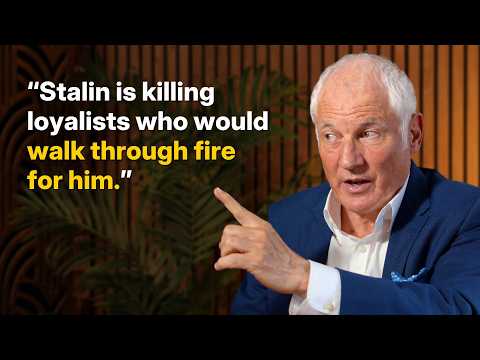
“Stalin offered to resign three times in writing and three times orally. Every time, the people around him begged him to stay. Then he killed all of them within 10 years.” — Stephen Kotkin, 1:38:00
Transcript
0:53 My guest today is Stephen Kotkin, who is a senior fellow at the Hoover Institution and has written two-thirds of his three-volume Stalin biography. The second one is called “Stalin: Waiting for Hitler.” Thank you for the honor of the invitation.
1:12 First question: how repressive was the tsarist regime really? Presumably the motivation behind the revolution is that it was very repressive. Lenin’s brother tried to kill the tsar. People like Stalin are in exile, robbing banks and engaged in small shenanigans. This happens in many countries today. How bad was it really? We need to widen the aperture a little bit here. The tsarist regime needs to be able to compete as a global power. That means it needs a modern military and modern industry — armaments, steel, railways. But it doesn’t want the workers to organize a labor movement or go on strike.
2:06 Similarly, you need the engineers in order to build the technology, but those engineers have their own ideas about politics and freedom. So all of these countries face this dilemma: importing modernization but trying to reject the value side that goes along with that. That’s a problem we still have today. The Chinese regime in Beijing has this problem. Russia has that problem. How do you bring in airplanes, or AI, but keep out freedom, property rights?
4:15 Modernization is not a sociological process that just happens. You modernize because you need to. If somebody has ships made out of steel, either you get them too or they’re going to show up at your door, like we did to Japan. The tsarist regime was repressive against the very people it needed to compete — the engineers and intellectuals. We would call this a vegetarian regime compared to what came after.
6:00 Stalin goes into the underground as a young man. He’s dedicated to fighting injustice. He was unbelievably successful as a student — great grades, did his homework. He gives it all up for the underground. For 15 years he’s a jobless revolutionary. What he’ll produce is a much more unjust society than the one he fought against. This is known as perverse unintended consequences.
10:00 Constitutional revolution only works before the mass age — like in England and the US, where you establish constitutional order while the franchise is restricted and the peasantry isn’t politically organized. That gives you breathing space to build institutions that you can then democratize over time. It worked in Taiwan and South Korea too. But the number of countries that have successfully made that transition is small.
24:38 The peasants brought Lenin to power, then he enslaved them. The peasants seized the land in 1917-18, which destroyed the forces of order that could have stopped the Bolsheviks. Then Stalin reversed the revolution by collectivizing the land — re-enslaving the peasants across all the territories. The peasant revolution inadvertently brought about its own destruction.
38:31 Why did so many go along with the terror? Young people were genuinely attracted to the promise of a total transformation of the world — eradication of exploitation, imperialism, inequality. There’s a simplicity to the ideology. Plus, if you’re not loyal to the party, you become an accomplice in the persistence of evil. The party is a larger cause than any individual.
1:03:19 The civil war on the left between those who say “capitalism is evil and must go” versus those who say “capitalism has problems but also produces prosperity and freedom” has never been resolved. The Swedish Social Democrats said “we keep markets and private property, we redistribute the income.” The Leninists said “destroy capitalism entirely.” This split still exists.
1:13:54 People say the Communist Party brought China’s economic growth. No. The Communist Party put more than a billion people in poverty in the first place. When they grudgingly allowed market behavior, the entrepreneurialism and ingenuity of the Chinese people lifted them out. Deng Xiaoping looked at Japan — a country that lost the war but rose to be the second-largest economy — and decided to partner with America. The formula was Japanese-style export-led growth filtered through British Hong Kong.
1:36:06 Why didn’t somebody just kill Stalin? There’s a collective action problem: you don’t know if the person suggesting it is an agent provocateur. There’s massive surveillance. And Stalin was unusually good at dictatorship — he built the system while personifying it. He offered to resign six times; every time they begged him to stay. Then he killed them all within a decade.
1:53:38 Communist regimes face an impossible dilemma with political reform. When you open up debate inside the party, someone inevitably says “I don’t want the party, I want another party.” You either have the monopoly or you don’t. Gorbachev learned this lesson — political reform liquidated the system. That’s why China’s leaders study Gorbachev in party school and have vowed never to open up the system politically.
2:05:00 The repressive apparatus is not a machine — it’s people. There comes a moment where the people who are supposed to do the repressing decide not to do it anymore. Your power can look really solid, like a bank built out of stone, but it can evaporate like a bank run in the repressive apparatus. What motivates that? The lack of political legitimacy. That’s what communist regimes can’t solve with tech.
2:10:00 In the long run, legitimacy wins. Systems rooted in genuine popular consent — where people have real freedoms, can vote, can be citizens, can realize their potential — that’s permanent. What’s permanent is power rooted in the people. In the short run, we need to avoid catastrophic war. If we can do that, in the long run, the legitimate systems prevail.