Grant Sanderson (@3blue1brown) – AI disproved a famous math conjecture. Now what?
Grant Sanderson (@3blue1brown) – AI disproved a famous math conjecture. Now what?
Summary
Dwarkesh Patel sits down with Grant Sanderson, creator of 3Blue1Brown, to work through what AI’s unusually fast progress in mathematics tells us about AI progress everywhere else. Sanderson describes a “spiky” and even fractal frontier: AI cold-solved IMO geometry in seconds via brute force, yet still stumbles on the playful, puzzly combinatorics problems. He distinguishes two very different flavors of mathematical breakthrough — “lightning bolts” that connect two fields an AI is already expert in (like the Montgomery–Dyson link between the Riemann zeta zeros and random matrix theory), versus “mountain building,” the creation of an entirely new conceptual framework. A Riemann-hypothesis solution that came from lightning bolts wouldn’t necessarily imply AGI; one that required building a new mountain of theory almost certainly would.
Much of the conversation orbits a hard problem: how do you reward the instinct that a definition or conjecture is good, when the verification loop can be a century long? Galois’s ideas about symmetry took roughly a hundred years — passing through Lagrange, Abel, Liouville, and Jordan — before the math community agreed they were valuable, and even the “verifier function” of the academy repeatedly rejected them. Sanderson and Patel probe whether elegance and compression (Kolmogorov complexity, the “unsolved expository problem”) could ever be turned into a training signal, and land on the idea that humans may shift from theorem-provers toward curators and educators — “museum curators” deciding which of an infinite space of AI-generated ideas is worth anyone’s attention.
They also dig into the machinery: why math and code are uniquely “grindable” (deterministic, containerizable, parallelizable) in a way computer use and business are not; why Lean and Mathlib might enable AlphaZero-style endless exploration that never needs a human to check in; why autoregression is a “weird” way to generate insight, and how forking agents with deliberately different biases — one proving, one disproving — could be a genuine advantage of digital minds. Finally, Sanderson explains why he thinks AI is still bad at writing (it lacks modularity and theory of mind — “they don’t have face muscles”), and offers advice to aspiring mathematicians: know where the money comes from, and lean into the deeply relational, hard-to-automate work of teaching.
Highlights
”The greatest mathematicians come up with definitions”
“How good mathematicians prove theorems, great mathematicians come up with conjectures, and the greatest mathematicians come up with definitions. That’s like that’s the premium tier mathematician.” — Grant Sanderson, 9:00
Clip command
yt-dlp --download-sections "*9:00-9:39" "https://www.youtube.com/watch?v=TfyPshgMbug" --force-keyframes-at-cuts --merge-output-format mp4 -o "greatest-come-up-with-definitions.mp4"”If you’re a young genius, don’t work on the quintic”
“Working on the quintic doesn’t seem to be good for your health.” — Dwarkesh Patel, 20:51
Clip command
yt-dlp --download-sections "*20:51-21:30" "https://www.youtube.com/watch?v=TfyPshgMbug" --force-keyframes-at-cuts --merge-output-format mp4 -o "dont-work-on-the-quintic.mp4"”Set a man on fire and he’s warm for the rest of his life”
“Build a man a fire and he’s warm for one night, but set a man on fire and he’s warm for the rest of his life. So that’s where I am with AI.” — Grant Sanderson, 36:00
Clip command
yt-dlp --download-sections "*36:00-36:45" "https://www.youtube.com/watch?v=TfyPshgMbug" --force-keyframes-at-cuts --merge-output-format mp4 -o "set-a-man-on-fire.mp4"”Mathematicians as museum curators”
“One interesting take that I’ve heard about like what mathematicians will end up being is actually more analogous to art museum curators than anything else… you still want someone to help you navigate in this like nearly infinite space of like what ideas are worth engaging with.” — Grant Sanderson, 36:09
Clip command
yt-dlp --download-sections "*36:09-37:00" "https://www.youtube.com/watch?v=TfyPshgMbug" --force-keyframes-at-cuts --merge-output-format mp4 -o "mathematicians-as-curators.mp4"”It’s not just verifiability, it has to be grindable”
“Because websites have like bot detectors and also it takes a tremendous amount of compute to run parallel rollouts. It’s very hard to just run like a thousand parallel rollouts at the same checkout flow on Amazon because you’ll get like shut down by Andy Jassy, right?” — Grant Sanderson, 54:32
Clip command
yt-dlp --download-sections "*54:32-55:20" "https://www.youtube.com/watch?v=TfyPshgMbug" --force-keyframes-at-cuts --merge-output-format mp4 -o "grindability-not-just-verifiability.mp4"”They don’t have face muscles”
“It would be like this very emergent thing to have theory of mind, whereas we can just like plug it into our own minds, and it’s like we’ve got the ready-made hardware to just like place it in.” — Grant Sanderson, 1:14:43
Clip command
yt-dlp --download-sections "*1:14:16-1:15:00" "https://www.youtube.com/watch?v=TfyPshgMbug" --force-keyframes-at-cuts --merge-output-format mp4 -o "they-dont-have-face-muscles.mp4"Key Points
- The spiky, fractal frontier of AI math (1:12) - AI cold-solved IMO geometry in “19 seconds” via brute force in 2024, but combinatorics is the “wild card” it struggles on. Zoom into any spike and the spikiness recurs.
- The rate limiter argument (3:08) - If AI solves a Millennium Prize problem, “whatever the rate limiter is” between now and then is the same rate limiter for white-collar work.
- Montgomery and Dyson’s lightning bolt (4:41) - A chance lunch connected Riemann zeta zeros to the eigenvalues of random Hermitian matrices — exactly the cross-field connection LLMs should excel at.
- Lightning bolts vs. mountain building (5:44) - Fermat’s Last Theorem required building whole “mountains” (elliptic curves, modular forms) before the right question could even be asked. Building a new mountain would be a far higher level of intelligence than drawing a lightning bolt.
- Proofs, conjectures, definitions (9:00) - The tiered view of mathematical greatness, and why a “conjecture generator” and “definition generator” are the premium tiers.
- Why a good conjecture can’t be a benchmark (10:31) - You’d measure it not by a headline score but by a “tone shift” in how mathematicians talk about working with the models.
- Galois and the century-long verification loop (13:45) - From Lagrange’s inkling about symmetry to modern group theory to Gell-Mann anticipating quarks — a ~100-year loop where the “verifier function” of the academy repeatedly rejected the idea.
- Compression as a proxy for elegance (23:36) - Could you reward the “smallness of the concepts,” maybe via Kolmogorov complexity, rather than just whether a problem was solved?
- Proof vs. explanation (31:59) - Timothy Chow’s “unsolved expository problem” for forcing and the continuum hypothesis: sometimes we’ve proven a thing but don’t know why it’s true.
- Good insight and good exposition come from the same place (33:58) - Einstein, Shannon, and Feynman were lucid writers; Sanderson now suspects AI will be good at the distilling/explaining half too.
- Mathematicians as museum curators (36:09) - Motivation and curation are social phenomena; we’ll still prefer a human curator we have a relationship with, like human musicians.
- The Langlands program as an ethos (39:22) - Much of math is preemptively finding connections on a big map rather than targeting one problem — where AI “supercharged connectors” could amplify.
- Autoregression is a weird way to think (42:00) - The “locked in a box, memory wiped each slip of paper” thought experiment for why models are slaves to their context and struggle to make unlikely connections.
- Forking agents and increasing entropy (48:00) - Systematically spinning off agents that prove vs. disprove, or carry deliberately different biases (Einstein’s “same in every reference frame”), as a digital-mind advantage.
- Grindability, not just verifiability (54:32) - Math and code can be containerized and replayed thousands of times deterministically, solving credit assignment; computer use and business can’t.
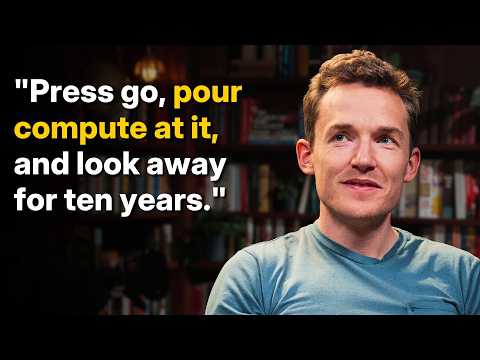
- Lean, Mathlib, and endless exploration (57:30) - You could press “go” on an AI extending a fork of Mathlib, walk away for 10 years, and come back to something — the AlphaZero-style loop that natural-language math can’t offer.
- Why writing lags: no modularity (1:07:26) - Code can be “slop” and still produce a working output; in writing the product is the words, so every sentence carries the substance.
- Theory of mind and the Botox study (1:13:00) - We read emotion partly by mimicking it with our own face muscles; an AI with no face has to emerge theory of mind the hard way.
- Learning: who matters more than what (1:16:47) - LLM explanations feel like Wikipedia — amazing, but the best move is often to ask “who should I read?” and go to the human-crafted source.
- Advice: know where the money comes from (1:23:08) - Teaching is one of the most stable post-AGI jobs because it’s so relational; distilling “what the AIs have seen” will be in high demand.
Mentions
Companies
- Jane Street (1:15:12) - Sponsor of 3Blue1Brown; Sanderson describes their fuzzy role definitions and “insane” retention rate.
- OpenAI (9:39) - Cited as the kind of lab that can write a headline about disproving the unit distance conjecture.
- DeepMind (57:00) - Solved the IMO in Lean one year and in natural language the next.
- DeepSeek (1:02:40) - DeepSeek Math’s verifier-trained-by-meta-verifier approach to natural-language proof checking.
- Amazon (54:32) - Example of why parallel computer-use rollouts get “shut down by Andy Jassy.”
- Boeing (1:30:00) - PDE/simulation insights that let them skip physical disassembly, saving billions.
Products & Technologies
- Lean (56:24) - Formalization language; debated as possibly overrated as a VR environment but valuable for endless exploration and green-check verification.
- Mathlib (57:30) - The GitHub repository of “all of math written in code” an AI could autonomously try to extend.
- AlphaGo / AlphaZero (57:30) - The model for pouring compute into self-play exploration that never needs human check-ins; “Move 37” as going outside prior heuristics.
- Gemini 3.5 Live Translate (25:18) - Sponsor read; real-time translation across 70+ languages.
- Cursor (52:51) - Sponsor read; used to cut ads for Bilibili uploads and to prep research from a repo of books and papers.
- Karpathy’s auto-research idea (1:00:00) - A single Python file for LLM training that agents modify, keeping any change that speeds up the run.
People
- Grant Sanderson (0:00) - Creator of 3Blue1Brown; guest, working on a new AI-and-math interview series.
- Dwarkesh Patel (0:00) - Host.
- Hugh Montgomery & Freeman Dyson (4:14) - The IAS lunch that linked the Riemann zeta zeros to random matrix theory.
- Lagrange (16:13) - First to sense that symmetry was the right lens for solving polynomials.
- Abel (15:00) - Proved the quintic is unsolvable by radicals; died at 26 of tuberculosis.
- Galois (13:45) - Teenage originator of group-theoretic abstraction; wrote in prison, died in a duel.
- Liouville & Jordan (21:04) - Rescued and, decades later, formalized Galois’s scattered notes into modern group theory.
- Gell-Mann (22:06) - Anticipated quarks from a purely group-theoretic question.
- David Bessis (29:56) - Blog post on theorem-proving as a “parasite” on definition-making.
- Timothy Chow (31:59) - Proposed the “unsolved expository problem” while explaining forcing.
- Einstein (33:58) - Lucid expositor; his “same in every reference frame” bias as a formative heuristic.
- Terry Tao (49:00) - Failed the “troll” IMO problem; cited on exhaustively searching the space of possible algebras.
- Eric Jang (1:00:02) - Used an auto-research loop to build a strong Go bot; noted agents are bad at stopping at dead ends.
- Alex Kontorovich (1:05:32) - On why a nonzero error rate in AI-generated papers would be “insufferable.”
- Andy Matuschak (1:11:14) - Report on trying to teach LLMs to write good spaced-repetition prompts.
- Steven Strogatz (1:19:27) - His chaos and nonlinear dynamics textbook, “like your videos in book form.”
Surprising Quotes
“You’ll get like shut down by Andy Jassy, right? And so you can—personally. [Presses the like red X on Dwarkesh button.] Exactly.” — Grant Sanderson, 54:32
“Imagine I’ve locked you in a box… you receive a slip of paper and then someone says can you like predict what will come next, and then you predict what will come next and then your memory’s wiped… you might look at that and be like this is awful, that’s not the essay that I would have written.” — Dwarkesh Patel, 42:00
“I actually got gaslit by this once… Claude was like ‘Yeah, here’s a couple’ and the top one was like ‘Here’s one from 3Blue1Brown.’ I’m like ‘I can guarantee that there’s not.’ … it had like misattributed someone else’s to me and it was good.” — Grant Sanderson, 1:18:33
“I wouldn’t trust any advice that I give. Uh, would maybe be how I’d like couch it.” — Grant Sanderson, 1:23:08
“Every time we wrote those grant proposals that said like, trust us, the elliptic curve progress is going to help with cryptography… it kind of shines a light on the fact that like maybe it doesn’t.” — Grant Sanderson, 1:33:07
Transcript
Dwarkesh Patel: 0:00 Today I’m starting with Grant Sanderson, who runs 3Blue1Brown and is now working on a new project documenting the progress AI’s making in math. And I wanted to talk to you about this because AI’s been making the fastest progress in mathematics as of any other field. So whatever is happening here, and whatever way we’re seeing AI progress happen or not happen, would tell us about what will happen to the rest of the world as AI gets better and better. So I wanted to start with this question I asked you when I first interviewed you three years ago. And I asked you, once we have AIs that can get gold in the International Math Olympiad, wouldn’t that just be AGI? Wouldn’t this just be able to do anything any human can do given how hard these problems are? And you had an answer which in retrospect turned out to be very wise and correct, which is like, it’ll be another benchmark like all these other benchmarks that AI are passing. Obviously AI has gotten better in general ways since then, but there won’t be some aha moment when this happens. First I’d be curious to get your heuristics on why that turned out to be true, and second I’m curious how long you think this narrowness can continue to be true. So by the point that AI has solved the Millennium Prize problem, do you think it’s still possible that at that point there’s lots of tasks that humans are doing that AI still can’t automate in the economy?
Grant Sanderson: 1:12 It’s an interesting question because it’s hard to answer without knowing what the solution looks like ahead of time. I mean, if we take the IMO, that’s something where I think the spirit of your question three years ago was in looking at how some of the solutions to these problems really seem to require creativity. And the designers of these problems, they’ll try to have them come up with things that you can’t train for as easily. I think the dirty secret with the IMO is that you really can train for a lot of them. And so with the whole AI and math project undergoing, I think as you point out, one of the reasons it’s interesting at all is that there’s a spiky frontier to AI, math is just right there in one of the spikes. But there’s kind of a fractal nature to that spikiness because when you zoom into the specific progress within math, you have some things are a lot easier than others. So if we just think about IMO, which is old news at this point, but it’s kind of like two years ago that they were really like doing quite well. They would have gotten a gold in 2024 if for not the following reason. They were very good, they’ve just like cold solved geometry basically. And the IMO has these four categories of problems: there’s geometry, number theory, algebra and combinatorics. So like geometry, just solves in like 19 seconds in 2024 because it’s kind of a brute force solver. And the dirty secret is for students, there’s also sort of a brute force way that you kind of can go at it. Combinatorics is the one that’s the wild card of much more like playful, puzzly seeming problems. And there were two combinatorics problems on that year’s test. There’s not always. There’s four categories, six different problems, so it’s kind of a toss-up which one is going to have two questions. Had it been more geometry questions, they would have gotten a gold that year. But it struggles on those combinatorics ones. And, you know, someone who’s trying to keep that torch of the last hold out of like math for humanity might say, well, you know, those are the ones that require the more creativity. Even then though…
3:00 I think the spirit of your question on like if they’re solving, you know, a millennium prize problem, does that also service a lot of white-collar work? It suggests that whatever the rate limiter is between where we are now and that is the same as the rate limiter for making things better at white-collar work. And we can maybe like paint a couple different ways that like if we focus on, I don’t know, Riemann hypothesis, like what would it look like to solve that. One possibility would be these things are extremely good at a specific domain of knowledge and just knowing it very deeply. And then knowing another domain and knowing another domain. And you’ve pointed this out, it’s like bizarre to have something with this superhuman breadth that like knows all the fields so well that’s not just finding those lightning bolts that connect them. I think we’re starting to see sparks of that of like actually finding connection between the things that it’s an expert in, which we’ll talk about in a bit. If the nature of the solution to the Riemann hypothesis was something like that, that feels pretty distinct to me then what’s necessary to get good at white-collar work. And there’s a reason to believe actually that that might be the nature of the solution. I don’t know if you know the story of like Hugh Montgomery and Freeman Dyson at the IAS like talking about—
Dwarkesh Patel: 4:13 No.
Grant Sanderson: 4:14 This is a side tangent, but it’s just kind of a fun story on how I don’t know if it was over lunch or something like that. Basically, you have this number theorist who is pointing out, just trying to understand the statistical correlation between pairs of zeros of the Riemann zeta function. So the Riemann hypothesis is all about like, do all these zeros sit on a straight line? And he’s finding this like this quantitative question you could ask about it. And he writes down a formula that looks like one over sine squared or something like that. Freeman Dyson, a physicist, is like, I know that expression. That expression comes up in studying the eigenvalues for random Hermitian matrices, which was something that comes up in studying the energy levels of of like a nucleus. And the idea that the statistics of those two seemingly different things were the same sort of prompted a potential exploration on, hey, are there aspects of random matrix theory that might be relevant to like Riemann zeta function? And I think it’s a little bit of an open question, like is there fruit to be had there? But that kind of bridging together from two different fields, like if it turned out that the solution to the Riemann hypothesis was exploring an idea like that even further, that has this character of kind of how you expect LLMs to be good at math. It’s like they’re an expert at the quantum physics, they’re an expert at the analytic number theory, they should be able to see that similarity in a way that doesn’t require like Montgomery and Dyson to be having lunch and like happening to talk about that. That’s totally different from white-collar work, right? In terms of like the extent to which you maybe have a hard time using an AI as an editor. It’s not because they know everything and you just need them to find that lightning bolt in between. Different possibility would be—what’s the right analogy? Maybe like if we think of Fermat’s last theorem between the moment of Fermat phrasing the question and then what the solution itself looks like, where ultimately the solution involves such heavy machinery in math, right? So the beauty of that problem is you can phrase it so simply. You ask about, you know, x to the n plus y to the n equals z to the n. Do you have integer solutions for this when when n is bigger than 3? And it’s, um, it’s something you might expect there to be an elementary number theory approach to it, but just as far as we can tell, there’s just not. Whereas the actual solution, you know, maybe there is something simpler, but this might be the, the, whatever it has to be. There’s such a complicated set of ideas that build on like centuries of work, uh, centered around elliptic curves. And then this other like mountain of ideas centered around these things called modular forms. And like both of those mountains have to be built before you can ask the right question that connects it. So if the solution to the Riemann hypothesis involved building a new mountain, like that’s a kind of skill, like the ability to like come up with the right new ideas that feels sufficiently different from like the character of how they’re intelligent right now that it’s not like that’s what you need from your hired video editor per se. But that like if it’s capable of building mountains, um, that are, you know, the correct new theory that crystallizes how we should be thinking about a subject. That’s just such a level of intelligence that then it starts to feel like it would be surprising if that didn’t permeate into other aspects of the economy besides like just the mountain building for math itself. Yeah.
Dwarkesh Patel: 7:17 Yeah. Or at the very least, even if it couldn’t like literally do every single thing white collar humans can do.
Grant Sanderson: 7:23 Yeah.
Dwarkesh Patel: 7:24 It would just have transformative effects in the way that getting gold in the IMO did not have transformative effects on the world. First of all, I do want to point out that I’m totally moving the goalposts here. Because when I interviewed Dario about two three years ago, I asked this question about why haven’t they been able to use their vast knowledge to connect ideas together and come up with a new discovery that way. That seems like the kind of thing even if a moderately intelligent person knew this much information they’d be able to like come up with a medical diagnosis from the fact that like this drug causes migraines and this other thing, you know, whatever does this and maybe it’s the same drug that can cure both things. And yeah, I don’t know, from an outsider’s perspective, mathematics seems clearly like a field where finding this counterexample to the unit distance problem conjecture was like an example of this kind of thing. So it’s total goalposts moving, but then we can ask, okay, what is the next benchmark? Now that AI’s can do this thing that we should have thought they should have been able to do, what is the next thing that would be quite impressive? And there’s a couple of candidate ideas here. So one could be coming up with interesting problems in the first place, and the other is coming up with new kinds of objects or conceptualizations that create or unify fields. On the first one, right now we just train these models to, like we have these millennium prize problems because, you know, like mathematicians have noted like Riemann came up with this idea of this, like Riemann zeta function, and because he thought that it would have some connection with like the density of prime numbers or if the zeros on this function would have some connection, uh, to prime numbers. And so like figuring out that there’s why do we think this is an interesting thing to, uh, study in the first place, why why are we building this object and trying to answer questions about it and answer this particular question about it? Seems like the kind of thing that would be, uh, the next benchmark.
Grant Sanderson: 8:59 I mean, you— You highlight two pretty good examples there. Um, if for anyone curious about the the unit distance conjecture, there’s this really nice video by a math channel called Polylog where they talk about it and um, one of the people in that… ‘cause all of these discussions it causes people to reflect on like the process of doing math, right? They’re like, oh this thing can do this impressive stuff, like what does that mean for us? Um, and he highlights this quote how good mathematicians prove theorems, great mathematicians um come up with conjectures, and the greatest mathematicians come up with definitions. And that’s more or less exactly your framing here on like those two like we need the conjecture generator and then like the definition generator. That’s like that’s the premium tier mathematician.
Dwarkesh Patel: 9:39 I don’t understand how exactly you’d make that a benchmark in the sense that usually when I think of the word benchmark, I’m thinking something that you have like it’s a goal post. The ball is through the goal or it’s not. Like you can clearly say like yes, this is done. Um, partly to be able to do things like RLHF, but also partly just to be able to like know that you haven’t moved the goal post in answering. You know, OpenAI can have their headline on disproving the unit distance conjecture because it’s a clear distinct it’s like it did it, right? Whereas imagine trying to have a headline on like GPT-5.4 came up with a really good conjecture, right? Like we promise everyone thinks it’s a good conjecture, it just doesn’t it doesn’t land the same way. Um, but maybe that doesn’t negate the fact that that’s the right thing to be thinking about. So I would be surprised if it ever take took the form of looking like a benchmark and like we have a score saying that it’s passed this benchmark because we can quantify how good a conjecture it is.
Grant Sanderson: 10:31 But probably the nature of what it would take is that you would feel a a tone shift in conversations with mathematicians about the way that it’s useful to work with. Right? And like this this series that you referenced that is not at all produced yet and probably won’t be for a couple months um takes the form of us interviewing a lot of mathematicians. And what’s interesting is we started to do this like over a year ago. And it’s fun to see a little bit of a tone shift in the way that they talk about AI between like mid-2025 and where we are now in 2026. You know, in the real world that’s a very short amount of time, in the AI world that’s eons, right? And like we’re able to see over those eons like this tone shift. I think the way that you’d measure conjecture generating ability is going to be more subjective on like that tone shift where um it’ll be mathematicians saying they’re not just using it to like solve their problems, but as they step back and decide what their research field should even be that a conversation with such and such model like was genuinely helpful for that. I don’t I don’t think it’s likely that you’d see it in the form of like a headline saying that like this was yet another benchmark knocked down.
Dwarkesh Patel: 11:33 Right. And so there’s it’s very interesting, the kinds of things you can’t make benchmarks for are also the kinds of things, at least in the current paradigm, you can’t easily train for, right? Because there’s there’s really no fundamental difference between a benchmark and a a training environment. Yes. I think it’s very easy to come up with some dichotomy of like here’s a deep reason why AI can’t do a certain thing and then it turns out well you were just thinking about it the wrong way and actually AI can do it pretty soon thereafter. But, I’m gonna come up with…
Grant Sanderson: 11:59 You’re gonna come up with one?
Dwarkesh Patel: 12:00 Please. with a couple anyway. And I think that this probably — I think it’ll probably turn out that there’s ways in which we can train AIs to do these kinds of things in the relatively near term. But it seems like it would have to be different from current RL we are training. So the thing I’m curious about and the thing it seems to me that drives a lot of the big progress in mathematics and science generally is like coming up with a new way to think about a problem or the new way to understand the world that then unifies different fields, spawns entire new fields, solves problems we weren’t even thinking we were trying to solve in the first place. Like, the reason Einstein was thinking about GR is not because he wanted to explain why light bends or why black holes exist. These are phenomena he didn’t even know needed to be explained in the first place. But in mathematics it often seems — okay, total outsider, I don’t even know the details of what I’m talking about here. From the outside, it seems like there’s often ways to say prove a specific problem that can motivate a new conceptualization, one which results in a whole new field, a whole new way of thinking, which is immensely productive, and one which doesn’t. I think — I’d be curious to hear you talk about whether Galois coming up with group theory and distinguishing his like solution to the quintic having no formula for the roots and Abel coming up with a different proof a few years earlier that didn’t come up with group theory. But then if you wanted to do a verification loop on like, is group theory an interesting concept, was something useful done here, why is this proof better? Potentially that verification loop is 100 years long, and it involves cryptography coming around and physics making progress and the ideas in group theory being relevant and understanding like symmetries in physics. All those kinds of things. It’s like a 100-year verification loop of why is this a productive concept in the first place.
Grant Sanderson: 13:45 Yeah. Boy, uh, yeah, you struck a nerve because I had this like project about Galois I was going to do in 2022 that I put on the shelf. But I spent like a year of my life like thinking a lot about what he did, so there’s a risk of me accidentally talking too long on the specifics. You can hold me back on. It’s a perfect example for your case because describing why it was a valuable insight does not come from immediate utility. And so, certainly if you’re thinking about RL reward environments, it’s like, okay, this is going to be really hard to do. But it’s interesting to note how even with like human verifiers at the time, like it took a really long time to recognize it as being useful. I think Einstein with GR, people sort of felt. You can like feel this feels like a good theory right away. Like what makes the Galois theory such an interesting example is you have literally this 100-year segment of like an idea that like flows through many different people’s heads before it like settles into something that the math community like agrees is good. So to back up a little bit, I don’t know, I mean, do you want the background on the problem at all?
Dwarkesh Patel: 14:50 Yeah.
Grant Sanderson: 14:51 All right.
Dwarkesh Patel: 14:51 I thought you were going to say we all learn about group theory in school.
Grant Sanderson: 14:53 We all learn about group theory.
Dwarkesh Patel: 14:54 We all know…
Grant Sanderson: 14:55 No, quadratic formula. Uh, so this was known in some sense like… Greeks could solve quadratics but they didn’t really write things in algebra and so it’s really more like the Arabs that like wrote down like a- that formula. There’s this delightful story around some like dueling Italian mathematicians, not real duels, just like um, like intellectual challenges, who uh, like secretively found a formula for the cubic, um, and then uh, very shortly thereafter found a formula for degree 4 polynomials. So natural open question for like mathematicians is, um, can you find a formula that solves degree 5 equations?
Dwarkesh Patel: 15:30 Right.
Grant Sanderson: 15:31 Now the nature, the degree 4, it’s monsters. It’s like a- it would be unwieldy to write it down, you usually don’t really write it down in full, you break it up as like a procedural thing. Um, so you might believe these things have this exponentially increasing complexity. So many hundreds of years nobody’s like really answering that question. Usually we say Abel was the first to prove it, um, he was this young precocious Norwegian mathematician, and he showed it’s- it’s simply impossible. That’s not that you can find a quintic formula, he thought he found one, but he showed it’s impossible. I think the real credit though, like you have to back up a little bit and talk about Lagrange, where Lagrange found the right kind of question to ask about this. Um,
Dwarkesh Patel: 16:12 Yeah.
Grant Sanderson: 16:13 I can go into the details if you want, but I’ll give it a very high level. He- he- he was studying the question and he recognized being able to solve these polynomials is actually very related to understanding like the way that certain algebraic expressions are like symmetric, like more or less so. Like if I write down A plus B plus C plus D, just like adding four variables, if I permute those, it doesn’t change the value of the expression. Whereas if I write like A plus B multiplied by C plus D, some of the permutations don’t change it, but some of them do. And he had this really, really nice insight about how if you can find expressions like this that have like four free variables, but all the permutations take on three distinct values, that had this unexpected relationship with being able to reduce degree 4 into degree 3. So he started approaching the like ‘can we find a quintic polynomial’ by saying ‘I wonder if I can extend that.’ Um, and to extend that method, you would have to have an expression that has five free variables such that as you permute them over all the 5 factorial permutations, it takes on only four values or fewer. So that’s- like you could put that in a puzzle book, you could put that in a brain teaser that like a 12-year-old could engage with. Um, and it’s- it’s not too hard to like find yourself feeling like that’s an impossible task. And so Lagrange is sitting here saying, ‘Hmm, here is a strategy that I’m trying to solve this problem, can I find a quintic polynomial? This strategy doesn’t- it seems like it might be impossible, at least from this strategy.’ But that was the first time in history that people had the instinct that some kind of question about symmetry was the right way to be studying these polynomials.
Dwarkesh Patel: 17:48 Mm-hmm.
Grant Sanderson: 17:49 In his mind it was just ‘a’ way. It had yet to be discovered that like actually there’s a tighter connection. And also like, maybe rather than searching for the formula, we should be asking the opposite question: can you prove that it’s impossible? So he sort of planted that seed. Um, like around 50 years later, Abel definitely read Lagrange and was influenced by it. Galois, we know that he loved Lagrange when he was like falling in love with math. And so it’s very hard to imagine that like these two young geniuses, the fact that they both come up with like pretty similar insights around that problem. It’s not like born from Lagrange. But to your question on like, are you — are you able to verify that this was a good idea? There — there wasn’t any like result that Lagrange came to. There’s never like he solved the problem and therefore we know that that was like the right question to ask. He asked it, there’s some like intrinsically interesting thing. It also wasn’t very important for math at the time, like most people were more interested in like applications to physics. This is almost in that like side almost recreational hobbyist type thing.
Dwarkesh Patel: 18:30 Yeah.
Grant Sanderson: 18:31 And like Abel, you know, he started working on quintic stuff but then he was advised to spend more of his effort studying elliptic functions and so more of his work was on that before he died young. He died at 26 from tuberculosis. And then Galois, um, he — he pushed both of those ideas like in the right direction where he really understood um the nature of abstraction. And so he had this really nice piece that he wrote while he was in prison actually. He was like — we could talk all about his life story, it’s pretty wild. But he’s like this teenage — he’s a teenager, he’s in prison, he had tried to submit his math papers and they had been rejected. And so again it’s like verifiable reward. The like verifier function that is the academy at that time is rejecting what he wrote. Cause frankly it was not very coherent. Like it wasn’t a complete proof, he wasn’t giving like a clear thought of like what the theory actually was. He was just like a young fledgling mathematician getting his bearings. So it’s like the verified reward there is like, eh, no good. But he has some instinct that there’s something there. So he’s writing this diatribe on like the nature of math being something which is um, it undergoes these like shifts over time and he talks about like the advent of just algebra itself and going from uh just thinking in terms of numbers to like having a certain fluency just with like pure algebraic expressions where you’re not tied to interpreting those expressions. And he has this instinct that like there is another layer of abstraction that seems like what we should be doing where rather than thinking about the formulas themselves, thinking about like what symmetries underlie those formulas. But it was still a pretty like ill-defined theory. So if you’re trying to say, okay, is the verified reward that like he has solved a problem that other people haven’t? It’s like, well Abel proved that quintics are unsolvable. And you say, well what was Galois doing? Well in principle the thing that Galois theory will let you do is take a specific polynomial and it gives you the rules to say, does that specific polynomial have roots that you could write down? For example like x to the fifth minus one, you know that a solution is one or x to the fifth minus two, you can write down fifth root of two. So it’s not that every quintic polynomial you can’t write down the solution, but could you find a specific one where you prove you can’t write the solution using radicals? He also didn’t even solve that exactly. Like he has a much more abstract — he didn’t show for a specific example that you couldn’t. So even describing like what problem did he solve is very tricky. So then he dies. It’s this very like romantic story of he has this duel, we can get more into it, there’s a lot of myth around like supposedly he writes up all his ideas the night before the duel. Really he tried to get them published like five times…
Dwarkesh Patel: 20:51 Working on the quintic doesn’t seem to be good for your health.
Grant Sanderson: 20:53 It’s very bad. Yeah, yeah, yeah. If you’re a young genius, don’t work on the quintic. And so he — he asks his brother and his close friend like ‘get these…’ His notes to Gauss, get these notes to like the important mathematicians of the day because I think there’s something here. Even then, it didn’t really take. Like, so his brother and his friend like tried to get them out. It wasn’t another 20 years until Liouville like sees these notes, sees that maybe there’s something in them and tries to like clean it up and understand like what was Galois getting at. And then even then, it was another 20 years or so until Jordan actually puts together a something like a modern treatment of group theory that they attributed to Galois. You could easily imagine history turning differently where these ideas were kind of coming about from other points in math and like Galois could have been forgotten in history if he was a less like florid character. But between the time of Lagrange, like having this inkling of maybe symmetries of roots is the right way to go, to where it all looks like modern group theory, you’ve got this long span. A lot of the time it’s like not even passing the like verified reward of human reviewers, right? Because it like gets on someone’s desk, they say ‘I don’t really know if there’s anything here.’ Gets on someone’s desk, they don’t. You have to have this like one person who sort of recognizes it. And then even then, it’s not really solving practical problems at that point. Like you point out cryptography and physics and things like that. You have to get into the 20th century before you have Gell-Mann thinking, ‘Hmm, maybe understanding the nature of like how certain groups break down has this relationship with what particles are made of’ and like he anticipates quarks based on a purely group-theoretic question. And like that’s so long after Lagrange before you have anything like that. And so you have to ask like what is the way of measuring progress that’s not based on solving a problem, right? And that’s that’s somehow capturing what is the instinct that’s inside Galois’s mind when he says ‘I think there’s something here’? What’s the instinct that’s inside Lagrange’s mind when he says like ‘I think this is the right way of thinking about it’? What’s the instinct inside Liouville’s mind when he says ‘Hmm, these like scattered notes from this long dead youngster like might have something to them’?
Dwarkesh Patel: 22:38 It’s so hard to put a finger on that, but I mean a different series of videos I’m making right now is about like, you know, the whole ‘compression is intelligence’ idea. And even though this isn’t really the angle I’m taking, you know there is something to the idea that the smaller expression that’s more predictive like feels more intelligent. And so I wonder the extent to which you can give some kind of verifiable reward around not just like ‘did you solve it’ or ‘what does it solve’, but around the smallness of the concepts required to do it. I mean going back to Riemann hypothesis solutions, what would that look like if an AI solves it? I think a third way that it could happen is it just straight up works harder, right? In the same way that you could maybe have an elementary proof of Fermat’s Last Theorem that’s just like spelled out over like thousands of pages that would be incoherent. But like the cleaner way to view it is with elliptic curves and all that. Maybe there’s some like thousand-page proof of Riemann hypothesis that’s like no one’s really getting anything out of it. And what you actually want is the succinct like compressed version of that that is… that feels like progress, even if it’s the same result.
Grant Sanderson: 24:00 Representations of those ideas like that would then lend themselves to human understanding and like I don’t know, Kolmogorov complexity, like maybe you throw that into your like your attempt to quantify what you mean by elegance. Uh, but I don’t think it’s easy, but I do think it’s something you would have to do in order to reward the Galois-like instinct rather than just rewarding have you solved a problem.
Dwarkesh Patel: 24:23 Yeah, it’s very hard to come up with a correct, like the heuristic for science. But clearly humans have been doing this somehow and like obviously AIs will do it at some point.
Grant Sanderson: 24:33 Well, what’s relevant also not just in terms of verified reward, but like presumably the end goal is understanding, and like human understanding. And so even if you do have some like thousand page proof of some math thing or some like grand new physical theory, the goal is understanding. Yeah, maybe if the goal is predictiveness, you can just have like automated engineers go off and like build rocket ships or something like we have no idea how these work, but we can get between stars, but like there’s going to be a lot of people wanting to understand. You’re still going to want whatever the like concision function is that like distills down here’s this complicated way of thinking into like the right one, like the equivalent of the universal law of gravitation for Newton. Like you would still want to train AIs to be able to do that and like find the compressed representation.
Dwarkesh Patel: 25:18 [Ad] I grew up in India till I was eight and so in addition to English, I also speak Gujarati. And since Google just released Gemini 3.5 Live Translate, I thought it’d be fun to put it to the test in this midroll. 3.5 Live Translate, aapu-aap 3.5 Live Translate, automatically detects more than 70 different languages and translates them in almost real time into the target language. Live translate your original speed and format while speaking, just like it’s doing right now. I visited China back in 2024 and I remember thinking at the time that this trip would have been so much more productive if I could have been able to live translate the conversations I’m having with researchers and random people I meet on the street. Now we have that technology. So if you’re building an app that needs live translation, you should 100% check out Gemini 3.5 Live Translate. It’s available now via the Gemini Live API and in AI Studio. Go to ai.studio/live to get started.
Dwarkesh Patel: 26:14 So people have this worry about mathematics in particular that, you know, the AIs will prove the Riemann hypothesis and our understanding of mathematics won’t be any the better for it. I have a couple questions about this. The first one is whether this is like a thing you should expect. Like isn’t the reason humans come up with general natural objects and sub-goals and whatever when we’re working on a big problem is that it’s just like useful when you’re trying to work on a complicated important problem? And so we can just think about like theoretically is it would this even be a simpler way to solve the Riemann hypothesis as opposed to just coming up with the natural abstractions that are relevant to thinking about the problem? And then two, empirically is this what we observe when AIs do make progress on problems today? When the when the AI came up with that counter-example to the unit distance problem conjecture. You can just read its chain of thought and it seems… it’s not understandable to me because I don’t know anything about mathematics. But it seems to other mathematicians it was like understandable and they made… made use of like known concepts in mathematics and like proved relationships between them and all in natural language. And as a result, accelerated our understanding of the connection between this object and this conjecture. So is this even a thing… like empirically is this a thing we should be worried about?
Grant Sanderson: 27:24 I think it depends on the nature of… yeah, like again if we sort of break down like the three possible ways of like solving the Riemann hypothesis, that one and the other like big one from this year was the like a certain Erdős problem numbered like 1196 but it’s a… about these things called primitive sets. But basically it had that character of bringing an idea from a seemingly different field. As soon as you just present the basic idea to a mathematician, you say like ‘What if we like use this… like tried a Markov chain process where we show that this thing is one from the bottom up probabilistically rather than the top down and like use the Von Mangoldt function?’ If you like say that to someone in the know, they’d… they’d kind of know how to run with it. So you have this very like small idea that has the form of expertise in one field, expertise in another, draw a little lightning bolt between them. Like those are… those are going to be very human-parsable, right? Because all you have to do is just like show the start and end point of what those connections are. If the character of it is a mountain building, you do have to… you have to put in a lot more time to like understand that new mountain that was built because it’s like a new thread that’s not just like a lightning bolt between them. And then if the nature of the progress was just like raw hustle, right? It’s just like this just super long thing that’s no new theories but it’s just like long, long, long chain of reasoning answer. Then… then you would have that where it’s like ‘Okay, there’s this whole digestion process.’ So I don’t think there’s one clear answer. I think it depends on what the… what the like solution there would look like. And on the mountain-building side, I would actually be really interested to see. Like is it by default a very human-understandable like the way that we like see new theories from like great mathematicians? Or is it like at… like an alien different kind of mountain being built where we even have to like re-process the kinds of abstractions that we… we engage with?
Dwarkesh Patel: 29:04 Right.
Grant Sanderson: 29:05 Well, the closest example here would be like the, you know, the attempted solution of the ABC conjecture that was… we maybe shouldn’t get into that one, but the… it’s probably not a correct solution but basically it’s this like whole new way of thinking that this otherwise reputable mathematician in Japan had like come up with. And it just took mathematicians like a long, long time to even parse what he was saying. But it had the feeling of just like an alien bit of mathematics that’s theory building, it’s not just like long chain of reasoning… just like, he called it like inter-universal geometry or something. And so the fear that you would have is that… yeah, it like does that. The biggest fear would be that it does that and then much like the ABC conjecture, like people work for years to go up the mountain and then like ‘Dang it, this just isn’t right,’ right? And like if there… if it turns out to be wrong but it like really looked right. But even if it was right, there’s… there’s just a lot of effort to like hike up a new mountain.
Dwarkesh Patel: 29:56 Yeah. If you end up in that situation, David Bessis had a really great blog post called ‘The…’ he followed the theorem of economy. where he’s talking about this, um, you know, historically there’s, as you were saying, mathematics has come up with these definitions and problems, and it’s about proving theorems, theorems about them. And that, um, really the theorem proving stuff is what gets all the credit, but it’s like really a parasite on the coming up with the definition stuff.
Grant Sanderson: 30:18 Yeah.
Dwarkesh Patel: 30:19 And historically it’s not been a problem in terms of credit apportionment because if you come up with a definition, you’re probably going to be the guy who comes up with a theorem. But now we’re in a situation where, um, if the valuable work is the coming up with the insight and an AI just automates the latter part, it—so, okay, imagine a scenario where we have AI comes up with like the abbo-like direct arguments about a bunch of important conjectures in the world, and then we just have these proofs. And now it’s up to humans or to future AIs to then consolidate—I mean, I’m sure if you had access, again, having no object-level understanding of this argument whatsoever, I’m sure if you had access to it, it would make it easier for you to then think about like, well, what is going on here? Is there some deeper way in which we can understand how—why this proof works that would make it easier to come up with the ideas behind group theory?
Grant Sanderson: 31:13 Yeah, I think it would—it would be hugely helpful, right? Because I mean, so much of like trying to discover new math is like—mostly being wrong, right? You’re like trying to solve a problem. It—what it doesn’t feel like constantly taking the correct step up the mountain.
Dwarkesh Patel: 31:23 Right.
Grant Sanderson: 31:24 Mostly it feels like a random drunken walk where you like—doing a thing and then, oh, you’re wrong, and like constantly discovering. So if at the very least you know that trying to digest what you know is ultimately leading to like a correct solution, like, that feels like progress simply because it’s—it’s providing like a sense of knowing that it leads to a solution. And there’s plenty of—plenty of like instances in the recent history of math where it feels like the reach has sort of exceeded the grasp, where there’s things that are proven like long before they’re understood.
Dwarkesh Patel: 31:58 Mhm.
Grant Sanderson: 31:59 And I mean, one of my favorite, like, openings to a paper—it’s not even like a research paper, it’s more like an expository one—is from this mathematician named Timothy Chow who was trying to understand a concept called forcing. And so there’s this problem called the continuum hypothesis that more or less asks, um, like you have a size of infinity for the natural numbers, you have as a size of infinity for the real numbers, is there something in between? And the answer is both yes and no, it depends on your axioms. Like it’s sort of outside the scope of—of our usual axiom systems, which is an interesting answer. But the method to—to describe it is just really, really hard to understand. And it’s the thing called forcing. And in the beginning of this paper he—he writes like, “I want to—like everyone knows the idea of an unsolved research problem, like I want to propose the idea of an unsolved expository problem.”
Dwarkesh Patel: 32:37 Ah.
Grant Sanderson: 32:38 Where like, sure, we’ve proven it, but we don’t really know why it’s true. And so then he proposes like a partial solution to that expository problem. You can imagine why I loved that framing because like, this is my whole life is like—I don’t do research math. It’s just—it’s just wholly about like, what’s the most clear way to understand this, um, even if it’s proven? Just like, there is a difference between proof and explanation. And so on that side, I think… that you are basically like getting to the- the importance of that distinction.
Dwarkesh Patel: 33:02 Yeah. And that will be the main incentive for- or the incentive would have to change in not just mathematics but in other areas of science from proving things about the world to consolidating proofs into problems or higher-level insights. But we were having a discussion earlier at lunch about like a recent talk you were giving about, you know, design and how it helps us understand things.
Grant Sanderson: 33:30 And in the limit is there really a difference between the conceptualization for an idea and the idea itself? So, you know, if you think about special relativity and like space-time diagrams and Minkowski space-time, is it like, yeah, this is like a way in which you illustrate this idea of like why there’s length contraction and time dilation, but is that like- that is the reality. So the exposition does seem to be like the explanation in some sense here.
Dwarkesh Patel: 33:58 Yeah, I mean there’s a couple interesting things there. One is it seems like there’s a really strong correlation between the people who come up with genuinely novel insights and also who are actually quite clear in their communication of it. Like you might imagine given that the experience of a university student is often that the expert there teaching them is not necessarily the best explainer of that topic because they are so spoiled by their expertise. But what seems at least in some cases to be the case is how the people who are really coming up with something quite novel- so you’ve got like Einstein or like Claude Shannon, something there, you read their- their papers, they’re really lucid papers, right? It doesn’t feel like ‘oh, this is just for the experts and you have to chop through it with a machete to get-’ They’re like very good expositors. Like Feynman has this characteristic too, like very good expositor. And so maybe the same part of the brain that comes up with the correct new way of thinking about it at a research level also has this knack for like good explanation. And I think this is pertinent to the AI one where I kind of used to think that AIs will become these automated theorem provers but like the role of the mathematicians is going to shift towards like my job, you know, like explain these things. I kind of suspect that actually they’ll also be like quite good at doing that and probably just like better than most humans are at like doing the explanation half and distilling half. And that’s actually not what’s left for the mathematicians is like digesting and explaining what was going on. Probably the nature of how these things are going. I could envision- we can talk about like ways this might not be it, but like probably the same thing that is coming up with like the really good new idea that solves some new problem is just also good at explaining it. That’s my new- like that’s a way my I think beliefs have changed.
Dwarkesh Patel: 35:37 What’s the last thing you think you’ll be doing? Or like- both you and then also what the mathematical community, the human mathematical community will be doing?
Grant Sanderson: 35:45 I will probably be doing something like what I am until I die.
Dwarkesh Patel: 35:48 Even if the doomer’s right?
Grant Sanderson: 35:51 Exactly! Because maybe that’ll be for the same reason.
Dwarkesh Patel: 35:53 Yeah, yeah.
Grant Sanderson: 35:54 Yeah, yeah. You know, it’s- um… Like build a man a fire and he’s warm for one night, but set a man on fire and he’s warm for the rest of his life. So that’s where I am with AI. No, because some of the… some of the like function of an explainer or a teacher is to like add clarity to a thing that someone’s curious about. That’s one thing. But some of it is like a little bit more relational and a little bit more like providing motivation, providing a sense of curation. Like one interesting take that I’ve heard about like what mathematicians will end up being is actually more analogous to art museum curators than anything else where the AI solved the thing so the art exists, right? They even know how to explain it really well, you know, all there. But like you still, you still want someone to help you navigate in this like nearly infinite space of like what ideas are worth engaging with, like someone kind of doing that. And that one even if AI’s were in some sense better at that, I think we would always still prefer like a human that we had a relationship with because the way that we get motivated to be interested in things is a social phenomenon, if you have some specific technology you’re trying to build, you know, that might be different, you need to know there. But I think like the people listening to this podcast, they sort of trust your curation on like what’s an interesting topic in the first place. It’s not that they’re landing on here because whatever your next topic is, that’s like what they in a prior sense wanted to understand, they’re trusting you as a curator. So my role and arguably that of like other mathematicians might actually just shift subtly into that curation direction of what ideas are worth displaying. And that’s a lot of my job right now even now is basically like I think people think a lot of the time for a video goes into the visuals and like sure a little bit it is, not like immediate but like actually a lot of it is just deciding what’s worth saying in the first place or what’s worth putting there. And because that is that’s just I want to engage with that and I think I have a trust with certain people and they are curious what I would choose to put forward even if the AI’s are better than that in the same way that like human musicians are always going to have a role because of that like social function of the story behind them even if the like objective quality of the MP3 file coming out is like better from some model. That’s kind of where what I see happening to my job.
Dwarkesh Patel: 38:11 Yeah. I want to go back to this question of earlier I was we were sort of just as AI has crossed this threshold, this important benchmark of being able to connect existing ideas to come up with a new discovery or prove or disprove something. Just as it’s crossed this threshold we’re like ‘Okay, but what’s the next thing?’ I want to just…
Grant Sanderson: 38:26 There’s a lot more to do on that one by the way. Like just because a couple lightning bolts have been… I still think there’s like this flourishing future over the next couple years of really connecting. Yeah.
Dwarkesh Patel: 38:37 Right. And so in the limit you could even say… I don’t know if this is accurate to say but potentially a lot of maybe the biggest breakthroughs like look like this at some level. It’s just general relativity… oh he’s just connecting together like Riemannian geometry and special relativity, right? And so as AIs keep getting better and better at this connection thing maybe a lot of big breakthroughs are not really… be of a different qualitative nature. I don’t know if you have a take on that.
Grant Sanderson: 39:03 Well, I mean, a lot of the conversation focus has been on problem solving and that nature of math, you know, like ticking off Erdős problems or something. I would say it’s not even a majority of mathematicians who would maybe characterize their work as like really targeting the next problem to take down. Are you familiar with like the Langlands program?
Dwarkesh Patel: 39:21 Ah, okay.
Grant Sanderson: 39:22 So this is like, it’s not even a field of math so much as it is a like a research ethos where Fermat’s Last Theorem is one inkling of this. You had like these two different seemingly disparate things and a connection between them like led to a solution. So Langlands was a mathematician, he has this like famous letter now essentially spelling out how it seems likely that there’s a lot more connections like that and even got like a little bit more specific about the nature of the connections such that you might imagine this like large map and you’ve got this like valley over here and this mountain over here and this like set of planes over there. And there’s a lot of mathematicians whose would characterize their work as being part of like trying to understand the threads like on this map. And the progress there, it’s not even like, here’s this one specific problem that we know will be solved by that connection. It’s more that there’s been enough time and time again cases where big problems were knocked down by finding connections that it’s almost preemptively finding the connections. And so you could imagine…
Dwarkesh Patel: 40:23 Interesting.
Grant Sanderson: 40:24 Yeah. It’s actually very interesting. This like anytime you run into a mathematician, like ask them whether, you know, the character of their work is more akin to like Langlands program or if it’s more akin to like targeting one particular problem and you get a certain like bifurcated split there. But the possibility of AI’s being supercharged connectors feels like it might be, you know, an amplifying tool in that pursuit. It’s hard to measure though, right? Because this cuts to what we were saying earlier. How do you, how do you assign a score to say like yes you’ve done it? If it’s knocking down a problem, you have a clear way of saying yes you’ve done it. You can write the headline. You can have your like PR move as the AI company to say we did it. Whereas like if it feels like that was the right connection drawn, you can write theorems around it and this is the nature of what the papers in that field look like. But I think it will require a lot more like human in the loop to basically like say what was it the kind of connection that we’re going for. But that’s my guess on what most of the useful progress from these models will look like like in the next five years, is just really filling in that landscape of like connections that you can draw as you’re an expert in multiple fields.
Dwarkesh Patel: 41:35 Like you pointed out, it’s kind of surprising we haven’t already had this.
Grant Sanderson: 41:37 Right.
Dwarkesh Patel: 41:38 And what I’d be curious like… I would be curious to know at a technical level what causes the unlock there. Because on the one hand, you can kind of paint an explanation in your head for why you could be an expert in all of these things and not be drawing those connections, which is when the thing is reasoning, like the method of reasoning is this auto-regressive chain of thought phenomenon. Auto-regression is actually like a really, really weak… good way to produce stuff. I think if you think about it. Like you’re an intelligent person. Imagine I’ve locked you in a box, right? And then the only way that you have of interacting with the world is that you receive a slip of paper in there and then someone says can you like predict what will come next, right? And then you predict what will come next and then your memory’s wiped, right? And then you get like another slip of paper and you go… imagine that was done a whole bunch and then what comes out on the other end, they’re like look at this essay that you wrote. You might look at that and be like this is awful, that’s not the essay that I would have written because like the process of repeatedly like predicting something is just pretty different from how you would think as a writer to like compose it and think it through and everything. And in particular what would probably happen is you’re sort of a slave to your context where you might be answering some question about some particular field and so you like draw on all the context around that and you’re going there. The connection that actually is where all the substance is going to come from is like by its nature a very like unlikely one and you know you can do all the RL that you want to try to like get better in some way but like what’s the thing that specifically upweighting and incentivizing making these unlikely connections when the vast majority of them like aren’t the predictable you know next token that would come in there. And so it’s like it might be the case that you just have this intelligence that’s sort of locked in there inside that box but it’s just a weird way of interacting with it. So the thing I’m curious about is like do you ever get any fruit by just like questioning the premise of how tokens are generated like every now and then in some way, right? And I don’t think it would be as simple as you like manipulate the temperature or something like that but like are there any things that you can do that take like the existing level of intelligence but like find the right ways of sparking those connections that like unlocks these sorts of things that we’ve seen or do you need just a little bit more intelligence such that at the level of prediction it’s kind of predicting that it should be making that lightning bolt to another field?
Grant Sanderson: 43:54 I think it’s more productive to reason instead of architecture or even loss function to reason about data. Like I don’t know we have diffusion models that do text and they’re like not of a wholly different character they’re just not explored as much. I think the more relevant thing is what is the data on which whatever architecture whatever loss function you have is incentivizing you to produce. And it does seem like they’re getting better at like okay forget about math I mean we did have this a couple of examples of this kind of thing. But if you just look at why are they getting better at being autonomous agents it just I don’t know they have like they’re in an environment where auto-regressively producing the step that says let’s step back and do a search over the whole codebase and then let’s step back and like assess my mistake is like the thing that works. I assume what happened in the case of progress in science or maybe in math is you have frontier math like problems which require like math…
Dwarkesh Patel: 45:00 Um, and then you specifically design them because they require connecting together two different fields and there’s all I’m guessing there’s all kinds of clever like partially synthetic ways in which to make harder and harder problems like that that require these kinds of connections, for example by like eliminating assumptions and still requiring the AI to continue to get to the answer. And then like, it doesn’t really end up mattering what the loss function is. It just like is really about can you come up with an environment which incentivizes this ability?
Grant Sanderson: 45:29 Yeah, it feels like you should be able to. Yeah. I can’t certainly can’t speak to the correct ways of doing that that like unlock all this, but it would just be pretty surprising. Like, don’t you think it would be kind of surprising if over the next three years there’s not just like a lot more of those lightning bolts?
Dwarkesh Patel: 45:44 So this I think is an important thing to think about, which is we often think about how smart a single system is and we don’t think about AIs having advantages that are more the result of other facts about them. So in this context, the key fact about them is that you can just parallelize and arbitrarily scale them, so that whatever level of capability they have, it’s not just like one idiosyncratic genius in the history of mathematics who makes a few connections and then dies in a duel. It’s just universally applying that waterline across all problems that are accessible at that level of capability. I feel like this is among the many advantages that digital minds inherently have that we don’t think enough about. The fact that you can- the other ones being the fact that you can like merge all the knowledge together, at least there will be techniques that allow this to happen, that you can like spawn off copies with identical levels of knowledge. But yeah, I feel like this parallelization is like quite an important property and I’d be curious about your predictions of even if they’re not as smart as a human mathematician, the fact that they are just, you know, billions- because for PR reasons, the AI companies are just dumping billions and billions of dollars at this, would have a- quantity has a quality all of its own.
Grant Sanderson: 46:57 That seems in the right direction. I think, I mean if we take that, you know, that conversation between Montgomery and Dyson at the IAS that like suggests some connection between Riemann hypothesis- or Riemann zeta function zeros and random matrices. That feels like the kind of thing that you could try to like automate and that you have, you know, agents representing expertise in all these and basically having, okay, we all know that an institute is smarter than an individual and like the reason for having people all in the same geographic location is because you want those like serendipitous conversations to happen. What does it look like to sort of engineer those between agents? Um, I mean, it’s interesting because you sort of point out like you can sort of pool all your knowledge and so forth. I actually wonder if one of the advantages is that you can do the opposite of that, where you have um, sometimes uh when an AI is- is failing, it’s because it sort of gets into a bad chain of thought and it’s really hard to get it out of it, right? So you have to like just start again. Same deal with humans, right? Like sometimes you like start thinking about it in a certain way, um, and actually what’s required is to just like back up, maybe go for a walk, sleep on it, come back, and just sort of, you know, let a fresh mind look at it. And if you’re the same mind, it’s really hard to look at something freshly. If you have agents that you can fork and you can maintain distinct context…
Dwarkesh Patel: 48:00 Sometimes the form of that, you know, there’s stories about people trying to prove something for a long time. And then at some point they say, hang on a sec. What if I tried to prove that it’s impossible? Like, prove the opposite. And that, like, unwinding your own context and going at it with a fresh mind, you could imagine systematizing that. Or like having multiple different agents deliberately given different pieces of context and try to like compare and contrast there. Like, we don’t have the same level of manipulation on our own context. Um, one in this, uh, like AI and math series, the first episode we’ll do will be about like when they solve the IMO. And I want to focus on one specific IMO problem that they failed on, which is one that a lot of very smart students failed on. Terry Tao also failed on it. And the nature of it is basically that it, people were very mad at the problem because they called it a troll problem. I almost don’t want to spoil it because I want to construct the episode around like leading someone in with, without knowing that it turns out to have a simple solution. Because you like can really empathize with what it’s like to be like a student solving this. Basically, there’s a really elegant way of going down what you really feel like is going to be the solution based on the context of being the International Math Olympiad problem positioned as it is. The like character of the solution is like really enticing, but it’s kind of hard to prove that it’s the best. The reason is that it’s not. There’s like this almost brain-dead solution that is the best. And so the like relevance of that to the whole AI story is like for a human, what’s required to answer that question is to like escape your context. Escape the context that you’re in the IMO, escape the context of the way you’ve been trained to solve these like contest math problems. Um, and if you just approached it like a, like a brain teaser that I throw someone off the street, like they’d probably answer it well. And you sort of want the same sometimes for like, uh, human research in other contexts where like sometimes just being able to say refresh your thinking, come at it completely differently. So of all the advantages that digital minds have, that might actually be one of them. Like a little bit more of a systematic, what does it look like to like refresh your thinking? Try answering two separate questions, like spin off two agents, one who’s trying to prove it, one who’s trying to disprove it. One who tries it like this way, one who tries it… and they like deliberately have different contexts. I would be curious to see if we’re having this conversation three years from now, how many of the like significant results that make headlines have that character of basically like erasing the context previously like trying a bunch of different things as opposed to merging the results of like a bunch of different agents.
Grant Sanderson: 50:26 I think this is incredibly interesting because a common concern people have about AI’s is this entropy collapse where they all think the same way because they’re trained in similar ways. Um, this is why they’re bad at writing. They kind of just like go down the same path and have similar patterns of speaking and so forth. But, um, maybe actually the key advantage AIs have is that you can systematically… it sounded like one of the reasons the unit distance problem conjecture took so long to be disproven was because people assumed the conjecture was actually true. So they were mostly trying to figure out ways in which to prove it. And so maybe one of the key advantages AIs will have is that you can…
Dwarkesh Patel: 51:00 is actually to increase the entropy by systematically trying out both the negation and trying to prove the positive of any given statement of like or being able to systematically give different agents different biases.
Grant Sanderson: 51:16 That’s a good point. Like it seems like an important thing in the history of human science that Einstein is just really motivated by this bias that things should look the same in different reference frames. And then he had multiple other biases like these but like that is just a very formative in his thinking and you can just like systematically survey a bunch of heuristics and see which ones are being productive at this given problem.
Dwarkesh Patel: 51:36 Yeah, and so you would suggest basically like systematically increasing entropy at the prompt level even though you have this like inevitable collapse at the auto-regression level? Yeah, that makes sense. And I mean Einstein would be an interesting example because it’s like he’s got this bias towards things should look the same. He also has a bias towards like God should not play dice, right? And it’s almost like you want to make sure that you don’t accidentally have all of your LLMs be Einstein because you might halt on quantum mechanics progress, right?
Grant Sanderson: 52:03 Which actually goes to show you that there’s not a correct heuristic for science. You actually just need multiple independent research organisms with their own heuristics.
Dwarkesh Patel: 52:12 Yeah, yeah. And that feels like old school software, right? As long as you’re able to like describe that in some way, you have like old school software that like amplifies that entropy in some way and if you’re able to like put a clear ontology to the distinct ways of thinking that you want to prompt, you like explore that full ontology and then each individual one, you know, runs off doing what it does. But I, you know, I think there’s a certain design question there on like how exactly do you describe like the different approaches. The easy one is are you trying to prove it or disprove it. The harder one would be to say what are all the tactics that you could take to prove this and make sure that you’re like sufficiently applying sufficient breadth to exploring that.
Dwarkesh Patel: 52:51 [Ad] I don’t think people appreciate the kinds of things that these models can just go handle for you when you equip them with a good harness like Cursor. For example, I started publishing my episodes on Bilibili for a hopefully burgeoning Chinese audience, but everything I upload there needs the sponsored segments cut out. Normally that would have meant that I would have had to ask my editors to go back through all the old episodes, cut out the ads, and re-export everything. But in about just as much time as it would have taken me to send them that Slack message, I can just tell Cursor to do it instead and spare them. And for research for the podcast, I have a whole repo that I’ve set up where I’ve just put every single book and paper that’s been relevant to prepping for any of the recent episodes. And I’ve been able to hodgepodge everything because the Cursor harness is just extremely good at helping the model figure out exactly what information to pull, whether that’s from my repo or from the web, in order to answer the questions I have while I’m doing research. So whatever you happen to be working on right now, just try pointing Cursor at it. Go to cursor.com/dwarkesh to get started.
Dwarkesh Patel: 53:49 Obviously AI for math is making a lot faster progress than everything else. And people point to verifiability of the domain as the key reason this is happening. I think that’s one of the two important reasons, but I don’t think
Grant Sanderson: 54:00 I think people really neglect the other one. And I’m outside the lab, I don’t know what’s actually going on, but this is just like a totally naive theory.
Dwarkesh Patel: 54:12 Okay, a tangential question to why AI is making so much progress in math. Why has it been so slow at computer use? Which is what you would think—you know, computers are actually very, very verifiable. Is like, you know, is my Etsy package coming or like is my event booked? Do you know, whatever. These are extremely verifiable things to survey. What computer use lacks is grindability.
Grant Sanderson: 54:32 Um, so because websites have like bot detectors and also it takes a tremendous amount of compute to run parallel rollouts. It’s very hard to just run like a thousand parallel rollouts at the same checkout flow on Amazon because you’ll get like shut down by Andy Jassy, right? And so you can—personally.
Dwarkesh Patel: 54:54 Presses the like red X on Dwarkesh button.
Grant Sanderson: 54:56 Exactly. And so you could try to build clones of every single website. This is very labor-intensive and slows you down. So, and the reason by the way you need to do so many parallel rollouts in order to learn a skill currently with deep learning is that we haven’t solved sample efficiency.
Dwarkesh Patel: 55:16 Process supervision to—as ChatGPT says.
Grant Sanderson: 55:19 Yeah, exactly. And of course people are working on many different techniques, but fundamentally there’s this big problem and—there’s this big constraint in the way we train AIs. That we just—with code also you can containerize a given level of progress in a repository and then just spin out thousands of parallel containers or hundreds of parallel containers and say like ‘try to implement this feature’ and it’s totally deterministic. And because it’s deterministic you can solve the credit assignment problem because you know that whatever caused this rollout to succeed and this one to fail, the diff is the thing that like worked. And this way you solve the credit assignment problem. If you have situations that are starting off at different starting points, this credit assignment problem becomes much harder to solve. But most of the things in the real world are just very hard to containerize in the same way. Like coding and math are exceptions to this rule. But if you’re just trying to figure out how do I build a new business that succeeds, how do I like go trade in the markets for a day and like make money? You can’t—the fact that you have to interact with the real world and things change day after day means that you can’t keep replaying and grinding and farming the simulator. But the math of course is the exception, and I feel like this is actually an important driver of progress in this domain and also in coding. It’s not just verifiability, it has to be grindable. The third reason that people point out that AI is making fast progress is they focus a lot on Lean and formalization. Again, I have literally no idea what’s going on in the labs. I feel like Lean just doesn’t matter that much for like the current level of progress in AI. Or like why is AI able to solve the unit distance problem? Well they—or sorry, disprove the conjecture by the unit distance problem. They released the chain of thought or at least a rewrite of the chain of thought. It doesn’t have any Lean in it. I think it’s just like the process-based supervision that Lean provides where you know each step is correct seems like less relevant than just having this grindable outcome that is verifiable.
Dwarkesh Patel: 57:00 …point, like, grindability mattering more. I guess I will say on the—yeah, okay, so naively you might think Lean provides something unique for math because you’re able to see if it can prove it, you have old school software that can tell you yes or no, you use that as your VR. I mean, what—so, so what would corroborate your point is the idea that, like, the initial attempts, again, I’ll just circle back to IMO. It’s like, initially, DeepMind basically does that. It’s like everything in Lean and then the next year it’s all in natural language. So to your point, not needed.
Grant Sanderson: 57:30 I do think there is a—a yet to be explored benefit of that formalization domain, which is at the moment you still need, you know, ultimately like a human is—is reviewing that counterexample to the unit distance conjecture to say looks good. And that provides a certain bound on how endlessly explorable things are. Like if you consider like AlphaGo, AlphaZero style stuff where they’re just like off in their own universe just like playing a bunch of Go and exploring themselves, just completely going potentially off the rails of what any human needs to look at, but they still have this automated verifiable reward. It’s not just that, hey, you can do RL on that, it’s also you basically never have to check in and you can just like pour compute at them, like exploring the universe of Go. What stands to be interesting, like, maybe this won’t pan out, but I think the—the jury has—should still be out on like whether this will yield anything. With Lean, you could imagine having a basically endlessly running program that’s constantly trying to extend Mathlib. So Mathlib, it’s this GitHub repository that’s basically like all of math written in code. It’s very far from all of math, but they want it to be all of math written in code that you can ask, like, is this proof correct? It’s very labor-intensive to write these proofs, there’s like a whole sub-community around it. But you could imagine, what if you just had an AI where you say simply try to extend Mathlib? Maybe it’s a fork of it so that it doesn’t have, you know, like trash in it because people—people have certain taste for for what they want to be in there. So you have like your fork of like the pure AI Mathlib and it just goes and it just like doesn’t stop. It doesn’t need anybody to check in on it, right? It could just keep going. It might come up with its own conjectures, it might come up with its own theories and like different definitions. Maybe many of them are useless, but it just has this infinite tree that it can like grow out. That’s a very unique thing that math has that nothing else has where you could press go and then just—just—just pour compute at it and like look away for 10 years and then come back and say, like, what do you have? And there’s—there’s going to be something, right? And then there’s a question: is it useful or not, like how do you suss that out? That’s just an interesting thing to be able to do. It would be very surprising if that didn’t yield like some sort of interesting mathematical insight from that, right? So I think like that’s the real case for okay, there’s—there’s like two different ways that like Lean is important in this story. That’s the first one at them basically is how it’s like you could let go, not even check in, and progress will be made. You can do that with Go. I don’t think you can do that with natural language math.
Dwarkesh Patel: 59:57 Hmm. This is very interesting. Have you seen Karpathy’s auto-research idea?
Grant Sanderson: 1:00:02 No.
Dwarkesh Patel: 1:00:02 He wrote this basically one Python file that does basic LLM training and then just had a repo where LLM agents would like try to make modifications to the file if it sped up the speed run the modification stays. Eric Jang who came on to explain how AlphaGo works did a similar thing when he was building- trying to build a very strong Go bot. And he had interesting observations about the kinds of- like it’s really good at just running an experiment and going down that path, but it’s bad at stopping at dead ends and just doing extremely parallel things. Anyways, this will probably be changed- this will change in the future. It’s very interesting to think about what it looks like in the limit. I mean this is fundamentally like what the human institution of mathematical research is, right? It’s just like this is a library, extended it in interesting and useful ways. And this way you don’t have any outcome-based supervision. Like there’s no outcome that you’re trying to incentivize but you have a process- you know the steps are correct, you just don’t know if it’s going in an interesting direction.
Grant Sanderson: 1:01:05 But yeah you would- like if you were doing that, you don’t want to completely go off the rails and like do a random walk through the space of logic. You’d probably want some like supervisor model that’s trying to provide heuristics on whether it’s useful or not. But yeah, something of that character- I mean you know people are working on it and like that’s one of those like five years from now I’d be curious to like be able to get the future version of us like talking about whether- like maybe that goes nowhere. But Terry Tao was talking about one like research project that’s basically try to exhaustively search the space of possible like algebras. Like you could imagine different like axiom systems that you apply to algebraic systems and so like when we come up with group theory there’s a certain axiom system that like has this flavor of- they kind of look like arbitrary rules unless you know the motivation. But it’s basically like what if you tried all of them? Do any of these yield useful things? And like the vast majority of them is just trash in some way, like it all collapses to like no interesting results. But every now and then there would be this little island of like a completely different type of axiom system that at the very least seems rich in terms of the number of theorems that can come out of it. And that’s like bread and butter for what you would imagine like automated provers being good for, is like exploring that space and seeing which one of them turns out to be something. And like maybe one of those islands actually turns out to be something you can retrospectively put motivation on to say this is the kind of structure that it’s trying to get at in the same way that you could imagine looking at the axioms for a group not knowing that it’s about symmetry but retrospectively realizing like wow this is very relevant to studying symmetry. So you could imagine results of that flavor but instead of just exploring possible algebra systems it’s like all possible like logical consequences of any kind of axiom.
Dwarkesh Patel: 1:02:40 On the point about whether you can provide process-based supervision without Lean, so DeepSeek had their DeepSeek Math model and they released a paper on how they trained it and it was quite interesting. So they have- the problem with having natural language proofs is you don’t know if it’s correct or not. And so they have a verifier and then the verifier is trained by a meta-verifier.
Grant Sanderson: 1:03:00 and then make sure that any of all the problems that they’re training this model to solve in like the art of problem solving, that the verifier is giving good feedback on that. And like it works, and so it’s just interesting, like natural language verification with some sort of meta-verification kind of works, at least seems to work so far in the published literature. And also it seems to work in the published products that we’re using, like if you look at coding agents, they’re getting better and better at like writing clean code and refactoring code and stuff like that. And I’m sure that there’s process-based like LLM-as-judge kinds of things which are saying, trying to provide taste and say, hey, is this like a clean way to write this function? Are there duplicates of the same kind of modular forms and so forth? I feel like that should also work for mathematics, right? It doesn’t seem—
Dwarkesh Patel: 1:03:46 It seems more plausible for math than anything else, even if you’re only working in natural language that you could trust a verifier. I mean, you and I were talking earlier about why they’re bad at writing, and I was asking like why you can’t just have, like they seem to be good judges if I give them two essays that students write, they’d be able to say which one’s more like accurate and insightful. So why can’t you just have like a verifier saying like, is this a good piece of writing or not? And maybe the ultimate failure there is like even if they’re good at discriminating between like a B essay and an A essay, they’re not actually good at discriminating between like an A essay and like a thing you actually want to read that would be, you know, followable on Substack and insightful and all of that. Like they actually end up preferring just uninsightful pieces of writing.
Grant Sanderson: 1:04:30 Yeah.
Dwarkesh Patel: 1:04:31 And so on the math front, I guess the question would be like, that step to simply know like, is this a correct proof or not? That lends itself to like an automated verifier even in natural language. You could probably still make a ton of the progress. It still doesn’t, like I still like the sort of tree of logic out of Lean front just in that you can really go off the rails, right? Like there’s just no constraint on like the previous way that things had been phrased before in the same way that, you know, everyone talks about like Move 37 in like AlphaGo and such, like what is the thing that lends itself to just going outside the prior heuristics? And you, it seems productive to have a disconnection from the rest of the world in that exploration as like a complementary research pursuit to the natural language math front. I mean, the other relevance of Lean there would be like, okay, let’s say you have your pure natural language RL environments and you have a pure natural language set of proofs, and some people have said like—
Grant Sanderson: 1:05:32 Precede AI mathematicians and they go and they generate like 10 papers a day that produce a bunch of stuff. If the error rate, if there’s like any error rate to that at all, so Alex Kontorovich has talked about this, it becomes insufferable, like as a mathematician, because you’d basically be like, every single time I see one of these, I kind of don’t know if it’s worth my time. Even if 99 out of 100 of them are right, I don’t know if it’s worth my time to even go through it because it’s really labor-intensive to find what that error would be and it’s like really frustrating.
Dwarkesh Patel: 1:06:00 frustrating if it turns out you spent all your time on a paper that was trash. And so having anything that’s able to give you that green check mark that says, even if this is going to be complicated to understand, even if it’s going to be a pain, you at the very least know it is correct. Like every other field would kill for that, right? And like math has that, if the models are also able to take their natural language proofs and formalize them. And so that seems huge, right? The ability to have that, like every field would love to have something like that. And so
Grant Sanderson: 1:06:30 I think you are right that Lean is maybe overrated on the side of the importance of it being used as a VR environment for any kind of like just progress in math generally. But I definitely wouldn’t write it out of the story.
Dwarkesh Patel: 1:06:43 Yeah.
Grant Sanderson: 1:06:44 Yeah. I also love this extension of MathLib as a metaphor for like what’s going to happen to our civilization pretty soon. Right? It just like for millennia, humanity has been building this like corpus of knowledge and understanding and everything that we’ve now distilled into these models. And at some point the models will just like extend that arbitrarily up. By the way on the writing front, I actually have, I have a theory of why writing is making worse progress than these other domains. So I think one of them is what you said, that they’re bad at judging not only A versus B, but they get like totally derailed by B-star
Dwarkesh Patel: 1:07:09 Okay.
Grant Sanderson: 1:07:10 which is this like shitty essay that just hits all the bells and whistles that A is supposed to hit, and then so the reward hacking just like totally goes off the rails. But I think the other important thing is that writing is not modular in the same way that code and math are. Like you know you can write a function many different ways and they kind of do the same thing and of course you want it to be very clean and stuff, but like at the end of the day, it works, it works. Same with like lemmas in mathematics.
Dwarkesh Patel: 1:07:25 Yeah.
Grant Sanderson: 1:07:26 And then you know you can like have some end product that is different from the way it is produced. So the code is the thing that produces some end product and you want a functional end product. Whereas in writing, the end product is directly the thing the AI is producing. And each paragraph, sentence, word matters because that is the thing that is like, like that is the substance. It’s not like some separate thing that is produced out of the writing. And so it any, it can’t just be it can’t like be slop. It has to the the in the way that code can be slop and still produce some outcome that you want.
Dwarkesh Patel: 1:07:59 But you but you were just pointing out how actually um we’ve gotten much better at agents writing not just functional code but clean code. Why is it not the case that the same progress that allows you to go from merely functional to like clean and and like a mergeable PR doesn’t also result in like clearer writing?
Grant Sanderson: 1:08:21 Yeah. That’s a good point. I mean also hasn’t it? Like I agree there’s many ways in which they’re terrible writers, but for a lot of writing I consume, I find it’s better to just copy paste it into an LLM and just say like, explain this to me. The explanation will be better than the thing that is produced by the
Dwarkesh Patel: 1:09:00 So, it’s funny that we say like these are such terrible writers. And also my revealed preference is just like, can I just have an LLM explain it? Even when I’m talking to a human expert like live on a call. If it’s a piece of knowledge they have that only they have that’s not encoded in the distribution, I want them to explain it to me. But then in order to understand that I need to understand a more basic concept, I would prefer if it was socially acceptable for me to just be able to say, “Let’s pause here, I’m just going to ask an LLM how that works and then we can come back to your special piece of knowledge.”
Grant Sanderson: 1:09:31 Well, it sounds, I mean that’s distillation, right, and explanation. And so if you’re, if I’m thinking of like quality of you as an essay writer, if it’s that I give you a book to read and I want a book report, right, then I might believe that okay the LLM maybe gives me a better book report. But I think what we’re, what people are really getting at when they say it’s bad at, like what is writing? It’s not just distillation of pre-existing ideas, it’s not just like how do you explain clearly because they are good explainers. It’s like, what is the insight? And this is where it gets like, just auto-regression is a very weird way to generate stuff because like when you’re writing, you sort of know, in order for it to be good, you have to have an element of the unpredictable. And it’s not just like increasing temperature in your mind or something, right? It’s like knowing exactly the correct point when you want to make an unpredictable move and that that’s going to be what’s more insightful. And so even if it’s like better at explaining a pre-existing thing, it’s like, what generated that book that you wanted distilled in the first place? Right? It wasn’t an LLM that like generated it and you just needed it. It’s like some author who through a lot of exploration of ideas in the world and then deciding what aspects of it were interesting and which ways of presenting it were like the coherent, well-motivated narrative, it’s like they put that all together in some way. And you know, if they’re a good author, it’s probably one that actually you would err on the side of reading their book instead of the distillation. But so what makes it worthwhile to like explore at all in the first place and you’re uploading it at all? I think it’s all of that side of it that’s the like when when people cite them being bad at writing. And it’s that element of unpredictability, of being deliberately choosing something that’s novel that’s like very directly contradictory to like the way that things are being produced.
Dwarkesh Patel: 1:11:14 Yeah, that’s a good point. I think they’re also really bad at building really good mental models of people, which I think is a very important skill in writing. So Andy Matuschak and another collaborator whose name I’m forgetting right now did an interesting report where they tried to teach LLMs to write good spaced repetition prompts. And I really like this because even though it seems like a really totally random skill, it’s just like people are talking about recursive self-improvement in AI and we can’t get these things to write good flashcards. And what’s going on there, right? And they tried many different kinds of techniques and they’re like sophisticated people, like they tried to RL open-source models, they tried all kinds of including chain of thought in a big prompt they sent to the best closed-source model, etc. And the key constraint it seemed to me was that writing a good— Making a card is about projecting somebody’s mind in three months and what is the way in which they will associate the question — like what kind of answer will they be thinking at the moment and is that the elicitation that inspires the detail you actually want to take away from the passage you’re trying to make cards about? I think writing also is similar to this where if you’re writing something, you’re — like the reason it’s such an enervating process that takes so long is each word you should be thinking, or each sentence you should be thinking, what is happening in my reader’s mind right now? Even if I flip the phrasing around so that the end phrase goes to the beginning and like this is the first image that comes to your mind before you read the rest of the sentence. That kind of maybe autoregression is bad at that kind of — maybe a more diffusion-like property of considering the whole rather than going sentence by sentence, but also I think that requires a lot of mentalizing, which these models weirdly struggle at.
Grant Sanderson: 1:12:54 Well, I mean, interesting question, like is it weird that they struggle at that? I might butcher this, this is, you know how when you cite studies that you once read and it’s like maybe the study wasn’t real or something? There’s one very memorable one on — okay, so let’s say you want to quiz people’s EQ, like you show a flashcard of someone’s facial expression and someone’s trying to describe like what’s that emotion. There’s actually these really good tests online that’ll have like a face and then four possible emotions, and it’s like surprisingly hard to describe exactly the correct emotion, but you also get the sense there really is a correct answer. And if you try this with like people in your life, you’ll notice that the ones who actually are pretty plugged in socially like do really well on it, and the ones who are a little bit more like left brained like don’t. Okay, so that is a kind of test you can do. I vaguely remember an experiment to this effect where they took people who had freshly gotten like Botox in some way, and they did like a pre-test and a post-test, and like post-test they were just much worse at like reading people’s expressions. Like that feels kind of weird.
Dwarkesh Patel: 1:13:54 Wait, they got Botox?
Grant Sanderson: 1:13:55 So the person taking the test. It’s like — so you do the test and then you go and you get Botox and your face is all like frozen. And now you are worse at understanding the emotions of what you see, right? And the thought is that part of —
Dwarkesh Patel: 1:14:11 Interesting.
Grant Sanderson: 1:14:12 — part of understanding like this emotion that you’re looking at is doing it yourself.
Dwarkesh Patel: 1:14:15 That’s crazy.
Grant Sanderson: 1:14:16 At a facial level, like you’re moving your face muscles and it’s like you see that, you mimic that, and you’re like, “Oh yeah, that’s anxiety,” right? At some like very subconscious level. So in that sense, if it is the case that models have bad theory of mind, sure, they know everything because they’ve read whatever everyone wrote. But at a level of like actually able to put themselves in your shoes in the same way that like my face muscles are mimicking your face muscles, that’s what helps me understand how you feel. Not surprising at all. They don’t have face muscles.
Dwarkesh Patel: 1:14:42 Right.
Grant Sanderson: 1:14:43 Their brain works completely different. It’s just like an alien trying to empathize. Like how could it have theory of mind? It would be like this very emergent thing to have theory of mind, whereas we can just like plug it into our own minds, and it’s like we’ve got the ready-made hardware to just like place it in.
Dwarkesh Patel: 1:14:59 That’s so interesting.
Grant Sanderson: 1:15:00 It’s not that from that lens it’s not that surprising.
Dwarkesh Patel: 1:15:03 Okay, Grant, we are both partners with Jane Street. I’m sure over the years you’ve interacted with a lot of Jane Streeters. What have you found that is unique about them or their culture?
Grant Sanderson: 1:15:12 I mean, what was interesting, I did this interview with them this year that partly was interesting because they don’t usually have anything outward facing. I mean, in the industry, they’re known as having like a pretty wild retention rate. Like people just stay there, and so getting an inside view of that. I remember one of the comments someone was saying, even though the people have role titles like, you know, researcher or trader or engineer, they often don’t know what their colleague’s actual role is because everyone’s doing a little bit of everything else. Like even if you’re officially a trader, you’re doing a lot of research. Even if you’re officially a researcher, you’re doing a lot of coding. Um, and I suspect maybe that’s part of like why they have the insane retention that they do because anyone who wants to be growing, they just have the chance to do a lot of different kinds of things.
Dwarkesh Patel: 1:15:49 [Ad] All right, Grant, I’ll do the plug for you this time. If you want to watch this full, sit down interview that Grant did with some of the folks there, go to 3B1B.co/janestreet. All right, Grant, let’s talk more about AI and math.
Dwarkesh Patel: 1:16:02 What advice do you have about using LLMs to learn? I, so as I was describing for a lot of well-known concepts, I find them very helpful. And but often just a couple of further messages down and I’m trying to understand something and I just they’re so confused themselves or confusing me and they don’t explain it the right way and then I’m just I know that talking to the right human could clear up my confusion in three minutes. I don’t know, and then I feel like more and more we’re gonna want to use these things as somebody who’s thought a lot about education and, you know, representation stuff, we’re gonna want to use these things to learn things. So, uh, yeah, have you noticed ways to use them more productively to understand concepts?
Grant Sanderson: 1:16:47 I’m curious to hear your take on this. I mean, I’ll give mine. I um, even pre-LLM, I feel like a relevant insight in learning was recognizing that like who matters more than what. So, like, advice to any college student when they’re choosing what courses to take, care a little bit less about your pre-existing interests because they’re kind of arbitrary right now and care a little bit more about whether like the person teaching it is a good educator and someone you resonate with. Um, I think in choosing what to read, like what books to read, like who the author is maybe matters more than if it’s a prior interest. So if there’s a book you’ve liked before, read what else that author’s written rather than reading another thing on that subject. Um, and I am getting to like LLMs on this. So, like, there’s a difference in feel for trying to learn something if you look at a Wikipedia page of it versus if you look at let’s say it’s a philosophy topic and you go to the Stanford Encyclopedia of Philosophy, or if it’s a math topic you go to the like Princeton Compendium of Math, where the difference there is like the articles are deliberately written by one individual who tries to actually craft a motivation around it and everything, whereas Wikipedia it’s this like local minimum that’s reached where basically every sentence has to be correct. And I think a good exposition, you care a little bit less about correct… ness on the way, but you can like deliberately craft things that are a little bit wrong that you correct along the way, they get like edited out in a crowdsourced environment.
Dwarkesh Patel: 1:18:07 Yeah.
Grant Sanderson: 1:18:08 So like, that LLM explanations feel to me at the moment a lot like Wikipedia. Which is to say amazing, right? Like imagine world before Wikipedia. Like how how long it would take to like find and like sus in and everything. But nevertheless, what’s the most useful part of a Wikipedia page? It’s often just the references at the bottom, right? You look at the like key references and you go to them and you read them and it’s like actually sometimes that gives a much like better overview of it.
Dwarkesh Patel: 1:18:30 Yeah, definitely.
Grant Sanderson: 1:18:33 So often I like to just ask an LLM, um, like who should I read? Right like um, and and maybe it can even give some specifics on ways I want to learn. I actually got gaslit by this once where I remember trying to learn about like I like semiconductors or something. I was like ‘This feels very visual, this is all like text’ I’m like ‘is there any really good like well visualized math video? Or not math, sorry. A well visualized video kind of like explaining the concepts that you’re getting at.’ And Claude was like ‘Yeah, here’s a couple’ and the top one was like ‘Here’s one from 3Blue1Brown.’ I’m like ‘I can guarantee that there’s not.’ And good, and it was a actual video, an actual link, but it had like misattributed someone else’s to me and it was good. And I was like I had a much better experience clicking over and watching that video to learn about the thing rather than like trying to proceed forward with questions there. So in that sense, basically using it like a very souped up version of Google on like zero in on the right human written resource. What about you? Like what - you engage with these a lot. What’s the best way you’ve found to learn from it?
Dwarkesh Patel: 1:19:27 I think you pushed your finger on it. The most productive learning sessions I’ve had is when there’s some artifact that a human’s produced whether it’s an article, a book, a video, that organizes the relevant concepts in the correct way and builds up the motivation of why building up the next idea would be relevant to solving the next problem you’d encounter and the next idea and the next idea. And then using the LLMs to just do a little bit pruning around this uh this this branch that the book has identified. So I was um I was actually I was going through I think you might have recommended Steven Strogatz’s textbook on…
Grant Sanderson: 1:20:08 The chaos one?
Dwarkesh Patel: 1:20:09 Chaos and nonlinear dynamics. I love that book.
Grant Sanderson: 1:20:11 He’s so good.
Dwarkesh Patel: 1:20:13 It was super fun. It was like your videos in like a book form.
Grant Sanderson: 1:20:16 He’s so good.
Dwarkesh Patel: 1:20:18 He was super fun. And the way I was learning it is like I’d have on one third of the screen his like lecturer from university, on one third of the screen I’d have that part of the textbook and on one third of the screen I’d have an LLM. And I was actually thinking if I was back in college and watching this lecture live, it would just totally go over my head. Like these kids must be really smart. Because I’m like pausing and like reading the textbook and talking to LLMs and then restarting again. But with him curating what is the right order to understand concepts, what is the right problem to motivate understanding a concept. Oh, also another thing LLMs are really bad at is um a thing a really good human can do is when you ask a question they say like ‘Actually you’re just not re-’
Grant Sanderson: 1:21:00 thinking about this topic the correct way. Yeah. Like, the question you want to be asking, yes. The correct way to organize these concepts is X. Yeah. And LLMs just can’t really do that.
Dwarkesh Patel: 1:21:09 Yeah. It’s a little too placate. I mean, this is ultimately like the very, like, supplicants and, you know, it’s very like, oh, what an insightful question, you know, that kind of thing. You want to strip that down. Um, that’s a good point. And I think that cuts to theory of mind a little bit. Like, recognizing that to ask a certain kind of question reveals that the mental structures are not, at least not the same as what the, like, explainer has.
Grant Sanderson: 1:21:35 And sometimes people do this to a fault, right? Like, I think a really good teacher, let’s say you have like a middle school, like, math classroom or something, if a student like asks a question that suggests they’re thinking about it in a different way, it’s actually really hard to like take seriously in the moment. Hang on, could you get to a right answer with that? Before you say, ‘Oh, instead of that, let’s do this.’ And like the really good teachers are, are able to like jujitsu the, like, uh, creative way that the student was thinking about it and, and, and bring it in. Um, I mean, LLMs aren’t doing that, right? When they are, uh, uh, not reframing your question, instead they kind of like run off. But at the very least it feels like there’s three levels here. And so like LLM is at one, good explainer’s at another, but then like the A-plus explainer is the one who can like jujitsu your way of thinking, um, and say like, ‘Oh, that’s, that’s where that’s useful.’ And so maybe there is a certain, you know, cycle all the way around where again five years from now the LLMs will also be doing that, but in the better way.
Dwarkesh Patel: 1:22:32 Mm. What is your recommendation to, um, uh, students who I’m sure are emailing you this question all the time. Look, I want, I was curious about doing mathematics, I’m really passionate about the subject, but seeing all the progress AI is making, it doesn’t, I don’t know if it makes sense for me to pursue this as a career. And this is not relevant not only to people in mathematics, but I’m sure it’s to people who are noticing that their field is, uh, more and more getting productivity gains or whatever from AI. So coding is very adjacent to this. Uh, yeah, what advice do you have for people?
Grant Sanderson: 1:23:08 I wouldn’t trust any advice that I give. Uh, would maybe be how I’d like couch it. But even pre-AI, it feels very important for any job that you’re going to go into, uh, to really understand, like if we’re talking about a job, right? We’re not talking about like you’re a gentleman scientist and you want to like engage with the math world or something. You should understand where the money’s coming from and like what value you’re actually adding, um, and like the connection between those two. And I think often like a surprisingly small amount of thought is put towards that. Especially students, they’re in this environment where they, they probably want to go into math because they’ve always been good at it and they’ve just been rewarded in life for like proceeding through the next hoop correctly and next step. And when they think they want to be a mathematician, it’s because it’s a version of getting to continue to engage with that. It’s like, ‘Well, where do people get to do this?’ Rather than thinking like, ‘What value am I adding to other people and to what extent is that like the reason that like, uh, salary is flowing in my direction?’ It’s actually quite different in different cases, like in some cases, it’s a very prestigious mathematician and like their presence at a university lends a certain brand value and that’s like why the university like wants them. In some cases, it’s like the NSF grant is given because you’ve got this like public good belief that we have that basic science has and like you’ve got this institution around that and there’s going to be this whole bureaucracy around trying to act as a proxy for what we think that public good is and a whole song and dance around how to like correctly make them predict that your progress will be in the spirit of that funding. Sometimes it’s just straight up teaching, right? It’s like people like to send their kids to an institute that has experts teaching them and like that’s what you are doing and you are providing the brand value by being an expert in and the direct value by like being a teacher. So regardless of whether AI’s are like proving theorems or not or like whether we’re talking in 2016 or 2026, like that is a thing that not enough students thinking I want to be a mathematician think about, but I think it’s worth thinking about. Like for me, I think that you know…
Dwarkesh Patel: 1:25:22 Hm.
Grant Sanderson: 1:25:23 It’s just I like wasn’t necessarily thinking about it and kind of stumbled into this career path where basically math exploration can be monetized as entertainment, right? And I like stumbled into that, I’m like very grateful that I did, but it was an accident. It wasn’t like this deliberate thing. And I think I could have avoided relying on serendipity and maybe done that a little bit more by design had I been like thinking critically about it.
Dwarkesh Patel: 1:25:30 Hm.
Grant Sanderson: 1:25:31 So to your question, if it’s the case that you have almost automated theorem proving, and then let’s say it’s the case they’re also really good explainers, so it’s like even to get the human understanding, I think a lot of the like social role that mathematicians serve actually doesn’t change that much, right? You still have a sense of as a public we sort of feel like there’s value to basic science and we’re trusting in the judgment of mathematicians to determine like where their time is best spent. And the prestige comes from within that community. It’s like other members saying that this was a really good result more than it is like the grant writer who like really understands algebraic number theory to understand that it’s a good result. And so there’s going to be some inner culture of what constitutes like valuable contributions. Maybe it shifts away from theorem proving and maybe it shifts towards like good definition writing. Maybe it’s that like museum curator idea, but you’re going to have that same community and as long as society as a whole is still like valuing like the premise of basic science. And if if we’re in the like abundance world of like what AI brings, probably there’s more funding in that direction in some sense, right? On the side of prestige to institutions for like who their lecturers are, I mean, I actually think teaching is one of the most stable like post-AGI jobs that there is because it’s so relational, it’s so like this is where parents want to spend their money if they have an abundance of wealth is like on good teaching and good educating and and it goes so far beyond explanation. Like even if LLMs are good explainers, the thing that a teacher is doing is such a social like coaching mentor type thing…
Dwarkesh Patel: 1:26:52 Yeah.
Grant Sanderson: 1:26:53 that like that’s probably the most one of the most stable careers that’s going to exist over the next 50 years. And so in so far as what a lot of mathematicians’ role is like overlaps with that, you know, you as the prospective student going into it, you could lean into that. I actually think a lot more students should like think about and give, like, take credence to the idea of being like just a math educator and like the value that that can serve towards a next generation. So I’ll couch again on I don’t think I’m the one to say, here prospective young mathematician, like here’s how you should think about the future because I’m like a YouTuber.
Dwarkesh Patel: 1:27:30 Right.
Grant Sanderson: 1:27:31 Right, I’m someone who is not in the institution that they are thinking of going into and so I’m speaking as an outsider looking in. But it feels like generally good universal advice: know where the money is coming from, know where you plug into that, and like if you’re just asking those questions you’re actually already like steps ahead of all of the other like fledgling prospective mathematicians.
Dwarkesh Patel: 1:27:52 Yeah.
Grant Sanderson: 1:27:53 And in fact, I think in the crazy world, in the world where within five to ten years the AIs are coming up with not only solutions to the Millennium Prize problems but coming up with, like, just totally novel problems to be solving in the first place, novel mathematical fields, and objects and stuff, it is in that world where first of all there’s a ton of abundance and two, the things that AI minds will have, like, gone furthest in, where they will have seen, like, furthest beyond our horizons will be mathematics. And there will be so much demand of, like, what have the AIs seen? Can you explain it to us?
Dwarkesh Patel: 1:28:21 Yeah.
Grant Sanderson: 1:28:21 Yeah, I feel like in that world if there’s any jobs whatsoever, surely distilling what the AIs have learned will be one of them. Also, it’s funny, like, because all of this sort of presumes that it’s useless, right? Like we’re not talking about the actual practical applications of what math is being, is being done. So in so far as there’s any economic utility to it, you would imagine that the people who understand it and are able to, like, make the decision of where it should point, like they actually have a lot more economic value by, like, being able to make that judgment as curator and point this, like, behemoth of, like, oh, new math, like point it in a useful direction. Like suddenly that’s a much more leveraged move to make than it had been previously.
Dwarkesh Patel: 1:29:08 Could I actually ask you about that? So obviously the, um, one question for AI for math is not only can it do it, but is it any good? Or is it any good for anything? You were describing all the ways in which group theory, we’re trying to solve this, we’re trying to figure out brand new facts about the roots of different kinds of functions and now it’s all these different applications that are practical across many different fields. Do you have some sense of if we just totally get to a place where mathematics is just accelerated 10x or 100x that, um, some crazy shit happens? Or are we just actually going to be bottlenecked by other fields or…
Grant Sanderson: 1:29:53 I think there’s some fields that probably will… I mean it’s super spiky, right? I think like progress in algebraic number theory… It feels unlikely that that then like unlocks some thing. But I don’t know, I remember talking to this mathematician who does more like dynamics and and like PDE solving type stuff, and he was referencing basically like his group had some ideas that let me see if I summarize this right. It’s like the way that Boeing would make planes is they would like make it and then they would do a bunch of tests and they had to like disassemble it and reassemble it based on those tests. And they essentially had some insights on how to like do more things in simulation such that you don’t have to like deconstruct and rebuild it. And it saved Boeing just like billions of dollars or something. And then they just started funding that like group, which is… so that’s it’s like much more obviously application adjacent, because like PDEs just sort of are that. So progress in that domain you would imagine like actually do unlock some things. And I don’t know if it’s these like step changes, but maybe it’s more on the side of like engine design becomes just a little bit more fluid or, you know, like coming up with the right wing shape instead of running a whole bunch of complicated like CFD, or maybe you’re able to like speed up your like CFD simulations because of certain pure math insights like makes those more efficient. I bet you’d just see like a lot of like great incremental improvement there. It seems less likely that like the massive breakthroughs in math immediately turn into like this massive economic breakthrough. Like you solve the Navier-Stokes like problems and then that unlocks like an ability to simulate more things. But you probably will see like at those fringes just some some meaningful like leakage outside of the pure math insights into into other things. But also, I mean there’s a ton of people working on things like, you know, AI engineers, like physical engineers, like material science and things like that, that would be… you have to imagine that like they would be in a good position to look at the AI math insights and decide if they’re relevant in some way or not. And so it’s another one of these things where I’m not going to sit here and like put a flag in the sand like predicting that there will be, but it would be a little bit disappointing and a little bit surprising if there weren’t over the next five years like economically valuable improvements that were made that were directly like referrable to the like AI progress in math. Like that just would be kind of disappointing if it was just ticking down a bunch of Erdős problems and like none of them actually, you know, it wasn’t doing any of the math that actually directly touches physical world.
Dwarkesh Patel: 1:32:25 Yeah. I mean, to your point about well, a lot of history in mathematics is about like building up these like piles of concepts and conjectures and whatever. And then sometimes the piles connect with each other or they you discover an application somewhere else. At the very least you just build up this huge pile and then as a, you know, broader progress in society happens during the singularity when like the we get to the industrial part of the singularity, you just have all these different ideas that you can hopefully are useful in the other parts of the world.
Grant Sanderson: 1:32:54 I mean, yeah, it’s like I said, one of the interesting things about what’s happening is it causes people to step back and ask like, what is math? And maybe one of the awkward conclusions of it will be revealing like, ah man, over the last, like it’s just become wholly useless. Like the kind of questions being asked have become like so divorced from things that are physically applicable that like that’s one of the things mathematicians have to come to terms with where everyone will look and be like, wait a second, like weren’t you guys supposed to, like if there’s so much technological progress there, like why aren’t we seeing it over here? And then the mathematician is like, every time we wrote those grant proposals that said like, trust us, like the elliptic curve progress is going to help with like cryptography. Like it kind of shines a light on the fact that like maybe it doesn’t. So that’s, that’s one possibility.
Dwarkesh Patel: 1:33:34 Grant, this was super fun. Thanks so much for doing it.
Grant Sanderson: 1:33:37 Absolutely, my pleasure.