Terence Tao -- How the world's top mathematician uses AI
Terence Tao — How the world’s top mathematician uses AI
Summary
Dwarkesh Patel interviews Terence Tao, widely regarded as the world’s greatest living mathematician, about how AI is transforming mathematical research and scientific discovery. The conversation opens with a brilliant extended analogy: Tao retells the story of how Kepler discovered the laws of planetary motion, arguing that Kepler functioned like “a high temperature LLM” — generating wild ideas (Platonic solids nested between planetary orbits) and testing them against data for decades until elliptical orbits emerged. The key lesson is that verification loops for correct ideas can take decades or millennia, and during that time the ultimately correct theory often makes worse predictions than the incumbent (Copernicus was less accurate than Ptolemy).
Tao describes how AI has driven the cost of idea generation “down to almost zero” — analogous to how the internet drove communication costs to zero. This creates a new problem: with millions of AI-generated hypotheses, how do you identify which constitute real progress? He argues that many great ideas in science were initially poorly received and only proved their worth through the “test of time,” which is difficult to automate. On the Erdos problems benchmark, Tao reveals that large-scale sweeps show significant selection bias — the successes get broadcast on social media, but for every problem solved, there are ten where the AI “bangs its head against the wall for five hours and gets nowhere.”
On his own work, Tao describes AI as making his papers “richer and broader, but not deeper.” He confirmed his 2023 prediction that AI would be a “trustworthy co-author if used correctly” by 2026, but notes the core of solving the hardest parts of math problems “hasn’t changed too much — I still use pen and paper for that.” He draws a crucial distinction between “artificial cleverness” (brute-force trial-and-error that scales) and “artificial intelligence” (cumulative, adaptive understanding that builds interactively). He predicts human-AI hybrids will dominate mathematics “for a lot longer” than pure AI, and advocates for a semi-formal language for mathematical strategies — not just proofs — that would let scientists communicate the way they actually reason, bridging the gap between formal deduction and intuitive heuristic thinking.
Highlights
”AI has driven the cost of idea generation down to almost zero”
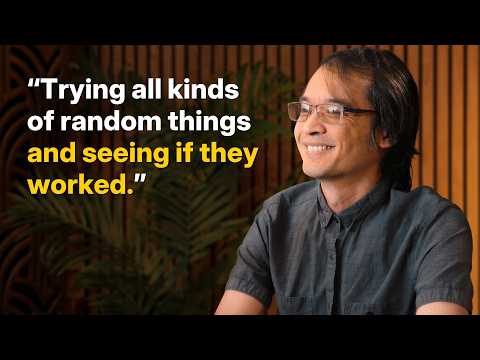
“Right, so I think AI has basically driven the cost of idea generation down to almost zero, in a very similar way to how the internet drove the cost of communication down to almost zero. Which is an amazing advance.” — Terence Tao, 12:17
Clip command
yt-dlp --download-sections "*12:17-13:00" "https://www.youtube.com/watch?v=Q8Fkpi18QXU" --force-keyframes-at-cuts --merge-output-format mp4 -o "idea-generation-cost-zero.mp4"”A trustworthy co-author if used correctly”
“Yeah, a trustworthy co-author if used correctly, which is looking pretty good in retrospect.” — Terence Tao, 46:54
Clip command
yt-dlp --download-sections "*46:54-47:50" "https://www.youtube.com/watch?v=Q8Fkpi18QXU" --force-keyframes-at-cuts --merge-output-format mp4 -o "trustworthy-co-author.mp4"”Made the papers richer and broader, but not deeper”
“So yeah, they’ve really sped up lots of secondary tasks. They haven’t yet sort of sped up the core thing that I do, but it’s allowed me to sort of add more things to my papers.” — Terence Tao, 48:48
Clip command
yt-dlp --download-sections "*48:48-49:20" "https://www.youtube.com/watch?v=Q8Fkpi18QXU" --force-keyframes-at-cuts --merge-output-format mp4 -o "richer-broader-not-deeper.mp4"”They excel at breadth, humans excel at depth”
“I agree. Yeah so they excel at breadth and humans excel at depth, human experts at least. Yeah so I think they’re very complementary but our current way of doing math and science is focused on depth.” — Terence Tao, 34:58
Clip command
yt-dlp --download-sections "*34:58-35:30" "https://www.youtube.com/watch?v=Q8Fkpi18QXU" --force-keyframes-at-cuts --merge-output-format mp4 -o "breadth-vs-depth.mp4"”Copernicus was less accurate than Ptolemy”
“Yes, yes. So it often actually the ultimately correct theory initially is worse in many ways. Yeah. So Copernicus’ theory of the planets, it was less accurate than Ptolemy’s theory.” — Terence Tao, 18:41
Clip command
yt-dlp --download-sections "*18:41-19:30" "https://www.youtube.com/watch?v=Q8Fkpi18QXU" --force-keyframes-at-cuts --merge-output-format mp4 -o "copernicus-less-accurate.mp4"”Human-AI hybrids will dominate math for a lot longer”
“I guess, I mean, I do believe that hybrid human plus AIs will dominate mathematics for a lot longer. It will require some additional breakthroughs beyond what we already have.” — Terence Tao, 1:19:54
Clip command
yt-dlp --download-sections "*79:54-80:40" "https://www.youtube.com/watch?v=Q8Fkpi18QXU" --force-keyframes-at-cuts --merge-output-format mp4 -o "human-ai-hybrids-dominate.mp4"Key Points
- Kepler as a high-temperature LLM (4:10) - Dwarkesh frames Kepler’s discovery method as generating many wild ideas and testing them against data, like an LLM with high temperature
- Correct theories initially perform worse (18:41) - Copernicus was less accurate than Ptolemy; the correct theory can survive decades of being “wrong” only through judgment and heuristics
- Idea generation cost driven to near zero (12:17) - AI is to idea generation what the internet was to communication — but verification remains the bottleneck
- Cognitive Copernican revolution (21:00) - We’re experiencing the realization that human intelligence is not the center of the cognitive universe
- Selection bias in AI math results (44:25) - Large-scale sweeps of Erdos problems show success stories get broadcast while failures are hidden
- AI as jumping machines (33:00) - AI tools can jump higher than humans but sometimes jump in the wrong direction; they lack cumulative understanding
- 2023 prediction confirmed (46:54) - Tao’s prediction that AI would be a “trustworthy co-author” by 2026 has been vindicated
- Papers richer but not deeper (49:14) - AI adds breadth to Tao’s papers (literature search, numerics, formatting) but the core problem-solving is unchanged
- Still uses pen and paper for hard problems (48:17) - The most difficult part of math problem-solving hasn’t been touched by AI
- Artificial cleverness vs artificial intelligence (49:21) - AI does brute-force trial and error (cleverness) but lacks cumulative, adaptive understanding (intelligence)
- Need semi-formal language for strategies (59:22) - We need a formal language for how scientists actually reason, not just for proofs (which Lean handles)
- Gauss and the prime number theorem (1:03:00) - Example of a revolutionary data-driven conjecture that inspired an entire field
- Math needs its experimental side (39:32) - Math has been 99% theory; AI enables the experimental side (testing thousands of problems systematically)
- Tao’s obsessive streak and blogging (1:10:43) - Tao blogs to combat forgetting; he had to quit computer games due to completionism
- Human-AI hybrids will dominate for much longer (1:19:54) - Additional breakthroughs beyond current capabilities are needed for AI to fully replace human mathematicians
Mentions
Companies
- Jane Street (27:34) - Sponsor; created a ResNet puzzle for Dwarkesh’s audience
- Mercury (1:08:49) - Sponsor; banking with Insights feature
- Labelbox (27:34) - Sponsor; rubric-based evals for AI training
Products & Technologies
- Lean (53:02) - Formal proof verification system; enables decomposing and studying proofs atomically
- GPT-2/GPT-3 (21:00) - Referenced in context of AI progress timelines
- Gemini 3 / Claude 4.5 (51:23) - Referenced as future model generations for math capabilities
People
- Kepler (0:00) - Central analogy: discovered laws of planetary motion through decades of idea generation and data testing
- Copernicus (0:23) - Proposed heliocentric model that was initially less accurate than Ptolemy
- Tycho Brahe (1:54) - Danish astronomer whose data enabled Kepler’s discoveries; Kepler stole his data
- Newton (4:10) - Provided the unifying framework explaining why Kepler’s laws must be true
- Darwin (20:00) - Cited as an example of a great science communicator who spoke in plain English
- Gauss (1:03:00) - Created one of first mathematical datasets by computing 100,000 primes
- Isaiah Berlin (1:10:07) - Tao identifies with Berlin’s “fox” archetype (breadth) over the “hedgehog” (depth)
- Johannes Bode (10:31) - Proposed Bode’s Law for planetary distances, which initially fit but was ultimately wrong
Surprising Quotes
“Copernicus’ theory of the planets, it was less accurate than Ptolemy’s theory.” — Terence Tao, 18:41
“2026 level AI would be stunning in 2021 and a lot of it, you know, face recognition, natural speech, doing college level math problems, we just take for granted.” — Terence Tao, 46:30
“The core of what I do, like actually solving the most difficult part of a math problem, that hasn’t changed too much. I still use pen and paper for that.” — Terence Tao, 48:17
“I’ve had to wean myself off computer games because I’ll start a game and I want to play it to completion, all the levels.” — Terence Tao, 1:11:11
“We’re going through a cognitive version of the Copernican revolution where we used to think that human intelligence is the center of the universe.” — Terence Tao, 21:00
Transcript
Dwarkesh Patel: 0:00 Okay today I’m starting with Terence Tao who needs no introduction. Terence I want to begin by having you retell the story of how Kepler discovered the laws of planetary motion because I think this will set the stage for our discussion about AI and mathematical discovery.
Terence Tao: 0:15 Okay yeah so I’ve always had an amateur interest in astronomy and so I’ve loved stories of how the early astronomers worked out the nature of the universe. So Kepler was building on the work of Copernicus who was himself building on the work of Aristarchus. Copernicus very famously proposed the heliocentric model that instead of the planets and the sun revolving around the Earth, the Earth and the planets revolve around the sun. And his theory kind of fit the observations that the Greeks and the Arabs and Indians had worked out over centuries.
Terence Tao: 1:13 I think Kepler got interested and he started proposing that if you take say the orbit of the earth and you enclose it in maybe a cube, the outer sphere of that that encloses the cube almost matches the orbit of Mars. The cube, the tetrahedron, icosahedron, octahedron and dodecahedron. And so he had this theory which he thought was absolutely beautiful that he could inscribe these Platonic solids between the spheres of the planets.
Terence Tao: 1:54 So he needed data to confirm this theory and at the time there was only one really high quality data set almost in existence, which was Tycho Brahe, this Danish astronomer, very wealthy eccentric, who had taken decades of observations of all the planets, Mars, Jupiter, every night, at least every night for which the weather was clear, with the naked eye. This was the last of the great pre-telescope observations.
Terence Tao: 2:31 And so Kepler started working with Tycho but Tycho was very jealous of the data, he only gave him little bits of it at a time. And I think Kepler eventually just stole the data, he copied it and ran off with it. But he did get the data and then he worked out, to kind of his disappointment, that his beautiful theory didn’t quite work.
Terence Tao: 3:00 But he worked on this problem for years and years and eventually he figured out how to use the data to work out the actual orbits of the planets and that was an incredible technical feat. He discovered that the planets moved in ellipses. And then 10 years later, after collecting a lot of data, the furthest planets like Saturn and Jupiter were the hardest for him to work out, but then he finally worked out this third law also that the period of a planet’s orbit is related to the cube of its distance from the sun.
Dwarkesh Patel: 4:10 The take I want to try on you is that Kepler was a high temperature LLM. Where Newton comes up with this explanation of why the three laws of planetary motion must be true, and of course the way that Newton reasons through things is extremely elegant and low temperature. And in fact, in the book in which he writes down the third law of planetary motion, it’s sort of an aside on The Harmonics of the World, which is his book about all these different planets making different notes.
Dwarkesh Patel: 5:13 And so Newton works that out, but the reason I think this is an interesting story is I feel like LLMs could do the kind of thing of like 20 years, let’s try random relationships.
Terence Tao: 5:45 Traditionally when we talk about the history of science, idea generation has always been kind of the prestige part of science. A scientific problem comes with many steps: you have to collect data, you need to figure out a strategy to analyze the data, to make a hypothesis, and at this point you need to propose a good hypothesis and then you need to validate it. The hypothesis generation has always been the most romanticized part, but in some ways data collection and validation are equally important.
Dwarkesh Patel: 6:43 But as you say, the verification had to be matched. We celebrate Kepler but we should also celebrate Brahe for his high quality data.
Terence Tao: 7:01 And that extra decimal point of accuracy was actually essential for Kepler to get his results. He was using Euclidean geometry and the most advanced math of his era.
Dwarkesh Patel: 9:00 96 is where he comes up with first polygons and then Platonic objects theory, but they were wrong. And then a few years later he gets Brahe’s data. And it’s only after 20 years of just trying random things that the correct laws emerge.
Terence Tao: 9:30 Yeah, the data was extremely important, but the distinction I was trying to make was that traditionally you make a hypothesis and then you test it against data. But now with AI the bottleneck isn’t hypothesis generation anymore.
Terence Tao: 10:03 Kepler’s third law is a little bit like this. Except that for the third law, instead of having the thousand data points that Brahe had, Kepler had like six data points — the distances to the six known planets.
Terence Tao: 10:31 There was a later astronomer, Johannes Bode, who took the same data and inspired by Kepler, proposed what we now call Bode’s Law. It initially fit beautifully. But then when we discovered Uranus and Neptune, Bode’s Law broke down.
Dwarkesh Patel: 11:44 Does this analogy make sense — if in the future we have smarter and smarter AIs and millions of hypotheses, how would you identify which ones among millions of papers actually constitute progress?
Terence Tao: 12:17 Right, so I think AI has basically driven the cost of idea generation down to almost zero, in a very similar way to how the internet drove the cost of communication down to almost zero. Which is an amazing advance.
Terence Tao: 15:13 Right. So a lot of it is the test of time. Many great ideas didn’t actually get a great reception at the time that they were first proposed. It was only after some other scientists realized their importance that they were appreciated.
Terence Tao: 16:00 People have argued that the transformer is the foundation of all modern large language models. And it was the first deep learning architecture that was really sophisticated enough to transform the field.
Terence Tao: 17:09 So you can’t look at any given scientific achievement purely in isolation and give it an objective grade without being aware of the context both in the past and the future. And so it may never be possible to fully automate evaluation of scientific contributions.
Terence Tao: 18:41 Yes, yes. So it often actually the ultimately correct theory initially is worse in many ways. So Copernicus’ theory of the planets, it was less accurate than Ptolemy’s theory. Geocentrism with epicycles had been refined over millennia and was pretty accurate.
Terence Tao: 21:00 And a cognitive version of the Copernican revolution where we used to think that human intelligence is the center of the universe. And now we’re seeing that there’s very different types of intelligence, some of which are now very clearly superhuman.
Terence Tao: 23:04 I think one aspect of science is it’s not just creating a new theory and validating it, but communicating it to others. Darwin was actually an amazing science communicator. He spoke in plain English, didn’t use equations, and he synthesized a lot of disparate observations into a narrative.
Terence Tao: 25:12 So yeah, there’s a social aspect to science. Even though we pride ourselves on having an objective side with data and experiment and validation, the social infrastructure matters enormously.
Terence Tao: 30:29 If there are really useful metrics or footprints of progress in data sets, we can examine citation patterns, we can look at which techniques spread and which don’t.
Dwarkesh Patel: 30:57 So this brings us nicely to the progress that from the outside it seems like AI for math is making. You had a post recently where you pointed out that over the last few months, a number of Erdos problems have been solved with AI assistance.
Terence Tao: 31:06 It does seem so. 50-odd problems have been solved with AI assistance, which is great, but there’s like 600 to go. And people are still chipping away at them.
Terence Tao: 33:00 These AI tools, they’re like these jumping machines that can jump two meters in the air, higher than any human, and sometimes they jump in the wrong direction and sometimes they jump in a useful direction.
Terence Tao: 34:58 I agree. They excel at breadth and humans excel at depth, human experts at least. So I think they’re very complementary but our current way of doing math and science is focused on depth. We have to redesign the way we do science to take full advantage of this breadth capability.
Terence Tao: 36:00 We can explore entire new fields of science by first getting these broad, moderately competent AI-generated results, and then having humans go deep on the most promising ones.
Terence Tao: 37:58 So certainly in math, the process is often more important than the problem itself. The problem is kind of a proxy for measuring progress. And even in software, there’s different types of software. Some software you want to crank out as fast as possible.
Terence Tao: 39:32 In most sciences there’s an equal division between the theoretical side and experimental side. But in math it’s been almost 99% theoretical. We have some intuition but we haven’t done large-scale studies where we take a thousand problems and test them. But we can do that now.
Terence Tao: 44:25 But what we found, so people have done large-scale sweeps of these Erdos problems, and if you only focus on the success stories, the ones that get broadcast on social media, it looks amazing. But for every problem that gets solved, there’s 10 where it bangs its head against the wall for five hours and gets nowhere.
Terence Tao: 46:30 2026 level AI would be stunning in 2021 and a lot of it — face recognition, natural speech, doing college level math problems — we just take for granted.
Dwarkesh Patel: 46:47 Okay, so speaking of 2026 AI, you made a prediction in 2023 that I think by 2026, it would be like a colleague in mathematics?
Terence Tao: 46:54 Yeah, a trustworthy co-author if used correctly, which is looking pretty good in retrospect.
Dwarkesh Patel: 46:59 Yeah, I’m pretty pleased. So let’s see if we can continue this streak. You personally are 2X more productive as a result of AI. What year would you say that?
Terence Tao: 47:09 Productivity, I think, is not quite a one-dimensional quantity. I’m definitely noticing that the style in which I do mathematics is changing quite a bit and the type of things I can do has expanded.
Terence Tao: 48:00 But it’s because these are sort of auxiliary tasks. For things like doing a much deeper literature search, supplying a lot more numerics, they enrich the paper but they’re not the core intellectual contribution.
Terence Tao: 48:17 So yeah, the core of what I do, like actually solving the most difficult part of a math problem, that hasn’t changed too much. I still use pen and paper for that. But there’s lots of small things. I use an AI agent now to reformat, like sometimes all my parentheses are not quite the right size. I used to manually change them by hand, and now I can get an agent to do it.
Terence Tao: 49:14 Yeah, so it’s made the papers richer and broader, but not necessarily deeper.
Dwarkesh Patel: 49:21 You made this distinction between artificial cleverness and artificial intelligence. What is an example of intelligence that is not just cleverness?
Terence Tao: 49:35 Intelligence is famously hard to define. But when I talk to someone and we’re trying to collaboratively solve a math problem, one of us has some idea and it looks promising, and then we test it and it doesn’t work, but then we modify it. There’s some adaptability and this cumulative process that builds up interactively.
Terence Tao: 50:31 And this is not quite what the AI does. It can kind of mimic this a little bit. But to go back to the analogy of these jumping robots, they can jump and fail, jump and fail, and then they try to jump from there. There isn’t this cumulative process.
Terence Tao: 51:00 It seems to be a lot more trial and error and just repetition, brute force. Which scales and can work amazingly well in certain contexts. But this idea of building cumulative understanding interactively — that’s the gap.
Dwarkesh Patel: 53:02 One big question I have is how plausible is it that if we just keep training AIs, they get better and better at solving problems in Lean, and that will continue to solve more and more impressive theorems?
Terence Tao: 53:38 We don’t know. Some problems have been solved by pure brute force. The four-color theorem is a famous example. We have still not found a conceptually elegant proof of it. We are pretty sure that something like the Riemann hypothesis requires something amazing to happen — a brute force approach just won’t work.
Dwarkesh Patel: 55:49 So suppose the AI figures it out and latent in the Lean proof is some brand new construction. How would we extract understanding from it?
Terence Tao: 56:26 The beauty of formalizing a proof in something like Lean is that you can take any piece of it and study it atomically. When I read a paper, I can tell which lemma looks standard and which is something I haven’t seen before.
Dwarkesh Patel: 59:22 You posted recently that it would be helpful to have a formal or semi-formal language for mathematical strategies as opposed to just mathematical proofs, which is what Lean specializes in.
Terence Tao: 59:34 We don’t really know how to do this. We’ve been lucky that we worked out the laws of logic in mathematics, but this is a fairly recent accomplishment. Having a formal framework for strategies and heuristics would be transformative.
Terence Tao: 1:03:00 Gauss was interested in the prime numbers and he created one of the first mathematical data sets. He just computed the first 100,000 primes. He found a statistical pattern and conjectured what we now call the prime number theorem. It was revolutionary because it was data-driven — maybe the first really important conjecture of mathematics that was purely statistical.
Terence Tao: 1:05:37 There’s this still open conjecture called the twin prime conjecture, that there should be infinitely many pairs of primes that differ by 2. Because we know that if the primes were generated by flipping coins, just by random chance we would see twin primes again and again.
Terence Tao: 1:10:07 I certainly identify with the fox archetype. As Isaiah Berlin described, there are foxes who know many things and hedgehogs who know one big thing. I work with hedgehogs a lot, and sometimes I can be a hedgehog if need be.
Terence Tao: 1:10:43 I’ve always had a little bit of an obsessive streak. If there’s something which I read about which I feel like I should understand, I have the capability to understand this, but I don’t understand it — I’ll just keep gnawing at it until I get it.
Terence Tao: 1:11:11 I’ve had to wean myself off computer games because I’ll start a game and I want to play it to completion, all the levels.
Terence Tao: 1:12:00 I’ve found that writing about what I’ve learned via a blog helps enormously. In the past, when I was younger, I would learn something and think I’m going to remember this. And then six months later, I’ve forgotten. The first few times it was so frustrating.
Dwarkesh Patel: 1:17:05 I’m very curious when you expect AI to actually do frontier math as well as the best human mathematician?
Terence Tao: 1:17:15 In some ways they’re already doing frontier math that is super-intelligent that humans can’t do, but it’s a different frontier from what we’re used to.
Terence Tao: 1:17:59 I think within a decade, a lot of things that mathematicians currently do, the bulk of our time, can be done by AI. But we’ll find that that actually frees mathematicians up to focus on the things that only humans can do.
Terence Tao: 1:18:16 100 years ago, a lot of mathematicians were just solving differential equations. People needed some exact solution and they hired a mathematician to laboriously compute it. That’s completely automated now.
Terence Tao: 1:19:54 I do believe that hybrid human plus AIs will dominate mathematics for a lot longer. It will require some additional breakthroughs beyond what we already have.
Terence Tao: 1:21:00 It’s possible that also by somehow just through serendipity we actually inhibit certain types of progress. Anything is possible really at this point. The world is very, very unpredictable.
Terence Tao: 1:21:29 We live in a time of change. It is a particularly unpredictable era. In terms of things that we’ve taken for granted for centuries about how mathematics is practiced, many of those assumptions are now being challenged.
Dwarkesh Patel: 1:23:47 Awesome. That’s a great note to close on. Terence, thanks so much.
Terence Tao: 1:23:48 Yeah, thanks. Pleasure.