The better AI gets, the smaller its share of the economy might get – Alex Imas and Phil Trammell
The better AI gets, the smaller its share of the economy might get — Alex Imas and Phil Trammell
Summary
Dwarkesh hosts Alex Imas (Director of AGI Economics at Google DeepMind, professor of economics at the University of Chicago) and Phil Trammell for a deep dive into the economics of AGI. The framing puzzle: labor’s share of GDP has been remarkably stable around 60-70% across centuries despite massive automation — this is a Kaldor fact. What would it take for that to change as AI automates an unprecedented breadth of cognitive work? Imas and Trammell argue that the obvious story (mass unemployment, capital share explodes) misses the deeper question: economists have been famously bad at forecasting because they consistently fail to anticipate the new goods, services, and “relational” sectors that absorb labor as old jobs get automated.
The middle of the conversation tackles the “messy middle” scenario popularized by Molly McKendree — a world where AI is automating jobs but not creating enough wealth to compensate. Trammell sees a narrow window for this. Imas points to Andy Hall’s observation that a 2% increase in unemployment completely changes the political winds, so even a modest version of this scenario could be politically destabilizing. They walk through redistribution mechanisms (wealth tax, consumption tax/VAT, universal basic capital, negative income tax) and the “indexing problem” — if returns are concentrated in private companies like OpenAI and Anthropic and most households’ “capital” is just a house, ordinary people structurally can’t ride the upside. Their counterargument: if AGI becomes like electricity (rather than social media), every S&P 500 company will be AI-leveraged and indexing works again.
The final stretch covers developing countries (advice: index, don’t try to leapfrog), the Rockefeller question (descendants don’t control everything because indexing the economy was historically hard, and private capital has grown disproportionately), and a striking observation: a house is “uniquely ill-suited” as capital because its value is in being close to other humans — which won’t be the main factor of production in an AGI economy. The takeaway is that Imas and Trammell’s framework strongly resists confident forecasting: every question about AGI’s economic impact branches into multiple scenarios, each with very different distributional implications.
Highlights
”Every 18 months the value of computation halves”
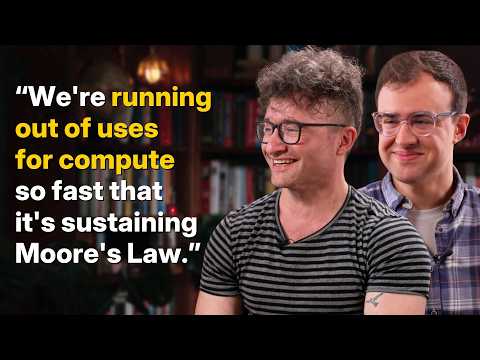
“The pessimistic framing of Moore’s Law is every 18 months the value of computation halves. We’re just running out of uses for computation so fast that it’s sustaining Moore’s Law.” — Phil Trammell, 15:11
Clip command
yt-dlp --download-sections "*15:11-16:15" "https://www.youtube.com/watch?v=Jj-kBHzUohs" --force-keyframes-at-cuts --merge-output-format mp4 -o "moores-law-pessimistic.mp4"”A 2% increase in unemployment completely changes the political winds”
“Andy Hall wrote a really nice blog post about the politics of AGI and he made a really interesting observation. If there’s a 2% increase in unemployment, the political winds completely change.” — Alex Imas, 22:06
Clip command
yt-dlp --download-sections "*22:06-23:00" "https://www.youtube.com/watch?v=Jj-kBHzUohs" --force-keyframes-at-cuts --merge-output-format mp4 -o "2-percent-political-winds.mp4"”Greedy titans of industry historically have, like, built libraries”
“Greedy titans of industry historically have, like, built libraries and…” “But that’s because they die.” “Oh, they all die, everybody dies.” — Phil Trammell and Dwarkesh Patel, 54:31
Clip command
yt-dlp --download-sections "*54:26-55:30" "https://www.youtube.com/watch?v=Jj-kBHzUohs" --force-keyframes-at-cuts --merge-output-format mp4 -o "titans-die-libraries.mp4"”Why the Rockefellers’ descendants don’t control everything”
“We were talking earlier about why the Rockefellers’ descendants don’t control everything. One argument is just that it’s very hard to index the economy… It’s just a very small fraction of the economy going back 100 years accounts for a majority of the value created now, and if you miss those particular things, your wealth would have just kind of stagnated.” — Alex Imas, 1:04:21
Clip command
yt-dlp --download-sections "*1:04:21-1:05:30" "https://www.youtube.com/watch?v=Jj-kBHzUohs" --force-keyframes-at-cuts --merge-output-format mp4 -o "rockefellers-indexing.mp4"”A house is uniquely ill-suited capital for the AGI economy”
“A house is sort of uniquely a capital that is uniquely ill-suited to be complementary to the production of AI or the serving of AI or to robots.” “Or the kind of goods that the rich will bid up the prices of.” “Exactly. The value of a house currently is really the land is close to other humans, and modulo relational stuff that is just not going to be the main factor of production.” — Phil Trammell, Alex Imas, Dwarkesh Patel, 1:05:31
Clip command
yt-dlp --download-sections "*1:05:25-1:06:30" "https://www.youtube.com/watch?v=Jj-kBHzUohs" --force-keyframes-at-cuts --merge-output-format mp4 -o "house-bad-agi-capital.mp4"”If AGI is electricity, everything in the S&P 500 indexes it”
“If it’s going to make it to the S&P 500, it is because it has leveraged AI. And then you’re indexed again.” — Alex Imas, 1:07:34
Clip command
yt-dlp --download-sections "*1:06:41-1:08:00" "https://www.youtube.com/watch?v=Jj-kBHzUohs" --force-keyframes-at-cuts --merge-output-format mp4 -o "agi-electricity-indexing.mp4"Key Points
- Labor share has been ~60-70% for centuries — a Kaldor fact (7:14) - Despite massive automation. Surprisingly stable
- David Ricardo would have wrongly predicted mass unemployment from automating manual labor (4:00) - He missed structural change: economies grow into new sectors (services, etc.) that absorb displaced labor
- The “task-based model” of jobs (10:06) - A job (e.g., doctor) is bundles of tasks (insurance forms, calls, diagnosis); you can automate most tasks and the consumer still pays for a human in the loop
- The transistor paradox (14:22) - We’ve produced trillions or quadrillions more transistors but the share of compute in GDP didn’t explode; Chad Jones has a result on this — the marginal value of compute keeps falling
- Increasing variety can save labor share (15:50) - New goods/services that didn’t exist yet keep being demanded, so the supply curve keeps shifting outward in qualitatively new directions
- Messy middle scenario (19:39) - Molly McKendree’s framing: AI is automating jobs but not creating enough wealth to redistribute back to displaced workers
- 2% unemployment shifts political winds (Andy Hall) (22:06) - You don’t need 50% unemployment to destabilize politics
- Universal Basic Capital has a “targeting” problem (27:38) - What if Anthropic goes to zero but some random robotics company takes all the surplus? Hard to know what to put in people’s portfolio
- Consumption tax (VAT) → government buys stocks (29:13) - David Autor’s proposal; a tax that lets the state acquire equity for distribution
- Wealth tax has a sustainability problem (28:03) - No politically stable equilibrium at 0.5% wealth tax; ends up at expropriation
- The white-collar apocalypse evidence is weak (30:02) - Growth is slower for entry-level SWE roles but still positive; anecdotal layoffs may be “this is a story as old as time”
- Elasticity of demand is key to whether automation costs jobs (32:44) - The O-ring model: if automating one task makes the whole product cheaper and demand is highly elastic, total employment can rise
- Gans-Goldfarb: if you can only automate 90% to lower standard (40:42) - This explains why lawyers, accountants haven’t been automated despite LLM capabilities
- Why human-mediated services may not disappear (45:00) - Trust, empathy, the ability to “blame a human” — these aren’t tech limitations, they’re regulatory and intrinsic preferences
- Greedy titans of industry exist now (54:25) - Elon Musk talks about mass drivers on the moon and seemingly doesn’t satiate; reproduces fast; lives forever scenario amplifies effect
- “Living forever is key” (49:42) - If accumulating dynasties don’t die, they dominate the wealth distribution over time
- Rockefellers couldn’t index, so wealth stagnated (1:04:21) - The historical answer to “why don’t their descendants control everything”
- A house is uniquely bad capital for an AGI economy (1:05:31) - Most household wealth is land valued at “close to other humans,” which is decoupled from AI production
- Developing countries should index, not retrain (1:10:03) - Imas’s advice for countries outside the AI supply chain
- If AGI is electricity, indexing the S&P solves the problem (1:07:14) - Every winning company will be AI-leveraged; if AGI is “social media” (concentrated in a few labs) it doesn’t
- Open models help diffuse capital share (1:08:01) - Trammell’s point: a world with open weights is one where AI rents disperse rather than concentrate
- Commoditizing labs has a safety cost (1:14:11) - A big gatekeeper can control speed and harms; commoditization diffuses misuse risk too
- Most US market cap is private (1:12:00) - Trammell notes that the total non-tiny private market is huge and most people can’t access it
Mentions
Companies
- Google DeepMind (0:00) - Where Alex Imas is Director of AGI Economics
- University of Chicago (0:00) - Imas is professor of economics
- OpenAI (1:12:00) - Cited as the canonical concentrated-private-AI scenario
- Anthropic (27:44) - Used as the canary in UBC targeting: “what if Anthropic goes to zero?”
- Jane Street (18:32) - Sponsor; apprenticeship model for turning smart people into researchers/engineers
- Cursor (1:00:17) - Sponsor; Sasha Rush demos on-policy self-distillation with hint tokens
- Google Gemini Omni (38:06) - Sponsor; multimodal model with strong video editing
Products & Technologies
- Index funds (1:04:21) - The mechanism that briefly let ordinary capital grow with the economy
- Wealth tax (28:03) - Redistribution lever; politically unstable
- Consumption tax / VAT (29:13) - David Autor’s proposal for AGI redistribution
- Universal Basic Capital (27:24) - Distribute share ownership rather than income
- UBI / Negative Income Tax (24:00) - Standard redistribution mechanisms compared
- Georgist (land value) tax (1:05:59) - Cited as the right tax for capturing AGI-era land rents
- Mass drivers (moon) (48:51) - Elon Musk’s stated ambition; example of insatiable rich
- S&P 500 indexing (1:07:14) - The mechanism by which ordinary investors might capture AGI gains
- Private equity / pre-IPO concentration (1:12:00) - The structural reason indexing might not work in AGI era
People
- Alex Imas (0:00) - Director of AGI Economics at Google DeepMind, U Chicago professor
- Phil Trammell (0:00) - Economist, AGI economics researcher
- David Ricardo (4:00) - 19th-century economist who would have wrongly predicted mass unemployment
- Chad Jones (14:29) - Stanford economist; result on how the share of compute in the economy hasn’t grown despite trillions more transistors
- Andy Hall (22:06) - Wrote blog post on politics of AGI: 2% unemployment shift moves political winds
- Molly McKendree (19:39) - Coined the “messy middle” scenario
- David Autor (29:33) - MIT economist; consumption tax → state equity proposal
- Gans and Goldfarb (40:59) - Recent paper on “automating nine-tenths to a lower standard” preserving high-skill jobs
- Elon Musk (48:51) - Cited as living example of non-satiating greedy capital accumulator
- The Rockefellers (1:04:21) - Used as the case study for “why don’t dynasties take everything”
- Sasha Rush (Cursor) (1:00:17) - In sponsor segment; on-policy self-distillation with hint tokens
- John von Neumann (probes) (59:44) - Self-replicating space probes; how do they show up in GDP?
- Magnus Carlsen (13:52) - Used as example of “what humans would still be paid for”
Surprising Quotes
“We have been famously terrible at forecasting.” — Alex Imas, on the failure of economists to predict structural change, 3:09
“Greedy titans of industry historically have, like, built libraries.” “But that’s because they die.” “Oh, they all die, everybody dies.” “Well, we’ll see.” — Phil Trammell and Dwarkesh Patel, on whether wealth-maximizers will dominate the AGI economy, 54:31
“Narratives matter. There’s this really negative narrative around AI right now, but that’s because people are not putting out the positive narrative. It’s more difficult to imagine something that doesn’t exist that’s a good thing than losing something that exists.” — Alex Imas, 1:13:31
“Or part of a house.” “A house is sort of uniquely a capital that is uniquely ill-suited to be complementary to the production of AI.” — Phil Trammell, on most households’ actual capital position, 1:05:29
“The risk of commodification is that it sort of diffuses the ability to use AI for harmful ends.” — Alex Imas, 1:15:14
Transcript
Dwarkesh Patel: 0:00 Today I’m chatting with Alex Imas, who is director of AGI Economics at Google DeepMind and professor of economics at University of Chicago, and Phil Trammell, economist working on the economics of AGI.
Phil Trammell: 0:43 Something like the relational sector, which is what I defined as basically services and goods where the fact that the human was involved matters.
Dwarkesh Patel: 1:06 I’m curious to understand whether humans doing services for other humans can ever be a big part of the economy, and here’s one intuition. Maybe right now we’re like the Mongolians in 1400 — we don’t know what the things people would want to spend money on are. Maybe in the future when robots can do everything we do today, people would actually want to spend their money on services that other humans provide.
Alex Imas: 2:24 I would like to pitch a rephrasing of that question. My view is that forecasts that economists like us would make are likely going to be terrible. So what we’re going to do, rather than looking at prediction markets where you get aggregate forecasts where you have a lot of degrees of freedom and people end up missing the systematic biases that show up in our forecasts — and the reason I think this is because we have been famously terrible at forecasting.
Alex Imas: 4:00 So if I was David Ricardo and I woke up and somebody told me all those jobs did get automated and you asked me, David Ricardo, like what do you think? David Ricardo ended up missing the fact that essentially you have these economics of structural change where capital basically flows into new sectors that previously didn’t have a big share of the economy.
Alex Imas: 4:57 But it’s kind of not obvious that money would go to services. Why wouldn’t they go to more automated goods or something like that? You can write down a model to say, hey, what if labor share just stays the same? What can make that happen?
Phil Trammell: 6:00 What I think is really useful is to think about what are the potential scenarios — and we’ll be talking about a lot of them today.
Dwarkesh Patel: 6:27 It’s probably worth defining labor share and capital share. So the whole economy — the total sum of goods and services sold — some fraction of it is paying wages to workers (labor share) and some fraction is paying returns to capital owners.
Alex Imas: 7:14 It’s like really this is a Kaldor fact. It’s incredibly — we should stress this — it’s incredibly surprising that it’s over 60% labor share across centuries.
Dwarkesh Patel: 8:01 But it’s not that surprising? Phil, you made this point that if labor and capital are complements you need both to do anything.
Alex Imas: 8:11 But you have had stuff be completely automated.
Phil Trammell: 8:21 There is a sense in which nothing’s yet been completely automated if you look at the network-adjusted factor share. Does the whole supply chain become automated and there’s no part in it that we care intrinsically about having a human do? That’ll be a qualitative shift. Interestingly, the implications of that shift for the overall capital share are uncertain — because if we let’s say we’ve got two sectors, the human-intrinsic sector (ballerinas etc.) and everything else, right now everything else has been scarce because of lack of labor. If we fully automate the supply chains for everything else, and we satiate in everything else really fast, then the quantity of everything else collapses.
Alex Imas: 9:48 Let me move away from the ballerina example because the point I was trying to make: right now we have a lot of jobs where you have different tasks. This is the task-based model of jobs. A doctor, what is their job? They’re filling out insurance documents, calling different pharmacies, doing the diagnostic interview. You could have a job, a service or a good, be a product of different types of tasks, and you can automate a ton of those. And if the consumer is willing to pay more for a product where every single task is automated versus one where almost every task is automated except one or two that a human does — a human in the loop — the labor share can stay high. We don’t have data to say “here are relational jobs, here are not” because you literally need to collect data of the form “do a conjoint analysis of here’s my willingness to pay for this service where everything is produced by AI vs. where there’s a human in the loop.” If I don’t have that data, what prediction am I going to make in this story?
Dwarkesh Patel: 11:35 Isn’t there another point which is that there’s a lot of fully automated goods that don’t even exist yet?
Alex Imas: 11:53 Absolutely. You could have an increase in variety in capital where you don’t get the satiation.
Phil Trammell: 12:00 You’re increasing variety so you’re not hitting that really diminishing marginal utility point.
Dwarkesh Patel: 12:25 I like your analogy to some Mongolian economist sitting around in 1400 thinking about what will be scarce.
Phil Trammell: 12:35 If you just looked at the goods available to a Mongolian of the distant past, you’d never predict the categories of consumption that dominate now.
Dwarkesh Patel: 13:52 I was going to make a point and I realize it’s a fallacy but the reason it’s a fallacy is interesting. I was going to say it’s just hard to imagine a world where there’s trillions upon trillions of robots but only some billion-odd humans and the cumulative amount we’re spending on robots and building more robots is less than what we’re spending to pay Magnus Carlsen and—
Alex Imas: 14:18 Or financial advisors or doctors or tutors—
Phil Trammell: 14:20 Or podcasters—
Dwarkesh Patel: 14:22 But then I realized why it’s a fallacy. The number of transistors in the world has literally—
Phil Trammell: 14:29 Certainly trillion X, maybe quadrillion X. And your colleague Chad Jones has a very interesting result about how the share of the economy spent on compute hasn’t grown despite this.
Dwarkesh Patel: 15:00 So not only are we producing more transistors more cheaply, but the value of the marginal transistor is decreasing.
Phil Trammell: 15:11 The pessimistic framing of Moore’s Law is every 18 months the value of computation halves. We’re just running out of uses for computation so fast that it’s sustaining Moore’s Law.
Dwarkesh Patel: 15:23 And this is literally relevant to a conversation about AI where, maybe for the first time, this is no longer true. But this is Phil’s point about increasing variety — what we have done is increased the types of things that people demand. Now all of a sudden you have a new variety that you could be using capital for, and all of a sudden you jump back up.
Phil Trammell: 16:05 You could imagine we just never satiate demand for compute. And as long as that stays the case, then the share of the economy that is going to compute could be huge.
Alex Imas: 16:13 That’s the big question. What number of new things matter for our future?
Alex Imas: 18:00 There’s no — a horse was an input into an output where you could replace the horse with something else. You only care about the output.
Dwarkesh Patel: 18:32 [Jane Street sponsor segment]
Dwarkesh Patel: 19:39 Molly McKendree has written something about this messy middle scenario. The possibility made me nervous. AI makes it possible to automate jobs such that many people are losing their jobs, but it doesn’t create enough wealth where the increased prosperity gets redistributed.
Phil Trammell: 20:19 There’s a trivial sense in which that must be true because whatever money you’re saving by automating, the company’s saving it.
Dwarkesh Patel: 21:00 So do you find the scenario plausible where AI is automating a bunch of things, but there isn’t enough wealth creation as there is automation?
Phil Trammell: 21:08 Possible. To me it does seem like a pretty narrow window. If we have the technology to automate so many jobs that it becomes politically intolerable, surely the productivity gains exceed the wages we used to pay people.
Alex Imas: 22:06 Andy Hall wrote a really nice blog post about the politics of AGI and he made a really interesting observation. If there’s a 2% increase in unemployment, the political winds completely change. Unemployment has a huge effect on what happens politically. So, to Molly’s excellent essay, in some ways what you might see is people not really being unemployed en masse but kind of slowly drifting out — and there was this drip, it wasn’t like this giant sector just disappeared.
Phil Trammell: 23:35 The concern is that suppose whatever you’re saving on those white-collar workers, if that’s not growing the economy but is just creating a windfall for the company that no longer has to pay them. Where you have the problem of: can I do a UBI off the money I saved by automating the white-collar workers?
Alex Imas: 24:05 You’re saying the pie did not grow that much. You’re just displacing a bunch of people but that actually doesn’t create much new value.
Phil Trammell: 24:16 Maybe every time this has happened in history — I don’t know if this is the case — maybe every time the technological frontier has expanded.
Dwarkesh Patel: 24:23 I think that’s the case.
Alex Imas: 25:57 It’s just really important to outline the cost and benefits. It’s also important to note that there are real risks.
Phil Trammell: 27:00 It really matters who’s in power. Right now we’re endowed with labor that can turn into income. When that is no longer the case, the politics changes.
Alex Imas: 27:21 But wouldn’t that be true of any sort of government redistribution program?
Dwarkesh Patel: 27:24 Something like universal basic capital where you have an ownership share and you have property rights for capital.
Phil Trammell: 27:30 Then you’re just a normal shareholder.
Alex Imas: 27:32 But this goes back to the question of indexing. Because if indexing is hard, then universal basic capital is hard.
Phil Trammell: 27:38 The problem of universal basic capital is targeting. What do you target to put into people’s portfolio?
Alex Imas: 27:44 What if Anthropic goes to zero but some random robotics company takes all the surplus?
Phil Trammell: 27:47 Exactly. With the negative income tax you have the same sort of issues that with UBI.
Alex Imas: 28:03 One concern with the wealth tax is that there’s no politically sustainable equilibrium at 0.5% wealth tax.
Phil Trammell: 28:43 It’s worth separating how the revenue is raised, what’s taxed, and then how it’s distributed.
Phil Trammell: 29:11 Or consumption.
Alex Imas: 29:13 So a consumption tax, like a European value-added tax type thing, allows the government to go buy a bunch of stocks.
Phil Trammell: 29:33 That’s David Autor’s proposal.
Alex Imas: 29:35 That’s not going to be that different from just redistributing the stocks, but it’ll be a little different.
Phil Trammell: 29:42 That was the proposal for social security by the way. That was privatizing social security — a basket of stocks.
Dwarkesh Patel: 30:02 Is there any evidence that suggests the white collar apocalypse is happening?
Alex Imas: 30:17 There’s a lot of people looking at it. This is an area where there’s a lot of eyes and a lot of data being produced.
Dwarkesh Patel: 31:13 So you’re saying the growth is slower than before, but there is still growth even on entry-level software engineers. What do you think is happening?
Alex Imas: 31:23 I think that’s anecdotal evidence.
Dwarkesh Patel: 31:25 You think it’s always been hard to get jobs for some people and now it’s getting turned into an AI narrative.
Alex Imas: 31:33 You have to be careful with all of this. There are these public coordination effects.
Phil Trammell: 32:44 This is one of the statistics that’s really important: elasticity of demand. The O-ring model of jobs.
Dwarkesh Patel: 33:00 On that task — the job will become more productive. If that translates into a price effect where the product is actually cheaper.
Phil Trammell: 33:30 The elasticity of demand argument is incredibly important for a lot of arguments. As something gets cheaper, you will want so much more of it that the total amount you spend on the thing increases.
Dwarkesh Patel: 34:12 Or insulin, right?
Phil Trammell: 34:13 Insulin’s another one. Agriculture famously is example where, even in the long run, demand doesn’t scale up with the productivity gain.
Phil Trammell: 35:00 The claim about software is this is a particular kind of good where as it gets cheaper we’ll want more and more of it.
Alex Imas: 35:05 A lot of this podcast is me summarizing your essays back to you.
Phil Trammell: 35:32 So part of it’s plausible, part of it’s not plausible.
Dwarkesh Patel: 38:06 [Google Gemini Omni sponsor segment]
Phil Trammell: 39:27 We were talking a second ago about why there isn’t more automation as a result of LLMs and one plausible mechanism could be that as you’re saving cost on one task, the entire job gets bottlenecked on the parts you can’t automate.
Alex Imas: 40:42 I just wanted to distinguish between the point that if you automate nine-tenths of a job, the cost of the job doesn’t drop by 9/10.
Phil Trammell: 40:59 From Gans and Goldfarb recently, which was that if you can only automate nine-tenths of the job but you can do it to a lower standard…
Alex Imas: 41:32 And they end up pulling down the quality or speed of the finished product.
Dwarkesh Patel: 41:40 The model you’re talking about seems extremely plausible to me of why more lawyers or accountants are not automated.
Alex Imas: 41:52 You’re also paying for a lot of regulation-type stuff. With lawyers particularly, you need some entity to back up the product. You need ownership of the product, somebody to be able to fire or hire, licensing issues.
Phil Trammell: 42:24 All these frictions on the political-type decisions that we are accustomed to only trusting humans.
Dwarkesh Patel: 43:07 So speaking of which, we’ve been talking about what preferences humans currently have and what impact that has on what kinds of goods will be in demand.
Alex Imas: 44:35 If there’s an AI that’s fully autonomous and it’s making its own decisions and interacting with one another and to trust and empathize with other humans versus a simulated AI…
Dwarkesh Patel: 45:11 I’ve heard a lot of arguments saying look, right now we’re just not used to the technology. And at some point, people get used to talking to AIs and they’re not going to need the empathy that the human is providing.
Alex Imas: 45:35 This is a really complicated question. Here’s one argument for why it’s not going to go away that has to do with reproduction.
Dwarkesh Patel: 46:12 Depends on how the reproduction is happening.
Phil Trammell: 46:41 Here’s one way to think about it. How is the wealth of the richest people in the world instantiated?
Alex Imas: 47:41 Could I just say, these two ways you could get the two kinds of people, one of whom prefers a human therapist and one of whom is fine with the AI.
Phil Trammell: 48:00 The marginal value of capital in the future compared to the marginal value of capital today for each of them.
Alex Imas: 48:39 If what’s driving the difference is that one person just doesn’t satiate in capital because they’re engaged by the prospect of exploring the universe, then in the long run they’re going to have most of the wealth.
Dwarkesh Patel: 48:51 We’re not talking about a hypothetical future. Elon Musk is talking about mass drivers on the moon, and he managed to reproduce fast as well.
Dwarkesh Patel: 49:42 The living forever is key.
Phil Trammell: 49:44 Even if they do reproduce more slowly biologically, that might just not matter in the long run.
Alex Imas: 49:45 If you could live forever, a lot of stuff changes.
Phil Trammell: 51:04 In the scenario with high labor share — returns to capital tend to be very low when wealth is very high relative to demand for capital.
Alex Imas: 51:36 The capital stock could grow quickly, but the price of capital goods relative to consumption goods could be falling fast.
Dwarkesh Patel: 51:56 So I could be putting my money toward earning 30% interest investing in data centers, but the price of robots is falling fast.
Alex Imas: 53:11 Prices are adjusting in this interesting way that too many macro models don’t allow for.
Phil Trammell: 53:49 If all of those extra robots next year are actually different and you’re not satiated on those robots, then it’s a very different story.
Dwarkesh Patel: 54:26 Why are we not expecting greedy titans of industry to keep existing?
Phil Trammell: 54:31 Greedy titans of industry historically have, like, built libraries and…
Dwarkesh Patel: 54:36 But that’s because they die.
Phil Trammell: 54:37 Oh, they all die, everybody dies.
Dwarkesh Patel: 54:41 Well, we’ll see.
Alex Imas: 54:42 Conditional on people dying, to understand the future you should look at people like Carnegie — they built libraries.
Dwarkesh Patel: 55:36 But it does seem to me in a lot of cases what is happening is that as they near the end of their lives they give away their wealth.
Phil Trammell: 56:22 The part about satiation and diminishing marginal utility keeps coming up.
Alex Imas: 57:00 You could have such high concentration that you could just have a couple of exceptions to the rule.
Phil Trammell: 57:10 The claim’s a little stronger — it seems that historically and today, wealth is highly concentrated.
Alex Imas: 57:52 Even without the intrinsic preference for accumulation, there are instrumental reasons why some people might keep accumulating.
Phil Trammell: 59:27 If we’re talking about whether they’ll dominate the economy, maybe this is a technicality, but we only count it as labor share if we recognize the entity as a person.
Dwarkesh Patel: 59:44 How does a von Neumann probe show up in GDP?
Phil Trammell: 59:45 If we recognize it as a person that owns itself and is optimizing on its own behalf…
Alex Imas: 1:00:00 When we’re talking about AI beings — it just completely depends on how we’re doing the accounting.
Dwarkesh Patel: 1:00:17 [Cursor sponsor segment]
Dwarkesh Patel: 1:01:29 Do economists have any advice for countries which are not in the AI production chain?
Alex Imas: 1:01:48 I think the biggest lack of resources allocated in the economic profession is thinking about middle-income developing countries.
Phil Trammell: 1:02:49 This seems to me like an extension of the messy middle case. One of the ways in which the messy middle might only be bad in a narrow window is that high interest rates would make redistribution easy.
Dwarkesh Patel: 1:03:00 It would be easy to redistribute not because the pie would be bigger, but because the interest rate would be way higher.
Alex Imas: 1:04:21 We were talking earlier about why the Rockefellers’ descendants don’t control everything. One argument is just that it’s very hard to index the economy. Maybe they would have just decided to have their heirs index the economy and their wealth grow at the rate of economic growth and they would be trillionaires by now. But historically, before index funds existed, it was very hard to just get a representative — it’s just a very small fraction of the economy going back 100 years that accounts for a majority of the value created now, and if you miss those particular things, your wealth would have just stagnated. Maybe there was a brief golden window from the creation of index funds up until five years ago where actually you could index the economy. But now we’re in this world with very concentrated returns, especially to private companies, which is capital that the average person has disproportionately less access to, as opposed to most of their capital being just a random house.
Phil Trammell: 1:05:29 Or part of a house.
Alex Imas: 1:05:30 Yeah, which is—
Phil Trammell: 1:05:31 As we were saying, sort of uniquely a capital that is uniquely ill-suited to be complementary to the production of AI or the serving of AI or to robots.
Alex Imas: 1:05:44 Or the kind of goods that the rich will bid up the prices of.
Dwarkesh Patel: 1:05:45 Exactly. What is the value of a house currently? The land is close to other humans and modulo relational stuff that is just not going to be the main factor of production.
Phil Trammell: 1:05:59 And this is where Georgist tax would—
Alex Imas: 1:06:00 Not enough money for the sort of programs we were discussing.
Dwarkesh Patel: 1:06:04 If it gets harder to index the economy now and that is supposed to be the main way the average person captures gains, that’s a problem.
Phil Trammell: 1:06:41 This brings up a really important point. Is AI going to be like electricity or social media?
Alex Imas: 1:07:14 The more you think — I don’t endorse this take yet, I’m going to talk out loud — the more you think AGI is going to be like electricity—
Dwarkesh Patel: 1:07:21 Our economy’s going to be run on AGI the way our economy currently runs on electricity? That is just a broad fundamental transformation of all sectors?
Alex Imas: 1:07:34 Exactly. If it’s going to make it to the S&P 500, it is because it has leveraged AI. And then you’re indexed again.
Phil Trammell: 1:08:01 The open model thing is going to be a big factor here. If we’re indeed in a world where it’s commoditized, returns disperse.
Dwarkesh Patel: 1:09:00 Whether Uganda will have any purchase on the returns of AGI.
Phil Trammell: 1:09:34 These are the two scenarios. There is a world where it is concentrated, in which case it’s going to be really hard to access.
Alex Imas: 1:10:03 To get back to the question about whether to go with retraining or just trying to index, I would prioritize trying to index.
Phil Trammell: 1:11:04 Although there are cases where in developing countries you have this leapfrogging effect with mobile banking for example.
Alex Imas: 1:11:40 About the ease of indexing — I think it’s definitely something to worry about a bit and keep an eye on.
Phil Trammell: 1:12:00 The total market cap of non-tiny companies in the US that’s private. Everyone thinks about OpenAI and Anthropic, and if that’s where the value is, that’s an issue.
Dwarkesh Patel: 1:12:54 This makes me hope even more so than before that the labs do get commoditized. Or at the very least, they go public as soon as possible.
Phil Trammell: 1:13:24 Electricity doesn’t take your job, but—
Dwarkesh Patel: 1:13:27 To some people it did.
Phil Trammell: 1:13:29 To some people, yeah.
Alex Imas: 1:13:31 Narratives matter. There’s this really negative narrative around AI right now, but that’s because people are not putting out the positive narrative. It’s more difficult to imagine something that doesn’t exist that’s a good thing than losing something that exists.
Dwarkesh Patel: 1:14:11 One big cost of having commoditized frontier AI is that things are safer because a big gatekeeper can control the speed of progress.
Alex Imas: 1:15:00 Between the leader and the laggard, but that means that the leaders get fantastically wealthy.
Phil Trammell: 1:15:04 You could just have a relatively big gap, but it’s a public company, ownership in it is widely distributed.
Alex Imas: 1:15:14 More recently I have been thinking that the risk of commodification is that it sort of diffuses the ability to use AI for harmful ends.
Alex Imas: 1:16:03 There’s a lot of unresolved questions, but it is helpful to know what is the first branch along the way.
Dwarkesh Patel: 1:16:07 Great. Thank you.
Phil Trammell: 1:16:08 Okay.