"I find it almost disturbing that the universe favors life this strongly" -- Nick Lane
“I find it almost disturbing that the universe favors life this strongly” — Nick Lane
Summary
In this fascinating 80-minute conversation on the Dwarkesh Podcast, Nick Lane — a biochemist at University College London — presents a radical reconceptualization of life’s 4-billion-year history. Lane’s central argument is that early life was continuous with the spontaneous chemistry of undersea hydrothermal vents, that the universal features of all living organisms (proton gradients, the Krebs cycle, Acetyl-CoA) can be explained by this geochemical origin, and that simple life may be almost chemically inevitable on hundreds of millions of planets in the Milky Way alone. The real bottleneck for complex intelligent life, he argues, is not the origin of life itself but the singular event of endosymbiosis that gave rise to eukaryotic cells.
Lane explains that all complex life on Earth — every animal, plant, fungus, and protist — shares the same fundamental cellular architecture: a nucleus, mitochondria, and similar internal machinery. This is because all eukaryotes descended from a single endosymbiotic event roughly 2 billion years ago when an archaeal cell engulfed a bacterium, which became the mitochondrion. Despite 4 billion years, bacteria never independently evolved eukaryotic complexity. This isn’t because they lack genetic diversity (they have far more metabolic diversity than eukaryotes) but because they lack the internal energy systems that mitochondria provide. The charge across mitochondrial membranes, though tiny (150-200 millivolts), operates across a 5-nanometer membrane, creating an electric field intensity of 30 million volts per meter — equivalent to a bolt of lightning.
The conversation ranges from why sex exists (mitochondria are the reason, Lane argues, because having two sexes prevents mitochondrial competition), to whether bioelectric fields might be linked to consciousness, to the implications for astrobiology and the search for intelligent life. Lane’s theory implies that simple life may bloom on hundreds of millions of planets, but the transition to complex eukaryotic life may be an extraordinarily rare “great filter” event.
Highlights
”The universe favors life this strongly”
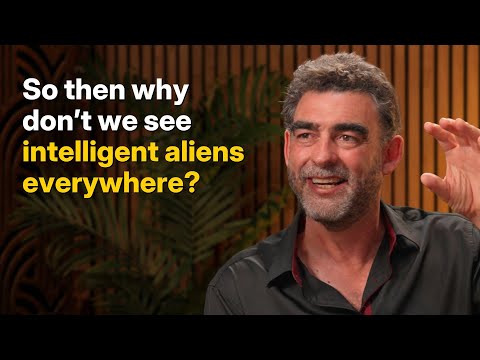
Clip command
yt-dlp --download-sections "*23:40-24:40" "https://www.youtube.com/watch?v=0GMWxuYuxJI" --force-keyframes-at-cuts --merge-output-format mp4 -o "0GMWxuYuxJI-23m40s.mp4"“I find it almost disturbing that the universe favors life this strongly. The Krebs cycle, the fundamental metabolic pathway, is thermodynamically favored. The chemistry just wants to happen. You don’t need enzymes to catalyze most of these reactions — they occur spontaneously in the right conditions.” — Nick Lane, 23:40
”A bolt of lightning across every membrane in your body”
Clip command
yt-dlp --download-sections "*4:00-5:10" "https://www.youtube.com/watch?v=0GMWxuYuxJI" --force-keyframes-at-cuts --merge-output-format mp4 -o "0GMWxuYuxJI-4m00s.mp4"“The charge is about 150 to 200 millivolts, but that’s across a membrane that is 5 nanometers thick. If you work out what the electric field strength is, it’s about 30 million volts per meter. That is equivalent to a bolt of lightning. Every single membrane in your body has a bolt of lightning across it.” — Nick Lane, 4:00
”All complex life from a single event”
Clip command
yt-dlp --download-sections "*1:30-2:40" "https://www.youtube.com/watch?v=0GMWxuYuxJI" --force-keyframes-at-cuts --merge-output-format mp4 -o "0GMWxuYuxJI-1m30s.mp4"“If you look inside a plant cell or a human cell with an electron microscope, they have all the same kit. Why would they have all the same kit when one is an algae living in an ocean doing photosynthesis? We know that all eukaryotes descended from a single event in the whole history of life on Earth. It gives rise to all complex life.” — Nick Lane, 1:30
”Mitochondria are the reason we have sex”
Clip command
yt-dlp --download-sections "*42:16-43:20" "https://www.youtube.com/watch?v=0GMWxuYuxJI" --force-keyframes-at-cuts --merge-output-format mp4 -o "0GMWxuYuxJI-42m16s.mp4"“If both parents pass on mitochondria, you get a mixture. Different mitochondria have different optimal settings. They’re going to be in conflict with each other. The cell can’t tune itself to either of them. The way to solve this is that one parent provides the mitochondria and the other doesn’t. That’s the origin of two sexes.” — Nick Lane, 42:16
”Bacteria had 4 billion years and never got there”
Clip command
yt-dlp --download-sections "*2:30-3:40" "https://www.youtube.com/watch?v=0GMWxuYuxJI" --force-keyframes-at-cuts --merge-output-format mp4 -o "0GMWxuYuxJI-2m30s.mp4"“Bacteria and archaea have far more genetic and metabolic diversity than eukaryotes do. They had 4 billion years to have a go at evolving complexity and they never got there. The barrier is not in the genes, it’s not about information. It’s about energy. The acquisition of mitochondria changes where the endpoints of evolution can be.” — Nick Lane, 2:30
Key Points
- Eukaryotic singularity (1:30) - All complex life on Earth (animals, plants, fungi, protists) descended from a single endosymbiotic event about 2 billion years ago; there’s no evidence it ever happened independently
- Energy barrier, not information barrier (2:30) - Bacteria have far more metabolic diversity than eukaryotes but never achieved complexity; the bottleneck is energy from mitochondria, not genetic information
- Mitochondria as the key innovation (3:30) - Mitochondria perform respiration, generating energy by driving proton gradients across membranes; this provides the power budget for complex cellular machinery
- Lightning across every membrane (4:00) - The 150-200 millivolt charge across a 5-nanometer membrane creates an electric field of 30 million volts per meter, equivalent to a lightning bolt
- Life continuous with geochemistry (8:26) - Lane argues early life arose from hydrothermal vent chemistry, where natural proton gradients and mineral catalysts drive the same reactions that living cells use
- Alkaline hydrothermal vents (10:00) - Unlike “black smoker” vents, alkaline vents have the right pH gradient, temperature, and mineral catalysts (iron-sulfur clusters) to drive proto-metabolism
- The Krebs cycle is thermodynamically favored (23:40) - The fundamental metabolic pathway doesn’t need enzymes; the chemistry occurs spontaneously in the right conditions, suggesting metabolism preceded genetics
- Acetyl-CoA as universal building block (15:00) - All life uses Acetyl-CoA as a key metabolic intermediate; Lane traces this back to geochemical conditions in hydrothermal vents
- Proton gradients are universal (12:00) - Every living thing on Earth uses proton gradients to generate ATP; this is not an obvious or necessary feature of life, suggesting a common geochemical origin
- Eukaryotes as the great filter (23:36) - Simple life may be common in the universe (potentially on hundreds of millions of planets in the Milky Way), but the transition to complex eukaryotic cells may be the real bottleneck for intelligent life
- Why sex exists (42:16) - Two sexes exist because of mitochondria: if both parents passed on mitochondria, the different mitochondrial genomes would conflict; one parent must provide mitochondria and the other must not
- Mitochondrial competition and sexes (44:00) - Without two sexes, mitochondria evolve “selfish” strategies that are bad for the cell; uniparental inheritance prevents this mitochondrial conflict
- Gene transfer to nucleus (35:00) - Mitochondria transferred most of their genes to the host nucleus, but a critical subset of genes remain in mitochondria because they need to be right next to the membranes they control
- Bioelectric fields and consciousness (1:08:12) - Lane discusses emerging research on bioelectric fields — the electrical patterns across cell membranes — and speculates about their potential connection to consciousness
- Simple life on hundreds of millions of planets (25:00) - If Lane’s theory is correct, hydrothermal vent chemistry makes bacterial life almost inevitable on rocky planets with liquid water, potentially blooming on hundreds of millions of worlds
- RNA world vs metabolism-first (18:00) - Lane challenges the dominant “RNA world” hypothesis, arguing that metabolism came first and that you need the energy and molecular machinery before you can have genetic systems
Mentions
Companies
- University College London (0:10) - Lane’s home institution where he conducts origin of life research
Products & Technologies
- Electron microscope (1:30) - Used to reveal the shared internal machinery of all eukaryotic cells
- CRISPR (referenced in passing) - Modern genetic engineering tool discussed in context of gene editing
People
- Nick Lane (0:10) - Biochemist at UCL, author, known for work on mitochondria, origin of life, and bioenergetics
- Dwarkesh Patel (0:00) - Host and interviewer
- Michael Levin (1:08:12) - Biologist at Tufts known for work on bioelectricity and regeneration; discussed in context of bioelectric fields and morphogenesis
- Peter Mitchell (12:00) - Nobel laureate who proposed the chemiosmotic hypothesis explaining how proton gradients drive ATP synthesis
- Lynn Margulis (3:00) - Biologist who championed the endosymbiotic theory of mitochondrial origin
- Bill Martin (8:26) - Evolutionary biologist and collaborator with Lane on the hydrogen hypothesis for eukaryotic origins
Surprising Quotes
“Every single membrane in your body has a bolt of lightning across it. That’s about 30 million volts per meter. And that is the basis of all energy generation in all of life.” — 4:00
“Bacteria had 4 billion years to have a go at complex life and they never got there. The barrier is not in the genes, it’s not about information. It’s about the acquisition of these internal power generators.” — 2:30
“If you took all the life on Earth and weighed it by biochemical diversity, bacteria and archaea win hands down. They can eat rocks, breathe iron, live in boiling acid. But not one of them ever independently evolved into anything as complex as a single eukaryotic cell.” — 3:00
“The reason we have two sexes and not three or five or one is purely because of mitochondria. If both parents pass on mitochondria, you get mitochondrial conflict that tears the cell apart. So one parent provides them and the other doesn’t. That’s it. That’s why there are two sexes.” — 42:16
“The Krebs cycle is not some arbitrary invention of evolution. It’s thermodynamically favored. The chemistry just wants to happen. Take away the enzymes and the reactions still go. It’s almost as if the universe is predisposed to generate the building blocks of life.” — 23:40
Transcript
0:00 Today I’m chatting with Nick Lane, a biochemist at University College London. His work has helped us reconceptualize life’s 4 billion years of history — everything from how life came to be in the first place to the many contingencies we see today in how life works.
0:20 Why are eukaryotes so significant in your thinking? First, thanks for having me here. Eukaryotes — what’s a eukaryote? It’s basically the type of cell that makes up things like amoeba or fungi, algae. Everything you can see is composed of this one type of cell. We have a nucleus where all the DNA is, complex internal machinery, cell membranes and things.
1:10 The weirdness is, if you look inside a plant cell or one of our cells with an electron microscope, they have all the same kit. Why would a human cell and an algae living in an ocean doing photosynthesis share all the same internal machinery? We know that’s because all eukaryotes descended from a single event in the whole history of life on Earth. This singularity happened about 2 billion years ago and gives rise to all complex life on Earth.
2:10 Below the eukaryotes you have bacteria and archaea, and in terms of their genetic and metabolic diversity, they have a lot more versatility than eukaryotes do. A bacterial cell has much less internal complexity but overall bacteria have far more biochemical tricks. They had 4 billion years to have a go at evolving complexity and they never got there. The barrier is not in the genes, it’s not about information. That something is the acquisition of these internal power generators — mitochondria.
3:20 Now let’s go to the origins of life. I started out working on mitochondria. Eukaryotes acquire these endosymbionts — bacteria that come to live inside them — and this changes the potential of evolution. It doesn’t change the rules, but it changes where the endpoints can be. You can now get to complex multicellular organisms and big brains and things.
3:50 What mitochondria are actually doing is respiration. They’re generating energy by generating a charge across a membrane — a proton gradient. That charge is small, about 150 to 200 millivolts, but it’s across a membrane that is 5 nanometers thick. If you work out the electric field strength, it’s about 30 million volts per meter. That is equivalent to a bolt of lightning. Every single membrane in your body has a bolt of lightning across it. And that is the basis of all energy generation in all of life.
5:00 Mitochondria are derived from bacteria, and bacteria invented this proton-pumping respiration billions of years ago. They’re generating energy by driving protons across their cell membrane. So the question is: where does this come from? Why do all living things on Earth use this bizarre mechanism of pumping protons across membranes to generate energy?
6:00 The answer takes us back to the very origin of life. If you look at the deepest branches of the tree of life — the most ancient bacteria and archaea — they all use this same proton gradient mechanism. They all use similar metabolic pathways. The Krebs cycle, Acetyl-CoA, all these fundamental metabolic molecules are shared. This can’t be coincidence. It tells us something deep about how life got started.
8:26 I came to the origins of life through thinking about mitochondria and bioenergetics. The idea is that the earliest life forms were continuous with the spontaneous chemistry of undersea hydrothermal vents. Can you recapitulate the story? There are places at the bottom of the ocean where rock meets water and chemical reactions happen spontaneously. At alkaline hydrothermal vents specifically, you have a natural proton gradient — acidic ocean water on one side, alkaline vent fluid on the other.
10:00 These aren’t the dramatic “black smoker” vents that are incredibly hot. Alkaline vents are cooler, have the right mineral catalysts — particularly iron-sulfur clusters — and they have thin mineral walls that act like early cell membranes. The chemistry happening there is remarkably similar to what happens inside living cells. The same kinds of molecules are being made, driven by the same kinds of energy gradients.
12:00 The really striking thing is that all life on Earth uses proton gradients. Peter Mitchell won the Nobel Prize for figuring out that ATP is made by protons flowing across membranes, like water flowing through a turbine. But this is a really weird way to power life. Why not just use chemical energy directly? The answer, I believe, is that the first cells were powered by natural proton gradients in hydrothermal vents. They inherited this mechanism from geochemistry.
15:00 Acetyl-CoA is a key metabolic intermediate used by every living thing. It sits right at the hub of metabolism. In hydrothermal vents, the equivalent molecule — an acetyl thioester — forms spontaneously when CO2 and hydrogen react on mineral surfaces. So the most fundamental metabolic molecule in all of life is also the easiest one to make geochemically. This is not a coincidence.
18:00 This challenges the dominant RNA world hypothesis, which says that life began with self-replicating RNA molecules. My argument is that you need metabolism first. You need the energy and the building blocks before you can have genetic systems. RNA is a fantastically complex molecule. Where do the nucleotides come from? They come from the Krebs cycle intermediates. So metabolism has to come first.
20:00 We’ve actually tested this in the lab. We can drive parts of the Krebs cycle using hydrogen and CO2 with iron-sulfur catalysts under conditions that mimic alkaline vents. The reactions work. The molecules form. And they form in approximately the right proportions. This is what I mean when I say life is continuous with geochemistry.
23:36 What does this mean for life elsewhere in the universe? If the chemistry of life is thermodynamically favored — if the Krebs cycle just wants to happen — then on any rocky planet with liquid water, hydrothermal vents, and CO2, you should expect to see proto-metabolic chemistry arising. The Krebs cycle is not some arbitrary invention of evolution. The chemistry just wants to happen. Take away the enzymes and the reactions still go. I find it almost disturbing that the universe favors life this strongly.
25:00 Simple bacterial life may bloom on hundreds of millions of planets in the Milky Way alone. But here’s the catch: the transition from bacteria to eukaryotes — that’s the great filter. It happened once in 4 billion years on Earth. Bacteria never independently crossed that threshold. If endosymbiosis is genuinely that rare, then simple life could be everywhere while complex intelligent life could be almost unique to Earth.
28:00 Why is endosymbiosis so hard? Because bacteria and archaea have fundamentally different cell wall structures. For one cell to get inside another, you need very specific conditions. The host cell needs to have lost its rigid cell wall, which is normally fatal. The engulfed cell needs to survive inside the host. The two need to develop a stable metabolic relationship. And then over millions of years, genes need to transfer from the endosymbiont to the host nucleus. Each step is improbable. The whole sequence is almost miraculous.
32:00 What was the likely host? We now think it was an archaeal cell — specifically something related to what we call Asgard archaea, which were discovered in 2015 from deep sea sediments near hydrothermal vents. These archaea have some eukaryote-like features: they have genes for cell shape, membrane trafficking. But they don’t have mitochondria, and without mitochondria they can’t get big or complex.
35:00 Here’s a critical detail about why mitochondria retain their own genes. Over evolutionary time, mitochondria transferred most of their genes to the host nucleus. But a core set of genes — maybe 13 in humans — remain in the mitochondria. Why? Because they code for the proton-pumping machinery in the inner mitochondrial membrane. If something goes wrong with that membrane, the cell needs to fix it immediately, right there. You can’t wait for a signal to go to the nucleus, get transcribed, translated, and shipped back. The genes need to be right next to the machinery they control.
38:00 This has enormous implications. Having genes inside mitochondria means mitochondria can mutate independently. Different mitochondria within the same cell can have different genomes. This creates the potential for conflict — selfish mitochondria that replicate faster at the expense of the cell’s health. And this conflict is ultimately why sex exists.
42:16 Mitochondria are the reason we have sex. Here’s the logic. If both parents pass on mitochondria, you get a mixture of genetically different mitochondria. Different mitochondria have different optimal settings — different demands on the nuclear genes that interact with them. They’re going to be in conflict with each other. The cell can’t tune itself to either of them. The way to solve this is that one parent provides the mitochondria and the other doesn’t. That’s the origin of two sexes. One sex has to destroy or exclude its mitochondria from the gamete.
45:00 This is why there are specifically two sexes and not three or five or one. If there were three sexes, you’d still have the problem of deciding which one passes on mitochondria. The simplest solution is a binary: one passes them on, one doesn’t. In animals, the egg provides the mitochondria and the sperm’s mitochondria are typically destroyed after fertilization.
48:00 So here’s the deep chain of causation: hydrothermal vents produce proton gradients, which drive the origin of life. Life keeps proton gradients as its energy mechanism. Endosymbiosis brings proton-pumping bacteria inside host cells as mitochondria. Mitochondria retain genes, which creates the potential for mitochondrial conflict. This conflict drives the evolution of two sexes to prevent mitochondrial mixing. Sex then drives the evolution of sexual selection, mate choice, and all the downstream consequences of having two sexes. It’s a remarkable chain from geochemistry to courtship.
52:00 What about aging? Mitochondria are also deeply connected to aging. As we age, mitochondrial function declines. The proton gradients become less efficient. Reactive oxygen species — free radicals — increase. These damage DNA, proteins, and lipids. The reason we age at all is partly because mitochondria are imperfect machines that leak. They generate oxidative damage as a byproduct of energy generation. Evolution has never fully solved this because the selection pressure for longevity is relatively weak once you’ve reproduced.
56:00 There’s interesting work on whether we could intervene in mitochondrial aging. If you could reduce the leakiness of mitochondria, or improve the repair mechanisms, you might slow aging significantly. Some species have much better mitochondria than others — birds, for example, live much longer than mammals of similar size, and their mitochondria leak fewer free radicals. The longest-lived vertebrates, like certain tortoises and whales, also seem to have better mitochondrial quality.
1:00:00 On the question of convergent evolution and intelligence: I’m fascinated by the fact that intelligence seems to have evolved multiple times — in mammals, birds, cephalopods. Octopuses are remarkably smart, yet their last common ancestor with us was over 600 million years ago. This suggests that once you have eukaryotic cells with sufficient energy budgets, the evolution of bigger brains and more complex behavior is at least somewhat probable. But you need that eukaryotic energy budget first.
1:04:00 One thing that’s really interesting is the relationship between metabolic rate and brain size. Brains are extraordinarily energy-expensive organs. The human brain is about 2% of body mass but uses about 20% of our energy budget. No bacterium could ever support that kind of energy expenditure. You need mitochondria — lots of them. Neurons are packed with mitochondria because they have such enormous energy demands. So the evolution of intelligence is ultimately an energy story, and that energy story goes back to mitochondria, which goes back to endosymbiosis, which goes back to hydrothermal vents.
1:08:12 Are bioelectric fields linked to consciousness? This is speculative but fascinating. Michael Levin at Tufts has done remarkable work showing that bioelectric patterns — the voltage patterns across cell membranes — can control things like regeneration and body plan formation. Cut a planarian worm in half and each half regenerates because the bioelectric pattern tells cells what to become. Levin can manipulate these patterns to make two-headed worms, for example.
1:12:00 The really speculative question is whether the electrical activity across neural membranes — which is fundamentally the same proton gradient mechanism we’ve been talking about — is somehow related to conscious experience. Every neuron fires by opening ion channels that allow charged particles to flow across membranes. This is the same basic mechanism as mitochondrial energy generation: charge separation across a membrane. Is consciousness just what it feels like from the inside to have complex bioelectric fields? I don’t know. But it’s a remarkable thing that the same fundamental mechanism — charge across a membrane — underlies both energy generation and neural computation.
1:15:00 If you take the whole story together, what I find most remarkable is how much you can explain from the starting point of hydrothermal vent chemistry. Start with proton gradients at a vent. You get the Krebs cycle running spontaneously. You get Acetyl-CoA forming. You get amino acids, sugars, lipids, nucleotides — all the building blocks of life. Simple cells emerge. They keep the proton gradient mechanism because it’s what they evolved with.
1:17:00 Then, once and only once in 4 billion years, one cell gets inside another. Mitochondria provide the energy for complexity. The need to manage mitochondrial genomes gives rise to sex. Sex drives genetic recombination and evolution accelerates. Eventually you get brains, powered by mitochondria, using the same electrical gradients for neural computation. And maybe, just maybe, those electrical gradients are related to consciousness itself. The whole story is a chain of consequences from a proton gradient at the bottom of the ocean.
1:19:00 The implication for astrobiology is profound. Look for rocky planets with liquid water and you’ll probably find life — bacterial life, running on proton gradients, using the Krebs cycle, just like here. But don’t expect to find complex intelligent life. That requires the eukaryotic transition, which may be vanishingly rare. The universe may be teeming with bacteria and barren of civilizations. That’s both hopeful and sobering.
1:20:00 What I take away from all of this is a deep sense of awe at the interconnectedness of everything. From proton gradients to consciousness, from geochemistry to sex, from hydrothermal vents to the evolution of intelligence — it’s all one story. And the fact that the universe seems almost predisposed to generate the chemistry of life is, as I said, almost disturbing. It suggests that we’re not accidents. We’re consequences of the laws of physics and chemistry, playing out on a wet rock orbiting an ordinary star. And that, I think, is the most profound conclusion of all.