Ray Dalio: "AI Is Eating Everything - and It Might Eat Itself"
Ray Dalio: “AI Is Eating Everything - and It Might Eat Itself”
Summary
In this discussion, Ray Dalio outlines the “big cycles” of history, arguing that the U.S. is currently facing a precarious convergence of five intertwined forces: unsustainable debt, internal wealth and values gaps, geopolitical power shifts, rapid technological change, and acts of nature. Dalio highlights the severity of the U.S. fiscal crisis, noting that the $2 trillion deficit and massive debt rollovers are creating “plaque in the system” that threatens long-term stability. He suggests that the government must reduce its deficit to roughly 3% of GDP to stabilize the economy and explains that the recent surge in gold prices reflects a global shift toward “hard money” as central banks and investors lose confidence in debt-denominated fiat currencies.
Beyond finance, Dalio identifies deep-seated social instability as a primary threat, placing the U.S. in “Stage 5” of a cycle characterized by irreconcilable political differences and a breakdown in civility. He argues that the nation’s success depends on three fundamentals: educating children to be productive and civil, maintaining an orderly environment for competition, and staying out of international and civil wars. Dalio notes that current domestic conflict often prevents the “executive leadership” necessary for reform, leading to a system where political infighting undermines national productivity.
Regarding the future of technology, Dalio warns of a potential bubble in the AI sector. While he believes the technology itself will be revolutionary, he distinguishes between the survival of the tech and the survival of the companies, predicting that many current AI firms will fail to generate adequate profits. He also contrasts the U.S. profit-driven approach with China’s utility-focused model, where AI might be treated as a free or open-source infrastructure like electricity. Ultimately, Dalio emphasizes the need for a practical, bipartisan path forward that prioritizes long-term financial prudence over immediate gratification and political warfare.
Highlights
”The government is running a 40% deficit on its spending”
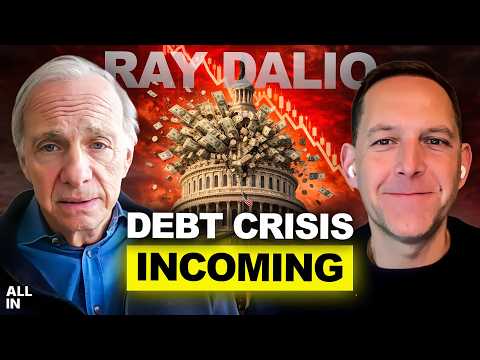
“The economics of a country are basically the same as the economics of a company or an individual, except the government has an ability to print money. It’s projected to spend about $7 trillion, take in about $5 trillion, so it’s running a 40% deficit, 40% of its spending.” — Ray Dalio, 3:23
Clip command
yt-dlp --download-sections "*3:23-4:23" "https://www.youtube.com/watch?v=u-vMNzHgSHI" --force-keyframes-at-cuts --merge-output-format mp4 -o "government-40pct-deficit.mp4"”60% of all Americans have below a sixth-grade reading level”
“You have the K economy… the question is who will be the first to be a trillionaire and that top one percent of the population, at the same time as you have the other part of the economy where 60% of all Americans have below a sixth-grade reading level. And to make them productive, particularly as we are also having AI have replacements for them, is a particularly difficult thing to achieve.” — Ray Dalio, 24:00
Clip command
yt-dlp --download-sections "*24:00-25:00" "https://www.youtube.com/watch?v=u-vMNzHgSHI" --force-keyframes-at-cuts --merge-output-format mp4 -o "k-economy-reading-level.mp4"”AI is eating everything, and it might eat itself”
“Right now, it looks to me like AI basically is eating everything, and it might eat itself. And what I mean by that is not produce adequate profits.” — Ray Dalio, 43:42
Clip command
yt-dlp --download-sections "*43:42-44:42" "https://www.youtube.com/watch?v=u-vMNzHgSHI" --force-keyframes-at-cuts --merge-output-format mp4 -o "ai-eating-itself.mp4"”We’re in Stage 5 of a cycle”
“I think we’re moving toward that war. We’re in that war. We’re in what I call Stage 5 of a cycle. When you get to this position when there are bad finances combined with large wealth and values gaps and irreconcilable differences, and you have external threats as well as domestic threats — you have this dynamic. I think that’s where we are.” — Ray Dalio, 41:35
Clip command
yt-dlp --download-sections "*41:35-42:35" "https://www.youtube.com/watch?v=u-vMNzHgSHI" --force-keyframes-at-cuts --merge-output-format mp4 -o "stage-5-cycle.mp4"”In China, they would say let’s make AI free for everyone”
“In China, they would say usage of AI is fantastic. So it should be like electricity or something, and let’s make it free for everyone. And let’s make it open source for everyone. And they might get much higher usage, and they’ll get their productivity gains through the usage.” — Ray Dalio, 44:43
Clip command
yt-dlp --download-sections "*44:43-45:43" "https://www.youtube.com/watch?v=u-vMNzHgSHI" --force-keyframes-at-cuts --merge-output-format mp4 -o "china-ai-free-for-everyone.mp4"”What an understatement — structurally a little difficult”
“What an understatement. Structurally a little difficult at this stage.” — Ray Dalio, 9:58
Clip command
yt-dlp --download-sections "*9:54-10:30" "https://www.youtube.com/watch?v=u-vMNzHgSHI" --force-keyframes-at-cuts --merge-output-format mp4 -o "structurally-difficult-understatement.mp4"Key Points
- Five forces shaping the world order (1:45) - Dalio identifies five intertwined forces: the debt/money cycle, domestic wealth and values gaps, international great power conflict, technology disruption, and acts of nature (droughts, floods, pandemics)
- U.S. running a 40% spending deficit (3:23) - The government is projected to spend $7 trillion while taking in only $5 trillion, with accumulated debt at 6x annual revenue
- Debt as plaque in the system (4:03) - When debt service grows relative to income, it squeezes out productive spending; half the $2 trillion deficit is now interest payments, plus $9 trillion in maturing debt must be rolled over
- Foreign buyers pulling back (5:48) - About a third of U.S. debt buyers are foreign, and geopolitical risks are making them less willing to hold dollar-denominated assets
- DOGE’s structural limitations (7:30) - Making government efficient quickly while maintaining democratic mandate is extraordinarily difficult; reforms face criticism from all sides before they can take effect
- Fraud as a symptom of the cycle (10:02) - Government fraud like the Minnesota daycare scandal is both a symptom of the cycle stage and of the inherent inefficiency of managing a system so large and complex
- Gold as the second-largest reserve currency (12:01) - Gold is not a speculative precious metal but the most established form of money; central banks are buying gold as they seek alternatives to debt-denominated fiat currencies
- 5-15% portfolio allocation to gold (18:00) - Dalio recommends everyone hold 5-15% of their portfolio in gold as a diversifier, regardless of their directional view on the metal
- Bitcoin’s key disadvantages vs. gold (21:04) - Bitcoin lacks privacy, central banks won’t buy it, it correlates highly with tech stocks, its market is relatively small and controllable, and quantum computing poses theoretical risks
- Tariffs as valid revenue tool (29:11) - Dalio argues tariffs were historically the biggest source of government revenue and are a valid way to raise money, with foreigners paying a portion; but they cannot replace income tax entirely
- 3% deficit target with bipartisan support (33:00) - There is a bipartisan bill supporting a three-part solution: spending cuts, tax adjustments, and interest rate management to bring the deficit to 3% of GDP
- Tariffs cannot replace income tax (34:02) - Despite Trump’s proposal at the State of the Union, tariffs are regressive and nowhere near large enough to replace income taxes
- Federal workforce declined 14% (34:46) - The federal workforce shrank by 317,000 employees, roughly 14% of the total, raising questions about where those workers go
- Three requirements for national success (37:13) - Educate children to be productive and civil, maintain an orderly environment for economic competition, and avoid civil and international wars
- Irreconcilable differences threaten the system (39:00) - When the causes people support become more important than the system itself, the system is in jeopardy; Dalio believes the U.S. is at this point
- AI bubble warning (42:23) - People confuse betting on a technology with betting on companies; historically, technologies survive but many companies built around them do not
- China’s AI-as-utility model (44:43) - China may treat AI as free public infrastructure like electricity, potentially achieving higher usage and productivity gains while U.S. companies must generate profits to survive
- The marshmallow test for nations (46:23) - America’s fundamental challenge is one of delayed gratification; the system favors immediate consumption over long-term financial prudence
Mentions
Companies
- Bridgewater Associates (0:00) - Ray Dalio’s hedge fund; context for his expertise as a macroeconomic thinker
- Airwallex (1:02) - Sponsor; global payments and financial platform for modern businesses
Products & Technologies
- Gold (11:13) - Discussed extensively as the second-largest reserve currency and safe haven asset; climbed ~80% since Dalio’s prior appearance
- Bitcoin (20:38) - Down 25% in the same period gold surged; Dalio highlights its lack of privacy, small market size, and correlation with tech stocks
- Silver (22:28) - Historical monetary metal with a speculative life of its own; supply is difficult to increase
- AI / Artificial Intelligence (42:23) - Dalio warns the technology will survive but many companies may not generate adequate profits; compares to the 2000 dot-com bubble
People
- Ray Dalio (0:00) - Founder of Bridgewater Associates, author of “Principles” and “The Changing World Order”; third appearance on All-In
- Jason Calacanis (0:00) - Host, conducts the interview
- Chamath Palihapitiya (0:08) - Co-host, opens with questions on the debt cycle and deficit-to-GDP ratio
- David Friedberg (13:47) - Co-host, asks about asset-backed money, Fed policy, Kevin Warsh, and tariff economics
- Elon Musk (7:30) - Referenced as DOGE leader who attempted sweeping government efficiency reforms
- President Trump (0:08) - Referenced regarding tariff policies, State of the Union address, and DOGE initiative
- Kevin Warsh (27:58) - Incoming Fed chair pick; Dalio describes him as practical but facing a very tough job
- Plato (39:03) - Referenced for writing about the cycle of democracies circa 350 BC
- Julius Caesar (39:03) - Referenced as historical parallel for the breakdown of democratic systems
Surprising Quotes
“What an understatement. Structurally a little difficult at this stage.” — Ray Dalio, 9:58
“When the causes people are behind are more important to them than the system, the system is in jeopardy.” — Ray Dalio, 39:03
“There’s a giant difference between the behavior of the companies and the behavior of the technologies. The norm is that a lot of companies won’t survive. But the technologies will go on and it’ll be great.” — Ray Dalio, 42:44
“I’m like a mechanic. My goal, I’m not ideological. I’m just a practical guy trying to make money in the markets and trying to describe things. And that’s what it looks like.” — Ray Dalio, 42:13
“It’s like the marshmallow test… therein lies our problem, the immediate gratification, and also the not knowing if things are going to be productive.” — Ray Dalio, 46:23
Transcript
Jason Calacanis: 0:00 Ray Dalio welcome back to the All-In podcast, third time’s the charm. Thanks for being here.
Ray Dalio: 0:04 Always a blast, always a blast to be here. Thank you for having me.
Chamath Palihapitiya: 0:08 The last conversation we had was so popular and it was so timely because it was just a few days actually after the inauguration of President Trump and you had provided some very kind of prescient outlooks for the administration that I think we all thought would be very helpful to get on the record. At the time you had highlighted, and as you have been for some time, this great debt cycle we’re in, the fiscal and monetary policy issues that are driving that debt cycle and provided some input that if we were able to cut our deficit to GDP to roughly 3%, we may have a shot at a smoother transition here. Today the CBO estimates that the 2026 deficit to GDP is about 6%.
Chamath Palihapitiya: 1:32 So the first question I have for you, looking back on the past year of the administration and the actions of Congress and the economy, are we on a good path? Are we on no different a path than we were say a year ago? Are we moving too slowly?
Ray Dalio: 1:45 I study these big cycles in history going back 500 years and there are five big forces that are intertwined to determine the answer to your question, which is, there’s the debt money one and I’ll take you into that in a minute. There is the domestic gaps, the wealth and values gaps that are causing irreconcilable differences between the left and the right that is affecting how taxes, democracy, and everything works. There’s the international great power conflict, the classic rising of a great power challenging an existing great power and changing the international world order. Then there’s technology, all through these cycles there’ve been technology, and then there’s acts of nature, droughts, floods, and pandemics. And when we think of orders, we’re talking about there’s always a monetary order, and all monetary orders have broken down for the same reason. All political orders, domestic political orders, they all always change in the United States.
Ray Dalio: 3:00 At least so, we have 250 years here, but they always change. There was one civil war in there. And then it — but internationally they always change, all orders change. And the international geopolitical order going from a multi-lateral to a unilateral world order is changing and certainly technology’s changing.
Ray Dalio: 3:23 Okay, so getting the fact that they’re all on them, now I’ll go down to explain the government’s finances and answer your question. The economics of a country are basically the same as the economics of a company or an individual, except the government has an ability to print money. Look at it like a company or like your own. Basically, it’s projected to spend about $7 trillion, take in about $5 trillion, so it’s running a 40% deficit, 40% of its spending. It’s been running deficits for a long time, so it has a debt that is 600%, six times the amount of money that it takes in, and we can project that number.
Ray Dalio: 4:03 The problem with debt cycles, and you could see them transpire, they’re almost like the circulatory system of the body. The capital markets bring credit to different parts of the economy, and if that credit is used to be productive and produces an income that pays for the debt service, it’s a healthy process.
Ray Dalio: 4:45 But what happens is that if the debt service grows relative to the income because it’s not paying for it, it’s like plaque in the system growing up and it squeezes out spending. And so we now have that $2 trillion deficit, half of that is interest payments, plus we have to roll over $9 trillion of debt that has been accumulated and is maturing.
Ray Dalio: 5:12 Okay, so now if you were to look at a company like that or an individual like that, you have that problem. So as a handy number, 3% of GDP would sort of stabilize the situation. Very unhealthy condition. It’s not just unhealthy because it’s squeezing out those spending, but also because there’s a supply and a demand. In other words, you have to roll over the $9 trillion of debt that’s coming due and you have to sell $2 trillion more, something like that.
Ray Dalio: 5:48 Okay, so now you go to the buyers, and the buyers, who are the buyers? There are some domestic buyers and there are foreign buyers. About a third are foreign buyers and now…
Ray Dalio: 6:00 Now it’s a riskier situation from their point of view. It’s riskier - first of all, it’s a lot to acquire. They - dollar-denominated debt is already a large percentage of their portfolio, larger than it would be if just decided on a prudent basis. But also, we have political geopolitical risks that also extend to possibly the risks that the debtor and the creditor will have a conflict. You could imagine that with China, you could imagine that with Europe even. And you know, Europeans could wonder whether they will get sanctioned. In other words, the debt service payments might not be made as a sanction, and the United States has to worry about whether it’s going to bring in that money. Now, the things that I’m describing have happened repeatedly through history. So in other words, I’m not just making this stuff up. If you were to see a particularly, you know, in the 1929 to 45 period, you saw this dynamic. You saw it before. So there is this financial piece, which in and of itself is not healthy for the US government and it’s but it’s also problematic because of the other factors compounding the problem.
Jason Calacanis: 7:30 You highlighted this problem - you provided a diagnosis that if we could get to 3%, we could soften the effect. But it hasn’t happened. We were all very hopeful last year around this time when Elon Musk decided to lead DOGE, the Department of Government Efficiency. He was going to go in and there were going to be these kind of big sweeping changes to reduce government spending, find fraud, waste, and abuse, and so on. Did DOGE fail because the actions that were taken were wrong, or did DOGE fail because the system itself cannot be changed at this point in the cycle? That there’s too much capital flowing, the economy is too dependent on it, there are too many individuals and businesses that are dependent on it, and it’s structurally impossible to pull our way out of it? I mean, does DOGE tell us something about what’s possible at this stage?
Ray Dalio: 8:17 Yeah, you’re talking about taking an inefficient government and making it efficient. And having to do it quick because there are elections and if people don’t like it then you know you lose your mandate. And in a society in which no matter what you do you’re criticized and torn down. So, you know, we have the factor of the question of does democracy and our system lend itself toward the sort of executive leadership that both makes it efficient and makes it acceptable for the broad population?
Ray Dalio: 9:00 You know, there was a lot of cutbacks in things like school lunch programs and things. And then trying to do it surgically. So it’s how do you do that effectively, quickly, in a manner that doesn’t cause so much controversy that the government falls. So if you look at history, that’s why you have to deal with it politically. If you deal with history and you deal just even common sense, think, are you going to have the executive leadership that’s going to be able to make this satisfactory with most people, and do that quickly? I think that’s a hell of a trick to pull off.
Jason Calacanis: 9:54 Right, so it might just be structurally a little difficult at this stage.
Ray Dalio: 9:58 What an understatement. Structurally a little difficult at this stage.
Jason Calacanis: 10:02 Yeah. Well, there was another big news story recently that there may be quite a lot of fraud going on with public dollars in Minnesota, that there were these daycares that don’t exist and billions of dollars are flowing to individuals to run these daycares. And now there’s a lot of this sort of citizen journalism going on across the country that federal spending is actually being fraudulently abused. Do you think that this is a symptom of the stage of the cycle? What’s your view on how this relates to this problem that we’re generally kind of talking about?
Ray Dalio: 10:31 Yeah, it’s both the stage of the cycle and if you’re going to have something well managed, are you going to have the government well manage it? I mean, how well managed, you know, go to the Department of Motor Vehicles for your… It’s so big and complex and such a mess like, when you think, is this a surprise to you that there’s all of this stuff going on all over the place in terms of inefficiency? Is that a surprise to you?
Jason Calacanis: 11:13 No. But, you know, I guess the question is are people waking up to this? Because last time we spoke, you highlighted that a piece of your portfolio was in gold. You’d invested quite a bit in gold. Since we spoke, I think gold has climbed from 1900 an ounce to 2200 an ounce. What has happened with gold over the last year? Is it that markets are waking up to the point in the cycle that we’re in, that you’ve been highlighting for a number of years at this point? Or is it because China is structurally abandoning the US dollar and Treasuries and moving more into gold, and other central banks are moving into gold? Is it because individual speculators and market participants are getting bubbly with gold? What’s your view on what’s gone on with gold and how it relates to the markets?
Jason Calacanis: 12:00 Acknowledgment of the stage that we’re at.
Ray Dalio: 12:01 It’s the big cycle and what you have to understand is that gold is not a precious metal that’s speculated on like most people have come to think of it as. It is the most established money that it’s the second largest reserve currency that central banks hold. And so what we’ve seen is for various reasons that I pretty much covered, the economics, the supply-demand, the politics, the geopolitical, for those reasons, central banks themselves have acquired gold to build that up. And individuals and others are looking for an alternative money. The question is what is money? So when we’re thinking about this, money mechanistically, money is debt. What I mean by that is that if you’re holding money, you’re holding it in the form of a debt instrument. And if you are holding a debt instrument, what you’re getting is a promise from somebody to deliver you money. And what as I mentioned in the beginning, the power of the central banks when they have too much debt is to print money.
Ray Dalio: 13:31 Okay, so if you’ve got that down, then you can understand what’s happening. Because the question is, Dave, what money do you think is safe given what I’ve just said?
David Friedberg: 13:47 That which has, yeah, asset backed. Right, I want an asset. I want to have something that’s got some physical known limitation to it.
Ray Dalio: 13:58 And particularly what you want is that can be transferred from one place to another because money is both a medium of exchange and a storehold of wealth. So in other words, if one country’s central bank or government wants to pay another government, it can’t just be in fixed assets like buildings. If you want to transact, you have to transact in something that you can transfer to them and so on. And gold is the only asset, it’s a long-term historic asset for reasons that mean that it can be transferred, they can’t print a lot of it, and it is not dependent on somebody giving you something. In other words, most money, most if you hold debt or you hold stocks or you hold something, you’re holding a promise from somebody to give you buying power.
Ray Dalio: 15:00 So you could — wealth is important thing to distinguish wealth from money. Wealth is in stuff. It’s in buildings, it’s in companies, and so on. But you can’t spend wealth. You have to — when you want to spend it, and that’s the purpose of money, you have to sell it, and then you get money to spend. And right now we have an awful lot of wealth relative to money. And the question is: what is that money? And there’s the risk that you go to convert your wealth into money that they’re going to print money because that’s what they’ve always done since we’ve had fiat currencies.
Jason Calacanis: 15:41 So as you look out and have conversations with all the market participants that you know, and you know everyone that’s of size and scale, where are we in terms of folks converting their wealth into gold or their money into gold? Like how much more do we have to run in terms of the dollar-denominated value of gold in the market cycle as this great rush for the door, rush for the exit happens?
Ray Dalio: 16:09 Two things that come to mind. What I look at is literally who has what assets including like central banks, what is the money in, and so on and what is that mix. And I look at the amount of wealth relative to money, or I look at the amount of wealth relative to gold. And what we’ve seen is that there’s an enormous amount of wealth, and there was an enormous amount in central banks of the other money relative to hard money, gold. And so we’ve seen about what I would call it go from an extremely small number to something that is a less small number. That price increase and that change in composition has brought it almost, not quite, but almost toward the average of what it’s been over a period of time, so being out of balance. However, because the wealth is total wealth is still so large relative to money, that’s a real issue. So let me give you a practical example of this: wealth taxes and wealth being a risk. One question that might be asked are: are we in a bubble? In other words, are AI stocks and other such stocks in a bubble? That’s a — if you want to get into that, we’ll get into that. But one of the things that we know from that is that one of the characteristics of bubbles is that there becomes a need…
Ray Dalio: 18:00 It for money that requires people to sell their assets to get money to meet that need. Now quite often that need comes from borrowing money to buy those assets. And then the assets go up in price and so on. But what happens is it can’t be sustained because you have to make the debt service payments and they’re not throwing off the cash to make that. And so they have to start to sell that and then when you have to sell it because you need money, you need cash to pay your debt service or to pay, nowadays, wealth taxes. So now we have a dynamic. The bubble will burst as that dynamic takes place. There are a number of things we could talk about about the bubble if you’re interested. But just imagine if you put in wealth taxes. Everybody could talk about whether they like or don’t like wealth taxes and stuff. But anything that — if you put in wealth taxes and there’s a lot of fear of wealth taxes in and of itself, that can drive money, the wealth to cash. And there’s only one way you’re going to get the cash with the wealth and that’s either sell it or to borrow against it, which has causes its own cash flow issues. And we have a dynamic having to do with the social part of this, you know, the wealth gap that makes that politically an issue. So anyway, all I’m saying is people should worry and companies should worry and countries should worry, do they have enough gold? I mean if you didn’t know what gold was likely to do and you had no view on gold, one should have between five and 15% of their portfolio in gold because of the fact of how it works with the other components. In other words, it’s a diversifier when the shit hits the fan. Gold does well and the other things don’t, generally speaking. And because of that correlation, depending on what else is in the portfolio, if you put it through an optimizer, you’d have something like that. So I’m not trying to tout people on buying gold, but I would say, what is safe? And it’s — safe is somewhere, if you had no view, between five and 15%.
Jason Calacanis: 20:38 Why hasn’t Bitcoin performed in the same way? In the same period that gold’s climbed 80% since we last talked, Bitcoin’s down 25%. What’s your view on what’s happened with Bitcoin and why that hasn’t played the role that many thought it was going to play, which is this safe haven asset?
Ray Dalio: 21:04 Bitcoin does not have privacy. Any transactions can be monitored and then indirectly perhaps controlled. Central banks are not going to want to buy Bitcoin and being able to hold it, so it’s not just individuals, it’s institutions and so on, but most, and central banks. So there are attributes of that. There has been some question or thoughts of the development of new technologies like quantum computing and so on, can there be issues regarding that? And then there’s who owns it and what are the other exposures that they have in their portfolio? It tends to have a pretty high correlation with the tech stocks. So from an ownership, just the supply demand is affected by if somebody gets squeezed in one thing, they sell something whatever else they have. So there are those dynamics. It’s a long way and it’s a relatively small market that’s a relatively controllable market. I think a lot of attention has been given to Bitcoin, but as a money, it’s small in relationship to gold and so those are the dynamics. There is only one gold.
Jason Calacanis: 22:28 What about silver? I mean, silver has had a big run-up in the past year as well. Is that a derivative to gold and it’s effectively people playing off of the wake of gold’s price movement?
Ray Dalio: 22:38 Yeah. Silver in its production is a residual commodity. The supply of it is difficult to increase. And through history, the pound sterling, silver was perceived as a monetary item. But it has also taken on a speculative life of its own. So people are hot in it because it’s been hot.
Jason Calacanis: 23:10 I just want to shift gear a little bit back to something you touched on, but the last time we met you also talked about the importance of making sure that interest rates remained low for us to kind of manage the effect and the impact of the stage of the cycle that we’re in. What’s your view, I guess, today on where rates are and how the Fed has acted over the past year relative to what needs to be done to soften the effects of the stage in the cycle that we’re in?
Ray Dalio: 23:35 Because we have so much debt, federal debt, interest rates are one of the three main considerations. There’s the taxes, there’s spending, and then there’s interest rates on the debt. But you can’t make interest rates severely artificially low because one man’s debts are another man’s assets. And if you make those…
Ray Dalio: 24:00 Interest rates too low for the creditor, you will produce the dynamic that we understand. In other words, you’ll produce a lot more borrowing, you’ll put it into things, and you can fuel a bubble. And so at the same time, you can’t have them so high that the debtor gets squeezed uneffectively. So there’s a balancing act, keep them high enough that they’re adequate for the creditor, but not so high that the debtor. And so when you have a lot of debt assets and liabilities, because for every debt asset there’s a debt liability, and when you have a lot of those, that balancing act is very difficult. This made more difficult because of what’s called the K economy. In other words, there are bubble elements that are going on in the part of the economy where the question is who will be the first to be a trillionaire and that top one percent of the population and all of that, at the same time as you have the other part of the economy where, for example, 60% of all Americans have below a sixth-grade reading level. And to make them productive, particularly as we are also having AI have replacements for them, is a particularly difficult thing to achieve. In other words, when you have so much debt assets and liabilities, and then you have such a disparity in conditions between those that are at the top and let’s call it the bottom 60% of the population, what that’s like, that’s another hat trick. That’s another difficult thing to pull off.
Ray Dalio: 25:59 So, this is a challenging situation. And as for, as far as monetary policy exists, the idea of setting an interest rate and having a fiscal policy and a monetary policy that’s for the economy as a whole and doesn’t deal with the differences in the circumstances, maybe more challenging. Well, is more challenging.
Jason Calacanis: 26:34 Well, so taking a look at Fed action and market activity, there’s been a lot of reporting over the past year that a number of global central banks have stopped buying US treasuries and are shifting to gold. Does this mean that the Fed in the US is going to have to start buying treasuries and expand their balance sheet again? Is it inevitable?
David Friedberg: 27:00 That we see a re-expansion of the Fed’s balance sheet in this phase in the cycle given what’s going on with global market action?
Ray Dalio: 27:07 I think that’s likely down the road. Right now, there’s the shortening of maturities as a means of trying to deal with that. Of course, that increases the debt rollover risk. But the, sell less long debt, try to hold the short rate down so that the longer rates attachment to it doesn’t get, helps to hold the long rate down and then try to use the government’s power of persuasion on other countries to either buy the debt or to hold the debt or to have other forms of capital enter the United States.
David Friedberg: 27:58 How do you like Kevin Warsh’s pick for Fed chair? What’s your view on how he’s going to guide interest rate policy for the Central Bank when he assumes his term?
Ray Dalio: 28:07 It’s a very, very big challenge. I think he’s a practical man. He understands both sides of the pros and cons. I think it’s a tough job.
David Friedberg: 28:18 One of the other things that I would say was pretty surprising over the past year is how adamantly against tariffs for fear of inflation and reduced consumption, which would mean a negative effect on GDP growth perhaps, tariffs might be. The president and the administration put in place a number of tariffs under the Emergency Economic Powers Act, which the Supreme Court in the last week or so overturned. But looking back on the economic effect of tariffs, what do you think economists got right and wrong about their predictions about the effect tariffs would have on the economy, on consumption, on inflation? And are there things that economists fundamentally missed or didn’t understand and why?
Ray Dalio: 29:11 Yeah, I think so. First of all, there’s the tax revenue part of them. I mean, thinking of it just as revenue. And I think that people — all economists — make the mistake of not including taxes in inflation. And what I mean by that is if your taxes go up, that’s inflation. I mean, why should it be any different than if your cost of housing goes up? Why shouldn’t it be part of the inflation calculation number? It’s taking money out of your pocket. I mean, it’s probably the, for a lot of people the biggest expense.
Ray Dalio: 30:00 And so when they say inflation is something separate, I think it’s changing the form of inflation in a sense.
Ray Dalio: 30:12 So what I mean is, through history, tariffs used to be the biggest source of revenue for government throughout most history and in most countries.
Ray Dalio: 30:26 So it is a… I think it’s viewed… it’s a totally valid way of raising money and it should be kept in consideration for that and you get the foreigners paying a portion of it.
Ray Dalio: 30:43 But there’s also as part of the big cycle question is the problem that we have that we are not independent. We’ve had a hollowing out — this is the big question — we’ve had a hollowing out of manufacturing, the middle class, and so on.
Ray Dalio: 31:03 Now are we going to try to build that and what is the plan to build that or are we going to continue on with large trade deficits and so…
Ray Dalio: 31:19 So you have unsustainable trade deficits that the United States has and which are capital surpluses — in other words, the dependence on foreign capital is the other side of those trade balances — and that’s unsustainable.
Ray Dalio: 31:37 So because that’s unsustainable, you need some way of rectifying that. So what is the plan to rectify that?
Ray Dalio: 31:51 Partially that plan can have trade tariffs. I think they’re totally valid, but it all has to be part of another greater plan which is to develop the industries that we need to have developed, which we’re seeing happen in a much more proactive way.
Ray Dalio: 32:13 In other words, you’re seeing more government activity to create infrastructure, to bring in industries and so on.
Ray Dalio: 32:20 You need that not only economically, but you need it geopolitically because you can’t have dependencies.
Ray Dalio: 32:26 In other words, we’re entering a world of greater conflict. We’ve moved from a multilateral world order to a power-based confrontational world economy.
Ray Dalio: 32:39 And in that environment, everybody’s threatening to cut off everything from the goods and capital wars that we can have are threatening.
Ray Dalio: 32:51 And so you have to build independence. And so that’s part of a plan to try to build that independence.
Ray Dalio: 33:00 I’d say, and it’s misunderstood. So yes, I think people are misunderstanding that and the important thing is we get the other things right. Like let’s get down to 3%. And by the way, there’s a bipartisan bill on this and Des- Des has come out in favor of it. I’m in favor of it. I mean lots of people are in favor of what I’ll call the 3% three part solution. 3% of GDP, three parts, a bit from one thing, a bit from another, taxes, spending, and hopefully interest rates.
Jason Calacanis: 33:45 And just to take the inflation question to its conclusion, at the State of the Union this week, President Trump shared his vision, which is that tariffs can completely replace an income tax in the United States. Do you think that that’s a feasible path? Does it make sense at some point for tariffs, which are effectively a consumption tax —
Ray Dalio: 34:02 No, I don’t think it’s — no, I don’t think it’s anywhere near that, both because of the combination of the size and then the impact of that size. Tariffs are regressive, and I think that there needs to be — we have to deal with the wealth gap. To me, the wealth gap, the biggest problem of the wealth gap, which is a big social problem, is also the productivity gap. And you have to make most people productive. And you have to do that through infrastructure and so on. And I don’t think — I think that needs to be addressed.
David Friedberg: 34:46 It’s a really important point you just made. I think my analysis indicates that nearly half of Americans either work for a government agency or a government service provider or contractor. The data over the past year is the federal workforce declined by 317,000 employees, roughly 14% of the total federal workforce. As this administration has reduced the size of some of these agencies, reduced the size of that workforce, what happens to those individuals? Do they go work in the private workforce and become productive, or do you think they’re getting subsumed by other government agencies, either state or local or government service providers, to do work that fundamentally is not productive to growing the economy?
Ray Dalio: 35:42 I haven’t studied the numbers. I don’t think I can adequately answer that. I would say government is extremely inefficient. It has a role. It has an important role, but even that role it’s handling very inefficiently. Other governments handle that role of maybe education —
Ray Dalio: 36:00 Education, some of these things in a better way, we need fundamental, we need, best thing you could invest in is education. But anyway where they go and what they do from the government and the other inefficiencies is a problem. The one thing that is good about the system, the capitalist system in a sense is it doesn’t live if it can’t — if somebody either won’t bet on it or it doesn’t make a profit. So wherever it goes, wherever those people go there’s just so many inefficient people and inefficient systems.
Jason Calacanis: 36:47 Is there not enough productivity driven economic growth in this nation at this time to give more people the opportunity to improve their income, improve their wealth, improve their livelihoods? Is that the fundamental issue we’re dealing with at the moment or is it that people aren’t prepared or educated to be productive and therefore the system itself has failed them?
Ray Dalio: 37:13 There are three things basically that you need to do to be successful. You have to first educate your children well so that they are capable of being productive and also educate them in civility so that they are civil with each other. The second is then they have to come out to an environment that is an orderly civil environment that people can compete and work with and compete and work with each other to be productive, that works for the most people. And the third thing is you have to stay out of wars. You have to have no civil war and no international war. If you do those three things right you will have a successful country. That’s all throughout history. We’re having problems with those.
Jason Calacanis: 38:53 And are those three things the antidote to some of the rising movements that we’re seeing in increased unionization and effects that unions are having on the political process which is also leading to these rises in socialism and support for socialist movements in the United States as well as the wealth taxes, which from the view that’s shared by those participating in those movements they are meant to solve income inequality, wealth gap issues that we’re seeing in the United States. So that’s their solution. Is the solution to those movements education and civility, creating a civil environment and staying out of wars? Is that all we need to do to make this successful or is there more to the equation?
Ray Dalio: 39:00 Irreconcilable differences. In other words, when the causes people are behind are more important to them than the system, the system is in jeopardy. Our system is in jeopardy because they want… people will not accept the system or the alternatives, and so they’re gonna fight. I think when we have the midterm elections, you’re going to go past the midterm elections with probably that Democrats will take the house and maybe, I don’t know, it’s going to be difficult. And you know what? Nobody can succeed because everybody’s going to be fighting. They’re going to all be fighting. So how does that affect productivity? And then when you deal with things like how do you get a good education system, so you have now almost the mob disorder, mob disorder and inefficiency. Nobody’s allowed to take charge of this. If you go back in history, Plato, I think it was like 350 BC, wrote about the cycle of democracies and the threat to democracies. What’s happening now is similar to Julius Caesar and Rome and being stabbed in the senate and what you need is you need a bipartisan… you need the country to have a strong, almost a strong leader. We do need a strong leader to get the reforms done to make the country work well. But I mean, so how do you force this mob of people who are behaving this way, including in the elections and so fragmented, to create order? So you need a tough leader who will force them to do different, force things to difficult things, and not fight with each other and focus on being productive. That’s what you need, I think.
Ray Dalio: 39:35 Yes. That’s what we need is to stop fighting. We’re now at a stage where we have irre-
Jason Calacanis: 41:23 It sounds a little like there may be this inevitable path of the choice that no one wants to make between some form of socialism and some form of fascism? Is that where this is going?
Ray Dalio: 41:35 I think we’re moving toward that war. We’re in that war. We’re in what I call Stage 5 of a cycle. In the book, I describe the pattern that’s happened over and over again. And when you get to this position when there are bad finances combined with large wealth and values gaps.
Ray Dalio: 42:00 And irreconcilable differences. And you have external threats as well as domestic threats. You have this dynamic. I think that’s where we are.
Ray Dalio: 42:13 I’m like a mechanic. My goal, I’m not ideological. I’m just a practical guy trying to make money in the markets and trying to describe things. And that’s what it looks like.
Ray Dalio: 42:23 I think when we look at the bubble question on AI, what a lot of people don’t realize in bubbles is that through all technologies, they think that they are betting on the technology when they buy the stocks and the companies. That’s not true.
Ray Dalio: 42:44 There’s a giant difference between the behavior of the companies and the behavior of the technologies. And that the norm is in these is that a lot of companies won’t survive in the start.
Ray Dalio: 42:58 Very small percentage, and they’ll all fight and so on. But the technologies will go on and it’ll be great. The technologies will. So I want to emphasize to people that dynamic.
Ray Dalio: 43:14 And I can go on and describe what it’s like. Of course, we’ve seen it to some extent with the 2000 bubble in the technologies and what went on. But even if I describe what it was like in the late 20s, it was unbelievable. But the technologies will go on, but the companies won’t necessarily go on.
Ray Dalio: 43:42 And so when I’m looking at that, that has big implications. Right now, it looks to me like AI basically is eating everything, and it might eat itself. And what I mean by that is not produce adequate profits.
Ray Dalio: 43:59 We can’t take just a domestic view of that. We have to look also at what’s happening in China and make interesting distinctions there. There’s a difference in philosophy that’s carried through in the economy of how the economies of the United States and China work.
Ray Dalio: 44:22 In that we have basically primarily a profit-based system. They have a system in which they might believe that profits are a second consideration. They’re not necessarily needed in order to achieve the best results.
Ray Dalio: 44:43 For example, in China, they would say usage of AI is fantastic. So it should be like electricity or something, and let’s make it free for everyone. And let’s make it open source for everyone. And they might get much higher usage, and they’ll get their productivity gains through the usage.
David Friedberg: 45:00 And we have a profit system to pay back.
Jason Calacanis: 45:03 Okay, well now we’re in one world. How do you compete in that world? What do you do with that? In other words, just imagine that their technologies are almost as good as ours because they are, they’re not far behind, and then but that you could get them for free, open source.
Ray Dalio: 45:23 Okay, now you got to pay it back. So I just want to emphasize that these are also systematic risks that enter into the picture of AI. But you certainly, yeah, there are a lot of unknowns here.
Jason Calacanis: 45:41 As we wrap, looking back on the history of this nation, I ask myself the question a lot: how did we get to the point that we’ve got to in terms of the amount of debt, the amount of government spending, the role that the central bank has played, and the risks that we find ourselves in today, that all seem largely avoidable if we hadn’t taken or made the decisions we made along the way? You’ve highlighted that they repeat over and over again. But if you could go back and restructure the United States and be a founding father and write the Constitution yourself, what are one to three things that you would have done differently? What would you have written into the Constitution that may have prevented us from getting into the situation that we’re in today?
Ray Dalio: 46:23 Well, it’s like the marshmallow test. You know the marshmallow test? You want to see is a kid going to at early age you give them the choice between one marshmallow now and two marshmallows in 20 minutes? And the kid that chooses the two marshmallows in 20 minutes is going to have a better life and make better decisions kind of thing. I mean, therein lies our problem, the immediate gratification, and also the not knowing if things are going to be productive. But the system has been remarkably adaptable, too. In other words, we’ve gone through crises, we’ve wiped out debts, and we’ve gotten past it, and there are certain ways of getting past it. But it’s a tough question to balance financial prudence with innovative inventions. Because particularly like take AI now. Nobody knows what’s going to come of it in what way, right? Is it going to pay? Is it not going to pay? And all of that. And so what do you write into the law that is going to get you financial prudence and controlled and do when you write it into the law, does that lessen the experimentation and the entrepreneurship and all of the things? So it’s tough to do this with rules. I think maybe the main thing is I would say read history.
Ray Dalio: 48:00 Study history and know these things and try to get that balance right. Everything’s a matter of the balance. So the balance of the pain of failing or the pain of putting money into something that fails.
Jason Calacanis: 48:15 Well Ray, I want to thank you once again for taking the time to be here with me. It’s always great to catch up, hear your perspective. Obviously so much has changed in the last year, and yet so much hasn’t. It’s been great to get your view on it, and I think it’s really helpful to do this. So thanks so much.
Ray Dalio: 48:31 And thank you for what you guys do. I’m riveted to your program and I think you make a great contribution. So conversations like these are really practical helps for a lot of people. So anyway, thank you for letting me participate and thank you for what you do for a lot of people. Thank you.
Jason Calacanis: 48:51 Thanks Ray.