The Next Bubble Is Already Here
The Next Bubble Is Already Here
Summary
Chamath Palihapitiya argues that private equity, now a $5 trillion industry, is headed for a reckoning. He explains how zero interest rates during the Obama era drove massive capital flows into alternative assets — venture capital, private equity, and hedge funds — creating a classic bubble pattern of early movers, fast followers, and laggards who flood the zone and destroy returns. His key metric: ask any PE firm what their DPI (distributions to paid-in capital) is, and over the last 4-5 years, “distributions have been few and far between.”
The discussion broadens into the dysfunctional IPO market and three paths to going public: traditional IPO (expensive, mispriced), direct listing (first trade is always the highest), and SPACs. Chamath shares his personal experience losing a billion dollars on the Slack direct listing and selling Coinbase on day one. He then pitches his SPAC 2.0 (“Raptor 2”) concept through his American Exceptionalism vehicle, which eliminates founder shares and warrants, and envisions a “Raptor 3” with pre-wired flexible capital that functions as a totally pre-baked IPO at a fair price.
The conversation also addresses how private credit is the next bubble building, how continuation funds are masking the lack of real exits, and why the secondary market is coming back. Chamath expresses pride that SPACs have raised over $150-200 billion for American companies and argues that institutional investors want great companies to be public because public markets enable far more growth than private markets.
Highlights
”Private equity is totally screwed”
Clip command
yt-dlp --download-sections "*0:14-1:00" "https://www.youtube.com/watch?v=eWE6xmHu6Jw" --force-keyframes-at-cuts --merge-output-format mp4 -o "eWE6xmHu6Jw-0m14s.mp4"“I think private equity is totally screwed. I don’t think Silver Lake or Infinity or this deal are screwed, but I think private equity in general is totally hosed.” — Chamath Palihapitiya, 0:14
”Investing in venture is a return-free risk”
Clip command
yt-dlp --download-sections "*2:49-3:35" "https://www.youtube.com/watch?v=eWE6xmHu6Jw" --force-keyframes-at-cuts --merge-output-format mp4 -o "eWE6xmHu6Jw-2m49s.mp4"“When you see that kind of hockey stick graph, it doesn’t matter what asset class it is, the returns go to zero. We’ve seen this in venture capital, we’ve seen this in hedge funds, and we’re now going to see this in private equity.” — Chamath Palihapitiya, 2:49
”What are your distributions? Don’t show me your IRR”
Clip command
yt-dlp --download-sections "*3:10-3:45" "https://www.youtube.com/watch?v=eWE6xmHu6Jw" --force-keyframes-at-cuts --merge-output-format mp4 -o "eWE6xmHu6Jw-3m10s.mp4"“In any of these alternative asset classes, there’s only one thing you should always ask: What are your distributions? Don’t show me your IRR. What is your DPI? And if the answer is zero, then it is a very challenged asset class.” — Chamath Palihapitiya, 3:10
”Private credit is the next big bubble”
Clip command
yt-dlp --download-sections "*4:10-5:00" "https://www.youtube.com/watch?v=eWE6xmHu6Jw" --force-keyframes-at-cuts --merge-output-format mp4 -o "eWE6xmHu6Jw-4m10s.mp4"“The money’s already leaked into private credit, which is the next big bubble that’s building. It looks like this chart that you just showed.” — Chamath Palihapitiya, 4:10
”With Slack I was offside a billion dollars”
Clip command
yt-dlp --download-sections "*6:27-6:50" "https://www.youtube.com/watch?v=eWE6xmHu6Jw" --force-keyframes-at-cuts --merge-output-format mp4 -o "eWE6xmHu6Jw-6m27s.mp4"“With Slack I was offside a billion dollars and I was like, I’m never letting this happen again. And so when I had the Coinbase thing, I sold it the first day.” — Chamath Palihapitiya, 6:27
Key Points
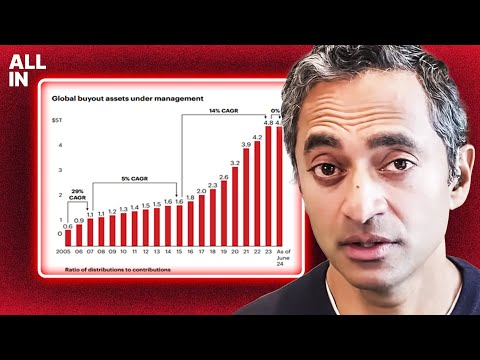
- PE Industry at $5 Trillion (0:00) - Private equity has tripled since 2015 and Chamath believes it’s following the classic bubble pattern
- 60/40 Portfolio Shift (1:06) - Zero interest rates pushed allocations from traditional 60/40 bonds/equities into alternatives
- Laggards Destroy Returns (2:16) - After early movers and fast followers, laggards flood in, overpay for assets, and drive returns to zero
- DPI is the Only Metric (3:10) - Distributions to paid-in capital is the only question to ask; PE distributions have been “few and far between”
- Silver Lake Exception (3:51) - Silver Lake cited as a rare well-run firm generating tens of billions in actual distributions
- Private Credit Next Bubble (4:10) - Capital fleeing PE is flowing into private credit, building the next bubble
- Continuation Funds Warning (4:27) - Continuation funds are spreading to venture; just moves assets around without real exits
- IPO Market Dysfunction (5:05) - Traditional IPOs are expensive and mispriced; banks take 6-8% fees
- Direct Listing Problem (6:15) - First trade is always the highest, then stock goes straight down (Slack, Coinbase, Spotify)
- Slack Billion-Dollar Lesson (6:27) - Chamath lost a billion on Slack direct listing; sold Coinbase day one based on that lesson
- SPAC 2.0 / Raptor 2 (7:53) - No compensation unless it works; eliminates warrants and founder shares from SPAC 1.0
- $150-200B Raised via SPACs (7:56) - Chamath claims SPACs have raised over $150-200 billion for American companies
- 98.7% Blue Chip Investors (9:11) - Nearly all capital in Chamath’s new vehicle from top institutional investors
- Public Markets Enable More Growth (9:38) - Good companies grow far more in public markets than they ever would staying private
- Raptor 3 Vision (11:06) - Pre-wired, pre-baked IPO with flexible common capital already committed from day one
Mentions
Companies
- Silver Lake (0:16) - Cited as exceptionally well-run PE firm with real distributions
- Slack (5:38) - Direct listing where Chamath lost a billion dollars
- Coinbase (5:38) - Direct listing where Chamath sold day one based on Slack lesson
- Spotify (6:25) - Another direct listing that followed the pattern of declining after first trade
- SpaceX (0:52) - Referenced as company that never goes public, impacting retirement accounts
- Stripe (0:47) - Referenced as great private company retail investors can’t access
- American Exceptionalism (8:10) - Chamath’s SPAC 2.0 vehicle name
Products & Technologies
- SPACs (5:25) - Special purpose acquisition companies; Chamath pioneered SPAC 1.0
- PIPE (9:58) - Private investment in public equity; traditionally done with common shares
- DPI (3:10) - Distributions to paid-in capital, the key metric for evaluating PE/VC
People
- Chamath Palihapitiya (0:14) - All-In host making the case that PE is a bubble
- Jason Calacanis (0:25) - Host asking about impact of PE growth on retirement accounts
- David Friedberg (4:50) - Host noting the secondary market is coming back
Surprising Quotes
“When you see that kind of hockey stick graph, it doesn’t matter what asset class it is, the returns go to zero.” — 2:49
“I started a normalization of this vehicle that’s now raised more than $150-200 billion dollars for American companies. I am very proud of that.” — 7:56
“When a good company gets public, the amount of money that they can raise and the amount of growth they have far outclasses what they’ll ever do as a private company.” — 9:38
Transcript
0:00 And if you look at private equity, pull up that chart I had there. This is just stunning how big this industry is getting. $5 trillion is what we’re up to here. And it just keeps growing. I think private equity is totally screwed. I don’t think Silver Lake or Infinity or this deal are screwed, but I think private equity in general is totally hosed.
0:25 It’s gotten huge just since 2015 and tripling in size. So why is private equity becoming so large and what impact does that have on society if people can’t put SpaceX into their retirement account? They can’t put Stripe into their retirement account. If we take all the great companies and we start to privatize them, what impact does that have on people’s retirement accounts?
0:56 The history of this is important. There was a long-standing belief that the best way to generate the best risk-adjusted return was to have a 60/40 allocation: 60% to bonds and 40% to equities. Over many years, especially when we artificially suppressed rates at zero, a lot of people started to move their allocations away from 60/40 and made more investments further out on the risk curve. The biggest beneficiaries were venture capital, private equity, and hedge funds.
1:45 The thing with private equity is that because rates were zero, they had an infinite amount of borrowing capacity and very little downside. So they were able to manufacture returns much faster than venture capital and hedge funds. You had an initial group defining the asset class making a ton of money, then fast followers, and then this flood of laggards that just flood the zone. It’s these laggards that make it very difficult to generate returns because they start overpaying for assets.
2:49 When you see that kind of hockey stick graph, it doesn’t matter what asset class it is, the returns go to zero. We’ve seen this in venture capital, we’ve seen this in hedge funds, and we’re now going to see this in private equity. Too much money going in.
3:10 In any of these alternative asset classes, there’s only one thing you should always ask: What are your distributions? Don’t show me your IRR. What is your DPI? The distributions on your paid-in capital. And if the answer is zero, then it is a very challenged asset class. And what I will tell you in private equity is that over the last four or five years, distributions have been few and far between.
3:41 So I think what’s going to happen is that the money is going to come out of private equity and get concentrated into the few companies that know what they’re doing, of which Silver Lake has generated tens and tens of billions of dollars of distributions. They are just an exceptionally well-run organization.
4:10 Where does the money go? The money’s already leaked into private credit, which is the next big bubble that’s building. It looks like this chart. What we’re seeing in private equity is these continuation funds. Continuation funds are coming to venture. I’ve been getting pitched on these where it’s like take all your assets, sell them to a new group of people, reset the clock, and then there’s never an exit.
4:42 The good news is the last year we’ve seen a lot more activity for shares of our companies that are still private. So the secondary market is coming back in a major way. But I do get worried about these continuation funds because now you’re just moving an asset from one class to the other and we need to have a functioning IPO market.
5:15 Look, there are three ways to go public. There’s the traditional IPO, the direct listing, and the reverse merger or SPAC. In the traditional IPO, you go to a bank, they underwrite you, they act as a gatekeeper, and they take 6-8% fees. They allocate underpriced stock to their best customers. Then you see a one-day pop. All those customers tend to unload and then the stock tends to drift down. The IPO is expensive and typically mispriced.
6:15 The direct listing: the first trade is always the highest trade and then it just goes straight down. That happened with Slack and Coinbase. With Slack I was offside a billion dollars and I was like, I’m never letting this happen again. So when I had the Coinbase thing, I sold it the first day. I texted Brian and said, “This is not a directional indication of your company. It’s the dynamics of the direct listing.”
6:46 Where does the SPAC come in, especially now in version two? I think it’s creating an incredibly competitive vehicle where you can have a ton of money go into private companies, take them public at a very low cost of capital.
7:15 So you closed your financing. What was the capital raise like? SPAC 1.0, of which I was right in the front of the parade, had a bunch of misfires and it was complicated, but it worked. The whole point was to prove that you could create a competitive alternative to the IPO. The thing I’m most proud of is I started a normalization of this vehicle that’s now raised more than $150-200 billion dollars for American companies.
8:10 I think what we did in American Exceptionalism is Raptor 2. It’s not yet perfect, but it tries to improve on the things that weren’t working in Raptor 1, especially the compensation and incentives. Investors were quite excited. They want a competitive IPO market that brings American businesses to the public market. The incentives are such now where there’s absolutely no compensation unless this thing really works.
9:08 No, in fact it was the opposite. The institutional investors — 98.7% of the capital was allocated to every single blue-chip A+ institutional investor — and what they wanted was great companies. They want great companies to be public because when a good company gets public, the amount of money that they can raise and the growth they have far outclasses what they’ll ever do as a private company.
10:56 I think the Raptor 3 will look like where a sponsor like me rolls everything up into one thing so that it’s already pre-wired from the beginning — a billion, two billion, three billion, whatever it is, flexible capital that can come in as common so that it’s a totally pre-baked IPO at a very fair price.